Scania
Scania R-series
Scania's R long-haul cab in seven versions, the 2026 Scania Dynamic update, 9- to 16-litre diesel and gas engines, the Super 11 and Super 13, and the battery-electric R.
- 2016—
- 7 configurations
- 206–566 kW
- Euro 6
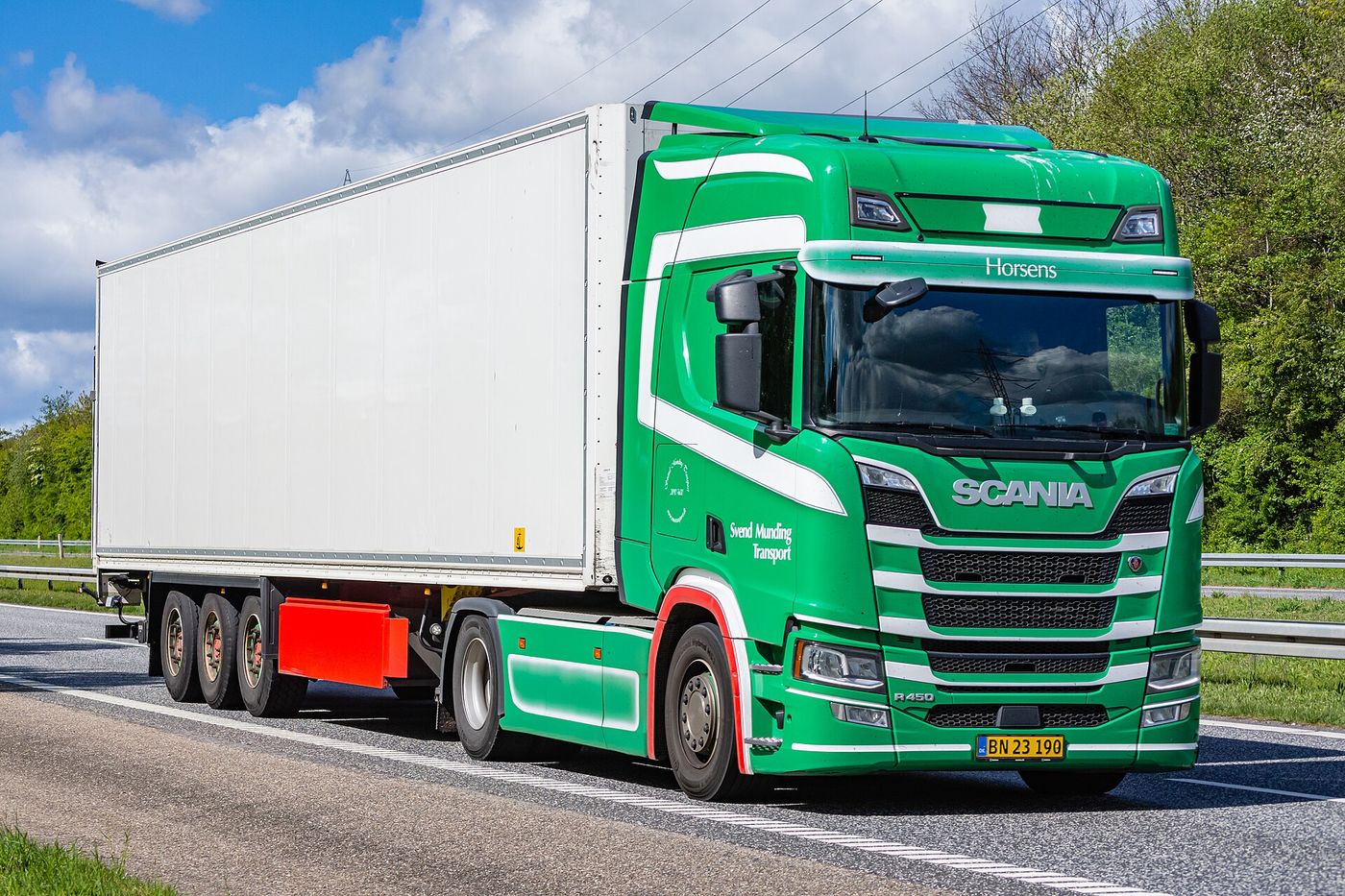

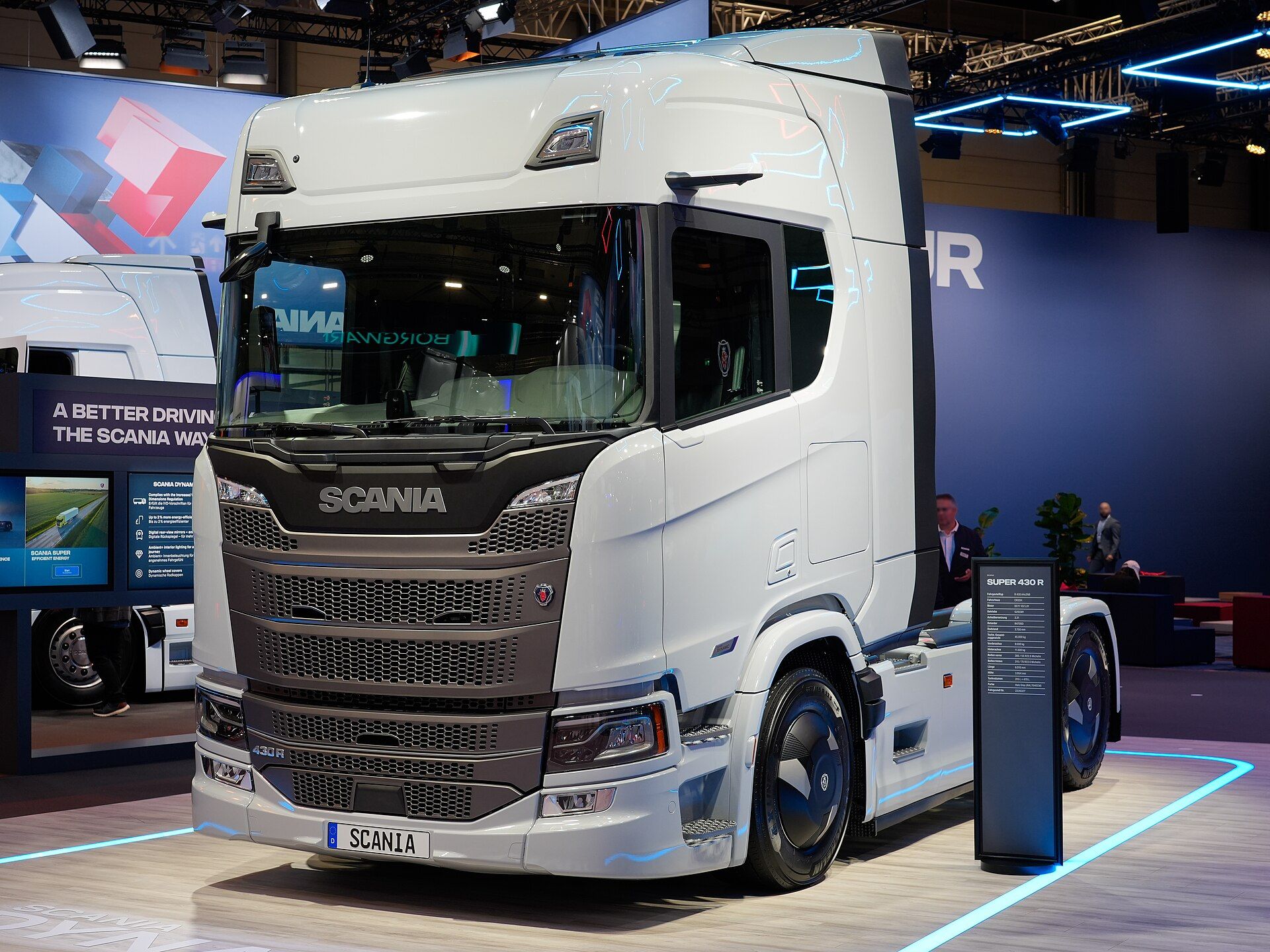
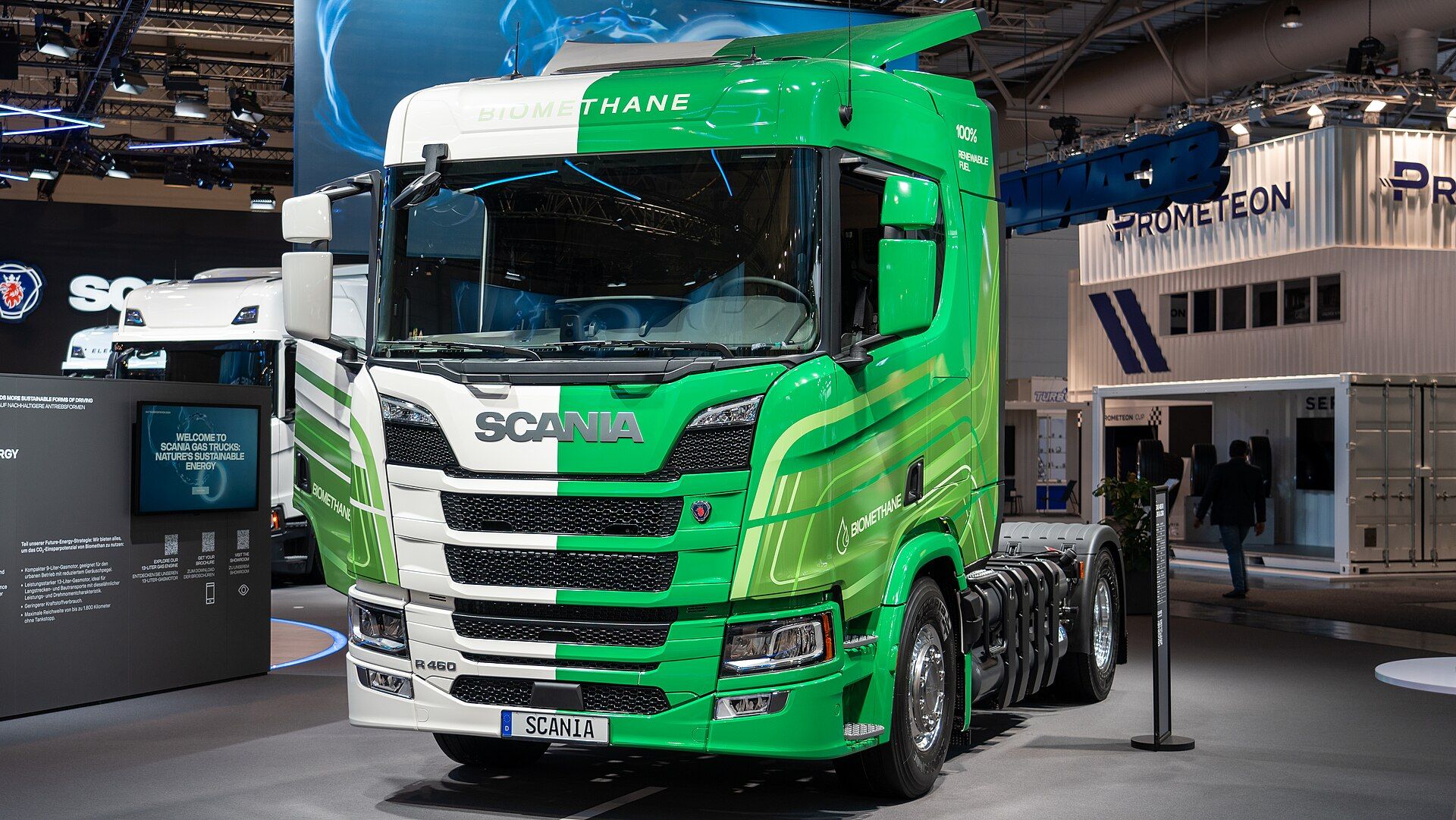
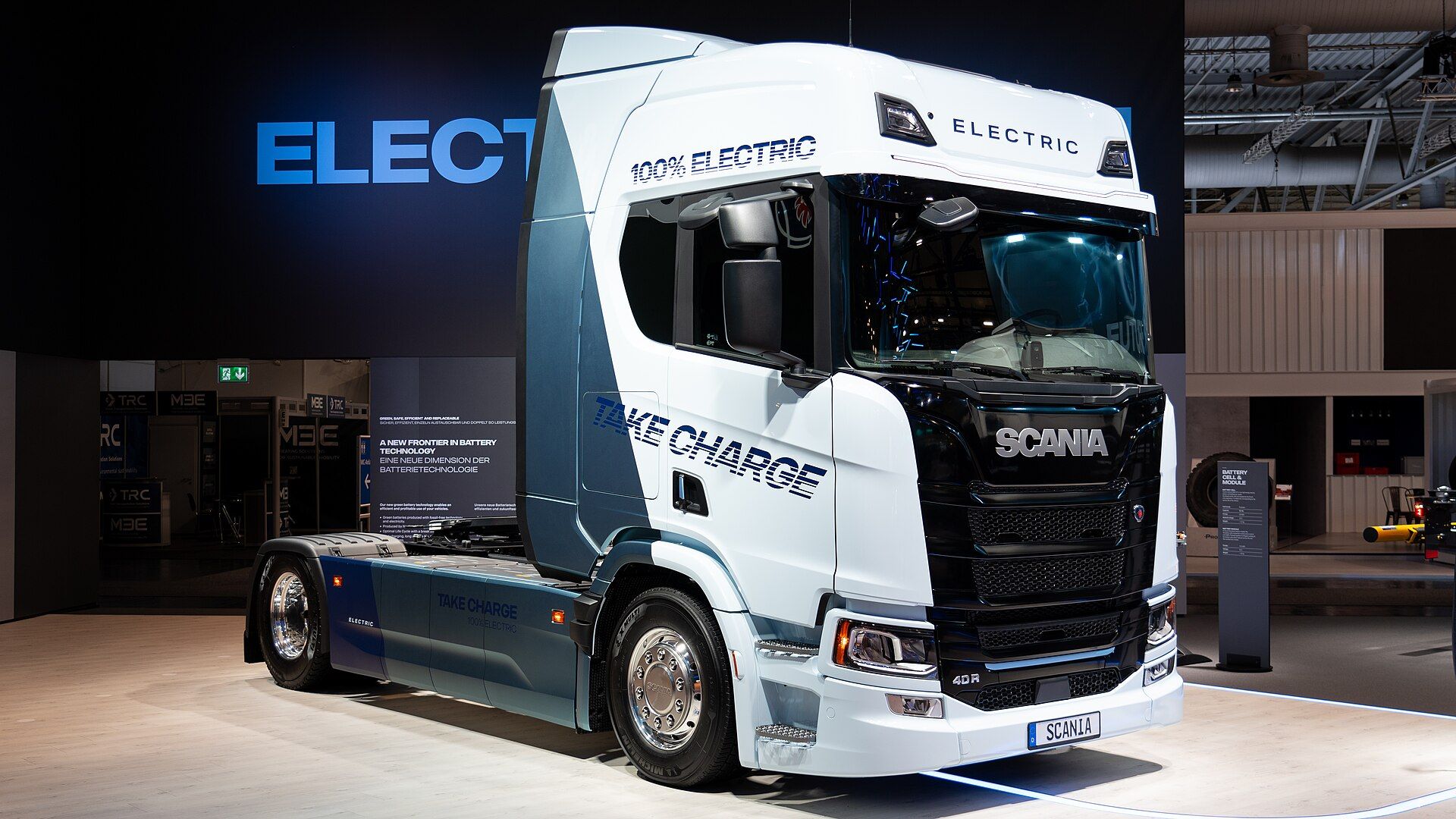
Model overview
- Segment
- Long-haul tractor
- Produced
- 2016—
- Axle configurations
- 7 (4x2…)
- Emission
- Euro 6
- Transmission
- Scania Opticruise G25 / G33 / G38, 14-speed, up to 8 reverse; range-change 8 and 8+1-speed; range-splitter 12 and 12+2-speed
- Battery capacity
- 356–624 kWh
- Charging
- 750 kW (MCS / CCS2)
- Electric motor
- 210/240/270/300/330/360/400/450 kW
Axle configurations: 4x2 · 4x4 · 6x2 · 6x2/2 · 6x2/4 · 6x4 · 6x6
Engine families
- Power
- 309–412 kW
- Torque
- 2300–2800 Nm
- Rated speed
- 1800 rpm
- Power
- 272–397 kW
- Torque
- 1900–2700 Nm
- Power
- 302 kW
- Torque
- 2000 Nm
- Rated speed
- 1900 rpm
- Power
- 311–340 kW
- Torque
- 2100–2300 Nm
- Rated speed
- 1900 rpm
- Power
- 390–566 kW
- Torque
- 2800–3700 Nm
- Power
- 206–265 kW
- Torque
- 1350–1700 Nm
- Rated speed
- 1900 rpm
The R-series is Scania’s long-haul cab; Scania’s UK page heads it “Your workhorse for long-haul transport”. The current R arrived with the truck generation Scania launched in August 2016: Scania’s news of 27 December 2016 says that launch “includes the R- and S-series trucks”, and its corporate milestones page describes the R as a high-mounted cab with generous accommodation. The R shares the Super 13, 13-litre and V8 engines, the gearboxes and the rear axles of the Scania S-series, and Scania’s UK R page adds 9-litre and Super 11-litre engines. Where the two pages give the same figures, Scania’s UK R- and S-series specifications pages print them alike and the kilowatts come from the same dated documents; the S-series page sets out at more length how the Opticruise gearboxes and the rear axle gear ratings work, and this page gives them only in brief.
This page is built from Scania UK’s R-series specifications page, whose component data was last changed on 17 April 2026 and which a listing card on Scania’s UK R-series page dates 5 August 2026, and from the UK and group R-series pages, all read on 6 October 2026; from Scania’s press release of 14 September 2026 and its group pages on Scania Dynamic; and, for kilowatts, displacements and rated speeds, from dated Scania documents: the Super 13-litre brochure (Edition 2021.10), press information of 16 August 2019, a press release of 7 December 2017, French engine data sheets dated 19 October 2020, the V8 brochure (Edition 2025.02) and a Scania UK release of 8 December 2023. The battery-electric R is described from the same specifications page, Scania’s group and UK electric-truck pages, and releases of 10 June 2022 and 18 October 2023. Nothing is converted from horsepower.
Earlier R-series generations
Scania’s corporate milestones date the R-series as a model line to 2004. The launch of the R-series “and, later, the PRT-range” in that year is described as the start of an era with a clearer identity for the different cab models, with model designations giving the cab type and then the horsepower rating; the R was the big forward-control cab, followed by the P-series, a smaller forward-control cab, and the bonneted T-series. In 2009, according to the same milestones, Scania introduced a new version of the R-series, five years after its launch and with more than 200,000 vehicles delivered worldwide; its options included the then-new Scania Driver Support system, which gives the driver real-time feedback on driving technique.
That generation is the one Scania calls PGR. A Scania Malaysia news item of 14 November 2018, reporting the last PGR truck off the assembly line at the regional production centre in Port Klang, says the P- and R-series were both introduced in 2004 and the G-series in 2007, and that more than 800,000 PGR trucks had been delivered globally since 2004. In Södertälje the two generations overlapped: Scania’s annual report for 2016 says the outgoing generation — “the current truck generation”, in the report’s words — was produced alongside the new one in the latter part of that year, and its year-end report says the first deliveries of the new range to customers were made in the fourth quarter of 2016. Neither sentence names the R-series on its own; they are what the 2016 in the table rests on.
Cab
Scania’s UK and group R-series pages list seven R cabs, each with the same powertrain range of 280 to 770 hp. Heights are given without air deflectors.
| Cab | Height | Bed or resting equipment | Scania’s description |
|---|---|---|---|
| R-day low | 3,190 mm | resting equipment, 540 mm | lower roof for transport of overhead loads |
| R-day normal | 3,530 mm | resting equipment, 540 mm | day cab with resting equipment for shorter trips |
| R-sleeper low | 3,190 mm | lower bed 800–1,000 mm | sleeper cab with a lower roof for overhead loads |
| R-sleeper normal | 3,530 mm | lower bed 800–1,000 mm, upper bed 600 mm | compact sleeper cab for shorter trips |
| R-Sleeper Long Normal | 3,530 mm | lower bed 800–1,000 mm, upper bed 600 mm | 270 mm more interior space; passenger edition with 2 to 4 seats in the rear |
| R-sleeper highline | 3,790 mm | lower bed 800–1,000 mm, upper bed 700/800 mm | more space, comfort and storage for longer trips |
| R-Sleeper Long Highline | 3,790 mm | lower bed 800–1,000 mm, upper bed 700/800 mm | 270 mm more interior space; passenger edition with 2 to 4 seats in the rear |
The two long cabs add 270 mm of interior space, and Scania says their passenger editions have room for up to four passenger seats in the rear of the cab. Scania gives no cab length, interior height or overall vehicle dimension for the R on the pages read for this record. The equipment the pages describe includes an adjustable driver seat and the option of a rotating and reclining passenger seat, an extendable table and a refrigerator, and a driver’s workplace with a modular instrument panel and a large infotainment display. On aerodynamics, Scania says the front, roof, sides and underbody have all been analysed and adjusted to streamline airflow, with gaps and angles narrowed. How day, sleeper and high-roof cabs differ in general is set out in truck cabs explained.
Scania Dynamic update (2026)
Scania announced Scania Dynamic in a press release of 14 September 2026 as “a comprehensive truck update for R- and S series”. The release, Scania’s group overview page and its Dynamic R-series page describe it; the items the R and S share are set out in full on the S-series page, and this section keeps to what Scania says about the R.
The Dynamic R-series page lists optimised A-pillars, extended side skirts, aerodynamic wheel covers, digital rear-view mirrors and updated door handles, and a new front design which, in Scania’s words, “means more miles for less energy – and more room for cargo within the same vehicle length”. The release describes the mirrors as two full-HD screens, one on the driver side and one on the passenger side, with standard, zoom and wide-angle modes, and the front as one that supports Increased Vehicle Dimension legislation; Scania gives no length for it. The EU rules behind such fronts are covered in aerodynamic cabs and the EU length rules. On energy, the release gives total energy consumption reduced by around 2 percent “in this step”, depending on vehicle specification and operation, and the Dynamic R-series page headlines “Up to 2% increased energy efficiency”; neither says what the figure is measured against.
Inside the cab, the Dynamic R-series page describes an updated seat whose headrest, it says, surpasses the standards for the latest safety regulations; a reclining bed 800 mm wide with a back section adjustable up to 60 degrees, which reclines out of the way on the passenger side; ambient lighting in several modes, with themes named Aurora Veil and Cosmic Glow; a surround sound system with two additional speakers in the top level; a magnetic wireless charging tray (15 W, according to the release); and a ventilated external storage compartment for wet or dirty gloves. The release adds a new colour scheme, curtains that are 100 percent recycled and wall and ceiling panels containing 70 percent recycled material. The page’s FAQ says the Dynamic R-series can be ordered with electric or combustion engines and answers the question of configuring one by pointing to a waiting list. None of the three Scania texts gives an order, production or delivery date, or any engine, gearbox, axle, weight or cab-dimension figure, so nothing in the record changes for the update.
Engines
Scania UK’s R-series specifications page says an R-cab can be fitted with a 9-, 13- or 16-litre engine, gives the R an engine range of 280 to 770 hp, and carries a Super 11-litre table in its Euro 6 tab as well. The table below follows that tab step by step, with its engine PTO column; the kilowatt figures come from the dated Scania documents named in each row, the same documents behind the S-series and Scania XT records.
| Engine (UK page) | Output / torque, as listed | kW and source | Engine PTO |
|---|---|---|---|
| 16-litre V8, DC16 120–123 | 530 hp / 2,800 Nm · 590 / 3,050 · 660 / 3,300 · 770 / 3,700 | 390, 434, 485, 566 kW (V8 brochure 2025.02) | 800 Nm |
| Super 13-litre | 420 hp / 2,300 Nm · 460 / 2,500 · 500 / 2,650 · 560 / 2,800 | 309, 338, 368, 412 kW (Super 13 brochure 2021.10) | up to 1,000 Nm |
| Super 11-litre | 350 hp / 1,800 Nm · 390 / 2,000 · 430 / 2,200 | not published | up to 1,000 Nm |
| 13-litre, DC13 163–166 and a 370 hp step | 370 hp / 1,900 Nm · 410 / 2,150 · 450 / 2,350 · 500 / 2,550 · 540 / 2,700 | 272, 302, 331, 368, 397 kW (press information 2019) | 600 Nm |
| 13-litre gas, OC13 101 | 410 hp / 2,000 Nm | 302 kW (data sheets 2020) | 600 Nm |
| 9-litre, DC09 139–141 | 280 hp / 1,400 Nm · 320 / 1,600 · 360 / 1,700 | 206, 235, 265 kW (data sheets 2020) | 600 Nm |
| 9-litre gas, OC09 104 and the 340 hp step | 280 hp / 1,350 Nm · 340 / 1,600 | 206, 250 kW (data sheets 2020) | 600 Nm |
The Super 13-litre is the engine of the S-series record in every figure: 12.74 litres, six cylinders in line and 1,800 rpm on all four steps in the 2021 brochure, Twin SCR, and a fuel column reading Diesel/HVO at 420 and 560 hp and Diesel/HVO/FAME at 460 and 500 hp. The UK page describes an optional compression release brake giving it auxiliary braking capacity up to 350 kW, and the brochure an engine-driven power take-off with power up to 238 kW. Scania’s group Super powertrain page, which lists the same four steps in an R-series table, credits it with up to 8 percent lower fuel consumption than the previous 13-litre.
The Super 11-litre appears on the UK R page’s Euro 6, Euro 5 and Euro 4 tabs at 350, 390 and 430 hp and 1,800 to 2,200 Nm, with Twin SCR, and the group Super powertrain page lists the same three steps for the R-series. The UK page describes it as a five-cylinder design sharing 85 percent of its architecture with the 13-litre, with up to 7 percent lower fuel consumption than the previous Scania 9-litre. Scania UK’s release of 20 May 2025 gives it as available for purchase from June 2025, up to 85 kg lighter than the Super 13, with up to 85 percent of its components shared with the Super 13 and maintenance intervals up to 30 percent longer than the 9-litre’s; Scania’s Super 11 page lists a compression release brake with settings of 230 kW (standard) and 344 kW (high). None of these documents gives a kilowatt rating, a displacement or a rated speed, so, as on the XT page, the Super 11 has no row in the spec table at the top of this page.
The 13-litre diesel steps are those of the S-series page: DC13 163 to 166 for 410 to 540 hp, and a 370 hp row that the UK page labels OC13 101, the designation its gas row carries. Scania’s 2019 press information gives 12.7 litres and 272 to 397 kW; the rated speed is 1,800 or 1,900 rpm depending on the designation, which is why the spec table at the top shows none (the S-series page sets out the documents). The UK page gives the exhaust brake as 242 kW at 2,400 rpm, as does the 2019 press information for DC13 162 to 166; the 2020 data sheets give 242 kW for DC13 162 to 164, but 265 kW for DC13 165 and 166, all at 2,400 r/min.
The 13-litre gas engine is where the R’s documents disagree. The UK page’s Euro 6 table lists only OC13 101 at 410 hp and 2,000 Nm, which the 2020 data sheets rate at 302 kW at 1,900 r/min and describe as a gas engine for compressed or liquefied natural gas. The same page’s text says “A gas version of this engine is available, rated to 460 hp”, using exhaust gas recirculation, and adds that the gas engine can only be fitted to G- and R-series cabs. Scania UK’s gas-truck page says the previous 410 hp engine has been replaced by 420 and 460 hp versions, lists the gas range with L, P, G, R and S cabs, and says the new 13-litre engines can now also be specified with the S-cab. Scania UK’s release of 8 December 2023 gives those two as OC13 103, 420 hp (311 kW) at 2,100 Nm, and OC13 104, 460 hp (340 kW) at 2,300 Nm, both 12.7 litres, rated at 1,900 r/min, with Scania EGR and a three-way catalytic converter. The record keeps OC13 101 as the table gives it and carries OC13 103 and OC13 104 as a row of their own.
The 16-litre V8 is DC16 120 to 123: 16.4 litres and 390 to 566 kW in the 2025 brochure, rated at 1,900 r/min on the lower three steps and 1,800 r/min at 770 hp. The UK page gives its exhaust brake as 300 kW at 2,400 rpm and says the 590 hp step can be specified for biodiesel.
The 9-litre is the R’s smallest engine. The UK page describes the DC09 as a straight five-cylinder diesel with Scania’s XPI injection, four valves per cylinder, a fixed-geometry turbocharger and SCR, with an exhaust brake rated at 183 kW at 2,400 rpm. The 2020 data sheets give 9.3 litres, 1,900 r/min and 206, 235 and 265 kW for DC09 139, 140 and 141, and 206 and 250 kW for the gas engines OC09 104 and OC09 105, which they describe as engines for compressed or liquefied natural gas; the UK page lists EGR for its gas rows. It gives its 340 hp gas row the designation of the 360 hp diesel, DC09 141; the data sheets name that gas engine OC09 105. For the 9-, 13- and 16-litre engines the UK page says they can run on HVO without modification.
Battery-electric R
The UK R-series specifications page covers the electric R in two places. A text block in its powertrain section, headed “Electric machine (2–4 speed transmission)”, describes a two-speed electric machine with a continuous output from 210 kW (290 hp) to 330 kW (440 hp), with the option of an e-PTO whose design the bodybuilder can tailor to the bodywork. The table in the page’s Electric tab goes further, to 450 kW and six speeds:
| Continuous power | Regeneration power (peak) | Gearbox speeds | Installed battery | Charging power, max | PTO types |
|---|---|---|---|---|---|
| 210 kW | 294 kW | 2 | 356 / 445 / 535 / 624 kWh | 375 / 750 kW | EL, EM, EC |
| 240 kW | 294 kW | 2 | 356 / 445 / 535 / 624 kWh | 375 / 750 kW | EL, EM, EC |
| 270 kW | 410 kW | 4 | 356 / 445 / 535 / 624 kWh | 375 / 750 kW | EL, EM, EC |
| 300 kW | 410 kW | 4 | 356 / 445 / 535 / 624 kWh | 375 / 750 kW | EL, EM, EC |
| 330 kW | 410 kW | 4 | 356 / 445 / 535 / 624 kWh | 375 / 750 kW | EL, EM, EC |
| 360 kW | 480 kW | 4 | 356 / 445 / 535 / 624 kWh | 375 / 750 kW | EL, EM, EC |
| 400 kW | 480 kW | 4 | 356 / 445 / 535 / 624 kWh | 375 / 750 kW | EL, EM, EC |
| 400 kW | 600 kW | 6 | 445 / 535 kWh | 375 kW | EL, EM, EG |
| 450 kW | 600 kW | 6 | 445 / 535 kWh | 375 kW | EL, EM, EG |
Beneath the table the page explains EL as an electric PTO at 650 V DC, EM as electromechanical at 60 kW and EC as mechanical in various options; the code EG on the six-speed rows is not explained. The battery column is installed capacity, which is not the figure Scania’s electric-truck pages give; the difference is explained in installed vs usable battery capacity.
Scania’s group and UK electric-truck pages describe one battery-electric platform for the L, P, G, R and S cabs and the CrewCab. They list three electric machines: the EM C1-2, two-speed, at 210 or 240 kW continuous; the EM C1-4, four-speed, at 270, 300, 330, 360, 400 or 440 kW; and the EM C3-6, six-speed, at 400 or 450 kW. The UK page gives usable battery capacities of 240, 320, 400, 480 or 560 kWh, and the group page adds 640 and 720 kWh, the 720 kWh option marked “Available in early 2027”. Both list CCS2 charging at 375 kW and the Megawatt Charging System at 750 kW — the standard is described in megawatt charging explained — a technical gross train weight of up to 74 t, axle distances from 3,250 to 6,350 mm, wheel configurations A/B 4x2, A/B 6x2, B 6x2*4, A/B 6x4 and B 8x4*4, and a charging interface on the left-hand side behind the driver door. With 560 kWh usable, the UK page gives ranges of up to 560 km at 29 t, 515 km at 42 t and 360 km at 64 t; with 720 kWh, the group page gives up to 720 km at 42 t, again marked as available in early 2027, and 450 km at 64 t. The documents do not agree in every detail. The R page has no 440 kW step, which both platform pages list; it gives 210 kW as 290 hp where both platform pages give 280 hp; and the two platform pages give the 440 kW step as 590 hp (group) and 600 hp (UK).
Scania’s release of 10 June 2022 introduced a battery-electric generation for regional long-haul “available with R or S sleeper cabs”, with 624 kWh of batteries installed and a continuous output of 410 kW for the Scania 45 R or S. It gave a 4x2 tractor with six batteries up to 350 km between charges at an average 80 km/h on motorways, an axle distance of 4,150 mm for six batteries, gross train weights up to 64 tonnes, charging up to 375 kW, and production starting in the fourth quarter of 2023; Scania’s milestones page dates the 45 R to June 2022. A Scania UK release of 18 October 2023, announcing an update of Scania’s urban battery-electric range, added the EM C1-4, a single permanent-magnet motor paired with a four-speed gearbox, at 270, 300, 330, 360 and 400 kW, and said every new battery-electric truck would have Northvolt cells in battery packs assembled by Scania in Södertälje.
Transmission
The Opticruise text in the gearbox section of the UK R page is the same as on the UK S-series page, and the S-series page sets it out in full. Opticruise G25, G33 and G38 have a 14-gear spread with super crawler and overdrive, and a planetary gear for reversing that gives up to eight reverse gears at speeds up to 30 km/h; Scania’s Opticruise brochure (Edition 2023.04) gives four reverse gears as standard on the G25 and G33 and eight as an option. Scania credits the platform with fuel savings of one percent, a cast-aluminium housing that cuts component weight by up to 75 kg, and a PTO programme with nine performance steps. Beside them, the page lists range-change gearboxes with 8 and 8+1 speeds and range-splitter gearboxes with 12 and 12+2 speeds.
The R page’s introduction to the section differs from the S page’s. It says the 8- and 12-speed boxes can be fitted with Opticruise and the Scania Retarder, and it names the “new Opticruise G33CM gearbox” as available for the 500 and 540 hp 13-litre and all 16-litre V8s except 770 hp; further down, the shared text gives the G33 for all V8 engines up to 660 hp and the same two 13-litre steps. The electric R has two-, four- or six-speed gearboxes, as the Electric tab above shows.
Axles, suspension and brakes
The UK R page lists seven tractor wheel formulas, with chassis heights: 4x2 (extra low, low, normal or high), 4x4 (high), 6x2 (normal), 6x2/2 (normal, captioned 6x2 pusher), 6x2/4 (normal or low, captioned 6x2 twin-steer), 6x4 (normal or high) and 6x6 (high). Its rigid list has fourteen formulas, from 4x2 to 10x4*6, captioned 10x4 rear-steer. The R is sold as both tractor and rigid; like the S-series record, this record carries the tractor list.
The rear axle gear capacities are those of the S-series page, stated as gross vehicle and train weights, not as a weight for the model: up to 78 tonnes for single driven single reduction (ratios 1.95 to 5.57), 80 tonnes for single driven hub reduction (3.80 to 7.18), 80 tonnes for the RB662 + R660 tandem driven single reduction (2.92 to 4.88) and 210 tonnes for tandem driven hub reduction (3.52 to 7.63). The R756 axle has ratios from 1.95 to 4.11 and is made for operations up to 53 tonnes GTW. The page adds that hub reduction is available in two strengths. The R-series pages read for this record describe no suspension.
On braking, the retarder on the G33 delivers 4,700 Nm at a propeller shaft speed below 600 rpm. The UK page rates the exhaust brakes at 183 kW (9-litre), 242 kW (13-litre) and 300 kW (16-litre), all at 2,400 rpm, and the Super 13’s optional compression release brake at up to 350 kW; Scania’s group Super page says that brake can replace or complement the Scania R4700D retarder depending on the operation. The Super 11’s compression release brake has the two settings given above. How the two kinds of auxiliary brake work is set out in retarders and engine braking.
Dimensions and weights
Scania publishes no gross vehicle or gross combination weight for the R-series as a model, and both fields are empty; the rear axle gear capacities above are ratings for the axles. For the battery-electric platform the group and UK pages give a technical gross train weight of up to 74 t, and the 2022 release gave gross train weights up to 64 tonnes for the battery-electric R it introduced. Apart from the cab heights in the cab table, the R-series pages read give no vehicle dimension; the electric platform pages give axle distances of 3,250 to 6,350 mm, the 2022 release gave 4,150 mm for a 4x2 tractor with six batteries, and the Dynamic R-series page says the new front makes more room for cargo within the same vehicle length without giving a figure.
Fuel, gas and AdBlue
Scania’s UK and group R-series pages give no diesel or AdBlue tank capacity for the R. Scania’s group Super powertrain page describes, for the chassis and tank programme introduced with the Super engines, aluminium D-shaped fuel tanks from 165 to 910 litres and side-mounted SCR tanks of 123 and 150 litres, without naming a cab series. The UK R specifications page describes the Twin-SCR system of the Super engines as dual AdBlue dosing. For the gas engines, Scania UK’s gas-truck page says tank options are available for both compressed and liquefied gas and that a typical semi-trailer tractor can achieve a driving range of about 1,800 kilometres; the December 2023 release puts it as up to 1,800 km for a 40-tonne combination with the largest Bio-LNG tanks Scania offers. How liquefied gas is carried and used on trucks is set out in LNG and bio-LNG trucks.
Safety and driver-assistance systems
The UK and group R-series pages say position lights and extra lights are integrated into the cab as part of the basic configuration, without a negative effect on aerodynamics. The Dynamic R-series page lists seven safety and driver-assistance systems as included: Safe stop assist, Forward distance alert, Vulnerable Road User braking – side (VRUBS), Moving Off Inhibit, Door Cycling Adult, Speed Sign Cruise Control (SSCC) and Curve Speed Cruise Control (CSCC). It describes safe stop assist as bringing the vehicle to a safe stop if the driver suddenly becomes unable to drive, in a 3-step sequence of signalling and braking to standstill that can be overridden at any time with the brake or accelerator pedal; the forward distance alert as showing a short distance to the vehicle in front on the driver display, with the time gap adjusted automatically by the adaptive cruise control; and the automatic emergency brake system, with low side and front sensors, as helping avoid or reduce the impact of collisions in intersections or at pedestrian crossings. It also says the Dynamic R-series has a door warning sensor alerting the driver to cyclists approaching from behind, and that the adaptive cruise control adjusts speed to detected speed signs and curves. The release says the speed-sign and curve functions “support the driver rather than replace driver responsibility”, and describes updated headlamps with an extended high-beam range and an automatic high beam, which the Dynamic R-series page calls LED headlamps; the overview page adds a 360° area view camera for manoeuvring.
Equipment and options
For bodywork, the UK page’s engine PTO column gives 800 Nm on the V8, up to 1,000 Nm on the Super 13 and Super 11 and 600 Nm on the 13- and 9-litre; the Opticruise PTO programme has nine performance steps; and the electric R takes electric, electromechanical or mechanical PTO, with the bodybuilder able to suggest the inverter for an e-PTO. In the cab, the passenger editions of the two long cabs take two to four rear seats; the Scania Dynamic cab equipment is set out under its own heading above.
Euro 6 in the table, Euro 5, 4 and 3 on the page
The engine rows follow the UK page’s Euro 6 tab; the page names no Euro 6 sub-step. Its Euro 5 and Euro 4 tabs list 16-litre engines at 520 and 620 hp, 13-litre steps that include 380 and 440 hp (and 540 hp on Euro 5 only), the Super 11 at the same three steps as Euro 6, and the 9-litre at 280, 320 and 360 hp. The Euro 3 tab, marked without SCR, lists a 560 hp 16-litre, 13-litre engines at 360, 410 and 460 hp and 9-litre engines at 250 and 310 hp. The page does not say where those tabs apply.
Source notes
Scania publishes no weight for the model. Its UK R-series page gives rear axle gear capacities as gross vehicle and train weights: up to 78 t single driven single reduction, 80 t single driven hub reduction, 80 t tandem driven single reduction and 210 t tandem driven hub reduction; its battery-electric pages give a technical GTW of up to 74 t for the electric platform. No rated speed is shown for the 13-litre diesel, rated at 1,800 or 1,900 rpm depending on its designation, or for the V8, at 1,900 rpm on the lower three steps and 1,800 rpm at 770 hp. The battery figures follow the UK R-series page, which gives installed capacity; Scania’s battery-electric pages give usable capacity instead.
Quick answers
- Which engines are available in the Scania R-series?
- The record for the Scania R-series covers these engine families: Scania Super 13-litre (12.74 l), Scania 13-litre (12.7 l), Scania 13-litre gas · OC13 101 (12.7 l), Scania 13-litre gas · OC13 103 / OC13 104 (12.7 l), Scania 16-litre V8 · 530/590/660/770 hp (16.4 l), Scania 9-litre (9.3 l). Output spans 206–566 kW and 1350–3700 Nm.
- What axle configurations does the Scania R-series come in?
- 4x2, 4x4, 6x2, 6x2/2, 6x2/4, 6x4, 6x6.
- What emission standard does the Scania R-series meet?
- Euro 6.
- When did production of the Scania R-series start?
- Production of the Scania R-series started in 2016.
- Which transmission does the Scania R-series use?
- Transmission: Scania Opticruise G25 / G33 / G38, 14-speed, up to 8 reverse; range-change 8 and 8+1-speed; range-splitter 12 and 12+2-speed.
- What battery capacity does the Scania R-series have?
- Battery capacity: 356–624 kWh; Charging: 750 kW (MCS / CCS2).
Scania models on this site, side by side
| Segment | Produced | Axle configurations | Power | Torque | |
|---|---|---|---|---|---|
| Scania P-series | Distribution | 14 configurations | 162–368 kW | 1000–2650 Nm | |
| Scania R-series | Long-haul tractor | 2016— | 7 configurations | 206–566 kW | 1350–3700 Nm |
| Scania S-series | Long-haul tractor | 2016— | 7 configurations | 272–566 kW | 1900–3700 Nm |
| Scania XT | Construction | 2017— | 14 configurations | 162–566 kW | 1000–3700 Nm |
Articles that mention the Scania R-series
More Scania on this site
Sources
- R-series specifications — engines by emission level, electric powertrains, gearboxes, rear axle gears, axle configurations — Scania
- R-series trucks — cab options, heights and bed dimensions — Scania
- New Scania Dynamic strengthens driver focus and energy efficiency (press release, 14 September 2026) — Scania, 14 Sept 2026
- Dynamic R-series truck — aerodynamics, cab comfort, driver assistance and FAQ — Scania
- High Five: Scania's new biogas engines have just got greener (press release, 8 December 2023, with data for OC13 103 and OC13 104) — Scania, 8 Dec 2023
- Battery electric trucks — technical specifications (Scania UK) — Scania
- Electric trucks — technical specifications (Scania Group) — Scania
- Scania R-series trucks — Scania
- S-series specifications — engines by emission level, gearboxes, rear axle gears, axle configurations — Scania
- Scania Dynamic — overview of the R- and S-series update — Scania
- Super Powertrain — Scania
- Scania Super 13-litre engine (brochure, Edition 2021.10) — Scania
- Scania adds a 540 hp version to its 13-litre engine range (press info, 16 August 2019) — Scania
- Scania introduces a 7-litre family for improved efficiency and reduced weight (press release, 7 December 2017, with technical data for the DC07, DC09, DC13 and DC16 Euro 6 engines) — Scania
- Moteurs Euro 6 NTG — engine data sheets dated 19/10/2020 (Scania bodybuilder documentation, France) — Scania
- The Scania V8 Range (brochure, Edition 2025.02) — Scania
- Scania Opticruise Gearbox G25 & G33 (brochure, Edition 2023.04) — Scania
- Gas trucks (Scania UK) — Scania
- A Super addition! New 11-litre engine joins Scania's line-up (press release, 20 May 2025) — Scania
- Super 11-litre engine — Scania
- Scania introduces electric trucks for regional long-haul (press release, 10 June 2022) — Scania
- New Energy: Scania's rejuvenated battery electric range is raring to go (press release, 18 October 2023) — Scania
- 2022: Scania launches the regional BEV (corporate milestones) — Scania
- The launch of a new truck generation (news, 27 December 2016) — Scania
- 2016: Launch of New Generation trucks (corporate milestones) — Scania
- The Scania Report 2016 — Annual and Sustainability Report (Report of the Directors, production and environment) — Scania
- Scania Year-end Report January–December 2016 — Scania
- 2004: Launch of the R-series (corporate milestones) — Scania
- 2009: New R-series awarded Truck of the Year (corporate milestones) — Scania
- Last of the Scania PGR series trucks rolls off the assembly line in Malaysia (news, 14 November 2018) — Scania