Scania
Scania P-series
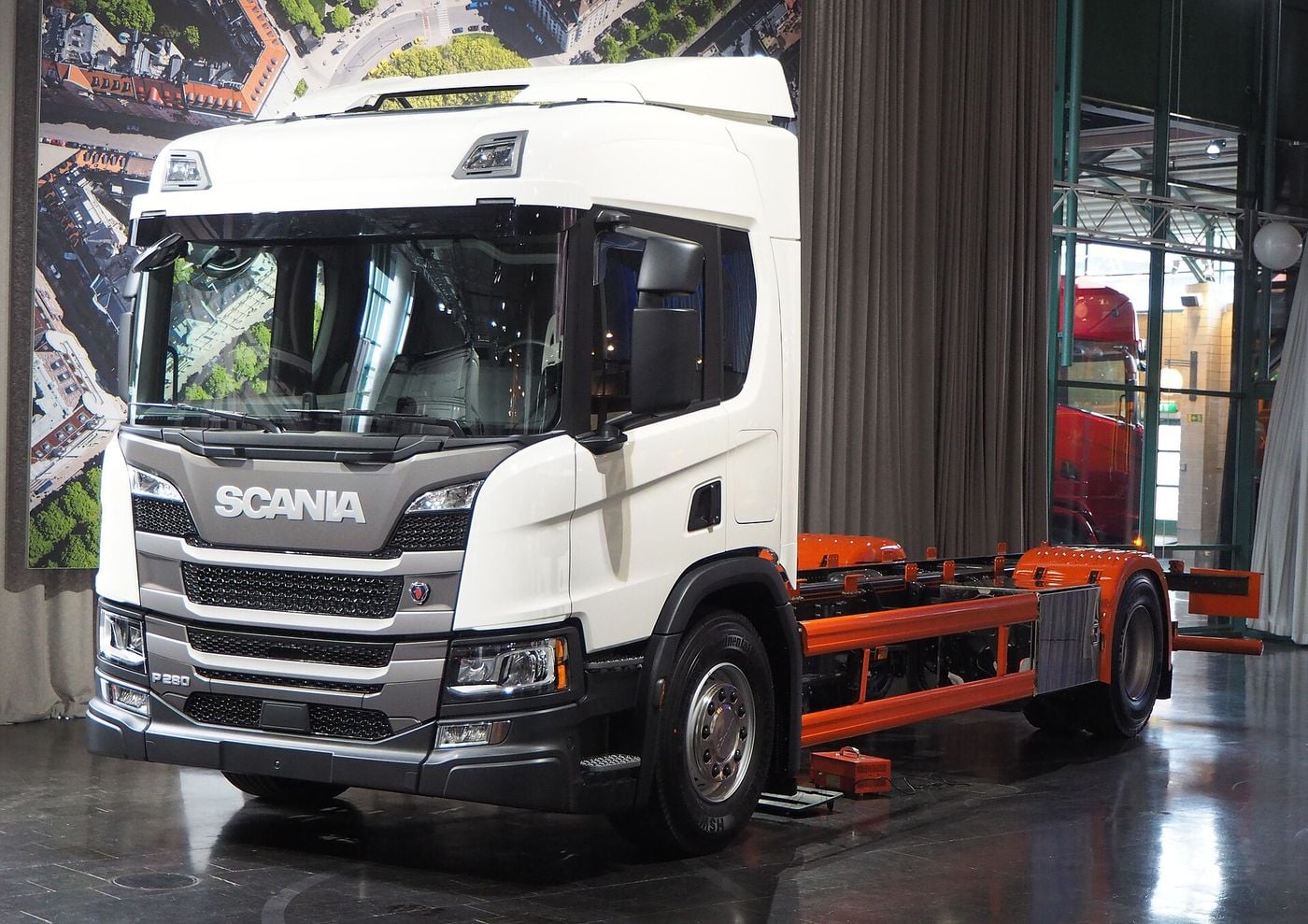
Scania's P-series cab for urban, regional and construction work: three cab versions, 7- to 13-litre diesel and gas engines, the Super 11 and Super 13, and the electric P.
- 14 configurations
- 162–368 kW
- Euro 6

Model overview
- Segment
- Distribution
- Axle configurations
- 14 (4x2…)
- Emission
- Euro 6
- Transmission
- Scania Opticruise G25 / G33 / G38, 14-speed, eight reverse gears through a planetary gear; range-change 8 and 8+1-speed; range-splitter 12 and 12+2-speed
- Battery capacity
- 356–624 kWh
- Charging
- 750 kW (MCS / CCS2)
- Electric motor
- 210/240/270/300/330/360/400 kW
Axle configurations: 4x2 · 4x4 · 6x2 · 6x2/2 · 6x2/4 · 6x2*4 · 6x4 · 6x6 · 8x2 · 8x2*6 · 8x2/4 · 8x4 · 8x4*4 · 10x4*6
Engine families
- Power
- 309–368 kW
- Torque
- 2300–2650 Nm
- Rated speed
- 1800 rpm
- Power
- 272–368 kW
- Torque
- 1900–2550 Nm
- Rated speed
- 1800 rpm
- Power
- 302 kW
- Torque
- 2000 Nm
- Rated speed
- 1900 rpm
- Power
- 206–265 kW
- Torque
- 1350–1700 Nm
- Rated speed
- 1900 rpm
- Power
- 162–206 kW
- Torque
- 1000–1200 Nm
- Rated speed
- 1900 rpm
| Cab | Engine tunnel (mm) | Standing height (mm) |
|---|---|---|
| P-short Low Roof | 440 / 345 | 1,500 |
| P-Day Normal Roof | 440 / 345 | 1,500 |
| P-sleeper High Roof | 440 / 345 | 2,030 |
The P-series is the cab range that Scania’s UK P-series page calls “our most versatile cab range”, for urban and regional operations and for construction and other demanding conditions: a low-weight cab mounted low on the chassis. In the current truck generation it followed the long-haul R- and S-series of 2016. Scania’s corporate milestones say the P- and G-series were introduced in 2017 as cab models mounted lower on the chassis, and Scania’s release of 7 December 2017, which brought the 7-litre engine and a lower engine tunnel for the P-cab, says that with its urban trucks Scania “now completes its new truck generation”. The long-haul cabs of the same generation are the Scania R-series and the Scania S-series; Scania’s construction specification, which its 2017 launch release offers “from the smallest P-series cab to the spacious S-series cab”, is described on the Scania XT page.
The figures on this page come from Scania UK’s P-series specifications page, whose tables were last changed on 17 April 2026 and whose introduction and 7-litre text were changed on 5 August 2026, and from Scania’s UK and group P-series pages, all read on 19 October 2026. Kilowatts, displacements and rated speeds come from dated Scania documents: a press release of 7 December 2017, press information of 16 August 2019, French engine data sheets dated 19 October 2020 and the Super 13-litre brochure (Edition 2021.10). The battery-electric and hybrid P are described from the same specifications page, Scania’s UK and group electric-truck pages and Scania releases dated between 2020 and 2026.
Earlier P-series generations
Scania’s corporate milestones date the P-series as a model line to 2004, when the R-series, the big forward-control cab, was followed by the P-series, a smaller forward-control cab, and the bonneted T-series; model designations gave the cab type and then the horsepower rating. Scania’s release of 20 September 2004 says the IAA in Hanover showed the new P-, R- and T-series for the first time at a main international show. A release of 6 June 2005 announced a new P-series CrewCab for emergency and fire service vehicles, in a CP28 version for 5 to 6 crew and a CP31 version for 6 to 8 crew; the CrewCab had first appeared on the Scania 4-series in the late 1990s, and about 2,000 had been delivered by then.
Scania calls that generation PGR. A Scania Malaysia news item of 14 November 2018 says the P- and R-series were both introduced in 2004 and the G-series in 2007, and that more than 800,000 PGR trucks had been delivered globally. Scania’s group news of 21 May 2018 reports the last PGR truck made in Europe leaving the production line in Zwolle, with PGR production continuing at Scania’s plant in South America until spring 2019.
The current generation began with the R- and S-series, which Scania launched in August 2016 according to its news of 27 December 2016. Scania’s release of 4 September 2017 calls the XT construction range the second stage of the introduction; the corporate milestone for 2017 adds the P- and G-series cabs; and Scania’s year-end report for 2017 says the new truck generation was completed in the fourth quarter of that year with trucks for urban traffic. No document opened gives a production start date for the current P-series.
Cab
Scania’s UK P-series page lists three P cabs. Each can have one of two engine tunnels: a “normal” tunnel 440 mm high, used with all 9- and 13-litre engines and with the 7-litre without an Opticruise gearbox, and a “low” tunnel 345 mm high, used with the 7-litre and an Opticruise gearbox. Cab heights are given without air deflectors.
| Cab | Cab height | Standing height | Bed or resting equipment | Scania’s description |
|---|---|---|---|---|
| P-short Low Roof | 2,920 mm | 1.5 m | not available on short cabs | short cab with low roof that maximises the load capacity; powertrain 220–500 hp |
| P-Day Normal Roof | low 2,920 mm, normal 3,260 mm | 1.5 m | foam rubber resting mattress, 7 cm thick, 2 m long, folds up against the rear wall | lower roof that allows transport of overhead loads |
| P-sleeper High Roof | low 2,920 mm, normal 3,260 mm, highline 3,520 mm | 2.03 m | lower bed 800–1,000 mm wide, 2 m long; no upper bed | sleeper cab with bed for longer trips |
The resting mattress of the P-Day cab has a 54 cm wide centre section and is scalloped to 34 cm behind the driver’s seat. The sleeper’s lower bed is an extendable bed 80 cm to 1 m wide or a fixed bed 80 cm wide, 2 m long, with an additional 20 cm extender available and foam, Bonell or coil-spring mattresses; the page says an upper bed is only available in G-, R- and S-series sleeper cabs. On the short and day cabs an additional crew seat can be specified on top of the engine tunnel. Under “Cab Floor” the page prints “140mm”, “170mm” and “200mm” (front wall to rear wall) for the short, day and sleeper cab. It gives no cab width.
The cab cards list engine power by family: the 7-litre at 220, 250 and 280 hp, the 9-litre at 280, 320, 340 (gas) and 360 hp, the 11-litre at 350, 390 and 430 hp, and the 13-litre at 420, 460, 500 and 560 hp. The specifications page’s Super 13 table for the P has 420, 460 and 500 hp; the short cab’s card gives a powertrain of 220 to 500 hp.
On the low engine tunnel, Scania’s UK page says the 7-litre’s compact format makes the tunnel 95 mm lower than in a regular P-cab, improving cross-cab access for drivers who enter and leave through the passenger door. Scania’s release of 7 December 2017 says the low tunnel requires the 7-litre engine and can be selected for all P-cabs, regardless of length or roof height, and that it gives the P-cabs the same storage compartments as the G-cabs, with new layouts for rear storage and bunks; it names no gearbox for the low tunnel. The UK page describes a cab in which position lights and extra lights are integrated as part of the basic configuration, cab and cab suspension designed to reduce vibrations, and an adjustable driver seat and steering wheel. How day, sleeper and low-entry cabs differ in general is set out in truck cabs explained.
Engines
The Euro 6 tab of Scania UK’s P-series specifications page lists five engine tables: Super 13-litre, Super 11-litre, 13-litre, 9-litre and 7-litre. The table below follows that tab step by step, with its engine PTO column; the kilowatt figures come from the dated Scania documents named in each row.
| Engine (UK page) | Output / torque, as listed | kW and source | Engine PTO |
|---|---|---|---|
| Super 13-litre | 420 hp / 2,300 Nm · 460 / 2,500 · 500 / 2,650 | 309, 338, 368 kW (Super 13 brochure 2021.10) | up to 1,000 Nm |
| Super 11-litre | 350 hp / 1,800 Nm · 390 / 2,000 · 430 / 2,200 | not published | up to 1,000 Nm |
| 13-litre, DC13 162–165 | 370 hp / 1,900 Nm · 410 / 2,150 · 450 / 2,350 · 500 / 2,550 | 272, 302, 331, 368 kW (press information 2019) | 600 Nm |
| 13-litre gas, OC13 101 | 410 hp / 2,000 Nm | 302 kW (data sheets 2020) | 600 Nm |
| 9-litre, DC09 139–141 | 280 hp / 1,400 Nm · 320 / 1,600 · 360 / 1,700 | 206, 235, 265 kW (data sheets 2020) | 600 Nm |
| 9-litre gas, OC09 104 and OC09 105 | 280 hp / 1,350 Nm · 340 / 1,600 | 206, 250 kW (data sheets 2020) | 600 Nm |
| 7-litre, DC07 111–113 | 220 hp / 1,000 Nm · 250 / 1,100 · 280 / 1,200 | 162, 184, 206 kW (release 2017, data sheets 2020) | 600 Nm |
The UK page says the entire Scania Euro 6 engine range is approved to run on up to 100% HVO; the fuel column gives Diesel/HVO/FAME for the 460 and 500 hp Super 13 and the 390 and 430 hp Super 11, Diesel/HVO/Biodiesel for the 410 to 500 hp 13-litre and the 320 and 360 hp 9-litre, Diesel/HVO for the other diesel steps and “Gas (CNG/LNG)” for the three gas rows. The fuel itself is described in what is HVO fuel.
The 7-litre is the P’s smallest engine. The UK page describes the DC07 as the lightest engine in the Scania range, approximately 360 kg lighter than the 9-litre engines: a straight six-cylinder diesel with Bosch injection, four valves per cylinder, a fixed-geometry turbocharger and Scania’s SCR system, for which Scania gives 220 to 280 hp and 1,000 to 1,200 Nm and which it places in light-duty urban operations under 26 t GTW. Scania’s release of 7 December 2017 gives 6.7 litres, a bore and stroke of 107 by 124 mm, a compression ratio of 17.1:1, 162, 184 and 206 kW at 1,900 rpm for DC07 111, 112 and 113, and peak torque from 1,050 rpm; it says the engine was developed together with Cummins, gives fuel savings of up to 10 percent according to Scania’s own measurements, and says nothing prevents 26-tonne vehicles with it. The documents give three exhaust brake ratings for the DC07, all at 2,500 rpm: 127 kW on the UK page, 88 kW in the 2017 release and the 2020 data sheets, and 105 kW in Scania’s group news item of the same day as the release.
The 9-litre comes, in the UK page’s words, with 280, 320, 340 and 360 hp depending on the choice of fuel. The 2020 data sheets give the DC09 diesels and the OC09 gas engines as five-cylinder in-line engines of 9.3 litres, rated at 1,900 rpm; the diesels have XPI injection, a bore and stroke of 130 by 140 mm, a compression ratio of 20:1 and an exhaust brake of 183 kW at 2,400 rpm, and the gas engines, with spark ignition and a compression ratio of 12.6:1, run on compressed natural gas at 200 bar or liquefied natural gas.
The Super 11-litre is on the UK page’s Euro 6, Euro 5 and Euro 4 tabs at 350, 390 and 430 hp and 1,800 to 2,200 Nm, with Twin SCR. The page describes it as a five-cylinder design sharing 85 percent of its architecture with the 13-litre, with up to 7 percent lower fuel consumption than the previous Scania 9-litre. Scania UK’s release of 20 May 2025 gives it as available to order from June 2025, up to 85 kg lighter than the Super 13, with up to 85 percent of its components shared with the Super 13, maintenance intervals up to 30 percent longer than the 9-litre’s, and the 390 and 430 hp versions preparable for FAME; Scania’s Super 11 page lists a compression release brake with settings of 230 kW (standard) and 344 kW (high). No document opened gives the Super 11’s kilowatt rating, displacement or rated speed.
The 13-litre diesel steps are DC13 162 to 165. Scania’s 2019 press information and the 2020 data sheets give 12.7 litres and 272 to 368 kW, all at 1,800 rpm. On the UK page the 13-litre is described in a text block headed “Super 13-litre engine”: a straight six-cylinder with Scania’s XPI injection, four valves per cylinder, a fixed-geometry turbocharger, charge air cooler and SCR, with an exhaust brake of 242 kW at 2,400 rpm. The same block gives the 13-litre power outputs of 370 to 540 hp, while the Euro 6 table stops at 500 hp and another text block on the page lists 370, 410, 450 and 500 hp. The 2019 press information gives the 242 kW exhaust brake for DC13 162 to 165; the 2020 data sheets give 242 kW for DC13 162 to 164 and 265 kW for DC13 165.
The 13-litre gas engine OC13 101 is in the P-series table at 410 hp and 2,000 Nm; the 2020 data sheets rate it at 302 kW at 1,900 rpm and describe it as a gas engine for compressed or liquefied natural gas. The UK page’s text says the gas version uses exhaust gas recirculation and adds “(n.b. gas engine can only be fitted to G-/R-series cabs)”. Scania UK’s gas-truck page lists its gas trucks with L, P, G, R and S cabs and says the previous 410 hp engine has been replaced by 420 and 460 hp versions.
The Super 13-litre is listed for the P at 420, 460 and 500 hp. Scania’s Super 13 brochure (Edition 2021.10) gives them as DC13 176, 175 and 174: 12.74 litres, six cylinders in line, 309, 338 and 368 kW at 1,800 rpm, with an optional engine-integrated compression release brake giving a retardation effect up to 350 kW and an engine-driven power take-off with power up to 238 kW.
Battery-electric P
Scania UK’s P-series specifications page covers the electric P in two places. A text block headed “2-4 speed Electric machine” describes a two-speed electric machine with a continuous output from 210 kW (290 hp) to 330 kW (440 hp), and an e-PTO whose design the bodybuilder can tailor to the bodywork. The table in the page’s Electric tab runs to 400 kW, with two- and four-speed gearboxes:
| Continuous power | Regeneration power (peak) | Gearbox speeds | Installed battery | Charging power, max | PTO types |
|---|---|---|---|---|---|
| 210 kW | 294 kW | 2 | 356 / 445 / 535 / 624 kWh | 375 / 750 kW | EL, EM, EC |
| 240 kW | 294 kW | 2 | 356 / 445 / 535 / 624 kWh | 375 / 750 kW | EL, EM, EC |
| 270 kW | 410 kW | 4 | 356 / 445 / 535 / 624 kWh | 375 / 750 kW | EL, EM, EC |
| 300 kW | 410 kW | 4 | 356 / 445 / 535 / 624 kWh | 375 / 750 kW | EL, EM, EC |
| 330 kW | 410 kW | 4 | 356 / 445 / 535 / 624 kWh | 375 / 750 kW | EL, EM, EC |
| 360 kW | 480 kW | 4 | 356 / 445 / 535 / 624 kWh | 375 / 750 kW | EL, EM, EC |
| 400 kW | 480 kW | 4 | 356 / 445 / 535 / 624 kWh | 375 / 750 kW | EL, EM, EC |
Beneath the table the page explains EL as an electric PTO at 650 V DC, EM as electromechanical at 60 kW and EC as mechanical in various options. The battery column is installed capacity; the difference from the usable capacity that Scania’s electric-truck pages give is explained in installed vs usable battery capacity.
Scania’s UK and group electric-truck pages describe one battery-electric platform; the UK page lists it with L, P, G, R and S cabs and the CrewCab, the group page with L, P, G, R and S. They list three electric machines: the EM C1-2, two-speed, at 210 or 240 kW continuous; the EM C1-4, four-speed, at 270, 300, 330, 360, 400 or 440 kW; and the EM C3-6, six-speed, at 400 or 450 kW. The UK page gives usable battery capacities of 240, 320, 400, 480 or 560 kWh and the group page adds 640 and 720 kWh, the 720 kWh option marked “Available in early 2027”. Both give CCS2 charging at 375 kW and the Megawatt Charging System at 750 kW — described in megawatt charging explained — a technical gross train weight of up to 74 t, axle distances from 3,250 to 6,350 mm and wheel configurations A/B 4x2, A/B 6x2, B 6x2*4, A/B 6x4 and B 8x4*4. The documents give the 210 kW step three horsepower figures: 290 hp on the P-series page, 280 hp on both platform pages and 285 hp in Scania’s release of 26 March 2024, which introduced the EM C1-2 at 210 and 240 kW and names a typical distribution truck with the 240 kW version a Scania 24 P. The same release gives battery packs of 416 or 624 kWh with about 83% usable energy. For the under-cab battery module that Scania’s release of 27 May 2026 announced as available for order, the release gives a 400 kWh usable option for 360 km of typical range and the UK electric-truck page 350 km.
Scania’s release of 15 September 2020 launched its first commercial electric trucks. The fully electric truck, offered with L- and P-series cabs, had a 230 kW electric motor, equal in Scania’s words to approximately 310 hp, and five or nine batteries for 165 or 300 kWh installed, the latter for a range of up to 250 km; one battery sat in the former engine tunnel and the others along the chassis sides, and charging by 130 kW DC through a CCS connector took less than 55 minutes with five batteries and less than 100 with nine. Scania’s corporate milestone for 2020 calls it Scania’s first commercially available fully electric truck. Scania UK’s release of 18 October 2023, announcing a major update with the four-speed EM C1-4 at 270, 300, 330, 360 and 400 kW, says the battery-electric urban truck range was originally launched in 2021. Scania’s milestone for 2022 records a Scania 25 P XT electric heavy tipper with a 6x4 axle configuration and a total weight including load of 49 tonnes, delivered to a location above the Arctic circle and taken into operation in the LKAB mine in Malmberget. At IFAT in 2026, according to Scania’s release of 28 April 2026, Scania showed a 36P 4x2 with a 360 kW e-machine and a FAUN road-sweeper body, a 40P 6x2*4 with a 400 kW e-machine and 445 kWh battery capacity carrying a Meiller skip loader, and a 27P 6x2*4 with a 270 kW e-machine whose battery packs were repositioned for crane installations.
Hybrid P
The plug-in hybrid of Scania’s release of 15 September 2020, also for L- and P-series cabs, had three batteries for 90 kWh installed, a 115 kW electric motor and a 280–360 hp combustion engine, with a range of 60 km in electric mode alone and charging from nil to 80 percent in about 35 minutes. Scania’s release of 9 December 2021 introduced hybrid (HEV) and plug-in hybrid (PHEV) trucks in P, G and L series cabs, as rigids and tractors, built around the GE281, an electric machine with two electric motors and six forward gears that gives 230 kW continuously, 290 kW at peak and 2,100 Nm, combined with a DC07 or DC09 engine in three outputs each. The PHEV carries 90 kWh in three 30 kWh batteries and charges fully in 35 minutes on a 95 kW DC charger, with an electric range of 60 km; the HEV has one 30 kWh battery. Scania says the GE281 can handle gross vehicle weights of up to 36 tons without the combustion engine, that a “Power” mode adds some 100 hp (74 kW) on top of the combustion engine’s peak, and that hybridisation gives fuel savings of up to 40% in city areas; the release dates Scania’s first hybrid truck generation to 2014, with an electric range of up to two kilometres.
Transmission
The gearbox section of the UK P-series page describes the Opticruise platform in three performance steps, G25, G33 and G38, with a 14-gear spread including super crawler and overdrive and, instead of a reverse gear, a planetary gear giving eight gears for reversing at speeds up to 30 km/h. Scania credits it with fuel savings of one percent, a cast-aluminium housing that cuts component weight by up to 75 kg, and a PTO programme with nine performance steps; the retarder on the G33 delivers 4,700 Nm at a propeller shaft speed below 600 rpm. Beside Opticruise the page lists range-change gearboxes with 8 and 8+1 speeds and range-splitter gearboxes with 12 and 12+2 speeds, the latter with overdrive versions. The same text gives the G33 as available for all V8 engines up to 660 hp and the 500 and 540 hp 13-litre engines; the P-series engine tables on the page list neither a V8 nor a 540 hp step. Scania’s group P-series specifications page, whose components were last changed on 13 December 2024, gives the Opticruise in two performance steps, G25 and G33.
The electric P has two- or four-speed gearboxes, as the Electric tab above shows, and the hybrid’s GE281 six forward gears.
Axles, suspension and brakes
The UK P-series page lists fourteen rigid wheel formulas with chassis heights: 4x2 (low, normal or high), 4x4 (high), 6x2 (low or normal), 6x2/2 (normal, captioned 6x2 pusher), 6x2/4 (normal, captioned 6x2 twin-steer), 6x2*4 (low or normal), 6x4 (normal or high), 6x6 (high), 8x2 (normal), 8x2*6 (low or normal, captioned 8x2 rear-steer), 8x2/4 (normal, 8x2 twin-steer), 8x4 (normal or high), 8x4*4 (normal, 8x4 rear-steer) and 10x4*6 (normal, 10x4 rear-steer). Its tractor list has seven: 4x2 (extra low, low, normal or high), 4x4, 6x2, 6x2/2, 6x2/4 (normal or low), 6x4 and 6x6, all of them also on the rigid list.
The rear axle gears are offered with differential locks. Their capacities are stated as gross vehicle and train weights: up to 78 tonnes for single driven single reduction (ratios 1.95 to 5.57), 80 tonnes for single driven hub reduction (3.80 to 7.18), 80 tonnes for the RB662 + R660 tandem driven single reduction (2.92 to 4.88) and 210 tonnes for tandem driven hub reduction (3.52 to 7.63). The P-series pages opened describe no suspension apart from the cab suspension.
For auxiliary braking, the UK page gives the exhaust brake of the 13-litre as 242 kW at 2,400 rpm and that of the 7-litre as 127 kW at 2,500 rpm; the other figures and the documents’ disagreements are under Engines above, with the compression release brakes of the Super 11 and Super 13 and the 4,700 Nm retarder on the G33.
Dimensions and weights
Scania publishes no gross vehicle or gross combination weight for the P-series as a model; the rear axle gear capacities above are ratings for the axles. The UK page places the 7-litre in operations under 26 t GTW, and the 2017 documents speak of 26-tonne vehicles with it. For the battery-electric platform the UK and group pages give a technical gross train weight of up to 74 t and axle distances from 3,250 to 6,350 mm. Apart from the engine tunnel heights above the cab table and the cab and standing heights in it, the P-series pages give no vehicle dimension.
Fuels and gas
Scania’s UK gas-truck page says its gas trucks use 9-litre or 13-litre Otto-cycle engines burning methane, for compressed or liquefied gas, with a power band from 280 to 460 hp, and are available with L, P, G, R and S cabs; it gives a typical semi-trailer tractor a driving range of approximately 1,800 kilometres. The P-series table lists the two 9-litre gas engines and OC13 101. No P-series page opened gives a diesel or AdBlue tank capacity.
Safety and driver-assistance systems
Scania’s UK P-series page describes an optional City Safe Window low down on the passenger door, for seeing children, pedestrians and cyclists near the truck, and says the low cab height and driver position give the driver improved road visibility in built-up areas relative to the G-, R- and S-series cabs. Scania’s release of 7 December 2017 gives the window, on the passenger side door, as available for all P- and L-series cabs and the CrewCab; Scania’s annual report for 2017 describes it as a window set low in the driver’s door. Scania’s group P-series page names a corner-eye camera and active safety systems including frontal collision mitigation, lane departure prevention and Vulnerable Road User Brake Side (VRUBS). Scania’s release of 9 December 2021 lists adaptive cruise control with active prediction and downhill speed control on the hybrid P.
Equipment, bodywork and power take-off
For bodywork, the UK page’s engine PTO column gives up to 1,000 Nm on the Super 13 and Super 11 and 600 Nm on the 13-, 9- and 7-litre; the Opticruise PTO programme has nine performance steps; and the electric P takes electric, electromechanical or mechanical PTO. Scania’s release of 9 December 2021 says the hybrid’s PTO can be engaged while the truck is moving, in electric as well as combustion mode. Scania’s group news of 7 December 2017 names distribution trucks, skip loaders and airport support vehicles as uses of the 7-litre, and the release of 15 September 2020 names hooklifts, tippers, concrete mixers, refuse collectors and fire and rescue services for its e-trucks. Bodies of these kinds are described in refuse collection vehicles and fire engines on truck chassis.
Euro 6 in the table, Euro 5, 4 and 3 on the page
The engine rows follow the UK page’s Euro 6 tab; the page names no Euro 6 sub-step. Its Euro 5 tab lists 13-litre engines at 380, 410, 440 and 450 hp, the Super 11 at the same three steps as Euro 6, the 9-litre at 280, 320 and 360 hp and the 7-litre at 220, 250 and 280 hp; the Euro 4 tab is the same without the 7-litre. The Euro 3 tab, marked without SCR, lists 13-litre engines at 360, 410 and 460 hp and 9-litre engines at 250 and 310 hp. The page does not say where those tabs apply. Scania’s group P-series specifications page has no Super 11 and no Electric tab, and its Euro 6 tab adds a 410 hp 13-litre row with Ethanol in the fuel column.
Source notes
Scania publishes no weight for the P-series as a model. Its UK P-series specifications page gives rear axle gear capacities as gross vehicle and train weights: up to 78 t single driven single reduction, 80 t single driven hub reduction, 80 t tandem driven single reduction and 210 t tandem driven hub reduction; its battery-electric pages give a technical GTW of up to 74 t for the electric platform. The engine rows follow the Euro 6 tab of the UK page, with kilowatts, displacements and rated speeds from Scania’s release of December 2017, press information of August 2019, French data sheets of October 2020 and Super 13 brochure of 2021; no document opened gives the Super 11’s kilowatts. The battery figures follow the UK P-series page, which gives installed capacity; Scania’s battery-electric pages give usable capacity instead. The cab section gives the engine tunnel heights, cab heights and standing heights the UK P-series page prints.
Quick answers
- Which engines are available in the Scania P-series?
- The record for the Scania P-series covers these engine families: Scania Super 13-litre (12.74 l), Scania 13-litre (12.7 l), Scania 13-litre gas · OC13 101 (12.7 l), Scania 9-litre (9.3 l), Scania 7-litre (6.7 l). Output spans 162–368 kW and 1000–2650 Nm.
- What axle configurations does the Scania P-series come in?
- 4x2, 4x4, 6x2, 6x2/2, 6x2/4, 6x2*4, 6x4, 6x6, 8x2, 8x2*6, 8x2/4, 8x4, 8x4*4, 10x4*6.
- What emission standard does the Scania P-series meet?
- Euro 6.
- Which transmission does the Scania P-series use?
- Transmission: Scania Opticruise G25 / G33 / G38, 14-speed, eight reverse gears through a planetary gear; range-change 8 and 8+1-speed; range-splitter 12 and 12+2-speed.
- What battery capacity does the Scania P-series have?
- Battery capacity: 356–624 kWh; Charging: 750 kW (MCS / CCS2).
Scania models on this site, side by side
| Segment | Produced | Axle configurations | Power | Torque | |
|---|---|---|---|---|---|
| Scania P-series | Distribution | 14 configurations | 162–368 kW | 1000–2650 Nm | |
| Scania R-series | Long-haul tractor | 2016— | 7 configurations | 206–566 kW | 1350–3700 Nm |
| Scania S-series | Long-haul tractor | 2016— | 7 configurations | 272–566 kW | 1900–3700 Nm |
| Scania XT | Construction | 2017— | 14 configurations | 162–566 kW | 1000–3700 Nm |
More Scania on this site
Sources
- P-series specifications — engines by emission level, electric powertrains, gearboxes, rear axle gears, axle configurations — Scania
- P-series trucks — cab options, engine tunnels, heights and beds — Scania
- Scania unveils future-oriented city trucks (press release, 7 December 2017) — Scania, 7 Dec 2017
- Scania introduces a 7-litre family for improved efficiency and reduced weight (press release, 7 December 2017, with technical data for the DC07, DC09, DC13 and DC16 Euro 6 engines) — Scania, 7 Dec 2017
- Milestone in Scania's electrification – introduces first commercial electric truck range (press release, 15 September 2020) — Scania, 15 Sept 2020
- Scania introduces world-class, versatile hybrid trucks (press release, 9 December 2021) — Scania, 9 Dec 2021
- Battery electric trucks — technical specifications (Scania UK) — Scania
- Electric trucks — technical specifications (Scania Group) — Scania
- P-series trucks (Scania Group) — Scania
- P-series specifications (Scania Group) — Scania
- A lighter Scania distribution truck for urban transport efficiency (news, 7 December 2017) — Scania, 7 Dec 2017
- Scania adds a 540 hp version to its 13-litre engine range (press info, 16 August 2019) — Scania, 16 Aug 2019
- Moteurs Euro 6 NTG — engine data sheets dated 19/10/2020 (Scania bodybuilder documentation, France) — Scania, 19 Oct 2020
- Scania Super 13-litre engine (brochure, Edition 2021.10) — Scania
- A Super addition! New 11-litre engine joins Scania's line-up (press release, 20 May 2025) — Scania, 20 May 2025
- Super 11-litre engine — Scania
- Gas trucks (Scania UK) — Scania
- New Energy: Scania's rejuvenated battery electric range is raring to go (press release, 18 October 2023) — Scania, 18 Oct 2023
- Scania is adding more solutions to its electric truck range (press release, 26 March 2024) — Scania, 26 Mar 2024
- Scania at IFAT 2026 in Munich: showcases sustainable urban operations (press release, 28 April 2026) — Scania, 28 Apr 2026
- Scania's new under-cab battery module and Megawatt Charging System now available for order (press release, 27 May 2026) — Scania, 27 May 2026
- 2020: First battery electric truck launch (corporate milestones) — Scania
- 2022: First Scania 25 P – for XT-ra demanding environments (corporate milestones) — Scania
- Scania launches new generation construction range (press release, 4 September 2017) — Scania, 4 Sept 2017
- 2017: The XT range introduced (corporate milestones) — Scania
- The launch of a new truck generation (news, 27 December 2016) — Scania, 27 Dec 2016
- Scania Year-end Report January–December 2017 — Scania
- Scania Annual and Sustainability Report 2017 — Scania
- 2004: Launch of the R-series (corporate milestones) — Scania
- Scania at the IAA exhibition in Hanover (press release, 20 September 2004) — Scania, 20 Sept 2004
- Interschutz 2005 – premiere for Scania's new CrewCab (press release, 6 June 2005) — Scania, 6 Jun 2005
- The last Scania PGR truck produced in Europe (news, 21 May 2018) — Scania, 21 May 2018
- Last of the Scania PGR series trucks rolls off the assembly line in Malaysia (news, 14 November 2018) — Scania, 14 Nov 2018