Fire engines on truck chassis: EN 1846 classes, ladders, the chassis and the body builders
What EN 1846, EN 14043 and EN 1777 cover, the L, M and S mass classes, German and Turkish rules, the chassis truck makers offer for fire service and the electric appliances now running.
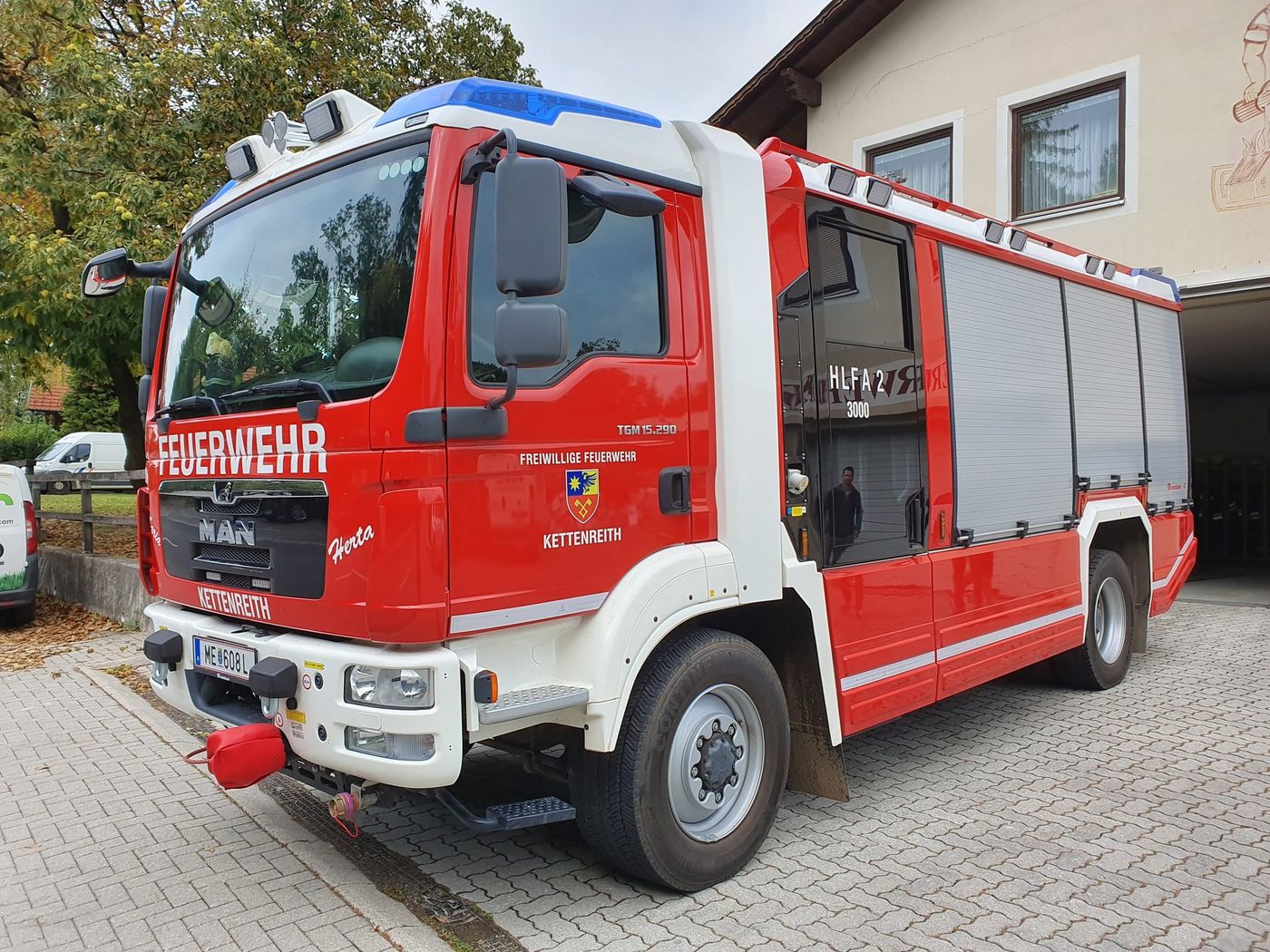
A fire engine — in the words of the standards, a firefighting and rescue service vehicle — is in most cases a truck chassis with a body that carries the crew, a pump, water and foam, equipment lockers or an aerial ladder or platform. Europe sets the requirements for the vehicle in the EN 1846 series and for aerial appliances in EN 14043, EN 14044 and EN 1777. The chassis itself is left to the truck makers: EN 1846-2 assumes a finished standard truck chassis and sets no requirements for it. This page sets out what the standards cover, how national rules in Germany and Türkiye build on them, and what chassis makers and body builders publish. It does not rank or recommend any of them.
EN 1846: classes, categories and common requirements
EN 1846-1:2011, Nomenclature and designation, sorts every vehicle above 3 t by its gross laden mass (GLM) into three classes — Light (L) above 3 t up to 7.5 t, Medium (M) above 7.5 t up to 16 t, and Super (S) above 16 t — and by its road and off-road ability into three categories: 1 urban, normally used on constructed roads and commonly with one driven axle; 2 rural, able to use all roads and limited off-road surfaces; and 3 all-terrain, able to go cross-country and commonly with all axles driven, differential locks and single tyres. The 2011 edition changed the class limits; the DIN type list notes that class M ended at 14 t until July 2011. CEN decided in 2024 to confirm the 2011 edition rather than revise it.
EN 1846-2:2024, Common requirements — Safety and performance, published in December 2024, supersedes the 2009+A1:2013 edition. It treats the finished standard automotive chassis as safe for its transport functions within the limits set by its maker and sets no requirements for it. It covers vehicles for use between –15 °C and +40 °C and leaves out vehicles of 3 t or less, ambulances, PTO-driven removable equipment not used for firefighting, and airport vehicles within the recommendations of the International Civil Aviation Organization. It defines the gross laden mass as the unladen mass plus 90 kg for each crew member with personal protective equipment, a further 15 kg for the driver’s protective equipment, and the extinguishing agents and equipment carried; the permitted maximum, the PTLM, is the gross laden mass the chassis maker declares. The general difference between actual and permitted weights is set out in truck weights: GVW and GCW. The 2024 edition adds requirements for a rollover protective structure (ROPS) for the cab and renames a clause “Energy storage and range”.
EN 1846-3, Permanently installed equipment — the water installation, liquid additive installation, monitor, equipment gantries and demountable systems using a hydraulic hook arm — is in force in its 2013 edition, for ambient temperatures of –15 °C to +35 °C. A revised edition was ratified by CEN on 24 August 2026 and was planned for publication on 13 October 2026; it extends the temperature range to +40 °C, covers wireless control systems and adds clauses on lifting systems using a crane and on extendable equipment.
Ladders and platforms
Turntable ladders follow EN 14043:2014 when their movements can be combined and EN 14044:2014 when they run one after the other. Both define classes 18, 24, 30 and above 30 up to 56, the class being the value equal to or immediately below the nominal rescue height, and apply in winds on the ladder of up to 12.5 m/s. CEN decided in January 2026 to revise EN 14043; we found no draft. EN 1777:2010 covers vehicle-mounted hydraulic platforms and is to be used together with EN 1846-2 and EN 1846-3.
Machinery law and type approval
EN 1846-2:2024 became a harmonised standard under the Machinery Directive with Implementing Decision (EU) 2025/1740 of 13 August 2025; the deletion of older references in that decision applies from 20 January 2027, the day the Machinery Regulation (EU) 2023/1230 starts to apply. CEN lists the revised EN 1846-3:2026 under that Regulation.
In EU type approval, Regulation (EU) 2018/858, as published in 2018, does not count fire engines among its special purpose vehicles; they appear among the two-digit supplements to the bodywork code of an N-category vehicle as “31 Fire engine”. The same list gives refuse collection vehicles the digits 18 and concrete mixers 15; see refuse collection vehicles and truck mixers and concrete pumps. Tippers have the digits 10; see tipper trucks.
National types: Germany and Türkiye
In Germany, the DIN 14530 series defines the vehicle types on top of EN 1846. Its type standards give the LF 10 and HLF 10 an engine-driven centrifugal pump of 1,000 l/min and the LF 20 and HLF 20 one of 2,000 l/min, each with a crew of one plus eight, the HLF carrying an extended minimum load of rescue equipment; the TLF 3000 carries at least 3,000 l of water in mass class M, and the TLF 4000 at least 4,000 l of water and 500 l of foam in mass class M or S. The DIN type list of fire vehicles (26th revision, April 2026) places the types in finer mass bands. In its pump column, FPN 10-2000 is the EN 1028 designation of a normal-pressure pump rated at 2,000 l/min at 10 bar.
| Type | Standard | Gross mass band | Minimum tank | Pump | Crew |
|---|---|---|---|---|---|
| LF 10 | DIN 14530-5 | 9.0 t to 14.0 t | 1,200 l | FPN 10-1000 | 1 + 8 |
| HLF 20 | DIN 14530-27 | 14.0 t to 16.0 t | 1,600 l | FPN 10-2000 | 1 + 8 |
| TLF 3000 | DIN 14530-22 | 9.0 t to 14.0 t | 3,000 l | FPN 10-2000 | 1 + 2 |
| TLF 4000 | DIN 14530-21 | 14.0 t to 16.0 t, or above 16.0 t | 4,000 l + 500 l foam | FPN 10-2000 | 1 + 2 |
| DLK 23 (DLAK 23/12) turntable ladder | DIN EN 14043 | 14.0 t to 16.0 t | — | — | 1 + 2 |
For the LF 20 and HLF 20 the list requires the maximum axle load of 10 t that DIN 14090 sets for fire-brigade areas on premises; for a TLF 4000 above 16 t it notes that the 10 t may be exceeded, which limits its use on such areas.
In Türkiye, the municipal fire regulation (Belediye İtfaiye Yönetmeliği) calls the fire vehicle a special-purpose vehicle (SC) under the road traffic rules, to be built within “TS, EN veya muadili uluslararası standartlar”, and sets minimum fleets by population — for 100,000 to 200,000 inhabitants, for example, six firefighting vehicles and two ladder vehicles among others. A 2017 technical specification of the state supplier DMO for fire tenders with portable ladders defines six classes from 7.5–8 t to 25–26 t with water tanks of 2,000 to 10,000 l, on 4x2 or 4x4 chassis up to class 5 and 6x2 or 6x4 for class 6. It requires the manufacturer to hold a certificate of conformity with TS EN 1846-1, 2 and 3, and the pump to be driven from a gearbox PTO that the chassis maker approves. Axle layouts such as 6x4 are explained in axle configurations.
Chassis the makers offer for fire service
In alphabetical order, as each maker presents it; for DAF and BMC we found no fire-service page:
- Ford Trucks. Ford’s Turkish page offers fire trucks and water tenders as 4x2, 6x2, 6x4 and 8x4, with water tanks of 2,000 to 18,000 l and ladders up to 30 m, though its model cards also list 32 m ladders; the cards run from the 18-tonne 1833 DC 4x2 to the 4145D 8x4, shown as an 18,000 l supply vehicle. Ford’s list of approved body builders includes Baksan, KARBA and Katmerciler, without saying who builds which body.
- Iveco. Iveco presents the Eurocargo 4x4, at 11 to 15 t, as a match for firefighting and civil protection trucks. Magirus, the fire-body maker, has belonged to Mutares rather than Iveco since 3 January 2025.
- MAN. MAN delivers fire engines, rescue vehicles and turntable ladders ex works, with crew cabs for up to seven people (1+6), switchable or permanent all-wheel drive or HydroDrive, and a clutch-independent mechanical PTO for pumps, winches, alternators and turntable ladders. Its electric eTGM 16.285, a 16-tonne 4x2, has 160 kWh usable, a range of up to 225 km and charging at up to 250 kW.
- Mercedes-Benz. Mercedes-Benz offers the Atego, up to 16.8 t, for bodies 3,300 mm high and with a fire-service gearbox programme; the Arocs from 18 to 48 t and from 4x2 to 8x8, with a 10-tonne front axle; the low-entry Econic at 18, 26 and 32 t, whose optional low cab leaves more room for ladder bodies; and the Unimog, which it says meets DIN 14530 and DIN 14555, with an engine PTO of 600 Nm and a crew cab for up to seven.
- Renault Trucks. Renault matches its D range to the EN 1846 categories — urban (1), rural (2) and forest (3) — with crew cabs for six or eight at 12 to 15 t and engine PTOs of 320 or 450 Nm, and offers the D Wide, C and K for heavier appliances, with approach angles of up to 37°.
- Scania. Scania names fire engines, water and foam carriers, turntable ladders and aerial platforms among its fire applications and recommends its CrewCab and P, L and R series. Its group page says the CrewCab carries up to eight passengers; its UK page gives seating for up to five passengers, and up to eight seats in the long cab.
- Volvo. Volvo offers the FL, FE, FM and FMX for fire service. Its FM and FMX crew cab for up to nine people was designed with body builders such as Rosenbauer, developed on the basis of EN 1846, impact-tested to ECE R29-03 and offered with a PTO of up to 2,000 Nm.
Crew cabs and other cab types are compared in truck cabs explained.
Bodies and body builders
Body builders publish pumps, tanks and ladder heights, and most of them build on several chassis makes:
- Rosenbauer (Austria) says its AT bodies “can be built on different chassis from various European chassis manufacturers”, with water tanks of 1,000 to 5,500 l and pumps of up to 4,500 l/min; its data sheets show an HLF 20 on a MAN TGM 4x4 and a TLFA 3000 on a Scania P420 4x4. Its aerial platforms reach 32 to 62 m.
- Magirus (Germany) gives its M32L turntable ladder a working height of 32 m and a rescue height of 30.5 m under DIN EN 14043, on 16-tonne class chassis such as the Iveco Eurocargo.
- Ziegler (Germany, CIMC group) shows an HLF 20 XL on a MAN TGM 13.320 4x4 at 16,000 kg with a 2,000 l tank and a 3,000 l/min pump. Schlingmann (Germany) builds its VARUS bodies for road and all-wheel-drive chassis, for crews of up to nine; EMPL (Austria) mounts its tanker bodies on a galvanised subframe; and Gimaex (France) offers its FPT pumper on Renault Trucks, MAN, Scania and Mercedes-Benz chassis.
- Turkish builders publish on their own sites ladder vehicles of 12 to 64 m and pumpers for chassis from 7,500 kg: Volkan (ladders up to 60 m, to TS EN 14043), KARBA (pumpers for chassis of at least 7,500, 15,000 and 18,000 kg, and Magirus distribution in Türkiye), Katmerciler and Baksan. None of them names a chassis make on the pages we read.
Electric fire engines
| Chassis | Battery | Main equipment | Operation as stated | |
|---|---|---|---|---|
| Rosenbauer RT | Rosenbauer’s own 4x4 chassis | 132 kWh (2 × 66 kWh), diesel backup | FPN 10-3000 pump, 2,000 l water, crew 1 + 8 | over 90 % of about 1,400 deployments in a 13-month Berlin trial purely electric |
| Rosenbauer L32A-XS turntable ladder | MAN eTGM, under 16 t | 178 kWh gross, 160 kWh usable | 32 m working height, class 23/12 | — |
| Gimaex FPT électrique | Renault Trucks | — | pumper | 4 h of autonomy |
| Scania BEV CrewCab | Scania CP31 4x2 | — | pumper body for Australia | — |
Volvo’s fire page gives the electric FL up to 180 kW and a range of up to 450 km, and the electric FE up to 225 kW and 275 km. Volvo’s 2025 overview of electric refuse trucks gives the FL Electric 130 kW of continuous power; the fire page does not say whether its 180 kW is a peak or a continuous figure. Gross and usable battery capacity are explained in installed vs usable battery capacity, and how makers arrive at range figures in how electric truck range is declared. How makers document electric trucks and buses for fire crews at an accident is covered in rescue sheets for electric trucks and buses.
Quick answers
- What is the European standard for fire engines?
- EN 1846, Firefighting and rescue service vehicles. Part 1 (2011) sets the mass classes and categories, Part 2 (2024) the common safety and performance requirements, and Part 3 (2013; a revised edition was planned for 13 October 2026) the permanently installed equipment such as the water installation. Turntable ladders fall under EN 14043 and EN 14044, hydraulic platforms under EN 1777.
- What do L, M and S mean on a fire engine?
- They are the mass classes of EN 1846-1, by gross laden mass: Light (L) above 3 t up to 7.5 t, Medium (M) above 7.5 t up to 16 t, and Super (S) above 16 t. The same standard defines three categories: 1 urban, 2 rural and 3 all-terrain.
- What is an HLF 20?
- A German fire engine type under DIN 14530-27: a rescue and firefighting vehicle with an engine-driven centrifugal pump of 2,000 l/min, a crew of one plus eight, and an extended minimum load of rescue equipment compared with the LF 20. The DIN type list places it between 14.0 t and 16.0 t gross mass, with a tank of 1,600 l.
- Are there electric fire engines?
- Yes. Rosenbauer's RT runs on Rosenbauer's own 4x4 chassis with a 132 kWh battery and a diesel backup; Rosenbauer and MAN have put an electric 32 m turntable ladder on the MAN eTGM; Gimaex offers a battery-electric pumper on Renault Trucks; and Scania has built a battery-electric CrewCab pumper for Australia.
- Is a fire engine a special purpose vehicle?
- Not in EU type approval: Regulation (EU) 2018/858, as published in 2018, gives the fire engine the bodywork supplement "31 Fire engine" and does not list it among its special purpose vehicles. Türkiye's municipal fire regulation, by contrast, calls the fire vehicle a special-purpose vehicle (SC) under the Turkish road traffic rules.
Models in this article
Sources
- EN 1846-1:2011 Firefighting and rescue service vehicles — Part 1: Nomenclature and designation — CEN record and public preview — iTeh Standards
- SS-EN 1846-1:2011 — catalogue entry — Swedish Institute for Standards (SIS)
- EN 1846-2:2024 Firefighting and rescue service vehicles — Part 2: Common requirements — Safety and performance — CEN record and public preview — iTeh Standards
- DIN EN 1846-2:2025-03 — catalogue entry — DIN Media
- EN 1846-3:2013 Firefighting and rescue service vehicles — Part 3: Permanently installed equipment — CEN record — iTeh Standards
- EN 1846-3:2026 Firefighting and rescue service vehicles — Part 3: Permanently installed equipment — CEN record — iTeh Standards
- EN 14043:2014 High rise aerial appliances for use with fire service — Turntable ladders with combined movements — CEN record — iTeh Standards
- EN 14044:2014 High rise aerial appliances for use with fire service — Turntable ladders with sequential movements — CEN record — iTeh Standards
- EN 1777:2010 Hydraulic platforms (HP) for fire fighting and rescue services — CEN record — iTeh Standards
- Commission Implementing Decision (EU) 2025/1740 amending Implementing Decision (EU) 2023/1586 as regards harmonised standards (OJ L, 14.8.2025) — Publications Office of the European Union
- Corrigendum to Regulation (EU) 2023/1230 on machinery (OJ L 169, 4.7.2023) — Publications Office of the European Union
- Regulation (EU) 2018/858 on the approval and market surveillance of motor vehicles and their trailers (OJ L 151, 14.6.2018) — Annex I — Publications Office of the European Union
- Feuerwehrfahrzeug-Typenliste der gängigsten genormten Fahrzeuge, 26th revision of 8 April 2026 — DIN, Standards Committee Firefighting and Fire Protection (FNFW)
- DIN 14530-27:2019-11 Hilfeleistungs-Löschgruppenfahrzeug HLF 20 — catalogue entry (with DIN 14530-5, -11, -21, -22 and -26) — DIN Media
- Belediye İtfaiye Yönetmeliği (Resmî Gazete 21.10.2006, No 26326) — consolidated text — Mevzuat Bilgi Sistemi, Republic of Türkiye
- Portatif merdivenli itfaiye arazözü teknik şartnamesi (A.26.02, 7 June 2017) — Devlet Malzeme Ofisi (DMO), Republic of Türkiye
- İtfaiye ve arazöz araçları — Ford Trucks Türkiye
- Tavsiyeli üstyapıcılar — onaylı iş ortakları — Ford Trucks Türkiye
- IVECO Eurocargo 4x4 — IVECO UK
- Mutares has completed the acquisition of Magirus GmbH from Iveco Group — Magirus
- Fire service and emergency services vehicles — MAN Truck & Bus
- MAN trucks for fire services (brochure D111.3694/EN) — MAN Truck & Bus
- MAN eTGM for fire-fighting (brochure) — MAN Truck & Bus
- Fire service goes electric (2 June 2026) — MAN Truck & Bus
- Fire fighting — Mercedes-Benz Trucks
- Econic — fire service — Mercedes-Benz Special Trucks
- Unimog — compliance with firefighting standards — Mercedes-Benz Special Trucks
- Fire and Rescue Solutions (brochure, 02/2023) — Renault Trucks
- Fire and rescue — Scania
- Scania CrewCab — Scania UK
- World's first Scania BEV CrewCab headed to Australia — Scania Australia
- Fire and rescue — Volvo Trucks
- New Volvo FM and FMX with crew cab for emergency vehicles (26 January 2021) — Volvo Trucks
- A complete range of electric trucks for garbage collection and waste management (1 October 2025) — Volvo Trucks
- AT — firefighting vehicles (product page, brochure and data sheets) — Rosenbauer
- RT — Revolutionary Technology (product page and brochure) — Rosenbauer
- Aerials — Rosenbauer
- World debut: Rosenbauer and MAN present the first all-electric aerial ladder under 16 tonnes (June 2026) — Rosenbauer
- Turntable ladder M32L — Magirus
- HLF 20 XL — Datenblatt — Albert Ziegler
- LF 20 / HLF 20 VARUS CASTRA — Schlingmann
- TLF — Kommunalfahrzeuge Deutschland — EMPL
- Fourgon pompe tonne — Gimaex
- Fourgon pompe tonne électrique — Gimaex
- Merdivenli araçlar — Volkan İtfaiye
- İtfaiye arazözleri — KARBA
- Magirus Türkiye — KARBA
- Hidrolik merdivenli itfaiye aracı — Katmerciler
- Merdivenli itfaiye araçları — Baksan