Scania
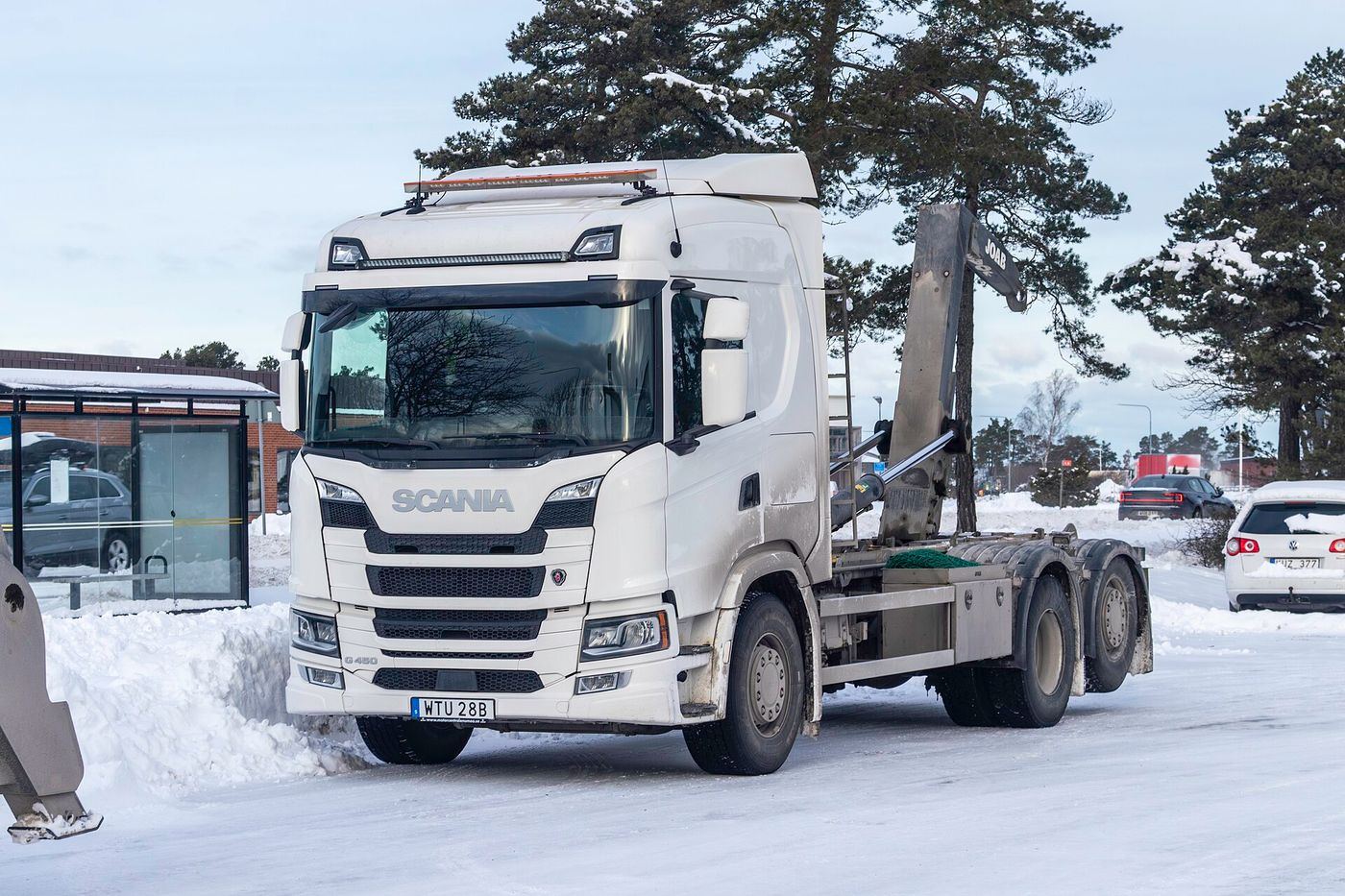
Scania G-series
Scania's medium-height G cab in short, day and sleeper versions, 9- and 13-litre diesel and gas engines, the Super 11 and Super 13, and the electric G.
- 7 configurations
- 272–412 kW
- Euro 6

Model overview
- Segment
- Long-haul tractor
- Axle configurations
- 7 (4x2…)
- Emission
- Euro 6
- Transmission
- Scania Opticruise G25 / G33 / G38, 14-gear spread, eight reverse gears through a planetary gear; range-change 8 and 8+1-speed; range-splitter 12 and 12+2-speed
- Battery capacity
- 356–624 kWh
- Charging
- 750 kW (MCS / CCS2)
- Electric motor
- 210/240/270/300/330/360/400 kW
Axle configurations: 4x2 · 4x4 · 6x2 · 6x2/2 · 6x2/4 · 6x4 · 6x6
Engine families
- Power
- 309–412 kW
- Torque
- 2300–2800 Nm
- Rated speed
- 1800 rpm
- Power
- 272–397 kW
- Torque
- 1900–2700 Nm
- Rated speed
- 1800 rpm
| Cab | Engine tunnel (mm) | Standing height (mm) |
|---|---|---|
| G-Short Low Roof | 325 | 1,500 |
| G-day low | 325 | 1,500 |
| G-sleeper normal | 325 | 1,800 |
The G-series is Scania’s medium-height cab. Scania’s UK G-series page says the medium-height cab mounting point makes numerous cab variants possible, from a short cab or a day cab to a sleeper, and presents the G as a cab for regional or national transport operations. Scania’s range as the same page lists it also includes the L-, P-, R- and S-series cabs; the P-series, R-series and S-series have pages of their own.
This page is built from Scania UK’s G-series specifications page and G-series page, both dated 5 August 2026 by listing cards on Scania’s UK site and read on 26 October 2026; for kilowatts, displacements and rated speeds, from Scania’s Super 13-litre brochure (Edition 2021.10) and its press information of 16 August 2019; for the Super 11-litre, from Scania UK’s release of 20 May 2025 and Scania’s group Super 11 page; for the electric G, from Scania UK’s battery-electric truck page and its release of 18 October 2023; for gas, from Scania UK’s gas-truck page; and for the model’s history, from Scania group news of 27 December 2016 and 21 May 2018.
The PGR generation and the 2016 launch
Scania’s group news of 21 May 2018 says Scania PGR series trucks had been produced since 2004, reports the last PGR truck made in Europe leaving Scania’s production line in Zwolle, and says PGR production would continue at Scania’s plant in South America until spring 2019. The same item says the launch of the next generation of Scania trucks in 2016 marked the beginning of the end for the PGR era. Scania’s news of 27 December 2016 dates that launch to August 2016, after an investment of close to a record 2 billion euros, says it included the R- and S-series, and reports that from September Scania hosted more than 20,000 people in Södertälje to see the new generation. Neither item names the G-series, and no document opened gives the year the current G cab was introduced or a production start.
Cab
Scania’s UK G-series page lists three G cabs. All three have a 325 mm engine tunnel, and the page gives cab heights without air deflectors.
| Cab | Cab height | Standing height | Bed or resting equipment | Scania’s description |
|---|---|---|---|---|
| G-Short Low Roof | 3,010 mm | 1.5 m | not available on short cabs | shorter cab with low roof for operations requiring maximum load length and/or weight capacity |
| G-day low | low 3,010 mm, normal 3,350 mm | 1.5 m | foam rubber resting mattress, 7 cm thick, 2 m long, folds up against the rear wall | day cab with a normal or low roof, for overhead loads, with the ability to sleep overnight in the vehicle |
| G-sleeper normal | low 3,010 mm, normal 3,350 mm, highline 3,610 mm | 1.8 m | lower bed 80 cm to 1 m wide, 2 m long; upper bed 60 cm wide, 2 m long (normal and high roof) | sleeper cab with a large bed, for longer national trips |
The day cab’s resting mattress has a 54 cm wide centre section and is scalloped to 34 cm behind the driver’s seat; Scania describes it as intended for short rest periods. The sleeper’s lower bed is an extendable bed 80 cm to 1 m wide or a fixed bed 80 cm wide, 2 m long, with an additional 20 cm extender available and foam (medium or hard density), Bonnell or pocket spring mattresses; the upper bed has a 12 cm thick Bonnell spring mattress and a safety net. On the short cab an additional seat can be specified on top of the engine tunnel, and on the day cab an extra seat there carries a driver and two crew members. Under “Cab Floor” the page prints “140mm”, “170mm” and “200mm” (front wall to rear wall) for the short, day and sleeper cab. It gives no cab width or length.
Every cab card lists engine power by family: the 9-litre at 280, 320, 340 (gas) and 360 hp, the 11-litre at 350, 390 and 430 hp, and the 13-litre at 420, 460, 500 and 560 hp.
Inside, the page describes an optimised driver’s position and instrument panel with a larger display, a dashboard lowered slightly for forward visibility, slim A-pillars and a larger surface area of glass, a work station with more adjustment possibilities, on-board entertainment, and cab suspension systems that Scania says reduce vibration. For storage, the short cab can have a storage bar on the rear wall for helmets, gloves and jackets, the day cab with a normal roof has front roof storage and a rear-wall storage module, and the G-series has exterior storage lockers for dirty or wet items. On aerodynamics, Scania says the front, roof, sides and underbody were analysed, designed and optimised for the lowest possible drag, with tight panel gaps. How day, sleeper and high-roof cabs differ in general is set out in truck cabs explained.
Engines
Scania UK’s G-series specifications page says the G cab can be fitted with a 9- or 13-litre engine and gives a power range of 280 to 540 hp; its Euro 6 tab also lists the Super 13-litre up to 560 hp and a Super 11-litre table, as the cab cards do. The table below follows that tab step by step, with its engine PTO column; the kilowatt figures come from the dated Scania documents named in each row.
| Engine (UK page) | Output / torque, as listed | kW and source | Engine PTO |
|---|---|---|---|
| Super 13-litre | 420 hp / 2,300 Nm · 460 / 2,500 · 500 / 2,650 · 560 / 2,800 | 309, 338, 368, 412 kW (Super 13 brochure 2021.10) | up to 1,000 Nm |
| Super 11-litre | 350 hp / 1,800 Nm · 390 / 2,000 · 430 / 2,200 | not published | up to 1,000 Nm |
| 13-litre, DC13 163–166 and a 370 hp step | 370 hp / 1,900 Nm · 410 / 2,150 · 450 / 2,350 · 500 / 2,550 · 540 / 2,700 | 272, 302, 331, 368, 397 kW (press information 2019) | 600 Nm |
| 13-litre gas, OC13 101 | 410 hp / 2,000 Nm | not published | 600 Nm |
| 9-litre, DC09 139–141 | 280 hp / 1,400 Nm · 320 / 1,600 · 360 / 1,700 | not published | 600 Nm |
| 9-litre gas, OC09 104 and a 340 hp step | 280 hp / 1,350 Nm · 340 / 1,600 | not published | 600 Nm |
The Super 13-litre steps are DC13 176, 175, 174 and 173 in Scania’s 2021 brochure: 12.74 litres, six cylinders in line, 1,800 rpm on every step, Twin SCR, and full torque from 900 rpm. The UK page’s fuel column reads Diesel/HVO at 420 and 560 hp and Diesel/HVO/FAME at 460 and 500 hp; the brochure gives HVO for the whole range and biodiesel for the 460 and 500 hp engines. Scania credits the engine with brake thermal efficiency of 50% and powertrain fuel savings of 8%, and describes a cylinder head with dual overhead camshafts, an engine-integrated compression release brake weighing 7 kg with a retardation effect up to 350 kW, which can be combined with the Scania R4700D retarder, and an engine-driven power take-off with power up to 238 kW.
The Super 11-litre appears on the UK page’s Euro 6, Euro 5 and Euro 4 tabs at 350, 390 and 430 hp and 1,800 to 2,200 Nm, with Twin SCR. The page describes it as a five-cylinder design sharing 85% of its architecture with the 13-litre, with up to 7% lower fuel consumption than the previous Scania 9-litre. Scania UK’s release of 20 May 2025 gives it as up to 85 kg lighter than the Super 13, with up to 85% of its components shared with the Super 13 and maintenance intervals up to 30% longer than the 9-litre’s, and lists cam phaser technology for variable valve timing, balance shafts and Scania’s turbo dosing system for AdBlue, and says the engine will be available for purchase from June 2025. Scania’s Super 11 page lists a Variable Valve Brake and a compression release brake with two settings, 230 kW (standard) and 344 kW (high), and says FAME compatibility applies under Euro 6 to the 390 and 430 hp versions only. None of these documents gives a kilowatt rating, a displacement or a rated speed.
The 13-litre diesel steps are DC13 163 to 166 for 410 to 540 hp and a 370 hp row that the UK page labels OC13 101, the designation of its gas row; Scania’s press information of 16 August 2019 gives the 370 hp engine as DC13 162. The press information describes all five as 12.7-litre inline sixes with a bore and stroke of 130 x 160 mm, four valves per cylinder, Scania XPI injection and SCR only, rated at 1,800 r/min. The compression ratio is 23.0:1 on DC13 162 to 164 and 21.0:1 on DC13 165 and 166, which have a fixed-geometry turbo with ball bearings instead of journal bearings. Maximum torque is available from 900 to 1,340 r/min on DC13 162 to 164, from 925 to 1,340 r/min on the 500 hp engine and from 1,000 to 1,300 r/min on the 540 hp engine. The exhaust brake is rated at 242 kW at 2,400 r/min and the oil capacity is 40 litres.
The gas engines in the UK page’s Euro 6 table are one 13-litre, OC13 101 at 410 hp and 2,000 Nm with the fuel “Gas”, and two 9-litre steps for “Gas (CNG/LNG)”: OC09 104 at 280 hp and 1,350 Nm, and a 340 hp step at 1,600 Nm that the table labels with the 360 hp diesel’s designation, DC09 141. All three use exhaust gas recirculation. Scania UK’s gas-truck page says the previous 410 hp 13-litre gas engine has been replaced by 420 and 460 hp versions, lists its gas trucks with L, P, G, R and S cabs, and describes Scania’s gas engines as 9- and 13-litre Otto-cycle engines burning methane, available for compressed or liquefied gas, in a power band from 280 to 460 hp. No document opened gives kilowatts for the gas engines.
The 9-litre diesel steps are DC09 139 at 280 hp and 1,400 Nm, DC09 140 at 320 hp and 1,600 Nm and DC09 141 at 360 hp and 1,700 Nm, all with SCR; the UK page says the 9-litre brings a significant weight reduction against the 13-litre. No document opened gives its kilowatts, displacement or cylinder count.
Battery-electric G
The UK G-series specifications page covers the electric G in two places. A text block headed “2-4 speed Electric machine” describes a two-speed electric machine with a continuous output from 210 kW (290 hp) to 330 kW (440 hp), and the option of an e-PTO whose design the bodybuilder can tailor to the bodywork, with the bodybuilder able to suggest the inverter. The page’s Electric tab lists seven steps up to 400 kW and four speeds:
| Continuous power | Regeneration power (peak) | Gearbox speeds | Installed battery | Charging power, max | PTO types |
|---|---|---|---|---|---|
| 210 kW | 294 kW | 2 | 356 / 445 / 535 / 624 kWh | 375 / 750 kW | EL, EM, EC |
| 240 kW | 294 kW | 2 | 356 / 445 / 535 / 624 kWh | 375 / 750 kW | EL, EM, EC |
| 270 kW | 410 kW | 4 | 356 / 445 / 535 / 624 kWh | 375 / 750 kW | EL, EM, EC |
| 300 kW | 410 kW | 4 | 356 / 445 / 535 / 624 kWh | 375 / 750 kW | EL, EM, EC |
| 330 kW | 410 kW | 4 | 356 / 445 / 535 / 624 kWh | 375 / 750 kW | EL, EM, EC |
| 360 kW | 480 kW | 4 | 356 / 445 / 535 / 624 kWh | 375 / 750 kW | EL, EM, EC |
| 400 kW | 480 kW | 4 | 356 / 445 / 535 / 624 kWh | 375 / 750 kW | EL, EM, EC |
Beneath the table the page explains EL as an electric PTO at 650 V DC, EM as electromechanical at 60 kW and EC as mechanical in various options. The battery column is installed capacity, which is not the figure Scania’s battery-electric truck page gives; the difference is explained in installed vs usable battery capacity.
Scania UK’s battery-electric truck page describes one battery-electric platform for the L, P, G, R and S cabs and the CrewCab, with three electric machines: the EM C1-2, two-speed, at 210 or 240 kW continuous; the EM C1-4, four-speed, at 270, 300, 330, 360, 400 or 440 kW; and the EM C3-6, six-speed, at 400 or 450 kW. It gives usable battery capacities of 240, 320, 400, 480 or 560 kWh, says a new under-cab battery module for the 400 and 560 kWh capacities is now available, and describes an MP12 under-cab battery with a 400 kWh usable option for 350 km of typical range. With 560 kWh usable, it gives ranges of up to 560 km at 29 t, 515 km at 42 t and 360 km at 64 t gross train weight. It lists CCS2 charging at 375 kW, a full charge taking 90 minutes with 560 kWh usable, and the Megawatt Charging System at 750 kW, 20 to 80% in 30 minutes — the standard is described in megawatt charging explained — a technical gross train weight of up to 74 t, axle distances from 3,250 to 6,350 mm, wheel configurations A/B 4x2, A/B 6x2, B 6x2*4, A/B 6x4 and B 8x4*4, and a charging interface on the left-hand side behind the driver door. The G page and the platform page differ: the G page lists no 440 kW step and no six-speed machine, and it gives 210 kW as 290 hp where the platform page gives 280 hp.
Scania UK’s release of 18 October 2023 announced an update of Scania’s urban battery-electric range, which it says was originally launched in 2021: an e-adapted chassis, new auxiliary systems, battery packs with Northvolt cells assembled by Scania in Södertälje, and the EM C1-4, a single permanent-magnet motor paired with a four-speed gearbox, at 270, 300, 330, 360 and 400 kW.
Transmission
The UK G page lists Scania’s Opticruise gearboxes in three performance steps, G25, G33 and G38, with a fully automated clutch, a 14-gear spread with super crawler and overdrive, variable oil volume and an oil spray function. Instead of a reverse gear a planetary gear is used for reversing, giving eight reverse gears at speeds up to 30 km/h. Scania credits the platform with fuel savings of one percent, a cast-aluminium housing that cuts component weight by up to 75 kg and lowers sound levels, an extended oil change interval, and a PTO programme with nine performance steps. The page says the G33 is available for all V8 engines up to 660 hp and for the 500 and 540 hp 13-litre engines; its engine tables for the G list no V8. A lay shaft brake is described as cutting gear-change time on up-shifts and reducing PTO and reverse or crawler engagement time.
Beside Opticruise, the page lists range-change gearboxes with 8 speeds, without crawler ratios, and 8+1 speeds, based on a 4-speed box plus a planetary section, with an extra crawler ratio, and range-splitter gearboxes with 12 and 12+2 speeds, the latter with two extra crawler ratios. Scania lists Opticruise, the Scania Retarder and power take-offs as options on the 8-speed and on all range-splitter boxes, and the Retarder and power take-offs on the 8+1-speed. The electric G has two- or four-speed gearboxes, as the Electric tab above shows.
Axles, suspension and brakes
The UK G page lists seven tractor wheel formulas, with chassis heights: 4x2 (extra low, low, normal or high), 4x4 (high), 6x2 (normal), 6x2/2 (normal, captioned 6x2 pusher), 6x2/4 (normal or low, captioned 6x2 twin-steer), 6x4 (normal or high) and 6x6 (high). Its rigid list has fourteen formulas, from 4x2 to 10x4*6, captioned 10x4 rear-steer, among them 6x2*4, 8x2*6, 8x4 and 8x4*4.
The rear axle gears are given as gross vehicle and train weights, not as a weight for the model: up to 78 tonnes for single driven single reduction (ratios 1.95 to 5.57), 80 tonnes for single driven hub reduction (3.80 to 7.18), 80 tonnes for the RB662 + R660 tandem driven single reduction (2.92 to 4.88) and 210 tonnes for tandem driven hub reduction (3.52 to 7.63); all are offered with differential locks. The page names front, rear, fixed and steered tag axles. Scania’s UK G-series page says frame strength, chassis height and suspension systems can be configured; neither page describes the chassis suspension.
On braking, the page says Scania’s gearboxes can be fitted with the Scania Retarder, which on the G33 delivers 4,700 Nm at a propeller shaft speed below 600 rpm. The 13-litre’s exhaust brake is rated at 242 kW at 2,400 r/min in the 2019 press information; the Super 13’s optional compression release brake gives up to 350 kW, and the Super 11’s has settings of 230 and 344 kW. How the two kinds of auxiliary brake work is set out in retarders and engine braking.
Dimensions and weights
Scania publishes no gross vehicle or gross combination weight for the G-series as a model; the rear axle gear capacities above are ratings for the axles. For the battery-electric platform, Scania UK’s page gives a technical gross train weight of up to 74 t and axle distances of 3,250 to 6,350 mm. Apart from the cab heights, engine tunnel and standing heights in the cab table and the “Cab Floor” figures quoted above, the G-series pages give no vehicle dimension.
Fuels, gas and AdBlue
The Super 11 and Super 13 use Scania’s Twin-SCR system, which the UK page describes as dual AdBlue dosing; the 13-litre DC13 engines use SCR only. No document opened gives a diesel, AdBlue or gas tank capacity for the G. Scania UK’s gas-truck page says tank options are available for both compressed and liquefied gas, that a typical semi-trailer tractor can achieve a driving range of about 1,800 km, that the updated 13-litre gas engines, combined with Super powertrain components, give a 5% reduction in fuel consumption against the previous gas engine generation, and that the gas engines can be specified to meet noise rules such as the PIEK Quiet Truck standard. How liquefied gas is carried and used on trucks is set out in LNG and bio-LNG trucks. The UK G page says the entire Scania Euro 6 engine range is approved to run on up to 100% HVO, and Scania’s 2019 press information says the same of all its Euro 5 and Euro 6 diesel engines; the fuel itself is described in what is HVO fuel.
Safety and visibility
The UK G-series page lists driver seat positioning, side windows, slim A-pillars and a larger surface area of glass among the features that give the cab its visibility, and a dashboard lowered slightly for forward visibility. Position lights and extra lights are integrated into the cab, and extra headlamp protection is available for tough conditions. Scania UK’s battery-electric page says the Scania Smart Dash in-cab system enhances vehicle safety using advanced driver assistance systems and receives over-the-air software updates. No document opened lists the G’s driver-assistance systems.
Equipment, bodywork and power take-off
For bodywork, the UK page’s engine PTO column gives up to 1,000 Nm on the Super 13 and Super 11 and 600 Nm on the 13- and 9-litre engines; the Super 13 brochure adds an engine-driven PTO with up to 238 kW; the Opticruise PTO programme has nine performance steps; and the electric G takes electric (650 V DC), electromechanical (60 kW) or mechanical PTO. In the cab, the short and day cabs can take an extra seat on the engine tunnel, and the G-series has exterior storage lockers.
Euro 6 in the table, Euro 5, 4 and 3 on the page
The engine rows follow the UK page’s Euro 6 tab; the page names no Euro 6 sub-step. Its Euro 5 tab lists 13-litre engines at 380, 410, 440, 450, 500 and 540 hp, the Super 11 at the same three steps as Euro 6, and the 9-litre at 280, 320 and 360 hp; the Euro 4 tab is the same without the 540 hp 13-litre. The Euro 3 tab, marked without SCR, lists 13-litre engines at 360, 410 and 460 hp and 9-litre engines at 250 and 310 hp. Scania’s Super 11 page gives the engine as meeting Euro 4, 5 and 6. The UK page does not say where those tabs apply.
Source notes
Scania publishes no weight for the G-series as a model. Its UK G-series specifications page gives rear axle gear capacities as gross vehicle and train weights: up to 78 t single driven single reduction, 80 t single driven hub reduction, 80 t tandem driven single reduction and 210 t tandem driven hub reduction; its battery-electric page gives a technical GTW of up to 74 t for the electric platform. The engine rows follow the Euro 6 tab of the UK page, with kilowatts, displacements and rated speeds from Scania’s press information of August 2019 and Super 13 brochure of 2021; no document opened gives kilowatts for the 9-litre, the Super 11-litre or the gas engines, which the page body describes. The battery figures follow the UK G-series page, which gives installed capacity; Scania’s battery-electric page gives usable capacity instead. The cab rows give the engine tunnel and standing heights the UK G-series page prints.
Quick answers
- Which engines are available in the Scania G-series?
- The record for the Scania G-series covers these engine families: Scania Super 13-litre (12.74 l), Scania 13-litre (12.7 l). Output spans 272–412 kW and 1900–2800 Nm.
- What axle configurations does the Scania G-series come in?
- 4x2, 4x4, 6x2, 6x2/2, 6x2/4, 6x4, 6x6.
- What emission standard does the Scania G-series meet?
- Euro 6.
- Which transmission does the Scania G-series use?
- Transmission: Scania Opticruise G25 / G33 / G38, 14-gear spread, eight reverse gears through a planetary gear; range-change 8 and 8+1-speed; range-splitter 12 and 12+2-speed.
- What battery capacity does the Scania G-series have?
- Battery capacity: 356–624 kWh; Charging: 750 kW (MCS / CCS2).
Scania models on this site, side by side
| Segment | Produced | Axle configurations | Power | Torque | |
|---|---|---|---|---|---|
| Scania G-series | Long-haul tractor | 7 configurations | 272–412 kW | 1900–2800 Nm | |
| Scania P-series | Distribution | 14 configurations | 162–368 kW | 1000–2650 Nm | |
| Scania R-series | Long-haul tractor | 2016— | 7 configurations | 206–566 kW | 1350–3700 Nm |
| Scania S-series | Long-haul tractor | 2016— | 7 configurations | 272–566 kW | 1900–3700 Nm |
| Scania XT | Construction | 2017— | 14 configurations | 162–566 kW | 1000–3700 Nm |
Articles that mention the Scania G-series
More Scania on this site
Sources
- G-series specifications — engines by emission level, electric powertrains, gearboxes, rear axle gears, axle configurations — Scania
- G-series trucks — cab options, engine tunnel, heights and beds — Scania
- Scania Super 13-litre engine (brochure, Edition 2021.10) — Scania
- Scania adds a 540 hp version to its 13-litre engine range (press info, 16 August 2019) — Scania, 16 Aug 2019
- A Super addition! New 11-litre engine joins Scania's line-up (press release, 20 May 2025) — Scania, 20 May 2025
- Super 11-litre engine — Scania
- Battery electric trucks — technical specifications (Scania UK) — Scania
- New Energy: Scania's rejuvenated battery electric range is raring to go (press release, 18 October 2023) — Scania, 18 Oct 2023
- Gas trucks (Scania UK) — Scania
- The launch of a new truck generation (news, 27 December 2016) — Scania, 27 Dec 2016
- The last Scania PGR truck produced in Europe (news, 21 May 2018) — Scania, 21 May 2018