Euro VI (Euro 6) and Euro 7 for trucks: steps and dates
Euro 6e on a spec sheet means Euro VI step E. Why trucks use Roman numerals, what steps A to E changed and what Euro 7 tightens: NOx, durability, brakes.
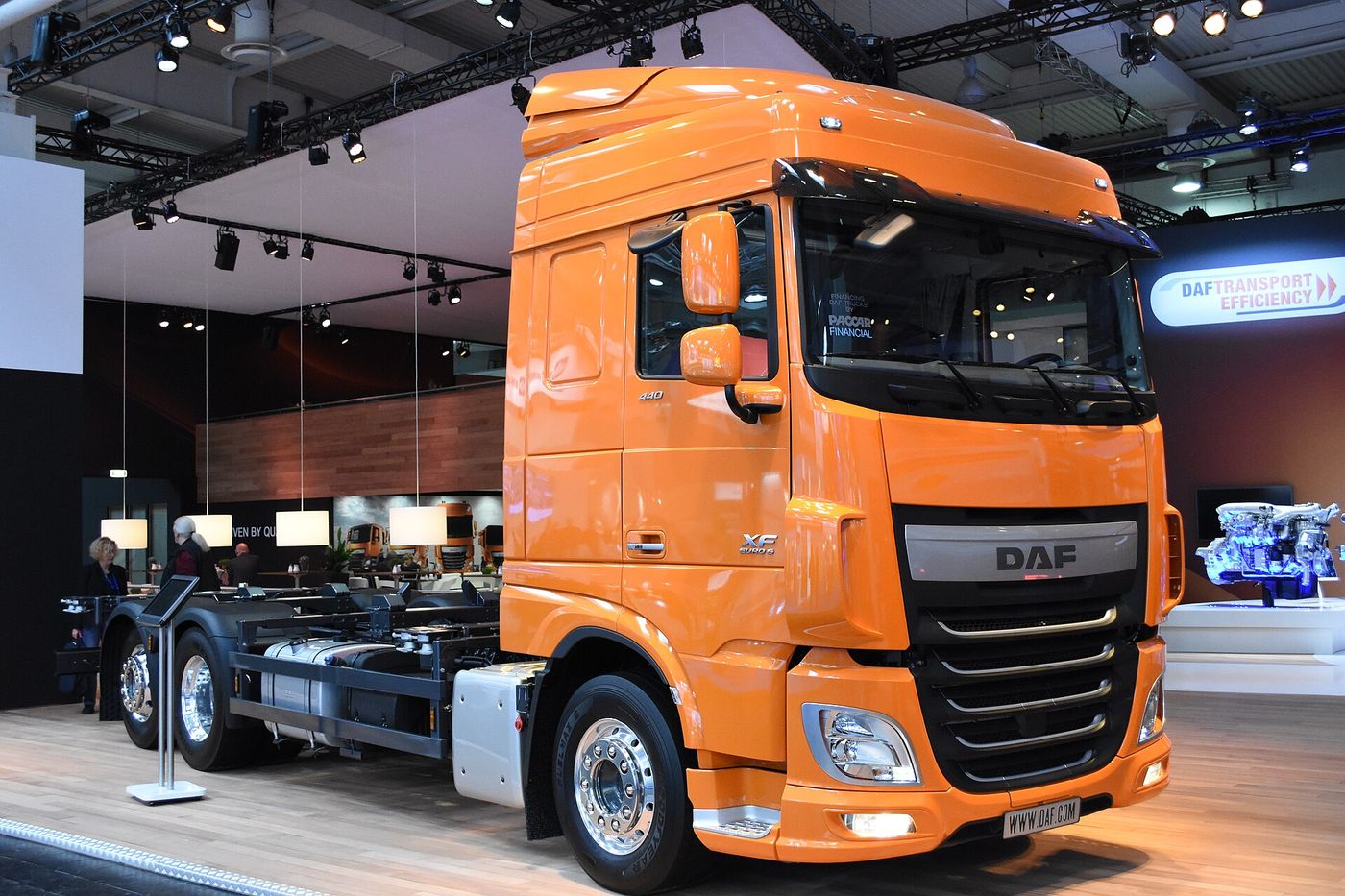
Euro VI and Euro 7 are the EU emission standards for new trucks and buses; the Euro 6e that some makers print on a truck means Euro VI step E, required of all new registrations since January 2022. Euro 7 applies from 29 May 2028 to new types of truck and bus and from 29 May 2029 to all new ones, so a truck type-approved before May 2028 can still be registered as Euro VI up to 28 May 2029. It halves the laboratory NOx limit to 200 mg/kWh and lengthens how long a heavy truck must stay within its limits: 700,000 km or twelve years, against 700,000 km or seven years under Euro VI.
The key dates for trucks and buses:
| Date | What applies |
|---|---|
| January 2021 and January 2022 | Euro VI step E, which some makers print as Euro 6e: first for new types, then for all new registrations |
| 1 July 2027 | Step E+ for new trucks within the scope of the EU rules on on-board fuel and energy consumption monitoring devices |
| 29 May 2028 | Euro 7 for new types of truck and bus |
| 28 May 2029 | Last date of registration for Euro VI steps E and E+ |
| 29 May 2029 | Euro 7 for all new trucks and buses |
| 31 December 2029 | Last date for registering certain buses and coaches as Euro VI |
The emission class on a truck’s specification sheet is not a trim level. It is a legal category that decides whether the vehicle can be registered at all, how long the manufacturer stays responsible for the emission system, and increasingly what the truck costs to move down a road. Euro VI has governed European heavy vehicles since the start of the 2010s. Euro 7 replaces it at the end of this decade, on dates close enough now to belong in fleet replacement planning.
Euro VI or Euro 6: what does Euro 6e mean on a truck?
The two systems are genuinely different regimes that happen to share a name. Heavy-duty standards use Roman numerals — Euro I through Euro VI — and are applied to the engine, tested on a dynamometer, with limits expressed in grams per kilowatt-hour. Light-duty standards use Arabic numerals and are applied to the whole vehicle, in grams per kilometre.
This matters when reading a spec sheet, because manufacturers do not always keep the convention. MAN publishes Euro 6e for the TGX and Mercedes-Benz publishes the same for the Actros L; on a heavy vehicle that means Euro VI step E. Others publish no sub-step at all: DAF states only Euro 6 for the XG+, and Scania does the same. Where a maker declines to name the step, the honest reading is that the step is not published, not that it is early.
What Euro VI actually requires
Euro VI comes from Regulation (EC) No 595/2009, with the test procedures set out in Regulation (EU) No 582/2011. Approval is against two world-harmonised engine cycles, the steady-state WHSC and the transient WHTC.
For a compression-ignition engine the ceilings are 0.40 g/kWh of NOx on the WHSC and 0.46 g/kWh on the WHTC, 0.01 g/kWh of particulate mass, and a particle number limit of 8.0×10¹¹ per kWh on the WHSC and 6.0×10¹¹ on the WHTC. Carbon monoxide is capped at 1.5 and 4.0 g/kWh respectively. Reaching those numbers is why every Euro VI diesel truck carries selective catalytic reduction, a particulate filter and exhaust gas recirculation, and why urea consumption is a real line in the operating budget rather than a rounding error. What the law actually demands of that reagent system, and what it does to the vehicle when the reagent runs out or fails a quality check, is set out in SCR and AdBlue.
Euro VI also introduced on-road testing with portable measurement equipment — the point at which the standard stopped being a purely laboratory exercise.
Steps A to E: the limits stayed, the testing hardened
The letters after Euro VI cause more confusion than anything else in the system. They are not tighter tailpipe limits. The ceilings above are the same from step A to step E; what changed is how hard it is to stay under them.
Step D, from September 2018 for new types and September 2019 for all new registrations, cut the power threshold for on-road measurement from 20% to 10%, which pulls low-load running into the assessed window. Step E, from January 2021 for new types and January 2022 across the board, added cold-start emissions to the on-road evaluation with a 30°C threshold and brought particle number into the portable measurement.
Regulation (EU) 2019/1939, which gave step E its implementation dates, records why the cold start was brought in. Emissions in the period after a cold engine start were not then assessed in the type-approval demonstration test or the in-service conformity test, both run with portable measurement equipment, and when data from those tests were analysed, significant amounts of the total NOx emitted were found to have been excluded from the analysis as a result; to represent real world emissions better, the regulation says, the measurement procedure should be revised to include that period. It also says the new in-service conformity requirements should not apply retroactively to engines and vehicles type-approved before they were introduced.
Regulation (EU) 2026/361 has since added a character, E+, to the table in Regulation (EU) No 582/2011 that lists the steps (Table 1 of Appendix 9 to Annex I), so that vehicles fitted with on-board fuel and energy consumption monitoring devices can be identified. The table gives E+ no date for new types; its date for all vehicles is 1 July 2027, for vehicles falling within the scope of Implementing Regulation (EU) 2025/2161, the Commission’s rules for those devices on certain heavy-duty vehicles, and it marks E+, like E, for cold start and particle number. E and E+ share 28 May 2029 as their last date of registration, for E subject, like its other two dates, to the transitional measures in Article 17a of Regulation (EU) No 582/2011.
When does Euro 7 apply to trucks and buses?
Regulation (EU) 2024/1257 replaces the Euro VI framework, and for heavy vehicles it applies from 29 May 2028 for new types of M2, M3, N2 and N3 vehicles, and from 29 May 2029 for all new vehicles in those categories. Small-volume manufacturers get until 1 July 2031. Cars and vans move earlier, from 29 November 2026 for new types.
Four practical readings follow. A truck type-approved before May 2028 can still be built and registered as Euro VI up to 28 May 2029, the last date of registration Regulation (EU) No 582/2011 gives steps E and E+; from 29 May 2029 its Article 17a has national authorities prohibit the registration of new vehicles on grounds relating to emissions, with 1 July 2031 instead for M2, M3, N2 and N3 vehicles built by small-volume manufacturers. Before that, from 1 July 2027, a new truck within the scope of Implementing Regulation (EU) 2025/2161 can be registered only if it complies with Regulation (EU) No 582/2011 as amended by Regulation (EU) 2026/361, the amendment that added E+. And trailers are inside the regulation for the first time — categories O3 and O4 appear alongside the tractors, on the same dates. A fourth reading applies only to buses and coaches: Article 10(8) of Regulation (EU) 2024/1257 has national authorities allow the registration of M2 and M3 vehicles as Euro VI up to 31 December 2029 where the Article describes them, under Regulation (EU) 2019/1242, as carrying ‘a 100 % zero-emission target as from the reporting period of the year 2030.’
What actually changes in the numbers
For buses and lorries, Euro 7 sets 200 mg of NOx per kWh in the laboratory cycles and 260 mg/kWh in real-driving conditions, against the 400 mg/kWh Euro VI allows on the WHSC. Particulate mass falls to 8 mg/kWh, and particle number is capped at 6.0×10¹¹ per kWh in the lab and 9.0×10¹¹ on the road.
Three structural changes matter more than the halving of NOx. Real-driving emissions now carry their own explicit limits rather than a conformity factor bolted onto a laboratory number. Particle counting moves to PN10, which captures smaller particles than the PN23 measurement used under Euro VI. And nitrous oxide, which Euro VI did not regulate, gets a mass limit of 200 mg/kWh, alongside a 60 mg/kWh ceiling for ammonia; both are slightly higher on the road.
Durability: the change with the longest tail
Under Euro VI the useful-life period for an engine in an N3 vehicle above 16 tonnes is 700,000 km or seven years, whichever comes first. Euro 7 keeps the distance and extends the time: a main lifetime of 700,000 km or twelve years, followed by an additional lifetime running to 875,000 km or fifteen years, during which the gaseous limits are relaxed by a durability multiplier of 1.2.
A Euro 7 tractor at 600,000 km is still inside its main lifetime, not past it.
The truck reports on itself
Euro 7 requires on-board monitoring on M2, M3, N2 and N3 vehicles that registers actual NOx, ammonia and particulate emissions in service and detects exceedances of at least 2.5 times the applicable limit. The system communicates through the OBD port for roadworthiness testing under Directive 2014/45/EU and roadside inspections under Directive 2014/47/EU, and anonymously over the air for type monitoring. It triggers a driver warning when emissions are significantly exceeded, deliberately without stopping the vehicle mid-journey. The monitoring devices cannot be deactivated while the vehicle is in use.
Each vehicle also comes with an environmental vehicle passport, a digital record handed to the purchaser with the truck. Between the two, a roadside inspection stops being a visual judgement and becomes a data read.
Brakes and tyres: what the regulation text says about non-exhaust emissions
Regulation (EU) 2024/1257 defines ‘non-exhaust emissions’ in Article 3(32) as ‘evaporative, tyre abrasion and brake emissions’. Under Article 3(30), ‘brake particle emissions’ are ‘the particles emitted from the brake system of a vehicle’, and under Article 3(31), ‘tyre abrasion’ is ‘the mass of material lost from the tyre due to the abrasion process and emitted into the environment’. Parliament’s press release of 18 December 2023 on the provisional agreement called it a novelty that the Euro 7 proposal ‘tackles non-exhaust emissions’, naming microplastics from tyres and particles from brakes.
In Annex I, the brake particle tables are Tables 4 to 8, and values appear in them only in columns for vehicles of categories M1 and N1: Table 4 sets limits for PM10 in a standard driving cycle ‘applying until 31 December 2029’, and Table 8, headed ‘applying from 1 January 2035’, has a value only in its column for M1 and N1. The tables for heavy vehicles hold no values. Table 6, for M2 and N2, is headed ‘applying from 1 January 2030 following the review’, and Table 7, for M3 and N3, ‘applying from 1 January 2030 until 31 December 2034 following the review’, the review in both being the one specified in Article 18(5); their cells are empty, and so are the columns for M2 and M3 and for N2 and N3 in Table 8. That is how the text reads as published on 8 May 2024 and as consolidated on 23 September 2026.
Article 15(2) is conditional: ‘Where a proposal for a UN Regulation, for a Global Technical Regulation or an amendment to a UN Regulation or to a Global Technical Regulation has been adopted and without undue delay after such adoption, or based on the reports submitted to the European Parliament and to the Council in accordance with Articles 18(4) and (5), where appropriate, taking into account technical progress, the Commission shall adopt delegated acts’. Point (a) of that paragraph is ‘setting out brake particle emission limits in Annex I in line with state-of-the art technologies’, ‘including, where relevant, amending Tables 5, 6, 7 and 8 of Annex I’ by ‘providing for different limits or criteria depending on categories of vehicles and powertrain technologies’. Point (a) carries no date of its own. Article 18(5) has the Commission submit to the European Parliament and to the Council, by 31 December 2027, ‘a report on brake particle emissions reviewing measuring methods and the state of the art, with a view to the adoption of the delegated acts referred to in Article 15(2), point (a), on the level of the second stage emission limits set out in Tables 5, 6, 7 and 8 of Annex I’. Recital 36 lists ‘setting out brake particle emission limits’ and ‘test conditions based on data collected when testing Euro 7 vehicles, brakes or tyres’ among the matters on which ‘the power to adopt acts in accordance with Article 290 of the Treaty on the Functioning of the European Union should be delegated to the Commission’.
Test conditions for brake particles follow the same pattern. Annex III, Table 4, ‘Conditions for testing compliance with brake particle emission limits’, as published on 8 May 2024, names a test only in its column for M1 and N1, ‘Testing according to the UN Global Technical Regulation No 24 on brake emissions’; its column for M2, M3, N2 and N3 is empty. Article 15(1)(e) empowers the Commission to amend ‘Tables 4 and 5 of Annex III, as regards the test conditions, based on data collected when testing “Euro 7” brakes or tyres’. Commission Delegated Regulation (EU) 2026/1214 of 9 June 2026, published in the Official Journal on 3 September 2026 and in force from 23 September 2026, cites that point and replaces Table 4; its column for M1 and N1 now reads ‘Testing in accordance with UN Regulation No 179 on the Laboratory Measurement of Brake Emissions for Light-Duty Vehicles’. Its recital 3 describes UN Regulation No 179 as one that ‘comprehensively covers light-duty vehicle categories’. In the replaced Table 4 the column for M2, M3, N2 and N3 is still empty.
For tyres, Article 21 provides that the regulation ‘shall apply from 1 July 2028 for new types of C1 class tyres, from 1 April 2030 for new types of C2 class tyres and from 1 April 2032 for new types of C3 class tyres’, the last being the heavy commercial class explained in truck tyre labelling, and Article 11(4) to (6) has national authorities grant type-approval from those dates only for new types ‘which comply with this Regulation’. From 1 July 2030 for C1, 1 April 2032 for C2 and 1 April 2034 for C3, Article 11 of Regulation (EU) 2024/1257 has national authorities prohibit the placing on the market of tyres of that class that do not comply with it, and the registration of new vehicles fitted with them; tyres that do not comply may continue to be made available on the market until 30 June 2032, 31 March 2034 and 31 March 2036 respectively.
What the text does not contain is a limit value. In the published text and in the consolidated text of 23 September 2026, Annex I, Table 9, ‘Euro 7 tyre abrasion limits’, has no values for C1, C2 or C3 tyres; Annex III, Table 5 gives the test for all three classes as ‘Based on the testing methodologies developed in UN WP.29 for testing tyre abrasion in real world’. Article 15(3) is conditional on UN WP.29: ‘Where the UN WP.29 has not adopted uniform provisions by’ a date that it sets for each class of tyre, among them 1 April 2028 for C2 class tyres and 1 April 2030 for C3 class tyres, ‘the Commission shall develop a method for the measurement of tyre abrasion and shall define abrasion limits for tyres based on existing state-of-the-art methods’. The second subparagraph of Article 15(2) has the Commission adopt delegated acts setting out abrasion limits ‘where the UN WP.29 has not adopted uniform provisions before the relevant deadline laid down in paragraph 3 of this Article’, with a deadline for each class of tyre, among them 1 April 2029 for C2 class tyres and 1 April 2031 for C3 class tyres.
Road charging and the cost of running
Emission class also reaches the operating account through road charging. The revised Eurovignette framework moves lorry charges towards addressing carbon dioxide alongside pollutant emissions, and phases out time-based vignettes on the core trans-European network in favour of distance-based charging. A fleet’s emission classes have become an input to what its kilometres cost, not only to whether they are permitted.
What to do with this
If you are ordering for delivery in 2028 or 2029, establish which side of 29 May 2029 the registration will fall on, and price the residual accordingly. If you are buying used, find out which Euro VI step the vehicle holds rather than accepting Euro 6 as an answer, because steps E and E+ carry the cold-start regime and earlier steps do not. And treat an emission warning as what the regulation designed it to be: a prompt for timely repair, not a light to be lived with.
Quick answers
- Why do trucks use Euro VI while cars use Euro 6?
- Heavy-duty standards use Roman numerals and apply to the engine, tested on a dynamometer with limits in grams per kilowatt-hour; light-duty standards use Arabic numerals and apply to the whole vehicle in grams per kilometre. When a maker prints Euro 6e on a truck such as the Actros L, it means Euro VI step E.
- Do the Euro VI steps A to E have different tailpipe limits?
- No. The ceilings are the same from step A to step E; what changed is the testing. Step D cut the on-road power threshold from 20% to 10%, and step E added cold-start emissions with a 30 °C threshold and brought particle number into the portable measurement.
- When does Euro 7 apply to trucks and buses?
- Regulation (EU) 2024/1257 applies from 29 May 2028 for new types of M2, M3, N2 and N3 vehicles and from 29 May 2029 for all new vehicles in those categories. A type approved before May 2028 can still be registered as Euro VI up to 28 May 2029, the last date of registration Regulation (EU) No 582/2011 gives Euro VI steps E and E+, and trailers (O3 and O4) fall under the rules for the first time. Buses and coaches are not all on the same clock: Article 10(8) of Regulation (EU) 2024/1257 has national authorities allow continued Euro VI registration up to 31 December 2029 for M2 and M3 vehicles that it describes as carrying, under Regulation (EU) 2019/1242, what the Article itself calls 'a 100 % zero-emission target as from the reporting period of the year 2030.'
- How long is a Euro 7 engine responsible for its emissions?
- For an N3 vehicle above 16 tonnes, Euro 7 sets a main lifetime of 700,000 km or twelve years, then an additional lifetime to 875,000 km or fifteen years with the gaseous limits relaxed by a 1.2 multiplier. Under Euro VI it was 700,000 km or seven years, so a Euro 7 tractor at 600,000 km is still inside its main lifetime.
- Does Euro 7 set brake and tyre emission limits for trucks and buses?
- In Regulation (EU) 2024/1257 as consolidated on 23 September 2026, Annex I has no values in Tables 6 and 7 (brake particles for M2 and N2 and for M3 and N3), in the columns for M2 and M3 and for N2 and N3 of Table 8, or in Table 9 (tyre abrasion for C1, C2 and C3 tyres). Article 15(2) provides, on conditions it sets, for delegated acts setting brake particle limits and tyre abrasion limits, and Article 18(5) has the Commission submit a report on brake particle emissions by 31 December 2027.
- What does 'non-exhaust emissions' mean under Euro 7?
- Article 3(32) of Regulation (EU) 2024/1257 defines them as 'evaporative, tyre abrasion and brake emissions'. Brake particle emissions are 'the particles emitted from the brake system of a vehicle' and tyre abrasion is 'the mass of material lost from the tyre due to the abrasion process and emitted into the environment'.
Sources
- Regulation (EU) 2024/1257 on type-approval of motor vehicles and engines with respect to their emissions and battery durability (Euro 7) — EUR-Lex, Official Journal of the European Union
- Regulation (EC) No 595/2009 on type-approval of motor vehicles and engines with respect to emissions from heavy duty vehicles (Euro VI) — EUR-Lex, Official Journal of the European Union
- Commission Regulation (EU) 2019/1939 amending Regulation (EU) No 582/2011 — Euro VI step E, measurement of emissions during cold engine start periods and PEMS particle number — EUR-Lex, Official Journal of the European Union
- Commission Regulation (EU) No 582/2011 (Euro VI implementing measures), consolidated text of 12 March 2026 — Annex I, Appendix 9, Table 1 and Article 17a (in force; EUR-Lex gives its end of validity as 30 June 2031, repealed by Regulation (EU) 2024/1257) — EUR-Lex, European Union
- Commission Regulation (EU) 2026/361 amending Regulation (EU) No 582/2011 — step E row replaced and character E+ added to Table 1 of Appendix 9 to Annex I; vehicles with on-board fuel and energy consumption monitoring devices — EUR-Lex, Official Journal of the European Union
- Commission Implementing Regulation (EU) 2025/2161 on on-board devices monitoring the fuel and energy consumption of certain heavy-duty vehicles — the scope that conditions character E+ — EUR-Lex, Official Journal of the European Union
- Emission Standards: Europe: Heavy-Duty Truck and Bus Engines — DieselNet
- Euro 7: deal on new EU rules to reduce road transport emissions — European Parliament
- Revision of the Eurovignette Directive on charging heavy goods vehicles — European Parliament, Legislative Train Schedule
- Regulation (EU) 2024/1257 (Euro 7), consolidated text of 23 September 2026, incorporating Delegated Regulations (EU) 2026/1216 and (EU) 2026/1214 — Annex I, Tables 4 to 9, and Annex III, Tables 4 and 5 — EUR-Lex, European Union
- Commission Delegated Regulation (EU) 2026/1214 amending Regulation (EU) 2024/1257 as regards conditions for testing compliance with brake particle emission limits — EUR-Lex, Official Journal of the European Union
- Commission Delegated Regulation (EU) 2026/1216 amending Regulation (EU) 2024/1257 as regards setting out durability multipliers for gaseous pollutants of heavy-duty vehicles of categories M3, N2 and N3 — EUR-Lex, Official Journal of the European Union