operating
Truck tyre labelling: reading the EU label on a C3 tyre
New C3 tyres placed on the EU market have had to be accompanied by a label since 1 May 2021. What the fuel efficiency, wet grip and noise classes mean, why the unit is N/kN, and what it leaves out.
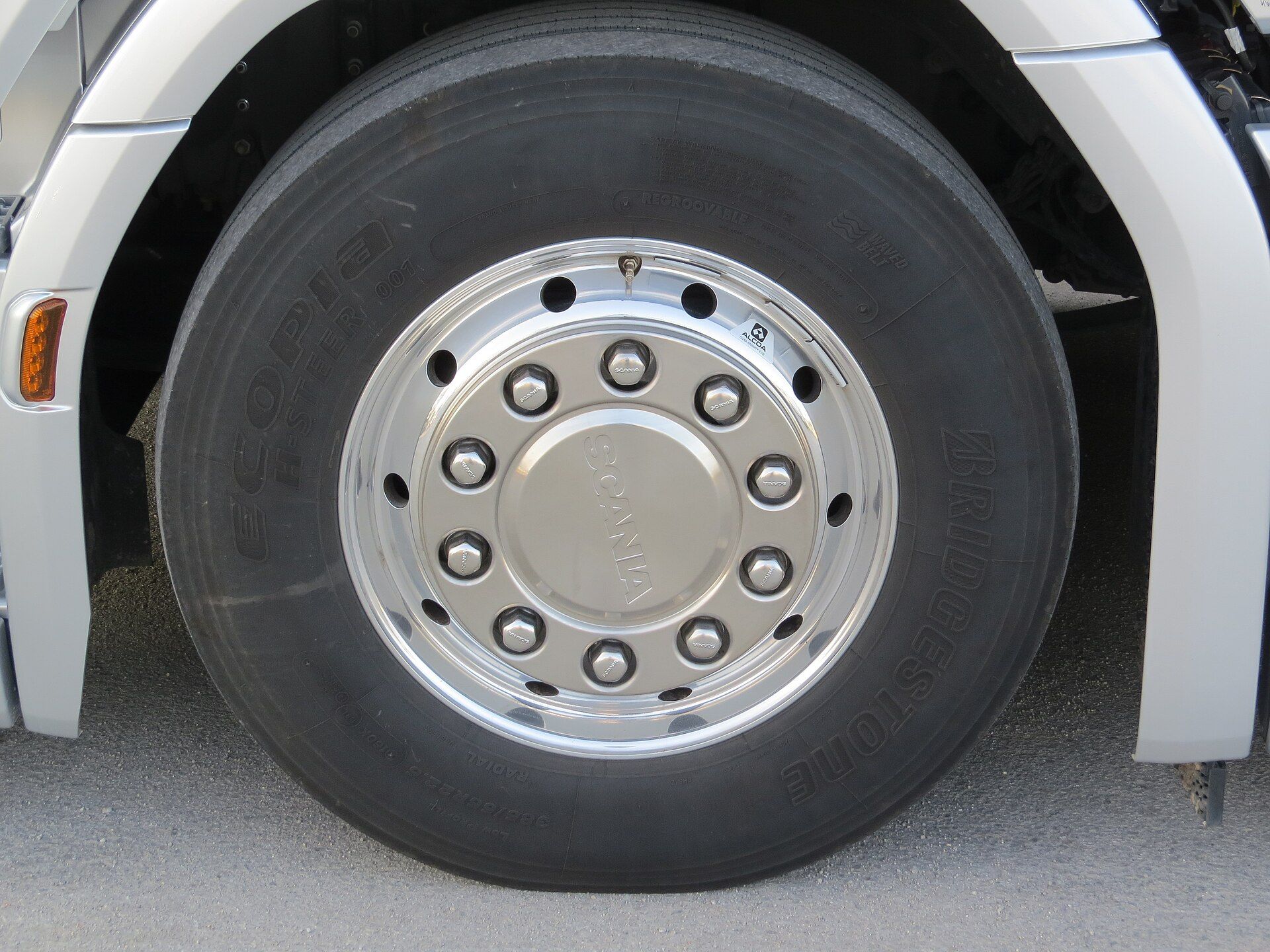
A new C3 tyre placed on the EU market since 1 May 2021 has to be accompanied by a label that looks like the one on a washing machine — under Article 4(1) of Regulation (EU) 2020/740 either as a sticker on each individual tyre or as one printed label for a batch of identical tyres, whichever the supplier chooses. Eight categories listed in Article 2(2) sit outside that duty, and re-treads sit outside it too until a testing method exists. For the tyres it does cover, it is the only harmonised performance statement that comes with them, the measurement behind one of its classes is the same one that feeds a new truck’s certified CO2 figure, and its unit is not the one most people assume.
Heavy tyres were outside the old label
Regulation (EU) 2020/740 is the instrument in force, and its title records what it did: repeal Regulation (EC) No 1222/2009 and amend Regulation (EU) 2017/1369, the energy labelling framework. Article 18 sets entry into force at the twentieth day after publication in the Official Journal — L 177 of 5 June 2020 — and application from 1 May 2021. Article 17 repeals the 2009 regulation with effect from the same date, so the changeover was a single step.
What changed for fleets is in recital 21: the old regulation required the label for car tyres (C1) and van tyres (C2) but not for heavy-duty tyres (C3), and the reason given for adding them is that C3 tyres consume more fuel and cover more kilometres in a year. Recital 4 sizes the parameter — tyres, mainly through rolling resistance, account for 20 to 30 % of the fuel consumption of vehicles.
The class definitions are borrowed, and from a repealed act
Article 3(1) does not define C1, C2 and C3. It defines them by reference to Article 8(1) of Regulation (EC) No 661/2009, with no independent definition anywhere in the labelling regulation.
That reference now leads somewhere awkward. EUR-Lex records Regulation (EC) No 661/2009 as no longer in force, with an end of validity of 5 July 2022, repealed by Regulation (EU) 2019/2144, which applies from 6 July 2022. Article 18(1) of the newer regulation is the repeal itself, and Article 18(2) provides that references to the repealed one are construed as references to it. Item C10 of its Annex II, “Tyre safety and environmental performance”, is satisfied through UN Regulations Nos 30, 54 and 117. Under its Article 15(3), Member States had to continue permitting, until the date set in Annex IV — 30 April 2023 — the registration of vehicles, and the sale or entry into service of components, that did not comply with UN Regulation No 117; the annex has one row only, for that UN Regulation, and the same row specifies that C3 tyres are to comply with Stage 2 rolling resistance requirements. The labelling regulation still points at the repealed text; this page reproduces the pointer rather than rewriting it.
Article 8(1) split tyres by vehicle category and rating. C1 was tyres designed primarily for M1, N1, O1 and O2 vehicles. C2 and C3 both covered M2, M3, N, O3 and O4: C2 where the load capacity index in single formation was 121 or less and the speed category symbol was N or above, C3 where the index was 121 or less with a speed symbol of M or below, or where the index was 122 or more. A tyre could fall in more than one class, and Annex I Part A of the labelling regulation resolves that by applying the grading scale of the highest class — its own example being C2 rather than C1.
The fuel efficiency scale, and its unit
The fuel efficiency class comes from the rolling resistance coefficient, measured in accordance with Annex 6 to UN Regulation No 117 and aligned by the laboratory procedure in Annex V. Annex I Part A states that coefficient in N/kN — newtons per kilonewton — not in kilograms per tonne. The kg/tonne figures that circulate in the trade came from elsewhere: Part B of Annex II to Regulation (EC) No 661/2009 stated maximum values in kg/tonne, and those were minimum type-approval requirements, not label classes.
| Class | C1 tyres | C2 tyres | C3 tyres |
|---|---|---|---|
| A | RRC ≤ 6.5 | RRC ≤ 5.5 | RRC ≤ 4.0 |
| B | 6.6 ≤ RRC ≤ 7.7 | 5.6 ≤ RRC ≤ 6.7 | 4.1 ≤ RRC ≤ 5.0 |
| C | 7.8 ≤ RRC ≤ 9.0 | 6.8 ≤ RRC ≤ 8.0 | 5.1 ≤ RRC ≤ 6.0 |
| D | 9.1 ≤ RRC ≤ 10.5 | 8.1 ≤ RRC ≤ 9.0 | 6.1 ≤ RRC ≤ 7.0 |
| E | RRC ≥ 10.6 | RRC ≥ 9.1 | RRC ≥ 7.1 |
Read across the table rather than down it and the letters stop being comparable. A heavy tyre reaches A at 4.0 N/kN, a car tyre at 6.5 — a value that on the C3 scale falls inside class D. The Commission’s product page adds that of the seven original rolling resistance and wet grip classes only five appear on the current label, and that further restrictions from 2024 reduce those populated classes to four.
Wet grip and noise
Wet grip runs on the same A to E ladder but on a different quantity: the wet grip index G, measured in accordance with Annex 5 to UN Regulation No 117, with Annex I Part B specifying G = G(T) − 0.03, where G(T) is the index measured in one test cycle. For C3 tyres, class A is 1.25 ≤ G, B is 1.10 to 1.24, C is 0.95 to 1.09, D is 0.80 to 0.94 and E is G ≤ 0.79. The bands again sit lower than the C1 bands, where A begins at 1.55.
Noise is built differently. Annex I Part C requires the external rolling noise value N in decibels, calculated in accordance with Annex 3 to UN Regulation No 117, with the class set relative to limit values LV: at or below LV − 3, above LV − 3 up to LV, or above LV. There are three noise classes, A to C, not five. Those limit values come from Part C of Annex II to Regulation (EC) No 661/2009, where they were 73 dB(A) for normal C3 tyres and 75 dB(A) for C3 traction tyres, plus 2 dB(A) for special use and 1 dB(A) for C3 snow tyres — the content of an annex no longer in force, not the values in force today, which this page does not assert. The Commission puts low-noise tyres at 67 to 71 dB and the highest levels up to 77 dB.
Snow and ice sit in Parts D and E of the same annex. Part D grades snow grip by Annex 7 to UN Regulation No 117, and a tyre meeting the minimum index values carries the Alpine symbol; Part E covers ice grip. The Commission notes a distinction the label does not show: the snow pictogram is awarded on braking distance over compacted snow for cars but on acceleration performance for trucks, and it records ice testing as running to ISO standard 19447, C1 tyres only. Part E itself names neither a class nor a single method: ice grip is tested by reliable, accurate and reproducible methods, and any tyre meeting the relevant minimum ice grip index values carries the pictogram. Recital 14 makes ISO 19447 the basis only once that standard is formally adopted. So the conclusion that a C3 tyre carries no ice pictogram is our inference from the testing practice the Commission describes, not a restriction the regulation imposes.
A class is a band with a tolerance
A declared class is not a hard wall. Annex VI sets the verification tolerances an authority applies: aligned measured rolling resistance must not exceed the upper limit of the declared class by more than 0.3 N/kN, measured noise must not exceed the declared N by more than 1 dB(A), and measured G(T) must not fall below the lower limit of the declared class. Behind that sits Annex V, an alignment procedure with reference laboratories named in the Official Journal and alignment tyre sets chosen separately for C3 tyres: the label figure is a laboratory result corrected onto a common scale, not a road measurement.
The same coefficient is used twice
Here the label stops being a sticker. Regulation (EU) 2017/2400, the framework behind VECTO and the declared CO2 figure discussed in tractor unit running costs, certifies tyres in its Annex X. Point 3.2 requires the rolling resistance coefficient to be measured and aligned in accordance with Annex I Part A of Regulation (EU) 2020/740, expressed in N/kN and rounded to the first decimal place. The same annex makes FuelEfficiencyClass a parameter taken from that Part A, recorded as “N/A” for tyres outside its scope, and sets a standard value of 13.0 N/kN for tyres outside the scope of Regulation (EC) No 661/2009 or Regulation (EU) 2019/2144.
Point 1 of the same annex says whose coefficient that is. For the calculation of the vehicle rolling resistance to be used as the simulation tool input, the coefficient and the related tyre test load are declared by the applicant for tyre approval for each tyre supplied to the original equipment manufacturers. That is the first-fit route: a truck’s CO2 and fuel-consumption figure is simulated at certification, on the tyres declared for it then, and it is that certified figure that fixes the vehicle’s CO2 emission class where a Member State levies a toll varying by class under the Eurovignette directive as amended in 2022, set out in EU road tolls and CO2 classes. A better letter on a replacement tyre does not send the vehicle back through the simulation, so it leaves that certified figure and that class where they are — our reading of the scope Annex X sets, not a sentence in the regulation. What it changes is fuel burned, which makes the tyre line on an order sheet a specification decision, in the way the liftable third axle described in truck weights, GVW and GCW is a weight-distribution decision before it is a fuel one.
What the label does not cover
Article 2(2) puts more outside the scope than most expect: off-road professional tyres, tyres designed to be fitted only on vehicles first registered before 1 October 1990, T-type temporary-use spares, tyres rated below 80 km/h, tyres with a nominal rim diameter not exceeding 254 mm or of 635 mm or more, tyres fitted with additional traction devices such as studded tyres, racing-only tyres, and second-hand tyres unless imported from a third country.
Re-treads are the gap that matters to heavy fleets. Article 2(1) provides that requirements for re-treaded tyres apply once a suitable testing method is available, and Article 13(2) required the Commission to adopt delegated acts introducing them by 26 June 2022, on the same condition. Recital 17 records that re-treads are a substantial part of the heavy-duty tyre market. EUR-Lex records no such delegated act: the Modified by field of its entry for the Regulation lists four corrigenda and nothing else. A re-tread placed on the market today therefore need not be accompanied by a label. Abrasion and mileage sit in the same position under Article 13(3): named as parameters in Article 3(20), conditional on test methods recital 16 says did not exist when the regulation was drafted. Until they arrive, wear rate — one reason bus fleet operating costs can be stated as an obligation but not as a number — is not on the label. Euro 7 abrasion limits are a separate track with their own dates, covered in Euro VI and Euro 7.
Two obligations matter when specifying rather than replacing. Article 7 requires vehicle suppliers and distributors to provide the label for tyres offered with or fitted on a new vehicle before the sale, so first-fit classes belong on the order rather than at the fitting bay — a counterpart to the documentary checks in buying a used truck. Article 11(2) limits Member State incentives to tyres in class A or B for rolling resistance or wet grip, and says taxation and fiscal measures are not incentives.
The rules are moving again
Article 15 required the Commission to evaluate the regulation and report by 1 June 2025. On 24 June 2026 it tabled COM(2026) 565 final, a proposal amending Regulation (EU) 2017/1369 and Regulation (EU) 2020/740 on simplification and digital options. Its Article 2 would retitle Article 6 to cover tyre fitters as well as distributors; require the EPREL registration number, link or QR code in all tyre offers, visual advertisements and on invoices; and delete Article 7 outright. It is a proposal at the start of the ordinary legislative procedure and none of it is law.
The habit is smaller than the regulation: read the letter, then the coefficient behind it, and check which class scale awarded it. Recital 25 explains the QR code: a user-oriented tool carried on the printed label to give easy direct access to the public part of the product database. Annex VII point 1 lists what that public part holds — the label in electronic format, the class or classes and the other parameters of the label, and the parameters of the product information sheet — so the letters and the values behind them sit there together.
Quick answers
- What do the A to E classes on a truck tyre label mean?
- For a C3 tyre, fuel efficiency class A is a rolling resistance coefficient of 4.0 N/kN or less, B is 4.1 to 5.0, C is 5.1 to 6.0, D is 6.1 to 7.0 and E is 7.1 or more. The scale is set out in Annex I Part A of Regulation (EU) 2020/740 and differs for C1 and C2 tyres.
- Is tyre rolling resistance on the EU label measured in kg per tonne?
- No. Annex I Part A of Regulation (EU) 2020/740 states the rolling resistance coefficient in N/kN, newtons per kilonewton. The kg/tonne figures that circulate came from Part B of Annex II to Regulation (EC) No 661/2009, which set minimum type-approval requirements rather than label classes; EUR-Lex records that regulation as no longer in force, repealed by Regulation (EU) 2019/2144.
- When did truck and bus tyres have to carry an EU label?
- 1 May 2021. Article 18 of Regulation (EU) 2020/740 sets that application date and Article 17 repealed Regulation (EC) No 1222/2009 with effect from the same day. Under the 2009 regulation the label was required for car and van tyres but not for heavy-duty C3 tyres.
- What is a C3 tyre?
- Article 3(1) of Regulation (EU) 2020/740 defines C1, C2 and C3 by reference to Article 8(1) of Regulation (EC) No 661/2009 — an act EUR-Lex records as no longer in force since 5 July 2022, repealed by Regulation (EU) 2019/2144, whose Article 18(2) provides that references to it are construed as references to that later regulation. Article 8(1) classified as C3 those tyres designed primarily for M2, M3, N, O3 and O4 vehicles with either a load capacity index in single formation of 121 or less and a speed category symbol of M or below, or a load capacity index of 122 or more.
- Do retreaded truck tyres carry an EU tyre label?
- No. Article 2(1) of Regulation (EU) 2020/740 provides that requirements for re-treaded tyres apply once a suitable testing method to measure their performance is available, and Article 13(2) required the Commission to introduce them by delegated act by 26 June 2022 on that same condition. EUR-Lex records no such act: the Modified by field of its entry for the Regulation lists four corrigenda and nothing else. Recital 17 notes that re-treads are a substantial part of the heavy-duty tyre market.
Sources
- Regulation (EU) 2020/740 on the labelling of tyres with respect to fuel efficiency and other parameters — EUR-Lex, Official Journal of the European Union L 177, 5.6.2020
- Regulation (EC) No 661/2009 on general safety type-approval requirements, consolidated text of 24 April 2019 — Article 8 and Annex II — EUR-Lex, European Union
- Regulation (EU) 2019/2144 on general safety and the protection of vehicle occupants and vulnerable road users — Articles 15 and 18, Annexes II and IV — EUR-Lex, Official Journal of the European Union L 325, 16.12.2019
- Regulation (EU) 2017/2400 on the determination of CO2 emissions and fuel consumption of heavy-duty vehicles, consolidated text of 1 January 2026 — Annex X — EUR-Lex, European Union
- Tyres — product page, scope, label classes and impact figures — European Commission, Energy Efficient Products
- COM(2026) 565 final — Proposal amending Regulation (EU) 2017/1369 and Regulation (EU) 2020/740 as regards simplification and better use of digital options for energy and tyre labelling — European Commission, Publications Office of the European Union
- European Product Registry for Energy Labelling (EPREL) — tyres — European Commission