Truck tyre markings explained: size, load index, speed symbol, M+S, 3PMSF and the date code
What UN Regulations 54, 117 and 109 put on the sidewall of a truck or bus tyre — size, service description, snow symbols, FRT and the date code — and how the US DOT code differs.
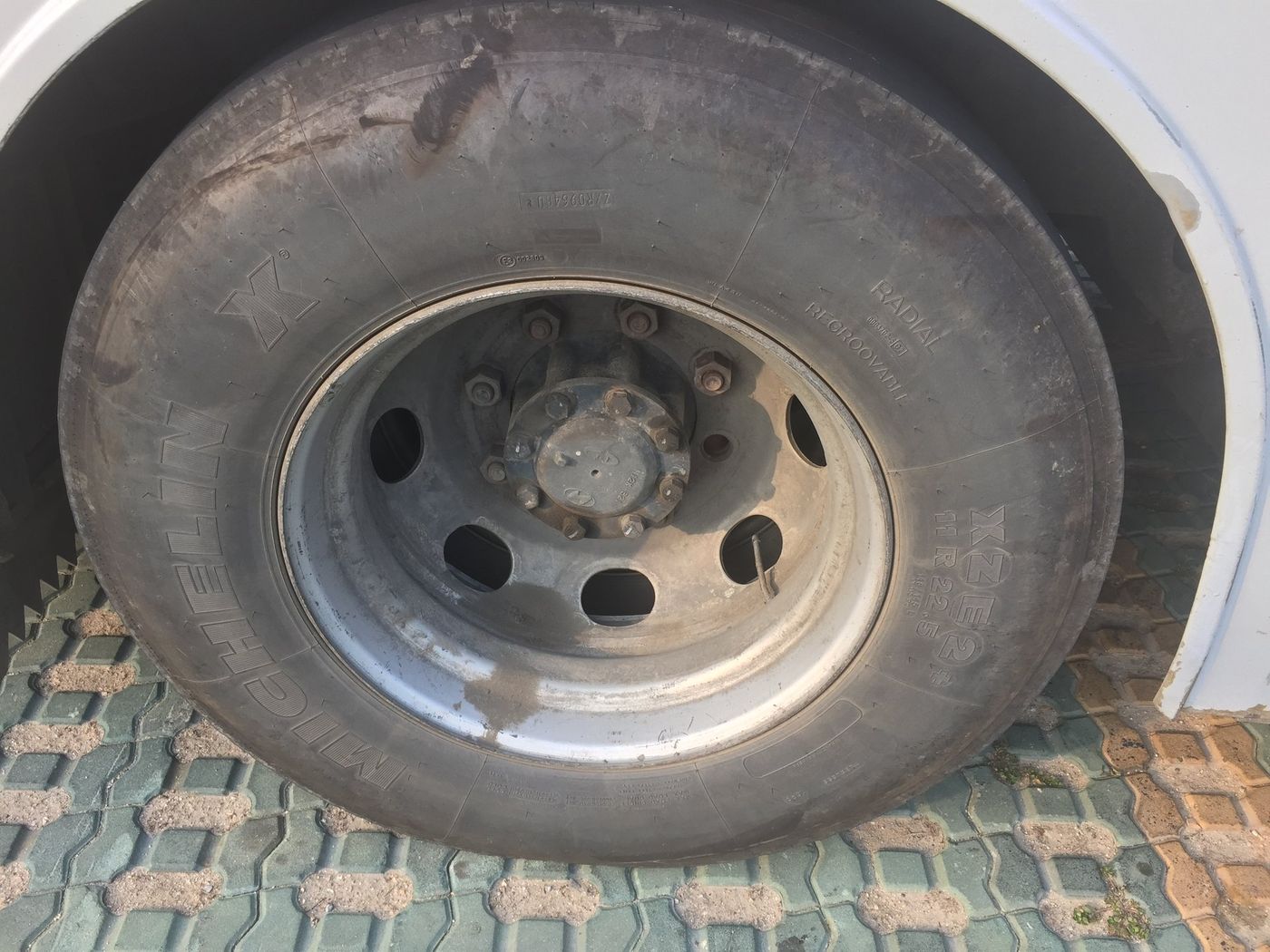
The sidewall of a truck, bus or trailer tyre carries a set of markings that UN Regulation No 54, the approval regulation for commercial-vehicle tyres, lays down: the size, the load and speed rating, the construction, the snow marking and the week of manufacture. UN Regulation No 117 adds the Alpine snow symbol, UN Regulation No 109 sets the markings of a retreaded tyre, and in the United States 49 CFR 574.5 and FMVSS 119 set the DOT code. This page reads them one by one. The EU tyre label, which comes with the tyre and is not moulded on it, has its own page: truck tyre labelling.
The Regulation No 54 text used here is the one published in the EU’s Official Journal in 2008 (supplement 16 to the original version), checked against the EU’s consolidated text of 2010; later supplements were not checked for this page.
The size designation
UN Regulation No 54 explains its own example, 255/70 R 22.5: a nominal section width of 255 mm, a nominal aspect ratio of 70, radial-ply construction (R) and a nominal rim diameter of 572 mm, for which the symbol is 22.5. On radial tyres the R stands in front of the rim-diameter marking, and the word RADIAL may be added. The Regulation requires these markings on both sidewalls of a symmetrical tyre and at least on the outer sidewall of an asymmetrical one.
Load index and speed symbol: the service description
The service description follows the size: one or two load-capacity indices and a speed-category symbol. Regulation No 54 defines the load-capacity index as one or two numbers which indicate the load the tyre can carry in single, or in single and dual, operation at the speed of the associated speed category. In the example 148/145 J, index 148 stands for 3,150 kg on a single wheel, index 145 for 2,900 kg per tyre in dual fitment, and J for 100 km/h. Read against the Regulation’s load-index table (Annex IV), a tyre marked 315/80 R 22.5 156/150 L would carry 4,000 kg single (index 156) and 3,350 kg dual (index 150) at 120 km/h (L).
A tyre may carry a second service description for a different speed, shown inside a circle near the first. The Regulation’s example is 145/143 L, for which its text gives 3,000 kg single and 2,725 kg dual at 120 km/h; in its own load-index table, though, index 145 stands for 2,900 kg, and 3,000 kg is index 146. The speed symbols run F 80, G 90, J 100, K 110, L 120, M 130, N 140, P 150, Q 160, R 170, S 180, T 190, U 200 and H 210 km/h; the Regulation adds that they should not be taken to indicate the speeds at which commercial vehicles fitted with such tyres may be operated on the roads. The tyre load index calculator turns a service description into kilograms per tyre and per axle.
C2 and C3: the tyre classes
UN Regulation No 117 sorts the tyres approved under Regulation No 54 into two classes by their marking. A C3 tyre has a load-capacity index in single formation of 122 or more, or of 121 or less with a speed symbol of M or lower; a C2 tyre has an index of 121 or less and a speed symbol of N or higher. The class decides which of the Regulation’s limits for rolling resistance, wet grip and noise apply; the EU tyre label also distinguishes C1, C2 and C3 tyres.
M+S and the Alpine symbol
Regulation No 54 requires the inscription M+S, M.S or M&S on a snow tyre, which it defines as a tyre whose tread pattern, tread compound or structure are primarily designed to achieve in snow a performance better than that of a normal tyre in starting or keeping the vehicle moving. No test is attached to that marking.
The Alpine symbol, a three-peak mountain with a snowflake (3PMSF), comes from UN Regulation No 117: it is added if the snow tyre is classified for use in severe snow conditions. To be classified, a C3 tyre is compared with a standard reference test tyre in an acceleration test and needs a snow grip index of at least 1.25. Regulation No 117 also names the special-use inscriptions MPT (multi-purpose truck), ML (mining and logging), ET (extra tread) and POR (professional off-road). Which of these markings a country accepts in winter is set nationally; several countries now ask for 3PMSF. The rules country by country are set out in winter tyres and snow chains.
TUBELESS, REGROOVABLE, FRT and the approval mark
Regulation No 54 lists further markings:
- TUBELESS if the tyre is designed for use without an inner tube.
- REGROOVABLE, or a symbol at least 20 mm in diameter, on each sidewall of a tyre that can be regrooved.
- FRT (Free Rolling Tyre) on tyres designed for trailer axles and for axles of motor vehicles other than the front steering and drive axles.
- PSI index, the inflation pressure to be used in the load/speed endurance tests.
- C or LT after the rim diameter, mandatory on tyres for 5° drop-centre rims that are suitable for single fitment only and have a load index of 122 or more, optional on those for single and dual fitment with an index of 121 or less.
- The approval mark: a circle around the letter E followed by the number of the country that granted approval, and an approval number.
The date of manufacture
The date is a group of four digits, the first two showing the week and the last two the year of manufacture; before 1 January 2000 three digits were allowed, the last one for the year. Regulation No 54 allows the date on one sidewall only. The Regulation’s worked example is a tyre manufactured during the twenty-fifth week of 2003. Age limits for tyres in service are national; Great Britain’s ten-year rule for front axles is described in tread depth and tyre age.
Retreaded tyres
A retread is approved under UN Regulation No 109 and carries its own markings: the retreader’s name or brand, the word RETREAD, the service description and the date of retreading. That date is also four digits, week and year, but it may cover a window: the Regulation’s example 2503 could indicate a tyre retreaded in week 25, 26, 27 or 28 of 2003. A retread classified as a snow tyre carries M+S, and one classified for severe snow conditions the Alpine symbol. A retread classified for severe snow or as a traction tyre also carries the approval mark of UN Regulation No 172, which covers the snow performance of retreads and the traction classification of C2 and C3 retreads.
The US DOT code
In the United States, 49 CFR 574.5 requires a tyre identification number (TIN) of 13 symbols on one sidewall of a new tyre and of seven symbols on a retreaded one, which is also marked with an R that is not part of the TIN. The last group of the TIN is a four-digit date code, week then year, but the week is counted differently from the UN rule: “01” is the first full calendar week, running from Sunday to Saturday, so 0109 is the week of 4 to 10 January 2009. The DOT symbol certifies that the tyre conforms to an applicable Federal Motor Vehicle Safety Standard; for tyres for vehicles with a GVWR of more than 4,536 kg (10,000 lb) that is FMVSS 119, which requires at least six treadwear indicators showing when the tread has worn to 1.6 mm.
Where the label fits in
Regulation (EU) 2020/740 has applied to C3 tyres since 1 May 2021. Its label shows fuel-efficiency, wet-grip and noise classes, and a snow pictogram for a tyre that meets the snow grip index of UN Regulation No 117; the label comes with the tyre and is not moulded on the sidewall. The classes are explained in truck tyre labelling.
Quick answers
- What do the numbers on a truck tyre mean?
- Take UN Regulation No 54's own example, 255/70 R 22.5 148/145 J: a nominal section width of 255 mm, an aspect ratio of 70, radial construction (R) and a rim diameter code of 22.5, followed by load indices 148 and 145 — 3,150 kg on a single wheel and 2,900 kg per tyre in dual fitment — at the speed of symbol J, 100 km/h.
- What does 3PMSF mean on a truck tyre?
- It is the Alpine symbol, a three-peak mountain with a snowflake. Under UN Regulation No 117 it may be added only to a snow tyre classified for use in severe snow conditions, which for a C3 truck tyre means a snow grip index of at least 1.25 against a standard reference tyre. M+S on its own has no test behind it.
- How do I read the date code on a truck tyre?
- Under UN Regulation No 54 it is four digits, the week first and then the last two digits of the year. On a retreaded tyre, UN Regulation No 109 lets the same four digits stand for a four-week window: 2503 can mean weeks 25 to 28 of 2003. On a US tyre the date code is the last four symbols of the DOT number.
- What does FRT mean on a tyre?
- Free Rolling Tyre. UN Regulation No 54 requires the inscription on tyres designed for trailer axles and for axles of motor vehicles other than the front steering and drive axles.
- What is the difference between C2 and C3 tyres?
- UN Regulation No 117 sorts commercial-vehicle tyres into classes by their marking: C3 is a load index in single formation of 122 or more, or 121 or less with a speed symbol of M or lower; C2 is a load index of 121 or less with a speed symbol of N or higher.
Sources
- UN Regulation No 54 — Uniform provisions concerning the approval of pneumatic tyres for commercial vehicles and their trailers (OJ L 183, 11.7.2008, supplement 16 to the original version) — Publications Office of the European Union
- UN Regulation No 117 — tyres with regard to rolling sound emissions, adhesion on wet surfaces and rolling resistance (OJ L 218, 12.8.2016, supplement 8 to the 02 series of amendments) — Publications Office of the European Union
- UN Regulation No 109 — approval for the production of retreaded pneumatic tyres for commercial vehicles and their trailers (OJ L 2026/308, 6.3.2026) — Publications Office of the European Union
- UN Regulation No 172 — retreaded tyres with regard to their snow performance and their classification as traction tyre (OJ L 2026/301, 5.3.2026) — Publications Office of the European Union
- Regulation (EU) 2020/740 on the labelling of tyres with respect to fuel efficiency and other parameters — Publications Office of the European Union
- 49 CFR 574.5 — Tire identification requirements (eCFR, current to 28 September 2026) — US Government Publishing Office / National Archives (eCFR)
- 49 CFR 571.119 — Standard No. 119; New pneumatic tires for motor vehicles with a GVWR of more than 4,536 kilograms (10,000 pounds) (eCFR, current to 28 September 2026) — US Government Publishing Office / National Archives (eCFR)