Winter tyres and snow chains for trucks and buses in Europe: the rules country by country
When heavy trucks and buses need winter tyres or chains in Austria, France, Germany, Italy, Spain, Sweden, Türkiye and Russia, on which axles, and whether M+S or 3PMSF counts.
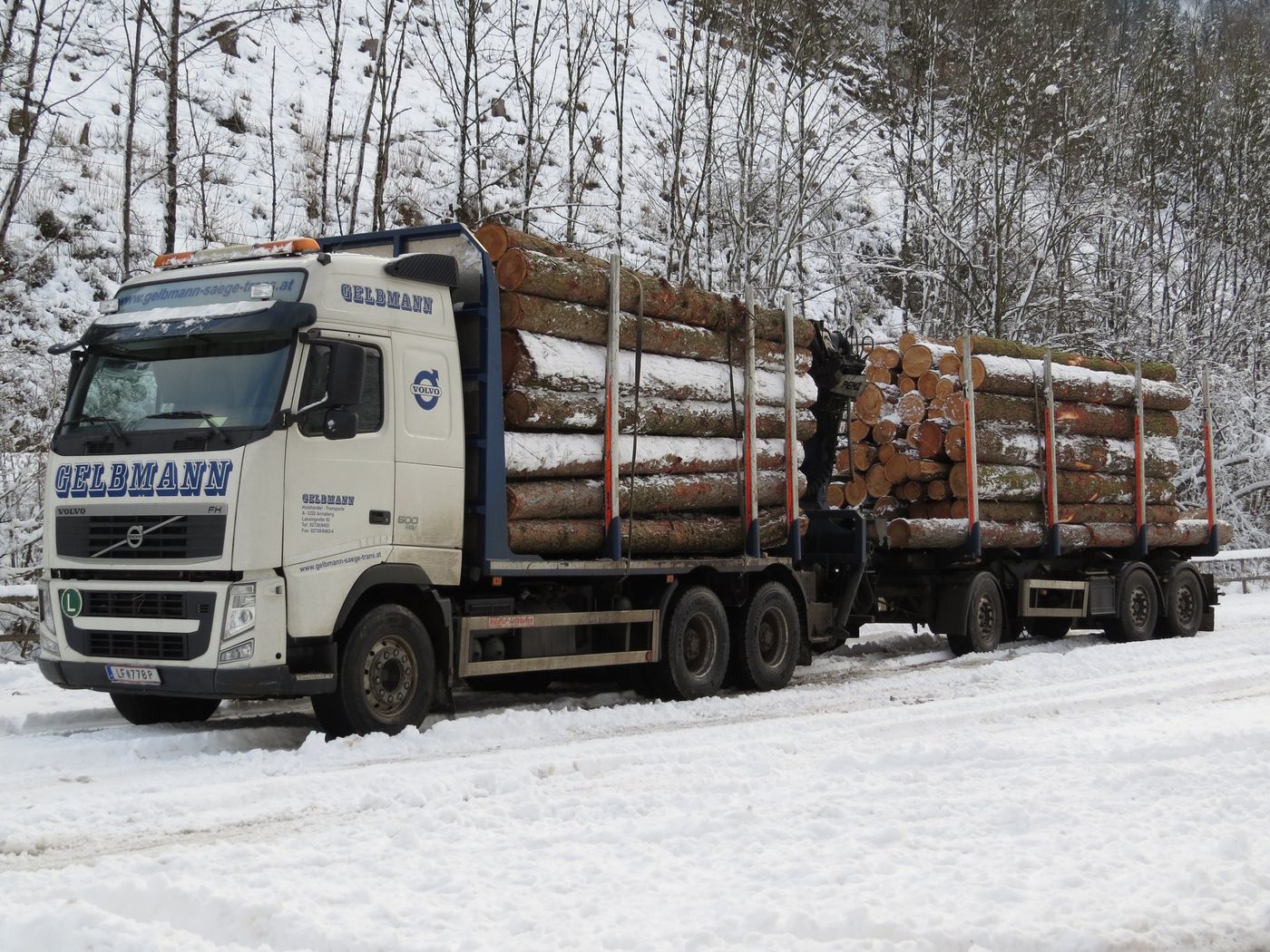
Winter equipment for heavy vehicles is set country by country, and the rules differ in four ways: whether they follow the calendar or the weather, which axles they cover, which tyre marking counts, and whether chains are carried as well. This page sets out the rules for trucks and buses over 3.5 t in eight countries as their own legal texts state them, without fines (except where noted) or local orders. What the markings M+S and 3PMSF mean is explained in truck tyre markings explained.
| Country | When | Which axles | Marking | Chains |
|---|---|---|---|---|
| Austria | trucks 1 Nov–15 Apr, buses 1 Nov–15 Mar | at least one drive axle | “Winterreifen”, no symbol named | carried 1 Nov–15 Apr, for two drive wheels |
| France | 1 Nov–31 Mar, listed mountain communes | two steering and two drive wheels | 3PMSF with M+S (from 1 Nov 2024) | with a trailer: compulsory, tyres not enough |
| Germany | weather | permanently driven and front steering axles | Alpine symbol (3PMSF) | — |
| Italy | 15 Nov–15 Apr where a road owner orders it | not specified for heavy vehicles | approved winter tyres | alternative to winter tyres, on the driven axles |
| Russia (EAEU) | no rule for heavy vehicles | — | — | left to member states |
| Spain | weather (winter mobility restrictions) | steering and drive axles | 3PMSF or POR | alternative to special tyres |
| Sweden | 10 Nov–10 Apr, any weather | drive and front axles (3PMSF, POR or studs) | 3PMSF, POR or studded; M+S on other axles | no requirement |
| Türkiye | 15 Nov–15 Apr, intercity roads | all driven axles | M+S and/or snowflake checked | do not replace winter tyres |
Austria
The Kraftfahrgesetz (KFG § 102(8a)) lets drivers use N2 and N3 vehicles from 1 November to 15 April, and M2 and M3 vehicles from 1 November to 15 March, only if winter tyres are fitted at least on the wheels of one drive axle. It defines winter tyres as tyres intended for snow and slush with a corresponding tread depth and names neither M+S nor the Alpine symbol. From 1 November to 15 April the drivers of M2, M3, N2 and N3 vehicles must also carry suitable chains for at least two drive wheels (§ 102(9)); the exemptions include vehicles on which chains cannot be mounted and buses used in scheduled services. The implementing regulation (KDV § 4) sets the minimum tread of winter tyres used under that rule on vehicles and trailers over 3,500 kg at 5 mm for radial and 6 mm for bias-ply tyres; outside winter use the minimum for those vehicles is 2 mm.
France
Decree No 2020-1264 inserted Article D. 314-8 into the Code de la route. It applies in the mountain massifs defined by the 1985 mountain law, in the communes that each prefect lists by order; the decree itself names none. The winter period runs from 1 November to 31 March. Buses (M2, M3) and trucks (N2, N3) without a trailer must either carry removable anti-skid devices for at least two drive wheels or have winter tyres on at least two steering wheels of the main steering system and at least two drive wheels. Trucks with a trailer or semi-trailer must carry the anti-skid devices; winter tyres alone do not meet the rule. From 1 November 2021 the decree accepted M+S as a winter tyre marking; since 1 November 2024 it has required the Alpine symbol together with M+S, M.S or M&S. The current text on Légifrance could not be checked for this page; what is given here is the decree as published in the Journal officiel.
Germany
Germany has no winter period. Under § 2(3a) of the Straßenverkehrs-Ordnung a motor vehicle may be driven in black ice, snow, slush, ice or frost only on tyres that meet § 36(4) of the Straßenverkehrs-Zulassungs-Ordnung; for M2, M3, N2 and N3 vehicles it is enough if at least the wheels of the permanently driven axles and of the front steering axles have them. § 36(4) requires both improved snow properties and the Alpine symbol under UN Regulation No 117, so M+S alone does not qualify.
Italy
There is no national calendar obligation. Road owners may impose one by ordinance, and the Ministry of Infrastructure and Transport’s directive 1580 of 16 January 2013 asks, for uniformity, that such a period fall between 15 November and 15 April. Where it applies, motor vehicles other than two-wheeled mopeds and motorcycles must have winter tyres or carry anti-skid devices suitable for snow and ice; chains must be fitted at least on the wheels of the driven axles, and devices meeting ÖNORM V5119 are also allowed for the heavier M, N and O categories. The directive does not say which axles of a heavy vehicle need winter tyres and does not mention the Alpine symbol.
Russia and the Eurasian Economic Union
Since 11 November 2018 the winter-tyre item of the Customs Union technical regulation TR CU 018/2011 (Annex 8, item 5.5) prohibits operating M1 and N1 vehicles without winter tyres on all wheels in December, January and February; member states may set a different period. The item does not cover trucks or buses. For M2, M3, N2 and N3 vehicles, chain requirements are left to the member states’ law (item 11.9), and an M3 bus may go without chains if they cannot be fitted or if it has winter tyres.
Spain
The texts read set no calendar. The Reglamento General de Vehículos, Annex VII as amended in May 2026, says that to comply with winter mobility restrictions, vehicles over 3,500 kg must fit tyres certified 3PMSF or POR at least on the steering axle and the drive axles. It defines special tyres as snow tyres marked M+S, M&S or M.S together with the 3PMSF pictogram, or professional off-road tyres marked M+S together with POR; where chains are compulsory or recommended, they may be fitted on at least one drive wheel on each side or replaced by special tyres. The DGT’s instruction 15/TV-87 of 1 December 2015 adds that at the red level a bus may run, by exception, on a full set of special 3PMSF winter tyres with at least 4 mm of tread.
Sweden
Since 1 November 2025 (SFS 2025:881), Chapter 4, § 18 b of the Trafikförordning requires heavy trucks, heavy buses and trailers drawn by them to have winter tyres or equivalent equipment from 10 November to 10 April, whatever the road conditions; the government’s press release adds that no chain requirement is introduced. Transportstyrelsen’s rules (TSFS 2009:19) accept tyres marked 3PMSF or POR, or studded tyres; on axles other than the drive and front axles of vehicles over 3,500 kg, and on trailers over 3,500 kg, M+S is accepted instead. In the same period the tyres of heavy trucks and buses need at least 5 mm of tread in the middle 75 % of the tread width, and a trailer coupled to them at least 1.6 mm. A two-axle truck with one drive axle and a trailer must also, from 10 November to 10 April, put at least 25 % of the train’s gross weight on the drive axle, or keep the trailers to no more than 1.5 times the truck’s gross weight.
Türkiye
The winter tyre communiqué (Kış Lastiği Tebliği) requires winter tyres from 15 November to 15 April on vehicles used for passenger and goods transport on intercity roads, whether registered in Türkiye or not; governors may extend the period by one month before and after. On trucks, tractor units, tankers and buses every tyre on the driven axles must be a winter tyre with at least 4 mm of tread; trailers and semi-trailers are outside the communiqué, and carrying or using chains does not lift the obligation. At checks the sidewall is examined for M+S, M+S with a snowflake, or a snowflake alone. Under Article 65/A of the Highway Traffic Law, as amended in February 2026, the fine for the operator is 6,000 Turkish lira.
Tables in tyre makers’ books can lag behind
Rules change faster than printed summaries. The winter table in Continental’s Technical Data Book of March 2024, headed “Winter 2023/2024”, ties the Swedish rule for heavy vehicles to wintry weather, gives Türkiye a period from 1 December to 1 April and has Russia requiring winter tyres on all axles of trucks and buses. Sweden and Türkiye have changed their rules since, and the Russian item has covered only M1 and N1 vehicles since November 2018. Dates and axles should be read from the country’s own text for the winter in question.
Quick answers
- Do trucks need winter tyres in Germany?
- Only in wintry conditions — black ice, snow, slush, ice or frost; there are no fixed dates. In those conditions an M2, M3, N2 or N3 vehicle needs tyres with the Alpine symbol at least on its permanently driven axles and its front steering axles. M+S alone does not qualify.
- When are winter tyres compulsory for trucks in Austria?
- From 1 November to 15 April for N2 and N3 trucks and from 1 November to 15 March for M2 and M3 buses, at least on the wheels of one drive axle. From 1 November to 15 April these vehicles must also carry chains for at least two drive wheels, and above 3,500 kg the winter tyres need 5 mm of tread (radial) or 6 mm (bias-ply).
- Do trucks need snow chains in France?
- In the mountain communes listed by each prefect, from 1 November to 31 March. A truck with a trailer or semi-trailer must carry chains or other removable anti-skid devices for at least two drive wheels. A solo truck or a bus may instead have winter tyres — marked with the Alpine symbol and M+S since 1 November 2024 — on at least two steering wheels and two drive wheels.
- What are Sweden's winter tyre rules for heavy trucks?
- Since 1 November 2025, heavy trucks, heavy buses and their trailers need winter tyres or equivalent equipment from 10 November to 10 April, whatever the road conditions. The drive and front axles need tyres with the 3PMSF symbol, POR or studs, and the tyres of heavy trucks and buses need at least 5 mm of tread in that period.
- When are winter tyres mandatory for trucks in Türkiye?
- From 15 November to 15 April on intercity roads. On trucks, tractor units, tankers and buses every tyre on the driven axles must be a winter tyre with at least 4 mm of tread; trailers and semi-trailers are outside the rule, and chains do not replace the tyres.
Sources
- Kraftfahrgesetz 1967 (KFG), § 102 — version in force from 1 October 2026 — Rechtsinformationssystem des Bundes (RIS), Republic of Austria
- Kraftfahrgesetz-Durchführungsverordnung 1967 (KDV), § 4 — Rechtsinformationssystem des Bundes (RIS), Republic of Austria
- Décret n° 2020-1264 du 16 octobre 2020 relatif aux équipements des véhicules en circulation en période hivernale (JORF, 18 October 2020, text 25) — Journal officiel de la République française (copy published by Bison Futé, French Ministry of Transport)
- Straßenverkehrs-Ordnung (StVO), § 2 — Federal Ministry of Justice, Germany (gesetze-im-internet.de)
- Straßenverkehrs-Zulassungs-Ordnung (StVZO), § 36 — Federal Ministry of Justice, Germany (gesetze-im-internet.de)
- Direttiva prot. 1580 del 16 gennaio 2013 — circolazione stradale in periodo invernale e in caso di emergenza neve — Ministero delle Infrastrutture e dei Trasporti, Italy
- Decision No 29 of the Council of the Eurasian Economic Commission of 16 February 2018 amending TR CU 018/2011 (in force 11 November 2018) — National Legal Internet Portal of the Republic of Belarus (pravo.by)
- Reglamento General de Vehículos (Real Decreto 2822/1998), consolidated text — Anexo VII as amended by Orden PJC/528/2026 — Boletín Oficial del Estado (BOE), Spain
- Instrucción 15/TV-87 — circulación excepcional de autobuses y vehículos pesados en nivel rojo (1 December 2015) — Dirección General de Tráfico (DGT), Spain
- Trafikförordning (1998:1276), 4 kap. 18 b–18 e §§ — Sveriges riksdag
- SFS 2025:881 — Förordning om ändring i trafikförordningen (1998:1276) — Svensk författningssamling
- TSFS 2009:19 — Transportstyrelsens föreskrifter om däck (consolidated to TSFS 2025:68) — Transportstyrelsen, Sweden
- Vinterdäck — Transportstyrelsen, Sweden
- Nya krav på vinterdäck för tunga fordon (press release, 2 October 2025) — Regeringskansliet, Sweden
- Kış Lastiği Kullanma Zorunluluğu ile İlgili Usul ve Esaslar Hakkında Tebliğ — consolidated text (Article 5 as amended, Resmî Gazete 4 October 2025, No 33037) — Mevzuat Bilgi Sistemi, Republic of Türkiye
- 2918 sayılı Karayolları Trafik Kanunu — Article 65/A (as amended by Law No 7574 of 12 February 2026) — Mevzuat Bilgi Sistemi, Republic of Türkiye
- Technical Data Book, truck tyres (03/24) — winter regulations table — Continental