Minimum tread depth and tyre age for trucks and buses: the EU gap and the national rules
Why EU law sets no tread depth for heavy vehicles, the minimums in Austria, Germany, Great Britain, Spain, Sweden and Türkiye, and Britain's ten-year age limit for front-axle tyres.
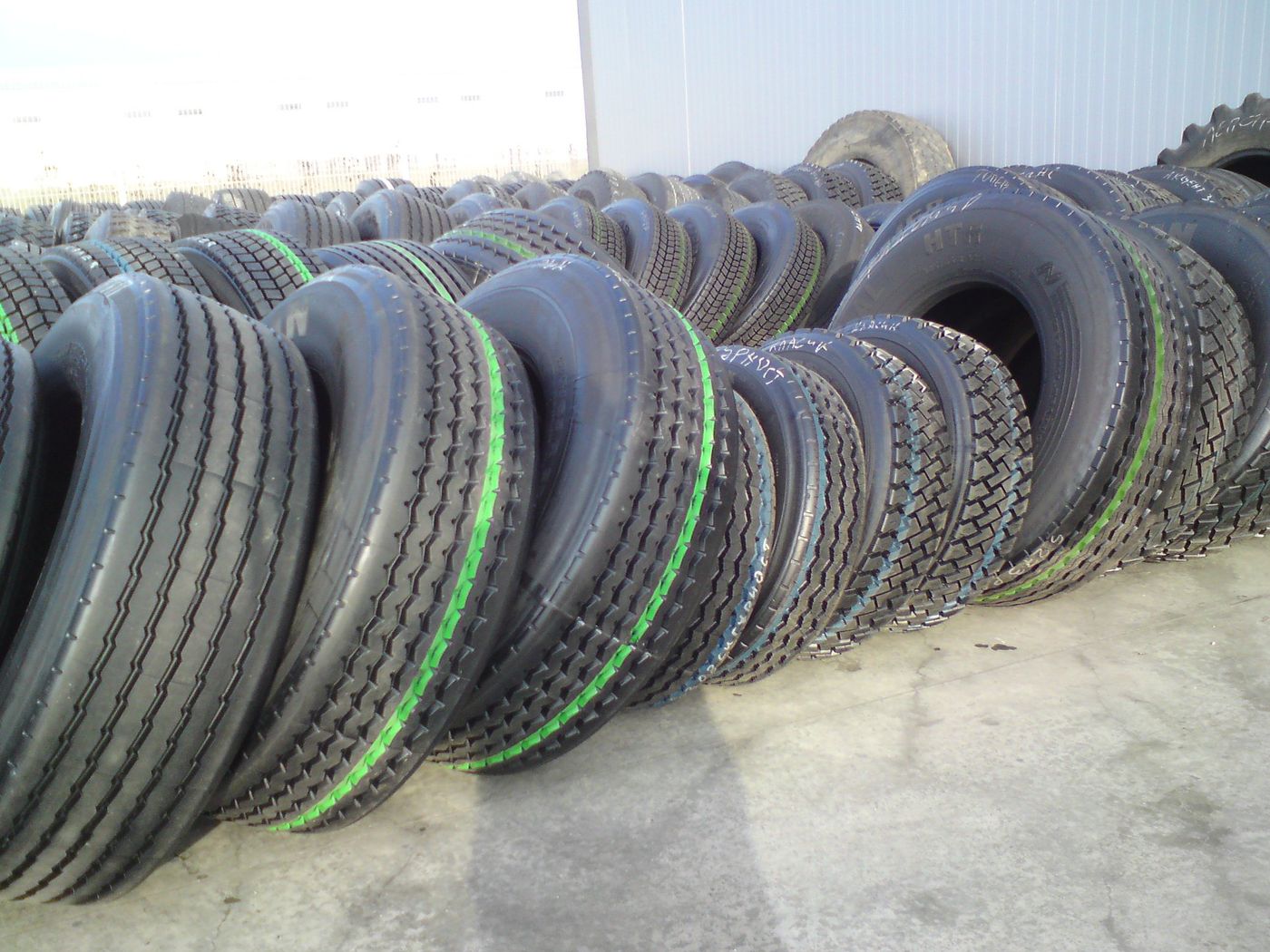
How much tread a truck, bus or heavy trailer tyre must keep is set by each country, because the one EU text on tread depth does not cover heavy vehicles. This page sets out the EU position, the national minimums the texts we read state, the higher winter figures, and the one legal age limit we found, in Great Britain. How to read a tyre’s week of manufacture is explained in truck tyre markings explained.
The EU rule stops at 3.5 tonnes
Council Directive 89/459/EEC of 18 July 1989 requires that tyres of M1, N1, O1 and O2 vehicles — cars, vans and light trailers — keep a tread depth of at least 1.6 mm in the main grooves throughout their service life. It names no heavy category. The EU Publications Office lists the Directive as in force and records no consolidated version of it, which indicates that it has not been amended. Minimum tread depths for M2, M3, N2, N3, O3 and O4 vehicles therefore come from national law, and they differ.
| Country | General minimum | Winter minimum |
|---|---|---|
| Austria | 2 mm above 3,500 kg | 5 mm radial, 6 mm bias-ply, for winter tyres used under the winter rule |
| Germany | 1.6 mm in the main tread, all round | — |
| Great Britain | 1 mm over at least three-quarters of the tread width | — |
| Spain | 1.0 mm for M2, M3, N2, N3, O3 and O4 | 4 mm for buses running on special tyres at the DGT’s red level |
| Sweden | 1.6 mm in the middle 75 % of the tread | 5 mm on heavy trucks and buses, 10 Nov–10 Apr; 1.6 mm on their trailers |
| Türkiye | not confirmed | 4 mm on the driven axles of trucks, tractor units, tankers and buses, 15 Nov–15 Apr |
| France, Italy, Russia | not confirmed | — |
Austria
The implementing regulation of the Austrian Kraftfahrgesetz (KDV § 4) sets 1.6 mm all round for motor vehicles and trailers in general, and at least 2 mm for those with a maximum permitted weight of more than 3,500 kg. Winter tyres used under the winter rule, or under a road-police order, on vehicles and trailers over 3,500 kg need at least 5 mm if radial and 6 mm if bias-ply.
Germany
§ 36(3) of the Straßenverkehrs-Zulassungs-Ordnung requires a tread depth of at least 1.6 mm all round in the main tread, which it defines as the wide grooves in the middle of the tread, covering about three-quarters of its width. The figure applies to motor vehicles and trailers alike; only mopeds and light motorcycles get by with 1 mm.
Great Britain
Regulation 27 of the Road Vehicles (Construction and Use) Regulations 1986 requires, for heavy vehicles, grooves at least 1 mm deep throughout a continuous band measuring at least three-quarters of the breadth of the tread and round the entire circumference; where the original pattern did not reach beyond three-quarters of the breadth, every original groove needs 1 mm. The 1.6 mm figure, over the central three-quarters, applies only to passenger vehicles with up to eight passenger seats, goods vehicles up to 3,500 kg (zero-emission ones up to 4,250 kg since 1 June 2026) and light trailers.
Spain
Annex VII of the Reglamento General de Vehículos, as amended in May 2026, requires at least 1.0 mm in the main grooves of tyres on M2, M3, N2, N3, O3 and O4 vehicles throughout their use on public roads, and 1.6 mm on M1, N1, O1 and O2 vehicles. It allows regrooving only on tyres of vehicles over 3.5 tonnes that are marked Regroovable or carry the regrooving symbol. The DGT’s instruction 15/TV-87 adds a winter figure for exceptional running at the red level: a bus may run on a full set of special 3PMSF winter tyres with at least 4 mm of tread.
Sweden
Transportstyrelsen’s tyre rules (TSFS 2009:19) set 1.6 mm in the middle 75 % of the tread width; on dual wheels of vehicles over 3,500 kg the outer tyre may be more worn, but not so far that its reinforcement shows. From 10 November to 10 April the tyres of heavy trucks and heavy buses need at least 5 mm in the middle 75 % of the tread, and Transportstyrelsen says a trailer coupled to such a vehicle needs at least 1.6 mm.
Türkiye
The winter tyre communiqué requires at least 4 mm on all tyres of the driven axles of trucks, tractor units, tankers and buses from 15 November to 15 April, measured in the grooves nearest the middle of the tread. We did not find a general, year-round minimum for heavy vehicles in the Highway Traffic Regulation or the vehicle inspection regulation.
Where we could not confirm a figure
For Italy, the 1992 law that transposed Directive 89/459/EEC set at least 1.60 mm for motor vehicles, trolleybuses and trailers, but it amended a 1959 code that has since been replaced, and the current provision was not located. The French order on tyres could not be opened, and the Russian figure was not confirmed from an official text. No figure is given for these three countries.
Tyre age: Great Britain’s ten-year rule
Since 1 February 2021 (S.I. 2020/1178), regulation 27 has barred a tyre whose week of manufacture, marked under UN Regulation No 30 or 54, falls more than ten years before the day the vehicle is used on the road, or which has no such marking. For a retread the same limit runs from the week of retreading marked under UN Regulation No 108 or 109. The rule applies to tyres on a front axle of a bus other than a minibus, to tyres fitted in single configuration on any axle of a minibus, and to tyres on a front axle of a goods vehicle over 3,500 kg; a front axle is any axle forward of the mid-point of the chassis whose wheels are steered. A further rule against illegible date markings covers all buses, minibuses included, and goods vehicles over 3,500 kg (zero-emission ones over 4,250 kg). Vehicles of historical interest used for non-commercial purposes are exempt. The other national texts read for this page set tread depth, not age.
The 1.6 mm indicators on US tyres
In the United States, FMVSS 119 requires new tyres for vehicles with a GVWR of more than 4,536 kg (10,000 lb) to have at least six treadwear indicators that show when the tread has worn to 1.6 mm. That is a manufacturing requirement for the tyre; the operating limits for trucks on US roads were not read for this page.
Quick answers
- What is the minimum tread depth for truck tyres in the EU?
- There is no EU-wide figure for trucks, buses or heavy trailers. Directive 89/459/EEC sets 1.6 mm only for M1, N1, O1 and O2 vehicles, and no amendment to it is recorded, so heavy vehicles are left to national law: 1.6 mm in Germany, 2 mm in Austria and 1.0 mm in Spain, for example.
- What is the legal tread depth for an HGV in the UK?
- At least 1 mm throughout a continuous band covering at least three-quarters of the tread width, round the whole circumference (regulation 27 of the Construction and Use Regulations 1986). The 1.6 mm figure applies to cars with up to eight passenger seats, goods vehicles up to 3,500 kg and light trailers.
- How old can a truck tyre be?
- Great Britain is the country on this page with an age limit: since 1 February 2021, a tyre whose marked week of manufacture is more than ten years old may not be used on the front axle of a bus or of a goods vehicle over 3,500 kg, or in single fitment on any axle of a minibus. Retreads count from the week of retreading.
- What tread depth do truck winter tyres need?
- It depends on the country: in Austria 5 mm on radial and 6 mm on bias-ply winter tyres of vehicles over 3,500 kg, in Sweden 5 mm on heavy trucks and buses from 10 November to 10 April, and in Türkiye 4 mm on the driven axles of trucks, tractor units, tankers and buses from 15 November to 15 April.
Sources
- Council Directive 89/459/EEC of 18 July 1989 on the tread depth of tyres of certain categories of motor vehicles and their trailers — Publications Office of the European Union
- Kraftfahrgesetz-Durchführungsverordnung 1967 (KDV), § 4 — Rechtsinformationssystem des Bundes (RIS), Republic of Austria
- Straßenverkehrs-Zulassungs-Ordnung (StVZO), § 36 — Federal Ministry of Justice, Germany (gesetze-im-internet.de)
- The Road Vehicles (Construction and Use) Regulations 1986, regulation 27 (revised, including amendments to 1 June 2026) — legislation.gov.uk, The National Archives
- The Road Vehicles (Construction and Use) (Amendment) Regulations 2020 (S.I. 2020/1178), as made — legislation.gov.uk, The National Archives
- Reglamento General de Vehículos (Real Decreto 2822/1998), consolidated text — Anexo VII as amended by Orden PJC/528/2026 — Boletín Oficial del Estado (BOE), Spain
- Instrucción 15/TV-87 — circulación excepcional de autobuses y vehículos pesados en nivel rojo (1 December 2015) — Dirección General de Tráfico (DGT), Spain
- TSFS 2009:19 — Transportstyrelsens föreskrifter om däck (consolidated to TSFS 2025:68), §§ 4 and 5 a — Transportstyrelsen, Sweden
- Vinterdäck — Transportstyrelsen, Sweden
- Kış Lastiği Kullanma Zorunluluğu ile İlgili Usul ve Esaslar Hakkında Tebliğ — consolidated text — Mevzuat Bilgi Sistemi, Republic of Türkiye
- Legge 19 febbraio 1992, n. 142 (legge comunitaria per il 1991), article 66 — Gazzetta Ufficiale della Repubblica Italiana
- 49 CFR 571.119 — Standard No. 119; New pneumatic tires for motor vehicles with a GVWR of more than 4,536 kilograms (10,000 pounds) (eCFR, current to 28 September 2026) — US Government Publishing Office / National Archives (eCFR)