operating
EU road tolls and CO2 emission classes: what the class changes
Why two mechanically identical trucks pay different tolls: the five CO2 emission classes in the Eurovignette Directive, the discount bands attached to them, and what the German tariff actually shows.
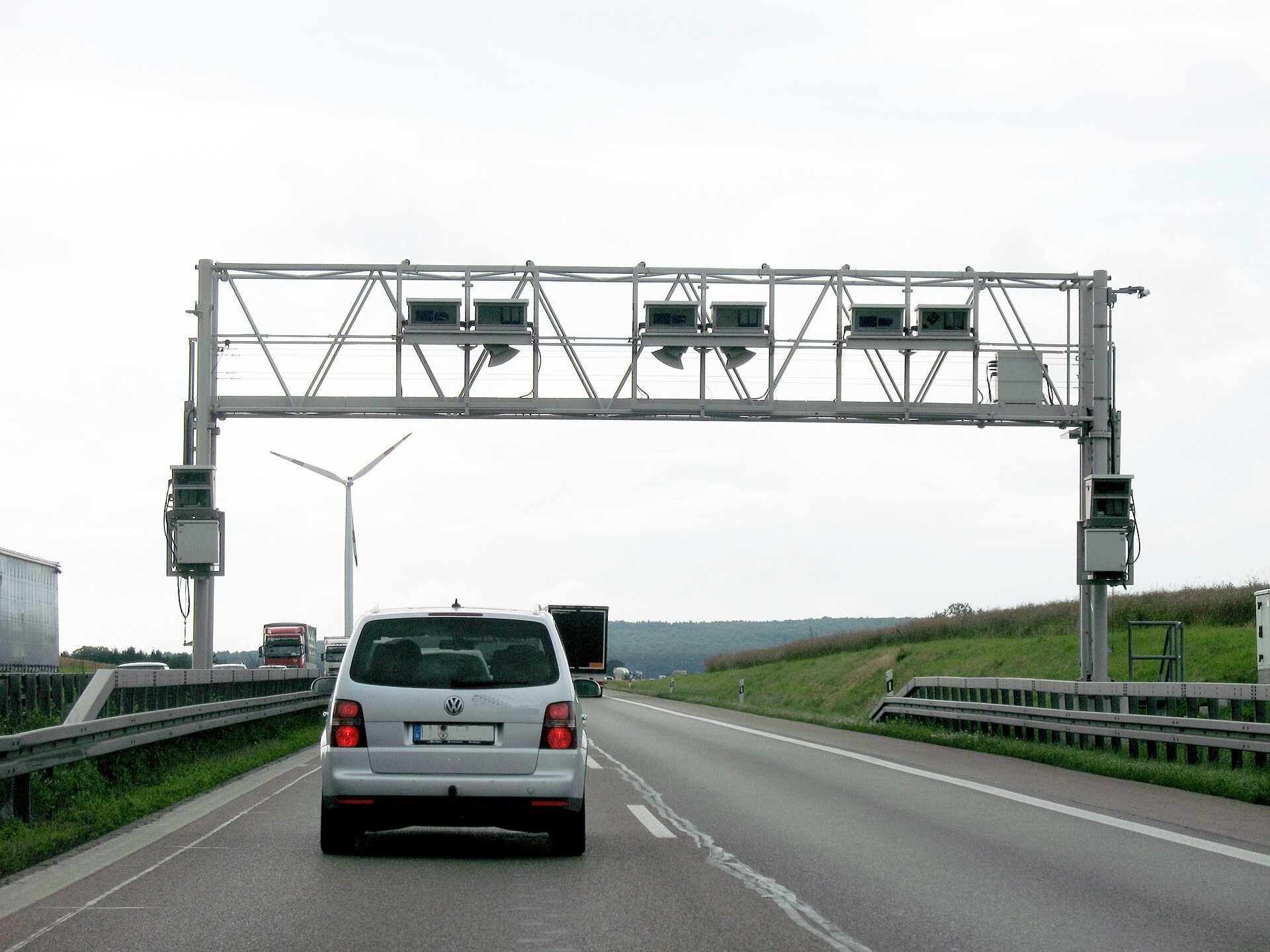
Two tractor units, the same engine, the same Euro VI step, the same load on the same motorway, and two different toll bills. The difference is not mechanical: it is a code recorded against the vehicle, set at first registration, and read by a gantry that never sees the engine.
That code is the CO2 emission class. It arrived with Directive (EU) 2022/362, which rewrote Directive 1999/62/EC on the charging of vehicles for the use of road infrastructures — the Eurovignette Directive. The parent directive is still the instrument in force: its EUR-Lex masthead reads In force, and the consolidated text is dated 24 December 2025, the day the most recent amendment took effect. Everything below is read from that consolidated version.
A toll is not one charge
Article 2(1)(7) defines a toll as a specified amount payable in respect of a vehicle, based on the distance travelled on a given infrastructure and on the type of vehicle, and consisting of one or more of three things: an infrastructure charge, a congestion charge, or an external-cost charge. Three separable components.
They recover different money. Article 7b ties the infrastructure charge to the construction, operating, maintenance and development costs of the network concerned. Article 2(1)(9) makes the external-cost charge a recovery of one or more of traffic-based air pollution, noise pollution and CO2 emissions. Article 7ca(3) makes one of those compulsory: from 25 March 2026 Member States shall apply an external-cost charge for traffic-based air pollution to heavy-duty vehicles on the tolled network referred to in Article 7(1) — the trans-European road network or sections of it, plus any additional sections of the national motorway network. Roads tolled under Article 7(2) — those belonging to neither — fall outside the obligation; that paragraph binds them only to Article 7(4) and (5), Article 7a and Article 7j(1), (2) and (4). Two derogations sit beside the obligation itself: the second subparagraph of Article 7ca(3), for sections where the charge would divert the most polluting vehicles at a cost to road safety and public health, and the second subparagraph of Article 7(4), for tolls on bridges, tunnels and mountain passes where the differentiation would not be technically practicable or would cause that same diversion.
A user charge is the alternative, not a fourth component: Article 2(1)(16) makes it a specified amount buying the right to use the infrastructure for a period, and Article 7(4) forbids imposing both a toll and a user charge on the same category of vehicle for the same road section — except, in the very next sentence of that paragraph, that a Member State which imposes a user charge on its network may still toll bridges, tunnels and mountain passes, which is how Alpine crossings are charged alongside a vignette. Annex II caps it at €1,649 a year for a Euro VI vehicle with a minimum of four axles, and Article 7a(2) caps the daily rate at 2 % of the annual one — €32,98 at that ceiling, our arithmetic rather than the directive’s. From 25 March 2030, Article 7(10) stops Member States applying user charges to heavy-duty vehicles on the core trans-European transport network, with two written exits: the duly justified sections Article 7(11) allows on prior notification to the Commission, where a toll would cost disproportionately more than it raises or would divert traffic against road safety or public health, and the combined charging system Article 7aa(2) permits notwithstanding Article 7(10) to a Member State that tolled that network before 24 March 2022.
The five classes
Article 7ga(2) requires Member States to establish five CO2 emission classes for each type of heavy-duty vehicle.
| Class | Definition | Reduction against class 1 |
|---|---|---|
| 1 | Vehicles not belonging to any of classes 2 to 5 | — |
| 2 | CO2 emissions more than 5 % below the emission reduction trajectory for the reporting period of the year of first registration and the vehicle sub-group | 5 % to 15 % |
| 3 | More than 8 % below that trajectory | 15 % to 30 % |
| 4 | Low-emission heavy-duty vehicles | 30 % to 50 % |
| 5 | Zero-emission vehicles | 50 % to 75 % |
Read the third column carefully; it is the source of most disappointment. Article 7ga(1) requires Member States to vary infrastructure charges and user charges in accordance with the article, and Article 7ga(3) measures its bands against “the charge applicable for CO2 emission class 1”. The bands bind those two charges and say nothing about an external-cost charge levied alongside them.
Class 4 is also narrower than it looks. Article 2(1)(30) defines a low-emission heavy-duty vehicle as either one meeting the definition in Article 3, point 12, of Regulation (EU) 2019/1242 — specific CO2 emissions below half the reference emissions of its vehicle sub-group — or, for a vehicle not covered by Article 2(1), points (a) to (d), of that Regulation, one whose CO2 emissions are lower than 50 % of the reference emissions of its vehicle group, other than a zero-emission vehicle. Sub-group and group are not the same denominator, and which limb applies depends on the vehicle.
Where the number comes from
Article 2(1)(28) connects the toll to the specification sheet: the CO2 emissions of a heavy-duty vehicle are its specific CO2 emissions given in point 2.3 of its Customer Information file under Commission Regulation (EU) 2017/2400. That is the VECTO result described in tractor unit running costs: a certified simulation output rather than a road measurement, and a document to ask for before signing.
The threshold it is measured against is defined in Article 2(1)(37): the emission reduction trajectory for the reporting period of a year and a vehicle sub-group is the annual CO2 emissions reduction factor multiplied by the sub-group’s reference CO2 emissions, and for years after 2030 the directive fixes that factor at 0,70.
Reporting period, not calendar year — the distinction decides which trajectory a truck is measured against. Article 2(1)(36) takes the term from Article 3, point 3, of Regulation (EU) 2019/1242, where the reporting period of the year Y is the period from 1 July of year Y to 30 June of year Y+1. On that definition a vehicle first registered in March 2026 falls in the reporting period of 2025 and is judged against the 2025 trajectory, and thresholds step on 1 July rather than 1 January. Applying the class definitions to the formula at that fixed 0,70 factor, a class 2 vehicle registered after 2030 must sit below 0,665 of its sub-group reference and a class 3 vehicle below 0,644 — both figures our arithmetic from that formula, neither printed in the directive. Roughly two percentage points of reference emissions separate the two middle classes — a specification decision rather than a technology change. The step down to class 4’s half-of-reference threshold is not, which is why efficient diesels populate the middle classes and not class 4.
The timetable is written in relative terms rather than calendar dates. Article 7ga(1) applies the variation to the sub-groups covered by Article 2(1), points (a) to (d), of Regulation (EU) 2019/1242 at the latest two years after the reference CO2 emissions for those sub-groups are published in implementing acts under Article 11(1) of that Regulation. That cross-reference now points at wording the Regulation no longer carries: points (a) to (d) as adopted were four lorry and tractor configurations — 4x2 and 6x2 rigids and tractors, the 4x2 variants above 16 tonnes — and since Regulation (EU) 2024/1610 replaced Article 2(1) the scope is stated in points (a), (b) and (c) by vehicle category instead.
For groups of heavy-duty vehicles outside that original scope, classes 1, 4 and 5 apply on a matching two-year rule keyed to implementing acts under Article 7ga(7), and the fourth subparagraph of Article 7ga(1) brings in classes 2 and 3 from the entry into force of emission reduction trajectories set by a Union legislative act amending point 5.1 of Annex I to that Regulation. That act is not hypothetical. Regulation (EU) 2024/1610 replaced Annexes I and II to Regulation (EU) 2019/1242 outright, and point 5.1 as replaced defines a trajectory for each vehicle sub-group and reporting period, taking its target years from the set {rY, 2030, 2035, 2040} for every sub-group beyond the original lorry set — the coach and Class II low-entry-bus sub-groups and the urban-bus sub-groups listed in point 4.2 among them. It entered into force twenty days after its publication in the Official Journal of 6 June 2024, and applies from 1 July 2024. Classes 2 and 3 for those groups run from an act already on the books, not from a pending future one.
What the German tariff actually does
Germany is the clearest worked example: the operator publishes the components. Toll Collect’s rate table, in force since 1 July 2024, splits the per-kilometre rate into infrastructure, air pollution, noise and CO2 shares, and BALM confirms the same four-part structure. For a Euro 6 vehicle over 18 tonnes with five or more axles — an ordinary long-haul artic — the rows differ in exactly one place.
| CO2 class | Infrastructure | Air pollution | Noise | CO2 | Total |
|---|---|---|---|---|---|
| 1 | 15,5 | 2,3 | 1,2 | 15,8 | 34,8 |
| 2 | 15,5 | 2,3 | 1,2 | 15,0 | 34,0 |
| 3 | 15,5 | 2,3 | 1,2 | 14,2 | 33,2 |
| 4 | 15,5 | 2,3 | 1,2 | 7,9 | 26,9 |
The infrastructure share does not move across the CO2 classes. Everything the CO2 class buys comes out of the CO2 component, and on that component alone the reductions are 5,1 %, 10,1 % and exactly 50,0 % — our arithmetic from the published figures. Against the whole rate they are 2,3 %, 4,6 % and 22,7 %. A fleet expecting the 30-to-50 % band of Article 7ga(3) to land on its invoice is reading the wrong charge. At 100,000 German motorway kilometres a year that is €34,800 against €26,900 — €7,900 apart, again our arithmetic.
The directive permits this shape. Article 7ga(5) lets a Member State decline to vary the infrastructure charge where an external-cost charge for CO2 emissions is levied and varied according to the reference values in Annex IIIc. The German figures track the Annex IIIc shape at a higher level: for a heavy goods vehicle above 32 tonnes or with five or more axles, Annex IIIc sets 9,3 cent for class 1 at Euro IV to VI and 4,7 cent for a low-emission vehicle, against Germany’s 15,8 and 7,9. Article 7cb(1) allows up to twice the Annex IIIc value where the Member State justifies and notifies the decision.
The class is a registration property, and it moves
Toll Collect assigns every vehicle to CO2 emission class 1, states that vehicles first registered before 1 July 2019 are therefore correctly classified, and says legal requirements prevent those vehicles being moved to a higher class. Reclassification is on application, evidenced by the vehicle registration certificate, the manufacturer’s Customer Information File, the certificate of conformity or an individual authorisation form. That is a hard date for anyone buying second-hand, and it belongs beside the checks in buying a used truck.
Movement is not one-way, and it runs on two clocks. The first is written into Article 7ga(2): a class 2 or class 3 vehicle is reassessed every six years after the date of its first registration and, where relevant, reclassified against the thresholds applicable at that time, the reclassification taking effect for a user charge at the latest on its first day of validity on or after the day of reclassification. That clock is set individually, by each vehicle’s own registration date.
The second is the thresholds themselves, and it moves whole cohorts at once. Toll Collect’s notice of 1 July 2026 announced that from that date the classification of trucks with a technically permissible maximum laden mass above 16 tonnes was changing, because the limit values used to categorise a vehicle were falling: one classified in class 3 in 2025 might fall into class 2 or class 1 in 2026, with higher toll costs. Toll Collect attributes the change to new EU rules adopted in December 2025 and names no instrument; neither will we until one can be read. What it is not is the six-year cycle firing, which cannot move an entire weight band on a single date. A CO2 class is an asset with a decay curve and two ways of decaying; a residual-value model that treats it as permanent is wrong in the operator’s favour.
Zero emission, and the date that now matters
Class 5 is the only class where the directive allows more than a discount. The fifth subparagraph of Article 7ga(1) lets Member States provide reduced rates of infrastructure or user charges, or exemptions from them, for zero-emission vehicles of any vehicle group from 24 March 2022 until 30 June 2031; from 1 July 2031 such reductions are limited to 75 % against the class 1 charge. Those two dates are new: Directive (EU) 2025/2459 of 26 November 2025 does one thing only, replacing 31 December 2025 with 30 June 2031 and 1 January 2026 with 1 July 2031. Any source still quoting the end of 2025 is quoting superseded wording.
Germany moved with it. The Fourth Act amending toll regulations came into force on 1 December 2025 and extended the existing exemption for zero-emission trucks to 30 June 2031, which Toll Collect describes as the government using the full period the Eurovignette Directive permits. For a battery-electric tractor such as the eActros 600 that is the whole German toll, not a slice of it, and the largest single line in any diesel-against-electric comparison until mid-2031. It is also finite, which is the point: the charging investment discussed in megawatt charging has to survive the day the exemption expires.
What the directive does not decide
It does not decide whether you are charged. Article 7(1) says Member States may maintain or introduce tolls and user charges; the mandatory parts govern how a charge is structured once it exists. Nor does it reach every road at once. For infrastructure covered by concession contracts, Article 7(7) lets a Member State choose not to apply Article 7ca(3), Article 7g(1) and (2), Article 7ga and Article 7gb — the mandatory air-pollution charge, the Euro-class variation and the CO2 variation together, for light-duty as well as heavy-duty vehicles — to tolls and user charges on those infrastructures, until the concession contract is renewed or the tolling or charging arrangement is substantially amended. Two things trigger it, not one: the contract signed before 24 March 2022, or the tenders or responses to invitations to negotiate under the negotiated procedure received in a public procurement process before that date. Article 7(8) extends the same treatment to long-term contracts between a public and a non-public entity signed before 24 March 2022 for the execution of works and/or the management of services, not including the transfer of the demand risk. Article 7ga(11) goes further again: the CO2 variation is not mandatory at all where another Union road transport fuel carbon-pricing measure applies.
And it does not merge the CO2 class with the Euro class. Article 7g(2) requires Member States to vary the infrastructure charge according to the Euro emission class of the vehicle, so that no infrastructure charge is more than 100 % above the same charge for equivalent vehicles meeting the strictest Euro emission standards — until the Article 7ga variation is applied, after which they may discontinue it. Article 7ga(3) provides that where the infrastructure charge or the user charge is also varied by Euro class, the CO2 reductions are measured against the charge applied to the strictest Euro emission standards.
Germany has taken that discontinuation: in Toll Collect’s published table the infrastructure share for a vehicle over 18 tonnes with five or more axles is 15,5 cent at every Euro step from Euro 0 to Euro 6. What still varies by Euro class in the German rate — 18,7 cent at Euro 0 against 2,3 at Euro 6 in that same axle and weight class — is the air-pollution component, and the table heads that column proportion of toll rate for external costs. It is a different charge under a different provision: Article 7c(1) requires an external-cost charge applied to heavy-duty vehicles to be varied in accordance with Annex IIIa and to respect the reference values in Annexes IIIb and IIIc, and Annex IIIb, which carries the air pollution and noise values, is banded Euro 0 to Euro VI. Which is why the Euro VI step and the CO2 class are two separate questions on the same specification sheet.
Quick answers
- How many CO2 emission classes are there for trucks in the EU?
- Five. Article 7ga(2) of Directive 1999/62/EC puts every heavy-duty vehicle that is not in one of the other four into class 1; class 2 and class 3 sit more than 5 % and more than 8 % below the emission reduction trajectory for the reporting period of the year of first registration; class 4 is a low-emission heavy-duty vehicle; class 5 is a zero-emission vehicle.
- How much cheaper is the toll for a CO2 class 4 truck?
- Between 30 % and 50 % lower than class 1 — but only on the infrastructure charge and the user charge. Article 7ga(3) sets 5–15 % for class 2, 15–30 % for class 3, 30–50 % for class 4 and 50–75 % for class 5, all measured against the charge applicable to class 1. It says nothing about the external-cost charges levied alongside them.
- Can a truck's CO2 emission class change after it is registered?
- Yes, and it can get worse, by two separate routes. Article 7ga(2) requires the classification of a class 2 or class 3 vehicle to be reassessed every six years after the date of its first registration against the thresholds applicable at that time. Separately, the thresholds themselves move: Toll Collect gave notice that from 1 July 2026 the limit values for trucks with a technically permissible maximum laden mass above 16 tonnes were falling, so a vehicle classified in class 3 in 2025 might fall into class 2 or class 1 — a change Toll Collect attributes to new EU rules adopted in December 2025, not to the six-year cycle.
- Are electric trucks exempt from EU road tolls?
- Not automatically, and not permanently. The fifth subparagraph of Article 7ga(1) lets Member States reduce or waive infrastructure or user charges for zero-emission vehicles of any vehicle group until 30 June 2031 — either charge, not both as a package; from 1 July 2031 the reduction is capped at 75 % of the class 1 charge. Germany took the full period on 1 December 2025.
- Why is my German toll bill not 30 % lower in CO2 class 4?
- Because in the published German tariff the CO2 class moves only the CO2 component. For a Euro 6 vehicle over 18 tonnes with five or more axles the infrastructure share stays at 15,5 cent per kilometre in classes 1 to 4, and the total falls from 34,8 to 26,9 cent — 22,7 % by our arithmetic, not 30 %.
Sources
- Directive 1999/62/EC on the charging of vehicles for the use of road infrastructures, consolidated text of 24 December 2025 — EUR-Lex, Publications Office of the European Union
- Directive (EU) 2025/2459 amending Directive 1999/62/EC as regards the extension of the period in which zero-emission heavy-duty vehicles can benefit from significantly reduced rates — EUR-Lex, Official Journal of the European Union
- Regulation (EU) 2019/1242 setting CO2 emission performance standards for new heavy-duty vehicles, consolidated text — EUR-Lex, Publications Office of the European Union
- Toll rates — composition of the toll rates and rate tables — Toll Collect GmbH
- CO2 emission classes — Toll Collect GmbH
- Extension of the toll exemption for zero-emission vehicles and new log-on option with TollNow — Toll Collect GmbH
- CO2 Toll: classification of vehicles is changing — Toll Collect GmbH
- How much is the toll? — Bundesamt für Logistik und Mobilität (BALM)