Scania 7-litre engine (DC07): versions, fuels and ratings
Scania's 6.7-litre six-cylinder in-line diesel of 2017, developed with Cummins: the DC07 111, 112 and 113, their fuels, Euro 6 SCR after-treatment and ratings.
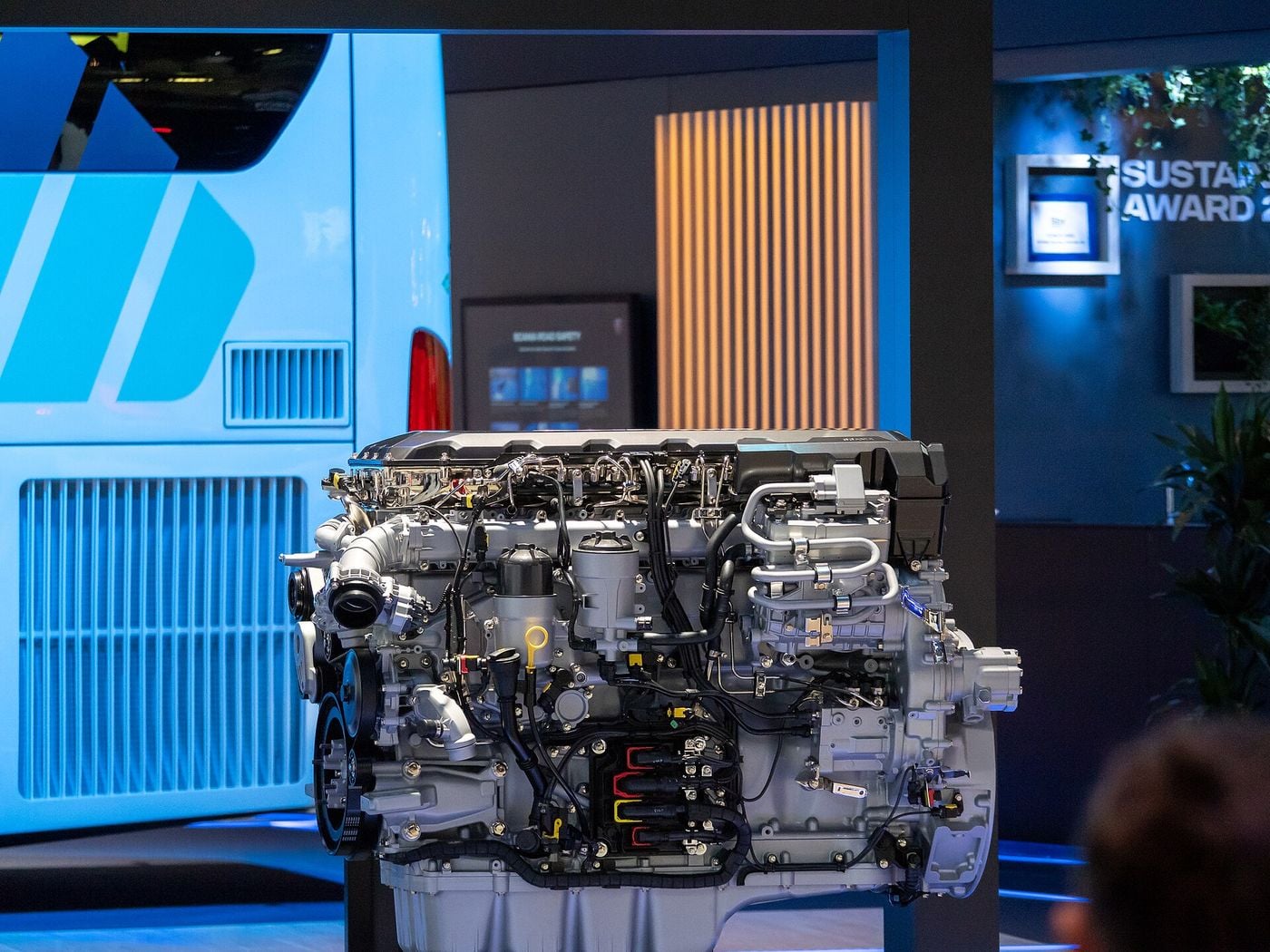
The Scania 7-litre is the six-cylinder in-line diesel engine of 6.7 litres that Scania introduced on 7 December 2017 as a fourth engine family for Euro 6 in its new truck generation. Scania’s documents call it the DC07 and list three ratings: the DC07 111 of 220 hp, the DC07 112 of 250 hp and the DC07 113 of 280 hp. Scania’s release says the engine “has been developed together with Cummins, a long-term partner of Scania in engine and component development”, and that “All of its monitoring and control systems are developed by Scania.” It runs on diesel and HVO and uses SCR only for its Euro 6 exhaust after-treatment; Scania’s P-series specification pages also list its three ratings under a Euro 5 tab. On this site it is the 7-litre engine of the Scania P-series and the Scania XT.
Status as of 26 October 2026. Scania’s press release of 7 December 2017 introducing the 7-litre family, Scania France’s body-builder engine data sheets (No 1-V10, dated 19 October 2020), Scania Australia’s 7-litre engine sheet, Scania UK’s bus range brochure (edition 2021.09) and the P-series specification pages of Scania Group and Scania UK were read on 26 October 2026. Each figure is given in the units its document uses, mostly hp, kW and Nm; how the units relate is explained in kW, hp and Nm: how to read a truck’s power figures.
What the 7-litre is
Scania’s release of 7 December 2017 introduces “a family of 7-litre engines intended mainly for urban applications” and names “applications such as distribution and waste collection”. It says the family “is based on a basic engine, of which more than 500,000 have been sold”, to which Scania added its own control units, “a completely new turbocharger installation” and its own exhaust after-treatment. In the release, Scania’s R&D engineer says the choice of Scania’s own control units also allowed the team “to get rid of the EGR system”, and describes the engine’s valve gear as pushrods with four valves per cylinder. Scania UK’s P-series page says of the DC07: “It is a straight 6-cylinder diesel engine equipped with a Bosch injection system, 4 valves per cylinder, a fixed geometry turbo, and Scania’s SCR-system.”
The base data below are those Scania prints in each document; a dash means that document does not give the item.
| Item | Release, 7 December 2017 | Scania France data sheet, 19 October 2020 |
|---|---|---|
| Cylinders | 6, inline | 6 in line, water-cooled |
| Displacement | 6.7 litres | 6.7 litres |
| Bore x stroke | 107 x 124 mm | 107 x 124 mm |
| Valves per cylinder | 4 | 4 |
| Cylinder heads | — | 1 |
| Firing order | 1-5-3-6-2-4 | — |
| Compression ratio | 17.1:1 | 17.1:1 |
| Fuel injection | Bosch | Bosch |
| Turbocharger | Fixed geometry | Fixed geometry |
| Emission control | Scania SCR | Scania SCR and a continuously regenerating diesel particulate filter |
| Exhaust brake | 88 kW at 2,500 rpm | 88 kW (120 ch) at 2,500 rpm |
Scania Australia’s engine sheet gives the same swept volume of 6.7 litres. Its introduction speaks of “SCR-only technology”, but under “Euro 6 technology” the data block of each rating prints “Lambda control, 3-way catalyst”, which differs from the SCR-only after-treatment that Scania’s release, its French data sheet and its P-series pages give for the 7-litre.
Fuels
Diesel and HVO. Scania’s release of 7 December 2017 says: “All Scania’s Euro 5 and Euro 6 engines can run on a mixture of up to 100 percent hydrotreated vegetable oil (HVO) and any proportion of diesel and HVO, regardless of engine family.” Scania UK’s P-series page says of the DC07: “These engines can run on HVO without any modifications being required.” Scania Group’s P-series page reads: “The entire Scania Euro 6 engine range is approved to run on up to 100% HVO.” What HVO is is set out in What is HVO?
Biodiesel. Scania’s P-series specification pages give a fuel for each 7-litre rating: “Diesel/HVO” under the Euro 6 tab and “Diesel/HVO/Biodiesel” under the Euro 5 tab (see the ratings below). Scania France’s 2020 data sheet prints “Diesel / xTL*” and “Diesel / xTL* / Biodiesel” in the fuel-compatibility row of its 7-litre page and defines xTL as hydrotreated vegetable oil (HVO).
Sulphur. The same French data sheet states that Scania’s Euro 6 engines require fuel with a sulphur content of at most 10 ppm.
Gas. None of the documents read lists a gas version of the 7-litre.
Emission class and after-treatment
Euro 6, SCR only. Scania’s release of 7 December 2017 says the engine “uses only selective catalytic reduction (SCR) for the exhaust gas after-treatment for Euro 6”, and that Scania’s own after-treatment system uses SCR only to reduce NOx emissions. Scania Group’s P-series page says: “Scania’s entire 7-, 9- and 13-litre engine range features SCR-only technology”. Scania France’s data sheet describes the system as Scania SCR with a continuously regenerating diesel particulate filter for Euro 6 exhaust emissions, and states that the engines comply with “EURO6 (627/2014D)”. Scania UK’s bus range brochure lists the DC07 113 under “Combustion Euro 6”. How SCR and AdBlue work is explained in SCR and AdBlue, and the steps of the standard in Euro VI (Euro 6) and Euro 7 for trucks.
Euro 5. Scania’s P-series specification pages, both Group and UK, have tabs for Euro 6, Euro 5, Euro 4 and Euro 3, and list the 7-litre at 220, 250 and 280 hp under the Euro 6 and Euro 5 tabs, with SCR under both; the Euro 4 and Euro 3 tabs have no 7-litre table. The pages do not say in which markets each tab applies.
Euro 7. The documents read give no Euro 7 version or rating of the 7-litre and do not name a Euro 6 step for it.
Generations and versions
Introduction (7 December 2017). Scania’s release presents the 7-litre as an addition to the Euro 6 engines of its new truck generation, which until then had been “based on three different engine families (9, 13 and 16 litres)”, and lists the DC07 111, DC07 112 and DC07 113 in its technical data. It says that with the DC07 Scania has “four different engine families in production for Euro 6”.
Body-builder data (19 October 2020). Scania France’s data sheets “Moteurs Euro 6 NTG”, for the New Truck Generation, No 1-V10 dated 19/10/2020, list the same three engines as “Moteur 7 litres SCR” with the same kilowatt and torque figures as the 2017 release.
Bus brochure (edition 2021.09). Scania UK’s bus range brochure lists the DC07 113 as one of two combustion engines for the Scania Fencer f1 single-deck bus on the Scania K 4x2 LB chassis, with 280 hp (206 kW) and 1200 Nm.
Current specification pages (read 26 October 2026). Scania Group’s and Scania UK’s P-series pages list the 7-litre at 220, 250 and 280 hp; the UK page names the rows DC07 111, DC07 112 and DC07 113. The documents read describe no later version or rating of the 7-litre.
Ratings as Scania states them
| Engine | Maximum power | Maximum torque |
|---|---|---|
| DC07 111 | 220 hp (162 kW) at 1,900 rpm | 1,000 Nm at 1,050–1,500 rpm |
| DC07 112 | 250 hp (184 kW) at 1,900 rpm | 1,100 Nm at 1,050–1,550 rpm |
| DC07 113 | 280 hp (206 kW) at 1,900 rpm | 1,200 Nm at 1,050–1,600 rpm |
The French data sheet labels the three engines 220, 250 and 280 ch. Scania Australia’s engine sheet gives the same power, torque and engine speeds for the 250 and 280 hp ratings, and gives the 220 hp rating as “220 hp (164 kW) at 1,900 r/min” with 1,000 Nm between 1,050 and 1,500 r/min.
| Engine ID (UK page, Euro 6 tab) | Output | Torque | Fuel, Euro 6 tab | Fuel, Euro 5 tab | Emission technology | Engine PTO |
|---|---|---|---|---|---|---|
| DC07 113 | 280 Hp | 1200 Nm | Diesel/HVO | Diesel/HVO/Biodiesel | Selective catalytic reduction (SCR) | 600 Nm |
| DC07 112 | 250 Hp | 1100 Nm | Diesel/HVO | Diesel/HVO/Biodiesel | Selective catalytic reduction (SCR) | 600 Nm |
| DC07 111 | 220 Hp | 1000 Nm | Diesel/HVO | Diesel/HVO/Biodiesel | Selective catalytic reduction (SCR) | 600 Nm |
Braking and power take-off. Scania’s release of 2017 gives the DC07’s exhaust brake as 88 kW at 2,500 rpm, and Scania France’s data sheet gives 88 kW (120 ch) at 2,500 rpm as a braking power that meets the endurance-brake requirements of ADR for a gross combination weight of 44 t. Scania UK’s P-series page reads: “The exhaust brake is rated to 127 kW @ 2,500 rpm.” The documents read do not explain the difference. What an endurance brake is, and how the law groups exhaust brakes with retarders, is explained in What is a retarder? Scania’s P-series pages list an engine PTO of 600 Nm for each 7-litre rating, and Scania Australia’s sheet a gearbox PTO of 600 Nm.
Trucks and buses on this site with the Scania 7-litre
Two model pages on this site carry the Scania 7-litre in their engine records, both of them trucks; no bus on this site records the engine. The Scania L-series page names the 7-litre in the engine tables it quotes from Scania but has no engine record for it. For the P-series, Scania’s 2017 release says the engine’s “compact format also opens for P-cabs with a low engine tunnel”: a tunnel 95 millimetres lower, which “requires you to opt for the new 7-litre engine and can be selected for all P-cabs, regardless of length or roof height.” The figures below are those of each model’s own page and of the Scania source that page cites, in kilowatts and newton-metres as the site’s records keep them; they are not the engine-level tables above.
| Model | Engine as recorded | Power (kW) | Torque (Nm) |
|---|---|---|---|
| Scania P-series | Scania 7-litre | 162–206 | 1,000–1,200 |
| Scania XT | Scania 7-litre | 162–206 | 1,000–1,200 |
Quick answers
- What is the displacement of the Scania 7-litre engine?
- 6.7 litres. Scania's release of 7 December 2017 and its French body-builder data sheet of 19 October 2020 give the DC07 as a six-cylinder in-line engine of 6.7 litres with a bore and stroke of 107 x 124 mm, four valves per cylinder and a compression ratio of 17.1:1. Scania Australia's engine sheet gives the same swept volume of 6.7 litres.
- What are the Scania DC07 111, DC07 112 and DC07 113?
- The three ratings of Scania's 7-litre engine, introduced on 7 December 2017: the DC07 111 with 220 hp (162 kW) and 1,000 Nm, the DC07 112 with 250 hp (184 kW) and 1,100 Nm, and the DC07 113 with 280 hp (206 kW) and 1,200 Nm. Scania gives maximum power at 1,900 rpm and maximum torque from 1,050 rpm. Scania's release says the engine was developed together with Cummins, with Scania's own monitoring and control systems.
- Can the Scania 7-litre run on HVO or biodiesel?
- HVO, yes, on Scania's account. Its 2017 release says all its Euro 5 and Euro 6 engines “can run on a mixture of up to 100 percent hydrotreated vegetable oil (HVO) and any proportion of diesel and HVO, regardless of engine family”, and Scania UK's P-series page says of the DC07 that “These engines can run on HVO without any modifications being required.” For biodiesel, Scania's P-series pages list the three 7-litre ratings as Diesel/HVO under their Euro 6 tab and Diesel/HVO/Biodiesel under their Euro 5 tab. None of the documents read lists a gas version.
- Which emission standard does the Scania 7-litre meet?
- Euro 6 in Scania's documents. The engine uses only selective catalytic reduction (SCR) for its exhaust after-treatment, without an EGR system, and Scania France's data sheet adds a continuously regenerating diesel particulate filter. Scania's P-series specification pages also list the three 7-litre ratings under a Euro 5 tab. The documents read give no Euro 7 version.
- Which trucks and buses use the Scania 7-litre?
- On this site, the Scania P-series and the Scania XT, both trucks, carry the 7-litre in their engine records at 162 to 206 kW and 1,000 to 1,200 Nm. Scania's 2017 release says the P-cab with a low engine tunnel, 95 millimetres lower, requires the 7-litre engine. Scania UK's bus range brochure, edition 2021.09, lists the DC07 113 of 280 hp (206 kW) and 1200 Nm for the Scania Fencer f1 single-deck bus.
Models in this article
Sources
- Scania introduces a 7-litre family for improved efficiency and reduced weight (press release P171204EN, 7 December 2017, with technical data for the DC07, DC09, DC13 and DC16 Euro 6 engines) — Scania, 7 Dec 2017
- Moteurs Euro 6 NTG (body-builder engine data sheets, No 1-V10, 19 October 2020) — Scania France, 19 Oct 2020
- Scania 7-litre engine (spec sheet, undated, read 26 October 2026) — Scania Australia
- Scania bus range (brochure, edition 2021.09) — Scania (Great Britain) Limited
- P-series specifications — engines by emission level (read 26 October 2026) — Scania Group
- P-series specifications — engine tables with engine IDs (read 26 October 2026) — Scania UK