Automated manual transmissions in heavy trucks
Why almost every European heavy tractor now shifts itself, how an automated manual differs from a torque-converter automatic, and why the gearbox is now a CO2-certification component under EU law.
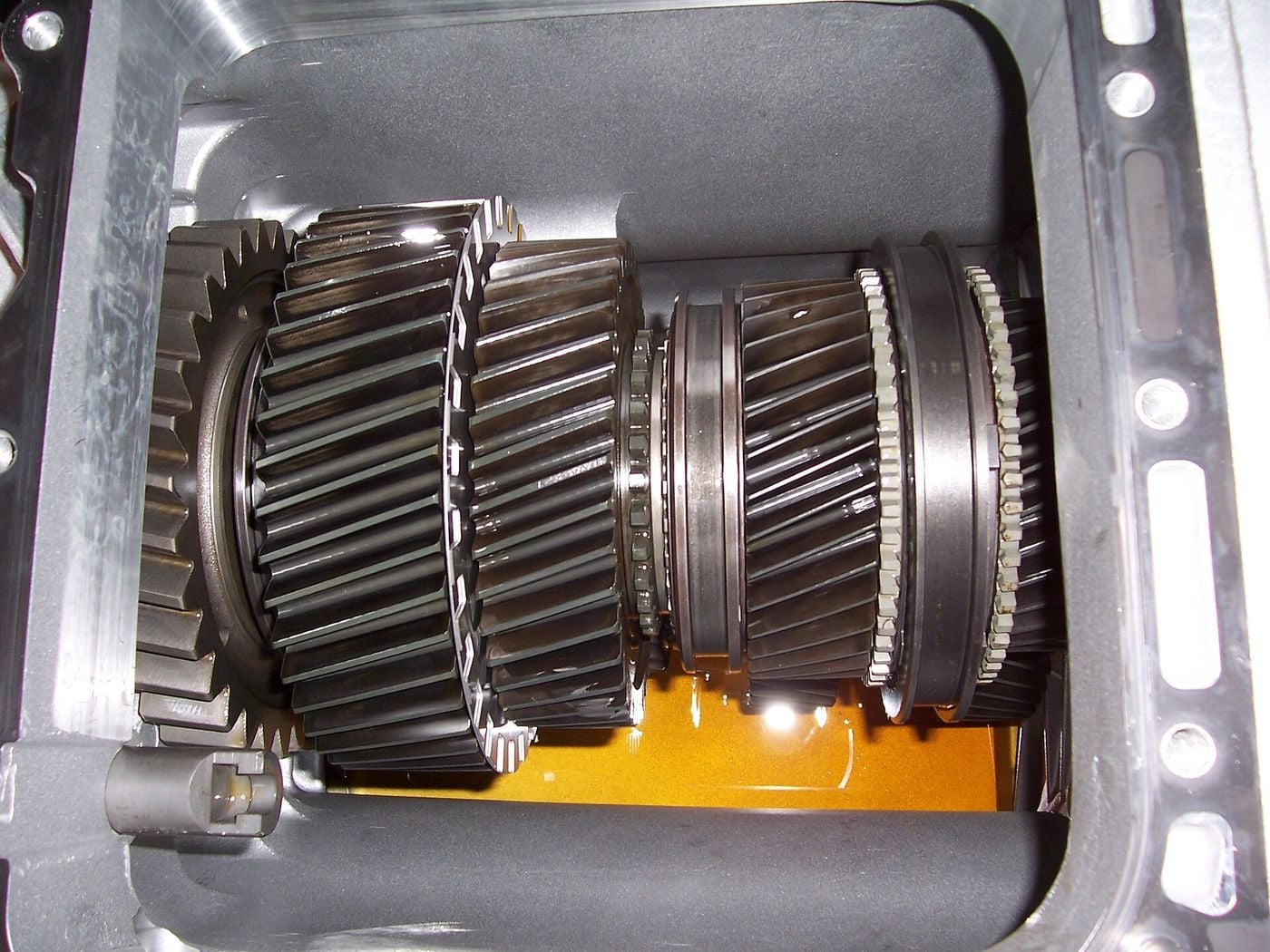
Order a heavy tractor in Europe today and the gearbox decision has largely been made for you. Volvo fits I-Shift as standard across the FH, FM and FMX. The Actros L comes with Mercedes’s own non-synchronised automated manual, the TGX with TipMatic, the DAF XG+ with ZF TraXon, the Scania S-series with Opticruise. The manual gearbox has not been outlawed; it has been out-competed. What replaced it is worth naming correctly, because “automatic” describes a different machine with different economics.
What an automated manual actually is
An AMT is a manual gearbox with the driver taken out of the loop. The gear sets, shafts and dog clutches are the ones a manual has. There is no torque converter, no planetary gear train, no hydraulic power path. What is added is actuation — pneumatic or electric actuators on the shift forks and on the clutch — plus a control unit that decides when to shift.
The shift itself is a coordinated sequence rather than a mechanical event: the ECU pulls engine torque, the actuator disengages the current gear, a brake on the gearbox input side drags the shaft to synchronous speed for the next ratio, and the gear is engaged. The main clutch is used to move away from rest and to manoeuvre; on the move, most changes happen without touching it.
That architecture is why the AMT beat the torque-converter automatic in long-haul rather than the other way round. ZF quotes 99.7 per cent transmission efficiency for TraXon, its 12-speed heavy-duty AMT, along with a torque density of 12.83 Nm per kilogram; the company passed one million units built in 2023. A torque converter cannot match a direct mechanical path, and on a truck that spends its working life in top gear, efficiency in top gear is the whole argument. Converter automatics survive where launch behaviour and low-speed control matter more than fuel: refuse collection, fire appliances, airport ground equipment. They can also hold a whole range, and the Iveco Eurocargo is the clearest case — its current brochures offer manuals, an eight-speed ZF automatic and a six-speed Allison automatic, and name no automated gearbox at all. A coach can be sold with both answers side by side: MAN offers the Lion’s Coach with a 12-speed automated TipMatic Coach or a six-speed EcoLife automatic, and its brochure restricts the automatic to the 480 hp step on the two three-axle models.
Why the manual lost, and it was not comfort
Three arguments, in rough order of how much money each moves.
The first is consistency. A manual gearbox returns whatever fuel economy the driver in the seat that day is capable of, and the spread between the best and worst driver on a fleet is wider than the specification gap between any two trucks in this class. An AMT shifts the same way on a wet Monday as it does on a good day.
The second is driveline protection. The control unit will not select a ratio that over-speeds the engine or shock-loads the driveline, and it will not slip the clutch to hold a truck on a gradient. On a heavy combination, how it is launched on a slope has more to do with driveline life than total mileage does.
The third is labour. A truck that requires no gear-changing skill widens the pool of people who can legally and competently drive it, and shortens the time to make a new driver productive. Where driver supply is the constraint on fleet growth — which is most of Europe, on the vacancy and retirement figures set out in European truck driver supply — that is not a comfort feature.
Gear count, and why twelve
Twelve forward speeds is the European default: a small number of ratios in the main box multiplied by a splitter and a range group. Twelve close-spaced steps let a modern diesel with a narrow economical band stay inside it on undulating ground instead of labouring or over-revving between widely spaced ratios. Below the heavy classes the count follows the engine rather than the maker: the MAN TGL carries a six-speed TipMatic behind its four-cylinder and a twelve-speed behind its six, which is the clearest illustration available of what the extra ratios are actually for.
Above twelve, the extra gears usually buy startability rather than economy. Scania’s heavy-duty Opticruise gearboxes — G25, G33 and G38 — offer a 14-gear ratio spread including a lower super-crawler gear and up to eight reverse gears, cover engines up to 770 hp, and weigh just five kilograms more than the standard version. Volvo’s crawler-gear I-Shift does the same job by a different route. Those extra ratios exist to get a very heavy combination moving on a slope and to creep under control on site — not to save fuel on a motorway. On a 40-tonne trunk operation, they are weight carried and never used. On a Scania S-series specified for very heavy combinations they earn their place: Scania describes the heavy-duty range as optimised for demanding operations with high gross train weight, and the rear axle gears Scania’s UK S-series specifications page lists can handle gross vehicle and train weights of up to 78 tonnes with single driven single reduction and up to 210 tonnes with tandem hub reduction — capacities of the axle gear, not a permitted weight for the truck, which only its plate gives.
The other choice buried in the gear count is overdrive versus direct drive at the top. Direct drive is the more efficient path in the highest ratio; overdrive instead pairs a numerically higher final drive ratio with the gearbox to reach the same overall reduction — our arithmetic, following the same total-ratio relationship set out on that page. MAN’s UK chassis sheets for the TGS carry two separate twelve-speed ratio sets rather than one: an overdrive set, 12.92 down to 0.77, on the two 8x4 tippers, the 8x4 tridem and the 6x4 rigid, and a direct-drive set, 16.69 down to 1.00, on the 4x2 and 6x2 rigids and the tractor sheets. Ford Trucks makes the same contrast visible within one model: the F-MAX runs a sixteen-speed of Ford’s own with an overdrive top, and its user manual still prints the ratio table for the direct-drive sixteen-speed it replaced.
The remaining gains are in prediction
The mechanical argument is largely settled. What is left is knowing what the road does next.
Mercedes-Benz’s Predictive Powertrain Control combines GPS position with stored three-dimensional road maps to build an electronic horizon, then adjusts road speed and gear selection for gradients, crests, bend radii, speed limits and junction priorities ahead. Mercedes says the system knows more than 95 per cent of European cross-country and trunk roads, saves up to five per cent fuel against a vehicle without it, and continuously optimises the transmission’s EcoRoll coasting mode so the truck uses its own momentum instead of accelerating into a descent. On the Actros L this is bundled with a driveline already built around holding a high gear: peak torque across all three of its engine families arrives at 1,100 rpm. Volvo’s I-See reaches the same result by learning topography from repeated runs rather than by reading a map.
The reason none of this works with a manual is that a prediction is worthless unless something acts on it every time. Holding twelfth over a crest instead of dropping a gear, or beginning a coast three hundred metres before a descent, has to happen on every crest and every descent — not on the ones the driver notices.
Dual clutch, and torque interruption
Volvo introduced I-Shift Dual Clutch in 2014, the first dual-clutch transmission in a heavy truck. Two input shafts and two clutches allow the next gear to be pre-selected while the current one is still driving, so the handover happens with no interruption in power or torque delivery. It is offered as an option on the Volvo FH alongside the standard I-Shift.
Torque interruption costs the most in heavy combinations on rolling terrain, in timber and tanker work on sustained gradients, and on distribution routes with constant speed changes. On flat trunk running at 40 tonnes, a modern single-clutch AMT shifts fast enough that the difference in torque interruption is small.
Shift speed has been the other line of development, and it is incremental engineering rather than a new architecture. Volvo’s 2022 I-Shift update claimed shifts up to 30 per cent faster, achieved through more accurate sensors, new software on a faster microprocessor, an added disc in the gearbox brake so it reacts sooner before a change, and reduced air volume in the shift-fork, clutch and gearbox-brake actuation.
Why the gearbox is now a certification item
There is a regulatory reason manufacturers argue about transmission losses to the third decimal place. Heavy-duty CO2 in the EU is not measured on a chassis dynamometer; it is simulated with VECTO, the Commission’s Vehicle Energy Consumption calculation Tool, whose use is mandated by Regulation (EU) 2017/2400. Gearbox friction is one of its input parameters, alongside rolling resistance, air drag, masses and inertias, auxiliary power and engine performance, with torque losses declared per gear.
That makes transmission efficiency a number the manufacturer’s declared fleet figure is measured against, not just a sales claim. It is why the gearbox stopped being a component truck makers bought on price.
Predictive functions such as PPC and I-See sit on top of that same hardware as software, ordered or not ordered when a truck was built; the gearbox itself looks identical either way, which is why the case for the transmission increasingly rests on what is running inside the control unit rather than what is bolted to the chassis.
Quick answers
- What is an automated manual transmission (AMT)?
- An AMT is a manual gearbox with the driver taken out of the loop: the same gear sets, shafts and dog clutches, but with actuators on the shift forks and clutch and a control unit that decides when to shift. There is no torque converter or planetary gear train, and on the move most changes happen without touching the clutch.
- What is the difference between an AMT and a torque-converter automatic?
- An AMT keeps a direct mechanical path — ZF quotes 99.7% transmission efficiency for its 12-speed TraXon — which is why it won in long-haul, where a truck spends its life in top gear. Torque-converter automatics survive where launch behaviour and low-speed control matter more than fuel: refuse collection, fire appliances, airport equipment.
- Why do European heavy trucks usually have twelve gears?
- Twelve forward speeds — a small main box multiplied by a splitter and a range group — let a modern diesel with a narrow economical band stay inside it on undulating ground. Gear counts above twelve buy startability, not economy: Scania’s heavy-duty Opticruise adds a super-crawler gear, and Scania says the range is optimised for demanding operations with high gross train weight — a gear a 40-tonne trunk operation carries and never uses.
- Why is the gearbox now a certification item?
- Heavy-duty CO2 in the EU is simulated with VECTO under Regulation (EU) 2017/2400, and gearbox friction is one of its input parameters, with torque losses declared per gear. That makes transmission efficiency part of the maker’s declared fleet figure, not just a sales claim — which is why makers argue about it to the third decimal place.
Models in this article
Sources
- TraXon — automated manual transmission for heavy vehicles — ZF Friedrichshafen
- Volvo Trucks increases I-Shift gearbox shifting speed by up to 30% — Volvo Trucks
- Heavy-Duty Opticruise Gearbox — Scania
- Predictive Powertrain Control (PPC) — 10 questions and answers about the predictive cruise control from Mercedes-Benz Trucks — Daimler Truck
- Vehicle Energy Consumption calculation Tool (VECTO) — European Commission — Directorate-General for Climate Action
- Volvo I-Shift automated manual transmission — Volvo Trucks
- Find out what makes I-Shift Dual Clutch such a smooth operator — Volvo Trucks
- Fact sheet — SPO2812 I-Shift Dual Clutch — Volvo Trucks
- S-series specifications — engines by emission level, gearboxes, rear axle gears, axle configurations — Scania