Volvo
Volvo FL
Two engine families from 5.1 to 7.7 litres, 4x2 and 4x4 drive, and a plate that changes with every variant — what the FL is and what to check used.
.jpg)
Model overview
Axle configurations: 4x2 · 4x4
Engine families
- Power
- 154–177 kW
- Torque
- 800–900 Nm
- Rated speed
- 2200 rpm
- Power
- 184–235 kW
- Torque
- 950–1200 Nm
- Rated speed
- 2100 rpm
Five diesel ratings, from the specification page: D5 210 hp (154 kW) at 2200 r/min with 800 Nm at 1100-1700 r/min; D5 240 hp (177 kW) at 2200 r/min with 900 Nm; D8 250 hp (184 kW) at 2100 r/min with 950 Nm at 900-1700 r/min; D8 280 hp (206 kW) at 2100 r/min with 1050 Nm at 950-1700 r/min; D8 320 hp (235 kW) at 2100 r/min with 1200 Nm at 1050-1600 r/min. Volvo marks the 240 hp and the 320 hp ratings "available with B100, biodiesel"; the 320 hp rating appears on none of the nine GB data sheets opened, which offer only D5K210, D5K240, D8K250 and D8K280. The product guide agrees with the sheets rather than with the specification page: it gives the range as "from 210 to 280 hp", prints those same four ratings and no others, and caps the six-cylinder at "up to 1050 Nm". The 320 hp step is published on two of the Volvo documents opened for this record: the UK specification page, and the global model page, whose own summary line reads "210 - 320 hp". The 235 kW and the 1200 Nm are the UK specification page's alone. The 14 May 2013 release is not a source for either. It is a joint Volvo FE / Volvo FL document; its sentence "The new 6-cylinder D8 engine has a displacement of 7.7 litres and is available with a choice of three power outputs: 320 hp, 280 hp and 250 hp" names no model, where the release names the FL explicitly for the four-cylinder D5 and names the FE explicitly for I-Shift; and it carries no kW and no Nm figure anywhere. The powerKw and torqueNm ranges above are the specification page's spans, and their top ends are that step. Both engines are quoted with a bore of 110 mm, a stroke of 135 mm and a compression ratio of 17.5:1; economy revs are 1100-1800 r/min on the D5 and 1000-1700 on the D8; oil change interval up to 100,000 km or two years with VDS5. Exhaust braking effect 80 kW on the D5 and 120 kW on the D8, both at 2800 r/min, with an optional compression brake of 170 kW at 2800 r/min on the D8; the data sheets code these EBR-EPG and EBR-CEB. The same page gives a hydraulic retarder for AL306 gearboxes a maximum effect of 400 kW and, three paragraphs later, a gearbox-mounted compact retarder a maximum effect of 440 kW, without reconciling the two. Gearbox table, with maximum torque and Volvo's own GCW approval: ZTO1006 manual 6-speed 1050 Nm 32.5 t, ZTO1109 manual 9-speed 1200 Nm 44 t, STO8006 manual 6-speed 850 Nm 24 t, AL306 automatic 6-speed 1600 Nm 36 t, 8AP1200 automatic 8-speed 1200 Nm 36 t. Those are component approvals, not weights any FL is plated at. The FL816 and FL818 4x2 sheets name the AL306 "Allison AL306 6-speed automatic gearbox"; all five steel-suspension 4x2 sheets opened list the automated 6-speed I-Sync ATO1056 and footnote it "if the truck is built from week 47 an 8 speed ZF powerline automatic", and the current specification page no longer lists ATO1056 at all. Neither 4x4 sheet opened lists any automatic — only the ZTO1006 manual. Note that the sheets give that incoming 8-speed no type code and the specification page's 8AP1200 entry names no maker: taking the two to be the same gearbox is this site's identification across two documents, not a statement either one makes. Rear axles, with maximum torque, maximum axle load and GCW approval: RSS0819A 950 Nm 8.5 t 19 t; RSS1125A 1050 Nm 11.5 t 25 t; RSS1132A 1050 Nm 11.5 t 32.5 t; RSS1344C 2600 Nm 13 t 44 t; and the hub-reduction RSH1140C, 1200 Nm 11 t 40 t, offered only on the 4x4. Published ratios run from 3.31:1 to 6.66:1. Chassis heights approx 810-830 mm (Low), 860 (Med), 950 (High), 960 (X-High) and 1175 (XX-High, 4x4 only); maximum front axle load 4.0 t to 7.5 t depending on height and on leaf or air suspension. Fuel tanks from 80 to 300 litres, with a two-tank combination of 215 litres each giving 430; AdBlue tank 32 litres. Day, short sleeper and crew cab, all with an interior height of 1605 mm. No crew-cab seat count is published here, because Volvo's own documents give two: the specification page says "up to 7 persons", six of the seven steel-suspension sheets opened code the cab FL-CREW2, "Cab - Four door six person crew cab", and the 16 September 2025 press release describes "a crew cab with room for six people". Wheels 17.5, 19.5 or 22.5 inches by model. GB plated weights, in kilograms, plated then design, all from the steel-suspension rigid sheets: FL510 4x2 10000 / 10000 gross vehicle and 0 / 15500 gross combination; FL512 12000 / 12000 and 0 / 15500; FL514 12960 / 14000 and 0 / 19500; FL816 14440 / 16000 and 0 / 19500; FL818 18000 / 18000 and 0 / 24000; FL812 4x4 13000 / 13000 and 0 / 16500; FL816 4x4 16000 / 16000 and 0 / 16500. The design combination weight is a property of the rear suspension, not of the designation. Volvo publishes a rear-air-suspension sheet of the same 2026-02-17 date for the same 4x2 designations, and on those the FL514 and the FL816 read 0 / 21000 rather than 0 / 19500 — FL 42 R 514A and FL 42 R 816A, both opened for this figure alone. The gross vehicle weights do not move with the suspension: the air sheets repeat 12960 / 14000 and 14440 / 16000. Nor does the FL818's, which is 0 / 24000 on both, so the gcwT above is unaffected; 24000 kg is the highest combination figure on any of the GB diesel sheets. Axle plates: FL816 4x2 5000 / 5800 front and 9440 / 10900 rear; FL818 7100 / 7500 front and 11500 / 11500 rear; FL812 4x4 5600 front and 7400 rear, which sum to its 13000 kg gross vehicle weight. Kerb weights across the sheets run from 3895 kg (FL510, shortest wheelbase) to 5550 kg (FL816 4x4, longest); at the same 3500 mm wheelbase the 4x2 FL816 is 4485 kg and the 4x4 FL816 5495 kg, a difference of 1010 kg that is this site's subtraction and not a Volvo statement. Wheelbases are per sheet and the ladders differ: twelve from 3250 to 6500 mm on the FL510, FL512, FL514 and FL816 4x2 sheets, twelve from 3500 to 6800 mm on the FL818, and four from 3350 to 4100 mm on both 4x4 sheets. Overall chassis length 6545 to 12030 mm; turning circle kerb to kerb 11600 to 23400 mm. Drawing heights are given per variant and run right across the seven sheets: 2694 mm on the FL510, 2695 on the FL512, 2748 on the FL514, 2761 on the FL816 4x2, 2836 on the FL818 and 3027 on both 4x4 sheets. The sheets add that height can vary by 20 mm for leaf and 10 mm for air suspension; the only width on any drawing is "Cab 2282". The 14 May 2013 release describes a 12-tonne version weighing 500 kg less than a corresponding truck with a six-cylinder engine, and calls that truck "lighter, lower and more competitively priced than the current model" — one of the phrases that make the release an update to an existing range rather than the start of the model — although the release also uses the word "launch" for the event, in "In conjunction with the launch of the new Volvo FE and Volvo FL". The 22 May 2006 release is where Volvo presents the FL as new, and it gives no output, weight or dimension: its only technical statement is that both models meet "the environmental requirements according to Euro 4 and Euro 5". Volvo's global model page describes the range as "Available in versions from 10 to 19 tonnes" with "five engine output alternatives between 210 and 320 hp". The upgraded 4x4 announced on 16 September 2025 is described only as having new front and rear axles, new axle ratios and Volvo's 8-litre engine, with production beginning during November 2025; no output, ratio or weight is given for it.
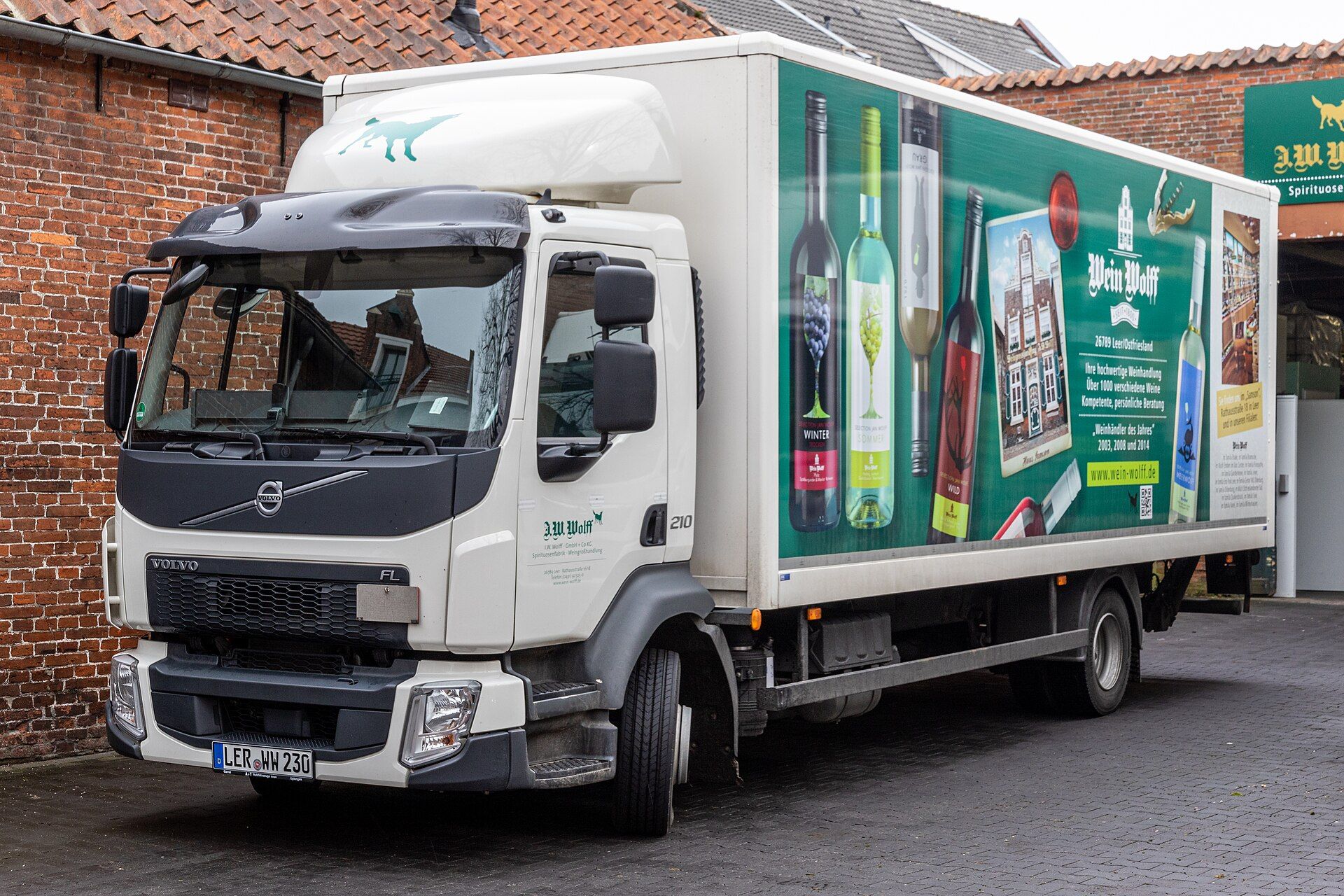
The FL is the smallest truck Volvo builds for Europe: a two-axle rigid chassis sold for city delivery, urban construction and rescue work, below the FE and well below the FM and FH. Volvo’s own summary is “Available in versions from 10 to 19 tonnes” with “five engine output alternatives between 210 and 320 hp”, in 4x2 or 4x4 drive. Nothing about it is built for a motorway.
Volvo presented the FL on 22 May 2006, alongside the FE — “two completely new distribution trucks”, meeting Euro 4 and Euro 5. What happened on 14 May 2013 was not a new truck but new engines in a range already being built: AB Volvo’s release of that date says the FL “range is extended with a very competitive four-cylinder, 5-litre engine”, introduces the six-cylinder D8 of 7.7 litres beside that compact D5 of 5.1 litres, revises the driver environment, and sets its new 12-tonner against “the current model”. That release does use the word launch — “in conjunction with the launch of the new Volvo FE and Volvo FL” — but what it describes is an existing range re-engined, which is why the date this record carries for the model is the 2006 presentation and not this one. Volvo announced an upgraded 4x4 on 16 September 2025 with new front and rear axles and new axle ratios, production beginning during November 2025; that release names no output, ratio or weight.
The engine, gearbox, rear-axle and chassis tables below are Volvo Trucks UK’s specification page. The weights, wheelbases, kerb weights and turning circles are seven of the 21 model-range data sheets that page links to — five 4x2 and two 4x4, all of them steel-suspension sheets — with two rear-air-suspension sheets opened for the combination and gross vehicle weights alone. Each of the nine is dated 17 February 2026 and each is footnoted “Legal weights can differ from country to country”; those are Great Britain figures, and they are the only figures here that are. Volvo’s product guide, the global model page and the three press releases are named separately where they are used, because none of them is a GB document.
Two engine families, four cylinders and six
The D5K is the four-cylinder, 5.1 litres, in two ratings: 210 hp (154 kW) and 240 hp (177 kW), both making maximum power at 2200 r/min, with 800 and 900 Nm. The D8K is the six-cylinder, 7.7 litres, in three: 250 hp (184 kW), 280 hp (206 kW) and 320 hp (235 kW), all at 2100 r/min, with 950, 1050 and 1200 Nm. Both share a bore of 110 mm, a stroke of 135 mm and a compression ratio of 17.5:1, and Volvo footnotes both power columns “Net output according to: EC 582/2011”, which is the footnote that makes two power figures comparable at all.
Volvo’s product guide says which is for what: the D5K is “Ideal for smaller trucks like the Volvo FL 12-tonner”, while for heavier versions such as the 18-tonner it calls the D8K with either 250 or 280 hp “a perfect match”. That guide carries no date, and what dates it is inside it: its electric block reads “Sales start in 2019”, its gearbox table opens with the ATO1056, and the eight-speed automatic appears nowhere in it. The application advice above is therefore older than the eight-speed, and is quoted as the guide’s, not as Volvo’s current word. No claim is made that it is older than the 320 hp rating: no document opened for this page dates that rating for the FL at all.
The 14 May 2013 release made the point from the other end, describing a 12-tonne FL with the 240 hp D5 as weighing 500 kg less than a corresponding truck with a six-cylinder engine — and on a multi-drop chassis that half-tonne is payload every day of the vehicle’s life.
Two ratings carry an asterisk: the 240 hp D5 and the 320 hp D8 are marked “available with B100, biodiesel”. The 320 hp appears on none of the diesel data sheets read here, which offer D5K210, D5K240, D8K250 and D8K280 and nothing else — and the product guide agrees with them rather than with the specification page, giving the range as “from 210 to 280 hp”, printing those same four ratings and capping the six-cylinder at “up to 1050 Nm”.
So the 320 hp step is published on two of the Volvo documents opened for this page: the UK specification page, and the global model page quoted at the top of this article, whose own summary line reads “210 - 320 hp”. The 235 kW and the 1200 Nm at the top of the D8 row in the table above are the specification page’s alone. The 14 May 2013 release is not a third source for either. It is a joint FE and FL document; its sentence “The new 6-cylinder D8 engine has a displacement of 7.7 litres and is available with a choice of three power outputs: 320 hp, 280 hp and 250 hp” names no model, where the same release names the FL explicitly for the four-cylinder D5 and the FE explicitly for I-Shift; and it carries neither a kW nor a Nm figure anywhere in it. The 320 hp is a real rating; it is not the ordinary top of the GB range.
The emission architecture is in the past tense here because that is where its sources are. When the D5 and D8 arrived in May 2013, Volvo described the Euro 6 solution as “a combination of selective catalytic reduction (SCR) and variable turbo geometry, a cooled EGR system and a particulate filter”; the product guide, dated above as the older document it is, sets out the same chain as SCR refined with a water-cooled exhaust gas recirculation system and a diesel particulate filter. No current Volvo document opened for this page restates it for the step E engines — the specification page carries no aftertreatment entry at all. What that page does carry is the AdBlue tank: a 32-litre plastic unit whose position on the chassis, left or right, is an ordering choice on the sheets — SCR and AdBlue as a body-building constraint.
Five gearboxes, and one of them is on the way out
Three manuals: ZTO1006 six-speed at 1050 Nm, ZTO1109 nine-speed at 1200 Nm, STO8006 six-speed at 850 Nm. Two automatics: the AL306 six-speed, which the FL816 and FL818 4x2 sheets name “Allison AL306 6-speed automatic gearbox” and which is a torque-converter automatic, at 1600 Nm; and the 8AP1200 eight-speed at 1200 Nm.
Those torques, and the approvals below, are the current specification page’s. The product guide disagrees with it on all four gearboxes the two have in common, and on the AL306 twice over: the guide gives that gearbox 1500 Nm and a 32 t approval against the page’s 1600 Nm and 36 t, the ZTO1006 32 t against 32.5 t, the ZTO1109 36 t against 44 t and the STO8006 19 t against 24 t. The three manuals’ maximum torques are the one thing the two agree on. The current page is followed here, and the guide is the older document for the reason set out above.
Volvo never says who builds the 8AP1200. The specification page gives the code and no maker; the data sheets describe the incoming gearbox as “an 8 speed ZF powerline automatic” and give it no code. Taking the two to be one gearbox is this page’s identification across two documents, not a statement either of them makes.
The interesting one is disappearing. All five steel-suspension 4x2 sheets read here still list the ATO1056 as an “Automated 6-speed I-sync overdrive”, footnoted “if the truck is built from week 47 an 8 speed ZF powerline automatic”, while the current specification page does not list it at all. Neither 4x4 sheet read here lists any automatic — only the ZTO1006 manual. That is an automated manual being replaced by a true automatic inside a model year, and it matters in a used advert, because the two behave differently and sellers use the words loosely.
Volvo publishes a GCW approval against each gearbox — 32.5 t for the ZTO1006, 44 t for the ZTO1109, 24 t for the STO8006, 36 t for both automatics. Those are component ratings. No FL sheet plates a vehicle near 44 tonnes, and an approval is not a gross combination weight the vehicle may be run at.
The rear axle, and the ratio ladder behind it
Four single-reduction hypoid axles are listed: RSS0819A at 950 Nm, 8.5 t axle load and a 19 t approval; RSS1125A at 1050 Nm, 11.5 t and 25 t; RSS1132A at 1050 Nm, 11.5 t and 32.5 t; RSS1344C at 2600 Nm, 13 t and 44 t. The fifth, RSH1140C, is hub reduction at 1200 Nm, 11 t and 40 t, and is offered only on the 4x4.
Volvo prints the whole ladder rather than a headline figure, from 3.31:1 to 6.66:1, and the spread is wide because one chassis has to carry a box body at road speed and a fire pump up a farm track — which is what a final drive ratio is chosen to separate.
What stops a truck that stops twenty times a day
Exhaust braking effect is 80 kW on the D5 and 120 kW on the D8, both at 2800 r/min, with an optional compression brake on the D8 rated at 170 kW at the same speed. On a chassis whose day is a sequence of decelerations into delivery points those figures decide how much work the wheel brakes do, and they are the kind of published number endurance braking usually has to do without.
The retarder is where Volvo contradicts itself: the same page gives a hydraulic retarder for AL306 gearboxes a maximum effect of 400 kW and, further down, a gearbox-mounted compact retarder a maximum effect of 440 kW. Both are Volvo’s. This page does not reconcile them.
What we could not confirm
The Euro VI step is not claimed. The specification table heads both diesel columns “Euro 6” and stops. All seven steel-suspension sheets carry the code EU6SCR, “Emission level - Euro VI step E”, as standard equipment — but each specifies one vehicle for one market, and a step named on seven GB documents is not a step named for the range. The record therefore stops at Euro VI; why a maker’s table and its own order code spell the same thing differently is a subject of its own.
No dimensions are published here. Overall chassis length runs 6,545 to 12,030 mm; turning circle kerb to kerb 11,600 to 23,400 mm; and drawing height moves right across the seven steel-suspension sheets — 2,694 mm on the FL510, 2,695 on the FL512, 2,748 on the FL514, 2,761 on the FL816 4x2, 2,836 on the FL818 and 3,027 on both 4x4s — before the sheets’ own 20 mm for leaf and 10 mm for air suspension is added. That the 4x4 stands a third of a metre taller than the lightest 4x2 is the clearest argument on this page for leaving the field blank. The only width on any drawing is “Cab 2282”, which is the cab.
No rev band for the 240 hp D5. The specification page puts its 900 Nm at 1200–1600 r/min; the FL510 and FL512 sheets put the same 900 Nm at 1100–1600.
No seat count for the crew cab. The specification page offers “ample space for several additional passengers up to 7 persons”. Six of the seven steel-suspension sheets code the same cab FL-CREW2, “Cab - Four door six person crew cab”, and the 16 September 2025 release describes “a crew cab with room for six people”. Three Volvo documents, two answers, and no reason on any of them to prefer one.
No FL Electric figure appears. Volvo lists the FL and the FL Electric as separate vehicles in its own navigation, and its documents disagree with each other on the electric’s power, battery and range. That vehicle needs its own record.
Two configurations, and a plate for each variant
The FL is built as a 4x2 and a 4x4 and that is the list, so the axle configuration question is settled before the specification starts. The wheelbase ladders are per sheet, not per model, and they do not line up: the FL510, FL512, FL514 and FL816 4x2 sheets each list twelve from 3,250 to 6,500 mm — the 16-tonner starts as short as the 10-tonner — the FL818 lists twelve of its own from 3,500 to 6,800 mm, and the two 4x4 sheets read here list four from 3,350 to 4,100 mm. Those are the seven steel-suspension sheets opened for the ladders out of the 21 the page links, so the ladders on the rest are not claimed here either way. Chassis height runs from approximately 810 to 1,175 mm, the tallest reserved for the 4x4, and maximum front axle load from 4.0 t to 7.5 t according to that height and to whether the suspension is leaf or air.
The weights are where a distribution rigid stops being one vehicle. Every GB sheet read here prints two columns, plated and design, and they are not always the same number: the FL510 is 10,000 kg gross vehicle on both, the FL512 12,000 on both, the FL514 12,960 plated against 14,000 design, the FL816 14,440 against 16,000, the FL818 18,000 on both. The sheet titled “FL812 4x4 Rigid 12 tonne” plates the vehicle at 13,000 kg, its 5,600 kg front and 7,400 kg rear axle plates adding to exactly that figure — our addition, not a Volvo statement — while the FL816 4x4 is 16,000 on both columns.
The combination figure is stranger, and it belongs to the rear suspension as much as to the designation. Every sheet read here prints 0 in the plated column against a design figure alongside, and on the seven steel-suspension sheets those are 15,500 kg on the FL510 and FL512, 19,500 on the FL514 and the FL816 4x2, 24,000 on the FL818, 16,500 on both 4x4s. Volvo publishes a rear-air-suspension sheet of the same date for the same 4x2 designations, and there the FL514 and the FL816 read 21,000 kg instead of 19,500. The gross vehicle weights do not move that way — the air sheets repeat 12,960 / 14,000 and 14,440 / 16,000 — and the FL818 reads 24,000 on both suspensions, which is why the figure in the table above survives the distinction. The design figure is Volvo’s; what the zero means for a particular registration is a question for the plate on the vehicle, not for this page. The figures in the table above are the FL818 steel-suspension sheet’s — one variant’s, and worth nothing quoted without it.
All-wheel drive costs weight, and the sheets let you price it: at the same 3,500 mm wheelbase and the same 16-tonne designation, the 4x2 FL816 has a kerb weight of 4,485 kg and the 4x4 5,495 kg. The difference of 1,010 kg is our subtraction from two documents dated the same day.
Three cabs are offered — day, short sleeper and crew — all with an interior height of 1,605 mm. How many the crew cab seats is not settled, for the reason given above. On a delivery truck the cab choice is an access decision before a comfort one, and the crew cab is there because much of what is bought as a distribution chassis is a municipal or rescue vehicle carrying people to a job.
Who this truck is right for
The FL suits urban and regional delivery fleets buying a rigid at 10 to 18 tonnes, and municipal, utility and rescue operators needing a small chassis with all-wheel drive and a published weight sheet their bodybuilder can work from. The four-cylinder D5 is the maker’s own answer for the lighter end, where kerb weight is worth more than reserve power; the D8 is for the 16- and 18-tonne end and for anything that tows.
It is the wrong truck for trunking: the sleeper is a short one, and no FL sheet read here plates a combination weight anywhere near long-haul work — the highest design figure on any of them is the FL818’s 24,000 kg, and the GB plated column reads 0 on every one of them. The gearboxes are not what stops it. The ZTO1109 is approved to 44 t, which is a component rating and not a weight any FL is plated at; it is the plate that ends at 24,000 kg, not the driveline.
Where it sits against its rivals
The MAN TGL, the Mercedes-Benz Atego and the DAF LF are the direct competitors. This site holds verified records for the first two, built from the makers’ own documents, so the comparison can be made rather than declined. Only the DAF LF is genuinely unopened here, and no LF figure appears below.
The MAN TGL is read from the same kind of document as the FL — MAN Truck & Bus UK’s GB bodybuilder sheets — and it stops earlier in every direction. It is 4x2 only, where the FL is also built as a 4x4. MAN’s GB plating tops out at 12,000 kg gross vehicle against 24,000 kg gross train, where the FL818 carries 18,000 kg gross vehicle against a design combination figure of the same 24,000 kg — with the difference that MAN prints that combination figure in its legal column and Volvo prints 0 in its plated one, which is the more useful distinction of the two. And the TGL’s ceiling is 184 kW, exactly where the FL’s six-cylinder starts.
The Mercedes-Benz Atego is the closer answer. It is built as a 4x2 and a 4x4 like the FL, and its two engines are the same two sizes: a 5.1-litre four-cylinder and a 7.7-litre six, against Volvo’s 5.1-litre D5K and 7.7-litre D8K. Weights cannot be set side by side at all, and the reason belongs to the Mercedes record rather than this one: Mercedes publishes no gross combination weight for the Atego in any document this site opened, and every gross vehicle weight it does publish is either a span or tied to one named vehicle. Against the Atego, then, the FL buyer is the better documented one — not the better served truck, necessarily, but the one whose figures can be checked.
The comparison with the class above is easier. The DAF XD begins at roughly the weight the FL ends at — 18,000 kg gross vehicle is the top of the FL’s GB sheets and the bottom of the XD’s — and the two overlap only there. What Volvo does better than anything read for this page is documentation: a separate sheet per plated variant, with kerb weights per wheelbase, lets a body supplier work out the finished vehicle’s payload before the order is placed, which matters more on a small chassis because the body is a larger fraction of the price.
Buying used
Read the plate, not the badge. A sheet titled “12 tonne” plates a 4x4 at 13,000 kg and one titled “16 tonne” plates a 4x2 at 14,440 kg against a 16,000 kg design figure; the name on the door tells you which document to look for and nothing else. The same discipline applies to the combination figure as in any used truck purchase: establish what the vehicle is plated to pull before agreeing what it will pull.
Ask which gearbox is fitted and when the chassis was built. The changeover from the automated I-Sync to the eight-speed automatic is undated in Volvo’s own footnote — “if the truck is built from week 47” — so on trucks from that period the only way to know is to look.
Ask what body it carried and how many stops a day it did. An odometer understates a multi-drop truck badly; engine hours and the service record around the emission system are the honest measures. On a 4x4, ask what the all-wheel drive was used for: a truck that spent its life on unmade ground has had a different decade from one that never left a yard.
Quick answers
- Which engines are available in the Volvo FL?
- The record for the Volvo FL covers these engine families: Volvo D5K (5.1 l), Volvo D8K (7.7 l). Output spans 154–235 kW and 800–1200 Nm.
- What axle configurations does the Volvo FL come in?
- 4x2, 4x4.
- What emission standard does the Volvo FL meet?
- Euro VI.
Compared with
- MAN TGL
- Mercedes-Benz Atego
- DAF LF
Sources
- Volvo FL specifications — engines, gearboxes, rear axles, chassis, data sheets — Volvo Trucks
- Model range data sheet — FL818 4x2 Rigid 18 tonne, steel suspension — Volvo Trucks
- Model range data sheet — FL816 4x4 Rigid 16 tonne, steel suspension — Volvo Trucks
- Model range data sheet — FL816 4x2 Platform 16 tonne, rear air suspension — Volvo Trucks
- Volvo FL product guide (publication id 10053) — Volvo Trucks
- Volvo FL — model overview — Volvo Trucks
- Two new trucks - Volvo FL and Volvo FE — AB Volvo
- The new Volvo FE and Volvo FL — optimised for city and suburban deliveries — AB Volvo
- Volvo Trucks launches upgraded Volvo FL 4x4 truck for demanding tasks — Volvo Trucks
- Model range data sheet — FL816 4x2 Rigid 16 tonne, steel suspension — Volvo Trucks
- Model range data sheet — FL514 4x2 Rigid 14 tonne, steel suspension — Volvo Trucks
- Model range data sheet — FL512 4x2 Rigid 12 tonne, steel suspension — Volvo Trucks
- Model range data sheet — FL510 4x2 Rigid 10 tonne, steel suspension — Volvo Trucks
- Model range data sheet — FL812 4x4 Rigid 12 tonne, steel suspension — Volvo Trucks
- Model range data sheet — FL514 4x2 Platform 14 tonne, rear air suspension — Volvo Trucks