Volvo D8K engine: 7.7-litre diesel, ratings, fuels and vehicles
Volvo's 7.7-litre in-line six diesel from Volvo's own documents: the Euro 6 D8K at 250 to 350 hp, HVO and B100, engine braking, and the trucks that use it.
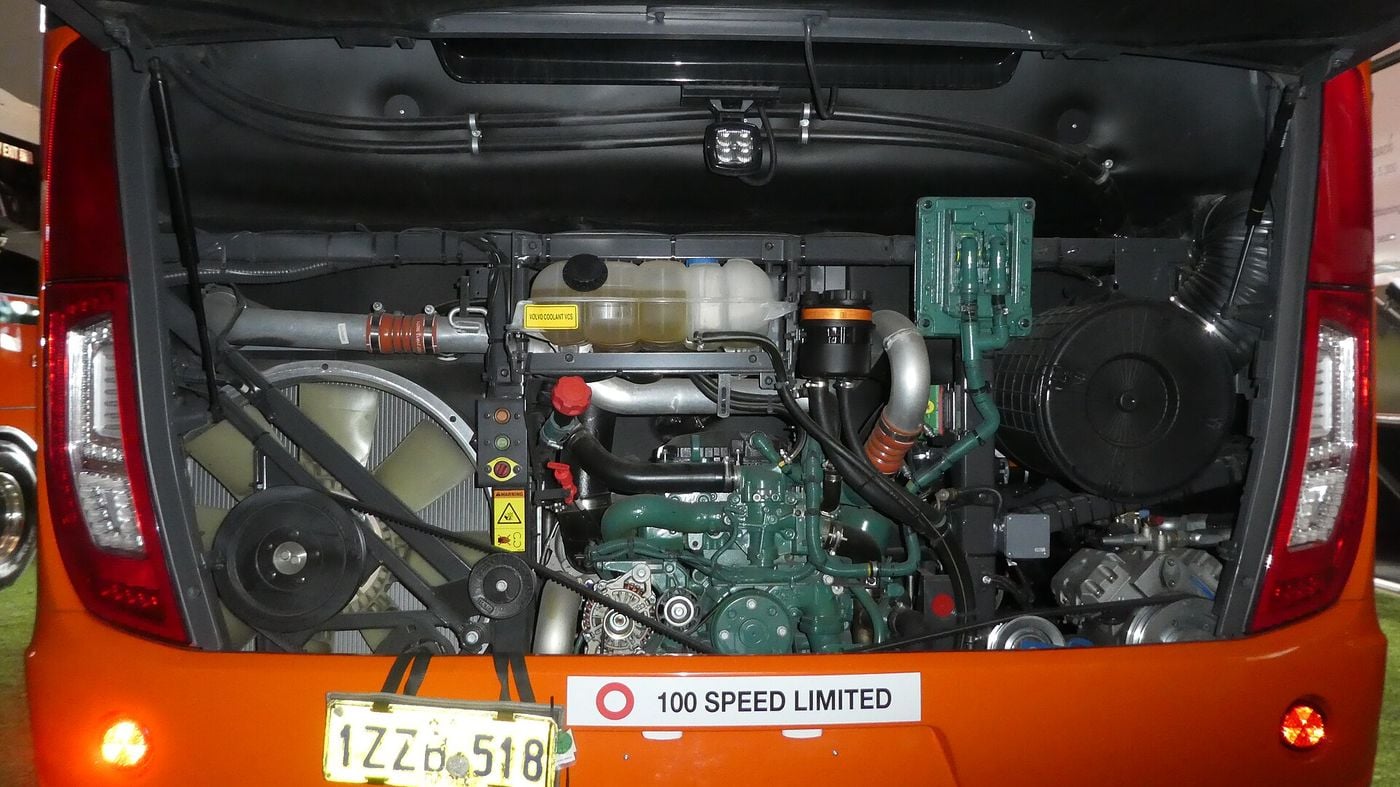
The Volvo D8K is Volvo’s 7.7-litre diesel engine with six cylinders in line. Volvo Trucks’ fact sheet of 11 September 2017 describes the D8K350, EU6SCR as “an in-line six-cylinder diesel engine with a displacement of 7.7 litres, equipped with a turbocharger and intercooler”, and both the D8K250 and the D8K350 sheets say the engine meets the Euro 6 standards. Volvo Trucks’ current specification pages list it as the “D8” in the Volvo FE, at 250 to 350 hp, and in the Volvo FL, at 250 to 320 hp. On the bus side, Volvo Buses announced its Euro 6 8-litre engine, the D8, on 19 September 2012, and its Volvo B8R specification page names the Euro 6 engine of that coach chassis the “Volvo D8K”.
Status as of 26 October 2026. Volvo Trucks’ D8K250 and D8K350 fact sheets (Version 02, 11 September 2017), Volvo Trucks UK’s Volvo FE specification page, Volvo Trucks Australia’s Volvo FL specification page, Volvo Buses’ B8R specification page and its releases of 19 September 2012 and 18 October 2013, and Volvo Trucks’ fuel releases of 22 June 2015 and 16 May 2024 were read on 26 October 2026. Figures are given as Volvo gives them: power in hp with kilowatts in brackets, torque in Nm. How the units relate is explained in kW, hp and Nm: how to read a truck’s power figures.
What the D8K is
The code appears in Volvo’s type designations “D8K250, EU6SCR” and “D8K350, EU6SCR”, where the number matches the engine’s horsepower, 250 hp and 350 hp. Volvo Trucks’ FE and FL pages call the engine “D8”, and Volvo Buses’ releases of 2012 and 2013 call it “Volvo D8” or “the new 8-litre engine”.
The fact sheets describe the construction. The engine has “a single cylinder head and an overhead camshaft which operates four valves per cylinder via rocker arms”; the cylinder block and cylinder head are cast iron and the cylinder liners are of the dry type. Fuel is injected by common rail “under high pressure (2000 bar)”, with injection pressure and timing controlled electronically, and the turbocharger is a VGT (Variable Geometry Turbine) unit. The sheets list an “electronically controlled and water-cooled EGR valve”. The table gives the base data; a dash means that document does not give the item.
| Item | D8K250 and D8K350 fact sheets (2017) | Volvo FE specification page (Volvo Trucks UK) |
|---|---|---|
| Engine | In-line six-cylinder diesel engine, turbocharger and intercooler | Diesel, D8 |
| No. of cylinders | 6 | 6 |
| Displacement | 7.7 litres (7.7 dm³) | 7.7 dm³ |
| Valves | Four per cylinder, overhead camshaft, rocker arms | — |
| Fuel injection | Common rail, 2000 bar | — |
| Turbocharger | VGT (Variable Geometry Turbine) | — |
| Max revs | 2800 r/min (D8K250); 2650 r/min (D8K350) | — |
| Economy rev range | 1000–1700 r/min (D8K250); 1200–1600 r/min (D8K350) | 1000–1700 r/min |
| Emission standard | Euro 6 | Euro 6 |
| Fuel prerequisites | — | EN 590 (EU norm) max 10 ppm sulphur |
Fuels
The D8K is a diesel engine. Volvo’s FE and FL pages give its fuel prerequisites as “EN 590 (EU norm) max 10 ppm sulphur”. The documents read for this page name no gas-fuelled version of the D8K.
HVO. Both fact sheets say: “The engine is also certified for usage of HVO - EN15940”. Volvo Trucks’ release of 22 June 2015 had announced that “In September 2015, there will be a global certification (VWTA) of HVO in the D5 and D8 engines for Euro 6”, and its release of 16 May 2024 says that “All of Volvo Trucks’ diesel engines are also certified to run on HVO100 fuel”. What HVO is is set out in What is HVO? Renewable diesel in trucks and buses.
Biodiesel (B100). Volvo’s FE and FL pages mark the D8 320 hp step, by a footnote, as “available with B100, biodiesel”. The release of 16 May 2024 lists the Volvo truck models certified for biodiesel B100 as “the Volvo FL, FE, FM, FMX, FH and FH16 models with certain variants of the 5-, 8-, 13- and 17-litre diesel engines” and adds that “the availability of variants differs between markets”; it describes biodiesel as “Fatty Acid Methyl Ester (FAME) according to standard EN14214”. For buses, Volvo Buses’ 2012 release lists the D8 320 hp step as “also available in biodiesel version”, and its 2013 release says that both the 5-litre and the 8-litre engine “are available for conventional diesel fuel and for biodiesel”.
Emission class and exhaust aftertreatment
The fact sheets say the engine “meets the EU exhaust emissions requirements according to the Euro 6 standards”; the FE and FL pages give the emission standard as “Euro 6” without naming a step (the steps are explained in Euro VI (Euro 6) and Euro 7 for trucks).
The sheets describe the aftertreatment in order. It starts in the diesel oxidation catalyst (DOC), continues in the diesel particulate filter and then in the “mixing zone/Selective Catalyst Reduction (SCR)”, where the exhaust is sprayed with AdBlue; at the final step an Ammonia Slip Catalyst (ASC) removes any remaining ammonia. In the sheets’ words, “The heat for active DPF regeneration is created by oxidizing diesel fuel from a 7th injector”. How SCR and AdBlue work, and what the law makes the system detect, is set out in SCR and AdBlue.
Volvo Buses’ 2012 release says the new engine range uses “SCR (Selective Catalytic Reduction) and EGR (Exhaust Gas Recirculation) systems” and diesel particulate filters, and its 2013 release says that “Volvo D5 and D8 also have EGR (Exhaust Gas Recirculation)”.
Versions and generations
D8A and D8C. Volvo Buses’ B8R specification page gives, for the Euro 3/5 version of the chassis, “Volvo D8A (Euro 3) or Volvo D8C (Euro 5), 6-cylinder, in-line diesel engine with common rail injection”, and for the Euro 6 version “Volvo D8K, 6-cylinder, in-line diesel engine with common rail injection”. The page gives no dates for these versions.
Euro 6 D8 for buses (announced 19 September 2012). Volvo Buses launched a new series of engines that “meet the new Euro 6 requirements”, with 5-, 8- and 11-litre engines. In the release, Volvo Buses’ product manager for city buses in Europe says: “The new 8-litre engine, the D8, is the first off the mark and it replaces our current 7- and 9-litre Euro 5 engines.” The release says that “The new 8-litre engine will be installed in the Volvo 8900 intercity bus and the Volvo 9500 tourist coach” and will also be supplied in chassis for selected bodybuilders, and that “The new engines will be available on the market in the second half of 2013.” On 18 October 2013 Volvo Buses wrote that it “has now switched all of the model series in Europe to the upcoming Euro 6 emissions standard” and listed “Volvo D8 for Volvo 8900 and Volvo 9500.” Both releases use the name D8, not the code D8K.
HVO certification (2015). Volvo Trucks’ release of 22 June 2015 announced a global certification of HVO in the D5 and D8 engines for Euro 6 for September 2015; the fact sheets of 2017 state the certification to EN15940.
Truck fact sheets (2017). The D8K250, EU6SCR and D8K350, EU6SCR sheets are dated 2017-09-11 and marked “Version 02”. The documents read for this page do not give the year the D8K went into Volvo’s trucks.
B100 (2024). Volvo Trucks’ release of 16 May 2024, on the expansion of its biodiesel B100 offer, lists the truck models certified for B100 with certain variants of the 8-litre engine among their engines.
Current truck ratings. Volvo Trucks UK lists four D8 steps for the Volvo FE, from 250 to 350 hp, and Volvo Trucks Australia three for the Volvo FL, from 250 to 320 hp. Neither page is dated; both were read on 26 October 2026.
Ratings as Volvo states them
The FE and FL pages give the output as “Net output according to: EC 582/2011”.
| Rating | Max power | Max power at | Max torque | Max torque at | Document |
|---|---|---|---|---|---|
| D8 250 hp | 250 hp (184 kW) | 2100 r/min | 950 Nm | 900–1700 r/min | Volvo FE page (UK); Volvo FL page (Australia) |
| D8 280 hp | 280 hp (206 kW) | 2100 r/min | 1050 Nm | 950–1700 r/min | Volvo FE page (UK); Volvo FL page (Australia) |
| D8 320 hp | 320 hp (235 kW) | 2100 r/min | 1200 Nm | 1050–1600 r/min | Volvo FE page (UK); Volvo FL page (Australia); “available with B100, biodiesel” |
| D8 350 hp | 350 hp (258 kW) | 2200 r/min | 1400 Nm | 1200–1600 r/min | Volvo FE page (UK) |
| D8K250, EU6SCR | 250 hp (184 kW) | 2200 r/min | 950 Nm | 900–1700 r/min | Fact sheet, 11 September 2017 |
| D8K350, EU6SCR | 350 hp (258 kW) | 2200 r/min | 1400 Nm | 1200–1600 r/min | Fact sheet, 11 September 2017 |
For the 250 hp step the 2017 fact sheet gives maximum power at 2200 r/min and the FE and FL pages at 2100 r/min; the documents read do not explain the difference.
Volvo Buses’ Euro 6 releases give the D8 three ratings:
| Power | Torque | Note in the releases |
|---|---|---|
| 280 hp | 1050 Nm | — |
| 320 hp | 1200 Nm | “also available in biodiesel version” (2012); “also available for biodiesel” (2013) |
| 350 hp | 1400 Nm | — |
Engine braking is rated separately. The fact sheets list an exhaust brake (EBR-EPG) of 120 kW at 2800 r/min on the D8K250 and 137 kW at 2650 r/min on the D8K350, and an engine brake with compression brake (EBR-CEB) of 170 kW at 2800 r/min on the D8K250 and 170 kW at 2650 r/min on the D8K350. The FE page gives an “Exhaust braking effect” of 120 kW (2800 r/min) and a “Compression brake effect” of 170 kW (2800 r/min), the latter as an option. What an engine brake is, and how the law groups it with retarders, is explained in What is a retarder?
Trucks and buses on this site with the Volvo D8K
Both entries are trucks; no bus on this site records the D8K. The figures are those of each model’s own page and of the source that page cites, in kilowatts and newton-metres as the site’s records keep them.
Quick answers
- What is the displacement of the Volvo D8K engine?
- 7.7 litres, in six cylinders in line. Volvo Trucks’ D8K250 and D8K350 fact sheets of 11 September 2017 describe an in-line six-cylinder diesel engine with a displacement of 7.7 litres, equipped with a turbocharger and intercooler, and Volvo Trucks UK’s Volvo FE page lists 7.7 dm³. The fact sheets give a single cylinder head with an overhead camshaft, four valves per cylinder and common-rail injection at 2000 bar.
- How much power and torque does the Volvo D8K have?
- From 250 hp (184 kW) with 950 Nm to 350 hp (258 kW) with 1,400 Nm. Volvo Trucks UK lists four steps for the Volvo FE: 250 hp with 950 Nm, 280 hp (206 kW) with 1,050 Nm, 320 hp (235 kW) with 1,200 Nm and 350 hp with 1,400 Nm; Volvo Trucks Australia lists the first three for the Volvo FL. Volvo Buses’ Euro 6 releases of 2012 and 2013 give the D8 at 280, 320 and 350 hp with 1,050, 1,200 and 1,400 Nm.
- Can the Volvo D8K run on HVO or biodiesel?
- Volvo’s documents say so. The D8K250 and D8K350 fact sheets say the engine is certified for HVO to EN15940, and Volvo Trucks’ release of 16 May 2024 says all of its diesel engines are certified to run on HVO100. The Volvo FE and FL pages mark the D8 320 hp step as available with B100 biodiesel; the 2024 release lists the Volvo FL and FE among the truck models certified for B100 with certain variants of the 8-litre engine, and says that the availability of variants differs between markets.
- Which emission standard does the Volvo D8K meet?
- Euro 6. The fact sheets say the engine meets the EU exhaust emissions requirements according to the Euro 6 standards, using SCR with AdBlue after a diesel oxidation catalyst and a diesel particulate filter, followed by an ammonia slip catalyst, and an electronically controlled, water-cooled EGR valve. Volvo’s FE and FL pages give the emission standard as Euro 6.
- Which trucks and buses use the Volvo D8K?
- On this site, the Volvo FE (184–258 kW, 950–1,400 Nm) and the Volvo FL (184–235 kW, 950–1,200 Nm). Volvo Buses’ B8R specification page names the Volvo D8K as the engine of the Euro 6 B8R coach chassis, and its October 2013 release lists the Volvo D8 for the Volvo 8900 and the Volvo 9500.
Models in this article
Sources
- Engine D8K250, EU6SCR (fact sheet, Version 02, 11 September 2017) — Volvo Trucks, 11 Sept 2017
- Engine D8K350, EU6SCR (fact sheet, Version 02, 11 September 2017) — Volvo Trucks, 11 Sept 2017
- Volvo FE specifications (UK specification page, read 26 October 2026) — Volvo Trucks UK
- Volvo FL specifications (Australian specification page, read 26 October 2026) — Volvo Trucks Australia
- Volvo B8R specifications (coach chassis page, read 26 October 2026) — Volvo Buses
- Volvo Buses launches all-new engine range (news, 19 September 2012) — Volvo Buses, 19 Sept 2012
- Fuel saving in focus when Volvo Buses meets Euro 6 norms (news, 18 October 2013) — Volvo Buses, 18 Oct 2013
- Volvo Trucks certify all engines for the diesel HVO (press release, 22 June 2015) — Volvo Trucks (via Cision), 22 Jun 2015
- Volvo expands its range of biodiesel-powered trucks (press release, 16 May 2024) — Volvo Trucks, 16 May 2024