Volvo
Volvo 7900 Electric
Volvo's battery-electric city bus in 12, 18 and 18.7 m lengths: one or two 200 kW motors, NCA or LFP batteries, OppCharge and CCS charging, dimensions and weights.
- 2 configurations
- 167 kW
- 12.11 m
- 19.5 t
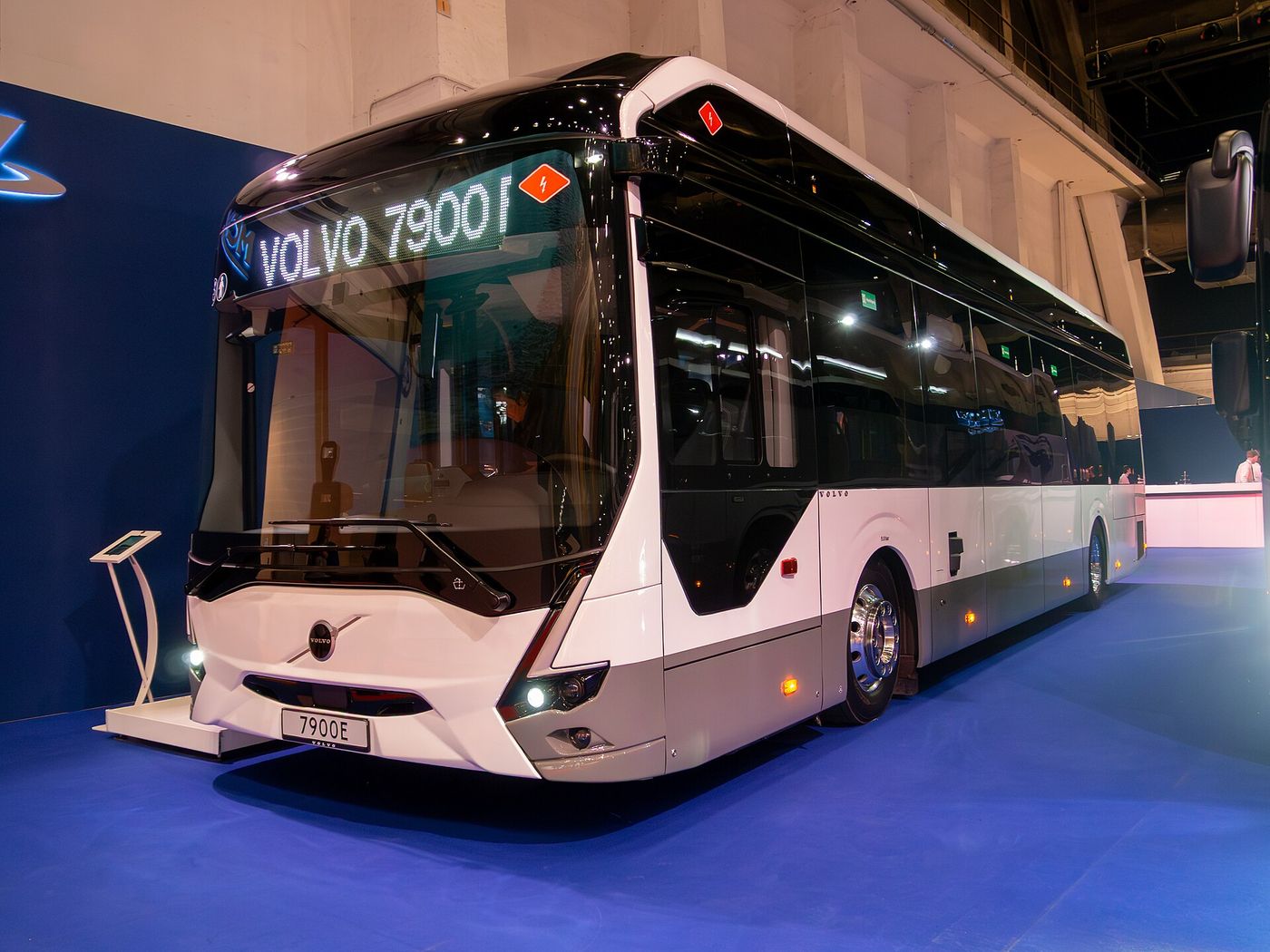

Model overview
- Segment
- Bus
- Axle configurations
- 2 (4x2…)
- Transmission
- 2-speed automated manual transmission
- Gross vehicle
- 19 500 kg
- Battery capacity
- 280–500 kWh
- Charging
- 300 kW (OppCharge)
- Electric motor
- 167 kW · 200 kW peak · 1×
- Length
- 12 110 mm
- Wheelbase
- 6 000 mm
Axle configurations: 4x2 · 6x2
The Volvo 7900 Electric is a battery-electric city bus built by Volvo Buses in three lengths: a 12.0 m bus, which the data sheet lists as Model 4x2, and two articulated buses of 18.0 m and 18.7 m. The figures on this page come from Volvo’s own English documents on its international site: the data sheets for the 7900 Electric and the 7900 Electric Articulated, both dated 15 August 2024 (BED 207465 and BED 377248); the specifications page, the product page and the explore page, which carry no date; and two fact sheets the specifications page links to, on the Opportunity Charging System (27 September 2017) and on Zone Management (9 June 2020). All were read on 27 October 2026. The data sheets note that equipment shown or mentioned may be optional and “may vary from one country to another”. How a battery-electric city bus is built and charged is set out in electric buses explained.
Overview
Volvo’s product page lists the 7900 Electric with City as its area of use, an electric driveline, axles 4x2 or 6x2, lengths of 12, 18 or 18.7 m and a low-floor configuration. The same page places the bus in Volvo’s “Zero City” idea: Volvo says it wants to help cities in their transformation towards zero cities, “with zero emissions, zero noise, zero congestion and zero accidents”. The explore page says that “Under the new design, new active safety features have been added to the well-proven, top ranked technology”, and does not date the design.
No document opened gives a launch date, a start of production or the earlier versions of the model.
Dimensions and weights
| Data sheet row | 12.0 m | 18.0 m | 18.7 m |
|---|---|---|---|
| Overall length | 12,110 mm | 17,950 mm | 18,660 mm |
| Overall width | 2,550 mm | 2,550 mm | 2,550 mm |
| Overall height | 3,300 mm | 3,300 mm | 3,300 mm |
| Wheelbase (front wheelbase on the articulated buses) | 6,000 mm | 5,945 mm | 5,945 mm |
| Rear wheelbase | – | 5,897 mm (4,037 + 1,860) | 6,605 mm (4,745 + 1,860) |
| Max horizontal/vertical turning angle of articulated joint | – | 52/10° | 52/10° |
| Front overhang | 2,800 mm | 2,800 mm | 2,800 mm |
| Rear overhang | 3,310 mm | 3,310 mm | 3,310 mm |
| Approach and departure angle | 7.0° and 7.0° | 7.0° and 7.0° | 7.0° and 7.0° |
| Turning radius, outer front corner | 10,810 mm (with VDS: 11,090 mm) | 12,500 mm | 12,500 mm |
| Turning radius, outer front wheel | 8,780 mm (with VDS: 9,120 mm) | 10,725 mm | 10,725 mm |
| Permitted front axle load | 7,500 kg | 7,500 kg | 7,500 kg |
| Permitted drive axle load | 12,000 kg | 12,500 kg | 12,500 kg |
| Permitted middle axle load | – | 10,000 kg | 10,000 kg |
| Permitted GVW | 19,500 kg | 30,000 kg | 30,000 kg |
Both data sheets give the overall height and the approach and departure angles with 275/70 R22.5 tyres. The 12.0 m sheet adds to each turning radius a second figure “with VDS”, Volvo Dynamic Steering; the articulated sheet gives one figure for each.
The specifications page prints the dimensions in metres: lengths of 12 m, 17.8 m and 18.5 m, a width of 2.5 m and a height of 3.3 m for all three, with a permitted gross vehicle weight of 19,500 kg, 30,000 kg and 30,000 kg. The product page gives the lengths as 12, 18 or 18.7 m. No document opened gives a kerb weight.
Passengers, doors and interior
The specifications page gives 95 passengers for the 12.0 m, 150 for the 18.0 m and 145 for the 18.7 m. The product page gives a maximum passenger capacity of 98 for the 12 m and 150 for the articulated bus. No document opened gives a seat count, a standing figure or the number of doors.
The data sheets list an electric door system, with inward gliding and outward sliding doors available, double glazing in all doors, an electric sensitive edge “for increased passenger safety” and a single front door as an option. The explore page says “the wide doors make boarding and exit quick and simple”. The 12.0 m sheet lists a low entry version with a high floor behind the mid-door as an option; the articulated sheet does not. Both sheets list Volvo city seats, “Available in a wide range of specifications”, an integrated position for passenger information displays and interior LED lights.
Electric motor and driveline
| Row | 12.0 m | 18.0 m | 18.7 m |
|---|---|---|---|
| Electric motor (data sheet) | EPT402 (1 motor) | EPT802 (2 motors) | EPT802 (2 motors) |
| Output, max, kW (data sheet) | R85 max 200 | R85 max 400 | R85 max 400 |
| Continuous power, kW (data sheet) | R85 min 167 | R85 30 min 337 | R85 30 min 337 |
| Max torque (data sheet) | 425 Nm | 850 Nm | 850 Nm |
| Max wheel torque (data sheet and specifications page) | 19,000 Nm | 31,000 Nm | 31,000 Nm |
| Electric motor, output max (specifications page) | 200 kW | 2x200 kW | 2x200 kW |
| Gearbox | 2-speed automated manual transmission (data sheets and specifications page) | ||
On the explore page Volvo says the articulated model “has a dual motor with a power output of no less than 540 hp to ensure the same reliable uphill performance as a 12-metre bus”, that fully loaded it can maintain more than 50 km/h on a 6% uphill gradient, and that the Hill Start function allows starts with heavy loads on a 20% uphill gradient. Volvo also says the bus “is built on a driveline concept which makes the bus less sensitive to uneven road surfaces and bumpy streets”. Gearboxes of the automated manual type are described in automated manual transmissions.
Axles, steering, tyres and brakes
Both data sheets give a Volvo RFS-L front axle, which the specifications page calls a “Volvo rigid low beam axle”, and a ZF AV133 rear axle, with no differential lock. Both sheets give left-hand drive and electric driven hydraulic power steering; the specifications page lists electrically powered hydraulic steering, with Volvo Dynamic Steering as an option. Kneeling is standard. The tyres are 275/70 R22.5 on 7.5 x 22.5” rims, under a row headed “steel and aluminium rims”. The articulated sheet lists a middle axle with a permitted load of its own.
The data sheets list disc brakes, the Electronic Braking System (EBS 5), the Anti-lock Braking System (ABS), anti slip regulation (ASR), the Electronic Stability Program (ESP), brake blending, Hill Start Aid, a brake temperature warning, brake assistance and brake pad wear indication, with a pneumatic system “easily accessible for external fill”. The specifications page lists Volvo disc brakes, EBS5, ABS, an Acceleration Slip Regulator (ASR), brake blending and hill start aid, and gives ESP “as option on 12.0 m”.
Battery
| Specifications page row | 12.0 m | 18.0 m | 18.7 m |
|---|---|---|---|
| Battery packs | NCA or LFP | NCA or LFP | NCA or LFP |
| Number of battery packs | 3, 4, or 5 (NCA); 8 or 12 (LFP) | 5 or 6 (NCA); 12 (LFP) | 5 or 6 (NCA); 12 (LFP) |
| Capacity | 280, 375 or 470 kWh (NCA); 350 or 500 kWh (LFP) | 470 or 565 kWh (NCA); 500 or 530 kWh (LFP) | 470 or 565 kWh (NCA); 500 or 530 kWh (LFP) |
| Charging system | OppCharge, CCS | OppCharge, CCS | OppCharge, CCS |
| Charging power | 300 kW (OppCharge); 250 kW (CCS) | 450 kW (OppCharge); 250 kW (CCS) | 450 kW (OppCharge); 250 kW (CCS) |
The specifications page offers two cell chemistries for every length, nickel cobalt aluminium oxide (NCA) and lithium iron phosphate (LFP), and says the energy storage system is automatically temperature controlled and that “The chassis includes an ESS module for roof mounting”. The chemistries are described in battery chemistries in heavy trucks.
| Row | 12.0 m | 18.0 m | 18.7 m |
|---|---|---|---|
| Battery chemistry type (data sheet) | Lithium-ion, NCA | Lithium-ion, NCA | Lithium-ion, NCA |
| Voltage (data sheet) | 600 V | 600 V | 600 V |
| Mass per battery (data sheet) | 609 kg | 609 kg | 609 kg |
| Available storage energy, battery capacity (data sheet) | 94 kWh | 94 kWh | 94 kWh |
| Available storage energy (data sheet) | Up to 470 kWh (up to 5 batteries) | Up to 470 kWh | Up to 564 kWh |
| Energy capacity, nominal (product page) | 470 kWh | 470 kWh | 565 kWh |
The documents give different capacities for the articulated buses. For the 18.7 m the articulated data sheet gives up to 564 kWh, while the product page gives 565 kWh and the specifications page lists 470 or 565 kWh with NCA. For the 18.0 m the data sheet gives up to 470 kWh, while the specifications page lists 470 or 565 kWh with NCA and 500 or 530 kWh with LFP. The articulated sheet’s row reads “up to 5 or 6 batteries”. No document opened gives a usable battery capacity or a range. The explore page describes Volvo’s “Useable Energy Commitment”: together with the operator Volvo determines the energy demand for the route, “and then we guarantee that this capacity will be available”.
The data sheets describe the battery protection: a battery management system with temperature and current management on cell, module and battery pack level; a battery disconnect unit with contactors and fuses; modules enclosed in a solid battery cage “providing high crash safety”; foam insulation inside the battery housing; fuses on the battery pack level and on the string/module level; fire-resistant material between cells and modules; thermal event detection; a hazardous voltage interlock loop embracing all connectors and lids; and insulation monitoring, detecting for example chafing on high-voltage cables. The bus keeps the traction batteries in working temperature so that it can be started directly when needed without a pre-heating period, and the 24V battery is monitored and charged if needed from the traction batteries or from the grid when connected. The electrical system is listed with 2 x 12 V batteries, a battery capacity of 2 x 140 Ah and an automatic shut-off of the main switch at low voltage level.
Charging
The data sheets list three charging systems. With Volvo Opportunity Charging (OppCharge) the bus carries a roof-mounted interface installed above the front axle for conductive charging, and the charging sequence is fully automatic. With the roof-mounted pantograph (“panto up”) the pantograph is installed on the bus above the front axle, and charging is started manually by a control on the dashboard. Both take a maximum charge power of 300 kW on the 12.0 m and 450 kW on the 18.0 m and 18.7 m. CCS DC charging uses plug-in sockets “in several locations to suit your depot layout”, with double plug-in points also available, a European standard connector and manual connection, at a maximum charge power of 250 kW, marked with a footnote that reads “Right front or Left front”, or 150 kW. The product page describes a charging concept “that allows both pantograph and cable”.
Volvo’s Opportunity Charging System fact sheet of 27 September 2017 describes the station side of OppCharge: charging starts automatically after the bus has stopped in the right position at the charging station and the driver has applied the handbrake, the charging interface connects to the bus from above, and all moving parts are integrated in the pylon, “while the contacts on the bus are fixed mounted”. The fact sheet adds that passengers can board and leave the bus during the charging process. The pantograph arrangements are set out in opportunity charging and pantographs.
The data sheets say the start time of pre-climatisation can be controlled via a timer in the bus or an offboard computer, and that preconditioning of the passenger and driver’s cabin can be started via a timer control via the charging interface, both according to the VDV 261 standard. Preconditioning at the depot is covered in electric bus depot charging and preconditioning.
Climate system
| Row | 12.0 m | 18.0 m and 18.7 m |
|---|---|---|
| Roof-top unit, heating at -10/16 °C (data sheet) | 26 kW (18 A), COP = 2.1 at max. blower speed | 52 kW (18 A), COP = 2.1 at max. blower speed |
| Roof-top unit, AC at 35/40 °C (data sheet) | 29 kW (18 A), COP = 2.3 at max. blower speed | 58 kW (18 A), COP = 2.3 at max. blower speed |
| Roof-top unit, max blower (data sheet) | 6,000 m³/h | 12,000 m³/h |
| Defroster (data sheet) | Heating Q80 max 17 kW; cooling max 6 kW; blower fan 880 m³/h | Heating Q80 max 17 kW; cooling max 6 kW; blower fan 880 m³/h |
| Convectors (data sheet) | 551 W/m at Δ temp. 60 °C | 551 W/m at Δ temp. 60 °C |
| Auxiliary heater (data sheet) | Fuel 16 kW; electric 24 kW | Fuel 23 kW; electric 24 kW |
| Roof unit, max (specifications page) | 25 kW | 2x25 kW |
| Defroster (specifications page) | 18 kW | 18 kW |
| Optional separate driver AC (specifications page) | 5.5 kW | – |
| Roof unit, heating pump / electric heater (specifications page) | 16/40 kW | 2x16/2x40 kW |
| Auxiliary heater, electric / fuel (specifications page) | 18/16 kW | 18/23 kW |
The data sheets describe a roof-mounted HVAC unit for heating, ventilation and air conditioning, including heat pump functionality, with pipe convectors and air blowers, air blowers at the doors and a convector or blower for the driver. Electric traction-voltage auxiliary heaters are standard, and a fuel heater for HVO, biodiesel or diesel is an option. Driver and passengers have separate climate zones: the passenger temperature follows a preset temperature curve, the driver’s area is controlled manually, and the driver has an individual, adjustable AC control. The interior climate is regulated steplessly, and the sheets state that “Global warming potential is minimised (GWP:1, ODP:0)”.
The documents describe the heating limits differently. The data sheets say the heat pump operates down to -20°C and that below -20°C heating is still available, but with auxiliary heaters. The explore page says “The heating system is 100% emission-free all the way down to -5° C”, and that below that a fuel heater that can run on HVO or biodiesel supports the interior climate.
Body and exterior
The data sheets list Volvo’s “patented lightweight aluminium body concept”, a front and rear wall in composite material with DPDS / ABS elements, a front and rear structure in anti-corrosion steel, double tinted glazing and an anti-corrosion treatment of the underbody with conservation sealing and silencing agents. Lighting is by LED headlights and LED daytime running lights, with auxiliary lights and fog lights as options; the external mirrors are electrically adjustable and heated. The explore page says that, as an option, the exterior rear-view mirrors can be replaced with cameras, with the image on interior displays.
Driver’s place
The data sheets give the cluster and controls as “transit mounted” and list, as also available with the Volvo dashboard, a dashboard that moves with the steering wheel adjustment, Volvo Dynamic Steering, a fully dynamic instrument cluster, steering wheel buttons, integrated infotainment, a digital speed, charging information, the state of charge in %, the remaining distance, a power meter and the Volvo Active Safety Platform. The explore page says that in the dynamic instrument cluster “All driving data, including that of the active safety systems, is presented in the display right in the driver’s field of vision”, and that “Volvo Dynamic Steering takes most of the effort out of driving a bus”. The audio system is a stereo radio with DAB and a foot-controlled public address system.
Safety and driver-assistance systems
The data sheets list as passive safety a flammability rating “according to ECE-R118.02”, a Front Impact Protection System compliant with the R29 (test A) front impact requirement, a Front Underrun Protection System compliant with the R93 underrun protection requirement and a Rear Underrun and Impact Protection System compliant with the R58 protection requirement. A seat belt for the driver is standard; a closed driver’s cabin, two-point or three-point seat belts for passengers and a child seat are options.
The active safety systems on the data sheets are front and rear cameras, side and front radars, Collision Warning, Side Collision Avoidance Support, Front Short Range Assist, Lane Keeping Support, Lane Change Support, Intelligent Speed Assistance, Driver Alert Support and a Tire Pressure Monitoring System. The specifications page lists Collision Warning with City Brake and Forward Collision Warning among the active safety systems, beside Intelligent Speed Assist, Side Collision Avoidance Support, Front Short Range Assist, Lane Change Support, Lane Keeping Support, Driver Alert Support and the Tire Pressure Monitoring System. Under driver support it lists I-Coaching, Safety Zones, Volvo Dynamic Steering, Electronic Stability Control, a rear-view camera and AVAS, the Acoustic Vehicle Alerting System, which the explore page describes as “a synthetic sound designed to notify the immediate surrounding”. The EU dates for systems of this kind are set out in mandatory driver assistance systems.
Volvo’s Zone Management fact sheet of 9 June 2020, linked from the specifications page, describes the service as one that “helps the vehicle to comply with local regulations on noise, speed and emissions”; in an active low-speed zone the driver is informed on entering and the vehicle reduces its speed to the limit set for the zone.
For the energy storage system the specifications page lists battery monitoring, automatic safety functions on cell and pack level, isolation resistance monitoring, charging safety, mechanical protection and a rescue sheet.
Source notes
The figures above are the 12.0 m Volvo 7900 Electric, Model 4x2, 12.0 m on Volvo’s English data sheet BED 207465 of 15 August 2024, with the battery span and the OppCharge charging power from the 12.0 m column of the current specifications page: length 12,110 mm, width 2,550 mm, height 3,300 mm, wheelbase 6,000 mm, front overhang 2,800 mm, rear overhang 3,310 mm, permitted front axle load 7,500 kg, drive axle load 12,000 kg and gross vehicle weight 19,500 kg; one EPT402 electric motor with an output of R85 max 200 kW and a continuous power of R85 min 167 kW, 425 Nm maximum torque and 19,000 Nm maximum wheel torque; and a 2-speed automated manual transmission. The articulated data sheet BED 377248 of the same date gives the 18.0 m and 18.7 m buses: lengths of 17,950 mm and 18,660 mm, 2,550 mm wide and 3,300 mm high, a front wheelbase of 5,945 mm, a rear wheelbase of 5,897 mm (4,037 + 1,860) or 6,605 mm (4,745 + 1,860), permitted axle loads of 7,500 kg front, 12,500 kg drive and 10,000 kg middle, 30,000 kg gross, and an EPT802 unit of two motors with an output of R85 max 400 kW, a continuous power of R85 30 min 337 kW, 850 Nm maximum torque and 31,000 Nm maximum wheel torque. The specifications page gives the motor output as 200 kW for the 12.0 m and 2x200 kW for both articulated lengths. The battery span of 280 to 500 kWh is the 12.0 m column of the specifications page: 3, 4 or 5 NCA packs giving 280, 375 or 470 kWh, or 8 or 12 LFP packs giving 350 or 500 kWh; for the 18.0 m and 18.7 m the page gives 5 or 6 NCA packs with 470 or 565 kWh, or 12 LFP packs with 500 or 530 kWh. The data sheets give NCA batteries only, a battery capacity of 94 kWh, a mass of 609 kg per battery and 600 V, with up to 470 kWh from up to 5 batteries on the 12.0 m, up to 470 kWh on the 18.0 m and up to 564 kWh on the 18.7 m; the product page gives a nominal energy capacity of 470 kWh for the 12 and 18 m and 565 kWh for the 18.7 m. Charging is by OppCharge or a roof-mounted pantograph at up to 300 kW on the 12.0 m and 450 kW on the articulated buses, and by CCS at 250 kW or 150 kW on all three. The Volvo documents differ on several figures. The specifications page gives 95, 150 and 145 passengers for the three lengths, the product page a maximum of 98 for the 12 m and 150 for the articulated bus. The specifications page gives lengths of 12 m, 17.8 m and 18.5 m, a width of 2.5 m and a height of 3.3 m. For the climate system the specifications page gives a defroster of 18 kW and an electric auxiliary heater of 18 kW, the data sheets a defroster heating output of max 17 kW and an electric auxiliary heater of 24 kW; both give a fuel auxiliary heater of 16 kW on the 12.0 m and 23 kW on the articulated buses. The data sheets say the heat pump operates down to -20°C, with auxiliary heaters below that; the explore page says the heating system is 100% emission-free down to -5° C, with a fuel heater below that. The specifications page lists ESP as an option on the 12.0 m, and both data sheets list it among the brake systems without an option mark. Volvo’s explore page gives the articulated bus a power output of no less than 540 hp and says that, fully loaded, it can maintain more than 50 km/h on a 6% uphill gradient. The product page gives the axles as 4x2 or 6x2; the articulated data sheet prints no wheel formula. No document opened gives a seat count, a kerb weight, a usable battery capacity, a range, a launch date or the earlier versions of the model.
Quick answers
- What axle configurations does the Volvo 7900 Electric come in?
- 4x2, 6x2.
- Which transmission does the Volvo 7900 Electric use?
- Transmission: 2-speed automated manual transmission.
- What is the gross vehicle weight of the Volvo 7900 Electric?
- Gross vehicle weight: 19 500 kg.
- What battery capacity does the Volvo 7900 Electric have?
- Battery capacity: 280–500 kWh; Charging: 300 kW (OppCharge).
- How long is the Volvo 7900 Electric?
- Length: 12 110 mm; Wheelbase: 6 000 mm.
Articles that mention the Volvo 7900 Electric
More Volvo on this site
Sources
- Specifications for Volvo 7900 Electric — Volvo Buses
- Data sheet Volvo 7900 Electric, EN 2024 (BED 207465) — Volvo Buses, 15 Aug 2024
- Data sheet Volvo 7900 Electric Articulated, EN 2024 (BED 377248) — Volvo Buses, 15 Aug 2024
- Volvo 7900 Electric bus (product page) — Volvo Buses
- Explore 7900 Electric — Volvo Buses
- Fact sheet Volvo Opportunity Charging System, EN 2017 (BED 209079) — Volvo Buses, 27 Sept 2017
- Fact sheet Zone Management, EN 2020 (BED 197903) — Volvo Buses, 9 Jun 2020