Opportunity charging for electric buses: pantograph types and standards
What opportunity charging is, where the pantograph sits, what SAE J3105, EN 50696 and AFIR Annex II say about it, and one maker's charging figures.
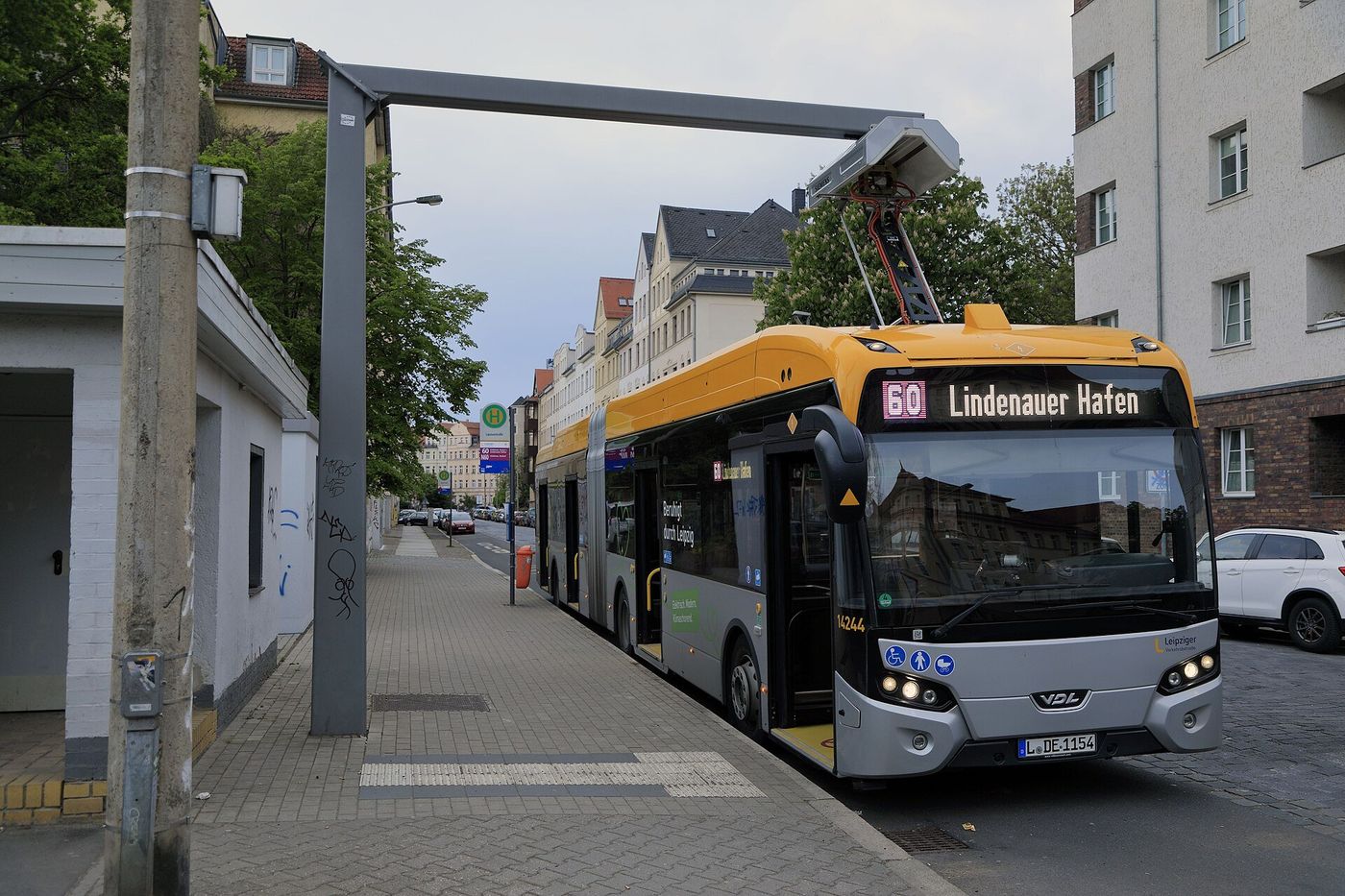
Solaris Bus & Coach defines opportunity charging as charging electric buses during short breaks in regular operations, without the need to return to the depot for extended periods; it says this typically takes place at terminal stops, loop stations or other locations along the route, and that pantograph chargers typically offer charging power from 150 kW to 600 kW. In the European Union, point 1.5 of Annex II to Regulation (EU) 2023/1804 (AFIR) requires the contact interface automated device for electric buses on conductive recharging in mode 4 to be equipped “at least” with the mechanical and electrical interfaces defined in EN 50696:2021; the SAE J3105 recommended practice is not named there.
What opportunity charging is
Solaris Bus & Coach’s eCity knowledge base separates two kinds of charging for battery-electric buses. Depot charging, which it says is commonly referred to as overnight charging, typically uses plug-in chargers; off-depot charging is what Solaris calls opportunity charging. Its definition is charging during short breaks in regular operations, without the need to return to the depot for extended periods. It “typically” takes place at terminal stops, loop stations or other locations along the route where the bus pauses during service, it is time-limited, and it “usually lasts for several minutes”.
Solaris adds that pantograph chargers typically offer charging power from 150 kW to 600 kW. That is Solaris’s general description on an undated page, not the specification of a particular bus.
Mercedes-Benz Buses does not use the words “opportunity charging” on its eCitaro page. It writes of “interim charging”, with “an end station” as its example, and describes the pantograph equipment that goes with it (see the next section and the eCitaro section below).
This page covers the pantograph side. Plug-in depot charging is outside it.
On the bus or on the mast: where the pantograph sits
Solaris describes two arrangements. In one, charging is carried out via a pantograph mounted on the roof of the bus. In the other, which it calls “inverted charging”, a pantograph is lowered from the charging station onto the current collector located on the vehicle’s roof. On a second knowledge-base page Solaris writes of placing the pantograph “on the roof of the bus or on the charging mast itself (the so-called inverted pantograph)”, and mentions the “inverted” option in connection with vehicles on which “only charging rails are installed”.
This site’s page on the Solaris Urbino 12 electric records that Solaris’s product page names a standard or an inverted pantograph for that bus. The page on the BMC Procity+ Electric records that BMC’s technical page lists pantograph fast charging as an option.
Mercedes-Benz Buses says the eCitaro can be fitted with a current collector (pantograph) or, alternatively, with charging rails on the roof that connect to the fixed pantograph at a charging station. It calls these “both pantograph solutions”.
The terms in this section are the makers’ own, and the SAE and AFIR terms in the next sections are those documents’ own. This page does not say which term of one set describes the same arrangement as a term of another.
SAE J3105: a recommended practice, issued 2020, revised 2023
SAE International’s catalogue lists J3105, “Electric Vehicle Power Transfer System Using Conductive Automated Connection Devices”, under the content type “Recommended Practice”, and this page uses that term. SAE Mobilus gives its issue date as 20 January 2020 and its current edition as the revision of 5 May 2023; the 2020 edition is listed as historical. The issuing committee is the “Hybrid - EV Committee”.
SAE’s press release of 23 January 2020, announcing the document, describes it as covering a “mechanized (hands-free)” conductive power transfer system “primarily for transit buses” using an “overhead coupler” capable of, but not limited to, transferring direct current (DC) power. The catalogue abstract gives the scope as the general physical, electrical, functional, testing and performance requirements for conductive power transfer, primarily for vehicles using a conductive ACD (automated connection device) connection capable of transferring DC power. It says the document defines conductive power transfer methods, including the infrastructure electrical contact interface, the vehicle connection interface, the electrical characteristics of the DC supply and the communication system.
The abstract of the main document lists three connection documents by these names: “Infrastructure-Mounted Cross Rail Connection” (J3105/1), “Vehicle-Mounted Pantograph Connection” (J3105/2) and “Enclosed Pin and Socket Connection” (J3105/3). SAE Mobilus lists each of them as a Recommended Practice:
| Document | Title after the common title, as listed by SAE Mobilus | Editions listed |
|---|---|---|
| J3105 | (the common title itself) | 20 January 2020; 5 May 2023 |
| J3105/1 | Infrastructure-Mounted Pantograph (Cross-Rail) Connection | 20 January 2020; 5 May 2023 |
| J3105/2 | Vehicle-Mounted Pantograph (Bus-Up) | 20 January 2020; 5 May 2023 |
| J3105/3 | Enclosed Pin and Socket Connection | 20 January 2020 only |
The abstract of J3105/1 says it details “the infrastructure-mounted pantograph, or cross-rail connection”. The abstract of J3105/2 says it details “the vehicle-mounted pantograph, or the bus-up connection”, using a conductive automated charging device “based on a conventional rail vehicle pantograph design”. J3105/3 is described as based on “an enclosed pin and socket design”. The terms “Bus-Up” and “bus-up” appear on this page only as SAE’s own words.
Each of the three abstracts says that, to allow interoperability for on-road vehicles “(in particular, buses and coaches)”, one configuration is described in the document, and that other configurations may be used for non-standard applications, “for example, mining trucks or port vehicles”.
The abstract of the 2023 revision of the main document adds that new editions of the documents “shall be backwards compatible” with the older editions; the 2020 abstract has no such sentence.
The catalogue pages give abstracts, not the documents themselves. This page therefore says nothing about contact layouts, voltage steps or communication protocols in J3105.
European standards: EN 50696 and IEC 61851-23-1
BSI Knowledge lists BS EN 50696:2021, “Contact Interface for Automated Connection Device”, as identical to EN 50696, with the status “Current” and a publication date of 28 February 2021. That is the date of BSI’s edition; CENELEC’s own record of the standard was not opened for this page.
BSI’s summary says the standard applies to automated connection devices of standardized configuration, intended for electric vehicle conductive charging systems which incorporate control means, with a rated operating voltage up to 1,500 V DC, and to high power DC interfaces intended for isolated conductive charging systems. It says the standard does not apply to solutions based on a vehicle connector described in EN 62196-3 driven by an automated mechanism, “as, for instance, a robotic arm”. It contains requirements for all types of automated connection devices, and “its annexes describe specific implementations and specific requirements”; the entry does not say which annex describes which arrangement. BSI’s summary gives its reason for automated connection: for heavier vehicles such as buses and trucks, short charging times at high energy raise problems of handling and safety with hand-held connecting devices, and an automated connection device is used for these high-current charging applications.
The IEC webstore lists IEC 61851-23-1:2026, “Electric vehicle conductive charging system – Part 23-1: DC electric vehicle supply equipment – Automated connection device”, as an International Standard, Edition 1.0, with a publication date of 18 June 2026. Its abstract gives the scope as requirements for DC electric vehicle supply equipment with an automated connection device for conductive connection to the vehicle, with a rated maximum voltage at “side A” of up to 1,000 V AC or up to 1,500 V DC and at “side B” of up to 1,500 V DC; the abstract does not explain the two sides. It says the document “only applies to automatic couplers of category 2, i.e. using an electro-mechanical interface”, and that requirements for reverse power transfer and bidirectional power transfer are under consideration and are not specified in it.
What EU law requires: AFIR Annex II point 1.5
Regulation (EU) 2023/1804 of 13 September 2023 “on the deployment of alternative fuels infrastructure, and repealing Directive 2014/94/EU” (AFIR) was published in the Official Journal on 22 September 2023 and applies from 13 April 2024. Article 21(1) provides: “The technical specifications set out in Annex II shall apply.” Point 1.5 of Annex II reads:
1.5. Contact interface automated device for electric buses on conductive recharging in mode 4, in accordance with standard EN 61851-23-1:2020, shall be equipped at least with mechanical and electrical interfaces, as defined in the standard EN 50696:2021, concerning:
- automated connection device (ACD) mounted on the infrastructure (pantograph);
- automated connection device (ACD) mounted on the roof of the vehicle;
- automated connection device (ACD) mounted underneath the vehicle;
- automated connection device (ACD) mounted on the infrastructure and connecting to the side or on the roof of the vehicle.
Delegated Regulations (EU) 2025/656 and (EU) 2025/671, both of 2 April 2025 and published on 18 June 2025, amended AFIR. The consolidated text of 8 January 2026 that incorporates them shows point 1.5 in the same words.
Point 1.5 names EN 50696:2021. It does not name SAE J3105, which neither the Official Journal text nor the consolidated text mentions. This page draws no equivalence between the connections of the SAE documents and the four arrangements listed in point 1.5.
Point 1.4 covers the plug-in side. As amended by Delegated Regulation (EU) 2025/656, which applies from 8 January 2026, it requires DC recharging points for electric buses installed or renovated from that date to be equipped “at least with vehicle connectors of the combined charging system ‘Combo 2’”, while points installed before that date “shall continue to comply” with the earlier edition of the standard until they are renovated. City Bus Propulsion and the EU Zero-Emission Mandate sets the point out in full, with AFIR’s other provisions on bus charging.
AFIR also defines “high-power” as a threshold: Article 2(31) describes a “high-power recharging point” as one “with a power output of more than 22 kW for the transfer of electricity to an electric vehicle”.
Three further points of Annex II name buses or overhead pantograph supply in a heading only. Point 1.11 reads “Technical specifications for inductive static wireless recharging for electric buses”, point 1.12 “Technical specifications for inductive dynamic wireless recharging for electric buses”, and point 1.13 “Technical specifications for electric road system for dynamic overhead power supply via a pantograph for heavy-duty electric vehicles”. In the consolidated text of 8 January 2026 each of the three is a heading with no standard named.
Before AFIR: Delegated Regulation (EU) 2021/1444
Commission Delegated Regulation (EU) 2021/1444 of 17 June 2021, published in the Official Journal on 6 September 2021, supplemented Directive 2014/94/EU “with regards standards for recharging points for electric buses”. The third indent of its Article 1 covered contact interface automated devices for electric buses on conductive recharging in mode 4, “according to EN 61851-23-1”, in the same four arrangements that point 1.5 now lists, and provided that they “shall be equipped with mechanical and electrical interfaces, as defined in the standard EN 50696”, without a date. Its recital 6 recorded that CEN and Cenelec had informed the Commission that EN 50696 “should be applied” for these devices “in order to ensure interoperability”.
It applied from 26 September 2023, and only to charging points for electric buses installed after that date; it did not apply to recharging infrastructure for trolleybus overhead wires (catenary). Article 25(1) of AFIR repealed it, with Directive 2014/94/EU and Delegated Regulation (EU) 2019/1745, with effect from 13 April 2024. Recital 81 of AFIR says that the two delegated regulations it names set out “undated technical specifications” and that those specifications “are now dated and listed in Annex II”. Point 1.5 cites EN 50696 with a date, 2021.
Is a bus-stop charger a public charging station?
Article 2(45) of AFIR defines publicly accessible alternative fuels infrastructure as infrastructure “located at a site or premises that are open to the general public”, irrespective of whether it is on public or private property, whether limitations or conditions apply in terms of access to the site or premises, and of the applicable use conditions.
The European Commission’s questions and answers page on AFIR, whose page data gives 17 March 2026 as its last modification, takes up the case in Question 2.20. The question is whether public transport recharging infrastructure, “for example opportunity recharging for electric buses”, can be considered publicly accessible. The Commission answers that such points are often located at major bus stops, but “only registered vehicles are authorised to use the bus stop”, that bus stops “are not sites open to the general public”, and that “recharging points installed to serve vehicles parked at a bus stop are not publicly accessible”. That answer is the Commission’s interpretation, not the text of the Regulation.
It does not say whether point 1.5 applies to a pantograph charger of that kind. On our reading it does. Article 21(1) applies Annex II without a condition of public accessibility, and point 1.5 contains none. Recital 5 of Delegated Regulation (EU) 2025/656 says that technical provisions for interoperability “should strictly refer to the capacity of both publicly accessible and private recharging and refuelling points”. In an answer about airport airside areas (Question 12.2), the Commission’s page says that “certain technical specifications established under AFIR apply to publicly accessible and private recharging points, including those located airside”. The Commission’s answer to Question 2.20 does not name point 1.5.
On our reading, AFIR also sets no numeric target for opportunity-charging points for buses. In the Official Journal text the word “bus” or “buses” occurs only in recital 64, in a footnote naming Delegated Regulation (EU) 2021/1444, and in Annex II points 1.4, 1.5, 1.11 and 1.12. The urban-node targets of Article 4(1), points (g) and (h), are for “publicly accessible recharging points dedicated to heavy-duty electric vehicles”; they are not repeated here.
For captive fleets, Article 14(2)(d) lists among the elements that each national policy framework “shall contain at least” measures, planned or adopted, to promote the deployment of alternative fuels infrastructure for captive fleets, in particular “recharging stations and hydrogen refuelling stations for public transport services and recharging stations for car sharing”.
One maker’s figures: the Mercedes-Benz eCitaro
Mercedes-Benz Buses’ eCitaro page, which carries no date and was read on 29 September 2026, gives two charging figures for the bus:
| Charging route, in the maker’s words | Figure given |
|---|---|
| CCS plug (“CCS2 plug in the depot”) | up to 150 kW |
| “Both pantograph solutions”: a current collector (pantograph), or charging rails on the roof | up to 300 kW |
The page adds that the eCitaro is also available with combinations of plug charging and pantograph or charging rails. It does not say which standard the pantograph or the charging rails follow, and it gives no charging time.
Technical data for the Citaro and for the Urbino 12 electric are on the site’s model pages for the Mercedes-Benz Citaro and the Solaris Urbino 12 electric. Charging for heavy-duty electric trucks, through the Megawatt Charging System, is a separate subject, covered in Megawatt Charging System: how electric truck charging scales.
What the opened sources do not establish
- The technical content of SAE J3105 and EN 50696. Only catalogue entries and abstracts were read, so contact layouts, voltage steps and communication protocols are not described beyond the scope sentences given above.
- Which annex of EN 50696 describes which of the four arrangements in AFIR’s point 1.5. The BSI entry says only that its annexes describe specific implementations.
- The dates of the Solaris and eCitaro pages. None of them carries a date, so their figures are as read on 29 September 2026.
- The number of pantograph charging points in service in Europe. No primary source was opened for it.
Quick answers
- What is opportunity charging for electric buses?
- Solaris defines it as charging during short breaks in regular operations, without the need to return to the depot for extended periods; it says this typically takes place at terminal stops, loop stations or other locations along the route where the bus pauses, and usually lasts for several minutes. Mercedes-Benz Buses uses the term “interim charging” on its eCitaro page, with an end station as its example, and does not use the words “opportunity charging” there.
- How powerful is an electric bus charger?
- Mercedes-Benz Buses gives up to 150 kW for the eCitaro’s CCS plug and up to 300 kW for its two pantograph solutions, a current collector on the bus or charging rails on the roof. Solaris says pantograph chargers typically offer charging power from 150 kW to 600 kW. In AFIR’s definitions, a recharging point with a power output of more than 22 kW is a “high-power recharging point”.
- What is the difference between a pantograph on the bus and one on the charging station?
- Solaris describes a pantograph mounted on the roof of the bus and, as “inverted charging”, a pantograph lowered from the charging station onto the current collector on the bus’s roof. SAE names two of its J3105 documents “Vehicle-Mounted Pantograph (Bus-Up)” (J3105/2) and “Infrastructure-Mounted Pantograph (Cross-Rail) Connection” (J3105/1). Mercedes-Benz Buses offers the eCitaro with a pantograph or with charging rails on the roof, both up to 300 kW. Each set of terms is that source’s own and is not matched to another’s here.
- Which standards apply to pantograph charging of electric buses?
- In the EU, point 1.5 of Annex II to Regulation (EU) 2023/1804 requires the contact interface automated device for electric buses on conductive recharging in mode 4 to be equipped at least with the mechanical and electrical interfaces defined in EN 50696:2021; BSI lists its identical British edition, BS EN 50696:2021, as published on 28 February 2021 and applicable up to 1,500 V DC. IEC 61851-23-1:2026, with a publication date of 18 June 2026, covers DC supply equipment with an automated connection device. SAE J3105, a Recommended Practice issued on 20 January 2020 and revised on 5 May 2023, is not named in AFIR.
- Does EU law require electric bus charging stations at bus stops?
- On our reading, AFIR sets no numeric target for bus opportunity-charging points. Its Annex II point 1.5 sets the interface of the automated device for electric buses, and the Commission’s questions and answers say that recharging points installed to serve vehicles parked at a bus stop “are not publicly accessible”. Article 14(2)(d) has each national policy framework contain at least measures, planned or adopted, to promote infrastructure for captive fleets, in particular recharging stations and hydrogen refuelling stations for public transport services.
- What happened to Delegated Regulation (EU) 2021/1444?
- It applied from 26 September 2023 and was repealed with effect from 13 April 2024 by Article 25(1) of AFIR. Its Article 1 covered the same four arrangements of automated device and referred to EN 50696 without a date; point 1.5 of AFIR’s Annex II now lists the four arrangements and cites EN 50696:2021.
Models in this article
Sources
- SAE J3105_202305 — Electric Vehicle Power Transfer System Using Conductive Automated Connection Devices (Recommended Practice; issued January 2020, revised 5 May 2023) — SAE International (SAE Mobilus)
- SAE J3105_202001 — Electric Vehicle Power Transfer System Using Conductive Automated Connection Devices (Recommended Practice, issued 20 January 2020) — SAE International (SAE Mobilus)
- SAE J3105/1_202305 — Infrastructure-Mounted Pantograph (Cross-Rail) Connection (Recommended Practice) — SAE International (SAE Mobilus)
- SAE J3105/2_202305 — Vehicle-Mounted Pantograph (Bus-Up) (Recommended Practice) — SAE International (SAE Mobilus)
- SAE J3105/3_202001 — Enclosed Pin and Socket Connection (Recommended Practice) — SAE International (SAE Mobilus)
- SAE International Publishes Updated Standard for On-Route Mechanized Conductive EV Charging Systems for Buses (press release, 23 January 2020) — SAE International (via PRWeb)
- BS EN 50696:2021 — Contact Interface for Automated Connection Device (identical to EN 50696) — BSI Knowledge (British Standards Institution)
- IEC 61851-23-1:2026 — Electric vehicle conductive charging system, Part 23-1: DC electric vehicle supply equipment, Automated connection device — International Electrotechnical Commission (IEC Webstore)
- Regulation (EU) 2023/1804 on the deployment of alternative fuels infrastructure (AFIR), OJ L 234, 22.9.2023 — recitals 64 and 81, Articles 2, 4, 14(2), 21, 25 and 26, and Annex II points 1.4, 1.5 and 1.11 to 1.13 — Official Journal of the European Union (Publications Office)
- Regulation (EU) 2023/1804 (AFIR), consolidated text of 8 January 2026 incorporating Delegated Regulations (EU) 2025/656 and (EU) 2025/671 — Annex II point 1.5 unchanged — Publications Office of the European Union (EUR-Lex consolidated text)
- Commission Delegated Regulation (EU) 2025/656 amending Regulation (EU) 2023/1804 as regards standards for wireless recharging, electric road system, vehicle-to-grid communication and hydrogen supply for road transport vehicles — Official Journal of the European Union (Publications Office)
- Commission Delegated Regulation (EU) 2021/1444 supplementing Directive 2014/94/EU with regards standards for recharging points for electric buses (repealed with effect from 13 April 2024) — Official Journal of the European Union (Publications Office)
- Questions and answers on the regulation on the deployment of alternative fuels infrastructure (EU 2023/1804) — Questions 2.20 and 12.2 — European Commission — Mobility and Transport
- eCitaro — charging and batteries — Mercedes-Benz Buses (Daimler Buses)
- Opportunity charging (knowledge base) — eCity powered by Solaris (Solaris Bus & Coach)
- Pantograph or plug-in? How to choose the right charging system (knowledge base) — eCity powered by Solaris (Solaris Bus & Coach)