Solaris
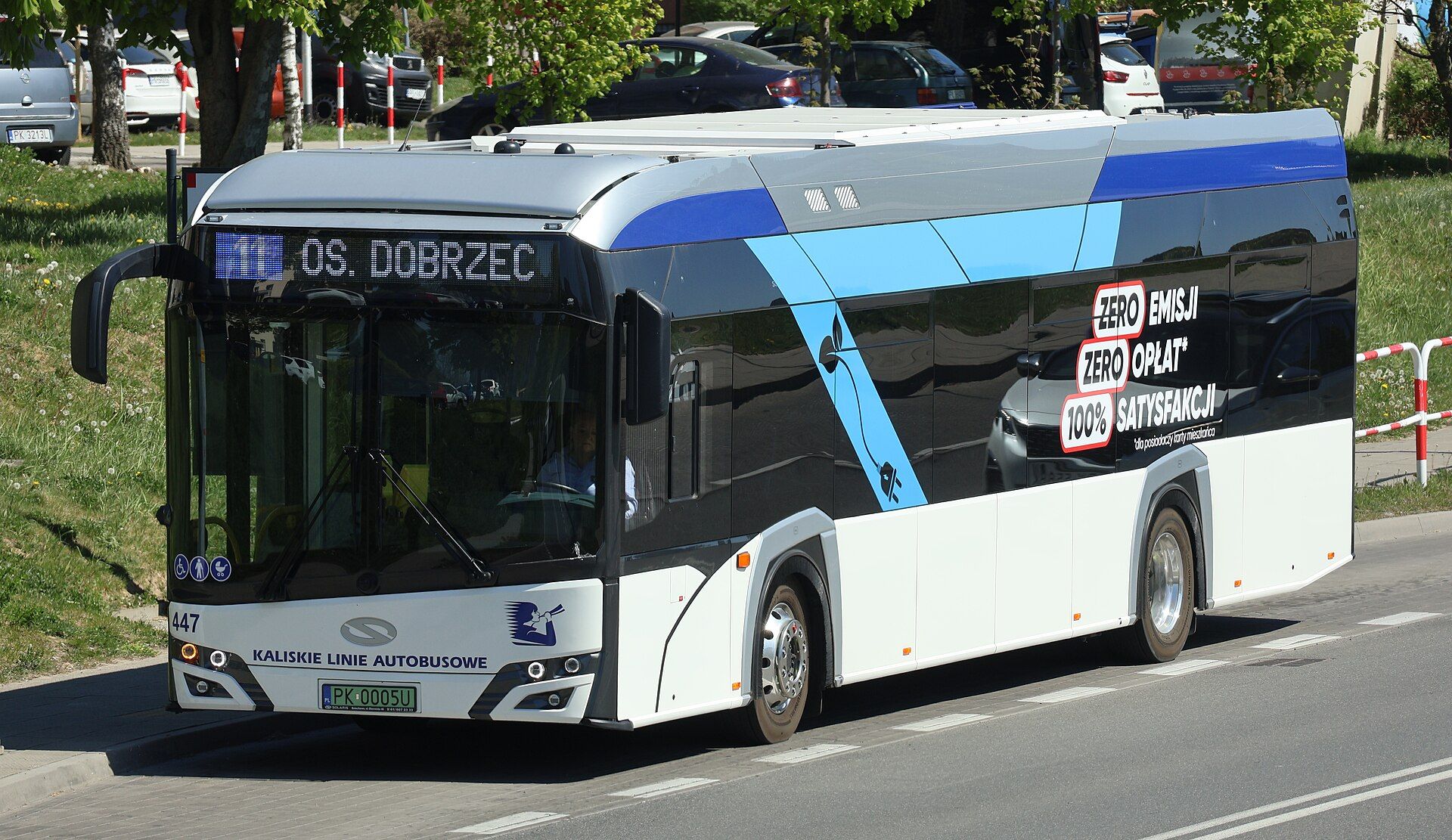
Solaris Urbino 12 electric
Solaris publishes a full data sheet for its 12-metre electric city bus: a central motor, a portal drive axle and roof batteries — and several sheets that disagree.

Model overview
The figures above are the Busworld 2025 sheet for the modular-drive version: a central 240 kW motor, a modular drive using SiC technology, an independent front axle and a portal drive axle both with stabiliser — the sheet names no axle make and no model number, only those types — Solaris High Energy batteries of 600 kWh, front overhang 2,700 mm and rear overhang 3,400 mm, charging plug-in with a pantograph in option, 14 of the seats reachable from the low floor (up to 16 in option), and a gross vehicle weight of 19,500 kg rising to 20,000 kg depending on country and tyres. The earlier sheets are different vehicles. The UITP 2023 sheet gives a ZF CeTrax drive of 220 kW — its entry reads Engine, ZF CeTrax 220 kW, and does not say where the motor sits, so describing that one as central is the site's reading rather than Solaris's word — a ZF AV 133 inverted drive axle and a ZF RL 82 EC independent front axle, batteries of 420 kWh, plug-in charging up to 260 kW and pantograph charging up to 450 kW, 21 seats, up to 77 passengers, 20,000 kg gross and a height of 3,300 mm rising to 3,480 mm with the pantograph. The Stockholm 2019 sheet gives a ZF AVE 130 drive axle with two integrated motors of 125 kW each, batteries of 240 kWh, an on-board charger of 34 kW, 28 seats, 75 passengers and 18,745 kg gross. The Transexpo 2022 sheet keeps the ZF AVE 130 and the 18,745 kg but raises the batteries to over 500 kWh and plug-in charging to 240 kW, with 26 seats and 60 passengers. Range is quoted by Solaris as over 600 km against energy consumption in SORT 2 tests. The capacity figures carry a footnote the data sheet omits: the press release of 5 March 2024 gives up to 100 people as the maximum in Italy, France and Spain at a gross weight of 20 tonnes and 94 people under European provisions at 19.5 tonnes, both for a 300 kWh battery rather than for the 600 kWh configuration the same documents headline. Solaris prints no wheel formula; the 4x2 above is this site's reading of a sheet listing exactly two axles, one of them driven, and is not Solaris's notation. The battery headline is framed twice and the two frames are kept apart here: the Busworld 2025 sheet prints a flat "Solaris High Energy, 600 kWh", while the press release of 5 March 2024 and the current product page both describe the vehicle shown at Mobility Move as carrying six batteries mounted on the roof with a total capacity of over 600 kWh. The installed figure above is the sheet's. The same sheet declares the bus GSR2 compliant and R66 compliant, and states no UN Regulation No 107 class; no other Solaris document opened states one either. Solaris states that the model was launched in 2011, that 1,500 had been built by March 2024, that it serves over 120 towns and cities in Europe, and that it was the first ever electric vehicle to be awarded the Bus of the Year 2017 title — that last a company superlative, recorded as Solaris's claim and not checked against any source outside Solaris.
The Urbino 12 electric is a two-axle, low-floor city bus; Solaris counts its capacity as standing and seated together, up to 100 people. The company says the model was launched in 2011, that 1,500 had been built by March 2024, that it serves over 120 towns and cities in Europe, and that it was the first ever electric vehicle to take the Bus of the Year title, in 2017 — all four its own claims, the last a superlative checked against no source outside Solaris. That is the fleet a municipality writing a zero-emission tender is being asked to buy into.
It is also unusually well documented. Solaris puts flat, single-page technical data sheets into its press assets as open PDFs, carrying the fields a specification actually needs — dimensions, overhangs, plated weight, door arrangement, seat counts — rather than a brochure’s adjectives. The complication is that there is more than one sheet, and they do not agree with each other or, in places, with the company’s own prose.
The modular drive is what changed
The current version, shown at Mobility Move in Berlin in March 2024 and later given the Sustainable Bus Award in the urban category, drops the engine tower altogether: Solaris describes a modular drive system with the components placed on the roof and at the rear. The figures for it come from a different document, and the two are kept apart here. The press release of 5 March 2024 gives no motor power, no axle description and no plated weight; all three are on the single-page sheet for the Urbino 12 electric with modular drive in Solaris’s Busworld 2025 press assets — the Busworld 2025 sheet below, and the sheet the record above is built on. It lists a central electric motor of 240 kW, an electric drive described as modular and using SiC technology, an independent front axle with a stabiliser, and a portal drive axle, also with a stabiliser. Whether the bus standing in Berlin was to that specification, neither document says.
That drive axle is why the floor can stay low over the driven wheels. Annex VII, paragraph 2(2) of Regulation (EU) 2017/2400 defines a single portal axle in exactly those terms — a vertical offset between the rotating axis of the crown gear and that of the wheel, due to the demand of a higher ground clearance or a lowered floor to allow a low floor concept for inner city buses — but paragraph 2 opens by confining its definitions to the purposes of that Annex. It is the vocabulary of one CO2 certification procedure, not a general definition of an axle in European law, as axle ratios and final drive sets out.
The earlier sheets describe a different machine. The Stockholm 2019 sheet gives a ZF AVE 130 drive axle with two integrated motors of 125 kW each — the motors inside the axle rather than one in the middle — and the Transexpo 2022 sheet keeps it. By the UITP 2023 sheet Solaris had moved to a ZF CeTrax drive of 220 kW on a ZF AV 133 inverted drive axle, with a ZF RL 82 EC independent front axle; that sheet’s entry reads Engine, ZF CeTrax 220 kW and does not say where the motor sits, so calling that one central is our reading rather than Solaris’s word. It is a change in the driveline rather than a change of catalogue number, and a used buyer needs to know which is under the bus in front of them.
Solaris prints no wheel formula anywhere. The 4x2 in the overview above is this site’s own reading of a sheet listing exactly two axles, one of them driven — it is not Solaris’s notation, and it is the only deduction entered into the record rather than quoted into it. The prose carries a few more, each flagged where it falls. What the notation counts is covered in axle configurations.
Six packs on the roof, and one number for all of them
Two Solaris documents frame the headline battery figure differently, and this page leaves them apart. The Busworld 2025 sheet prints a flat number: Solaris High Energy, 600 kWh. The press release of 5 March 2024 and the current product page both describe the vehicle on the stand as carrying six batteries mounted on the roof with a total capacity of over 600 kWh. The record above takes the sheet’s figure, which is why the overview grid reads 600 kWh where the company’s own prose reads over it. Neither carries a second number for usable energy — the gap that is the most useful line on an electric truck’s sheet. That row is blank because Solaris does not fill it, not because it was overlooked.
The figure is different on every sheet, and not in a straight line: 240 kWh at Stockholm in 2019, over 500 kWh at Transexpo in 2022, 420 kWh on the UITP 2023 stand, 600 kWh on the Busworld 2025 sheet. These are configurations rather than generations — Solaris says it offers carriers different battery configurations, all roof-mounted — so the question to put to a seller is never “how big is the battery on an Urbino 12 electric” but “how big is the battery on this one”.
Range is the figure most tender documents want and the one Solaris declines to give as a number. The company publishes a floor for the six-battery configuration: over 600 km, measured against the energy consumption recorded in SORT 2 tests. A floor is not a range figure, and it is not entered as one in the record above. Why a city bus is measured on a standardised cycle at all belongs with city bus propulsion.
Plug-in or pantograph is the buyer’s decision
The Busworld 2025 sheet gives the charging method and no power for it: plug-in, with a pantograph in option. Solaris expands on the hardware without adding figures — a standard or an inverted pantograph above the first axle, and plug-in charging above the first axle on either side, at the front or at the rear.
The kilowatt ratings that exist belong to earlier vehicles and are quoted here as theirs. The UITP 2023 sheet gives plug-in charging up to 260 kW and pantograph charging up to 450 kW on a bus with 420 kWh of battery. The Transexpo 2022 sheet gives plug-in up to 240 kW. The Stockholm 2019 sheet was still quoting an on-board charger of 34 kW, which is the argument for overnight depot charging in one number: a bus that charges at that rate does not leave the depot until morning.
This is the decision the operator is really making. Overnight depot charging buys a simpler vehicle and a bigger, heavier battery; opportunity charging by pantograph buys a smaller battery and a route that depends on the mast staying in service. The choice reshapes the depot, the substation connection and the duty roster before it touches the bus — the same tension that, on the freight side, runs through megawatt charging.
The weight and the passenger count are the same question
The Busworld 2025 sheet plates the bus at 19,500 kg, adding that this rises to 20,000 kg depending on country and tyres. The parenthesis is doing a great deal of work. Solaris’s own press release of 5 March 2024 spells it out in a footnote: up to 100 people is the maximum passenger capacity in Italy, France and Spain, which gives a gross vehicle weight of 20,000 kg; 94 people is the maximum under European provisions, which gives 19,500 kg. The passenger figure and the plate are the same number expressed twice.
The 19,500 kg comes from Directive 96/53/EC, and its boundary is not the one a reader would guess. Annex I point 2.3.1 sets two-axle buses at 19.5 tonnes and attaches nothing to that figure; the uplift in the same point — up to 1 tonne for an alternatively fuelled vehicle, up to 2 tonnes for a zero-emission one — is written for two-axle motor vehicles other than buses, and point 2.4 gives the three-axle articulated bus its own version of both. The line runs between bus and non-bus, not between short and long. Nor does the ceiling bind everywhere: Article 3 bars refusal on weight grounds in international traffic, Article 4(1)(b) holds national passenger transport to Annex I’s dimension points alone, and Article 4(2)(b) expressly lets a Member State authorise national passenger vehicles that do not conform to point 2 — the weights. The 20,000 kg plate in Italy, France and Spain is that permission in use rather than a tyre anomaly, and how weights and dimensions bind differently is set out in bus classes.
There is a second qualification in the same footnote that the data sheet does not repeat. Both capacity figures are quoted for a 300 kWh battery, not for the 600 kWh configuration the same documents headline. The Busworld 2025 sheet nonetheless prints up to 100 passengers alongside its 600 kWh battery line. The two documents are not reconciled here, and a buyer specifying the largest battery should ask for the capacity figure that goes with it in writing.
What we could not confirm
Usable battery capacity, as against installed: Solaris publishes one figure. Charging power for the current vehicle: the sheet names the method only. A single range figure: the company publishes a floor against a test cycle. Turning circle: absent from every sheet opened, a real gap for a 12,000 mm bus that has to work a bus station. Kerb weight: never published, so payload cannot be derived. Passenger capacity at the largest battery: see above. The vehicle’s type-approval class: no Solaris document opened states it. Those rows are blank on purpose. A blank line is a fact about the manufacturer’s disclosure; a plausible number would be a fact about nothing.
Doors, seats and the low floor
The door arrangement is 2-2-2, and that notation is all the sheet prints; reading it as three double-width service doors is ours. What the rules ask for is less than the layout delivers. No Solaris document opened names the vehicle’s class under UN Regulation No 107 either, so Class I — paragraph 2.1.1.1’s vehicles constructed with areas for standing passengers, to allow frequent passenger movement — is our reading of a low-floor bus sold on standing and seated capacity together. On that reading Annex 3 paragraph 7.6.1.1 asks three service doors of a Class I vehicle carrying 71 to 100 passengers, and paragraph 7.6.1.6 counts a double service door as two: 2-2-2 therefore stands at six against a floor of three, and three single doors would clear it. The layout is Solaris’s specification, not the regulation’s minimum.
The Busworld 2025 sheet gives 35 seats, up to 41 in option, of which 14 are reachable from the low floor, up to 16 in option. Set that against the UITP 2023 vehicle at 21 seats and up to 77 passengers, or the Stockholm 2019 vehicle at 28 seats and 75 passengers, and the point of moving the drive to the roof becomes plain: the seats came back. Solaris puts the gain at seven over the previous version.
Low floor is a defined status rather than a description, but it fixes less than it is credited with. Paragraph 2.1.4 makes a low-floor vehicle one of Class I, II or A in which at least 35 per cent of the area available for standing passengers forms an area without steps and includes access to at least one service door — the whole of the definition. Step heights, ramp geometry and the wheelchair space attach to the class instead, paragraph 5.2 making Annex 8 compulsory for Class I vehicles and leaving the approach to Contracting Parties elsewhere. What low-floor status changes is the means: only a kneeling system, and not a retractable step, may be engaged to reach the step figures. That definition, and the difference between low-floor and low-entry, is in bus accessibility.
The same sheet declares the bus GSR2 compliant and R66 compliant. GSR2 is Regulation (EU) 2019/2144, the second General Safety Regulation, which replaced Regulation (EC) No 661/2009 — a later generation of the instrument, not a later stage within one, and not one gate either. Article 16 hangs three consequences on the dates in Annex II: type-approval refused to a new type, certificates of conformity treated as no longer valid and registration prohibited, and non-compliant components kept off the market. The dates differ system by system, which is why the sheet can put intelligent speed assistance and blind spot information under mandatory GSR2 and lane departure warning among its additional systems, and why mandatory driver assistance systems runs to four timetables.
The R66 line does not resolve on the documents opened here. Paragraph 1.1 of UN Regulation No 66 reaches single-deck rigid or articulated M2 or M3 vehicles of Classes II or III or class B having more than 16 passengers, so a bus whose only class is Class I sits outside it. But R107 paragraph 2.1.1.4 lets a vehicle belong to more than one class and be approved for each, and a 12,000 mm bus with 35 seats and a 2-2-2 door arrangement is an unremarkable candidate for Class II alongside Class I — on which footing paragraph 1.1 asks for exactly the declaration the sheet makes. Paragraph 1.2 is a third route again, letting a manufacturer request the Regulation on any other M2 or M3 vehicle. Which of the three this is, no Solaris document says; what the declaration means on each is in UN R66 rollover strength.
Who this bus is right for
A transport authority replacing a diesel fleet on urban routes, with a depot it can rebuild and overnight electrical capacity it can secure, is the buyer this vehicle is built around: the largest battery, plug-in charging, nothing on the street. An operator running high-frequency routes with tight turnarounds and no depot headroom is the pantograph case, and should specify the mast and the bus together rather than in sequence. It is a poor fit on interurban work with few stops, where a standing-passenger layout wastes the vehicle. The obligations that follow either choice — driver qualification, roadworthiness testing, and the procurement rules that push authorities toward zero-emission buses at all — are set out in bus fleet operating costs. The tachograph is one to check rather than assume: Article 3(a) of Regulation (EC) No 561/2006 leaves regular services whose route does not exceed 50 kilometres outside that Regulation, and Article 3(1) of Regulation (EU) No 165/2014 borrows the same scope.
Where it sits against its rivals
The Mercedes-Benz eCitaro, the MAN Lion’s City 12 E and the VDL Citea answer the same tender. What is distinctive about the Solaris is not a number but its disclosure: overhangs, plated weight, door arrangement and seat counts on an open one-page PDF, which is the level of detail a technical specification has to be written at. That disclosure has narrowed in one place. The Stockholm 2019, Transexpo 2022 and UITP 2023 sheets name the axles by make and model number — ZF RL 82 EC, ZF AVE 130, ZF AV 133 — while the Busworld 2025 sheet gives only a type and a stabiliser at each end. Where the eCitaro’s published battery and charging figures sit against the ones above, and how the trolleybus and fuel-cell alternatives Solaris also builds compare, is in city bus propulsion.
Buying used
Start with which sheet the bus was built to. Three drive configurations appear across the sheets published under one model name, and the differences are structural: motors inside the drive axle against a central motor, a battery anywhere from 240 kWh to 600 kWh, plated weights from 18,745 kg to 20,000 kg. Ask for the technical data sheet that came with the vehicle, not the current one.
Then read the plate rather than the badge, because on Solaris’s own footnote the plated weight and the approved passenger number are the same statement. Confirm the charging interface separately: whether a pantograph is fitted, whether it is the standard or the inverted type, and whether the depot it is going to can feed it. Battery capacity, measured state of health and the terms of any battery agreement are commercial questions to settle before the vehicle moves — the same discipline set out in buying a used coach.
Quick answers
- What axle configurations does the Solaris Urbino 12 electric come in?
- 4x2.
Compared with
- Mercedes-Benz eCitaro
- MAN Lion's City 12 E
- VDL Citea LF-122
Sources
- Solaris Urbino 12 electric with modular drive — technical data (Busworld 2025 press assets) — Solaris Bus & Coach
- Urbino 12 electric with modular drive — Solaris Bus & Coach
- Mobility Move 2024: new version of the Solaris Urbino 12 electric bus debuts — Solaris Bus & Coach
- UN Regulation No 107 on the general construction of M2 and M3 vehicles (OJ L 52, 23.2.2018) — paragraphs 2.1.1.1, 2.1.1.4, 2.1.4 and 5.2, Annex 3 paragraphs 7.6.1.1 and 7.6.1.6 — Official Journal of the European Union / UNECE
- UN Regulation No 66 on the strength of the superstructure of large passenger vehicles, 02 series (OJ L 84, 30.3.2011) — paragraphs 1.1 and 1.2 — Official Journal of the European Union / UNECE
- Council Directive 96/53/EC on maximum authorised dimensions and weights, consolidated to 14.8.2019 — Articles 3 and 4, Annex I points 2.3.1 and 2.4 — Official Journal of the European Union
- Solaris Urbino 12 electric — technical specification (press release, UITP 2023) — Solaris Bus & Coach
- Solaris Urbino 12 electric — technical specification (press release, Stockholm 2019) — Solaris Bus & Coach
- Technical details — Solaris Urbino 12 electric (Transexpo 2022) — Solaris Bus & Coach
- Solaris Urbino 12 electric — technical specification (InnoTrans) — Solaris Bus & Coach
- Regulation (EU) 2019/2144 on general safety type-approval requirements, consolidated text of 2 August 2026 — Articles 16 and 18(1) and Annex II — Official Journal of the European Union
- Commission Regulation (EU) 2017/2400 on the determination of CO2 emissions and fuel consumption of heavy-duty vehicles, consolidated text of 1 January 2026 — Annex VII, paragraph 2(2) — Official Journal of the European Union
- Regulation (EC) No 561/2006 on the harmonisation of certain social legislation relating to road transport, consolidated text of 31 December 2024 — Article 3(a) — Official Journal of the European Union
- Regulation (EU) No 165/2014 on tachographs in road transport, consolidated text of 31 December 2024 — Article 3(1) — Official Journal of the European Union