Solaris
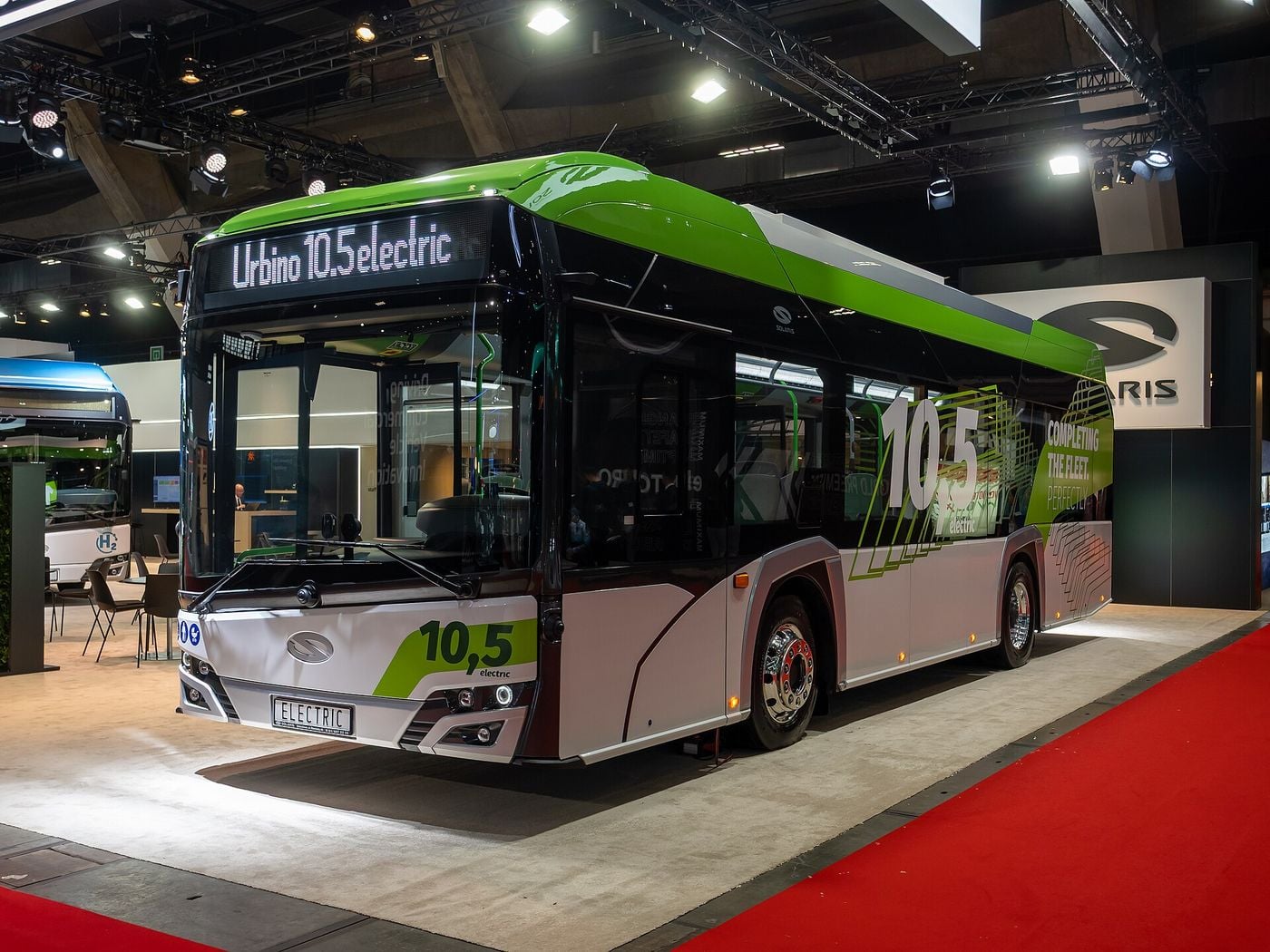
Solaris Urbino 10,5 electric
Solaris's 10.5-metre electric city bus with modular drive: a central 240 kW motor, 350 kWh Solaris High Energy batteries, up to 85 passengers, dimensions and safety systems.
- 240 kW
- 10.55 m
- 19.5 t

Model overview
- Segment
- Bus
- Transmission
- Modular drive with SiC technology, driving a portal axle with stabiliser
- Gross vehicle
- 19 500 kg
- Battery capacity
- 350 kWh
- Electric motor
- 240 kW
- Length
- 10 550 mm
- Wheelbase
- 4 450 mm
- Capacity
- 29 seats (up to 33 in option)
- Doors
- 2-2-2 (2-2-0, 1-2-2, 1-2-0 in option)
The Urbino 10,5 electric is a battery-electric city bus from Solaris, 10,550 mm long, with a modular drive, as on other buses of the Urbino family. Solaris presented it for the first time at Busworld 2025 in Brussels on 3 October 2025. This page is built from four Solaris documents in English, all read on 26 October 2026: the press release of 3 October 2025 announcing the world premiere, the model’s product page on solarisbus.com, and two technical data sheets headed “Solaris Urbino 10,5 electric with modular drive” — one in Solaris’s Premiera_105 asset folder, whose file properties are dated 1 October 2025, and one among the press files for Transexpo 2026, in a folder dated 14 October 2026. Neither sheet prints a date or a market.
Premiere and model family
Solaris’s release of 3 October 2025 reports “the world premiere of the Urbino 10,5 electric” at Busworld, held in Brussels on October 3-9, and invites visitors to Solaris’s stand 502 in Hall 5; alongside the new model, Solaris presented the Urbino 18 hydrogen and the Urbino 12 electric at the fair. Solaris calls the new model “a compact, fully electric bus”, and its product page, which carries the label “New product”, says Solaris unveiled it at Busworld 2025.
According to the release, the model was developed on the basis of solutions known from the Urbino 12 electric and other buses of the Urbino family with a modular drive, and full standardisation has been kept in key driveline and body components. The release also names the eSConnect platform, which Solaris says supports energy optimisation, remote diagnostics and fleet management, and gives the bus a recyclability rate of nearly 97%.
The “See also” list on the release’s page names a release of 15 October 2026 headed “Solaris Urbino 10,5 electric wins TRANSEXPO 2026 Medal” and one of 14 October 2026 headed “Solaris with its latest zero-emission buses at TRANSEXPO 2026”. The technical data sheet filed with the Transexpo 2026 press assets prints the same figures as the sheet in the Premiera_105 folder, with one difference in the list of driver-assistance systems, set out below. No document opened gives a start of series production or describes an earlier generation of the model.
Electric motor and drive
Both technical data sheets list the electric motor as “Central, 240 kW” and the electric drive as “Modular drive, SiC technology”. The press release of 3 October 2025 gives “a synchronous motor of 240 kW”; the product page gives “a new-generation synchronous motor with a power of up to 250 kW”. No document opened splits the power into continuous and peak figures or gives a torque figure.
The release says the debut vehicle is equipped with a modular drive system and that eliminating the engine tower increased passenger space and optimised weight distribution. The distribution of the driveline components, it adds, also created more space on the roof, where the traction batteries are located. How a battery-electric city bus is built and charged is set out in electric buses explained.
Axles and brakes
The sheets describe the front axle as “Independent axle, with stabiliser” and the drive axle as “Portal axle, with stabiliser”. They name no axle make and no model number, and no document opened prints a wheel formula; the sheets list one front axle and one drive axle.
Under “Braking system” both sheets list acceleration slip regulation (ASR), brake assistance, brake pads wear monitoring, an electronic braking system (EBS) and Hill Holder. Under “Additional braking systems” they list a collision mitigation system (CMS) and electronic stability control, abbreviated “ECS” on the sheets. No document opened gives the wheel brakes, the suspension, the steering or the tyre size.
Dimensions and weights
| Row | Technical data sheets |
|---|---|
| Length | 10,550 |
| Width | 2,550 |
| Height | 3,330 (3,250 in option) |
| Wheelbase | 4,450 |
| Front overhang | 2,700 |
| Rear overhang | 3,400 |
| GVW (gross vehicle weight) | 19,500 kg (up to 20,000 kg depending on country and tires) |
The two overhangs and the wheelbase add up to the printed length: 2,700 + 4,450 + 3,400 = 10,550. The sheets do not say what the 3,250 mm height option consists of. The press release gives the length as “10,5 meters” and the product page as “10.5 metres”.
The sheets give no turning circle. The press release gives “a turning radius of under 17 meters”, and the product page “a turning diameter of less than 17 meters”. No document opened gives a kerb weight or axle loads.
Battery, charging and range
Both sheets list the batteries as “Solaris High Energy, 350 kWh (up to 400 kWh in option)”. The press release says the bus presented at Busworld 2025 uses Solaris High Energy batteries “with a capacity of around 350 kWh”, and that configurations “with a capacity of over 400 kWh are also available”; the product page gives Solaris High Energy batteries “with a capacity of over 400 kWh”. The option reads “up to 400 kWh” on the sheets and “over 400 kWh” in the release and on the product page. The documents opened give one capacity figure per configuration and do not say whether it is installed or usable energy; the difference between the two is explained in installed vs usable battery capacity.
Range is given only as a floor. The product page says the batteries of over 400 kWh “provide a range of more than 600 km (eSORT tests)”. In the release, the sentence after the two battery figures reads: “They provide a range of more than 600 km according to eSORT tests and allow all-day operation without the need for recharging.”
The sheets give the charging system as “Plug-in (with a pantograph in option)”, and the release says the bus “can be charged both via a plug-in connector and a pantograph”. No document opened gives a charging power, a connector standard or the position of the charging points. How pantograph charging works is set out in opportunity charging and pantographs.
Doors, seats and capacity
The sheets give the door arrangement as “2-2-2 (2-2-0, 1-2-2, 1-2-0 in option)”, the passenger capacity as “Up to 85”, the maximal number of seats as “29 (up to 33 in option)” and the maximal number of seats available from the low floor as “8 (max)”. The press release ties the higher seat count to one door layout: eliminating the engine tower, it says, made it possible “to provide up to 33 seats in a 2-2-0 arrangement while maintaining a high total capacity”. The product page gives up to 85 people, “including up to 33 seated”.
No document opened gives a standing-passenger figure, a wheelchair space or the class of the bus under UN Regulation No 107. The classes are set out in bus classes, and what low floor means as a defined term in bus accessibility.
Climate control
Both sheets list “CO2 air-conditioning with a heat pump”, with the driver’s cabin “air-conditioned via AC of the passenger compartment”. The press release describes the air conditioning as working with a CO2 heat pump.
Safety and driver-assistance systems
Both sheets state “GSR2 compliant, R66 Compliant”. Under “Solutions included in mandatory GSR2” they list AIF (Alcolock Interlock Installation Facilitation), BSIS (Blind Spot Information System), DDAW (Driver Drowsiness and Attention Warning), ESS (Emergency Stop Signal), ISA (Intelligent Speed Assistant), MOIS (Moving Off Information System), RD (Reversing Detection) and TPMS (Tire Pressure Monitoring System).
Under “Additional systems” both sheets list E-mirrors, LDW(S) (Lane Departure Warning System), LSM (Left side monitoring), PLCA (Passive Lane Change Assist) and TSR (Traffic Sign Recognition). The sheet in the Premiera_105 folder also lists AHBC (Automatic High Beam Control), which the Transexpo 2026 sheet does not.
The press release describes an advanced driver assistance package (ADAS) “compliant with GSR2 regulations” that includes, among others, a blind-spot monitoring system, intelligent speed assistance, sensors detecting pedestrians and cyclists in front of the vehicle, a driver drowsiness warning system and forward collision warning. It names the Mirror Eye system, cameras replacing traditional mirrors, as an option. Which assistance systems EU rules make mandatory, and from when, is set out in mandatory driver assistance systems.
Source notes
The figures above are the two Solaris technical data sheets for the Urbino 10,5 electric with modular drive, which print the same figures: a central 240 kW electric motor, a modular drive using SiC technology, an independent front axle and a portal drive axle, both with stabiliser and with no axle make or model number, Solaris High Energy batteries of 350 kWh, up to 400 kWh in option, plug-in charging with a pantograph in option, a front overhang of 2,700 mm and a rear overhang of 3,400 mm, a height of 3,330 mm or 3,250 mm in option, up to 85 passengers, 29 seats or up to 33 in option, of which at most 8 are available from the low floor, and a gross vehicle weight of 19,500 kg, up to 20,000 kg depending on country and tyres. The sheet in the Premiera_105 folder lists AHBC (Automatic High Beam Control) among the additional systems; the Transexpo 2026 sheet does not. The other Solaris documents frame some figures differently. The press release of 3 October 2025 gives a synchronous motor of 240 kW, while the product page gives a new-generation synchronous motor with a power of up to 250 kW; no document splits continuous from peak power. The release gives around 350 kWh for the bus presented at Busworld 2025 and says configurations of over 400 kWh are also available, while the sheets give up to 400 kWh in option and the product page gives over 400 kWh. Range is given only as a floor, more than 600 km according to eSORT tests: by the product page for the batteries of over 400 kWh, and by the release in the sentence that follows its two battery figures. The release gives a turning radius of under 17 metres, the product page a turning diameter of less than 17 metres; the sheets give neither. No Solaris document opened gives a usable battery capacity, a charging power, a connector standard, a standing-passenger figure, a wheel formula, a kerb weight, the suspension or a UN Regulation No 107 class.
Quick answers
- Which transmission does the Solaris Urbino 10,5 electric use?
- Transmission: Modular drive with SiC technology, driving a portal axle with stabiliser.
- What is the gross vehicle weight of the Solaris Urbino 10,5 electric?
- Gross vehicle weight: 19 500 kg.
- What battery capacity does the Solaris Urbino 10,5 electric have?
- Battery capacity: 350 kWh.
- How long is the Solaris Urbino 10,5 electric?
- Length: 10 550 mm; Wheelbase: 4 450 mm.
- How many passengers does the Solaris Urbino 10,5 electric carry?
- Capacity: 29 seats (up to 33 in option).
Articles that mention the Solaris Urbino 10,5 electric
More Solaris on this site
Sources
- Solaris Urbino 10,5 electric with modular drive — technical data (Premiera_105 folder) — Solaris Bus & Coach
- Solaris Urbino 10,5 electric with modular drive — technical data (Transexpo 2026 press assets) — Solaris Bus & Coach
- Busworld 2025: World premiere of Solaris Urbino 10,5 electric — Solaris Bus & Coach, 3 Oct 2025
- Urbino 10,5 electric — Solaris Bus & Coach