Electric buses explained: how they work and how widespread they are in Europe
How a battery-electric city bus is built and charged, what makers declare for range, and what ACEA, ICCT, T&E, IEA and EU law say about electric buses in Europe.
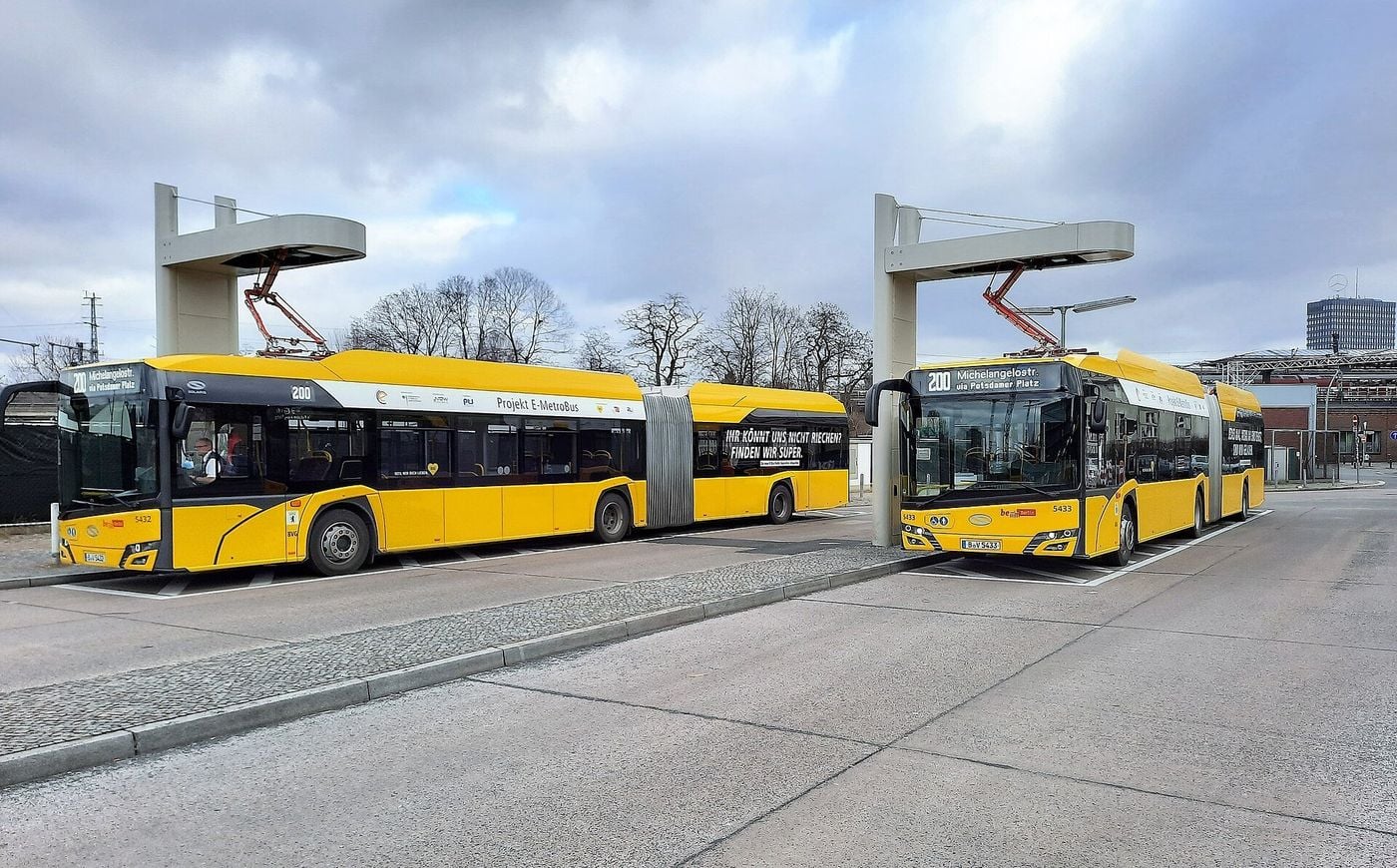
A battery-electric bus is driven by electric motors that draw on battery packs, and it is charged by cable at a depot or, for longer routes, by pantograph or charging rails on the way. ACEA puts the share of electrically chargeable vehicles, a category that includes plug-in hybrids, at 27.7 per cent of new EU registrations of buses and coaches above 3.5 tonnes in the first half of 2026, and this page sets that beside the different definitions and figures of ICCT, T&E and IEA, the makers’ own declarations and the EU rules that bind manufacturers.
This page covers the battery-electric kind. Trolleybuses, hydrogen fuel-cell buses and the mechanics of the EU zero-emission target for urban buses are set out in City Bus Propulsion and the EU Zero-Emission Mandate. Fuel-cell buses and a hydrogen coach are set out model by model in Hydrogen fuel-cell buses and coaches.
What counts as an electric bus
In EU law a battery-electric bus is one kind of zero-emission heavy-duty vehicle. Recital 9 of Regulation (EU) 2024/1610 says zero-emission heavy-duty vehicles currently include battery electric vehicles, fuel-cell and other hydrogen-powered vehicles. Point (a) of the definition of “zero-emission heavy-duty vehicle” in Article 3(11) of Regulation (EU) 2019/1242, as amended by Regulation (EU) 2024/1610, covers a heavy-duty motor vehicle without an internal combustion engine, or with one that emits not more than 3 g CO2/(tkm) or 1 g CO2/(pkm) as determined in accordance with Article 9 of Regulation (EU) 2017/2400; the definition has further points that are not covered here.
The statistics draw their own boundaries, so this page keeps each source’s figures apart and does not convert one into another.
| Source | Area | Buses counted | What “electric” covers |
|---|---|---|---|
| ACEA (trade association of European vehicle makers) | EU | Medium and heavy buses and coaches over 3.5 tonnes, as one item | “Electrically chargeable”: battery electric and plug-in hybrids; fuel cell electric vehicles are in “others” |
| ICCT (International Council on Clean Transportation), data from Dataforce | EU-27 except Malta | City buses, inter-urban buses, coaches and minibuses, split by weight and use (defined below) | “Zero-emission”: a dedicated battery electric, fuel-cell electric or other motor not driven by combustion |
| T&E (Transport & Environment, a clean-transport advocacy group), opinion piece | EU | “City buses”; the page gives no definition and no data source | “Zero-emission (ZE)”: battery-electric and fuel cell powertrains |
| IEA (International Energy Agency) | World and regions; the page does not say which countries “Europe” covers | Buses with 10 or more seats, urban and intercity | “Electric buses”; battery electric powertrains were 98% of those sold worldwide in 2025 |
On our reading, plug-in hybrids sit inside ACEA’s chargeable line and outside ICCT’s zero-emission definition, while fuel cell buses sit inside ICCT’s definition and in ACEA’s “others” line. Nothing on this page adds, subtracts or reconciles figures across the four sources.
How a battery-electric city bus is put together
MAN and Mercedes-Benz state the battery as a number of packs, and the count depends on the length or version of the bus; Solaris gives a single capacity. Three makers, in alphabetical order:
- MAN (Lion’s City E product page): the 10 E has four battery packs with a built-in capacity of 356 kWh, the 12 E four, five or six packs with 356 to 534 kWh, and the 18 E six, seven or eight packs with 534 to 712 kWh. MAN says each additional battery pack increases the range, while fewer batteries increase passenger capacity and reduce charging time. Its batteries are installed on the roof, which frees the space that would otherwise be taken up by the engine tower. Its release of 11 June 2025 names lithium-ion battery technology (NMC) for the MAN BatteryPack.
- Mercedes-Benz (Daimler Truck release, 2 October 2025): the eCitaro solo bus and the short eCitaro K are available with four to six battery packs, which with NMC4 packs have up to 666 kWh together, divided into three or four packs on the roof and two in what used to be the engine compartment (the version with four packs has three on the roof and one in the major assembly compartment); the eCitaro G articulated bus has four to seven packs, up to 777 kWh combined with NMC4 packs. A fully charged NMC3 pack contains 98 kWh of energy, against 111 kWh for the NMC4 battery. Daimler Buses describes NMC4 as the fourth generation of lithium-nickel-manganese-cobalt batteries and says it will be used in the eCitaro, eCitaro G and eCitaro K low-floor city buses from 2026; that is a statement of intent, and this page holds no later source on when NMC4 use began.
- Solaris (Urbino 12 electric data sheet, October 2025): Solaris High Energy batteries of 600 kWh.
The chemistries that truck makers state are compared in Battery chemistries in heavy trucks: what LFP, NMC and NCA are and which makers state which.
The documents show two drive layouts.
A central motor. MAN lists an electric central motor for the 10 E, 12 E and 12 E LE and, for the 18 E, two driven axles with two electric central motors. It gives continuous and maximum power of 160 and 240 kW for the solobus and 267 and 320 kW for the articulated bus, with a single-stage adapter gearbox. Solaris’s October 2025 data sheet lists a central 240 kW electric motor and a portal drive axle.
Motors on the wheel hubs. Daimler Buses says the eCitaro drive is based on the ZF AxTrax 2 LF portal axle with electric motors on the wheel hubs, with a peak output of 440 kW and a continuous output of 360 kW.
MAN says the range is extended by recovering energy during each braking process. Daimler Buses says battery capacity alone does not say enough about the performance and range of a city bus, that the true benchmark is energy consumption, and that in a city bus consumption is very strongly influenced by the climatic conditions and thus by the cooling and, above all, the heating of the vehicle interior. It heats the eCitaro’s passenger compartment with a heat pump, and Solaris lists CO2 air-conditioning with a heat pump for the Urbino 12 electric.
Charging: at the depot and on the route
IEA’s Global EV Outlook 2026 says depot charging is a crucial element of heavy-duty vehicle electrification, particularly for urban bus fleets, which typically rely on overnight or opportunity charging at central depots. It gives depot chargers as typically 50 to 150 kW, against 350 kW to 1 MW+ for some opportunity charging, and says grid upgrades at depots may be needed, especially for larger fleets. In some cases, IEA says, shifting part of the charging load to daytime or off-peak periods can reduce maximum depot power demand by up to 60 per cent. It calls grid connection delays a major bottleneck for electric bus deployment, especially for large depots with a high concentration of charging points, and says that in urban areas limited substation capacity, long permitting procedures and the need for network reinforcements can delay charging depots by several years. To enable longer daily driving ranges and expand the applications of electric heavy-duty vehicles, IEA says, en route or other opportunity chargers, such as at terminal bus stops or highway service stations, are needed.
Each maker states its own charging figures, in alphabetical order:
- MAN (Lion’s City E product page): a charging capacity of up to 150 kW, and all battery packs can be fully charged in two and a half to five hours. MAN says it also supplies the matching charging infrastructure, whether via cable or pantograph.
- Mercedes-Benz (Daimler Truck release, 2 October 2025): charging at the depot through a vehicle socket, with charging capacities of up to 150 kW possible; two eCitaro buses can be charged one after the other at a charger with two charging points. For even longer routes, intermediate charging via pantograph or charging rails is also possible, which Daimler Buses says is called opportunity charging in the technical jargon; in combination with charging rails on the roof, the charging capacity increases to up to 300 kW. The interior can be preconditioned while the batteries charge at the depot, so that, Daimler Buses says, the energy for climate control is not drawn from the battery at the start of the journey and the range is increased.
- Solaris (Urbino 12 electric data sheet, October 2025): plug-in charging, with a pantograph as an option; the sheet gives no charging power.
Each figure is one source’s statement for its own bus or charger, so they are not set against one another. No source used for this page gives a charging time in minutes for pantograph or opportunity charging, so none is stated. The EU’s binding connector standards and recharging targets for buses are set out in City Bus Propulsion and the EU Zero-Emission Mandate.
Range is a declaration, with conditions attached
IEA says there is currently no harmonised regulatory regime for measuring the actual range of electric heavy-duty vehicles across different countries and regions. For buses it gives the average range of available battery electric bus models as 360 km, around 15 per cent more than in 2020, and says this range is already sufficient to cover the mileage needs of urban buses, which drive on average 150 to 300 km per day. It adds that few battery electric bus models available today can cover the range needs of intercity buses, which can reach up to 800 km per day.
Makers attach their own conditions to the figures they publish. Two examples, in alphabetical order of maker:
- MAN (Lion’s City E product page): for its “Maximum Range” battery usage strategy, up to 500 km for the Lion’s City 12 E with six battery packs (6xCBP in MAN’s notation) and up to 460 km for the 18 E with eight (8xCBP). MAN’s footnote says the figures are according to SORT (Standardised On-Road Test) but with air conditioning/heating and a preconditioned vehicle, and that consumption values follow VECTO (Vehicle Energy Consumption Calculation Tool) depending on the specific configuration.
- Mercedes-Benz (Daimler Truck release, 2 October 2025): a reliable range of up to 600 km for the eCitaro solo bus and the eCitaro K with the maximum equipment of NMC4 batteries. The release’s footnote says the range was determined internally under specific conditions, including maximum battery capacity, a battery in as-delivered condition, typical city bus operation and a moderate weather scenario; that it may deviate from the values determined in accordance with Regulation (EU) 2017/2400, for example; and that the actual range depends on the individual use and configuration of the vehicle and other external factors, so it may be below or above the specified value.
The figures are listed, not ranked: each rests on its own conditions. The range Daimler Buses states for its battery-electric intercity bus, and the conditions it attaches to that figure, are set out in Mercedes-Benz eIntouro.
How many are sold in the EU
All buses and coaches (ACEA)
ACEA, the European Automobile Manufacturers’ Association, reports new EU bus registrations as one item, medium and heavy buses and coaches over 3.5 tonnes. Its “electrically chargeable” power-source line includes battery electric and plug-in hybrids, so it is not a share of battery-electric buses alone; its hybrid-electric line covers full and mild hybrids; fuel cell electric vehicles are counted in its “others” line, together with vehicles powered by natural gas, LPG, E85/ethanol and other fuels.
| Period and release | New registrations | Electrically chargeable | Hybrid-electric | Diesel |
|---|---|---|---|---|
| Full year 2025 (release of 29 January 2026) | 38,238 (+7.5%) | 23.8% | 7% | 62.1% (63.2% in 2024) |
| First half of 2026 (release of 29 July 2026) | 22,590 (+22.7%) | 27.7% (21.6% in H1 2025) | 6.1% | 58.2% |
For the first half of 2026 ACEA reports electrically-chargeable registrations up 56.8 per cent, diesel up 11 per cent and hybrid-electric up 10.7 per cent. For 2025 it reports hybrid-electric down 24.9 per cent and diesel up 5.7 per cent. The two rows cover different periods, a full year and a half-year. The definitions come from the footnotes to the tables in ACEA’s PDF releases; the H1 2026 web release does not repeat them. ACEA’s bus item is not split into city buses and coaches. What ACEA’s categories count is explained in What a European truck registration figure counts.
City buses and coaches (ICCT, IEA, T&E)
ICCT does split them, on its own definitions. A city bus is a passenger vehicle used exclusively in urban environments with a gross vehicle weight above 7.5 tonnes. An inter-urban bus has a gross vehicle weight above 7.5 tonnes and is used in both urban and regional environments. A coach is used exclusively in regional environments with a gross vehicle weight above 3.5 tonnes. A minibus has a gross vehicle weight between 3.5 and 7.5 tonnes. ICCT’s data were supplied by Dataforce and cover all EU-27 countries except Malta.
ICCT’s report for January to December 2025 (March 2026) says the sales share of zero-emission city buses grew from 45 per cent to 58 per cent between 2024 and 2025, while zero-emission interurban buses and coaches remained at a 4 per cent zero-emission share across both years. Its report for January to June 2026 (July 2026) says over 60 per cent of new city buses were electric in Q2 2026, the segment’s highest share to date and a reversal from a downward trend witnessed the year before. Its Figure 4.1 for Q2 2026 gives city buses as 61 per cent battery electric, 30 per cent diesel (including hybrids) and 9 per cent natural gas, and inter-urban buses and coaches as 87 per cent diesel, 8 per cent natural gas and 5 per cent battery electric. The report notes that Q2 2026 data for Finland and Sweden were unavailable at the time of publication.
Three sources give an EU city bus share for 2025, and they measure different things. This page does not reconcile them.
- ICCT: zero-emission city buses were 58 per cent of sales in 2025, against 45 per cent in 2024.
- IEA: battery electric city buses reached a share of over 55 per cent in the European Union in 2025, up from around 45 per cent the previous year.
- T&E, an advocacy group, in an opinion piece of 20 February 2026 that does not state its data source: six out of ten new EU city buses were zero-emission in 2025, with battery-electric and fuel cell powertrains making up 56 per cent and 4 per cent of new sales respectively. It puts fuel cell at 3 per cent of new EU city buses in 2024.
What two makers say about their own fleets
MAN’s release of 11 June 2025 quotes its Head of Product Marketing Bus as saying that over 2,500 of its eBuses are in operation throughout Europe. Daimler Buses’ release of 2 October 2025 says that since the start of series production in 2018 it has delivered over 3,000 eCitaro buses to customers. One counts buses in operation, the other buses delivered, and they are not added or compared.
How many are sold worldwide
IEA’s Global EV Outlook 2026, published on 20 May 2026 under a CC BY 4.0 licence, says sales of electric buses reached almost 70,000 globally in 2025, growing 12 per cent year on year. IEA’s figures refer to buses with 10 or more seats, including both urban and intercity buses. Battery electric powertrains made up 98 per cent of the electric buses sold worldwide.
China again accounted for most global electric bus sales in 2025, but IEA says its share of global sales has gradually declined from nearly 100 per cent in 2018 to around 60 per cent in 2025. In China, IEA says, electric buses represented more than 60 per cent of total bus sales and sales of city buses were nearly 100 per cent electric, while zero-emission vehicles represented around 10 per cent of coach sales in 2025.
Europe has been the world’s second-largest electric bus market for the past decade, IEA says, though sales volumes remain well below those in China. In 2025 sales in Europe totalled more than 12,000, 28 per cent higher than in 2024, and the share of electric buses in new bus sales exceeded 12 per cent. IEA’s page does not say which countries it counts as Europe, and the 12 per cent is a share of all new buses with 10 or more seats, not a city bus share; on our reading it does not line up with ACEA’s category, and this page draws no comparison between them. By country in 2025, IEA reports that electric buses accounted for more than 60 per cent of new bus sales in Norway, around 30 per cent in the United Kingdom and over 25 per cent in Germany.
Elsewhere, IEA reports that India remained the third-largest electric bus market for the second year in a row, with sales passing 4,000 for the first time in 2025; that in Latin America electric bus sales more than tripled year on year to exceed 3,000, with nearly 2,000 sold in Chile alone; and that electric bus sales in the United States fell 40 per cent in 2025 compared with 2024.
Moscow, by the city’s own account
The figures in this section come from an announcement of the Moscow city government of 1 September 2026 on its portal mos.ru. They are the city’s own statement, not independent data. It says that more than 3,100 electric buses have arrived at Mosgortrans sites since 2018, a count of deliveries that on our reading is not the size of today’s fleet, and that they work on 310 routes and that on average more than 1.2 million trips are made on them daily. It says more than 470 ultra-fast charging stations have been installed in depots and at 59 terminal stations, that electric buses of KamAZ and LiAZ run on the city’s streets, and that this year buses began to be delivered that charge from stations with an inverted-type pantograph.
What EU law requires of manufacturers
Regulation (EU) 2024/1610 of 14 May 2024 amends Regulation (EU) 2019/1242 to strengthen the CO2 emission performance standards for new heavy-duty vehicles. It was published in the Official Journal on 6 June 2024 and applies from 1 July 2024. The European Commission’s climate directorate says the targets apply to new heavy-duty vehicles registered in a reporting period, which runs from 1 July of a year to 30 June of the following year. For manufacturers’ new buses the Regulation does two different things, and both fall on the manufacturer, not on a city or an operator; its separate provision for public buyers is noted at the end of this section.
Urban buses: a zero-emission share. Article 3d(1), inserted into Regulation (EU) 2019/1242, provides that for the heavy-duty vehicles in the fourth column of the table in point 4.2 of Annex I (“urban buses”), manufacturers shall comply with the 90 % and 100 % minimum shares of zero-emission heavy-duty vehicles in their fleet of new heavy-duty vehicles in accordance with point 4.3.2 of Annex I.
| Reporting periods of the years | Before 2030 | 2030–2034 | 2035–2039 | From 2040 |
|---|---|---|---|---|
| Zero-emission mandate | 0 | 90 % | 100 % | 100 % |
The share is a zero-emission share, not a battery-electric share: it uses the Regulation’s definition set out above, and Recital 9 lists battery electric, fuel-cell and other hydrogen-powered vehicles.
Coaches and interurban buses: CO2 targets, no zero-emission share. In Annex I point 4.3.1, coaches and interurban buses, a row that also lists sub-groups 31-L2 and 33-L2, carry CO2 emissions reduction targets of 0 for the reporting periods 2025 to 2029, 43 % for 2030 to 2034, 64 % for 2035 to 2039 and 90 % from 2040. The zero-emission table in point 4.3.2 lists only urban buses. Where the line between urban bus and coach is drawn is set out in City Bus Propulsion and the EU Zero-Emission Mandate and, for the passenger classes, in Bus Classes Under UN R107: Class I, II, III, A and B.
Public buyers are addressed by Article 3e, which the same Regulation inserts into Regulation (EU) 2019/1242 and which sets how contracting authorities and contracting entities award contracts for new zero-emission urban buses, and by a separate instrument, Directive 2009/33/EC; this page sets out neither. Article 3e is covered in City Bus Propulsion and the EU Zero-Emission Mandate and Directive 2009/33/EC in The Regulatory Floor Under Bus Fleet Operating Costs.
The electric models on this site
Model pages for buses with an electric version, in alphabetical order:
- Iveco Crossway, an intercity nameplate whose versions include the electric CROSSWAY ELEC
- MAN Lion’s City, which includes the Lion’s City E
- Mercedes-Benz Citaro, which includes the all-electric eCitaro
- Otokar Kent, whose propulsions include the e-Kent
- Solaris Urbino 12 electric
The sister subject for trucks and tractor units is Electric trucks and tractor units explained: how they work, what makers declare, where they charge.
Quick answers
- How does an electric bus work?
- The makers' documents describe battery packs that feed electric motors. MAN's Lion's City 12 E carries four, five or six packs (356 to 534 kWh built in) on the roof and an electric central motor with a single-stage adapter gearbox, while the Mercedes-Benz eCitaro has electric motors on the wheel hubs of a portal axle and its packs on the roof and in what used to be the engine compartment. MAN gives a charging capacity of up to 150 kW and says braking energy is recovered to extend range; Daimler Buses says depot charging through a vehicle socket is possible at up to 150 kW, with pantograph or charging rails for longer routes.
- How long does it take to charge an electric bus?
- MAN says all battery packs of its Lion's City E can be fully charged in two and a half to five hours, with a charging capacity of up to 150 kW. Daimler Buses gives depot charging capacities of up to 150 kW for the eCitaro and up to 300 kW with charging rails on the roof, and IEA gives typical depot chargers as 50 to 150 kW against 350 kW to 1 MW+ for some opportunity charging. Each time or power is one source's statement, and no source used here gives an opportunity-charging time in minutes, so none is stated.
- How far can an electric bus go on one charge?
- IEA puts the average range of available battery electric bus models at 360 km, around 15 per cent more than in 2020, and says there is currently no harmonised regulatory regime for measuring the actual range of electric heavy-duty vehicles. MAN gives up to 500 km for the Lion's City 12 E with six battery packs and up to 460 km for the 18 E with eight, according to SORT but with air conditioning/heating and a preconditioned vehicle; Mercedes-Benz states up to 600 km for the eCitaro solo bus and eCitaro K with maximum equipment of NMC4 batteries, determined internally under specific conditions. Each figure rests on its own maker's conditions and the figures are not ranked.
- What share of new buses in the EU are electric?
- ACEA reports that electrically-chargeable buses and coaches above 3.5 tonnes took 23.8 per cent of new EU registrations in 2025 and 27.7 per cent in the first half of 2026, against 21.6 per cent in the first half of 2025. ACEA's electrically-chargeable category includes battery electric and plug-in hybrids, so it is not a battery-electric share, and its bus item is not split into city buses and coaches; diesel took 62.1 per cent in 2025 and 58.2 per cent in the first half of 2026.
- Are coaches going electric as fast as city buses?
- ICCT reports that the sales share of zero-emission city buses in the EU grew from 45 per cent to 58 per cent between 2024 and 2025, while zero-emission interurban buses and coaches stayed at 4 per cent in both years. In EU law, Regulation (EU) 2024/1610 sets minimum zero-emission shares of 90 % for the reporting periods 2030 to 2034 and 100 % from 2035 for manufacturers' urban buses, while coaches and interurban buses carry CO2 emissions reduction targets and no zero-emission share.
- How many electric buses are sold worldwide?
- IEA reports that sales of electric buses reached almost 70,000 globally in 2025, growing 12 per cent year on year, with battery electric powertrains making up 98 per cent of those sold. IEA counts buses with 10 or more seats, urban and intercity; China's share of global sales fell from nearly 100 per cent in 2018 to around 60 per cent in 2025, and sales in Europe totalled more than 12,000 in 2025, 28 per cent higher than in 2024, though IEA's page does not say which countries it counts as Europe.
Models in this article
Sources
- New commercial vehicle registrations: vans +1.9%, trucks +9.8%, buses +22.7% in H1 2026 — ACEA — European Automobile Manufacturers' Association, 29 Jul 2026
- New commercial vehicle registrations: vans +1.9%, trucks +9.8%, buses +22.7% in H1 2026 (press release with tables) — ACEA — European Automobile Manufacturers' Association, 29 Jul 2026
- New commercial vehicle registrations: vans -8.8%, trucks -6.2%, buses +7.5% in 2025 (press release with tables) — ACEA — European Automobile Manufacturers' Association, 29 Jan 2026
- Race to zero: European heavy-duty vehicle market development quarterly (January–December 2025) — International Council on Clean Transportation (ICCT), 11 Mar 2026
- Race to Zero: European heavy-duty vehicle market development quarterly (January–June 2026) — International Council on Clean Transportation (ICCT), 30 Jul 2026
- Past the inflection point: electric now clearly dominates the city bus market (opinion) — Transport & Environment (T&E), 20 Feb 2026
- Global EV Outlook 2026 — Trends in other EV modes — International Energy Agency (IEA), 20 May 2026
- Global EV Outlook 2026 — Electric vehicle charging — International Energy Agency (IEA), 20 May 2026
- Regulation (EU) 2024/1610 amending Regulation (EU) 2019/1242 as regards strengthening the CO2 emission performance standards for new heavy-duty vehicles — recital 9, Articles 3(11), 3d and 3e as amended or inserted, Annex I points 4.3.1 and 4.3.2 (OJ L, 6.6.2024) — Publications Office of the European Union, 14 May 2024
- Lorries, buses and coaches — European Commission — Directorate-General for Climate Action
- The new NMC4 battery in the Mercedes-Benz eCitaro: More capacity, longer service life — Daimler Truck AG, 2 Oct 2025
- MAN Lion's City E — MAN Truck & Bus
- UITP Summit 2025: MAN Lion's City E with new battery generation celebrates world premiere — MAN Truck & Bus, 11 Jun 2025
- Solaris Urbino 12 electric with modular drive — technical data (October 2025) — Solaris Bus & Coach sp. z o.o.
- Электробусы обслуживают 310 столичных маршрутов наземного транспорта — Mos.ru — official portal of the Moscow city government, 1 Sept 2026