Mercedes-Benz
Mercedes-Benz eIntouro
Daimler Buses' battery-electric high-floor intercity bus in two lengths: one or two 207 kWh LFP packs, a ZF central drive of 320 kW and the conditions behind 'up to 500 km'.
- 320 kW
- 12.18 m
- 19.5 t
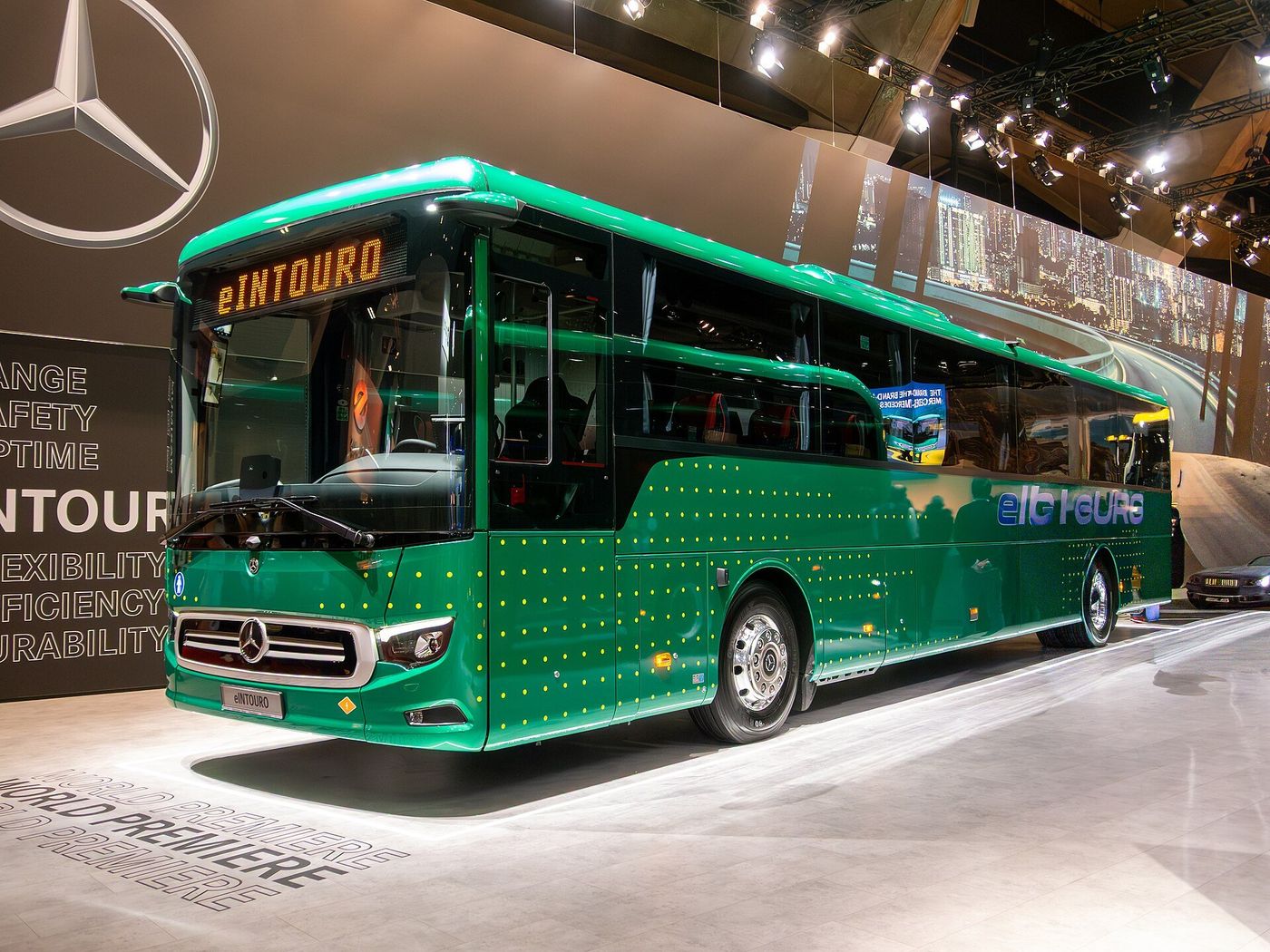

Model overview
- Segment
- Bus
- Transmission
- ZF CeTrax 2 dual central drive, integrated fully automatic 3-speed transmission
- Gross vehicle
- 19 500 kg
- Battery capacity
- 207–414 kWh
- Electric motor
- 320 kW · 400 kW peak
- Length
- 12 180 mm
- Wheelbase
- 6 080 mm
- Turning circle
- 21 458 mm
- Capacity
- Standard seating 51 (eIntouro), 59 (eIntouro M)
- Doors
- 2
The eIntouro is the battery-electric version of the Mercedes-Benz Intouro, a high-floor intercity bus. Mercedes-Benz Buses’ model page says it “is based on the well-known diesel-powered Intouro, but has a battery-electric drive”, and lists two lengths, the 12.18-metre eIntouro and the 13.09-metre eIntouro M.
In brief, each with its conditions in the sections below: one or two LFP battery packs of 207 kWh each, 414 kWh at most; a ZF CeTrax 2 dual central drive rated at 320 kW continuous and 400 kW peak; CCS Type 2 charging at up to 400 kW with two packs and up to 225 kW with one; and a range of up to 500 km, which Daimler ties to the maximum battery equipment. The dimensions in the overview grid above are those of the 12.18 m eIntouro.
The data sheet is “The eIntouro. Technical data and equipment at a glance”, on the Mercedes-Benz Buses website, with Daimler Buses GmbH as its named provider (footer 07/2026, opened on 29 September 2026). It has one column for the eIntouro and one for the eIntouro M and marks each item of equipment as standard or optional. Daimler Truck’s releases from 18 November 2024 to 21 September 2026 supply the history and the statements the sheet does not carry; two of them, both of 21 September 2026, are called below the FIAA 2026 range release (“The Mercedes-Benz range at FIAA 2026”) and the FIAA 2026 table (“Technical specifications of the vehicles on display”). The sheet prints a full stop as the thousands separator and a comma as the decimal mark: the sheet’s 12.180 is 12,180 mm and its 7,1 is 7.1°.
Overview and model line
Daimler Truck’s release of 2 October 2025, which announces the world premiere, calls the eIntouro the company’s “first all-electric series-production inter-city bus”; the model page calls it “the first fully electric inter-city bus from Mercedes-Benz”. Both are the maker’s statements about its own range. The same release says that on the outside “the eIntouro is hardly distinguishable from the familiar Intouro models” and that the drive configuration “enables a high share of common parts with the conventional Intouro”. A Daimler release of 18 November 2024 says that with a length of between 12.18 and 13.09 metres and a seating capacity of 50 to a maximum of 63, “the vehicle offers just as much space as the conventionally powered variant”.
The model page states the maker’s intended use in one sentence: “The all-electric Mercedes-Benz eIntouro was developed for intercity routes, school bus transport, shuttle and plant transport as well as excursions and shorter trips.” Of the diesel-powered Intouro, an abridged Daimler release of 2 October 2025 says that since series production began in 1999 Daimler Buses has delivered 20,000 units. That figure is the diesel bus’s, not the eIntouro’s. Propulsion types for urban buses and the EU zero-emission mandate are covered in City Bus Propulsion and the EU Zero-Emission Mandate.
Development and launch timeline
Every date below is Daimler’s own, taken from its releases and given with the release date.
| Date | What Daimler states | Document |
|---|---|---|
| 18 November 2024 | Near-production prototype presented for the first time at the 2024 eMobility Days in Berlin. On ordering: “The vehicle will be available to order in the first quarter of 2025.” On deliveries: “First customer deliveries are planned from 2026.” | Two Daimler Truck releases of 18 November 2024 |
| “Last winter” | Two prototypes “had already successfully completed extensive winter tests in Rovaniemi, Finland, at temperatures of up to minus 30 degrees Celsius”. | Release of 16 September 2025 |
| Beginning of April 2025 | First customer test drive “at the beginning of April”: the near-production prototype completed “the approximately 380-kilometre test drive on the regular route of the EUROBUS Rustexpress”. “The start of production is planned for 2026.” | Release of 3 April 2025 |
| Spring 2025 | “The vehicle has been available to order since spring 2025.” | Release of 2 October 2025 |
| Summer 2025 | Around five weeks of summer testing “at extreme temperatures of up to 45 degrees Celsius in Andalusia in southern Spain”, with climbs in the Sierra Nevada “up to an altitude of 2,500 metres at full load”. The test vehicles covered “around 300 to 500 kilometres a day”, and the two prototypes made “the entire almost 4,000-kilometre round trip from Mannheim to Granada in Spain and back on their own wheels”. | Release of 16 September 2025 |
| 3 October 2025 | World premiere of the series-production version at Busworld Europe 2025 in Brussels (fair 4 to 9 October, with 3 October as press day). The release of 7 October 2025 says “Last Friday, Daimler Buses presented the series-production version of the Mercedes-Benz eIntouro for the first time”; that Friday was 3 October 2025. The same release says Daimler Buses “will be exhibiting the new eIntouro at Busworld Europe as a 12.18-metre long intercity version at the stand in Hall 5 of the Brussels Expo”. | Releases of 2 and 7 October 2025 |
| 23 March 2026 | Release for Bus2Bus 2026 (15–16 April, Berlin): “The first customer vehicles are expected to be delivered in the second half of 2026.” The release of 2 October 2025 has the same sentence. | Release of 23 March 2026 |
| 21 September 2026 | FIAA 2026 in Madrid: Daimler Buses presents the eIntouro M, and Daimler Buses España “will make three vehicles available for test drives by trade visitors”, one of them the eIntouro M. The portfolio release is datelined “Madrid, 22 September 2026”. | Releases of 21 September 2026 |
The release of 16 September 2025 puts the Spanish summer test at “up to 45 degrees Celsius”; the release of 7 October 2025 quotes the CEO of Daimler Buses on “the equally challenging summer test in Spain at temperatures above 45 degrees”. The two wordings are not reconciled in either document.
As of 29 September 2026, Daimler’s latest statement on deliveries in the documents cited here is the expectation of March 2026 quoted above.
Two lengths: eIntouro and eIntouro M
The data sheet gives the eIntouro a length of 12,180 mm and the eIntouro M 13,090 mm, both 2,534 mm wide and 3,465 mm high. Standard seating is 51 seats on the eIntouro and 59 on the eIntouro M, and maximum passenger capacity 55 and 63; the seating section below sets out how the other documents word these figures. Daimler’s own prose writes the lengths as 12.18 and 13.09 metres. The two-axle eIntouro of 12.18 metres is the vehicle in the overview grid above.
| Row on the data sheet | eIntouro | eIntouro M |
|---|---|---|
| Length [mm] | 12,180 | 13,090 |
| Length incl. mirrors [mm] | 12,510 | 13,420 |
| Width [mm] | 2,534 | 2,534 |
| Height [mm] | 3,465 | 3,465 |
| Inner stand height central aisle [mm] | 2,180 | 2,180 |
| Parapet height (above ground) [mm] | 750 | 750 |
| Wheelbase front axle-drive axle [mm] | 6,080 | 6,990 |
| Overhang at front [mm] | 2,800 | 2,800 |
| Overhang at rear [mm] | 3,300 | 3,300 |
| Tyre size | 295/80 R 22.5 | 295/80 R 22.5 |
| Turning circle min. [mm] | 21,458 | 23,834 |
| Turning circle BOKraft [mm] | 25,000 | 25,000 |
| Ring width turning circles min. [mm] | 6,857 | 7,277 |
| Ring width BOKraft [mm] | 5,945 | 6,917 |
| Ring width max. permissible according to BOKraft [mm] | 7,200 | 7,2 |
| Track circle minimal [mm] | 17,424 | 19,797 |
| Wheel impact front axle max. [°] | 54 / 46 | 54 / 46 |
| Cockpit height [mm] | 891 | 891 |
| Floor height over roadway [mm] | 891 | 891 |
| Pedestal height [mm] | 210 | 210 |
| Entry height door 1 [mm] | 361 | 359 |
| Entry height door 2 [mm] | 378 | 370 |
| Slope angle in front [°] | 7.1 | 7.1 |
| Slope angle rear [°] | 7.7 | 7.7 |
| Luggage compartment volume [m³] | 4.5 | 6 |
In the eIntouro M column the sheet prints “7,2” for the ring-width row, in a row labelled [mm]. The row labels, BOKraft among them, are the sheet’s own. What a data sheet’s dimension and weight rows are read against, including the European length and width limits, is set out in how a coach specification sheet is read; its worked example is a different maker’s sheet.
The sheet’s own rows explain the two lengths: front overhang, wheelbase and rear overhang add up to 2,800 + 6,080 + 3,300 = 12,180 mm for the eIntouro and 2,800 + 6,990 + 3,300 = 13,090 mm for the eIntouro M. The eIntouro M is 910 mm longer, and the whole 910 mm is wheelbase (6,990 − 6,080). Length including mirrors exceeds length by 330 mm in both columns (12,510 − 12,180 and 13,420 − 13,090).
Two quantities carry a second figure elsewhere in Daimler’s documents. The model page gives the 12.18 m eIntouro “a centre aisle height of 860 millimetres”. The data sheet’s “Floor height over roadway” row reads 891 mm in both columns, the sheet’s “Cockpit height” row also reads 891 mm, and Daimler’s FIAA 2026 table for the eIntouro M on display gives “Height of centre aisle above roadway” as 891 mm. The documents do not reconcile 860 and 891 mm. For luggage, the sheet gives the eIntouro M 6 m³ while the model page writes “boot of up to 5.5 cubic metres” for it; the documents do not reconcile those either.
Battery
Daimler offers the eIntouro with “one or two battery packs, each with a capacity of 207 kWh”, and the model page adds: “The maximum total capacity is 414 kWh.” The data sheet’s battery table reads the same in both columns: number of battery packs 1 - 2, capacity 207 kWh, and capacity of battery pack 1/2 207/414 kWh. The first pack “is always accommodated in the space behind the front axle”; the optional second pack is installed at the rear, in what the FIAA 2026 range release calls the “former engine compartment”.
Daimler’s documents carry a second capacity figure. The release of 18 November 2024 calls the 207 kWh a “nominal capacity”, per pack. The image captions of the FIAA 2026 press kit, marked with the release date 2 October 2025, describe the eIntouro M and the 12.18 m eIntouro in the photographs as having “2 battery packs with 207,6 kWh each”. No Daimler document opened says how 207 and 207.6 kWh relate.
The batteries “are based on lithium iron phosphate cell technology (LFP) and provide a supply voltage of 800 volts” (release of 2 October 2025); the data sheet’s drive table lists “Nominal voltage [V]” as 800. The model page says the LFP batteries and “many of the high-voltage components” are “already successfully deployed in the battery-electric Mercedes-Benz eActros 600”, which has its own page, Mercedes-Benz eActros 600. What LFP stands for, and which makers name which chemistry, is in Battery chemistries in heavy trucks.
In the documents opened, Daimler gives the usable share of the capacity as a percentage, not in kilowatt-hours. The release of 2 October 2025 says “more than 95 percent of the installed capacity can also be used with LFP technology”, the FIAA 2026 range release words it “more than 95 per cent”, and the release for Bus2Bus 2026 writes “a high usable capacity of 95 percent”. How installed and usable capacity differ is set out in Installed vs usable battery capacity in electric trucks.
On service life the release of 2 October 2025 says “a service life of up to 15 years is possible for individual applications”, and the FIAA 2026 range release says “up to 15 years possible in certain applications”. The documents opened give no battery warranty for the eIntouro.
Charging
The data sheet lists the charging technology as a CCS Type 2 connector; its eIntouro column prints the German “CCS-Typ-2-Stecker”. Daimler’s figures are “up to 400 kW charging capacity when equipped with two battery packs and up to 225 kW charging capacity with one battery pack” (release of 2 October 2025), and the FIAA 2026 range release repeats them: “up to 400 kW when the vehicle is equipped with two battery packs and up to 225 kW with one battery pack”.
The FIAA 2026 range release adds that customers “can choose from four locations” for the charging socket, “front, rear, right or left behind the front axle”, and that “a maximum of two charging sockets can be fitted to each vehicle”. For companies that already have eCitaro buses in their fleet, the release of 2 October 2025 says the existing charging technology can be used “provided that it has an output voltage of at least 900 V”.
The prototype announcement of November 2024 gave a different charging figure: the batteries could be charged with “a charging capacity of up to 300 kW”, and “The two batteries can be fully charged with up to 300 kW within 90 minutes; with just one battery pack, this can even be achieved in just 70 minutes.” Those two times belong to the 300 kW figure of that announcement, not to the 400 and 225 kW of the series-production releases. The documents opened give no charging time for the series-production bus.
Range and what it rests on
Daimler’s range figure is “up to 500 km”, and it is stated for the maximum battery equipment. The model page says: “With maximum battery equipment, the eIntouro achieves a range of up to 500 km without the need for a recharge.” The release of 2 October 2025 says: “If equipped with two battery packs, the eIntouro can cover up to 500 kilometers … without recharging, depending on driving style, topography, and weather conditions.” The ellipsis marks the footnote reference that the release prints there. The data sheet’s “Ranges” row reads “up to 500 km” in both columns. The documents opened give no range figure for a one-pack eIntouro.
Two different footnotes stand behind the figure. The footnote on the model page, which the data sheet reprints on its page 9, reads: “When equipped with the maximum battery capacity, with the LFP battery in its as-delivered condition, typical intercity bus operation as derived from the CO2 VECTO interurban cycle at moderate temperatures between 5°C and 28°C allows realistic ranges of up to 500 km. The actual range depends on individual vehicle use, vehicle configuration, and other external factors, and may be lower or higher than this value.”
The footnote in the release of 2 October 2025 reads: “The range was determined internally under specific conditions, including equipment with maximum battery capacity, battery in delivery condition, in typical inter-city bus operation and moderate weather scenario, and may deviate from the values determined in accordance with Regulation (EU) 2017/2400, for example. The actual range depends on the individual use of the vehicle, the vehicle configuration, and other external factors. Therefore, the actual range may be below or above the specified value.” How makers declare electric range, including internally determined figures and the EU’s VECTO tool, is set out for trucks in How electric-truck range is declared.
Electric drive and transmission
The data sheet lists the electric drive as “ZF CeTrax 2 dual” in both columns, with “Power (peak/ duration) [kW]” of 400/320. The model page gives “320 kW continuous output”, and the release of 7 October 2025 says “The electric central drive delivers 320 kW continuous power and 400 kW peak power”. The releases of 2 October 2025 and 21 September 2026 name the unit the “ZF CeTrax 2 dual CX332” central drive. The drive force, the release of 2 October 2025 says, “is transmitted via a fully automatic three-speed transmission integrated in the drive unit to the Mercedes-Benz RO 440 drive axle”. The model page words this as an “electric central motor with integrated transmission”.
Daimler’s documents are not uniform on the number and type of motors: the model page says “an electric central motor”, in the singular, while Daimler’s FIAA 2026 table for the eIntouro M on display lists the motor type as “Three-phase asynchronous motors”, in the plural. ZF’s bus fact sheet for the CeTrax 2 dual (EN 06/2024) is a component sheet, not one for the eIntouro. It describes the unit as “Equipped with 2 hairpin electric motors delivering up to 380 kW continuous power” and as including “2 integrated 800 Volt silicon carbide (SiC) inverters”, and it does not name the CX332 or 320 kW. The model page says of the eIntouro “The integrated 850V silicon carbide (SiC) power inverters maximise electrical efficiency and thus range.” The 800 V above is the batteries’ figure; 850 V is the model page’s figure for the inverters.
Torque is not one figure in Daimler’s documents. Each is printed here with its document and its label, and no document explains the differences.
| Document | Label | Figure |
|---|---|---|
| Data sheet, both columns | “Max. Torque [Nm]” | 2,470 Nm |
| Model page | “maximum output torque” | 2,470 Nm |
| Releases of 2 October 2025 and 21 September 2026 | “maximum output torque” | 24,700 Nm |
| Release for Bus2Bus 2026 | “maximum drive torque” | 24,700 Nm |
| FIAA 2026 table, eIntouro M for test drives | “Maximum/continuous torque” | 2,470 / 1,368 Nm |
| FIAA 2026 table, eIntouro M on display | “Maximum torque” | 4,500 Nm |
| FIAA 2026 press-kit captions | “max. torque” | 4,500 Nm |
ZF’s fact sheet labels 24,700 Nm “peak system output torque”, for the CeTrax 2 dual it describes, with up to 380 kW continuous power.
Axles, suspension and brakes
The data sheet lists power steering, a ZF RL 82 EC front axle and a Mercedes-Benz RO 440 driven axle in both columns, and a dash for the trailing axle type and for the wheelbase between drive axle and trailing axle. The model page calls the 12.18 m eIntouro “two-axle”. No Daimler document opened prints a wheel formula such as 4x2; what the notation counts is covered in axle configurations explained.
Independent front suspension with an anti-roll bar and air suspension via the electronic level control system (ENR) are standard. An anti-roll bar on the drive axle, a raising/lowering system and kneeling are optional.
Braking is by pneumatic disc brakes on all axles, standard. The sheet’s brakes table marks as standard the Electronic Stability Programme (ESP®), the anti-locking system (ABS), Acceleration Slip Regulation (ASR) and the parking brake. It marks as optional the electronically controlled braking system (EBS), Brake Assist (BAS), the retarder limiter (RL), the automatic bus stop brake with pull-away lock, the HOLD function and hill-start assist. The model page says: “The ABS, ASR and ESP assistance systems are standard equipment.”
Weights
The data sheet gives a gross vehicle weight of 19,500 kg in both columns, with maximum permissible axle loads of 7,500 kg on the front axle and 12,600 kg on the drive axle, and a dash for the trailing axle. Daimler’s FIAA 2026 table for the eIntouro M gives the same three figures. The two axle limits come to 20,100 kg, 600 kg more than the gross vehicle weight; the sheet does not comment on the difference. No Daimler document opened gives an unladen (kerb) weight. How a bus’s weight limits are set is covered in how a coach specification sheet is read.
Seats, doors and passenger compartment
On the data sheet, standard seating is 51 seats for the eIntouro and 59 for the eIntouro M, and “Passenger capacity max.” is 55 and 63. The model page says “up to 55 seats” for the eIntouro and “up to 63 seats” for the eIntouro M. The releases give “seating variants from 50 to a maximum of 63 seats”, and the release for Bus2Bus 2026 writes “seating configurations from 50 up to a maximum of 63 passengers”. No document opened says how the 50 relates to the sheet’s rows. The sheet lists Inter Star Eco seating as standard and Travel Star Eco (TSE) Softline seating as optional; the driver’s seat is a GRAMMER Linea MSG 90.6 P, air-sprung, as standard, with an ISRI 6860 with integrated pneumatic system and 3-point seat belt as an option. A wheelchair space is optional.
No Daimler document opened states the eIntouro’s UN R107 class; the classes are set out in Bus Classes Under UN R107. The sheet’s only seat-belt row is the driver’s seat with a 3-point belt named above; it has no row for passenger seat belts. Which classes must have belts is in Bus Seat Belts.
The sheet lists 2 doors in both columns, with an outward swiveling door standard, a lift optional, single glazing standard, double glazing optional and a heatable windscreen optional. The release of 2 October 2025 describes “a wide entrance with single-leaf door at the front and optional single or double-wide entrance in the middle”, and says “A lift on the right-hand side is optionally available for both length variants.” For the toilet of the 13-metre version the documents word the position differently. The releases of 2 October 2025 and 18 November 2024 and the model page’s passenger-comfort text say “in front of the rear entrance”; the model page’s eIntouro M text and the FIAA 2026 table for the vehicle on display say “in front of the centre entrance”.
The model page lists luggage racks, retaining bars for school bags under the seats, and reading lamps and air vents at each double seat. Entry heights, floor height and luggage volume are in the dimensions table above.
Heating and air conditioning
The sheet marks electric roof air conditioning (modular system) as standard, and driver’s area air conditioning and a roof-mounted air-conditioning system with heat pump as optional; the refrigerant is R513A. Its rows “Cooling capacity passenger compartment [hp/kW]” and “Heating power passenger compartment [hp/kW]” read 29 and 52 in both columns. The sheet prints one figure per row and does not say whether it is in hp or kW.
Safety and driver-assistance systems
Standard on both lengths, in the sheet’s wording: Sideguard Assist 2; Frontguard Assist; Front Collision Guard (FCG); Attention Assist 2 (AtAs); Traffic Sign Assist; Electronic Stability Program (ESP®); Tyre Pressure Monitoring (TPM); reversing camera; extinguishing system; rain-light sensor; flat wiper blades with water fed through wiper blade; “Body strength in accordance with ECE-R 66.02”; and “Rollover strength compliant with in ECE R29.03”. Optional on both: Lane Assist (SPA), Active Brake Assist 6 Plus (ABA 6 Plus), the 360° camera and a reversing buzzer. Tyre Pressure Monitoring appears twice on the sheet, marked standard in the safety table and optional in the table headed “Profitability”, which also lists Driver Score as optional. The wording of the two rows on body and rollover strength is the sheet’s; the scope of UN Regulation No 66 is in UN R66 Bus Rollover Strength.
The model page describes ABA 6 Plus as initiating emergency braking “if there is a risk of a rear-end collision with vehicles in front or stationary obstacles”, and as able to “detect moving or stationary pedestrians and cyclists in front of the vehicle”, responding “with an audible and visual warning as well as automatic partial or maximum full-stop braking”. Daimler’s documents do not name the emergency braking system alike: the release of 2 October 2025 says “Active Brake Assist 6 (ABA 6)”, the release for Bus2Bus 2026 “Active Brake Assist 6 plus”, and the data sheet and the model page “Active Brake Assist 6 Plus (ABA 6 Plus)”. No document opened says whether the differing names denote one system or two.
The model page says: “Whether moving off or driving slowly (up to 15 km/h), the intelligent assistant can detect potential collisions with unprotected road users.” Of Sideguard Assist 2 the release of 2 October 2025 says it monitors “not only the front passenger side but also the driver’s side” and that “At speeds above 40 km/h” it “also performs the function of a lane change assistant”; the release of 18 November 2024 gave 30 km/h. The model page says Attention Assist “uses a discreetly installed driver camera to detect signs of fatigue or distraction”. The sheet’s glossary says of Lane Assist (SPA): “If it crosses the markings, the driver is warned by a clear vibration through the driver’s seat.”
The release of 2 October 2025 lists as standard equipment “the intelligent Traffic Sign Assist speed limiter, the Tire Pressure Monitoring (TPM) system, Attention Assist (AtAs), an interface for the use of alcohol testers for the driver’s area, and a reversing camera”. It adds that the optional 360° camera system can replace the reversing camera and that “MirrorCam instead of conventional mirrors is also available”. MirrorCam has no row in the data sheet’s equipment tables. Which driver assistance systems EU rules require on new vehicles, and from which dates, is set out in Mandatory driver assistance systems.
Cockpit, lighting, electronics and over-the-air updates
According to the FIAA 2026 range release, “The direction of travel is selected using the D-N-R selector on the steering-column stalk”, and “A power availability display replaces the rev counter and shows the current power demand or level of energy recuperation.” The model page adds “a multi-function steering wheel and a high-resolution driver display”. On the sheet, low beam, high beam, daytime driving lights with LED technology, a front fog lamp and a cornering light are standard, and ambient lighting for reverse driving is optional.
Daimler says that with the eIntouro it “is the first bus manufacturer in Europe to present a bus that can be updated over-the-air” (release of 2 October 2025). The same release says: “In all cases, installation only takes place when the vehicle is stationary, the parking brake is applied and drive-ready state is switched off. No internet connection is required during installation.” The release for Bus2Bus 2026 adds: “Remote vehicle control or manufacturer-driven autonomous rollout of software is excluded.” Of the Omniplus On data interfaces, the release of 2 October 2025 says “the total communication path from the vehicle to the cloud is certified in accordance with the latest UN ECE R155 Cyber Security standard”.
The eIntouro M shown at FIAA 2026
Daimler’s release “Technical specifications of the vehicles on display” of 21 September 2026 has two tables for the eIntouro M, one for the vehicle on display and one for the vehicle for test drives. What they list is that vehicle’s equipment, not the model’s standard. In both tables the length, width, height, wheelbase, overhangs, turning circle, standing height in the centre aisle, tyre size, gross vehicle weight and axle loads equal the eIntouro M column of the data sheet, and the tables give a 414 kWh LFP battery and a maximum charging power of 400 kW. They differ in the drive:
| Row | Vehicle on display | Vehicle for test drives |
|---|---|---|
| Motor or drive | “Three-phase asynchronous motors” | “CeTrax 2 dual central electric motor” |
| Output | Maximum 400 kW, continuous system output 320 kW | Maximum/continuous 400 / 320 kW |
| Torque | Maximum 4,500 Nm | Maximum/continuous 2,470 / 1,368 Nm |
| Overall drive axle ratio | 3.154 (printed 3,154) | not listed |
| Seating | not listed | Inter Star Eco seats, 53 seats |
| Wheelchair space | not listed | “Lift at entrance 2” |
| Air conditioning | not listed | EvoThermatik |
The display vehicle is equipped with two battery packs, “one located directly behind the front axle and the other in the former engine compartment”, Predictive Powertrain Control (PPC), Adaptive Cruise Control (ART) with Active Brake Assist 6 (ABA 6), Traffic Sign Assist, Sideguard Assist 2, Frontguard Assist, Attention Assist, Tyre Pressure Monitoring, MirrorCam in place of conventional exterior mirrors and a 360° camera system, with a toilet in front of the centre entrance. The release describes “Automatic body lowering at 78 km/h” as reducing the frontal area. The test-drive vehicle’s list has Electronic Stability Program, ABS, ASR, Brake Assist (BAS), ABA 6 Plus, Adaptive Cruise Control ART with Stop-and-Go function, Sideguard Assist 2, MirrorCam, Lane Assist, Frontguard Assist, Traffic Sign Assist, Attention Assist, TPM, LED headlamps, a rain and light sensor and an Acoustic Vehicle Alerting System, with Predictive Powertrain Control and over-the-air software updates as additional equipment.
The captions of the FIAA 2026 press kit, marked with the release date 2 October 2025, describe the eIntouro M in the photographs as “electric motor: ZF CeTrax 2 dual CX332 with 320 kW, max. torque: 4500 Nm, 2 battery packs with 207,6 kWh each”, with “length/width/height: 13090/2534/3465 mm, seating: 1/48”; the 12.18 m eIntouro’s caption ends “12180/2534/3465 mm, seating: 1/49”. No document opened defines the notation “1/48” or “1/49”.
Quick answers
- Which transmission does the Mercedes-Benz eIntouro use?
- Transmission: ZF CeTrax 2 dual central drive, integrated fully automatic 3-speed transmission.
- What is the gross vehicle weight of the Mercedes-Benz eIntouro?
- Gross vehicle weight: 19 500 kg.
- What battery capacity does the Mercedes-Benz eIntouro have?
- Battery capacity: 207–414 kWh.
- How long is the Mercedes-Benz eIntouro?
- Length: 12 180 mm; Wheelbase: 6 080 mm.
- How many passengers does the Mercedes-Benz eIntouro carry?
- Capacity: Standard seating 51 (eIntouro), 59 (eIntouro M).
Articles that mention the Mercedes-Benz eIntouro
More Mercedes-Benz on this site
Sources
- The eIntouro — technical data and equipment at a glance (facts-eintouro.pdf, footer 07/2026) — Daimler Buses / Mercedes-Benz Buses
- eIntouro — model overview — Mercedes-Benz Buses
- World premiere of the Mercedes-Benz eIntouro: e-mobility for inter city routes and excursions — Daimler Truck
- Daimler Buses celebrates world premiere of the Mercedes-Benz eIntouro at Busworld Europe — Daimler Truck
- Abridged version: Daimler Buses at Busworld Europe 2025 in Brussels — Daimler Truck
- Near-production prototype: The new Mercedes-Benz eIntouro — electric mobility for interurban and excursion routes — Daimler Truck
- Daimler Buses is electrifying bus transport between urban and rural areas — Daimler Truck
- Energised for E: successful summer testing of the new Mercedes-Benz eIntouro in Spain — Daimler Truck
- First customer test drive of the eIntouro: fully electric with EUROBUS to Europa-Park — Daimler Truck
- Daimler Buses at Bus2Bus 2026 — Daimler Truck
- The Mercedes-Benz range at FIAA 2026 — Daimler Truck
- Technical specifications of the vehicles on display (FIAA 2026) — Daimler Truck
- Daimler Buses highlights at FIAA 2026 — Daimler Truck
- Daimler Buses highlights its comprehensive portfolio of vehicles and services for passenger transport at FIAA 2026 — Daimler Truck
- Daimler Buses at FIAA 2026 — press kit, with image captions — Daimler Truck
- CeTrax 2 dual electric central drive — bus fact sheet (EN 06/2024) — ZF Friedrichshafen AG