Mercedes-Benz
Mercedes-Benz Atego
Seven power ratings out of two engines, 4x2 and 4x4, and a gross weight that changes with the document you open — what the Atego is and what to check used.
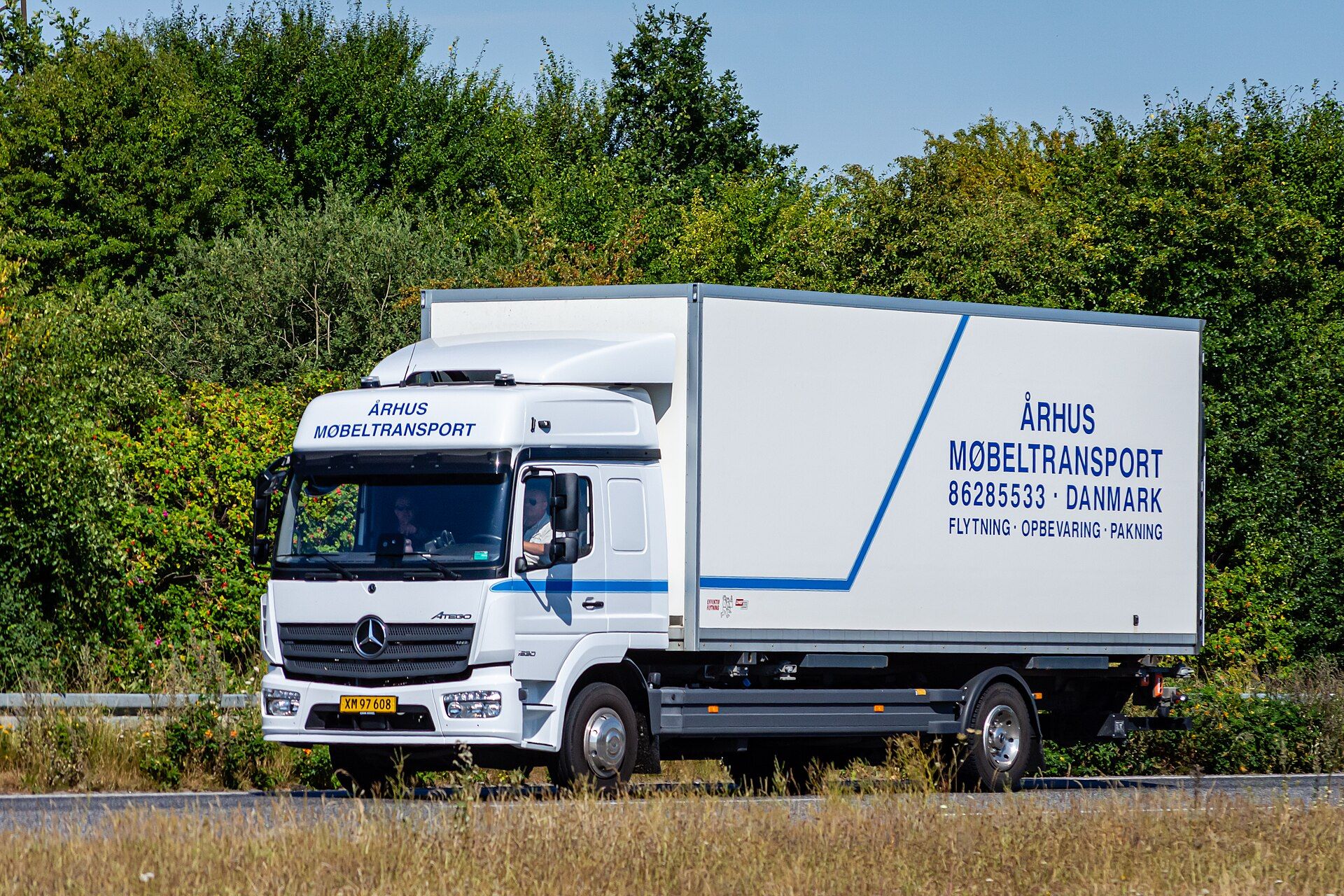
.jpg)
Model overview
Axle configurations: 4x2 · 4x4
Engine families
- Power
- 115–170 kW
- Torque
- 650–900 Nm
- Rated speed
- 2200 rpm
- Power
- 175–220 kW
- Torque
- 1000–1200 Nm
- Rated speed
- 2200 rpm
Mercedes publishes seven discrete ratings out of two displacement classes rather than a continuous range, so the power and torque spans above are spans across those steps: OM 934 at 115 kW (156 hp), 130 kW (177 hp), 155 kW (211 hp) and 170 kW (231 hp), and OM 936 at 175 kW (238 hp), 200 kW (272 hp) and 220 kW (299 hp). Mercedes does also print the span itself: the defence technical table carries a row headed "Power (min-max) (kW (hp))" reading 115-220 (156-299), the 2023 anniversary release says "from 115 to 220 kW (156 to 299 hp)", and the international model page and the February 2025 UK product sheets state the ceiling as "engine outputs of up to 220 kW (299 hp)". Those spans run across the seven steps; they are not a continuum, and no eighth rating sits between them in any document opened here. Torque runs 650, 750, 850 and 900 Nm on the four-cylinder and 1,000, 1,100 and 1,200 Nm on the six, every step held between 1,200 and 1,600 rpm. The 1,200 Nm shown for the 220 kW OM 936 is contested inside Mercedes' own documentation: the engine table on the international model pages gives 1,400 Nm, in every locale checked, while the prose on that same page, the February 2025 UK product sheets, the defence technical table (900-1,200 Nm) and the 2016 UK brochure all give 1,200. This record follows the four documents rather than the one table and does not reconcile them. No gross combination weight is published for the Atego at all, and the gross vehicle weight moves between documents, which is why the field above is blank: the February 2025 UK product sheets give 7.5-15 t for both the distribution range (model 967 LHD/RHD, 20 versions) and the construction range (9 versions), on a WHEEL FORMULA row reading "4x2, 4x4"; the defence table gives 15.6-16.0 t for the 4x4 and 14 t for the Atego 1430; the August 2025 release gives 16 t for the Atego 1530 AF 4x4 equipment truck, which carries a payload of over 3.6 t; and a December 2018 release names a model-wide "6.5 to 16-tonne permissible gross vehicle weight class". No band assembled across those documents is quoted as a Mercedes figure. Mercedes names "Euro VI" for this model and no lettered sub-stage. Transmission naming is not stable either: the international model page and the February 2025 UK product sheet call the standard automated gearbox PowerShift Advanced and attach no gear count to it, while the 2023 anniversary release, narrating the 2013 launch, and the defence 4x4 table call it PowerShift 3 with six and eight gears plus EcoRoll. A 9-speed appears in no current Atego specification table: the February 2025 UK distribution sheet says only "a wide array of manual and automatic transmissions", the February 2025 UK construction sheet contains the words transmission, gearbox and PowerShift zero times, the model page says "a wide range of manual and automated" transmissions, and the defence technical table reads "6- or 8-speed manual transmissio / PowerShift 3 (automated) / Allison fully automatic transmission". It does survive in current maker marketing text, so the claim above is bounded to specification tables: the 2016 UK brochure offers 6, 8 and 9 speeds, the "Choice of 6, 8, and 9-speed transmission" on the defence page sits in the same Core Technology marketing panel that puts an "Engine OM 460 LA" on the Atego, and the Mercedes-Benz Defence Trucks product-range page for the Atego carries both that line and "up to 9 speed transmissions for the drive systems are available". None of those is carried into the field above. Cabs are four versions in three lengths, all 2,300 mm wide with 2,000 mm of interior width across an engine tunnel of 320 mm, a figure whose label is not settled: the February 2025 UK product sheets head the column "TUNNEL WIDTH (MM)", while the 2016 UK brochure prints the same 320 mm for the Atego cabs without naming the dimension and, in its Antos half, gives 170 mm and 320 mm as engine tunnel heights with headroom over the tunnel of 1,460 mm and 1,310 mm respectively. The number is recorded with its column label and nothing is inferred from it. Cab dimensions: ClassicSpace S-cab 1,650 mm long, S-cab extended 1,830 mm, ClassicSpace L-cab and BigSpace L-cab 2,250 mm, interior height 1,510 mm except the BigSpace at 1,910 mm. The 2023 anniversary release attributes a single-piece bed with a seven-zone cold foam mattress to the large cab, which the sentence before it defines as the L cab in Classic or BigSpace form, so the bed belongs to both L-cabs rather than to the BigSpace alone. The 2016 UK brochure rates a three-stage engine brake at up to 235 kW and footnotes it "Available as standard from 9.5 t", so it is not standard across the model: on the 6.5, 7.49 and 7.99 t Ategos of that brochure's own overview it is not standard equipment. No current Mercedes document restates the 235 kW figure. The optional three-stage, wear-free High Performance Engine Brake at up to 300 kW depending on engine version is published both by the February 2025 UK construction sheet and by the international Atego construction model page; neither gives a rating for the ordinary engine brake. Maintenance intervals are 120,000 km. Active Brake Assist 6 and Active Sideguard Assist 2 have been fitted since April 2024. Everything published in detail about the 4x4 comes from one document, the Mercedes-Benz Defence Trucks Atego 4x4 page, and that is a military configuration listed at 15.6-16.0 t with an S cab or crew cab and military-specific options: on that table alone the 4x4 carries a 2,500 mm vehicle width, a 3,260-4,760 mm wheelbase range, 600 mm fording capability rising to 800 mm optionally, gradeability up to 80%, maximum axle loads of 6.1 t at the front and 8 t on a single-tyred or 10 t on a twin-tyred rear axle, and seats for up to 7. No comparable table is published for the civilian all-wheel-drive chassis the February 2025 UK sheets cover at 7.5-15 t. The nameplate is older than everything above: the first generation arrived in 1998 at 6.5-15 t in 25 basic types, with the OM 904 LA and OM 906 LA of 4.25 and 6.37 litres delivering 90-205 kW (122-279 hp) and 470-1,300 Nm.
The Atego is the Mercedes-Benz distribution rigid: the truck below the Actros, on a chassis a bodybuilder finishes rather than a fifth wheel carries. Mercedes sells it in two ranges off one model series — a distribution range and a construction range, both model 967 in left- and right-hand drive, with twenty versions listed for the first and nine for the second — and in two wheel formulas, one for made roads and one for ground nobody has prepared.
The nameplate is older than the figures on this page. Daimler-Benz presented the first Atego at the Amsterdam commercial vehicle show in 1998, replacing the LK light-class series, with 25 basic types covering 6.5 to 15 tonnes and a choice of the OM 904 LA and OM 906 LA — 90 to 205 kW (122 to 279 hp) and 470 to 1,300 Nm out of 4.25 and 6.37 litres. The truck described here is the second generation, rolled out in 2013 around Euro VI versions of the OM 934 and OM 936; Daimler Truck says the engines in the Atego today are the most recent versions of those two families.
Seven ratings out of two displacements
Mercedes publishes seven discrete ratings out of two displacement classes. Where it prints a range — the defence technical table’s “Power (min–max)” row reads 115–220 kW (156–299 hp), and the model pages state a ceiling of “up to 220 kW (299 hp)” — that range is a span across those seven steps, not a continuum. The span in the table above is the same span, and nothing is orderable between the steps.
The OM 934 is the four-cylinder at 5.1 litres, in four steps: 115 kW (156 hp), 130 kW (177 hp), 155 kW (211 hp) and 170 kW (231 hp), with torque of 650, 750, 850 and 900 Nm. The OM 936 is the six at 7.7 litres, in three: 175 kW (238 hp), 200 kW (272 hp) and 220 kW (299 hp), at 1,000, 1,100 and 1,200 Nm.
Two rows of that table matter more than the headline. Every rating is quoted at 2,200 rpm, and every torque figure is held between 1,200 and 1,600 rpm. On a long-haul tractor those would be strange numbers — that segment is rated far lower and cruises lower still, which is what downspeeding means. On a truck that spends its day accelerating away from delivery points they describe an engine tuned for a different duty cycle entirely, and illustrate why a power figure means little across segments without the rest of the curve beside it.
Mercedes states “Euro VI” here and names no lettered sub-step anywhere this site could read one — unlike the Actros L, where it publishes Euro 6e. Where a maker declines to name the step, the honest reading is that the step is not published, which is the position Euro 6 and Euro 7 takes throughout.
Three transmission architectures in one model
The Atego is unusual in offering three genuinely different gearbox types at once. The current documents list a manual in six or eight gears, Mercedes’ own automated unit, and — on the defence 4x4’s technical table, not on any civilian sheet — an Allison fully automatic. That is the whole taxonomy of automated manuals against true automatics inside one order form, and the three behave and cost differently.
The automated unit’s name is not stable across Mercedes’ own documents. The international model page and the February 2025 UK product sheet call the standard automated shift PowerShift Advanced and give it no gear count at all. The 2023 anniversary release, narrating the 2013 launch, and the defence technical table call it PowerShift 3, with six and eight gears plus EcoRoll, alongside an optional manual with six or eight gears plus crawler and a five-speed automatic for municipal work. This page records both names rather than treating them as one product.
A nine-speed is the one gear count worth being careful about. It appears in the 2016 UK brochure, and in the “Choice of 6, 8, and 9-speed transmission” line of the marketing panel on the defence page — the same panel that puts an “Engine OM 460 LA” on a truck its own technical table below gives an OM 934 or OM 936 — and again on the Mercedes-Benz Defence Trucks product-range page for the Atego, which offers “up to 9 speed transmissions for the drive systems”. Outside those defence marketing panels, no current Atego specification table repeats it: the defence technical table lists six or eight speeds and nothing more, the February 2025 UK distribution sheet says only “a wide array of manual and automatic transmissions” with no gear count attached, and the February 2025 UK construction sheet does not mention a transmission at all.
Braking forks the same way. The February 2025 UK construction sheet and the international construction model page both publish an optional three-stage, wear-free High Performance Engine Brake at up to 300 kW depending on the engine version, and neither restates a rating for the ordinary engine brake. The only figure for that one this site could open is the 2016 UK brochure’s — a three-stage system at up to 235 kW — and the brochure footnotes it “Available as standard from 9.5 t” rather than across the range. On a truck this light the gap between an ordinary engine brake and that option is a real difference in how much work the service brakes are left to do, which is the argument retarders and engine braking makes about mass and sustained descent.
What we could not confirm
The torque figure for the biggest engine is contested inside Mercedes’ own documentation. The engine table on the international Atego pages gives 1,400 Nm for the 220 kW OM 936. The prose on that same page gives 1,200 Nm; so do the February 2025 UK product sheets, the defence technical table at 900–1,200 Nm, and the 2016 UK brochure’s engine chart. The 1,400 Nm cell appears in every language version of the model page checked, so it is systematic rather than a single-market typo. This record follows the four documents rather than the one table, and says so rather than quietly picking a winner.
No gross combination weight is published for the Atego anywhere. The cover of the 2016 UK brochure carries “6.5–44 tonnes gcw”, but that brochure covers the Atego and the Antos together and the Antos supplies the top of the range. The row is blank here on purpose.
The gross vehicle weight depends on which Mercedes document you open, so the record above carries none. The February 2025 UK product sheets give 7.5–15 t for both ranges, on a wheel-formula row that reads “4x2, 4x4” and so covers the all-wheel-drive chassis too. The defence table gives 15.6–16.0 t for the 4x4, and 14 t for the Atego 1430. The August 2025 press release gives 16 t for one named vehicle, the Atego 1530 AF 4x4 equipment truck, which carries a payload of over 3.6 t. A December 2018 release names a “6.5 to 16-tonne permissible gross vehicle weight class” for the model. A single-number field cannot hold that, and picking one of those figures would have printed it as the Atego’s gross vehicle weight with the variant stripped off — so none of them is in the field, and all of them are here.
No vehicle length, height, wheelbase or turning circle is shown. Mercedes publishes cab dimensions, not vehicle dimensions, and the product sheets claim a “small turning circle” with no number attached. There is no single wheelbase to publish either: the 2016 brochure lists twelve, from 3,020 to 6,260 mm, and the defence table gives a 3,260–4,760 mm range for the 4x4 alone.
Axles and weights: two formulas, and only two
Every current Mercedes wheel-formula listing for the Atego — both product sheets and both model pages — gives 4x2 and 4x4, and nothing else. That is a short list next to the ladder an axle configuration guide has to cover, and the second entry is not a variant of the first. The 4x4 is a distinct vehicle rather than a traction option bolted on — but the detail Mercedes publishes about it is not the dealer’s 4x4. On the Mercedes-Benz Defence Trucks Atego 4x4, a military configuration listed at 15.6–16.0 t against the UK sheets’ 7.5–15 t, with an S cab or crew cab and stealth lights among its military-specific options, Mercedes gives a 2,500 mm vehicle width, a 3,260–4,760 mm wheelbase range, 600 mm of fording rising to 800 mm as an option, gradeability up to 80%, and maximum axle loads of 6.1 t at the front and 8 t on a single-tyred or 10 t on a twin-tyred rear axle. No comparable table is published for the civilian all-wheel-drive chassis.
The weights make the point gross vehicle against gross combination exists to make better than any tractor could. One of the two moves with the document you open; the other is not published at all. A tonnage quoted for an Atego without the variant attached to it is not yet information.
Cabs, and why the tunnel matters
Four cab versions in three lengths, all 2,300 mm wide with 2,000 mm of interior width and an engine tunnel between the seats. The ClassicSpace S-cab is 1,650 mm long externally and its extended version 1,830 mm; the ClassicSpace and BigSpace L-cabs are 2,250 mm. Interior height is 1,510 mm everywhere except the BigSpace at 1,910 mm, and the 2023 anniversary release puts a single-piece bed with a seven-zone cold foam mattress in the L cab — in its Classic form as well as the BigSpace — for the occasional long-distance trip.
The tunnel is the figure to sit with, and the label on it is not settled. The February 2025 UK product sheets print 320 mm under a column headed “tunnel width”. The 2016 UK brochure prints the same 320 mm for the Atego’s own cabs without naming the dimension, and in its Antos half gives 170 mm and 320 mm as engine tunnel heights, with headroom over the tunnel of 1,460 mm and 1,310 mm respectively. The international model pages carry no tunnel dimension at all. So the number goes down here with the column label it was found under and nothing is read off it, the same way the 1,200 against 1,400 Nm disagreement is left standing above. The point survives the ambiguity: cab choice on a distribution truck is an ergonomics decision long before it is a comfort one — a cab crossed and climbed out of all day is not the long-haul cab it resembles in a photograph — and the S-cab exists because every millimetre of cab exterior length is body length given away.
Who this truck is right for
The Atego is right for short-radius distribution and municipal fleets buying a bodied rigid in Mercedes’ own distribution weight band, and for construction-adjacent trades — Mercedes names flatbed, tipper and crane superstructure — that need site access without a four-axle chassis. Quote that band with the document attached to it: the February 2025 UK product sheets print 7.5–15 t for the British market, and the closest thing to a model-wide figure the maker has published is the “6.5 to 16-tonne permissible gross vehicle weight class” of a December 2018 release. Refrigerated distribution lives in this weight band too, and there the thing being certified is the insulated body rather than the chassis under it, which is the first correction the ATP rules make to a used advert.
The 4x4 is a narrower proposition, for buyers whose requirement is fording and gradeability rather than payload: the example Mercedes published in 2025 is a technical-relief equipment truck, not a haulage vehicle.
It is the wrong truck for trunking at 40 tonnes. That is what the Actros is for, and the Atego’s rated speeds and torque band are tuned for a different day.
Where it sits against its rivals
The DAF LF, the MAN TGL and the Volvo FL compete on the same ground: mid-weight distribution rigids with four- and six-cylinder options and a similar body-mounting brief. The TGL and the FL have records of their own here. No figure-by-figure table is offered on this page, because the documents behind those records are not the documents behind this one, and a comparison built across them would be comparing publishing practice as much as trucks.
Set it beside the heavier DAF XD and the contrast is documentary rather than mechanical: DAF publishes a specification sheet for each axle layout and engine entry point, while Mercedes publishes a range sheet and leaves the gross combination weight out entirely.
Buying used
The engine and the cab are the two things that date and place a used Atego. A 5.1-litre four in a long cab is a mismatch worth asking about; a 7.7-litre six under an S-cab on a tipper is exactly what it looks like. Read the plated gross vehicle weight on the registration document rather than inferring it from the badge: the maker’s own documents disagree, so the plate is the only arbiter.
Ask which gearbox is fitted and what its maker calls it, because manual, automated and fully automatic all appear in this range and the words are used loosely in adverts. Ask whether the High Performance Engine Brake is fitted, and what the truck has if it is not: an ordinary engine brake and a 300 kW three-stage sustained-action brake are different trucks on a hill, the option is the one Mercedes still publishes a rating for, and at the light end of the range the ordinary brake is not something the maker’s own documents promise as standard.
Maintenance intervals are 120,000 km, so the service record should be short and legible rather than dense. Active Brake Assist 6 and Active Sideguard Assist 2 have been fitted since April 2024 on a new electronics platform, so a vehicle registered before that date carries the earlier kit — a real difference in what the mandatory assistance systems do at a junction.
Beyond that the checks are the ordinary ones for any used truck, with one correction: on a multi-drop chassis the odometer understates the wear. Engine hours, stop counts and the state of the air dryer and compressor tell you more about the life this truck has had than the mileage does.
Quick answers
- Which engines are available in the Mercedes-Benz Atego?
- The record for the Mercedes-Benz Atego covers these engine families: Mercedes-Benz OM 934 (5.1 l), Mercedes-Benz OM 936 (7.7 l). Output spans 115–220 kW and 650–1200 Nm.
- What axle configurations does the Mercedes-Benz Atego come in?
- 4x2, 4x4.
- What emission standard does the Mercedes-Benz Atego meet?
- Euro VI.
Compared with
- DAF LF
- MAN TGL
- Volvo FL
Sources
- The Atego for distribution — model overview and engine performance data — Mercedes-Benz Trucks
- The Atego — distribution product sheet, February 2025 — Mercedes-Benz Trucks UK
- Atego 4x4 — technical specification — Mercedes-Benz Defence Trucks
- 25th anniversary of the Mercedes-Benz Atego — Daimler Truck
- 75th Atego on its 75th birthday: handover of equipment trucks to THW — Daimler Truck
- 542 Mercedes-Benz Atego trucks for Hertz, December 2018 — Daimler Truck
- The Atego for construction — model overview and engine performance data — Mercedes-Benz Trucks
- The Atego — construction product sheet, February 2025 — Mercedes-Benz Trucks UK
- Atego for medium-duty operations — product range — Mercedes-Benz Defence Trucks
- Mercedes-Benz Trucks at bauma 2025 — Daimler Truck
- The Atego, The Antos — distribution brochure — Mercedes-Benz UK