Mercedes-Benz
Mercedes-Benz Unimog
The Mercedes-Benz Unimog on its international pages: the U 219 to U 535 implement carrier with 140–260 kW engines and the extreme off-road U 4023 and U 5023.
- 140–260 kW
- Euro VI

Model overview
- Segment
- Construction
- Emission
- Euro VI (implement carrier); Euro VIe (extreme off-road U 4023/U 5023)
- Transmission
- Implement carrier: EPS fully synchronised electropneumatic manual, 8 forward and 6 reverse gears, extendable with crawler, working and off-road gear groups, AutomaticShift (EAS) automated shifting, EasyDrive hydrostatic drive. Extreme off-road: 8-speed EPS with off-road gear group, automated gearshift (EAS)
Engine families
- Power
- 140–260 kW
- Power
- 170 kW
- Torque
- 900 Nm
| Variant | Wheelbase (mm) | Gross vehicle (kg) | Sheet |
|---|---|---|---|
| U 219 | 2,800 | 10,000 | Unimog implement carrier, Technical data (int/en model page, read 26 Oct 2026); gross weight with corresponding special equipment |
| U 319 | 3,000 | 11,000 | Unimog implement carrier, Technical data (int/en model page, read 26 Oct 2026); gross weight with corresponding special equipment |
| U 323 (special model) | 3,000 / 3,150 / 3,600 | Unimog implement carrier, Technical data (int/en model page, read 26 Oct 2026); gross weight printed as 13.8/14.0 t | |
| U 327 (special model) | 3,150 / 3,600 | 14,000 | Unimog implement carrier, Technical data (int/en model page, read 26 Oct 2026); gross weight with corresponding special equipment |
| U 423 | 3,000 / 3,150 / 3,600 | Unimog implement carrier, Technical data (int/en model page, read 26 Oct 2026); gross weight printed as 13.8/14.0 t | |
| U 427 | 3,150 / 3,600 | 14,000 | Unimog implement carrier, Technical data (int/en model page, read 26 Oct 2026); gross weight with corresponding special equipment |
| U 430 | 3,150 / 3,600 | 14,000 | Unimog implement carrier, Technical data (int/en model page, read 26 Oct 2026); gross weight with corresponding special equipment |
| U 435 | 3,150 / 3,600 | 14,000 | Unimog implement carrier, Technical data (int/en model page, read 26 Oct 2026); gross weight with corresponding special equipment |
| U 527 | 3,350 / 3,900 | 16,500 | Unimog implement carrier, Technical data (int/en model page, read 26 Oct 2026); gross weight with corresponding special equipment |
| U 530 | 3,350 / 3,900 | 16,500 | Unimog implement carrier, Technical data (int/en model page, read 26 Oct 2026); gross weight with corresponding special equipment |
| U 535 | 3,350 / 3,900 | 16,500 | Unimog implement carrier, Technical data (int/en model page, read 26 Oct 2026); gross weight with corresponding special equipment |
| U 4023 | 3,850 | Extreme off-road Unimog, Technical data (int/en model page, read 26 Oct 2026) | |
| U 4023 crew cab | 3,850 | Extreme off-road Unimog, Technical data (int/en model page, read 26 Oct 2026) | |
| U 5023 | 3,850 | Extreme off-road Unimog, Technical data (int/en model page, read 26 Oct 2026) | |
| U 5023 crew cab | 3,850 | Extreme off-road Unimog, Technical data (int/en model page, read 26 Oct 2026) |
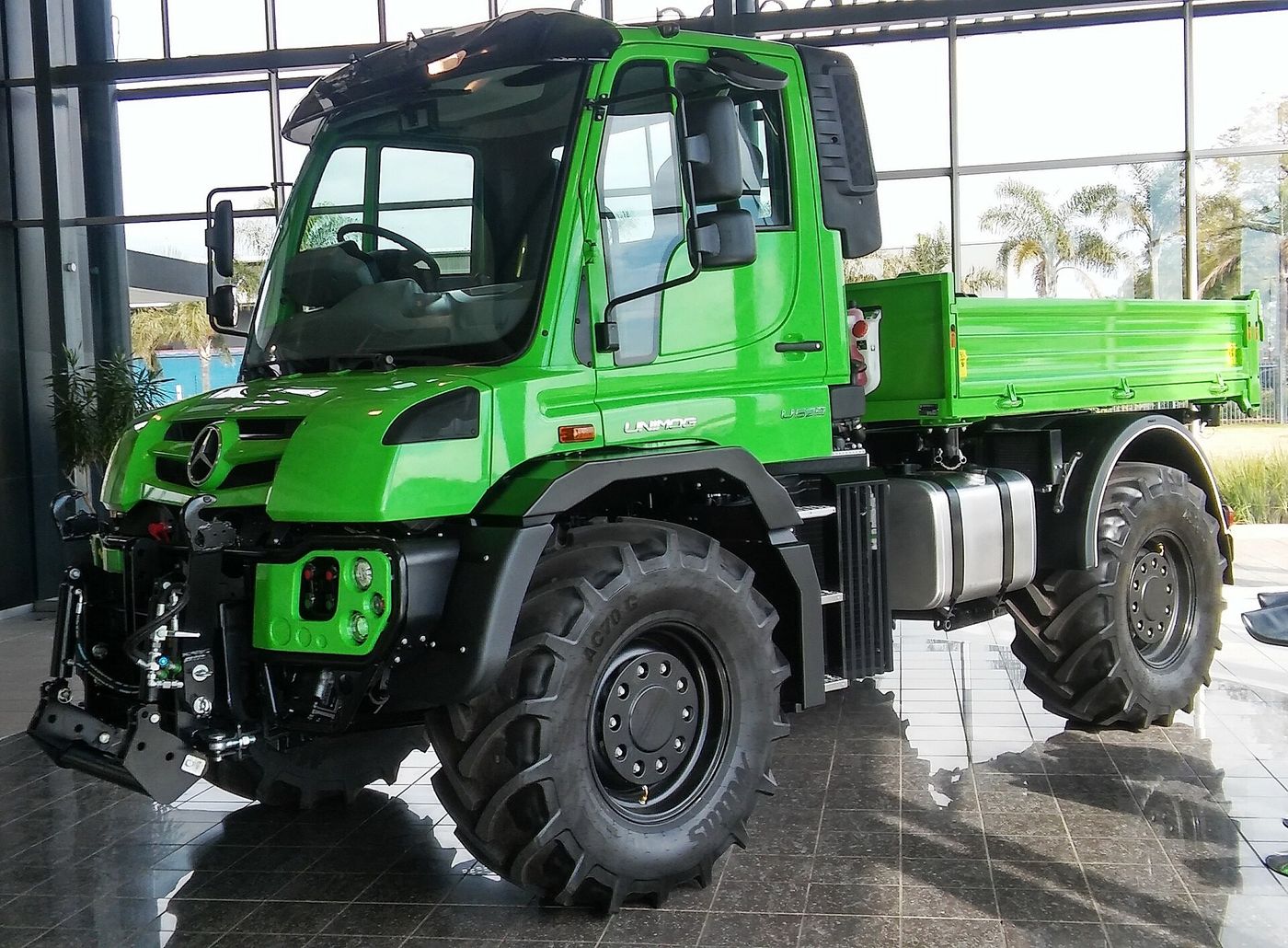
The Unimog is the Mercedes-Benz Trucks line of all-wheel-drive implement carriers and off-road trucks. Mercedes-Benz Trucks International presents the current vehicles on two model pages: the Unimog implement carrier, in eleven models from the U 219 to the U 535, and the extreme off-road Unimog, the U 4023 and the U 5023, each also listed as a crew cab. This page is built from those two documents, both on the international English-language site, both undated and both read on 26 October 2026. Mercedes-Benz describes the implement carrier as a vehicle that allows different implements and bodies to be used flexibly, and the extreme off-road Unimog as a vehicle for “extreme terrain, extreme weather conditions, or extreme tasks”.
Overview
| Item | Implement carrier | Extreme off-road |
|---|---|---|
| Models | U 219, U 319, U 323, U 327, U 423, U 427, U 430, U 435, U 527, U 530, U 535 | U 4023, U 5023, each also as a crew cab |
| Engine | 4- and 6-cylinder, 140 to 260 kW (190 to 354 hp), up to 1,380 Nm | 4-cylinder, 170 kW, 900 Nm |
| Emission standard | Euro VI | Euro VIe |
| Gearbox | EPS, 8 forward and 6 reverse gears, extendable with crawler, working and off-road gear groups | 8-speed EPS with off-road gear group |
| Drive | permanent all-wheel drive | engageable all-wheel drive |
| Axles | link-guided portal axles, up to three differential locks | portal axles, three individually engageable differential locks |
Origins
The implement carrier page states that “more than 75 years ago, the so-called Universal-Motor-Gerät (universal engine unit) was designed precisely for this purpose and has been consistently further developed since then”. No document opened gives the year of the first Unimog, of the current generation or of any earlier generation.
Engines
The implement carrier page gives its engines as “modern, powerful 4‑ and 6‑cylinder engines from 140 to 260 kW (190 to 354 hp)”, with up to 1,380 Nm of torque, meeting the Euro VI emission standard. It names no engine designation, displacement or rated speed, and does not say which output belongs to which model. The extreme off-road page gives one engine, a 4-cylinder with 170 kW and 900 Nm, complying with the Euro VIe emissions standard, and says the drivetrain uses engines from Mercedes-Benz Trucks. Neither page names the fuel. The lettered steps of Euro VI are set out in Euro 6 and Euro 7, and how kW and hp figures are stated in how truck power figures are measured.
Transmission and drive
On the implement carrier, a transfer case drives all wheels permanently. The gearbox is a fully synchronised electropneumatic (EPS) manual transmission with 8 forward and 6 reverse gears. The page gives its extension in two ways: the feature panel says it “can be extended by 6 or 16 gears with crawler, working and off-road gear groups”, and the drivetrain text that “it can be optionally expanded by 8 or 16 gears”. A synchronised Electronic Quick Reverse turning group is used for quick changes of direction, optionally with a forward/reverse switch in the multifunction operating lever.
AutomaticShift automates clutch and gearshift operation in two drive programmes. In “A” the programme takes over shifting and clutch operation completely; in “M” the driver selects the gear with the multifunction lever and the clutch is engaged automatically. AutomaticShift (EAS) with 2-pedal operation, accelerator and brake, is listed as an option. How automated manual gearboxes work is covered in automated manual transmissions.
EasyDrive combines the manual transmission with a stepless hydrostatic drive, and the driver can switch between the two while moving between work sites or manoeuvring. In Drive mode the hydrostatic drive covers 0 to 50 km/h steplessly through the accelerator pedal, with the driving speed proportional to the engine speed. In Work mode the driving speed and the working speed are set independently of the engine speed, which stays constant; Mercedes-Benz names mowing and trenching as low-speed work for the hydrostatic drive.
The extreme off-road Unimog has an 8-speed EPS transmission with an off-road gear group, an automated gearshift (EAS), engageable all-wheel drive and Electronic Quick Reverse. Its page mentions motorway driving “at up to 89 km/h”.
| Models | Basic gears | Working gears (SA) | Crawler gears |
|---|---|---|---|
| U 219 | 5.9–77.3 | 1.03–13.4 | 0.11–1.38 |
| U 319 | 7.1–92.1 | 1.23–16.0 | 0.13–1.65 |
| U 323, U 327, U 423 to U 430 | 7.2–94.3 | 1.26–16.3 | 0.13–1.69 |
| U 435 | 7.2–94.3 | 1.25–16.38 | 0.13–1.69 |
| U 527 to U 530 | 7.1–91.9 | 1.23–15.9 | 0.13–1.64 |
| U 535 | 7.0–91.9 | 1.22–15.96 | 0.13–1.64 |
| U 4023 (extreme off-road) | 6.6–86.4 | not listed | not listed |
| U 5023 (extreme off-road) | 6.9–89.6 | not listed | not listed |
On the implement carrier page the eighth basic-gear figures 92.1, 94.3 and 91.9 km/h carry an asterisk, and the footnotes under the speed tables read “Values for standard tyres in km/h. Vehicle speeds may differ with other tyres.”, “Vmax = 90 km/h.” and “Only in 2-way operation.” The same page’s off-road gear table heads its columns U 200, U 300, U 400 and U 500; its forward speeds run from 1.86 to 24.24 km/h, 2.22 to 28.9 km/h, 2.27 to 29.58 km/h and 2.22 to 28.82 km/h in those four columns. On the extreme off-road page the off-road gears run from 2.1 to 27.1 km/h on the U 4023 and from 2.2 to 28.1 km/h on the U 5023.
Axles, suspension, steering and brakes
The implement carrier runs on link-guided portal axles with up to three differential locks. The rear axle has hydropneumatic suspension with travel sensors that keeps the frame level in the same position; gas is compressed or decompressed by a change in oil volume, and the suspension works in combination with hydraulic cylinders, spring mechanisms, hydraulic valves, sensors and the control unit. The TireControl plus tyre pressure system has three preset modes, “Road”, “Sand” and “Rough Terrain”. Steering is electric motor-driven power steering. Optional all-wheel steering reduces the turning circle by roughly an additional 20 percent against standard steering, according to the page, and adds crab steering, with the wheels aligned diagonally in the same direction, and rear-axle steering for manoeuvring in reverse. The page gives the 12.6 m figure under two labels: “From a turning radius of 12.6 m” in its highlights, and “small turning circle — from 12.6 m and a 2,800 mm wheelbase” in its compactness text.
The extreme off-road Unimog has portal axles with an asymmetrical arrangement of the axle differentials, three individually engageable differential locks, pneumatic disc brakes as standard, off-road ABS and TireControl plus ex works. Its frame is offset (cranked) and fully welded; the frame’s torsional flexibility, combined with torque tube technology and the three-point mounting of the engine, transmission, cab and bodies, allows a diagonal articulation of up to 600 mm, and the axle connection via torque tube, thrust ball on the transmission and coil springs allows axle articulation of up to 30°. The drive shafts are encapsulated against dust and water. Mercedes-Benz gives a fording depth of 1.2 m and a climbing ability of up to 100%, and fits single tyres, the rear wheels following the front wheels in the same track.
| Models | Standard | Smallest | Largest |
|---|---|---|---|
| U 219 | 295/60 R22.5 | 295/60 R22.5 | 425/75 R20 |
| U 319 | 315/80 R22.5 | 295/60 R22.5 | 425/75 R20 |
| U 323, U 327 | 315/80 R22.5 | 315/80 R22.5 | 445/70 R24 |
| U 423 to U 435 | 315/80 R22.5 | 315/80 R22.5 | 445/70 R24 |
| U 527 to U 535 | 385/65 R22.5 | 365/85 R20 | 495/70 R24 |
The size notation is explained in truck tyre markings. The extreme off-road page gives no tyre sizes.
Dimensions
| Models | Wheelbase | Length | Width | Height | Front end from centre of axle |
|---|---|---|---|---|---|
| U 219 | 2,800 | 4,800 | 2,200 | 2,880 | 1,065 |
| U 319 | 3,000 | 4,980 | 2,200 | 2,870 | 1,065 |
| U 323, U 423 | 3,000 / 3,150 / 3,600 | 4,980 / 5,130 / 5,575 | 2,200 | 2,925 | 1,060 |
| U 327, U 427, U 430, U 435 | 3,150 / 3,600 | 5,130 / 5,575 | 2,200 | 2,925 | 1,060 |
| U 527, U 530, U 535 | 3,350 / 3,900 | 5,327 / 6,246 | 2,300 | 2,920 | 1,060 |
The page marks the U 323 and U 327 as special models and notes that other wheelbases are available on request. Mercedes-Benz states that the Unimog “generally falls significantly short of the legally prescribed front-end dimension of a maximum of 3.5 m, even with implements”.
| Models | Wheelbase | Length | Width | Height | Space for installations |
|---|---|---|---|---|---|
| U 4023 | 3,850 | 6,000 | 2,480 | 2,797 | 4,100 x 2,280 x 1,400 |
| U 4023 crew cab | 3,850 | 6,000 | 2,480 | 2,797 | 3,100 x 2,280 x 1,400 |
| U 5023 | 3,850 | 6,000 | 2,480 | 2,873 | 4,100 x 2,280 x 1,400 |
| U 5023 crew cab | 3,850 | 6,000 | 2,480 | 2,873 | 3,100 x 2,280 x 1,400 |
Weights
| Models | Max. permissible gross weight | Max. weight on front axle | Max. weight on rear axle |
|---|---|---|---|
| U 219 | 10.0 | 5.2 | 5.5 |
| U 319 | 11.0 | 5.5 | 6.0 |
| U 323, U 423 | 13.8/14.0 | 6.9/7.0 | 7.8/8.0 |
| U 327, U 427, U 430, U 435 | 14.0 | 7.0 | 8.0 |
| U 527, U 530, U 535 | 16.5 | 7.5 | 9.5 |
The extreme off-road page prints three figures in each weight cell and footnotes the middle one “Standard configuration”. It heads the first row “Permissible maximum gross combination weight (with corresponding special equipment) (tons)”.
| Models | Permissible maximum gross combination weight | Front axle | Rear axle |
|---|---|---|---|
| U 4023, U 4023 crew cab | 7.5/8.0/10.3 | 4.1/4.1/4.6 | 4.6/4.6/6.0 |
| U 5023, U 5023 crew cab | 12.5/13.0/14.5 | 5.5/5.7/6.4 | 7.1/7.9/8.8 |
Neither page gives a kerb weight or a payload. The difference between gross vehicle and gross combination weight is set out in gross vehicle and gross combination weight.
Implements, power take-offs and hydraulics
The implement carrier has up to 4 attachment zones with standardised mechanical, hydraulic and electrical interfaces. Mechanical implement drive is available as special equipment, with a front PTO shaft with a continuous output of 160 kW or with optional engine and transmission power take-offs. The electrical interface consists of 4 standardised plug connections in the cab and on the outside, fed by an on-board alternator with 28 V/150 A; the parameterisable on-board electronics hold settings such as an engine speed limit to protect mechanically driven implements, an immobiliser when the support legs are extended, and a speed limit.
The 4-cell work hydraulics consist of up to two circuits. The combined equipment circuits I and II, 32 plus 55 l/min, deliver 35 kW at up to 240 bar, and the load-sensing system supplies up to 110 l/min at 240 bar, adapting pump pressure or volumetric flow to demand. Up to 30 l of oil is available from the fully proportional work hydraulics. Circuit I controls up to 8 implement positioning movements at 210 bar system pressure (32 l/min) through 4 double-acting valves, or drives hydraulic motors in the lower power range. The VarioPower power hydraulics add two open circuits, III and IV, each with 125 l/min of oil flow, a system pressure of 280 bar and a maximum output of 58 kW; Mercedes-Benz says they replace plug-on pumps on the power take-off shaft or diesel body engines. They are operated with buttons on the multifunction steering wheel and are mounted in the platform intermediate frame so that they can be removed from the platform frame.
The extreme off-road page names three attachment and implement spaces. The vehicle’s standardised attachment points include a front mounting plate for attachments up to 1.5 t, mounting brackets for compressors or major assemblies, a winch holder, frame mounting brackets, mounting parts for platforms or box bodies, and a subframe for special bodies that mounts platforms or box bodies torsion-free. It has an engine-powered PTO and optional transmission PTOs, among them a fast one for hydraulic pumps and a very fast one for fire service pumps; fire bodies on truck chassis are covered in fire engines on truck chassis. Its single-circuit hydraulic system delivers 240 bar at 60 l/min with a pump capacity of 24 kW, with standardised plug connections at the front and rear, for equipment such as self-recovery winches, snow ploughs, front loaders or hydraulic tools; 4 standardised sockets supply electrical power to equipment.
Both pages name the Mercedes-Benz Trucks plants in Wörth and Molsheim for custom-built vehicles with requirements beyond standard production.
Cab and controls
The implement carrier has a short-nosed cab with a low-drawn windscreen. With VarioPilot transferable steering, the steering wheel, the whole instrument panel and the pedals move to the other seat position in less than 30 seconds, for right-hand drive in one-man operation or left-hand drive on the road. The UNI-TOUCH user interface has a 10.5-inch screen that swivels, rotates and tilts; profiles, processes and controls can be configured and loaded through a USB data interface. The gearshift system, engine brake and EasyDrive sit in the steering-column stalks, the multifunction steering wheel carries the controls for the instrument cluster display, cruise control and hands-free system, and the steering column adjusts for height and tilt. An air-sprung driver’s seat, a fully glazed mowing door and a rotating mowing seat are listed as options.
The extreme off-road Unimog has an all-steel cab, with the driver seated in the low-vibration area behind the front axle; gearshifts, engine brake and Electronic Quick Reverse are in the steering-column stalk switches. It can be ordered with a double cab: a front bench for 3 people and a rear bench with 4 seats, 7 people in total, entered through 4 wide-opening doors. The rear bench has individual seat belts, folds, and has storage space underneath; 2 air-sprung individual seats can replace it.
Safety and driver-assistance systems
The implement carrier’s cab has a reinforced underbody and a tubular bracket, and the page states that it complies with the ECE-R29/3 standard for cab strength. The page names a tyre pressure monitoring system, Frontguard Assist, a reversing camera and Attention Assist among its assistance systems without marking any of them standard or optional, under a footnote that “assistance systems can only assist drivers”. An optional camera system consists of a front camera, a rear camera and a freely positionable additional camera for mounted equipment, with a monitor in the cab. On the extreme off-road Unimog, Mercedes-Benz lists the welded frame, the all-steel cab, the 1.2 m fording depth, the torque tube concept and off-road ABS under safety.
Source notes
All figures are from two Mercedes-Benz Trucks International model pages, both undated and read on 26 October 2026: the Unimog implement carrier page (U 219, U 319, U 323, U 327, U 423, U 427, U 430, U 435, U 527, U 530 and U 535) and the extreme off-road Unimog page (U 4023 and U 5023, each also as a crew cab). Neither page names an engine designation or displacement, prints a wheel formula, gives a kerb weight, a payload or a fuel or AdBlue tank volume, or gives a year for the current generation or an earlier one. The implement carrier page gives its engines as 4- and 6-cylinder units from 140 to 260 kW (190 to 354 hp) with up to 1,380 Nm and Euro VI, and assigns no output to a model; the extreme off-road page gives one 4-cylinder engine with 170 kW and 900 Nm and Euro VIe. The implement carrier page says in its feature panel that the 8-forward, 6-reverse EPS gearbox can be extended by 6 or 16 gears, and in its drivetrain text by 8 or 16. It marks the U 323 and U 327 as special models, gives its gross weights “with corresponding special equipment”, and prints 13.8/14.0 t for the U 323 and U 423. The extreme off-road page prints three figures in each weight cell, the middle one footnoted “Standard configuration”, under the row label “Permissible maximum gross combination weight (with corresponding special equipment) (tons)”. The implement carrier page gives the 12.6 m figure once as a turning radius and once as a turning circle.
Quick answers
- Which engines are available in the Mercedes-Benz Unimog?
- The record for the Mercedes-Benz Unimog covers these engine families: 4- and 6-cylinder engines · implement carrier, 4-cylinder engine · extreme off-road U 4023/U 5023. Output spans 140–260 kW.
- What emission standard does the Mercedes-Benz Unimog meet?
- Euro VI (implement carrier); Euro VIe (extreme off-road U 4023/U 5023).
- Which transmission does the Mercedes-Benz Unimog use?
- Transmission: Implement carrier: EPS fully synchronised electropneumatic manual, 8 forward and 6 reverse gears, extendable with crawler, working and off-road gear groups, AutomaticShift (EAS) automated shifting, EasyDrive hydrostatic drive. Extreme off-road: 8-speed EPS with off-road gear group, automated gearshift (EAS).
Mercedes-Benz models on this site, side by side
| Segment | Produced | Axle configurations | Power | Torque | Gross combination | |
|---|---|---|---|---|---|---|
| Mercedes-Benz Actros | Distribution | 1996— | 7 configurations | 175–460 kW | 1000–3000 Nm | |
| Mercedes-Benz Actros L | Long-haul tractor | 2021— | 7 configurations | 265–460 kW | 1800–3000 Nm | 44 t |
| Mercedes-Benz Arocs | Construction | 2013— | 12 configurations | 175–460 kW | 1000–3000 Nm | |
| Mercedes-Benz Atego | Distribution | 2013— | 2 configurations | 115–220 kW | 650–1200 Nm | |
| Mercedes-Benz Unimog | Construction | 140–260 kW | 900 Nm |
Articles that mention the Mercedes-Benz Unimog
More Mercedes-Benz on this site
Sources
- Unimog implement carrier — model overview and technical data — Mercedes-Benz Trucks
- Extreme off-road Unimog — model overview and technical data — Mercedes-Benz Trucks