Mercedes-Benz
Mercedes-Benz Intouro
Mercedes-Benz diesel interurban bus with a raised floor, in four models from 10,745 to 14,880 mm long: OM 936 and OM 470 engines, gearboxes, weights, seats and equipment.
- 220–290 kW
- Euro VI E
- 12.18 m
- 19.5 t

Model overview
- Segment
- Bus
- Emission
- Euro VI E
- Transmission
- Mercedes-Benz GO 190 6-speed (Intouro, K, M) or GO 250-8 (L); optional ZF Ecolife 2 (Intouro) or Voith DIWA.6 (K, M, L)
- Gross vehicle
- 19 500 kg
- Length
- 12 180 mm
- Wheelbase
- 6 080 mm
- Turning circle
- 21 458 mm
- Capacity
- Standard seating 55 (Intouro), 47 (Intouro K), 63 (Intouro M), 71 (Intouro L)
- Doors
- 2
Engine families
- Power
- 220–260 kW
- Power
- 290 kW
- Torque
- 1900 Nm
The Intouro is a Mercedes-Benz interurban bus with a raised floor and a diesel engine, offered in four models: the two-axle Intouro, Intouro K and Intouro M, and the three-axle Intouro L. Mercedes-Benz Buses’ international model page lists its uses: “In addition to the classic interurban service, this includes, for example, use as a shuttle bus, as a bus for transporting staff within a plant or factory and, depending on the country, also as a school bus.” It adds excursions and short trips.
The figures on this page come from the data sheet “The Intouro. Technical data and equipment at a glance” on the Mercedes-Benz Buses website, with Daimler Buses GmbH as its named provider and a footer reading 03/2026, opened on 26 October 2026. It has one column for each of the four models and marks each item of equipment as standard or optional. The international model page in English and the Swiss model page in Italian, both undated and opened the same day, supply Daimler’s descriptions and the Intouro hybrid. The sheet prints a full stop as the thousands separator and a comma as the decimal mark: its 12.180 is 12,180 mm and its 7,7 is 7.7 litres.
Four models
The model page sets out the range “from the two-axle variants Intouro, Intouro M and K to the first three-axle model in the range, the Intouro L”, and gives each model a line of its own: the Intouro “Two axles and universally deployable”, the Intouro K for “mountainous regions and winding village streets”, the Intouro M “for higher passenger volume and versatility” and the Intouro L “for very high passenger volumes and works transport”. The Swiss page in Italian begins its Intouro L entry with “A due assi” (two axles), while its own range text calls the L “primo a tre assi della serie”, first three-axle model of the series. The data sheet gives the Intouro L a trailing axle.
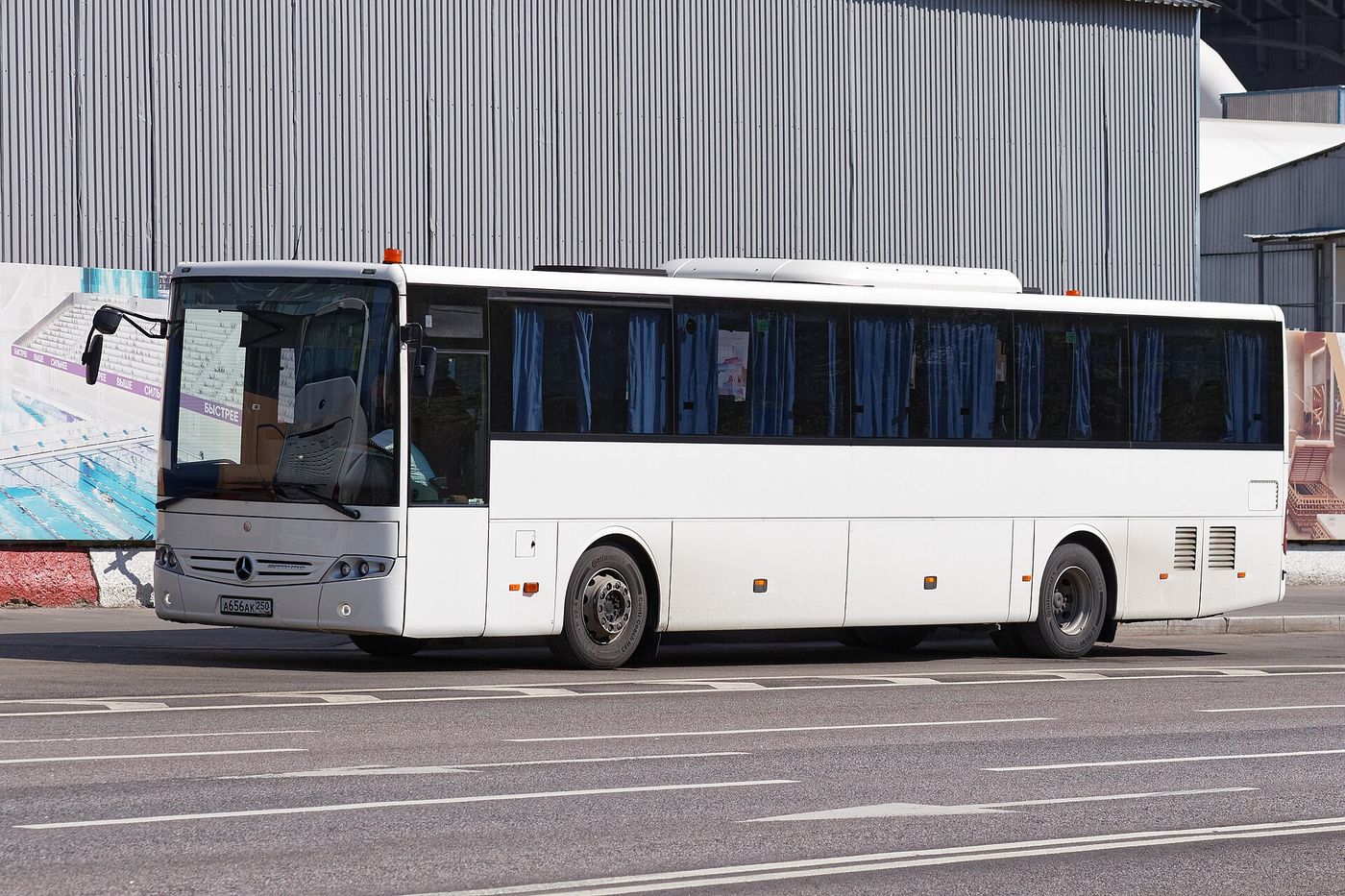
All four are 2,534 mm wide and 3,365 mm high. The lengths are 12,180 mm for the Intouro, 10,745 mm for the Intouro K, 13,090 mm for the Intouro M and 14,880 mm for the Intouro L. The model page gives the Intouro K’s turning circle as 18.34 metres, which the sheet gives as 18,344 mm. The overview grid at the top of this page shows the Intouro.
| Row on the data sheet | Intouro | Intouro K | Intouro M | Intouro L |
|---|---|---|---|---|
| Length [mm] | 12,180 | 10,745 | 13,090 | 14,880 |
| Length incl. mirrors [mm] | 12,510 | 11,075 | 13,420 | 15,205 |
| Width [mm] | 2,534 | 2,534 | 2,534 | 2,534 |
| Height [mm] | 3,365 | 3,365 | 3,365 | 3,365 |
| Inner stand height central aisle [mm] | 2,180 | 2,180 | 2,180 | 2,180 |
| Parapet height (above ground) [mm] | 750 | 750 | 750 | 750 |
| Wheelbase front axle-drive axle [mm] | 6,080 | 5,270 | 6,990 | 7,180 |
| Wheelbase drive axle - trailing axle [mm] | - | - | - | 1,600 |
| Overhang at front [mm] | 2,800 | 2,175 | 2,800 | 2,800 |
| Overhang at rear [mm] | 3,300 | 3,300 | 3,300 | 3,300 |
| Tyre size | 295/80 R 22.5 | 295/80 R 22.5 | 295/80 R 22.5 | 295/80 R 22.5 |
| Turning circle min. [mm] | 21,458 | 18,344 | 23,834 | 24,056 |
| Turning circle BOKraft [mm] | 25,000 | 25,000 | 25,000 | 25,000 |
| Ring width turning circles min. [mm] | 6,857 | 5,982 | 7,277 | 7,311 |
| Ring width BOKraft [mm] | 5,945 | 4,766 | 6,917 | 7,039 |
| Ring width max. permissible according to BOKraft [mm] | 7,200 | 7,200 | 7,2 | 7,200 |
| Track circle minimal [mm] | 17,424 | 15,316 | 19,797 | 20,021 |
| Wheel impact front axle max. [°] | 54 / 46 | 54 / 46 | 54 / 46 | 54 / 46 |
| Cockpit height [mm] | 891 | 891 | 891 | 891 |
| Floor height over roadway [mm] | 891 | 891 | 891 | 891 |
| Pedestal height [mm] | 210 | 210 | 210 | 210 |
| Entry height door 1 [mm] | 361 | 363 | 359 | 362 |
| Entry height door 2 [mm] | 378 | 370 | 370 | 370 |
| Slope angle in front [°] | 7.1 | 9.1 | 7.1 | 7.1 |
| Slope angle rear [°] | 7.7 | 7.7 | 7.7 | 7 |
| Luggage compartment volume [m³] | 5.2 | 3.7 | 6.55 | 6.85 |
In the Intouro M column the sheet prints “7,2” in the ring-width row labelled [mm], where the other three columns read 7,200. The row labels, BOKraft among them, are the sheet’s own; what a coach data sheet’s dimension and weight rows are read against is set out in how a coach specification sheet is read, whose worked example is a different maker’s sheet.
The model page gives “an interior headroom of more than two metres to the front of the rear axle”; the sheet’s “Inner stand height central aisle” row reads 2,180 mm in all four columns. The model page also says: “With an aisle height of 890 millimetres, all four models cover the classic segment of interurban buses with raised floors.” The sheet’s “Floor height over roadway” row reads 891 mm in all four columns, as does its “Cockpit height” row; the documents do not reconcile 890 and 891 mm.
Engines and gearboxes
| Row on the data sheet | Intouro | Intouro K | Intouro M | Intouro L |
|---|---|---|---|---|
| Engine | Mercedes-Benz OM 936 | Mercedes-Benz OM 936 | Mercedes-Benz OM 936 | Mercedes-Benz OM 470 |
| Engine type | 6-cylinder in-line engine | 6-cylinder in-line-engine | 6-cylinder in-line-engine | 6-cylinder in-line-engine |
| Output [kW] | 220 | 220 | 220 | 290 |
| Output 2* [kW] | 260 | 260 | 260 | - |
| Max. torque [Nm] | 1,200 | 1,200 | 1,200 | 1,900 |
| At speed [1/min] | 1,200-1,600 | 1,200-1,600 | 1,200-1,600 | 1,100 |
| Displacement [l] | 7.7 | 7.7 | 7.7 | 10.7 |
| EU emissions standard | Euro VI E | Euro VI E | Euro VI E | Euro VI E |
| Transmission | Mercedes-Benz GO 190, 6-Gang | Mercedes-Benz GO 190-6, 6-speed | Mercedes-Benz GO 190, 6-speed | Mercedes-Benz GO 250-8 |
| Transmission 2* | ZF Ecolife 2 | Voith DIWA.6 | Voith Diwa.6 | Voith Diwa.6 |
The Intouro, Intouro K and Intouro M have the Mercedes-Benz OM 936, a 6-cylinder in-line engine of 7.7 litres, at 220 kW; 260 kW is in the row “Output 2*”, and the sheet’s legend reads “* Optional equipment”. The Intouro L has the Mercedes-Benz OM 470, a 6-cylinder in-line engine of 10.7 litres, at 290 kW, with a dash in the “Output 2*” row. All four columns read Euro VI E; the steps of Euro VI are set out in Euro VI and Euro 7 for trucks.
The sheet has one torque row: 1,200 Nm in the three OM 936 columns and 1,900 Nm for the OM 470, with no torque figure beside “Output 2*”. The row below it, “At speed [1/min]”, reads 1,200-1,600 for the OM 936 and 1,100 for the OM 470; the sheet does not say whether that speed belongs to the output or to the torque.
Each column names a Mercedes-Benz gearbox in its “Transmission” row and a starred alternative in “Transmission 2*”: a six-speed GO 190 on the Intouro, Intouro K and Intouro M (the Intouro column writes “6-Gang”, the Intouro K column “GO 190-6, 6-speed”), a GO 250-8 on the Intouro L, the ZF Ecolife 2 as the alternative on the Intouro and the Voith DIWA.6 on the other three. The sheet names the gearboxes without describing them.
The model page says: “All engines, axles and gearboxes carry the star; all drive components are perfectly matched.” The sheet names a ZF front axle on all four models and ZF and Voith gearboxes in its starred rows. The model page also states: “Thanks to a weight reduction of about 300 kg and improved aerodynamics, fuel savings of up to 3% can be achieved.” It does not say which vehicle the 300 kg are measured against.
Intouro hybrid
The model page presents the Intouro hybrid as “Now available for Intouro, Intouro M and Intouro K models.” An electric motor sits between the combustion engine and the automatic transmission: “It generates an output of 14 kW and a peak torque of 220 Nm.” According to the page, the motor “does not, however, serve to increase the maximum output, which is why the output and torque figures for the intercity bus remain unchanged.”
The motor works as a generator when the bus brakes and coasts, and the stored energy supports the diesel engine when idling, moving off and accelerating; the page calls the support when moving off the “boost phase”. It states: “The system consists of an electric motor, an inverter, two storage modules (Mild Hybrid Storages) on the roof and an additional cooling circuit for the electric motor and inverter.” It describes the storage as “capacitors, also known as supercaps”, and the electrical side as “a separate 48-volt system” in place of a high-voltage system. Daimler’s fuel figure is: “This can save up to five percent in fuel when used in urban areas on regular service routes, shuttle or factory-shuttle services.” The data sheet has no row for the hybrid. How regenerative braking is treated in type approval is covered in regenerative braking in trucks and buses.
Axles, suspension and brakes
All four models have power steering, a ZF RL 82 EC front axle with independent suspension and an anti-roll bar, a Mercedes-Benz RO 440 driven axle and air suspension via the electronic level control system (ENR), all standard. The Intouro L adds a trailing axle, which the sheet types “ZF 82 RL EC”, with active steering and independent suspension as standard; its wheelbase from drive axle to trailing axle is 1,600 mm. An anti-roll bar on the drive axle is standard on the Intouro K and optional on the other three. A raising/lowering system and kneeling are optional on all four.
Pneumatic disc brakes on all axles, the Electronic Stability Programme (ESP®), the anti-locking system (ABS), Acceleration Slip Regulation (ASR) and the parking brake are standard on all four. The electronically controlled braking system (EBS), Brake Assist (BAS) and a retarder are standard on the Intouro L and optional on the other three. The retarder limiter (RL), the automatic bus stop brake with pull-away lock, the HOLD function and hill-start assist are optional on all four. What a retarder does is set out in retarders and engine braking.
Weights, tanks and capacity
| Row on the data sheet | Intouro | Intouro K | Intouro M | Intouro L |
|---|---|---|---|---|
| Gross vehicle weight [kg] | 19,500 | 19,500 | 19,500 | 24,750 |
| Axle loads, max. permissible front axle [kg] | 7,500 | 7,500 | 7,500 | 7,500 |
| Axle loads, max. permissible drive axle [kg] | 12,600 | 12,600 | 12,600 | 12,600 |
| Permissible weight trailing axle [kg] | - | - | - | 5,750 |
| Capacity of fuel tank [l] | ca. 185 | ca. 185 | ca. 185 | ca. 185 |
| AdBlue® additive tank [l] | ca. 53 | ca. 36 | ca. 53 | ca. 53 |
| Number of seats – standard seating | 55 | 47 | 63 | 71 |
| Passenger capacity max. | 92 | 79 | 103 | 117 |
The sheet gives a gross vehicle weight of 19,500 kg for the three two-axle models and 24,750 kg for the Intouro L, with maximum permissible axle loads of 7,500 kg on the front axle and 12,600 kg on the drive axle on all four, and 5,750 kg on the Intouro L’s trailing axle. No document opened gives an unladen weight.
An earlier row, “Capacity fuel tank left / right [l]”, prints one figure, 185, in each column, and the row “Usable volume / capacity AdBlue [l]” in the dimensions table repeats the AdBlue figures of 53 and 36 litres.
Seats, doors and passenger compartment
Standard seating is 55 seats on the Intouro, 47 on the Intouro K, 63 on the Intouro M and 71 on the Intouro L, and “Passenger capacity max.” is 92, 79, 103 and 117. Inter Star Eco (ISE) seating is standard and Travel Star Eco (TSE) Softline seating optional. The driver’s seat is a GRAMMER Linea MSG 90.6 P, air-sprung, as standard, with an ISRI 6860 with integrated pneumatic system and 3-point seat belt as an option. A wheelchair space and a lift are optional on all four. All four have 2 doors, an outward swiveling door and single glazing as standard, and double glazing and a heatable windscreen as options.
The model page says: “The passenger compartment of the Intouro has a modular design, with individual versions ranging from strictly cost-oriented interurban buses to comfortable equipment for excursions.” The seats “are arranged on platforms and can be moved up to the front of the rear axle without any incline”, and TravelStar Eco seating and “service sets with nozzle ventilation and reading lights” are offered. The bus “is available in a basic version or, optionally, in the premium version with design package.”
Heating and air conditioning
A turbo roof ventilator is standard on all four models. EvoCool Basic is standard on the Intouro and the Intouro M and optional on the Intouro K and the Intouro L; EvoCool Comfort is optional on the first three and shown as a dash for the Intouro L. Driver’s area air conditioning, a roof-mounted air-conditioning system with heat pump and an electric roof air conditioning (modular system) are optional on all four.
The rows “Cooling capacity passenger compartment [hp/kW]” and “Heating power passenger compartment [hp/kW]” read 32 and 36 in all four columns; “Refrigerant filling capacity [lbs/kg]” reads 9.5 (printed 9,5) and “CO₂ equivalent [lbs/t]” 13.585 (printed 13,585). Each row prints one figure under a pair of units and does not say which of the two applies.
Safety and driver-assistance systems
Standard on all four models, in the sheet’s wording: Sideguard Assist 2; Frontguard Assist; Front Collision Guard (FCG); Traffic Sign Assist; Attention Assist 2 (AtAs); Electronic Stability Program (ESP®); Tyre Pressure Monitoring (TPM); reversing camera; extinguishing system; rain-light sensor; flat wiper blades with water fed through wiper blade; “Rollover strength compliant with in ECE R29.03”; and “Rollover strength compliant with ECE-R 66.02”. Optional on all four: Lane Assist (SPA), Active Brake Assist 6 Plus (ABA 6 Plus), the 360° camera, MirrorCam and a reversing buzzer. Tyre Pressure Monitoring appears twice, marked standard in the safety table and optional in the table headed “Profitability”. The scope of UN Regulation No 66 is in UN R66 bus rollover strength, and which assistance systems EU rules require on new vehicles is in mandatory driver assistance systems.
The model page’s FAQ lists “Active Brake Assist 6 Plus, Sideguard Assist 2, Traffic Sign Assist, Frontguard Assist and Attention Assist 2 as standard”; the data sheet marks ABA 6 Plus as optional on all four models. The model page describes ABA 6 Plus as initiating emergency braking “if there is a risk of a rear-end collision with vehicles in front or stationary obstacles” and as able to “detect moving or stationary pedestrians and cyclists in front of the vehicle”.
Of Frontguard Assist the model page says: “Whether you are pulling away or driving slowly (up to 15 km/h), the intelligent assistance system can detect potential collisions with unprotected road users.” The sheet’s description of the same system gives “up to 9.3 mph”. The model page also says that “At speeds above 40 km/h, Sideguard Assist 2 takes over the function of Lane Change Assist”, that the 360° camera system “consists of four cameras”, with a 10-inch screen whose place in the cockpit depends on the vehicle, and that the high beam assist “is active from a speed of 35 km/h and is automatically deactivated below a speed of 27 km/h”; the high beam assist has no row on the sheet. Lane Assist warns the driver “by a clear vibration through the driver’s seat”, and Attention Assist 2, in the sheet’s description, warns “visually and acoustically when it detects typical signs of overtiredness or inattention”.
Cockpit, lighting and body
The model page describes the Cockpit Basic with a multifunction steering wheel and a “high-resolution TFT colour display with intuitive stack-and-cards menu”. It describes the Driver Score assistance system, which “evaluates in four categories - acceleration, braking, uniformity and coasting”, and adds: “Information on the vehicle status, such as low fill levels of fuel, AdBlue or engine oil, is also relevant.” The sheet lists Driver Score as optional on all four models.
On all four models, low beam, high beam and daytime driving lights with halogen are standard; daytime driving lights with LED technology, “Headlamps Bi-Xenon incl. cleaning system”, a front fog lamp, a cornering light and ambient lighting for reverse driving are optional.
The model page describes the body with “the steeply rising windscreen and the brand-typical unit of grille and headlights” and “straight side walls”, an engine flap “without ventilation slits”, and a door 1 “made of sheet metal in the lower area”.
Model line and the eIntouro
No document opened for this page dates the Intouro’s introduction or describes earlier generations; the model page calls the current bus “the new Intouro”. Mercedes-Benz Buses’ eIntouro page says: “The new eIntouro is based on the well-known diesel-powered Intouro, but has a battery-electric drive.” It offers that bus in two lengths, the 12.18-metre eIntouro and the 13.09-metre eIntouro M, described on its own page, Mercedes-Benz eIntouro.
Source notes
The grid above describes the 12,180 mm two-axle Intouro. The data sheet (footer 03/2026) lists three more models of the same width of 2,534 mm and height of 3,365 mm: the two-axle Intouro K at 10,745 mm and Intouro M at 13,090 mm, and the three-axle Intouro L at 14,880 mm. The Intouro, Intouro K and Intouro M have the 7.7-litre Mercedes-Benz OM 936 with 220 kW, or 260 kW as an option; the Intouro L has the 10.7-litre OM 470 with 290 kW. Gross vehicle weight is 19,500 kg on the three two-axle models and 24,750 kg on the Intouro L. Standard seating is 55 on the Intouro, 47 on the Intouro K, 63 on the Intouro M and 71 on the Intouro L, and maximum passenger capacity 92, 79, 103 and 117. Turning circles are 21,458 mm, 18,344 mm, 23,834 mm and 24,056 mm in the same order.
Quick answers
- Which engines are available in the Mercedes-Benz Intouro?
- The record for the Mercedes-Benz Intouro covers these engine families: Mercedes-Benz OM 936 (7.7 l), Mercedes-Benz OM 470 (10.7 l). Output spans 220–290 kW.
- What emission standard does the Mercedes-Benz Intouro meet?
- Euro VI E.
- Which transmission does the Mercedes-Benz Intouro use?
- Transmission: Mercedes-Benz GO 190 6-speed (Intouro, K, M) or GO 250-8 (L); optional ZF Ecolife 2 (Intouro) or Voith DIWA.6 (K, M, L).
- What is the gross vehicle weight of the Mercedes-Benz Intouro?
- Gross vehicle weight: 19 500 kg.
- How long is the Mercedes-Benz Intouro?
- Length: 12 180 mm; Wheelbase: 6 080 mm.
- How many passengers does the Mercedes-Benz Intouro carry?
- Capacity: Standard seating 55 (Intouro), 47 (Intouro K), 63 (Intouro M), 71 (Intouro L).
Articles that mention the Mercedes-Benz Intouro
More Mercedes-Benz on this site
Sources
- The Intouro — technical data and equipment at a glance (facts-intouro.pdf, footer 03/2026) — Daimler Buses / Mercedes-Benz Buses
- Intouro — model overview — Mercedes-Benz Buses
- Intouro — model overview, Swiss site (Italian) — Mercedes-Benz Buses Svizzera
- eIntouro — model overview — Mercedes-Benz Buses