Hydrogen fuel-cell buses and coaches: the models in Europe
Fuel cell, battery, hydrogen tanks, declared range and refuelling time for the fuel-cell buses and coach that Irizar, Karsan, Mercedes-Benz, Otokar, Solaris and Wrightbus publish.
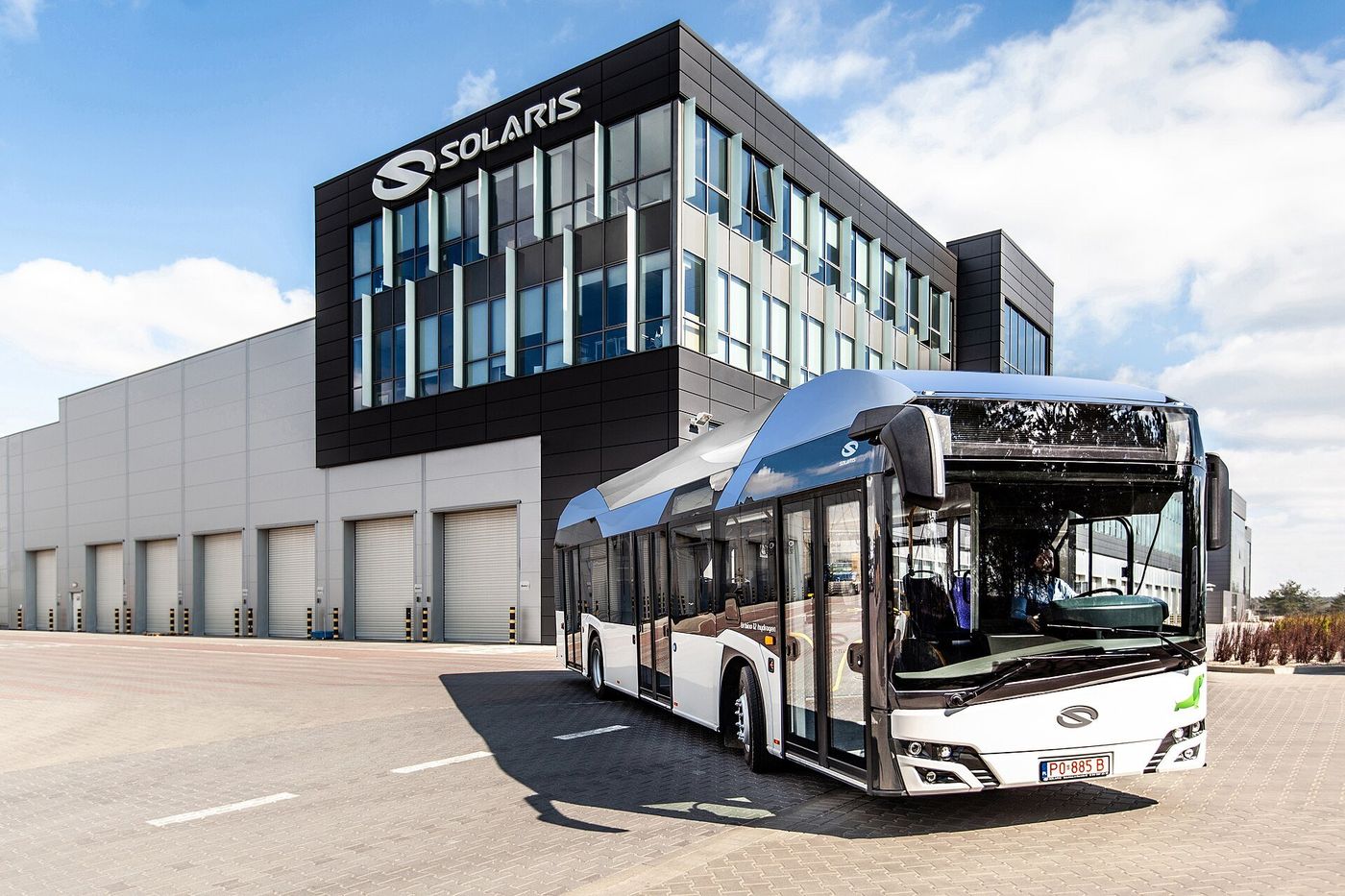
In a hydrogen fuel-cell bus, stored hydrogen and oxygen react in a fuel cell, and the electricity produced runs the bus and charges its battery, as Karsan describes its e-ATA HYDROGEN. This page sets out the figures that Irizar, Karsan, Mercedes-Benz, Otokar, Solaris and Wrightbus publish for their fuel-cell buses and one coach, model by model and each with its source, and it ranks none of them.
The figures are the makers’ own, taken from their own pages and documents, in their own units: litres, kilograms and miles stay as published and nothing is converted. A dash in the table means that this page records no figure for that cell. Makers appear in alphabetical order within each section, and the one coach has a section of its own. This is not a list of every hydrogen bus in Europe: the CaetanoBus H2.City Gold, for one, is covered from its 2021 brochure in City Bus Propulsion and the EU Zero-Emission Mandate and is not repeated here.
How a fuel-cell bus is put together
Karsan’s model page gives the principle: stored hydrogen is transferred into the fuel cell, where hydrogen and oxygen enter a chemical reaction, and with a fuel cell power of 97 kW the electrical energy generated powers the bus while it charges the onboard battery. Solaris words it at the level of the driveline for the Urbino 18 hydrogen: the fuel cell transforms hydrogen into electricity, which is then transferred to the driveline.
Three makers say where the parts sit. Otokar places a lightweight Type-IV hydrogen storage system on the roof of the Kent C Hydrogen and the fuel cell module on top of the vehicle. Mercedes-Benz installs the eCitaro fuel cell’s hydrogen tanks on the roof. Solaris designed the Urbino 18 hydrogen without a conventional engine compartment, with a modular drive whose components are placed on the roof and at the rear.
Solaris and Mercedes-Benz describe the balance between fuel cell and battery, and they describe it differently. For the Urbino 18 hydrogen, Solaris gives a 100 kW fuel cell and a 60 kWh battery that serves as an auxiliary power source, used for example during acceleration and for energy storage; Solaris’s chief technical officer is quoted as saying that almost all the energy is stored in the hydrogen. Mercedes-Benz calls the eCitaro fuel cell a combination of a battery and a fuel cell range extender: the battery is the main energy source (294 kWh in the solo bus, up to 392 kWh in the articulated bus), and the 60 kW fuel cell charges the batteries while the vehicle is in operation. Both descriptions are the makers’ own and this page does not rank them.
On the EU’s CO2 rules for heavy-duty vehicles, recital 9 of Regulation (EU) 2024/1610 of 14 May 2024 says that zero-emission heavy-duty vehicles currently include battery electric vehicles and fuel-cell and other hydrogen-powered vehicles. The regulation replaces point (11) of Article 3 of Regulation (EU) 2019/1242; in point (11)(a), a zero-emission heavy-duty vehicle is a heavy-duty motor vehicle without an internal combustion engine, or with an internal combustion engine that emits not more than 3 g CO2/(tkm) or 1 g CO2/(pkm) as determined in accordance with Article 9 of Regulation (EU) 2017/2400. On our reading, a fuel-cell bus without an internal combustion engine falls under point (a); whether each model here is a heavy-duty vehicle within the regulation’s scope is not tested on this page. What the EU sets for city buses and for hydrogen refuelling stations is in City Bus Propulsion and the EU Zero-Emission Mandate.
The models at a glance
| Model | Length | Fuel cell | Battery | Hydrogen storage | Declared range | Refuelling | Passengers |
|---|---|---|---|---|---|---|---|
| Karsan e-ATA HYDROGEN | 12,220 mm | 97 kW | 43.5 kWh (LTO) | 1,687 litres | 500+ km (under realistic conditions; may change with driving profile) | 7 minutes (catalogue) | +/-90; a maximum of 40 seats |
| Mercedes-Benz eCitaro fuel cell (solo) | 12,135 mm | 60 kW | 294 kWh (three packs) | 25 kg (five tanks) | up to 600 km (specific conditions, footnote) | — | 88 maximum |
| Mercedes-Benz eCitaro G fuel cell (articulated) | 18,125 mm | 60 kW | up to 392 kWh (three or four packs) | 30 or 35 kg (six or seven tanks) | up to 500 km (specific conditions, footnote) | — | 128 maximum |
| Otokar Kent C Hydrogen | 12,000 mm (brochure) | — | up to 140 kWh (web page) | approximately 1,600 L and 38 kg | over 500 km (web page); up to 400 km (brochure) | less than 10 minutes | up to 82 (web page); up to 104 (brochure) |
| Solaris Urbino 12 hydrogen | — | 70 kW | lithium-ion (capacity —) | 5 × 312 l | up to 350 km (no basis stated) | — | — (seats: max. 37 + 4) |
| Solaris Urbino 18 hydrogen | 18,000 mm | 100 kW | 60 kWh | 2,142 l, 51.2 kg (at 350 bar and 15 °C) | 600 km (based on energy consumption in e-SORT 2 tests) | about 20 minutes | up to 140 |
| Wrightbus Kite Hydroliner | — | option of 70 kW or 100 kW | 54 kWh | 32, 40 or 50 kg (4, 5 or 7 cylinders) | not recorded | less than 10 minutes | up to 90 |
| Wrightbus StreetDeck Hydroliner (double-deck) | — | 70 kW net | 111 kWh | 27 kg / 1,120 litres | over 300 miles (no basis stated) | 8 minutes | 90 maximum |
| Irizar i6S Efficient H2 FCEV, second generation (coach) | — | 190 kW | — | — | exceeding 1,000 km (no basis stated) | around 10–15 minutes | 69 seats and up to 18 standing |
City buses: 12-metre and single-deck
Karsan e-ATA HYDROGEN
Karsan lists the e-ATA HYDROGEN as a full low-floor electric bus of category M3, Class I, left-hand drive; what the classes mean is in Bus Classes Under UN R107. The drive is a hub electric motor, with an electric portal rear axle and an independent front axle. Karsan gives a maximum power of 250 kW and, in its descriptive text, 250 kW and 22,000 Nm of torque. The fuel cell is 97 kW and the high-voltage battery is an LTO type of 43.5 kWh.
The hydrogen tank volume is 1,687 litres. The documents opened for this page give no tank mass and no pressure, so this page does not convert the volume to kilograms. Karsan gives the range as 500+ km, with a footnote saying it is under realistic conditions and that range may change with the driving profile, and a maximum speed of 80 km/h. Its catalogue (English edition, footer dated 23.09.2025) gives a refuelling time of 7 minutes.
The specification page lists a gross vehicle weight of 19,000 kg (19,500 kg optional) and dimensions of 12,220 mm in length, 2,550 mm in width and 3,350 mm in height. It gives a maximum of 40 seats and a passenger capacity of +/-90. Karsan’s footnotes say the seat figure may change with the door arrangement and seat layout, and the passenger figure with battery capacity, seat layout, door arrangement, GVW and the technical gross axle value depending on the country of registration. The tyres are 275/70 R22.5, the suspension is air suspension with electronic levelling and a kneeling function, and the brakes are ABS, ASR, EBS and a regenerative braking system.
Karsan presented the first version of this bus on 19 September 2022 at the IAA Transportation fair in Hannover; its release is dated 20 September 2022. That release gave a 70 kW fuel cell, a 30 kWh LTO battery, an overhead 1,560-litre composite hydrogen tank, a range of over 500 km under real conditions of use (which the release defines as a vehicle full of passengers on stop-and-go line routes), over 95 passengers depending on the maximum permissible loaded weight and optional features, refuelling in less than 7 minutes, and a ZF electric portal axle with 250 kW and 22,000 Nm. These are the 2022 release’s figures for the first version; they are not the current sheet’s and are not mixed with them. The specification and the equipment lists are on the Karsan e-ATA HYDROGEN model page.
Mercedes-Benz eCitaro fuel cell
Mercedes-Benz describes the eCitaro fuel cell as a battery-electric bus with a fuel cell range extender; the fuel cell charges the batteries while the vehicle is in operation. It names the fuel cell as Toyota’s second-generation heavy-duty fuel cell and gives its maximum output as 60 kW. The solo bus has five hydrogen tanks with a total capacity of 25 kg and three battery packs with a total energy content of 294 kWh. The tanks are carbon fibre reinforced Type 4 tanks of 5 kg each, installed on the roof and certified as per ECE R 134, and the hydrogen system is designed for a pressure of 350 bar. In the solo bus the fuel cell module is on the roof just behind the front axle.
The April 2026 data sheet gives the solo bus as 12,135 mm long, 2,550 mm wide and 3,450 mm high, with a gross vehicle weight of 20,000 kg and a maximum passenger capacity of 88. Its electric drive row reads ZF AxTrax 2 LF, with power (peak/ duration) of 360 / 260 kW. The declared range is up to 600 km, with the footnote set out under “Declared range: read the condition”.
Daimler Buses announced on 22 May 2023 that it would show the eCitaro fuel cell at the Global Public Transport Summit 2023 in Barcelona, 4 to 7 June 2023; the release refers to the launch of series production in June. The Citaro range has its own Mercedes-Benz Citaro model page.
Otokar Kent C Hydrogen
Otokar’s web page describes the Kent C Hydrogen as a 12 m low-floor city bus; the brochure gives its dimensions as 12,000 × 2,550 × 3,390 mm. The fuel cell module is positioned on top of the vehicle, and a lightweight Type-IV (carbon-reinforced structure) hydrogen storage system is positioned on the roof, with a capacity of approximately 1,600 L and 38 kg and, Otokar says, filling in less than 10 minutes. The web page gives the battery as up to 140 kWh. Neither of the two Otokar documents opened gives a figure labelled as fuel cell power, or a tank pressure.
The two documents differ on two points, and both are recorded here. The web page gives a range of over 500 km (its summary box reads 500 km) and a capacity of up to 82 passengers. The brochure gives a zero emission battery range of up to 400 km and up to 104 passengers. Neither document says which applies today. A Busworld Europe news item of 11 October 2023 says Otokar displayed four new models at Busworld Europe 2023, the Kent C Hydrogen among them. The other Kent versions and propulsions are on the Otokar Kent model page.
Solaris Urbino 12 hydrogen
Solaris’s page gives the premiere of the Urbino 12 hydrogen as the UITP event in Stockholm on 9 to 12 June 2019, and a drive range up to 350 km with no basis stated. The technical data on the same site lists a 70 kW hydrogen fuel cell, lithium-ion traction batteries (the table gives no capacity), composite hydrogen tanks of 5 × 312 l, and an electric portal axle ZF AVE130 with 2 × 125 kW as its traction motor maximum power; an asynchronous 220 kW motor is listed as an option. The number of passenger seats is given as max. 37 + 4, depending on door arrangement and batteries.
A 2021 technical sheet for this model is discussed in City Bus Propulsion and the EU Zero-Emission Mandate and is not repeated here. Solaris’s battery-electric Urbino 12 electric has its own model page.
Wrightbus Kite Hydroliner
Wrightbus’s Europe page introduces the Kite Hydroliner as a single-deck bus powered entirely by hydrogen. The fuel cell is a Ballard FCmove, with a choice of a 70 kW or a 100 kW module. The filling pressure is 350 bar, and the hydrogen stored is 32 kg with a 4-cylinder arrangement, 40 kg with 5 cylinders and 50 kg with 7 cylinders. The battery capacity is 54 kWh, stated as that of the Microvast x2 MV-C modules. The page says the bus carries up to 90 people, depending on its length and specification, with a 1, 2 or 3 door option, and that it refuels in less than 10 minutes.
This page records no range for the Kite: Wrightbus’s own pages for it, the Europe page and the United Kingdom page, do not give one consistent figure.
Articulated and double-deck buses
Mercedes-Benz eCitaro G fuel cell
The articulated bus has a choice of six or seven hydrogen tanks providing a total capacity of 30 or 35 kg, and three or four battery packs with a maximum energy content of 392 kWh. Its 60 kW fuel cell module is installed at the front of the rear section’s roof. The April 2026 data sheet gives its dimensions as 18,125 mm in length, 2,550 mm in width and 3,450 mm in height, a gross vehicle weight of 29,000 kg and a maximum passenger capacity of 128. The declared range is up to 500 km, with the same footnote as the solo bus. According to Daimler Truck’s release of 23 November 2023, the first three eCitaro G fuel cell vehicles were handed over on that date to Rhein-Neckar-Verkehr GmbH.
Solaris Urbino 18 hydrogen
Solaris unveiled the Urbino 18 hydrogen on 14 September 2022. Its technical data give 18,000 mm in length, 2,550 mm in width, 3,300 mm in height (including batteries), a wheelbase of 6,000 mm and a gross vehicle weight of 29,000 kg. The capacity is up to 140 passengers, with up to 52 seats (up to 18 low-floor seats) and up to 88 standing places. The motor is 240 kW: continuous power 240 kW and peak power 240 kW (electronically limited), with a continuous torque of 1,470 Nm and a peak torque of 2,100 Nm.
The fuel cell is a Ballard FCmove HD+ rated at 100 kW. Solaris gives its maximum efficiency as 57%, the estimated lifetime of the product as more than 30,000 hours of operation, cold start from -25 °C and operation at -30 °C to +50 °C. The hydrogen tanks are Type IV composite with a nominal working pressure of 350 bar and a total capacity of 2,142 l, 51.2 kg (at 350 bar and 15 °C). This page gives the total only, because two Solaris documents list the individual tanks differently. The battery is 60 kWh, LTO cell chemistry, placed on the roof.
Solaris states a range of 600 km on a single refill, based on energy consumption in e-SORT 2 tests. Its general Urbino Hydrogen page, in the text about the 2022 unveiling, says the bus will be able to cover about 350 km on a single refill in various weather conditions. This page does not reconcile the two. Solaris states that full refuelling takes about 20 minutes.
Wrightbus StreetDeck Hydroliner
The StreetDeck Hydroliner is Wrightbus’s double-deck hydrogen bus. This section follows Wrightbus’s United Kingdom page, and this page does not establish whether the bus is offered outside the United Kingdom. The page lists a maximum capacity of 90 and a gross vehicle weight of 19,500 kg. The fuel cell module is a Ballard FCmove-HD of 70 kW net power with freeze start from -25 °C. Hydrogen storage is 27 kg / 1,120 litres at a filling pressure of 350 bar, and the battery system is a Forsee ZEN Slim of 111 kWh capacity. The front axle is a ZF RL 82 EC and the rear axle a ZF AV133. The page states 8 minutes to refuel and a range of over 300 miles; miles stay as published.
A hydrogen coach: the Irizar i6S Efficient H2 FCEV
Irizar’s news item of 28 July 2026 describes the second generation of the i6S Efficient H2 FCEV. The coach has a 190 kW Bosch hydrogen fuel cell and an electric propulsion system designed for medium- and long-distance operations, with refuelling times of around 10–15 minutes and a range exceeding 1,000 km. Seating capacity is 69 passengers, with up to 18 standing. After successfully completing type approval tests, the vehicle was presented in May 2026 at the general assembly of SHYNE, the Spanish Hydrogen Network, and Irizar says Alsa was operating it in Madrid during June and July.
The item says the coach will be available for production in the first half of 2027. That is a plan dated 28 July 2026, and the page does not treat the coach as a series-production vehicle. The item says the new model improves on the previous version with increased luggage and passenger capacity, greater range and reduced weight, and gives no figures for those improvements. Irizar’s earlier item of 29 May 2026 words refuelling and range as around 10 minutes and over 1,000 km; the figures above are from the later item. In the two items opened there is no figure for the hydrogen tanks, the battery, motor power, dimensions or weight, so the table leaves them blank.
The first generation, presented at Busworld in late 2023, is on the Irizar i6S model page.
Tanks, pressure and refuelling
Hydrogen storage, as each maker states it and in its unit, alphabetically:
- Irizar: no figure in the two items opened.
- Karsan: 1,687 litres.
- Mercedes-Benz: 25 kg in the solo bus and 30 or 35 kg in the articulated bus; Type 4 carbon fibre reinforced tanks of 5 kg each; a hydrogen system designed for 350 bar.
- Otokar: approximately 1,600 L and 38 kg; Type-IV storage system.
- Solaris: Urbino 18 hydrogen 2,142 l, 51.2 kg (at 350 bar and 15 °C), Type IV composite tanks with a nominal working pressure of 350 bar; Urbino 12 hydrogen composite tanks of 5 × 312 l.
- Wrightbus: Kite Hydroliner 32, 40 or 50 kg; StreetDeck Hydroliner 27 kg / 1,120 litres; a filling pressure of 350 bar for both.
Three makers state a pressure: Mercedes-Benz (a system designed for 350 bar), Solaris (a nominal working pressure of 350 bar) and Wrightbus (a filling pressure of 350 bar), each in its own term. Karsan, Otokar and Irizar state none in the documents opened. Solaris ties its pair of litres and kilograms to 350 bar and 15 °C; Karsan gives litres only, so this page keeps litres and converts nothing. What the EU asks of publicly accessible hydrogen refuelling stations is in City Bus Propulsion and the EU Zero-Emission Mandate.
Refuelling times, in the makers’ words and alphabetically:
- Irizar: around 10–15 minutes (28 July 2026 item; the 29 May 2026 item says around 10 minutes).
- Karsan: 7 minutes (catalogue); the 2022 release for the first version said less than 7 minutes.
- Mercedes-Benz: no refuelling time in the documents opened.
- Otokar: less than 10 minutes.
- Solaris: full refuelling of the Urbino 18 hydrogen takes about 20 minutes.
- Wrightbus: Kite Hydroliner less than 10 minutes; StreetDeck Hydroliner 8 minutes.
Each time is the maker’s own statement, and this page sets none against another.
Declared range: read the condition
Every range on this page is a maker’s declaration, and the bases the makers state differ. Alphabetically:
- Irizar: a range exceeding 1,000 km for the second-generation coach; the news item names no basis.
- Karsan: 500+ km, with a footnote reading under realistic conditions and adding that range may change with the driving profile. The 2022 release for the first version gave over 500 km under real conditions of use, meaning a vehicle full of passengers on stop-and-go line routes.
- Mercedes-Benz: up to 600 km for the solo bus and up to 500 km for the articulated bus. The data sheet’s footnote says the range was determined under specific conditions, including equipment with maximum battery capacity and hydrogen capacity, battery in delivery condition, typical city bus operation and a moderate weather scenario, and that it may deviate from the values determined in accordance with Regulation (EU) 2017/2400, for example. It adds that the actual range depends on the individual use of the vehicle, its configuration and other external factors, and may be below or above the specified value.
- Otokar: over 500 km on the web page and, in the brochure, a zero emission battery range of up to 400 km; neither document names a test basis.
- Solaris: up to 350 km for the Urbino 12 hydrogen with no basis stated; for the Urbino 18 hydrogen, 600 km based on energy consumption in e-SORT 2 tests, and about 350 km in various weather conditions on another Solaris page.
- Wrightbus: over 300 miles for the StreetDeck Hydroliner with no basis stated on its page; no range recorded for the Kite Hydroliner.
On our reading, these figures cannot be set side by side. The conditions the makers state are not the same: vehicle equipment, battery state and weather in one footnote (Mercedes-Benz), realistic conditions of use (Karsan), an energy consumption test named e-SORT 2 (Solaris), and in several cases no stated basis at all. That is our finding from the texts above, not a judgement of the makers. For that reason the table lists the models alphabetically and this page has no range ranking.
How many fuel-cell buses were registered in 2025
The one market figure on this page is a secondary one. Sustainable Bus reported on 6 March 2026 on the 2025 Annual Report on European Bus Data of DVV Media Group, and says that hydrogen fuel-cell buses accounted for 558 registrations in 2025 across the European markets included in the DVV dataset. That dataset covers the markets of the EU27 together with the United Kingdom, Iceland, Norway, Switzerland, Serbia and Ukraine and excludes trolleybuses, and its figures are compiled from national statistics bodies. The same article gives total registrations of non-diesel buses above 8 tonnes in 2025 as 17,108 units, within which it lists the 558 fuel cell buses, and puts Germany at 336 registrations, or 60.2% of the hydrogen bus total. We did not open the DVV report itself; the figures are as Sustainable Bus reports them.
Transport & Environment, an environmental advocacy group, says in an opinion piece of 20 February 2026 that fuel cell powertrains went from 3% of new EU city buses in 2024 to 4% in 2025. That is a different scope, new EU city buses, from the DVV dataset above, and the two figures are not combined here.
Quick answers
- How does a hydrogen fuel-cell bus work?
- Karsan describes its 97 kW fuel cell like this: stored hydrogen is transferred into the fuel cell, where hydrogen and oxygen enter a chemical reaction, and the electricity generated powers the bus while it charges the onboard battery. Mercedes-Benz describes the eCitaro fuel cell differently, as a battery-electric bus whose 60 kW fuel cell is a range extender that charges the batteries while the vehicle is in operation, with the battery as the main energy source.
- How far can a hydrogen bus go on one fill?
- The makers on this page declare figures such as 500+ km for the Karsan e-ATA HYDROGEN, 600 km for the Solaris Urbino 18 hydrogen, up to 600 km for the solo Mercedes-Benz eCitaro fuel cell and a range exceeding 1,000 km for the Irizar coach, each on a different basis. Karsan's is under realistic conditions, Solaris's is based on energy consumption in e-SORT 2 tests, Mercedes-Benz's was determined under specific conditions listed in a footnote and Irizar's names none. On our reading they cannot be compared line by line, and this page does not rank them.
- How long does it take to refuel a hydrogen bus?
- Karsan states 7 minutes for the e-ATA HYDROGEN, Wrightbus 8 minutes for the StreetDeck Hydroliner and less than 10 minutes for the Kite Hydroliner, Otokar less than 10 minutes for the Kent C Hydrogen, Irizar around 10–15 minutes for its coach and Solaris about 20 minutes for the Urbino 18 hydrogen. These are the makers' own statements in their own wording; Mercedes-Benz gives no refuelling time in the documents opened for this page.
- How many hydrogen buses were registered in Europe in 2025?
- Sustainable Bus, reporting DVV Media Group data, gives 558 fuel-cell bus registrations in 2025 across the European markets included in the DVV dataset: the EU27 together with the United Kingdom, Iceland, Norway, Switzerland, Serbia and Ukraine, with trolleybuses excluded. This is a secondary source, and we did not open the DVV report itself.
- Do fuel-cell buses count as zero-emission under EU rules?
- Regulation (EU) 2024/1610 of 14 May 2024 says in recital 9 that zero-emission heavy-duty vehicles currently include battery electric vehicles and fuel-cell and other hydrogen-powered vehicles. Point (11)(a) of Article 3 of Regulation (EU) 2019/1242, as replaced, covers a heavy-duty motor vehicle without an internal combustion engine, or with one that emits not more than 3 g CO2/(tkm) or 1 g CO2/(pkm); on our reading, a fuel-cell bus without an internal combustion engine falls under point (a).
- Is there a hydrogen coach?
- Irizar publishes one: the second-generation i6S Efficient H2 FCEV has a 190 kW Bosch hydrogen fuel cell and seats 69 passengers with up to 18 standing, and Irizar states refuelling of around 10–15 minutes and a range exceeding 1,000 km (news item of 28 July 2026). Irizar says it will be available for production in the first half of 2027.
Models in this article
Sources
- e-ATA HYDROGEN — technical specifications — Karsan Otomotiv Sanayi ve Ticaret A.Ş.
- e-ATA HYDROGEN — model page — Karsan Otomotiv Sanayi ve Ticaret A.Ş.
- e-ATA HYDROGEN 12 — catalogue (English, dated 23.09.2025) — Karsan Otomotiv Sanayi ve Ticaret A.Ş.
- Karsan Starts the Hydrogen Era! — Karsan Otomotiv Sanayi ve Ticaret A.Ş., 20 Sept 2022
- eCitaro fuel cell — model page — Daimler Buses / Mercedes-Benz Buses
- eCitaro fuel cell — technical data and equipment at a glance (April 2026) — Daimler Buses / Mercedes-Benz Buses
- World premiere at Global Public Transport Summit 2023: Mercedes-Benz eCitaro fuel cell – greater range thanks to fuel cell — Daimler Truck AG, 22 May 2023
- World's first series-production vehicles Mercedes-Benz eCitaro G fuel cell delivered to Rhein-Neckar-Verkehr GmbH — Daimler Truck AG, 23 Nov 2023
- KENT C HYDROGEN — model page (English) — Otokar Otomotiv ve Savunma Sanayi A.Ş.
- KENT — city and intercity bus range brochure (English) — Otokar Otomotiv ve Savunma Sanayi A.Ş.
- Otokar featuring four new models — Busworld Europe, 11 Oct 2023
- Urbino Hydrogen — Urbino 12 hydrogen and Urbino 18 hydrogen, with technical data — Solaris Bus & Coach sp. z o.o.
- Urbino 18 hydrogen — model page with technical data — Solaris Bus & Coach sp. z o.o.
- Solaris Urbino 18 hydrogen — technical details (September 2024) — Solaris Bus & Coach sp. z o.o.
- Kite Hydroliner FCEV — model page (Europe) — Wrightbus
- GB Kite Hydroliner FCEV — model page (United Kingdom) — Wrightbus
- StreetDeck Hydroliner FCEV — model page (United Kingdom) — Wrightbus
- The new generation of the Irizar i6S Efficient H2 FCEV operating in real-world conditions with passengers — Irizar, 28 Jul 2026
- The new generation of the Irizar i6S Efficient H2 FCEV is here — Irizar, 29 May 2026
- European electric bus market grew nearly 50% to 11,607 units in 2025 as MAN and BYD more than triple volumes (DVV Media Group data) — Sustainable Bus, 6 Mar 2026
- Past the inflection point: electric now clearly dominates the city bus market (opinion) — Transport & Environment, 20 Feb 2026
- Regulation (EU) 2024/1610 amending Regulation (EU) 2019/1242 as regards strengthening the CO2 emission performance standards for new heavy-duty vehicles (recital 9; Article 1, point (3)(g), which replaces point (11) of Article 3) — Official Journal of the European Union (EUR-Lex)