Karsan
Karsan e-ATA HYDROGEN
Karsan's 12-metre fuel-cell city bus: a 97 kW fuel cell, a 43.5 kWh LTO battery, a 1,687-litre hydrogen tank, 250 kW maximum power and a stated range of 500+ km.
- 12.22 m
- 19 t
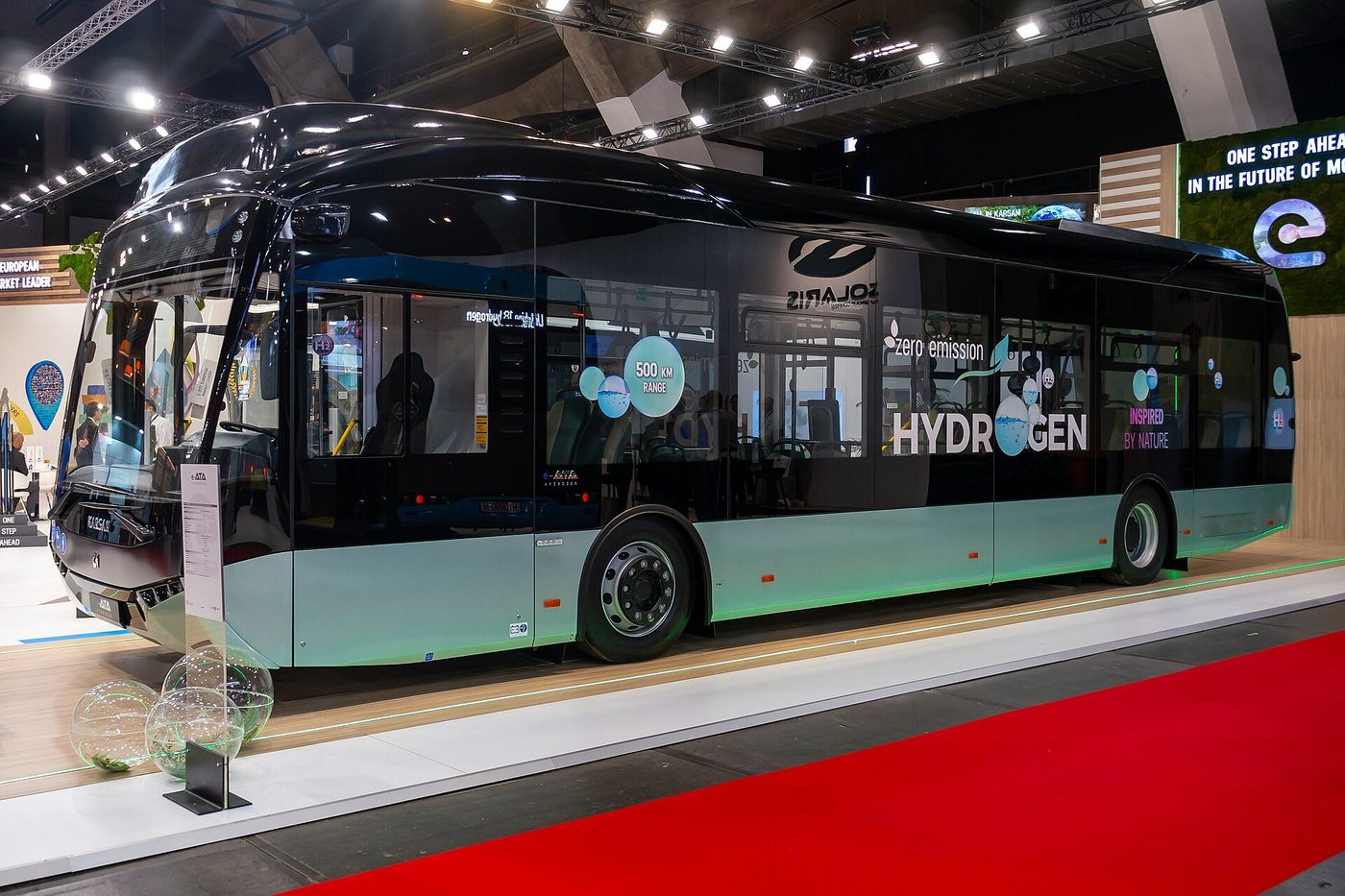

Model overview
- Segment
- Bus
- Gross vehicle
- 19 000 kg
- Battery capacity
- 43.5 kWh
- Electric motor
- 250 kW peak
- Fuel cell
- 97 kW
- Hydrogen tank
- gaseous
- Range on hydrogen
- 500 km
- Length
- 12 220 mm
- Capacity
- 40 maximum
- Doors
- 2 or 3 door options
The Karsan e-ATA HYDROGEN is a 12-metre fuel-cell city bus. Karsan’s specification page gives it as a “Full Low Floor Electric Bus, M3 Category, Class I, LHD”, and its product page calls it a “ZERO-EMISSION FUEL CELL BUS”. Karsan presented it to the world at the IAA Transportation Fair in Hannover on 19 September 2022. The current figures on this page are read from Karsan’s own specifications page, its product page and its English catalogue dated 23 September 2025. How fuel-cell drives are laid out on city buses in general is in city bus propulsion.
Overview and the 2022 launch specification
Karsan’s launch release of 20 September 2022 describes the bus as it was first shown: a 70 kW fuel cell, a 30 kWh LTO battery, a 1,560-litre overhead lightweight composite hydrogen tank, and 250 kW of power with 22,000 Nm of torque from an electric portal axle that the release names as ZF’s. It gives a range of over 500 km, room for over 95 passengers and refuelling in less than 7 minutes; the conditions it attaches to the range and the passenger figure are set out in the sections below. The release calls the battery “positioned as an auxiliary power source in the vehicle” and says it “feeds more power to the electric motor in difficult road conditions and offers additional range for emergencies”.
Karsan’s earlier catalogue, whose footer reads “04.01.2024” and which we read as January 2024, gives the same 250 kW, the same 500+ km, the same 80 km/h, the same 12,220 mm by 2,550 mm outline, the same 19,000 kg gross vehicle weight, the same 40 seats, the same 2 or 3 door options and the same 275/70 R22.5 tyres as the current table. By our count it differs in five figures: a 70 kW fuel cell, a 30 kWh LTO battery, a 1,560-litre tank, a height of 3,325 mm and a passenger capacity of “± 95”. The current specification page and the catalogue dated 23 September 2025 give 97 kW, 43.5 kWh, 1,687 litres, 3,350 mm and “+/-90”, which the catalogue prints as “± 90”. By our arithmetic that is 27 kW more fuel-cell power, 13.5 kWh more battery, 127 litres more tank volume and 25 mm more height; Karsan does not list these differences itself, and it names no generations. This page speaks of the version launched in 2022 and the earlier specification in the January 2024 catalogue.
The equipment lists differ in places too. ESP is an option in the earlier catalogue and standard in the current one; Heated Windscreen and Passenger Sidewall Heaters are standard in the earlier one and options in the current one; Fire Detection System, Electronic Parking Brake and Charging Plug for Batteries are not in the earlier list at all. No Karsan document read gives a production start year, a plant or a delivery count, so the spec record carries no production year: 19 September 2022 is the date of the world launch.
Fuel cell, battery and drive
Karsan’s specification page gives “Fuel Cell Power (kW): 97”, and its catalogue repeats it as “97 kW Fuel Cell”. No Karsan document read names a fuel-cell supplier or gives the number of stacks or modules or the output of each, so none is written here. The product page describes the energy flow in one sentence: “With a fuel cell power of 97 kW, the electrical energy generated powers e-ATA Hydrogen while simultaneously charging the onboard battery.” Karsan says the bus “releases only water vapor as its byproduct”, and its catalogue carries the heading “100% Zero Emission”.
The battery is given as “LTO – 43,5 kWh” under “High Voltage Battery (Type - Capacity)”: Karsan gives the battery as LTO, 43.5 kWh, one figure with no second capacity beside it. The drive is listed as “Drive Type: Hub Electric Motor”; the product page speaks of electric hub motors in the plural, and no document read says how many motors there are or what each delivers. The table gives “Maximum Power (kW): 250” and the catalogue “Max. Torque: 22.000 Nm”, which the product page prints as “Delivering 250 kW power and 22,000 Nm torque”. Karsan gives the 250 kW as maximum power and publishes no continuous rating; it is the figure for the drive, not for the fuel cell, whose 97 kW is a separate line. Maximum speed is listed as 80 km/h.
“Charging Plug for Batteries” is on Karsan’s equipment list as an option; no charging power and no connector standard are given.
Hydrogen tank, refuelling and range
Karsan gives the tank by volume: “Hydrogen Tank Volume (lt): 1.687”, which is 1,687 litres. Karsan prints the point as a thousands separator, as in its 12.220 mm; the 2022 release’s “1560-liter” tank is the “1.560 lt” of the earlier catalogue, which is how the notation is read here. The documents read give no hydrogen mass, no storage pressure, no number of cylinders and no cylinder type for the current tank, and litres are not converted to kilograms on this page, because that needs a pressure and a temperature Karsan does not state. The catalogue’s safety text describes “high pressure resistant tank systems”, “valves that evacuate the gas in case of an emergency” and sensors that “automatically close”; that wording is the basis for recording the storage as gaseous.
The catalogue lists “7 Minutes Refuelling Time”, with no conditions, protocol or pressure attached. The 2022 release said the bus “can be fueled up with hydrogen in less than 7 minutes”.
The specification table gives “Range (km): 500+” with the footnote “Under realistic conditions. Range may change with driving profile.” The spec record carries the bare 500; the “+” is kept here in the text, because Karsan’s “500+” is a floor, not an exact figure. Karsan gives no hydrogen consumption figure and names no test cycle. The 2022 release stated over 500 km “under real conditions of use, that is, when the vehicle is full of passengers and travels on stop-and-go line routes”.
Body, doors and passenger capacity
The body is listed as “Carbon Steel: Space Frame Steel Tube Structure”, with “Cataphoresis & Underbody Coating” as its corrosion resistance. Karsan’s category line calls the bus a full low floor bus, and its suspension row includes a kneeling function; low floor and the ramp rules are explained in bus accessibility, and the M3 category and Class I in bus classes. A Manual Wheelchair Access Ramp is standard, together with “Backrest Totem and Wheelchair Designations”; the electric and the double electric wheelchair access ramps are options that carry Karsan’s footnote “Option can be offered during tender process.”
The table gives “Door Arrangement: 2 or 3 Door Options”, and “Metro Type Sliding Doors” are an option. Door requirements in general are covered in bus doors and emergency exits.
Seating is given as “Maximum Seat Capacity: 40 Seats”, with Karsan’s footnote “May change with door arrangement and seat layout.”; the catalogue heads it “Up to 40 Seats”. Plastic passenger seats are standard, and plastic seats with upholstery an option. Passenger capacity is given as “+/-90”, with the footnote “May change with battery capacity, seat layout, door arrangement, GVW and technical gross axle value depending on country of registration.” Karsan gives no separate standing figure. The 2022 release said the bus “can readily carry over 95 passengers depending on the maximum permissible loaded weight and preferred optional features”, and the earlier catalogue gave “± 95”.
Axles, suspension, brakes and tyres
The front axle is listed as “Independent” and the rear axle as “Electric Portal Axle”. The 2022 release named the portal axle as ZF’s; the current documents name no axle maker. Karsan prints no wheel formula, so none is given here. The suspension row reads “Air Suspension, Electronic Leveling, Kneeling Function”.
The brake system row reads “ABS, ASR, EBS, Regenerative Braking System”. The standard list adds ESP, HSA (Hill Start Aid) and front and rear anti roll bars; Electronic Parking Brake is an option. Tyres are given as “275/70 R22.5”, and the catalogue lists 22.5-inch steel wheels, front and rear, as standard.
Dimensions and weights
Karsan’s table gives an overall length of 12,220 mm, an overall width of 2,550 mm and an overall height of 3,350 mm; the product page gives the length as 12 m. The earlier catalogue gave a height of 3,325 mm. Gross vehicle weight, in Karsan’s term, is 19,000 kg, with 19,500 kg as an option. Karsan publishes no wheelbase, no overhangs, no turning circle, no kerb weight and no axle loads in the documents read, so no payload is derived here.
Safety and driver-assistance systems
Karsan’s safety equipment list opens with a standard “GSR Package”, whose footnote reads: “Includes: Emergency stop signal, Tyre pressure monitoring system, Blind spot information system, Reversing information system, Moving off information system Alcohol Interlock Facilitation Installation, Driver drowsiness and inattention warning, Intelligent speed assistance.” The mandatory systems and their timetables are covered in mandatory driver assistance systems. “Cyber Security” is also standard; its footnote names “ECE R.155: Protection of vehicle against cyberattacks” and “ECE R.156: Software update and software updates managment system”, spelt as Karsan prints it.
Also standard: ESP (Electronic Stability Program), AVAS (Acoustic Vehicle Alerting System), EBS, ABS, ASR (Anti-Slippage System), RBS (Regenerative Brake System), HSA, a Fire Detection System, a Tire Pressure Monitoring System, Rear Park Sensors and a Reverse Gear Buzzer. Fire safety as a subject is covered in bus fire safety explained.
Mirror Cameras are an option. The product page speaks of “camera mirror systems positioned at eye level” and, of ADAS systems, says “Cameras and warning screens placed at critical points help detect passengers, cyclists, and objects in blind areas”. The equipment list has no ADAS entry outside the GSR package, so the standard or optional status of those items is not stated. The 2022 release said “mirror camera technology, front collision warning, lane keeping assist, blind spot monitoring, speed limit indicator detection and other technological features can be included as options”.
Driver’s cab and equipment
Karsan describes a “VDV-compatible ergonomic driver cabin” and lists left-hand drive (LHD) on its category line. An Isolated Cabin is standard and a Separated Driver Cabin with High Glass an option. The 8-Way Pneumatic Driver Seat with 3-Point Seat Belt is listed twice: “(SEGE)” as standard and “(ISRI)” as an option. A Sliding Heated Driver’s Window and a manual front sun visor for the driver are standard; a Heated Windscreen, an electric front sun visor, a Driver Seat with Heating Function and Cruise Control are options. The catalogue’s text names “Heated driver seat, heated windshield, digital dashboard and cruise control”, while its equipment list puts the heated seat, the heated windscreen and cruise control among the options and the Full Digital Cluster among the standard items.
Technology on the standard list: Full Digital Cluster, Smart Tachograph (explained in smart tachograph explained), Telematics System and FMS Socket. Options: Ticket Validator Preparation, Passenger Counting System, Passenger Information System, Wi-Fi Infrastructure and the audio and screen items (MP3+USB+Aux, Announcement System, External Speakers, 7” LCD + Rear Cam, 19” LCD).
Climate control: Passenger A/C with Heating Function, Driver A/C with Heating Function and an Electrical Heater are standard. Options are Passenger A/C with CO2 & Heating Function, Passenger Sidewall Heaters, Vehicle Pre-Conditioning and an Air Purifier System. The 2022 release and the earlier catalogue’s headline features name a carbon dioxide air conditioner; in the equipment lists of both catalogues the passenger air conditioning with CO2 is an option.
Passenger space and exterior, standard: USB on Sidewalls (Type A + Type C), an Anti-Slip PVC Floor Cover, yellow handrail tubes, stop signs with a digital clock and temperature indicator, an anchor-cable-type emergency hammer, LED front and rear lights, LED day-time running lamps, a front fog lamp, electrical and heated pipe-type mirrors, light tinted side glass, front and rear towing hooks, wheel nut covers, a white body and roof, and preparation for monocolour LED destination signs. Options include the destination signs themselves, Hand Luggage Area, Handgrips, stainless steel handrail tubes, Cornering Lamps, a Mudguard Set, a Flag Holder, a special body or roof colour and a Billboard.
The footnote “Option can be offered during tender process.” is attached on Karsan’s list to Vehicle Pre-Conditioning, the electric and double electric wheelchair access ramps, the door opening buttons (outside and inside), the External Speakers, a 3rd Stop Lamp and Double Glass Windows.
Source notes
Karsan gives the hydrogen tank by volume only, 1,687 litres, with no mass or storage pressure, and the range as 500+ km under realistic conditions, varying with driving profile. The 250 kW is Karsan’s maximum power for the hub-motor drive; the fuel cell is rated at 97 kW. A gross vehicle weight of 19,500 kg is optional. Karsan gives passenger capacity as +/-90, varying with battery capacity, seat layout, door arrangement, GVW and technical gross axle value depending on country of registration.
Quick answers
- What is the gross vehicle weight of the Karsan e-ATA HYDROGEN?
- Gross vehicle weight: 19 000 kg.
- What battery capacity does the Karsan e-ATA HYDROGEN have?
- Battery capacity: 43.5 kWh.
- How long is the Karsan e-ATA HYDROGEN?
- Length: 12 220 mm.
- How many passengers does the Karsan e-ATA HYDROGEN carry?
- Capacity: 40 maximum.
Articles that mention the Karsan e-ATA HYDROGEN
More Karsan on this site
Sources
- e-ATA HYDROGEN — specs — Karsan Otomotiv Sanayi ve Ticaret A.Ş.
- e-ATA HYDROGEN — product page with standard and optional equipment — Karsan Otomotiv Sanayi ve Ticaret A.Ş.
- e-ATA HYDROGEN 12 — catalogue (English), dated 23.09.2025 — Karsan Otomotiv Sanayi ve Ticaret A.Ş.
- e-ATA HYDROGEN 12 — earlier catalogue (English), dated 04.01.2024 — Karsan Otomotiv Sanayi ve Ticaret A.Ş.
- Karsan Starts the Hydrogen Era! (launch release, 20 September 2022) — Karsan Otomotiv Sanayi ve Ticaret A.Ş.