industry
What a European truck registration figure counts
ACEA reports the European truck, bus and van market in four categories it defines itself, with fixed weight thresholds. What each one counts, and what the 2025 figures said.
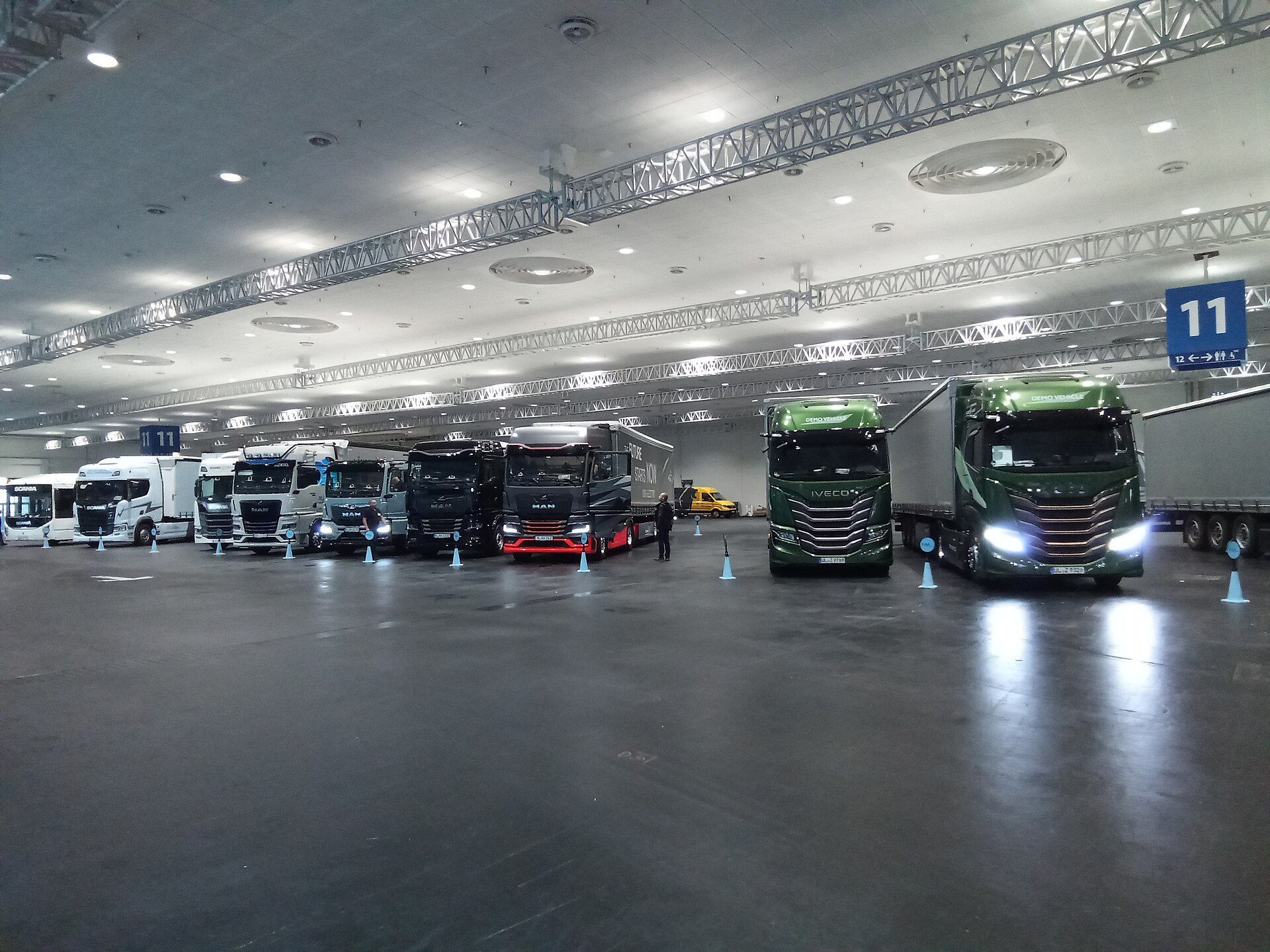
A trade headline saying the European truck market fell six per cent in 2025 is describing one specific series: new registrations in the European Union, published quarterly by the European Automobile Manufacturers’ Association in categories that ACEA defines for itself. The number is accurate. It is also narrower than it sounds, because each of the four words in it — truck, European, registration, 2025 — carries a definition that is not the obvious one, and three of the four are set by the association rather than by law.
The categories, in ACEA’s own words
ACEA publishes its category definitions on a statistics FAQ page, and they are short enough to reproduce exactly.
| Code | Definition as published |
|---|---|
| PC | Passenger cars |
| LCV | Light commercial vehicles up to 3.5 t, also called ‘vans’. Light buses and coaches are also included in this category |
| HCV | Heavy commercial vehicles over 16 t, also called ‘heavy trucks’ |
| MHCV | Medium and heavy commercial vehicles over 3.5 t, also called ‘trucks’ |
| BC | Buses and coaches over 3.5 t |
Read those two truck lines together and the structure follows: everything over 16 tonnes is also over 3.5 tonnes, so HCV is contained inside MHCV rather than sitting beside it. The “trucks” headline is the wider bucket. The FAQ defines no separate medium category at all, although the press releases report a medium-truck movement alongside the heavy one; the only band the two published definitions leave for it is above 3.5 tonnes and not above 16, and that reading is ours rather than ACEA’s.
The bus line has no weight split
BC is a single item: buses and coaches over 3.5 tonnes. Below that threshold, light buses and coaches are counted as vans. There is no ACEA heavy-bus figure, no ACEA city-bus figure, and nothing in the series that separates a 24-seat midibus from a three-axle double-deck coach. A bus number lifted from an ACEA release is every vehicle in that whole range.
That boundary also has nothing to do with the way buses are classified for construction purposes. UN Regulation No. 107 — read here in the consolidated text at Official Journal L 52 of 23 February 2018, current to Supplement 1 and Corrigendum 1 to the 07 series of amendments — applies to every single-deck, double-deck, rigid or articulated vehicle of category M2 or M3 (paragraph 1.1), and not to vehicles designed for the secure transport of persons, ambulances, off-road vehicles or vehicles specially designed for carrying school children (paragraph 1.2). Inside that scope it sorts on capacity first: above 22 passengers in addition to the driver into Classes I, II and III (paragraph 2.1.1), at 22 or fewer into Classes A and B (paragraph 2.1.2). Only within those brackets does standing capacity divide them — Class II, for one, is constructed principally for the carriage of seated passengers but designed to allow standing passengers in the gangway and/or in an area not exceeding the space provided for two double seats (paragraph 2.1.1.2). ACEA sorts by mass, and the two systems cut across each other; a figure built on one answers no question posed in the terms of the other.
They are not the type-approval categories either
The legal categories a vehicle is actually approved in are set by Article 4 of Regulation (EU) 2018/858, in force and consolidated to 2 August 2026. Category M covers vehicles built primarily to carry passengers and their luggage: M1 has not more than eight seating positions besides the driver’s and no space for standing passengers; M2 has more than eight and a maximum mass not exceeding 5 tonnes; M3 has more than eight and a maximum mass exceeding 5 tonnes. Category N covers goods vehicles: N1 up to 3.5 tonnes, N2 above 3.5 and up to 12 tonnes, N3 above 12 tonnes.
Only one of ACEA’s thresholds lines up with that. The 3.5-tonne van boundary is the N1/N2 boundary. The 16-tonne heavy-truck boundary matches nothing in Article 4 — N3 opens at 12 tonnes — and the 3.5-tonne bus boundary is not the M2/M3 boundary of 5 tonnes. An ACEA heavy truck and an N3 vehicle are therefore different populations, and neither is the same population as the vehicles subject to a given weight limit under the gross weight and axle load rules.
A registration is not a sale
Article 3(53) of the same Regulation defines registration as an administrative authorisation for the entry into service in road traffic of an approved vehicle, involving identification of the vehicle and the issuing of a serial number known as the registration number, on a permanent or temporary basis. Article 3(50) defines placing on the market separately, as making a vehicle available for the first time in the Union.
The counted event is the plating, not the order and not the invoice. A vehicle sold in one period and registered in the next falls into the later figure, which is why order intake, deliveries and registrations are three different clocks and only the third one is what these releases report. ACEA is explicit that this is not a production series either: its own FAQ sends anyone wanting production figures to OICA. Nor does it reach model level. Asked where passenger car registrations broken down by brand and by model can be found, ACEA answers that it publishes monthly provisional registration figures by country and by brand, but not by model; the commercial vehicle releases are published by country, fuel type and vehicle category. The shape of the industry behind the badges is a separate subject, covered in who builds trucks in Europe.
What 2025 actually was
The release of 29 January 2026 gives the year. New EU truck registrations fell 6.2 per cent to 307,460 units, driven by a 5.4 per cent decline in heavy trucks and a 9.9 per cent fall in medium trucks; Germany was down 12.2 per cent, France 9 per cent and Spain 3.6 per cent. New EU bus registrations rose 7.5 per cent to 38,238 units, led among the larger markets by Germany at plus 28 per cent and Poland at plus 16.6 per cent, with Italy down 15.9 per cent and Spain down 4 per cent. New EU van registrations fell 8.8 per cent.
Set the two published totals for the vehicles above 3.5 tonnes against each other and buses are 11.1 per cent of them — that division is our arithmetic, not a figure ACEA publishes, and it holds only because both totals come from the same release and the same geography. It is worth doing once, because the bus segment is small enough that a large percentage movement in it is a small movement in units.
Which fuel, in which bucket
The power-source figures come with the same category boundaries attached. Diesel accounted for 93.2 per cent of new registrations in the EU heavy- and medium-duty truck market in 2025, on volumes down 8 per cent. Electrically-chargeable trucks above 3.5 tonnes took 4.2 per cent, up from 2.3 per cent a year earlier, with the Netherlands up 205.4 per cent — against a 40.8 per cent fall in its total truck registrations — Germany up 39.6 per cent and France up 30.5 per cent, the three together accounting for two-thirds of the EU’s electrically chargeable truck market. What those diesel registrations have to be approved against is a separate matter, set out in Euro VI and Euro 7.
On the bus side the electrically-chargeable share reached 23.8 per cent by the end of 2025, diesel held 62.1 per cent against 63.2 per cent the year before, and hybrid-electric fell 24.9 per cent to 7 per cent of the market. Germany, the largest market by volume, grew 106.4 per cent in the electric segment, Sweden 262.1 per cent and Belgium 233.5 per cent. Because BC is one undifferentiated line, none of that separates urban buses from coaches, a limitation that also constrains what can be said about city bus propulsion.
In the van bucket, diesel registrations fell 12.8 per cent to 1,168,561 units for an 80.7 per cent share, down from 84.4 per cent; electrically-chargeable vans took 11.2 per cent against 6.1 per cent; petrol fell 31.9 per cent to a 4.4 per cent share; hybrids rose 21.4 per cent on 2.7 per cent of the market. Light buses and coaches are inside those numbers.
Provisional now, consolidated later
ACEA states that the data it publishes for the current year is provisional and provided by national sources, and that consolidated figures — compiled by the Association Auxilliaire de l’Automobile and updated annually for the current and previous year — are published at the beginning of each year. It also states that its registration data changes regularly for both the current and the previous year, because the official licensing authorities keep changing their registration files.
A registration figure is therefore a reading rather than a fact, and two correct citations of the same year can disagree because they were taken at different times. One further caveat is ACEA’s own: the restriction that monthly press releases cover only ACEA members, with all brands appearing in the annually consolidated manufacturer figures, is stated on that page for passenger cars.
The period decides the answer
Nothing in this series moves evenly, so the window quoted does most of the work. ACEA’s half-year release for 2025 was headlined at minus 15.4 per cent on 155,367 trucks, with heavy down 14.5 per cent and medium down 20 per cent; the full year closed at minus 6.2 per cent. Quoting the half-year figure as the state of the market would have been accurate and badly misleading.
The 2026 releases show the same effect in the other direction. Q1 2026 came in at 81,766 trucks, up 10.7 per cent, and 10,964 buses, up 24.5 per cent; H1 2026 at 171,933 trucks, up 9.8 per cent, and 22,590 buses, up 22.7 per cent. The electrically-chargeable bus share reads 21.8 per cent at the first quarter and 27.7 per cent at the half-year, against 23.8 per cent for the whole of 2025 — three different true answers to the question of how electric the EU bus market is.
Four questions settle what any of these numbers mean: which category, which geography, which period, and which vintage of the data. ACEA reports commercial vehicles by country, fuel type and vehicle category on a quarterly cycle and cars monthly, and the headline is the EU, not Europe. A figure quoted without those four attached is not a market fact; it is a fragment of one.
Quick answers
- How many trucks were registered in the EU in 2025?
- 307,460, which ACEA reported as a fall of 6.2 per cent on 2024. Heavy-truck registrations fell 5.4 per cent and medium-truck registrations 9.9 per cent.
- What does ACEA count as a truck?
- MHCV — medium and heavy commercial vehicles over 3.5 tonnes. ACEA's statistics FAQ also defines HCV as heavy commercial vehicles over 16 tonnes, so the heavy figure sits inside the truck figure rather than beside it.
- Does ACEA publish separate figures for heavy and light buses?
- No. There is one bus line, BC, defined as buses and coaches over 3.5 tonnes, and light buses and coaches are counted inside the LCV van category. No ACEA figure for a heavy bus market exists to quote.
- What share of new EU trucks is electric?
- Electrically-chargeable trucks above 3.5 tonnes took 4.2 per cent of the EU market in 2025, up from 2.3 per cent the year before. Diesel took 93.2 per cent of the EU heavy- and medium-duty truck market in 2025 — ACEA's MHCV line, over 3.5 tonnes.
- Are ACEA registration figures final?
- No. ACEA states that current-year data is provisional and supplied by national sources, that consolidated figures compiled by the Association Auxilliaire de l'Automobile follow at the beginning of each year, and that the data changes regularly because licensing authorities change their registration files.
Sources
- Frequently asked questions about ACEA statistics — ACEA (European Automobile Manufacturers' Association)
- New commercial vehicle registrations: vans -8.8%, trucks -6.2%, buses +7.5% in 2025 — ACEA (European Automobile Manufacturers' Association), 29 Jan 2026
- New commercial vehicle registrations: vans -13.2%, trucks -15.4%, buses -4.4% in H1 2025 — ACEA (European Automobile Manufacturers' Association), 30 Jul 2025
- New commercial vehicle registrations: vans +2.3%, trucks +10.7%, buses +24.5% in Q1 2026 — ACEA (European Automobile Manufacturers' Association), 29 Apr 2026
- New commercial vehicle registrations: vans +1.9%, trucks +9.8%, buses +22.7% in H1 2026 — ACEA (European Automobile Manufacturers' Association), 29 Jul 2026
- Reliable figures and statistics — ACEA (European Automobile Manufacturers' Association)
- Regulation (EU) 2018/858 — consolidated text of 2 August 2026, Articles 3 and 4 — EUR-Lex, Publications Office of the European Union
- UN Regulation No 107 — Uniform provisions concerning the approval of category M2 or M3 vehicles with regard to their general construction (OJ L 52, 23.2.2018), consolidated to Supplement 1 and Corrigendum 1 to the 07 series — Official Journal of the European Union / UNECE