Charging electric trucks and buses: depot, opportunity and megawatt charging
How electric trucks and buses charge at the depot, by opportunity charging and in the driver's break: power classes, connectors, AFIR targets, public networks and grid lead times.
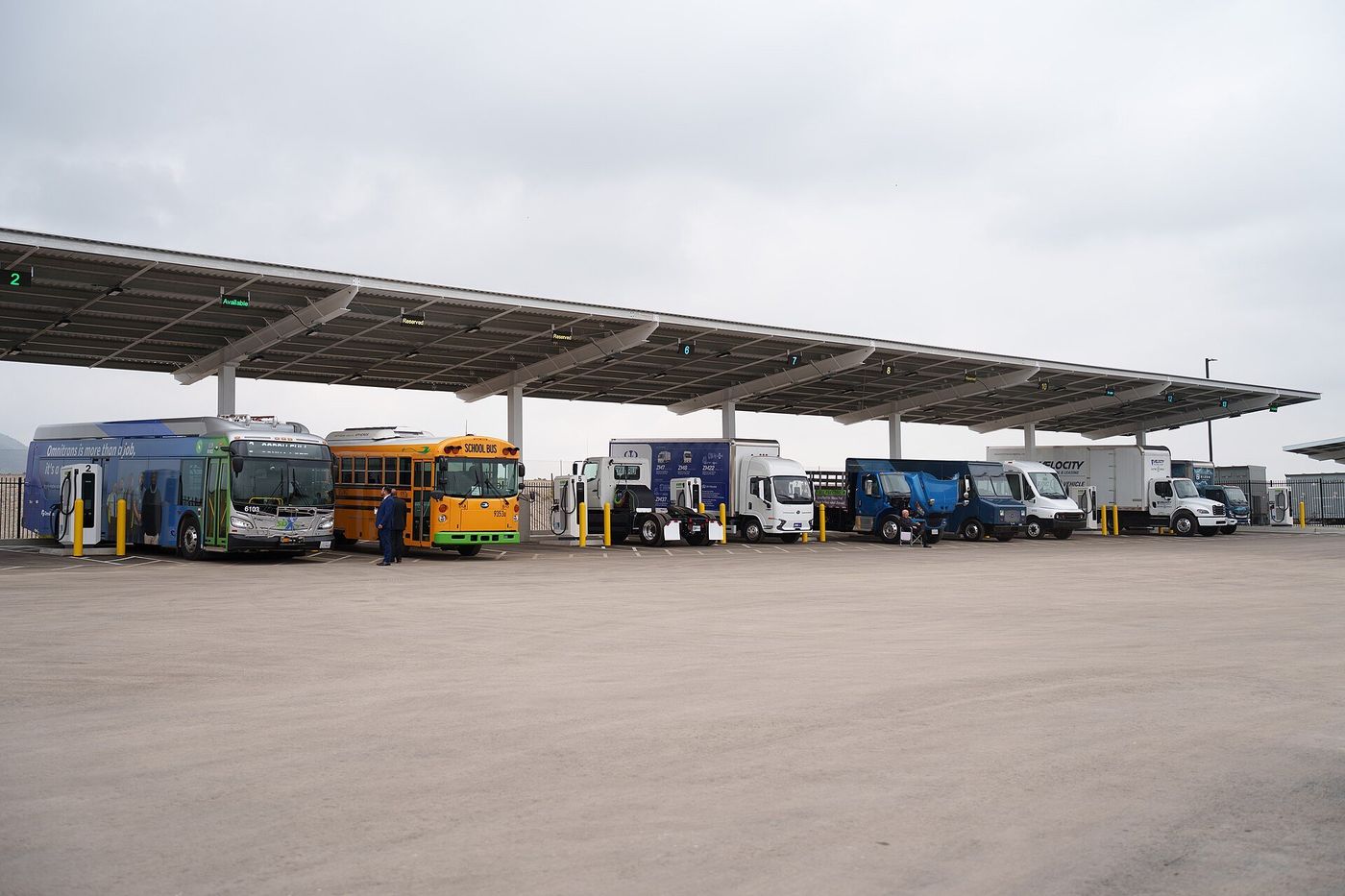
Electric trucks and buses charge in three settings, which this page groups together: overnight at the depot, by opportunity charging for buses, and at high power on the road within the driver’s break. Scania says today’s battery-electric trucks use CCS2, “typically delivering up to 350–400 kW”, which it calls “sufficient for overnight depot or destination charging, as well as for en-route top-ups”, while the Megawatt Charging System (MCS) “is designed for en-route charging where speed is essential”.
The page takes the settings one at a time, then the power classes and connectors, what the EU’s alternative fuels infrastructure regulation (AFIR, Regulation (EU) 2023/1804) requires, public networks and the grid connection. Every count carries the definition and date its source gives. The megawatt system itself is on Megawatt Charging System, and bus drivetrains are on city bus propulsion.
Where heavy electric vehicles charge
The one full list of charging locations that this page uses comes from Germany. In a news item of 21 September 2022 the Nationale Leitstelle Ladeinfrastruktur — which, under the roof of the federal NOW GmbH and on behalf of the federal transport ministry, coordinates and steers the build-out of charging infrastructure in Germany — announced a newly published overview of “die sieben typischen Ladeorte bzw. -szenarien für schwere batterieelektrische Nutzfahrzeuge”, the seven typical charging locations or scenarios for heavy battery-electric commercial vehicles. Translations from the German are ours throughout.
In non-public space it lists company-owned sites, other companies’ sites and depots, and mobile charging points. In public space it lists charging hubs in commercial areas, hubs on transport axes for overnight charging and longer breaks, and hubs on axes for intermediate charging and driver breaks (“Zwischenladen und Lenkpausen”). Charging at transhipment points, it adds, takes place in both public and non-public space.
The grouping into three settings is this page’s own: none of its sources says there are three. Depot and overnight charging, opportunity charging for buses and charging in the driver’s break each have a section below.
Power classes and connectors
AFIR draws the line between normal and high power at 22 kW. It defines a “normal power recharging point” as a recharging point with “a power output less than or equal to 22 kW” and a “high-power recharging point” as one with “a power output of more than 22 kW”. The term “power output” means “the theoretical maximum power, expressed in kW”, that a recharging point, station or pool can provide. A recharging point “is capable of recharging only one electric vehicle at a time”; a recharging station is “a physical installation at a specific location, consisting of one or more recharging points”, and a recharging pool is “one or more recharging stations at a specific location”. A point, station or pool is dedicated to heavy-duty vehicles when it is “intended for the recharging of heavy-duty vehicles, either due to the specific design of the connectors/plugs or to the design of the parking space adjacent to the recharging point, station or pool, or both”, and a heavy-duty vehicle is a Category M2, M3, N2 or N3 motor vehicle of Regulation (EU) 2018/858.
NOW’s depot guide (11/2023) uses the term for another range: “Das Laden mit einer Ladeleistung von 150 kW oder mehr wird auch als Hochleistungsladen bezeichnet”, that is, charging at 150 kW or more is also called high-power charging (HPC). The two definitions are not the same, and each stays with its source here. In practice, the guide says, charging power is often presented in four categories, the so-called charging power classes (Ladeleistungsklassen); its Table 1 gives them as follows, with the time to charge 100 kWh and 400 kWh at maximum charging power.
| NOW class | Maximum charging power, kW | Connector | 100 kWh | 400 kWh |
|---|---|---|---|---|
| Normalladen (normal charging) | up to and including 22 | Typ 2, CCS | 4.5–5 h | more than 18 h |
| Schnellladen (fast charging) | more than 22 to less than 150 | CCS | around 1 h | 2–3 h |
| Hochgeschwindigkeitsladen (high-speed charging) | 150 or more to less than 400 | CCS | around 30 min at a charging power of 350 kW | around 1.5 h at a charging power of 350 kW |
| Megawatt-Laden (megawatt charging) | about 1,000 | MCS | depending on future design; probably less than 30 min | depending on future design; probably less than 45 min |
The megawatt row reflects the state of November 2023, when the guide said megawatt charging “befindet sich aktuell noch im Normierungsprozess”, is still in the process of standardisation. The guide’s running text words the 22 kW boundary as “weniger als 22 kW” for normal charging where its table reads “≤ 22”; AFIR’s definition puts 22 kW itself in the normal class. For high-power charging the guide adds: “In der Praxis werden aktuell Ladeleistungen um die 400 kW erreicht. In einzelnen Erprobungen finden Aufladungen mit bis zu 750 kW statt.” That is, as of November 2023, charging powers of around 400 kW were reached in practice and, in individual trials, up to 750 kW.
On hardware, the guide says a Ladesäule (charging column) “wird üblicherweise eingesetzt, wenn höhere Ladeleistungen zum Einsatz kommen”, is usually used where higher charging powers are involved, and “kann über einen oder mehrere Ladepunkte verfügen”, can have one or more charging points. Fast-charging equipment is, it says, “in der Regel als Kompaktladesäule konzipiert”, as a rule designed as a compact charging column.
The megawatt system rests on documents of different kinds. CharIN says it initiated a task force in 2018 “to invent a holistic system approach based on the Combined Charging System CCS”, and among the requirements it says are “currently discussed” it lists “Max 1.250 volt & 3.000 ampere (DC)”, which multiplied out is 3.75 MW (our arithmetic). NOW’s guide of 11/2023 says charging powers of up to 3.75 MW (at 1,250 V) or 4.5 MW (at 1,500 V), each at 3,000 A, are technically possible in theory (“theoretisch”). IEC TS 63379:2026, a Technical Specification published on 28 January 2026, is titled “Vehicle connector, vehicle inlet and cable assembly for megawatt DC charging” and applies to vehicle couplers and cable assemblies with a rated operating voltage not exceeding 1,500 V DC and a rated current up to and including 3,000 A. IEC 61851-23-3:2026, an International Standard published on 21 August 2026, applies to EV supply equipment with a rated maximum voltage at side A (supply network side) up to 1,000 V AC or up to 1,500 V DC and a rated maximum voltage at side B (EV side) up to 1,250 V DC. SAE J3271_202503 is a Technical Information Report, issued on 5 March 2025. What each document covers, and what named trucks are rated at, is on Megawatt Charging System.
MAN announced on 30 July 2026 that the first series-produced eTruck equipped with MCS had rolled off its assembly line. MAN states that CCS “currently allows charging capacities of up to 375 kW for MAN eTrucks” while MCS-equipped vehicles “can achieve charging capacities of up to 750 kW, with up to 1,000 amps and up to 750 volts”. MAN’s charging figures for the eTGX are on the MAN eTGX model page and Volvo’s on the Volvo FH Electric page; the makers’ declared values for electric tractor units, with the conditions attached, are in electric tractor units: declared values.
Depot and overnight charging
Scania says CCS2 “remains highly suitable for depot and destination charging, especially where charging can happen overnight or during loading and unloading”. It adds that “Scania’s BEVs can be fitted with both connectors, depending on the application”. In its Current Policies Scenario the IEA projects that depot charging “continues to dominate charging, and still accounts for 99% of all HDV chargers in 2035”, HDV being heavy-duty vehicles. The charging scenarios of NOW’s depot guide, the grid connection and load management at a truck depot are set out in depot charging for electric trucks.
Article 4 of AFIR sets targets for “publicly accessible” recharging points. Private depots are addressed in recital 27: “The deployment of recharging infrastructure for heavy-duty electric vehicles is equally important in private locations that are not accessible to public, such as in private depots and at logistics centres to ensure overnight and destination charging.” The recital continues that public authorities “should consider taking measures” in their revised national policy frameworks to ensure that appropriate infrastructure is provided for overnight and destination charging for heavy-duty electric vehicles.
NOW’s guide of November 2023 expected (“Man geht aktuell davon aus”) that megawatt charging, because of the high costs and the high grid connection capacity needed, would not take place at company depots but mainly in public charging in long-distance transport and at transport hubs. That is an expectation as of 11/2023, not a current finding. The eActros 600’s CCS2 charging figures, with the conditions under which its maker states them, are on eActros 600 explained. Depot grid connections are covered in the last section below.
Electric buses: depot and opportunity charging
The IEA’s Global EV Outlook 2026, published on 20 May 2026, says: “Depot charging is a crucial element of HDV electrification, particularly for urban bus fleets, which typically rely on overnight or opportunity charging at central depots.”
Mercedes-Benz Buses describes the charging options of its eCitaro city bus. “Using a CCS plug, the fully electric eCitaro can be charged with up to 150 kilowatts.” The bus “can also come fitted with a current collector (pantograph) or alternatively with charging rails on the roof, which can be connected to the fixed pantograph at a charging station”, and “Both pantograph solutions enable high-performance charging with up to 300 kW charging capacity.” The page also says: “If you prefer interim charging, for example at an end station, the eCitaro can also adapt as needed.” It adds that “The eCitaro is also available with combinations of plug charging and pantograph or charging rails” and that “There’s also the possibility of charging two eCitaro buses sequentially, i.e. one after the other, at a single charger with two charging points.” These are the maker’s statements about its own bus.
In the consolidated text of 8 January 2026, Annex II point 1.4 of AFIR covers normal power and high-power recharging points for electric buses. DC points installed or renovated from 8 January 2026 “shall be equipped, for interoperability purposes, at least with vehicle connectors of the combined charging system Combo 2 for Mode 4 recharging”, and AC points “at least with connectors of Type 2 for Mode 3 recharging”. Point 1.5 covers automated connection: a “Contact interface automated device for electric buses on conductive recharging in mode 4, in accordance with standard EN 61851-23-1:2020, shall be equipped at least with mechanical and electrical interfaces, as defined in the standard EN 50696:2021”, in four arrangements, an automated connection device (ACD) “mounted on the infrastructure (pantograph)”, “mounted on the roof of the vehicle”, “mounted underneath the vehicle”, or “mounted on the infrastructure and connecting to the side or on the roof of the vehicle”. The standards’ editions and the transition for older points are set out on city bus propulsion.
SAE J3105_202001 is a separate document of SAE International, a Recommended Practice issued on 20 January 2020. SAE gives its scope as “the general physical, electrical, functional, testing, and performance requirements for conductive power transfer, primarily for vehicles using a conductive ACD connection capable of transferring DC power”. Its sub-documents are SAE J3105/1, Infrastructure-Mounted Cross Rail Connection; SAE J3105/2, Vehicle-Mounted Pantograph Connection; and SAE J3105/3, Enclosed Pin and Socket Connection. Charging figures for one bus model are on the Solaris Urbino 12 electric page.
Charging in the driver’s break
The European Commission’s questions and answers on driving and rest times, prepared by the Commission services and saying they do not commit the Commission, state: “Article 7, first subparagraph, requires that a driver takes at least a 45 minute break after a driving period of 4,5 hours.” On splitting the break they say: “The possibility to take a break of at least 45 minutes in two parts, which must be at least 15 minutes followed by at least 30 minutes, is not limited to the situation of solo driving.” Scope and exceptions are on driving time and rest rules.
Recital 19 of AFIR says of the publicly accessible fast recharging points dedicated to heavy-duty vehicles that are to be deployed along the TEN-T network: “That infrastructure should have sufficient power output for heavy-duty vehicles to be recharged within the driver’s legal break time.”
What a truck charges within that break is, in the sources here, a statement by a maker or an operator about its own vehicles or about one demonstration. MAN says that charging the battery from 20% to 80% state of charge “in a MAN eTGX or MAN eTGS with six batteries and a total battery capacity of 534 kWh takes less than 30 minutes using MCS technology”, and that “This means that eTrucks can be recharged during legally required driver break periods.” Scania describes a driver who “drives for 4.5 hours, takes a legally required 45-minute rest break, and then continues driving for another 4.5 hours”: “With MCS, the 45-minute break is enough to recharge the battery up to 80 percent.”
Milence, a charge point operator, reported on 14 September 2026 that, joined by Daimler Truck, MAN Truck & Bus and Scania, it had held a demonstration of MCS on Press Day at IAA TRANSPORTATION, “showing how quickly battery-electric commercial vehicles could be charged in the future”. It writes: “Vehicle batteries were charged to 80% or fully charged within the legally mandated driver rest breaks of 30 to 45 minutes scheduled for long-haul operations.” The installation used Alpitronic’s HYC1000 megawatt charging system, “delivering charging power of up to 1,000 kW”. MCS ratings and charging times per truck are on Megawatt Charging System.
What AFIR requires
Article 4(1) opens: “Member States shall ensure a minimum coverage of publicly accessible recharging points dedicated to heavy-duty electric vehicles in their territory.” Its headline targets, in the Regulation’s own terms for the power figures, are these.
- By 31 December 2025, along at least 15% of the length of the TEN-T road network, publicly accessible recharging pools dedicated to heavy-duty electric vehicles in each direction of travel, each pool with a power output of at least 1,400 kW and at least one recharging point with an individual power output of at least 350 kW (point (a)).
- By 31 December 2027, along at least 50% of that length, each pool on the core network with at least 2,800 kW and at least two points of at least 350 kW each, and each pool on the comprehensive network with at least 1,400 kW and at least one such point (point (b)).
- By 31 December 2030, on the core network, pools with a maximum distance of 60 km between them, each with at least 3,600 kW and at least two points of at least 350 kW (point (c)); on the comprehensive network, a maximum distance of 100 km, each pool with at least 1,500 kW and at least one point of at least 350 kW (point (d)).
- In each safe and secure parking area, at least two publicly accessible recharging stations dedicated to heavy-duty electric vehicles with an individual power output of at least 100 kW by 31 December 2027, and at least four by 31 December 2030 (points (e) and (f)). Article 2(63) defines such an area as one accessible to drivers engaged in the carriage of goods or passengers and “certified in accordance with Commission Delegated Regulation (EU) 2022/1012”.
- In each urban node, publicly accessible points with an aggregated power output of at least 900 kW by 31 December 2025 and at least 1,800 kW by 31 December 2030, provided by recharging stations with an individual power output of at least 150 kW (points (g) and (h)). Recital 23 says this infrastructure “is necessary in particular for providing charging opportunities for delivery trucks and for destination charging for long-haul trucks”.
The full table, and the provisions of Article 4 that let Member States depart from it, are on Megawatt Charging System. On our reading no individual-point requirement in Article 4(1) is above 350 kW, and none of the targets asks for MCS. The consolidated text of 8 January 2026 carries Article 4(1)(a) to (h) with the same targets. The article is read paragraph by paragraph, with the Commission’s questions and answers, in AFIR truck-charging targets, article by article.
Annex II point 1.6 was, in the 2023 Official Journal text, only a heading: “Technical specifications regarding the connector for recharging heavy-duty electric vehicles (DC charging).” In the consolidated text of 8 January 2026 it reads: “Direct current (DC) high-power recharging points for recharging infrastructure capable of supplying electricity to both light- and heavy-duty electric vehicles shall be equipped, for interoperability purposes, at least with vehicle connectors of the combined charging system Combo 2 for Mode 4 recharging as described in standard EN IEC 62196-3:2022.” The text applies to DC high-power points that can supply both light- and heavy-duty vehicles; it does not name MCS or IEC TS 63379.
AFIR has applied since 13 April 2024. Article 24(2) provides: “By 31 December 2026 and every five years thereafter, the Commission shall review this Regulation.” Recital 22 says: “New recharging infrastructure standards for heavy-duty electric vehicles are currently being developed. Therefore, the Commission should consider increasing the individual power output of recharging stations at recharging pools once the new common technical specifications are available.”
Public networks and maps
The three counts below use three different definitions and dates. They are not added together or compared.
EAFO. The European Alternative Fuels Observatory (EAFO, European Commission) says the first publication of its dataset on public recharging infrastructure for heavy-duty vehicles, released on 16 October 2025, “marks the start of monthly updates on HDV-dedicated recharging infrastructure, supporting EU monitoring efforts under Regulation (EU) 2023/1804”. “Only publicly accessible recharging locations are included”, and “Private depot or fleet-only sites are excluded.” An item of 28 May 2026 describes the April 2026 dataset, which “focuses on operational recharging locations that meet the AFIR-related 350 kW compliance criterion”. In total it “includes 373 operational locations, 2,405 recharging points, and 1,225 recharging stations across 21 countries”. Mixed-use locations dedicated to heavy-duty vehicles account for 278 locations and 1,838 recharging points; exclusive heavy-duty vehicle locations for 95 locations and 567 recharging points. EAFO says Sweden records the largest recharging points count, followed by the Netherlands and Germany. In October 2025 EAFO said the data “will also be progressively integrated into the TEN-Tec Interactive Map Viewer, where users will be able to view the exact geographical location of each HDV recharging pool”; we have not verified that this integration is complete.
Milence. Milence describes itself as “Established as a joint venture between Daimler Truck, the TRATON GROUP, and the Volvo Group”. Its press release of 14 September 2026 says it has “almost 40 charging hubs already operational across nine markets”, and: “By the end of 2027, Milence plans to expand its network to 70 charging hubs, with more than half expected to support MCS technology.” Both are the operator’s own statements, and the second is a plan.
Germany’s Lkw-Schnellladenetz. The page of the Nationale Leitstelle Ladeinfrastruktur says that the federal transport ministry (BMV), supported by Autobahn GmbH des Bundes and the Leitstelle, has drawn up a concept for a nationwide truck fast-charging network along the federal motorways. “Nach derzeitigem Planungsstand”, according to the current planning status, it comes to 351 locations, 227 at serviced (bewirtschaftete) and 124 at unserviced (unbewirtschaftete) rest areas. At these locations the aim (“angestrebt”) is the construction and operation of around 1,800 MCS and around 2,400 CCS charging points. The contracts for planning, construction and operation of the fast-charging infrastructure at the 124 unserviced rest areas were awarded by Autobahn GmbH des Bundes on 30 June 2026. At those locations, the page says, 836 charging points for road freight are being built, 447 of them MCS and 389 CCS; that figure is for the 124 unserviced rest areas only. We found no opening date on the page.
The grid connection
NOW’s depot guide of 11/2023, written for Germany, gives three voltage levels in its Table 2: low voltage at a nominal 230–400 V, medium voltage at 1–35 kV and high voltage at 60–150 kV. For more energy-intensive consumers such as logistics depots, it says, the grid connection is “in der Regel” at the medium-voltage level.
The guide gives the time an extension takes twice, and the two statements carry different conditions. In the main text, in its step on applying for the extension of the grid connection: “In der Praxis dauern Erweiterungen im Niederspannungsbereich in der Regel zwischen drei und sechs Monate, im Mittelspannungsbereich bei vorhandener Netzkapazität zwischen sechs und zwölf Monate und im Bereich der Hochspannung acht bis zehn Jahre.” In practice, that is, extensions in the low-voltage range as a rule take between three and six months, in the medium-voltage range with existing grid capacity between six and twelve months, and in the high-voltage range eight to ten years. In footnote 18: “Abhängig von der Spannungsebene ist mit folgenden Umsetzungszeiträumen zu rechnen: Niederspannung: 3–6 Monate – Mittelspannung: 6–24 Monate – Hochspannung: 8–10 Jahre.” Depending on the voltage level, these implementation periods are to be expected. The medium-voltage figure is therefore six to twelve months in the main text, where existing grid capacity is a condition, and 6–24 months in the footnote, which states no condition.
Just before the main-text sentence the guide says that where the capacity of the existing grid does not suffice for the requested power, expansion measures by the grid operator are necessary (“sind entsprechende Ausbaumaßnahmen durch den Netzbetreiber notwendig”); this “kann je nach vorhandenen Ressourcen des jeweiligen Netzbetreibers zu einem erhöhten Zeitbedarf bei der Umsetzung führen”, depending on the resources of the respective operator it can lengthen the time needed. The guide, written for Germany, also says that grid operators are legally obliged to expand grid capacity, so that “eine Ablehnung des Antrags wird in aller Regel nicht erfolgen”, a rejection of the application will as a rule not occur. NOW’s advice: “Möglichst früh sollte der Netzbetreiber über die Pläne der Flottenelektrifizierung und einer möglichen Netzanschlusserweiterung informiert werden”, the grid operator should be informed as early as possible of the plans for fleet electrification and a possible grid-connection extension.
On depots, the IEA says that in some cases shifting part of the charging load to daytime or off-peak periods “can reduce maximum depot power demand by up to 60%”. It adds: “Despite these optimisation options, grid connection delays remain a major bottleneck for electric bus deployment, especially for large depots with a high concentration of charging points.” Of urban areas it says that limited substation capacity, long permitting procedures and the need for network reinforcements “can delay charging depots by several years”.
For public hubs, a 2022 news item of the Leitstelle on its study of grid connections for e-truck charging hubs says the study shows “dass an hochfrequentierten Standorten spätestens ab 2035 ein Anschluss ans Hochspannungsnetz erforderlich wird”, that at high-traffic sites a connection to the high-voltage grid becomes necessary from 2035 at the latest. AFIR recital 19 refers to “the time needed for the planning, design and implementation of recharging infrastructure, which might include extending or upgrading the electricity grid in certain areas”, and says publicly accessible recharging infrastructure for such vehicles “should be deployed progressively from 2025 with a view to covering the entire TEN-T network by 2030”.
Quick answers
- How are electric trucks charged?
- Scania puts the CCS2 that today's battery-electric trucks use at 'typically delivering up to 350–400 kW', which it calls 'sufficient for overnight depot or destination charging, as well as for en-route top-ups', and describes MCS as 'designed for en-route charging where speed is essential'. MAN states that CCS 'currently allows charging capacities of up to 375 kW for MAN eTrucks' and that MCS-equipped vehicles 'can achieve charging capacities of up to 750 kW'. In a 2022 overview Germany's Nationale Leitstelle Ladeinfrastruktur lists seven typical charging locations or scenarios for heavy battery-electric commercial vehicles: non-public (company-owned sites, other companies' sites and depots, mobile charging points), public (hubs in commercial areas, hubs on axes for overnight charging and longer breaks, hubs on axes for intermediate charging and driver breaks) and charging at transhipment points, which takes place in both.
- How are electric buses charged?
- Mercedes-Benz Buses says its eCitaro 'can be charged with up to 150 kilowatts' using a CCS plug, and that with a pantograph or roof charging rails it reaches 'up to 300 kW charging capacity'. The IEA says urban bus fleets 'typically rely on overnight or opportunity charging at central depots'. Annex II point 1.5 of AFIR names four arrangements for the automated connection device of an electric bus: mounted on the infrastructure (pantograph), on the roof of the vehicle, underneath the vehicle, or on the infrastructure and connecting to the side or on the roof of the vehicle.
- What does EU law (AFIR) require for truck charging?
- Article 4(1) of Regulation (EU) 2023/1804 sets targets for publicly accessible pools dedicated to heavy-duty electric vehicles along the TEN-T road network, each with at least one recharging point of at least 350 kW (at least two on the core network from 2027). The first is pools of at least 1,400 kW along at least 15% of the network by 31 December 2025; by 31 December 2030 the core network is to have pools of at least 3,600 kW at most 60 km apart, and the comprehensive network pools of at least 1,500 kW at most 100 km apart. Safe and secure parking areas and urban nodes have their own targets. Article 4 concerns 'publicly accessible' points; private depots are addressed in recital 27, which says public authorities 'should consider taking measures'. On our reading no individual-point requirement in Article 4(1) is above 350 kW and none asks for MCS.
- Is there a map of electric-truck charging stations?
- The European Alternative Fuels Observatory (EAFO) publishes monthly data on public heavy-duty recharging infrastructure. Its April 2026 dataset, described in an item of 28 May 2026, 'focuses on operational recharging locations that meet the AFIR-related 350 kW compliance criterion' and includes 373 operational locations, 2,405 recharging points and 1,225 recharging stations across 21 countries. In October 2025 EAFO said the data 'will also be progressively integrated into the TEN-Tec Interactive Map Viewer', where users 'will be able to view the exact geographical location of each HDV recharging pool'; we have not verified that this is complete. Milence and Germany's Lkw-Schnellladenetz plan each describe their own network with their own definition and date.
- How long does a grid connection for a truck or bus depot take?
- NOW's German depot guide of 11/2023 says that in practice extensions in the low-voltage range take, as a rule, between three and six months, in the medium-voltage range with existing grid capacity ('bei vorhandener Netzkapazität') between six and twelve months, and in the high-voltage range eight to ten years. Its footnote 18 gives 'Niederspannung: 3–6 Monate – Mittelspannung: 6–24 Monate – Hochspannung: 8–10 Jahre', so the medium-voltage figure is 6–12 months where capacity exists and 6–24 months with no condition stated. These are figures for Germany as of 11/2023. For urban areas the IEA says limited substation capacity, long permitting procedures and the need for network reinforcements 'can delay charging depots by several years'.
- Can an electric truck charge during the 45-minute break?
- The Commission's questions and answers on driving and rest times say a driver takes 'at least a 45 minute break after a driving period of 4,5 hours'. MAN states that a MAN eTGX or eTGS with six batteries and 534 kWh 'takes less than 30 minutes using MCS technology' from 20% to 80% state of charge, and Scania says that with MCS 'the 45-minute break is enough to recharge the battery up to 80 percent'. Both are statements about the makers' own trucks. Milence reported on 14 September 2026 that in a demonstration on Press Day at IAA TRANSPORTATION vehicle batteries 'were charged to 80% or fully charged within the legally mandated driver rest breaks of 30 to 45 minutes'. AFIR recital 19 says the infrastructure 'should have sufficient power output for heavy-duty vehicles to be recharged within the driver's legal break time'.
Models in this article
Sources
- Einfach laden am Depot — Leitfaden für den Aufbau von Ladeinfrastruktur für schwere Nutzfahrzeuge (Erscheinungsdatum 11/2023) — Nationale Leitstelle Ladeinfrastruktur / NOW GmbH, on behalf of the German Federal Ministry for Digital and Transport (BMDV)
- Studie „Einfach Laden an Rastanlagen“ — grid connections for e-truck charging hubs (news item, 21 September 2022) — Nationale Leitstelle Ladeinfrastruktur (NOW GmbH)
- Lkw-Schnellladenetz — Nationale Leitstelle Ladeinfrastruktur (NOW GmbH)
- Regulation (EU) 2023/1804 on the deployment of alternative fuels infrastructure (AFIR), OJ L 234, 22.9.2023 — Articles 2, 4, 24 and 26, recitals 19, 22, 23 and 27, Annex II — Publications Office of the European Union
- Regulation (EU) 2023/1804 (AFIR), consolidated text of 8 January 2026 — Annex II points 1.4, 1.5 and 1.6 — EUR-Lex, Publications Office of the European Union
- Driving & rest times — questions and answers — European Commission — Mobility and Transport
- Global EV Outlook 2026 — Electric vehicle charging (published 20 May 2026) — International Energy Agency (IEA)
- New public HDV recharging infrastructure data now live on EAFO (20 October 2025) — European Alternative Fuels Observatory (European Commission)
- April 2026 Heavy-Duty Vehicle Charging Data Published on EAFO (28 May 2026) — European Alternative Fuels Observatory (European Commission)
- Megawatt charging — all you need to know about MCS — Scania Group
- MAN starts series production of MCS-ready eTrucks (press release, 30 July 2026) — MAN Truck & Bus
- Megawatt Charging System (MCS) — CharIN e.V.
- IEC TS 63379:2026 — Vehicle connector, vehicle inlet and cable assembly for megawatt DC charging — International Electrotechnical Commission (IEC Webstore)
- IEC 61851-23-3:2026 — Electric vehicle conductive charging system, Part 23-3: DC electric vehicle supply equipment, Megawatt charging systems — International Electrotechnical Commission (IEC Webstore)
- SAE J3271_202503 — SAE Megawatt Charging System for Electric Vehicles (Technical Information Report, issued 5 March 2025) — SAE International (SAE Mobilus)
- SAE J3105_202001 — Electric Vehicle Power Transfer System Using Conductive Automated Connection Devices (Recommended Practice, issued 20 January 2020) — SAE International (SAE Mobilus)
- eCitaro — Mercedes-Benz Buses (Daimler Buses)
- Megawatt Charging impresses at IAA TRANSPORTATION 2026 (14 September 2026) — Milence
- Milence — home page (joint venture of Daimler Truck, the TRATON GROUP and the Volvo Group) — Milence