AFIR truck-charging targets, article by article
What Regulation (EU) 2023/1804 requires for heavy-duty charging: TEN-T pools, safe and secure parking areas, urban nodes, the derogations, the 350 kW rule and the 2026 review.
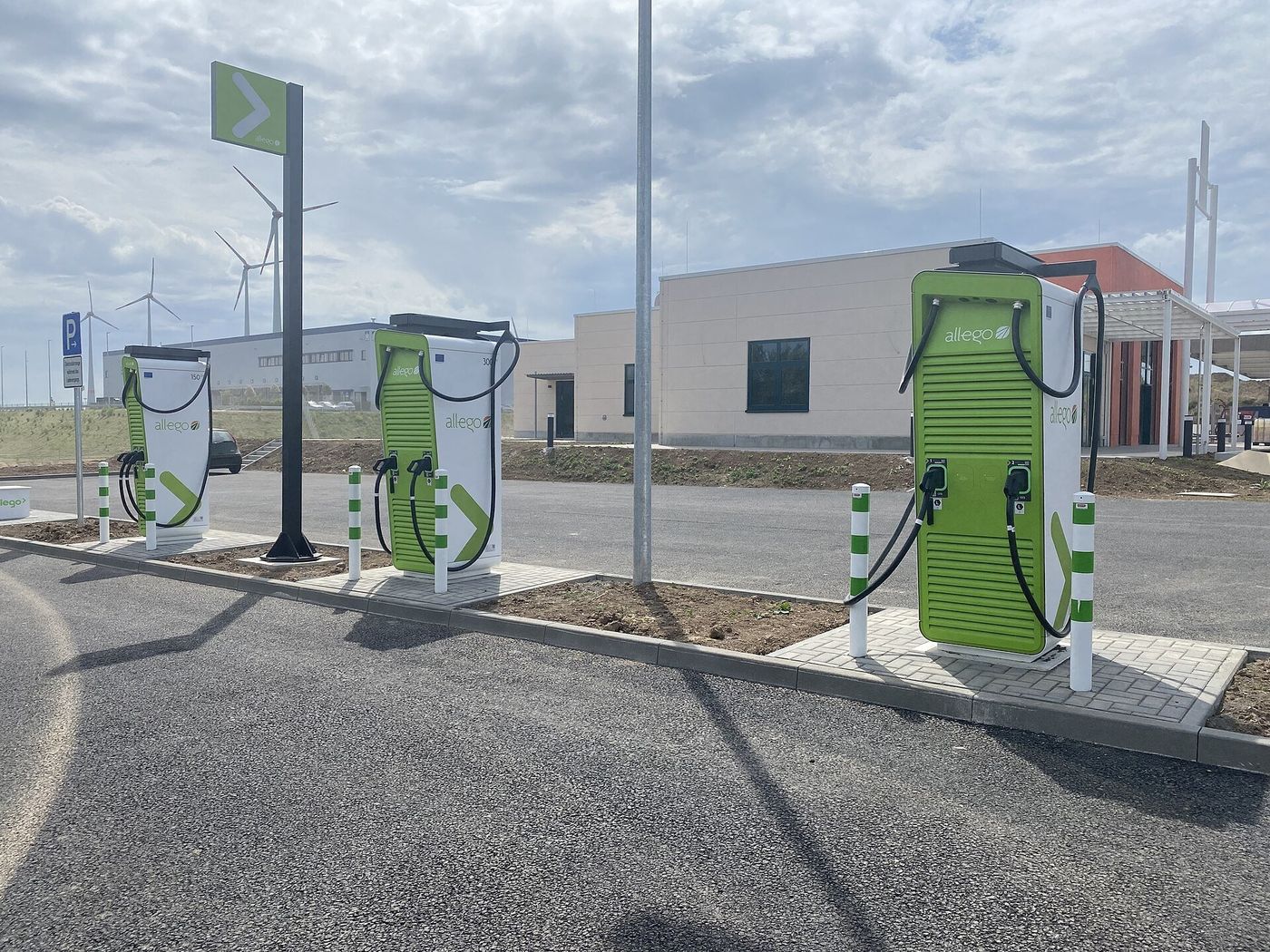
AFIR, the Alternative Fuels Infrastructure Regulation, is Regulation (EU) 2023/1804 of 13 September 2023 “on the deployment of alternative fuels infrastructure, and repealing Directive 2014/94/EU”; it “shall apply from 13 April 2024”. For heavy-duty electric vehicles, its Article 4(1) sets eight targets — four along the TEN-T road network, two in safe and secure parking areas and two in urban nodes — falling due on 31 December 2025, 31 December 2027 and 31 December 2030.
The Regulation is “binding in its entirety and directly applicable in all Member States” (Article 26), and Article 25(1) repeals Directive 2014/94/EU “with effect from 13 April 2024”. Articles 2, 4, 14, 15, 17 and 24 to 26, the ones read here, are unchanged in the consolidated text of 8 January 2026. This page goes through Article 4, recharging for heavy-duty vehicles, paragraph by paragraph; hydrogen refuelling stations have their own targets in Article 6, and LNG is on LNG and bio-LNG trucks. Where the Commission’s published questions and answers add a reading, the page says so.
The terms the targets are written in
Article 2(30) defines a “heavy-duty vehicle” as a vehicle of category M2, M3, N2 or N3 of Regulation (EU) 2018/858, so buses and coaches are inside the targets as well as trucks.
A recharging point (Article 2(48)) is “capable of recharging only one electric vehicle at a time”; a recharging station (Article 2(52)) is “a physical installation at a specific location, consisting of one or more recharging points”; a recharging pool (Article 2(51)) is “one or more recharging stations at a specific location”. “Power output” (Article 2(44)) is “the theoretical maximum power, expressed in kW”; for a pool, the Commission’s questions and answers say, the total is “the theoretical aggregated maximum power output of all recharging stations within that pool”. A point, station or pool is “dedicated to heavy-duty vehicles” (Article 2(50)) when it is intended for recharging them “either due to the specific design of the connectors/plugs or to the design of the parking space adjacent to the recharging point, station or pool, or both”.
Stations are “along the TEN-T road network” when “they are located on the TEN-T road network or within 3 km driving distance from the nearest exit of a TEN-T road” (Article 2(3)(a)). A “safe and secure parking area” (Article 2(63)) is “a parking area accessible to drivers engaged in the carriage of goods or passengers which has been certified in accordance with Commission Delegated Regulation (EU) 2022/1012”, a regulation that supplements Regulation (EC) No 561/2006 (see Driving time and rest rules). An “urban node” (Article 2(72)) is defined by reference to Article 3, point (p), of Regulation (EU) No 1315/2013; the Commission’s questions and answers, which name Regulation (EU) 2024/1679 as “the TEN-T Regulation”, say the targets apply “to all urban nodes identified in the TEN-T Regulation in force at the time of application of the respective target”.
Article 4(1): eight targets, three places
Article 4 is headed “Targets for recharging infrastructure dedicated to heavy-duty electric vehicles”. Paragraph 1 opens: “Member States shall ensure a minimum coverage of publicly accessible recharging points dedicated to heavy-duty electric vehicles in their territory.” The addressee is the Member State. The eight points are:
| Point | Due | Where | What each pool, area or node must have |
|---|---|---|---|
| (a) | 31 December 2025 | Along at least 15% of the length of the TEN-T road network; pools in each direction of travel | Power output of at least 1,400 kW, including at least one recharging point with an individual power output of at least 350 kW |
| (b)(i) | 31 December 2027 | Along at least 50% of the length of the TEN-T road network, pools in each direction of travel — along the core network | At least 2,800 kW, including at least two points with an individual power output of at least 350 kW |
| (b)(ii) | 31 December 2027 | The same 50% — along the comprehensive network | At least 1,400 kW, including at least one point with an individual power output of at least 350 kW |
| (c) | 31 December 2030 | The core network; pools in each direction of travel at most 60 km apart | At least 3,600 kW, including at least two points with an individual power output of at least 350 kW |
| (d) | 31 December 2030 | The comprehensive network; pools in each direction of travel at most 100 km apart | At least 1,500 kW, including at least one point with an individual power output of at least 350 kW |
| (e) | 31 December 2027 | Each safe and secure parking area | At least two publicly accessible recharging stations dedicated to heavy-duty electric vehicles, each with an individual power output of at least 100 kW |
| (f) | 31 December 2030 | Each safe and secure parking area | At least four such stations, each with an individual power output of at least 100 kW |
| (g) | 31 December 2025 | Each urban node | Publicly accessible recharging points with an aggregated power output of at least 900 kW, provided by stations with an individual power output of at least 150 kW |
| (h) | 31 December 2030 | Each urban node | The same, with an aggregated power output of at least 1,800 kW |
Points (a) to (d) are written in pools, with a total output and a number of points; points (e) and (f) in stations; points (g) and (h) in aggregated power output.
Recital 18 names the design: “distance-based targets along the TEN-T network”, “targets for overnight recharging infrastructure” and “targets at urban nodes”. Recital 19 says the infrastructure “should have sufficient power output for heavy-duty vehicles to be recharged within the driver’s legal break time” (the break rules are on Driving time and rest rules) and “should be deployed progressively from 2025 with a view to covering the entire TEN-T network by 2030”.
Safe and secure parking areas: points (e) and (f)
Points (e) and (f) set a number of stations and a power figure for each station: at least two stations of at least 100 kW each by 31 December 2027 and at least four by 31 December 2030, in each safe and secure parking area. Unlike points (a) to (d), they contain no total power output and no distance.
Asked whether “stations” instead of “points” in point (e) was intentional, the Commission’s questions and answers say: “The article clearly refers to stations. There is no indication in the legal text that this wording was not intentional.” They add that “the minimum power output is determined by the power output of recharging stations, rather than by the power output of recharging points”. On access, they say safe and secure parking areas “are therefore considered publicly accessible, irrespective of any requirement to book in advance or to identify at the gate”.
The same infrastructure can count towards more than one target “provided that it meets all the relevant requirements for each of the targets”. The Commission’s example is a pool in a safe and secure parking area along the core network in 2027: it can contribute to points (b) and (e) “provided that it offers a power output of at least 2,800 kW and it includes at least two recharging points with an individual power output of at least 350 kW”. Recital 23 adds that “heavy-duty electric vehicles should also be able to use publicly accessible recharging infrastructure for overnight recharging along the main transport network to specifically support the electrification of the long-haul sector”.
Urban nodes: points (g) and (h)
Points (g) and (h) ask for recharging points in each urban node with an aggregated power output of at least 900 kW by 31 December 2025 and at least 1,800 kW by 31 December 2030, “provided by recharging stations with an individual power output of at least 150 kW”. The requirement is a total plus a floor for each station; the text sets no number of stations or points and no distance. Recital 23 gives the purpose: the infrastructure “is necessary in particular for providing charging opportunities for delivery trucks and for destination charging for long-haul trucks”.
A pool that lies both along the TEN-T road network and in an urban node and meets the relevant requirements “can be counted towards the targets for both the TEN-T road network and the target for urban nodes”, according to the Commission’s answers. Asked whether such a pool has to provide twice the minimum required output, the Commission answered “No.” Buses count as heavy-duty vehicles; the urban-node figures and the Annex II provisions for electric buses are on City bus propulsion.
How the percentages and distances are counted
The 2025 and 2027 targets are percentages of network length. Article 4(2) sets the calculation: the denominator is “the total length of the TEN-T road network within the territory of the Member State”; the numerator is the cumulated length of the sections between two qualifying pools, “excluding any sections of the TEN-T road network between two of those recharging pools that are more than 120 km apart”. The 120 km is therefore an exclusion in the calculation. The distances that pools must keep, 60 km on the core network and 100 km on the comprehensive network, belong to points (c) and (d) and fall due on 31 December 2030.
The Commission’s questions and answers give five readings of what counts and how:
- Whole network. The percentage is “calculated based on the total length of the network, without distinction between core and comprehensive”. In the Commission’s example a network is 3,000 km, of which 1,000 km core and 2,000 km comprehensive, and “the target is met if 1,500 km of the network comply with the relevant requirements, irrespective of whether they are part of the core or comprehensive network”.
- Both directions. “The length of the network in both directions of travel should be used for both the numerator and the denominator (E.g. a TEN-T road with a length of 100 km in each direction would count as 200 km).”
- Completed sections. The targets “shall only apply to those parts of the TEN-T network that have been completed”.
- The exit. The driving distance between a pool and the nearest exit of the TEN-T road network “is part of the distance between two recharging or refuelling stations, and therefore has to be taken into account”.
- Light-duty infrastructure. Infrastructure dedicated to light-duty vehicles “cannot be counted for the HDV targets, and vice-versa”; where the same infrastructure effectively serves both categories, “Member States can decide for which target (LDV or HDV) it is counted”, but “the Member State cannot count the infrastructure for both targets”.
Article 4(3) lets a single pool serve both directions of travel along the TEN-T road network provided that it is easily accessible from both directions, adequately signposted, and meets the single-direction requirements for distance, total power output, number of points and power output of single points “for both directions of travel”. It sets no traffic threshold. Paragraph 4, below, has one, and its text asks that the requirements “applicable for a single direction of travel” be complied with, without the words “for both directions of travel”.
Derogations and cross-border sections: Article 4(4) to 4(9)
Paragraphs 4 and 5 apply along TEN-T roads with a total annual average daily traffic of fewer than 2,000 heavy-duty vehicles, and only where the deployment of infrastructure “cannot be justified in socio-economic cost-benefit terms”. The Commission’s answers say: “Both conditions need to be met in order for the derogation to be applied. It is up to the Member State wishing to apply this derogation to demonstrate that both conditions are met.”
- Under paragraph 4 a Member State “may provide” that one pool serves both directions of travel, if the single-direction requirements are complied with and the pool is easily accessible from both directions and adequately signposted.
- Under paragraph 5 it “may reduce by up to 50 %” the total power output of a pool, provided the pool serves only one direction and the other requirements — maximum distance, number of points and power output of single points — are complied with. The reduction reaches total power output only.
For both, Member States “shall notify the Commission of any cases in which they have made use of the derogation” and “shall review those cases every two years as part of the national progress reporting referred to in Article 15”.
Paragraphs 6 and 7 concern the core network and the 60 km of point (c) only. Along core-network roads with a total annual average daily traffic of fewer than 800 heavy-duty vehicles, Member States “may allow a longer distance, of up to 100 km”, “provided that the distance between recharging pools is adequately signposted”; the same notification and two-year review apply. Once a Member State has notified such a case, the maximum-distance requirement of point (c) “shall be deemed to have been complied with” (paragraph 7). Unlike paragraphs 4 and 5, paragraph 6 as worded has no cost-benefit condition.
Paragraph 8 concerns Cyprus alone. Cyprus “may submit to the Commission a reasoned request for authorisation” to apply lower requirements for the total power output of pools, or a longer maximum distance of up to 100 km, or both, “provided that such request, if authorised, would not impede the circulation of heavy-duty electric vehicles in that Member State”. The Commission must, “within six months of receipt of a reasoned request”, “adopt a decision as justified in each case”, and an authorisation “shall be valid for a maximum of four years”. Recital 25 gives the reason: heavy-duty recharging needs in Cyprus “will mostly be covered by overnight recharging capacities in private locations, such as depots”.
Paragraph 9 covers cross-border sections. By 31 December 2030 neighbouring Member States “shall ensure” that the maximum distances of points (c) and (d) “are not exceeded for cross-border sections of the TEN-T core road network and TEN-T comprehensive road network”; before that date they “shall make all possible efforts to respect those maximum distances”.
350 kW, and the connector question
The figure Article 4(1) attaches to an individual recharging point is 350 kW, in points (a) to (d); points (e) to (h) attach 100 kW and 150 kW to stations. On our reading no target in Article 4(1) asks for more than 350 kW from any one recharging point. Asked whether the 350 kW requirement could be met “through a recharging point with a higher power output, e.g. a megawatt charging system with individual power output of 1MW”, the Commission’s questions and answers say “Yes”, and give the rule: “When the AFIR requires a minimum number of recharging points, each with a minimum individual power output, this requirement can be met with the same number of recharging points, each one providing the minimum individual power output required or a higher individual power output.” Recital 22 says new standards for heavy-duty recharging “are currently being developed”.
The connector is in Annex II. In the 2023 text point 1.6 was a heading only: “Technical specifications regarding the connector for recharging heavy-duty electric vehicles (DC charging).” Delegated Regulation (EU) 2025/656 of 2 April 2025 replaced it; the act “shall apply from 8 January 2026”. The new point 1.6, headed “High-power recharging points for heavy-duty electric vehicles”, reads: “Direct current (DC) high-power recharging points for recharging infrastructure capable of supplying electricity to both light- and heavy-duty electric vehicles shall be equipped, for interoperability purposes, at least with vehicle connectors of the combined charging system ‘Combo 2’ for Mode 4 recharging as described in standard EN IEC 62196-3:2022.”
Recital 14 of the same act gives the reason and the limit. “Pending adoption of the relevant final standards containing the technical specifications for the megawatt charging system (MCS)”, it says, “it is necessary to ensure the interoperability of recharging infrastructure capable of supplying electricity to both light-duty and heavy-duty electric vehicles”; and “that standard should not apply to recharging infrastructure dedicated exclusively to heavy-duty vehicles and equipped solely with the MCS, as the relevant technical specifications will be introduced in Regulation (EU) 2023/1804 once the standardisation work for the MCS is completed.”
In its Communication of 27 May 2025 (COM(2025) 260 final) the Commission wrote that “At least in the short and medium terms, both the CCS and the MCS are widely expected to coexist as standards for the recharging of battery electric vehicles” (CCS being, in the Communication’s words, “the combined charging standard”), and that “It remains to be seen if the sector will converge towards the MCS for all recharging in the future.” What MCS is, and what makers state for their trucks, is on Megawatt Charging System.
What Article 4 leaves out
Every target in Article 4(1) is for publicly accessible infrastructure. Private depots and logistics centres appear in recital 27, which says such infrastructure “is equally important in private locations that are not accessible to public, such as in private depots and at logistics centres to ensure overnight and destination charging”, and that public authorities “should consider taking measures in the context of setting up their revised national policy frameworks to ensure that appropriate infrastructure is provided for overnight and destination charging for heavy-duty electric vehicles”. In the operative text, each national policy framework has to contain “measures, planned or adopted, to encourage and facilitate the deployment of recharging stations for light-duty and heavy-duty vehicles in private locations that are not accessible to the public” (Article 14(2)(e)).
On the grid, the Commission’s questions and answers say: “The AFIR does not require a specific connected or contracted grid capacity in relation to the aggregated power output of the recharging stations.” And: “It does not require that the recharging points or stations must be able to provide their maximum rated power at every moment in time or for a specific period.” The Commission’s Communication of 27 May 2025 names grid access as the main obstacle: “both the support study and stakeholder consultations indicate that the primary barrier to deploying a widespread charging network for heavy-duty vehicles is access to the electricity grid, not the cost of deploying the recharging infrastructure”.
Reporting: national frameworks and progress reports
Each Member State was to “draft its final national policy framework in an easily readable and understandable form and notify it to the Commission” by 31 December 2025 (Article 14(11)). By 31 December 2027 and every two years thereafter it submits “a standalone national progress report on the implementation of its national policy framework” (Article 15(1)) — the reporting in which the derogation cases of paragraphs 4 to 6 are reviewed. Under Article 17(1), “By 31 December 2026, the Commission shall assess the national policy framework notified by Member States pursuant to Article 14(11)”.
Article 24: the 2025 readiness report and the 2026 review
Article 24(1) set 31 December 2024 for a Commission “technology and market-readiness report dedicated to heavy-duty vehicles”. The Commission’s Communication COM(2025) 260 final, dated Brussels, 27 May 2025, cites Article 24(1) in its introduction and says that “this report provides an analysis of the technology and market readiness of zero-emission heavy-duty vehicles”. It says of the targets: “Those targets are meant to provide only basic infrastructure along the EU’s main transport network, while additional infrastructure is expected to develop through market forces where additional demand exists.” And: “According to the analysis carried out under the support study, dedicated HDV recharging stations mandated should be sufficient to meet at least 47% of the total energy demand for publicly accessible recharging by the electric HDV fleet expected in 2030.” The support study is by Transport & Mobility Leuven, Ramboll and the University of Antwerp, and the Communication notes that “The exact share will be highly dependent on a number of factors, including the share of long-distance battery electric trucks, their driving patterns and the possibility of charging at the depot.” It is an estimate, not a measurement.
Article 24(2) sets the review: “By 31 December 2026 and every five years thereafter, the Commission shall review this Regulation.” The Commission is to assess “in particular” a list of elements, the first being “whether the traffic thresholds referred to in Article 3(6) and (7), in Article 4(4) and (5) and in Article 6(4) are still relevant in view of the expected increase of the share of hydrogen-powered vehicles or battery electric vehicles compared to the total fleet of vehicles circulating in the Union”. That list names Article 4(4) and (5); it does not name Article 4(6). The review is also to “identify any provisions that could be updated and simplified” and to include “an assessment of the burden this Regulation imposes on businesses”. Article 24(3) adds: “The Commission shall consider, if appropriate, whether to accompany that review with a proposal to amend this Regulation, in view of the outcome of the assessment referred to in paragraph 2.”
The Commission’s Have Your Say record for the initiative “Review of EU rules on alternative fuels infrastructure” (DG MOVE) shows a call for evidence open from 23 March to 20 April 2026 and a public consultation from 11 May to 3 August 2026. Its summary says the rules “must be reviewed by the end of 2026” and that the review “will address among others the appropriateness of the targets for road recharging and refuelling infrastructure”. As at 29 September 2026 the record lists a proposal as planned for the fourth quarter of 2026, from 1 October to 31 December 2026, with no publication date. This page does not describe what a proposal might contain.
A news item of the European Alternative Fuels Observatory dated 12 May 2026 says the consultation also considers “whether clearer minimum criteria are needed for a recharging point or pool to be classified as dedicated to heavy-duty vehicles, including requirements related to layout, dimensions and practical usability by trucks”, and that “A key focus of the review is whether the current AFIR targets are sufficient to ensure coherent infrastructure coverage across all EU regions.” That is the Observatory’s account of what the consultation asks, not a proposal.
Quick answers
- What is AFIR?
- AFIR, the Alternative Fuels Infrastructure Regulation, is Regulation (EU) 2023/1804 of 13 September 2023, which repealed Directive 2014/94/EU with effect from 13 April 2024; it 'shall apply from 13 April 2024' and is 'binding in its entirety and directly applicable in all Member States'. Its Article 4 sets the targets for publicly accessible recharging infrastructure dedicated to heavy-duty electric vehicles, a category (M2, M3, N2 and N3) that takes in buses and coaches as well as trucks. Articles 2, 4, 14, 15, 17 and 24 to 26 are unchanged in the consolidated text of 8 January 2026.
- What does AFIR require for electric truck charging along the TEN-T network?
- By 31 December 2025, publicly accessible recharging pools dedicated to heavy-duty electric vehicles along at least 15% of the length of the TEN-T road network, in each direction of travel, each pool with a power output of at least 1,400 kW and at least one recharging point of at least 350 kW. By 31 December 2027, the same along at least 50%: on the core network at least 2,800 kW and two such points per pool, on the comprehensive network at least 1,400 kW and one. By 31 December 2030, pools at most 60 km apart on the core network (at least 3,600 kW, two such points) and at most 100 km apart on the comprehensive network (at least 1,500 kW, one such point). According to the Commission's questions and answers the percentages are measured on the whole network, core and comprehensive together, and Article 4(2) leaves out any section between two qualifying pools that are more than 120 km apart.
- What does AFIR require at truck parking areas and in cities?
- In each safe and secure parking area, at least two publicly accessible recharging stations dedicated to heavy-duty electric vehicles by 31 December 2027 and at least four by 31 December 2030, each station with an individual power output of at least 100 kW (Article 4(1), points (e) and (f)). In each urban node, recharging points with an aggregated power output of at least 900 kW by 31 December 2025 and at least 1,800 kW by 31 December 2030, provided by stations with an individual power output of at least 150 kW (points (g) and (h)). A safe and secure parking area is one certified in accordance with Delegated Regulation (EU) 2022/1012 (Article 2(63)). The addressees are the Member States: 'Member States shall ensure'.
- Does AFIR require megawatt charging (MCS)?
- Article 4 does not: the figure it attaches to an individual recharging point is 350 kW, and on our reading no target in Article 4(1) asks for more from any one point. Asked whether a megawatt charging point of 1 MW could meet the 350 kW requirement, the Commission answered 'Yes.' Annex II point 1.6, as replaced by Delegated Regulation (EU) 2025/656 and applying from 8 January 2026, asks 'at least' Combo 2 connectors of DC high-power points that can supply both light- and heavy-duty electric vehicles; recital 14 of that act says the standard 'should not apply' to infrastructure dedicated exclusively to heavy-duty vehicles and equipped solely with the MCS, whose specifications 'will be introduced' once the standardisation work is completed.
- Can a Member State depart from the truck-charging targets?
- Within the limits of Article 4(4) to 4(8). Along TEN-T roads with a total annual average daily traffic of fewer than 2,000 heavy-duty vehicles, where deployment 'cannot be justified in socio-economic cost-benefit terms', a Member State may let one pool serve both directions of travel (paragraph 4) or reduce a one-direction pool's total power output by up to 50% (paragraph 5). On core-network roads with a total annual average daily traffic of fewer than 800 heavy-duty vehicles it may allow up to 100 km instead of 60 km between pools (paragraphs 6 and 7). Cyprus may ask the Commission to authorise lower total power output, a distance of up to 100 km, or both, for a maximum of four years (paragraph 8). Cases under paragraphs 4 to 6 must be notified to the Commission and reviewed every two years in the national progress reporting.
- Is AFIR being revised?
- A review is required by 31 December 2026; a proposal to amend is, as at 29 September 2026, only planned. Article 24(2) says 'By 31 December 2026 and every five years thereafter, the Commission shall review this Regulation', and Article 24(3) makes an accompanying proposal a matter for the Commission to consider 'if appropriate'. The Commission's Have Your Say record shows a public consultation from 11 May to 3 August 2026 and a proposal planned for the fourth quarter of 2026 with no publication date. Its summary says the review will address 'among others the appropriateness of the targets for road recharging and refuelling infrastructure'.
Sources
- Regulation (EU) 2023/1804 on the deployment of alternative fuels infrastructure (AFIR), OJ L 234, 22.9.2023 — Articles 2, 4, 14, 15, 17, 24, 25 and 26, recitals 18, 19, 22, 23, 25 and 27, Annex II (Articles 2, 4, 14, 15, 17 and 24–26 unchanged in the consolidated text of 8 January 2026) — EUR-Lex, Publications Office of the European Union
- Regulation (EU) 2023/1804 — consolidated text of 8 January 2026 (Annex II point 1.6 as replaced by Delegated Regulation (EU) 2025/656) — EUR-Lex, Publications Office of the European Union
- Commission Delegated Regulation (EU) 2025/656 of 2 April 2025 amending Regulation (EU) 2023/1804 as regards standards for wireless recharging, electric road system, vehicle-to-grid communication and hydrogen supply for road transport vehicles — recital 14, Article 2 and Annex point (3) — EUR-Lex, Publications Office of the European Union
- Questions and answers on the regulation on the deployment of alternative fuels infrastructure (EU 2023/1804) — European Commission — Mobility and Transport
- Communication on the technological and market readiness of heavy-duty road transport vehicles, COM(2025) 260 final, 27 May 2025 — European Commission (EUR-Lex)
- Review of EU rules on alternative fuels infrastructure (initiative 16672: call for evidence, public consultation, planned proposal) — European Commission — Have Your Say
- AFIR review: shaping Europe's alternative fuels network (12 May 2026) — European Alternative Fuels Observatory (European Commission)