Depot charging for electric trucks: power, grid connection and lead times
What charging power a truck depot uses, what a grid connection involves and how long extending one takes in Germany, from NOW's depot guides, Scania and the AFIR text.
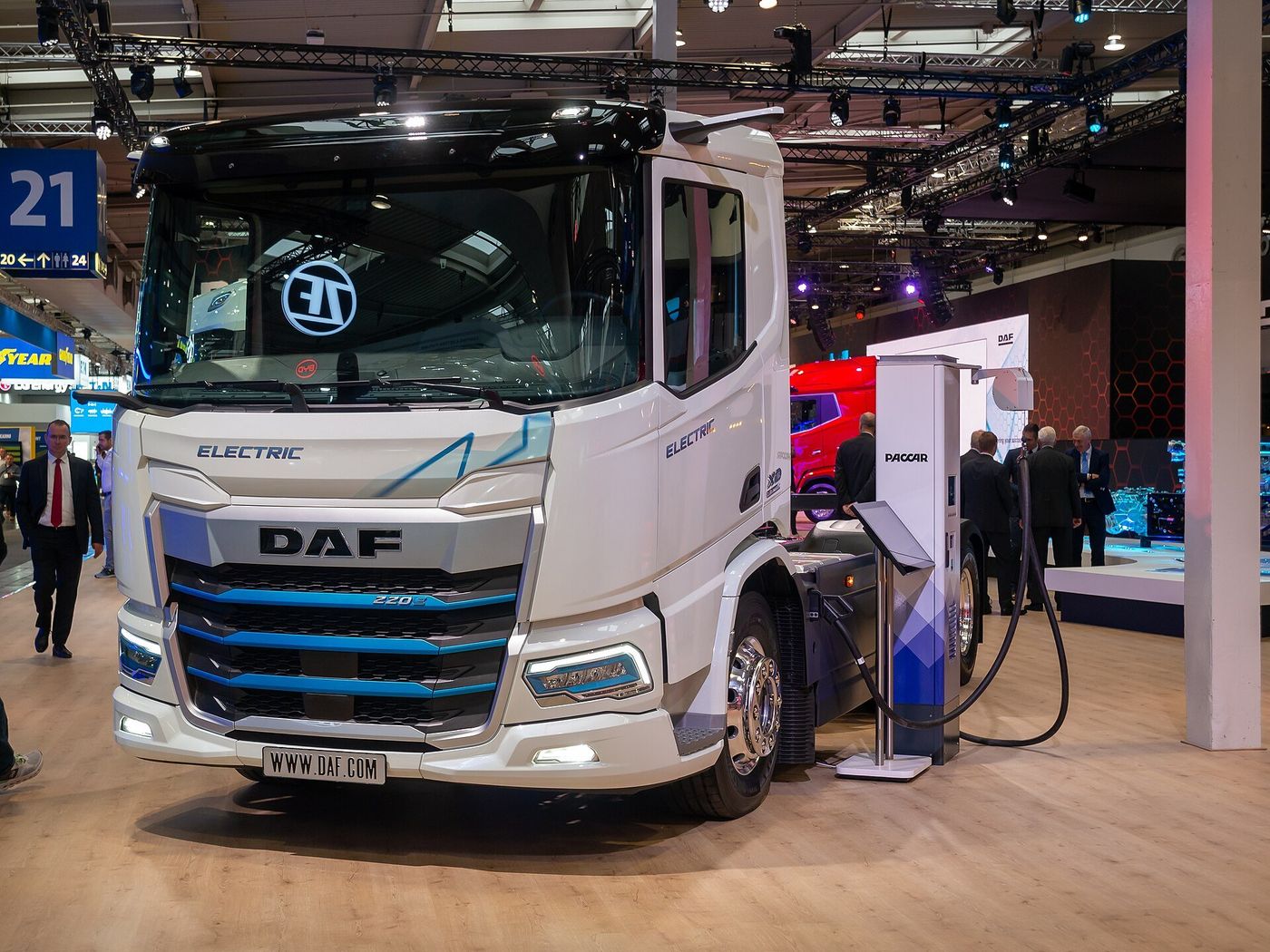
In the November 2023 depot guide of Germany’s Nationale Leitstelle Ladeinfrastruktur (National Centre for Charging Infrastructure, under NOW GmbH), up to 22 kW of charging power is sufficient for a truck with more than 8 hours in a row to charge that needs no more than 100 kWh a day, and at least 300 kW is necessary for a truck with less than 2 hours in a row that needs more than 400 kWh a day. Charging power also depends on the depot’s chargers and grid connection, and the same guide gives the time to extend a grid connection in Germany as, in practice, 3–6 months at low voltage, 6–12 months at medium voltage where grid capacity is available (6–24 months in a footnote that names no such condition) and 8–10 years at high voltage.
The Leitstelle’s news item of 21 September 2022 describes it as coordinating and steering, on behalf of the federal transport ministry (BMDV) and under the roof of the federally owned NOW GmbH, the activities to expand charging infrastructure in Germany. Two NOW documents carry most of this page. The first is the guide Einfach laden am Depot (Easy charging at the depot), dated 11/2023 and announced by the Leitstelle on 16 November 2023. It was prepared by the Leitstelle and the team Klimafreundliche Nutzfahrzeuge (climate-friendly commercial vehicles) of NOW GmbH, on behalf of the Federal Ministry for Digital and Transport (BMDV) as the guide prints the name, in cooperation with hySOLUTIONS GmbH. It covers charging infrastructure for heavy battery-electric commercial vehicles (N3 under the EC vehicle classes) at the operating yard (Betriebshof), and says its presentations, notes and tips rest on the findings of a task force on depot charging (Task-Force Depotladen), carried out in 2022 by the BMDV, NOW GmbH and the Leitstelle. The second document is the short guide (Kurzanleitung) Lkw-Ladeinfrastruktur im Depot of May 2026, which lists the 2023 guide as the detailed guide (Ausführlicher Leitfaden).
The NOW documents are in German. What this page reports from them is our translation, with the German term in brackets where it matters, and every NOW time and voltage figure below is for Germany. This page gives no costs, incentives or break-even figures; the running-cost lines of a tractor unit are the subject of What it costs to run a tractor unit.
Where depot charging sits among truck charging locations
On 21 September 2022 the Leitstelle published its study “Einfach Laden an Rastanlagen” (Easy charging at rest areas), carried out for it by the Energiedenkfabrik ef.Ruhr, on the grid connection of charging hubs for electric trucks. The same news item presents a new overview of what it calls 7 typical charging locations or scenarios for heavy battery-electric commercial vehicles. In non-public space they are company-owned premises, third-party company premises and depots, and mobile charging points; in public space they are charging hubs in commercial areas, charging hubs on traffic axes for overnight charging and longer breaks, and charging hubs on traffic axes for intermediate charging and driver breaks. Charging at transshipment points takes place in both public and non-public space.
Regulation (EU) 2023/1804 (AFIR), of 13 September 2023 and published in the Official Journal on 22 September 2023, mentions depots in a recital, and its provision on national planning covers private locations that are not accessible to the public. Recital 27 says: “The deployment of recharging infrastructure for heavy-duty electric vehicles is equally important in private locations that are not accessible to public, such as in private depots and at logistics centres to ensure overnight and destination charging.” It adds that public authorities “should consider taking measures” in the context of setting up their revised national policy frameworks to ensure that appropriate infrastructure is provided for overnight and destination charging for heavy-duty electric vehicles. Article 14(1) has each Member State prepare and transmit to the Commission a draft national policy framework “By 31 December 2024”, and Article 14(2)(e) lists, among the elements the framework “shall contain at least”, “measures, planned or adopted, to encourage and facilitate the deployment of recharging stations for light-duty and heavy-duty vehicles in private locations that are not accessible to the public”. On our reading, neither passage sets a number of depot charging points; the numerical targets of Article 4 concern publicly accessible pools and are set out in the megawatt charging explainer.
That explainer also covers the Megawatt Charging System (MCS). NOW’s guide of November 2023 records an assumption of its time: it was currently assumed that megawatt charging, because of the high costs and the high grid connection power needed, would not take place at operating depots but would be used mainly in public charging on long-distance routes and at traffic hubs, and, as it focuses on depots, the guide does not consider that power class further. Scania’s page, which carries no date, says CCS2 “remains highly suitable for depot and destination charging, especially where charging can happen overnight or during loading and unloading”, and that “Scania’s BEVs can be fitted with both connectors, depending on the application.”
Charging power classes at a depot
NOW’s guide sorts charging power into classes. It says that charging at 150 kW or more is also called high-power charging (Hochleistungsladen), while its Table 1 and its scenario IV use the term Hochgeschwindigkeitsladen (high-speed charging); the May 2026 short guide uses Hochleistungsladen. Table 1 also gives charging times for 100 kWh and for 400 kWh of energy at the maximum charging power, on the assumption, stated in a footnote, that the charging power stays constant over the whole charge.
| Class | Power, guide of 11/2023 | Power, short guide of May 2026 | Time for 100 kWh, Table 1 | Time for 400 kWh, Table 1 |
|---|---|---|---|---|
| Normal charging (Normalladen) | up to 22 kW | up to 22 kW | 4.5–5 h | more than 18 h |
| Fast charging (Schnellladen) | more than 22 kW to less than 150 kW | 22–150 kW | about 1 h | 2–3 h |
| High-power charging (Hochleistungsladen) | 150 kW or more | from 150 kW | about 30 min at a charging power of 350 kW | about 1.5 h at a charging power of 350 kW |
For the top class the guide says that charging takes place only with direct current (DC) and over a charging cable with a CCS plug that may have to be cooled, that in practice charging powers of around 400 kW are currently reached, and that in individual trials charging at up to 750 kW takes place. A footnote adds that about 400 kW is a common figure for high-speed charging and that higher speeds are theoretically possible but still rarely in use. These are statements of November 2023. Scania says on its megawatt charging page that today’s battery electric trucks use CCS2, “typically delivering up to 350–400 kW”, and that this “is sufficient for overnight depot or destination charging, as well as for en-route top-ups”.
According to the guide, normal charging can use an AC or a DC charger, with a Type 2 plug for AC and a Combo 2 plug, also called a CCS plug, for DC; fast charging is usually DC through a CCS plug. It says that for commercial vehicles a charger with a rectifier is used in most cases, because of the higher power requirements, and that fast charging with AC above 22 kW is theoretically possible but very rarely used in practice: AC charging power is limited to 43 kW, so this type of charging rarely adds value, especially in electric heavy-duty transport. Its example of power and energy: at 200 kW charging power, 200 kWh of energy can be provided in 1 hour.
The guide says the charging power depends on the maximum power of the electrical infrastructure at the yard (charger and grid connection) and on further factors: the state of charge of the battery, the vehicle’s maximum charging power and the outside temperature. The maximum power at which a charge can take place is set by the technical prerequisites of the truck. The charging powers the makers state for their own trucks are listed in the electric trucks explainer, and the published CCS2 charging windows of one truck, at up to 400 kW, are set out on the eActros 600 page.
How much power a depot needs: NOW’s four scenarios
The guide sorts the daily use of a truck into four scenarios by two parameters, the charging window per day and the energy needed for the day’s use, and gives a charging power for each. It says the scenarios derive from discussions with logistics companies and trade associations and, because of the vehicle models and ranges available at the time, relate to distribution and regional transport.
| Scenario | Charging window per day | Energy needed for the day’s use | Charging power |
|---|---|---|---|
| I | more than 8 hours in a row | no more than 100 kWh | up to 22 kW is sufficient (normal charging) |
| II | more than 8 hours in a row | more than 400 kWh | up to 50 kW is sufficient (fast charging) |
| III | less than 2 hours in a row | less than 100 kWh | at least 75 kW is necessary (fast charging) |
| IV | less than 2 hours in a row | more than 400 kWh | at least 300 kW is necessary (high-speed charging, HPC) |
A footnote to the figure gives the premises: as a rule it is assumed that a charging option is available for each electric commercial vehicle, and that the vehicles will not fall below a state of charge of 15 percent at the end of their use. The guide adds that the classification cannot represent all use cases.
The May 2026 short guide puts the principle in general terms: the charging power needed is determined from the available standing times and the energy to be recharged; long standing times, for example overnight, allow lower charging powers, and short breaks require higher ones. Its example is an electric tractor unit (Sattelzugmaschine) with a 500 kWh battery and 450 km range, which it says charges at 400 kW in about 1 hour from 5 to 90 percent, or, at 50 kW overnight, in around 8 hours.
Where a load and charge management system is present, the guide assumes a concurrency factor (Gleichzeitigkeitsfaktor) when calculating the total charging power of the yard. A factor of 1 means that all consumers on the yard, for example charging points, are used at full power at the same time. The guide says this is not to be assumed as the normal case, that the factor usually falls as the number of charging points rises, and that it is to be determined individually for each yard.
What a grid connection involves
The guide defines the grid connection (Netzanschluss) as the handover point between the public electricity grid and the customer installation (Kundenanlage) on a private plot such as an operating yard; the yard is supplied through it with the contractually agreed connection capacity (vertraglich vereinbarte Anschlussleistung). It divides the German public grid into 4 voltage levels. The fourth, extra-high voltage, serves only to transport electricity; the other three are in its Table 2.
| Voltage level | Nominal voltage | Connection, as the guide words it |
|---|---|---|
| Low voltage (Niederspannung) | 230–400 V | cable house connection, connection to a distribution cabinet |
| Medium voltage (Mittelspannung) | 1–35 kV | transformer substation (Umspann- bzw. Trafostation), connection to the busbar of a substation |
| High voltage (Hochspannung) | 60–150 kV | individual determination |
For energy-intensive consumers such as logistics depots, the guide says, the grid connection is as a rule at the medium-voltage level (nominal voltage 1–35 kV); for especially energy-intensive consumers a connection at the high-voltage level is installed. Elsewhere it says that larger logistics companies as a rule have a connection at least at medium voltage. For use on the yard the voltage is transformed by a transformer station to a level of usually 400 V (low voltage). When a grid connection is extended, the guide says, a transformer station usually has to be built, and as a rule the station passes into the ownership of the client.
If the connection capacity is not enough, the guide names two options for the company. The contractually agreed capacity can be raised, provided the existing connection is technically designed for a capacity increase at the same voltage level or can be upgraded; or a connection at a higher voltage level may be needed. The extension is to be applied for with the responsible distribution system operator (Verteilnetzbetreiber), and the guide says it is as a rule linked to construction measures, costs and time. For raising the connection capacity, the May 2026 short guide says that in practice these steps are usually needed: approach the grid operator, clarify the grid connection technically, agree costs, and plan the details, have them approved and implement them.
Unlike with the electricity supplier, the guide says, there is only one responsible grid operator per region, so the distribution system operator cannot be changed, and as a quasi-monopoly it is subject to the regulations of the Bundesnetzagentur (the federal network agency). The network operator’s area of responsibility, it says, generally extends to the handover point at the yard, and the company is responsible for all further construction measures on its own areas.
This page reports only the structure of the connection costs, not amounts. According to the guide, the grid connection costs are set by the responsible network operator and depend substantially on the voltage level chosen and on the total power applied for. The connecting party bears the resulting costs in the form of a construction cost contribution (Baukostenzuschuss), which is paid to the distribution system operator as a share in the cost of the work commissioned. According to the guide, grid connections up to 30 kW are as a rule exempt from it, and a grid connection that is not fully used, possibly oversized, raises the contribution, which depends on the contractually agreed electrical power. The guide also says that extending a grid connection several times in short intervals brings very high costs and long lead times.
How long it takes
The guide gives lead times for extending a grid connection in Germany in two places: in the main text of its step 2, on extending the connection, and in a footnote to the passage saying that such an extension is as a rule linked to construction measures, costs and time.
| Voltage level | Main text of the guide | Footnote 18 of the guide |
|---|---|---|
| Low voltage (230–400 V) | 3–6 months, as a rule (in der Regel) | 3–6 months |
| Medium voltage (1–35 kV) | 6–12 months, where grid capacity is available (bei vorhandener Netzkapazität) | 6–24 months |
| High voltage (60–150 kV) | 8–10 years | 8–10 years |
The main-text sentence opens with “In der Praxis” (in practice), adds “in der Regel” (as a rule) for low voltage, and gives its medium-voltage figure with the condition of available grid capacity. The footnote says that, depending on the voltage level, the following implementation periods (Umsetzungszeiträume) are to be expected. The guide gives these times for extensions of a grid connection; it does not give them as the time of a whole depot project or of the delivery of chargers. For medium voltage it gives two values in two places, 6–12 months in the main text with the capacity condition and 6–24 months in the footnote with none. The guide does not explain the difference, and this page does not supply an explanation.
Other times in the guide belong to other things. The step of applying for the extension of the grid connection, which the guide places in its step 4, on organising the construction work, under approvals (Genehmigungen), can take several months depending on the complexity of the local circumstances, the grid connection power to be applied for and the order load at the network operator concerned. It says the charging hardware should be ordered shortly after the application for the grid extension, and that delivery times vary with the market situation and the product wanted, in some cases extending to more than 1 year. For the transformer station it says that, because of in some cases very long delivery times, its construction should follow directly after the application for the grid extension, and it gives no figure for that time.
The guide also says that network operators are legally obliged to expand grid capacity, so a rejection of an application will as a rule not occur; if the capacity in the existing grid is not enough for the power applied for, the network operator has to carry out expansion measures, which, depending on the resources of the operator concerned, can lead to a longer time for implementation. The guide also says that, given the number of different network operators in Germany, the handling of such requests can differ regionally.
The May 2026 short guide gives no month range. It says that, depending on the power requirement and regional circumstances, raising the grid connection capacity can take several months, and that charge points, transformers, cable routes and load-management components should be ordered in good time because long delivery times are often to be expected. It does not repeat the month ranges of the 2023 guide.
A 2022 document gives a different range for high voltage. The Leitstelle’s news item on the rest-area study says, in the context of building a needs-based charging network for battery-electric trucks on long routes, that for a connection to the high-voltage grid a lead time of 5–10 years must be taken into account. That is a different document, of 2022, and it is about the grid connection of a charging network for long routes, not about depots; this page sets it beside the 8–10 years of the 2023 guide and does not reconcile them. The item also says the study makes clear that at highly frequented locations a high-voltage connection becomes necessary from 2035 at the latest, and that the authors derive requirements for the grid connection from forecasts of how many charging points of what power are needed at 3 prototypical charging hubs in 2027, 2030 and 2035. The study itself could not be opened for this page; only the Leitstelle’s news item was read.
The IEA’s Global EV Outlook 2026, published on 20 May 2026, says in a passage that is mainly about electric buses that “grid connection delays remain a major bottleneck for electric bus deployment, especially for large depots with a high concentration of charging points”, and that in urban areas limited substation capacity, long permitting procedures and the need for network reinforcements “can delay charging depots by several years”. The passage names no figure for truck depots.
Peaks and load management
The guide puts intelligent control of the consumers on the yard first, so that the existing grid connection can be used optimally; only if the connection capacity is not enough despite load management does it turn to applying to the network operator for an increase. Its section on load peaks (Lastspitzen) says they should be avoided and explains it, for Germany, through the grid charge (Netzentgelt), which is made up of a work price (Arbeitspreis) and a capacity price (Leistungspreis): the higher the load peaks, the higher the grid charge, even if a peak occurs only once a year. The capacity price is independent of electricity consumption, covers the cost of providing the power at the site and is calculated from the maximum power drawn in the billing period, the load peak; even if that maximum occurred only once in the year, it is decisive.
A charge management system (Lademanagement) is, in the guide’s words, a software application that controls charging processes. Static load management follows the simple principle of distributing a fixed maximum power evenly across the available chargers; dynamic load management is marked by a permanent measurement of the power drawn at the grid connection.
The May 2026 short guide says that an intelligent load and charge management system distributes the power dynamically across the charge points, prioritises vehicles according to their operational requirements and can significantly reduce load peaks. It says the existing grid connection is on many yards mostly not fully used, so that free capacity can be used for charging at night, when operational electricity demand is low, without having to extend the connection; that is NOW’s assessment, and the brochure gives no data for it.
The IEA says that planning depot charging for electric bus and truck fleets requires an integrated approach, combining route profiling, battery sizing, charging strategies and the number of chargers installed. It continues: “Poorly optimised charging infrastructure can significantly increase peak power demand, raising costs and increasing grid connection timelines. In some cases, shifting part of the charging load to daytime or off-peak periods can reduce maximum depot power demand by up to 60%.” The passage gives no measurement behind the 60%.
What the sources leave open
- The NOW lead times are dated November 2023. The sources read for this page give no NOW month range dated later, and no primary source was opened for lead times in countries other than Germany.
- The rest-area study of 2022 could not be opened; only the Leitstelle’s news item is used.
- Scania’s page carries no date, so its 350–400 kW is an undated statement of the maker.
- This page describes no electrical design or installation, and it makes no sizing calculation for a fleet.
Quick answers
- How long does it take to extend a truck depot's grid connection in Germany?
- In NOW's November 2023 guide, extending a grid connection takes in practice 3–6 months at low voltage, 6–12 months at medium voltage where grid capacity is available and 8–10 years at high voltage; a footnote in the same guide gives 6–24 months for medium voltage and names no capacity condition. The guide does not explain the difference, and it gives these times for extending a grid connection in Germany, not for a whole depot project. NOW's short guide of May 2026 says only that raising the connection capacity can take several months, depending on the power requirement and regional circumstances.
- What charging power does an electric truck need at a depot?
- In NOW's four scenarios of November 2023, which relate to distribution and regional transport, up to 22 kW is sufficient with more than 8 hours in a row to charge and no more than 100 kWh needed a day, up to 50 kW with more than 8 hours and more than 400 kWh, at least 75 kW with less than 2 hours and less than 100 kWh, and at least 300 kW with less than 2 hours and more than 400 kWh. The guide assumes a charging option for each vehicle and that vehicles do not fall below 15 percent state of charge by the end of their use, and it says the scenarios cannot represent all use cases. Scania says that CCS2 on today's battery electric trucks typically delivers up to 350–400 kW.
- Which voltage level is a truck depot usually connected to?
- For energy-intensive consumers such as logistics depots, NOW's guide says the grid connection is as a rule at the medium-voltage level, with a nominal voltage of 1–35 kV; it gives low voltage as 230–400 V and high voltage as 60–150 kV, and its figures are for the German grid. It adds that especially energy-intensive consumers get a high-voltage connection, that larger logistics companies as a rule have a connection at least at medium voltage, and that a transformer station usually brings the voltage on the yard down to 400 V.
- Is megawatt charging used at truck depots?
- NOW's November 2023 guide assumed that megawatt charging would not take place at operating depots, because of the high costs and the high grid connection power needed, but mainly in public long-distance charging and at traffic hubs; it gives this as an assumption of that date. Scania's page says that CCS2, typically delivering up to 350–400 kW, is sufficient for overnight depot or destination charging, and that its battery electric trucks can be fitted with both connectors, depending on the application.
- Does AFIR require charging points at truck depots?
- On our reading, Regulation (EU) 2023/1804 sets no number of depot charging points: Article 14(1) has each Member State transmit a draft national policy framework to the Commission by 31 December 2024, and Article 14(2)(e) lists, among the elements the framework shall contain at least, 'measures, planned or adopted, to encourage and facilitate the deployment of recharging stations for light-duty and heavy-duty vehicles in private locations that are not accessible to the public'. Recital 27 names private depots and logistics centres and says public authorities 'should consider taking measures' to ensure that appropriate infrastructure is provided for overnight and destination charging for heavy-duty electric vehicles.
- Why does load management matter at a depot?
- The IEA says that in some cases shifting part of the charging load to daytime or off-peak periods can reduce maximum depot power demand by up to 60%, in a passage on planning depot charging for bus and truck fleets. In NOW's guide the German grid charge rises with the load peaks, even when a peak occurs only once a year, and the capacity charge (Leistungspreis) is calculated from the maximum power drawn in the billing period. The guide puts intelligent control of the consumers on the yard first, so that the existing grid connection is used optimally.
Sources
- Einfach laden am Depot — Leitfaden für den Aufbau von Ladeinfrastruktur für schwere Nutzfahrzeuge (Erscheinungsdatum 11/2023) — Nationale Leitstelle Ladeinfrastruktur, NOW GmbH, for the Federal Ministry for Digital and Transport (BMDV)
- Leitfaden Einfach laden am Depot veröffentlicht (16 November 2023) — Nationale Leitstelle Ladeinfrastruktur (NOW GmbH), 16 Nov 2023
- Lkw-Ladeinfrastruktur im Depot — Kurzanleitung zum Aufbau der Ladeinfrastruktur für batterieelektrische Lkw (May 2026) — NOW GmbH — Nationale Leitstelle Ladeinfrastruktur
- Studie Einfach Laden an Rastanlagen — grid connections for truck charging hubs (21 September 2022) — Nationale Leitstelle Ladeinfrastruktur (NOW GmbH), 21 Sept 2022
- Megawatt charging — all you need to know about MCS — Scania Group
- Regulation (EU) 2023/1804 on the deployment of alternative fuels infrastructure (AFIR) — recital 27 and Article 14, OJ L 234, 22.9.2023 — Publications Office of the European Union, 22 Sept 2023
- Global EV Outlook 2026 — Electric vehicle charging (published 20 May 2026) — International Energy Agency (IEA), 20 May 2026