BMC
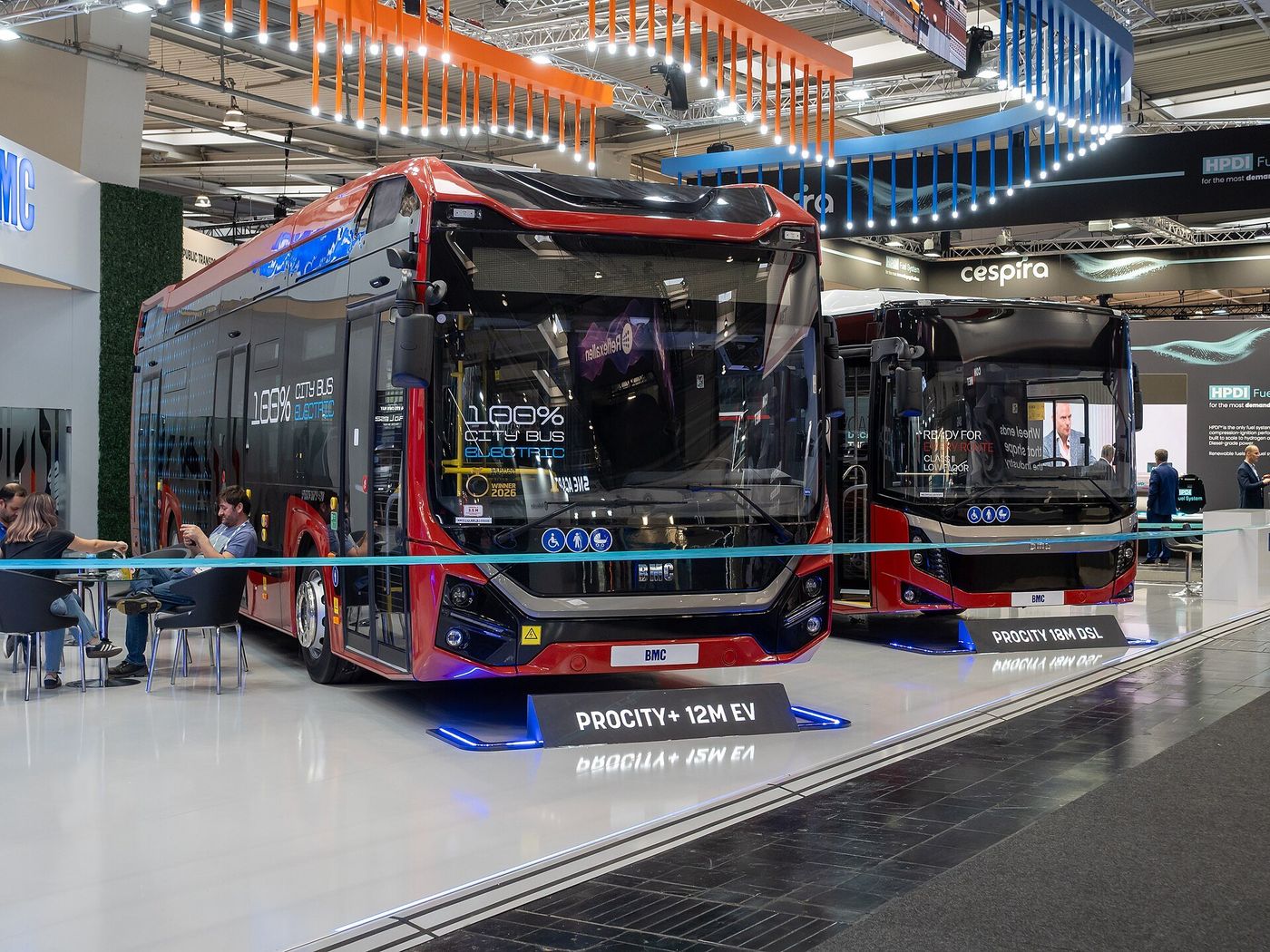
BMC Procity+ Electric
What BMC's technical page gives for the 12-metre and 18-metre Procity+ electric buses: VEM motor, NMC and LFP batteries, CCS2 and pantograph charging, dimensions, capacity.
- 12.09 m

Model overview
- Segment
- Bus
- Battery capacity
- 362–434.4 kWh
- Electric motor
- 180 kW peak
- Length
- 12 090 mm
- Wheelbase
- 5 850 mm
- Capacity
- 31 + 31
The Procity+ Electric is the electric version of BMC’s Procity urban bus. BMC’s Procity technical-specifications page lists it in two lengths, 12 m and 18 m, and BMC’s own news items name the buses “PROCITY+ 12M EV” and “PROCITY+ 18M EV”. The figures below are those of the two electric tabs of that page, not of the diesel and CNG tabs beside them. BMC’s page carries no date; it was read on 29 September 2026. Where the two lengths differ, each figure says which length it belongs to.
Overview and exhibitions
BMC describes the Procity urban bus family as offered in diesel, CNG and EV options in 10.7 m, 12 m and 18 m sizes. The electric tabs are headed “+12 METER ELECTRIC” and “+18 METER ELECTRIC” on the English page and “+12 METRE ELEKTRİKLİ” and “+18 METRE ELEKTRİKLİ” on the Turkish one. For the drives a city bus can have and the EU rules around them, see city bus propulsion.
The sources date the two buses only through exhibitions. On 2 October 2025 BMC announced that it would exhibit at Busworld Europe, in Brussels from 4 to 9 October 2025, and named the PROCITY+ 12M EV and the PROCITY+ 18M EV among the models it would show. Busworld Europe reported on the fair’s website on 9 October 2025 that BMC had unveiled the next-generation Procity 12M and 18M models there, developed in partnership with Kiepe. BMC’s news item of 20 September 2026 on IAA Transportation 2026, held in Hanover from 15 to 20 September, names the PROCITY+ 12M EV and a PROCITY 18M diesel bus among the vehicles shown; the 18 m electric is not named in it. No source opened gives a production start for either bus, so the dates above are exhibition dates.
Electric motor and drive
BMC’s sheet names the motor for both lengths as VEM, model DKLBZ. For the 12 m it gives a maximum power of 180 kW and a maximum torque of 1,875 Nm. For the 18 m it gives 250 kW and a maximum torque of 2,410 Nm; the English sheet labels the 250 kW “continuous power”, while the Turkish sheet’s label, “Motor Gücü” (motor power), carries no qualifier. The two power figures carry different labels. The sheets give no motor count and no motor type.
Kiepe Electric describes the drive in a release of September 2025, in which it presents itself as a system partner. Its eDrive Unit consists of the Kiepe Traction Inverter (KTI), the Kiepe Energy Control Unit (ECU) and an electric motor, and Kiepe says these components power the BMC PROCITY+ 12 EV and 18 EV buses. It says it developed the drive system so that the KTI and the electric motor from the VEM Group work together. The release adds that the ECU controls auxiliary units such as heating, ventilation and air conditioning, and that the KTI complies with ISO 26262. This is the supplier’s description, not BMC’s.
Regenerative braking is listed on both tabs, activated via a hand lever or the brake pedal; the English 18 m sheet writes “and/or”, and the Turkish sheets call the lever adjustable. The two electric tabs carry no transmission row.
Battery
On BMC’s technical page the 12 m carries an NMC battery of 362 kWh as standard or 434.4 kWh as an option, and the 18 m an LFP battery of 466 kWh as standard or up to 704 kWh as an option. Busworld Europe’s report of the launch gives the same two chemistries and capacities; it writes the 12 m option as 434 kWh and the 18 m span as 466 kWh to 704 kWh. The chemistry follows the length: NMC on the 12 m, LFP on the 18 m. What the abbreviations stand for is set out in battery chemistries in heavy trucks.
BMC’s label for the figure is “Capacity” (“Kapasite” on the Turkish page), and the sheet does not say whether it is installed or usable capacity. The overview grid files the 12 m figures under installed capacity. The difference between the two kinds of figure is set out in installed vs usable battery capacity.
Both tabs list a battery heating and cooling system as standard equipment and, as an option, a battery fire detection and delay system. The sheets give no cell supplier, no module count and no capacity steps between 466 and 704 kWh.
Charging
Both tabs list a dual CCS2 charging connection socket as standard, at the right front and right rear. The options are a dual CCS2 socket at the left front and right rear, and “Pantograph Fast Charging 450 kW”. The sheets give no kW figure for the CCS2 sockets; the only power BMC prints for charging is the optional pantograph’s 450 kW.
Busworld Europe’s report gives charging times without naming a power. For the 12 m, with standard DC charging the battery goes from 20 to 80 per cent in 2-2.5 hours, and fast charging reduces this to 1 hour. For the 18 m the report gives 3 hours, and 1.5 hours with fast charging. The report does not define fast charging, does not say which method or power the fast-charging times refer to, and states no charging power.
Kiepe’s release gives a maximum charging power of 400 kW for the bus its drive system powers, in a sentence that names no length or battery, within a section headed with the PROCITY+ 12 EV; BMC’s sheet gives 450 kW for the optional pantograph. Neither document reconciles the two.
The electrical system is listed as 24 V negative ground with two 12 V, 240 Ah batteries on both tabs. The DC/DC converter is 2 x 5.6 kW as standard, with a 3 x 5.6 kW converter as an option.
Range, as reported outside BMC’s technical page
Neither electric tab has a range row. Busworld Europe’s report gives the 12 m a range of 350-450 km and states no test cycle, temperature, load or state of charge for it; it does not tie 350 to one battery and 450 to the other. Kiepe Electric’s release of September 2025 gives up to 490 km for the bus its drive system powers; the sentence names no length or battery, though the section it stands in is headed with the PROCITY+ 12 EV. No source opened gives a range for the 18 m.
Axles, suspension, steering and brakes
The 12 m tab lists a ZF independent front axle with a load capacity of 8,200 kg and a ZF portal rear axle with 13,000 kg. The 18 m tab lists a ZF independent front axle with 8,200 kg, a rigid ZF middle axle with 11,500 kg and a portal ZF rear axle with 13,000 kg. These are per-axle load capacities as the sheets print them; they are not a gross vehicle weight.
On the 12 m the suspension is air bellows with telescopic shock absorbers, two of each at the front and four of each at the rear. The 18 m tab lists two air bellows, two shock absorbers and two level sensors at the front, and four air bellows, four shock absorbers and two level sensors at each of the middle and rear axles; the Turkish sheet calls those shock absorbers telescopic and the English sheet hydraulic. Level sensors appear only on the 18 m tab. Both tabs list an anti-roll bar, on the front and rear axles of the 12 m and on the front, middle and rear axles of the 18 m, and both list right-side kneeling (ECAS) as standard equipment. The steering system is hydraulic on both tabs.
The 12 m brake row reads air-controlled disc brakes, an air-operated parking brake, EBS/ABS and ESC, and the same tab’s options list also carries “Electronic Stability Control (ESC)”; the sheet lists ESC in both places. The 18 m brake row reads air-operated disc brakes, an air-operated parking brake and EBS/ABS, and neither its brake row nor its options list carries an ESC entry. A hill holder is standard equipment on both tabs. Regenerative braking is described in the motor section above.
Tyres are 275/70R 22.5 on 8.25 x 22.5 rims: six on the 12 m and ten on the 18 m.
Dimensions
The dimensions below are in millimetres, as the two tabs print them.
| 12 m tab | 18 m tab | |
|---|---|---|
| Wheelbase | 5,850 | 5,850 and 6,010 |
| Overall length | 12,090 | 18,100 |
| Overall width | 2,550 | 2,550 |
| Maximum height | 3,320 | 3,320 |
| Inner height | 2,370 | 2,370 |
| Front overhang | 2,870 | 2,870 |
| Rear overhang | 3,370 | 3,370 |
| Front track width | 2,096 | 2,152 |
| Rear track width | 1,832 | 1,832 |
| Entrance height | 340 | 340 |
| Inner width | 2,410 | 2,410 |
The English 18 m tab prints two separate wheelbase rows, 5,850 and 6,010, and does not say which axle pair each belongs to; the Turkish tab prints them as one row reading “5850 - 6010”. Adding the overhangs and the wheelbases gives the published length in both cases: 2,870 + 5,850 + 3,370 = 12,090 for the 12 m and 2,870 + 5,850 + 6,010 + 3,370 = 18,100 for the 18 m. The 340 mm figure is labelled “Basamak Yüksekliği” (step height) on the Turkish 12 m tab, “Giriş Yüksekliği” (entrance height) on the Turkish 18 m tab and “Entrance Height” on both English tabs; the sheets give no measuring condition for it. The 18 m tab adds a row, number of steps: stepless. The sheets do not say whether the 3,320 mm maximum height includes the optional pantograph, and give no turning circle, unladen weight, top speed or gradeability.
Body, capacity, doors and access
Both tabs list a monocoque body, fully low floor.
BMC prints four passenger rows for each length. The 12 m rows are from the English tab, where the list is headed “Carrying Limit”; the 18 m rows are from the Turkish tab, headed “Taşıma Sınırı”, because the English 18 m tab has no capacity rows. “EY” is the Turkish sheet’s abbreviation, which the English 12 m tab writes as “Disabled”.
| 12 m | 18 m | |
|---|---|---|
| Row 1 | 31 seated + 31 standing | 43 seated + 63 standing |
| Row 2 | 31 seated + 27 standing + 1 disabled | 43 seated + 55 standing + 2 disabled (EY) |
| Row 3 | 31 seated + 60 standing (GVM: 20 t) | 43 seated + 92 standing (GVM: 30 t) |
| Row 4 | 31 seated + 56 standing + 1 disabled (GVM: 20 t) | 43 seated + 84 standing + 2 disabled (GVM: 30 t) |
BMC attaches a GVM figure, 20 t on the 12 m tab and 30 t on the 18 m tab, only to rows 3 and 4; rows 1 and 2 carry none. Neither tab states a UN R107 class for the bus; what the classes are is set out in bus classes.
The tabs give door equipment and no door count or arrangement. A front door with a heated front wing is standard; the options are electric-operated inward-opening doors, electric-operated outward-opening doors except the front door, and a double glass door. What UN Regulation No 107 sets for service doors and emergency exits is in bus doors and emergency exits.
For access, both tabs list a manual disabled ramp, a wheelchair safety belt, an ABS-covered wheelchair backrest, passenger landing lights (step lighting) and right-side kneeling (ECAS) as standard, and an electric disabled ramp and an ironing-board-type wheelchair backrest as options. What low floor means as a defined term, and what the accessibility requirements are, is set out in bus accessibility.
Standard seating is plastic passenger seats with a fabric cover, and the driver has an isolated cabin described as “VDV compatible”, a seat with a 3-point safety belt and an adjustable steering wheel integrated with the dashboard (DWP). The options are other passenger-seat finishes (plastic pad or artificial leather), a driver’s cabin with a separated driver’s path, and a heated driver’s seat with a 3-point seat belt.
Safety and driver-assistance systems
The standard list on both tabs names a “GSR Package”, blind spot detection, pedestrian and cyclist collision warning, reversing detection and information systems (rear parking sensor), an intelligent speed assistance system, infrastructure for an alcohol detection and engine locking system, driver fatigue detection, a tyre pressure monitoring system (TPMS), an emergency brake signal, cyber security, a tachograph and emergency exit hammers without roller. The sheets name no regulation beside the “GSR Package” entry. Which driver assistance systems the EU makes mandatory, and from when, is set out in mandatory driver assistance systems.
The options are an automatic fire detection and extinguishing system, a mirror camera system, a camera monitoring and recording system, a rear view camera with recorder, Class V mirrors, a driver and passenger panic button, and emergency exit hammers with roller.
Equipment and options
Standard equipment on both tabs includes an air conditioner, convector heaters, an electric preheater, a defroster with a heating function, electrically heated tube-type side mirrors, LED interior lighting, LED destination boards at the front, rear and right, front fog lights, sliding side windows, front and driver-side roller blinds, a USB charger for the driver, a glass separation panel and chassis bottom covers.
The options include a diesel pre-heater, an independent driver air conditioner, a defroster with heating and cooling, a heated windscreen, a passenger counting system, an LCD monitor, an announcement system, a USB charger for passengers, wireless internet, GPS, validator preparation or application at the front or doors, a refrigerator, automatic cornering lighting, LED low beams, front axle automatic lubrication, lockable side windows, inward-opening hinged side windows and coach-type mirrors.
Source notes
The figures above are the 12 m Procity+ electric as BMC’s technical page gives it: a VEM DKLBZ motor of 180 kW maximum power and 1,875 Nm, an NMC battery of 362 kWh standard or 434.4 kWh optional, a ZF independent front axle with a load capacity of 8,200 kg and a ZF portal rear axle of 13,000 kg, two CCS2 sockets as standard and a 450 kW pantograph as an option, and 31 seated plus 31 standing, or 31 plus 60 in a row the sheet marks GVM 20 t. BMC’s word for the battery figure is capacity; it does not say installed or usable. The 18 m electric on the same page is 18,100 mm long on three axles, with a VEM DKLBZ motor too, at 250 kW, which the English tab labels continuous power, and 2,410 Nm, an LFP battery of 466 kWh standard and up to 704 kWh optional, axle load capacities of 8,200, 11,500 and 13,000 kg, two wheelbases of 5,850 and 6,010 mm, and 43 seated plus 63 standing, or 43 plus 92 in a row marked GVM 30 t. Neither tab gives a range, a door count, a turning circle or a gross vehicle weight for the standard rows. Range and charging times are published only outside BMC’s own pages: Busworld Europe’s report of the launch gives the 12 m a range between 350 and 450 km with no test conditions, and charging from 20 to 80 per cent in 2-2.5 hours on standard DC charging for the 12 m and 3 hours for the 18 m, or 1 hour and 1.5 hours with fast charging, which it does not define; it writes the 12 m battery option as 434 kWh. Kiepe Electric, which names itself a system partner for the drive, gives up to 490 km and 400 kW for the bus its drive system powers, in a sentence naming no length or battery under a heading that names the PROCITY+ 12 EV.
Quick answers
- What battery capacity does the BMC Procity+ Electric have?
- Battery capacity: 362–434.4 kWh.
- How long is the BMC Procity+ Electric?
- Length: 12 090 mm; Wheelbase: 5 850 mm.
- How many passengers does the BMC Procity+ Electric carry?
- Capacity: 31; Standing places: 31.
Articles that mention the BMC Procity+ Electric
More BMC on this site
Sources
- Procity — Teknik Özellikler (tabs +12 METRE ELEKTRİKLİ and +18 METRE ELEKTRİKLİ) — BMC Otomotiv Sanayi ve Ticaret A.Ş.
- Procity — Technical Specifications (tabs +12 METER ELECTRIC and +18 METER ELECTRIC) — BMC Otomotiv Sanayi ve Ticaret A.Ş.
- Procity — urban bus family overview — BMC Otomotiv Sanayi ve Ticaret A.Ş.
- BMC launches next gen PROCITY models (news, 9 October 2025) — Busworld Europe
- BMC is ready for Busworld Europe 2025 (news, 2 October 2025) — BMC Otomotiv Sanayi ve Ticaret A.Ş.
- IAA Transportation 2026'yı başarıyla tamamladık (news, 20 September 2026) — BMC Otomotiv Sanayi ve Ticaret A.Ş.
- KIEPE at Busworld Europe 2025: Efficient Traction Solutions for all Types of Advanced Electric Buses (September 2025) — Kiepe Electric GmbH