Electric Bus Depot Charging and Preconditioning
How bus makers describe charging electric buses in the depot and preparing them for departure: charger layouts, charging management, preconditioning and Omniplus's recommendation on full batteries.
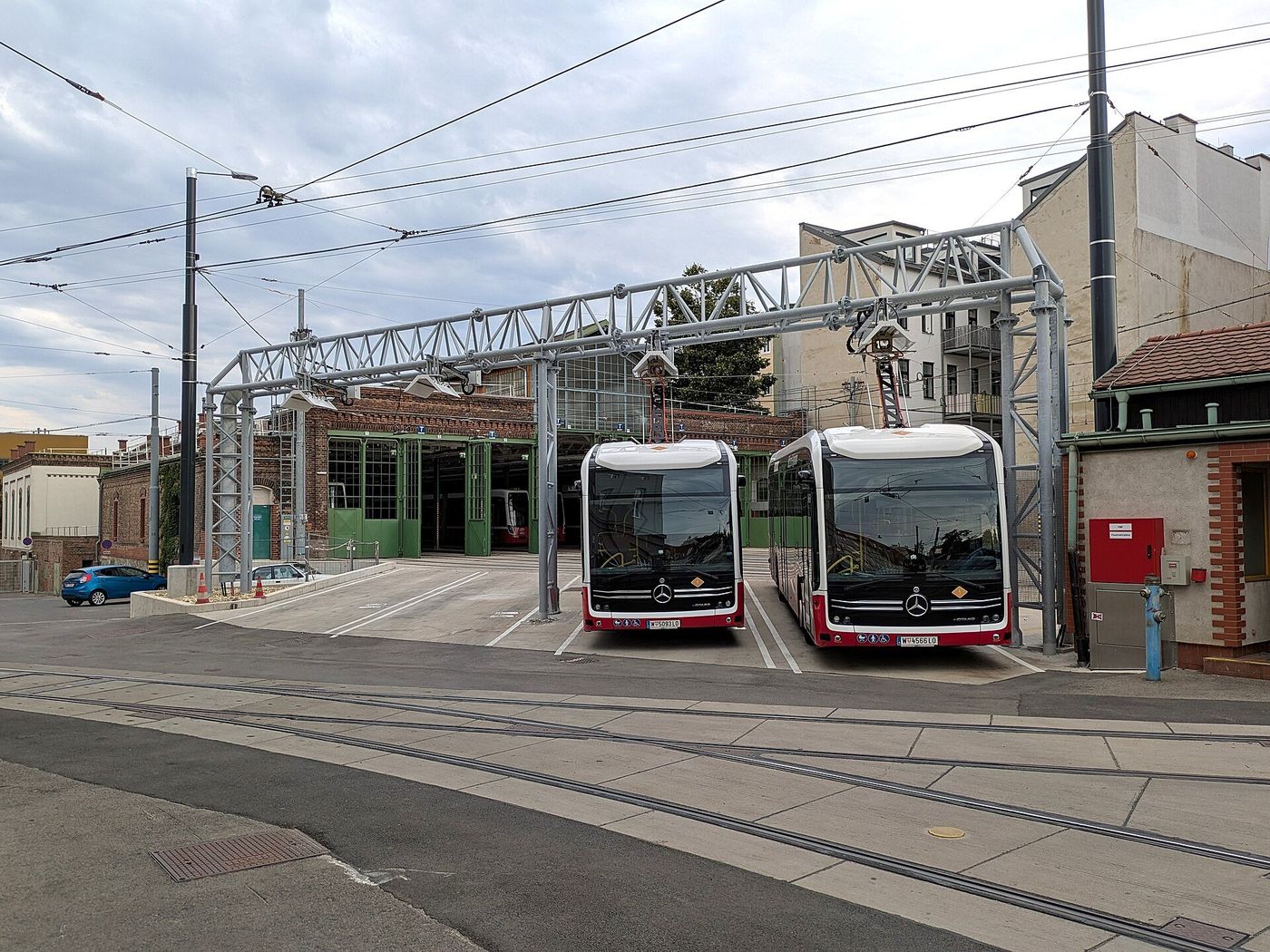
Solaris’s knowledge base describes depot charging as charging an electric bus’s batteries in the time it spends at the depot overnight or during longer breaks, usually at lower output power (approx. 50–150 kW) and most commonly through plug-in systems, with stationary chargers installed in the depot or mobile chargers. Daimler Buses says the interior of its eCitaro can be preconditioned to the desired temperature while the batteries are being charged at the depot, so that the energy for the required climate control “is not drawn from the battery at the start of the journey”.
This page reports what bus makers, their service arms and a German transport association say about charging in the depot and preparing buses for departure. Apart from the association’s summaries, the sources are the makers’ own releases, articles and product pages, so what they claim is the maker’s claim, not an independent measurement. The page gives no advice of its own; electrical installation, grid connection and costs are not covered here, and the legal duties that sit on a bus operator are set out in The Regulatory Floor Under Bus Fleet Operating Costs.
What depot charging means for a city bus
Solaris adds that most buses return to the depot after their scheduled daily transport tasks, that depot charging “is often referred to as slow charging”, that pantograph charging is used less frequently, and that opportunity charging, or fast charging at higher power levels, is a complementary technology. The Solaris page carries no date.
In its eCitaro release of 2 October 2025, Daimler Buses puts depot vehicle socket charging first for the eCitaro with new generation batteries, with opportunity charging optional, and says charging capacities of up to 150 kW are possible in that process. The release lists socket positions on the left and right above the front axle and at the rear, an additional plug position in the area of the vehicle front, and a maximum of two positions per vehicle. Of the eCitaro K shown at mobility move 2025 in Berlin, Daimler Buses’ release of 25 March 2025 says the vehicle “has been designed for plug-in charging in the depot” and can be configured with charging sockets at different positions. The eCitaro is the all-electric Citaro; the Citaro line itself is described on the Mercedes-Benz Citaro page.
MAN’s Lion’s City E page gives a charging capacity of up to 150 kW and says all battery packs can be fully charged in two and a half to five hours, adding that fewer battery packs increase passenger capacity and reduce charging time. The pack counts and capacities are on the MAN Lion’s City model page.
Opportunity charging and the EU rules for bus charging interfaces are covered in City Bus Propulsion and the EU Zero-Emission Mandate; this page stays with the depot.
Four ways to bring the charger to the bus
A 2025 Mercedes-Benz Buses article in which experts from Daimler Buses Solutions explain how electric buses are charged describes four concepts:
- Chargers with a CCS plug. The article says the charger with a CCS plug has an output of up to 80 kilowatts and can be carried in the vehicle. The charging stations “usually offer up to two times 150 kilowatts of charging capacity” and can be monitored and controlled via a charging management system. In a split system, the power unit “can be installed up to 100 metres away”.
- Plug charging from above with cable reels. The article describes charging reels, suspended cable reels, installed in the hall ceiling, and says “very little additional space is required” apart from the space needed for the power units.
- Roof-mounted pantographs. These systems can achieve up to 300 kilowatts of charging capacity, “twice as much as plug charging”, according to the article. Under this heading the article names an installation for its customer HTM in The Hague that provides 109 charging points for 109 buses.
- Pantographs and charging rails. With the station-side pantograph, the only elements installed on the vehicles are very compact, heatable charging rails. The article says the charging capacity and automation are the same as those of conventional vehicle-mounted pantographs, and that in emergencies “all pantographs can be lifted at the same time across the depot” to disconnect the power.
Daimler Buses’ eCitaro release of 2 October 2025 adds that the charging rails of the eCitaro can optionally be equipped with an RFID tag to ensure unique vehicle identification during the charging process at the depot.
Charging management: one charger, several buses
The eCitaro release of 2 October 2025 also says two eCitaro buses can be charged “sequentially, i.e. one after the other”, at a charger with two charging points, and that this “avoids charging peaks”. Daimler Buses’ release of 25 March 2025 describes charging management with parallel charging, “whereby the charging power can be distributed over several buses”. It says the charging management system can also ensure that the high-voltage batteries are charged gently and that electric buses are charged and preconditioned in time for their service. With an interface to the Omniplus On Data Packages, further vehicle information such as the position, charge level and remaining range of each vehicle can be added, and the system “works independently of the vehicle type” and is also suitable for multi-brand fleets.
In a 2025 interview on the Mercedes-Benz Buses site, Karsten Wasiluk, Product Manager Charging and Energy Technology at Daimler Buses Solutions GmbH, says parallel charging has “largely replaced the sequential charging process that we used previously”. He describes a project in The Hague in which the operator wanted to use 300 kilowatts for fast charging during the day and also to set up gentle slow charging at night. This was achieved, he says, with a dynamic charger that distributes its power to four buses at night, and “depending on the customer’s deployment scenario” between 60 and 90 kilowatts are thereby made available for each bus. He also names smart charging management “which reduces charging peaks” and says the customer Rhönenergie Fulda already has an interface with the energy supplier that can reduce peak loads in a targeted manner.
A Mercedes-Benz Buses article on the operator VY Buss in Östersund, Sweden, describes the charging set-up for its eCitaro fleet: “13 charging stations and two additional mobile chargers, a total of 25 charging points”, supplying 21 eCitaro solo buses and four eCitaro G buses. According to the article, the buses are charged and preconditioned at night in the depot so that they are ready for operation in the early morning despite the cold Swedish nights; depending on how much they are used, they receive an additional quick charge during the day. The 21 solo buses are charged via plugs, and the four eCitaro G buses also have a pantograph, which lets them use the existing charging infrastructure in the city. The article gives temperatures of -10 to -15 degrees Celsius as “not uncommon” there and says each eCitaro has to cover 84,000 kilometres a year. It names Ekoenergetyka as the charging station manufacturer and Sinos as the software provider that takes care of the charging management system in Östersund.
What preconditioning means in a bus depot
In its eCitaro release of 2 October 2025, Daimler Buses says the vehicle interior of the eCitaro can be preconditioned to the desired temperature while the batteries are being charged at the depot, and that the energy for the required climate control is then not drawn from the battery at the start of the journey and the range is increased. The same release describes what it calls overconditioning: in winter the city bus starts from the depot with a higher temperature in the passenger compartment to counteract the cooling from the outside, which Daimler says further reduces consumption during operation, and in summer it is “already precooled somewhat stronger”.
The release’s thermal management section says energy consumption in a city bus is “very strongly influenced by the climatic conditions”, and thus by the cooling and, above all, the heating of the vehicle interior. It says that, for example, the high-voltage batteries are “tempered to the ideal temperature”, which it says leads to maximum charging capacity, performance and service life; the passage does not tie this to the depot or to a departure time. The release says the passenger compartment is heated in an energy-saving manner by a heat pump and, if necessary in the event of significant temperature changes, supported by the braking resistor connected to the water circuit.
An earlier Daimler Buses release, of 31 August 2023, says that preconditioning of the vehicle interior at the depot, part of the eCitaro’s climate control system, is “now also possible without a direct connection to the CCS charger”. Daimler describes this as advantageous if the bus arrives at the depot with largely charged batteries or if charging en route is planned: no charging station at the depot is then unnecessarily occupied just to send a preconditioned vehicle out on its scheduled cycle.
The Mercedes-Benz Buses article on four charging concepts mentions preconditioning under the plug-station, roof-mounted pantograph and station-side pantograph concepts. For the CCS plug stations, the charging management system “also controls the preconditioning function”, so that the bus can be thermally preconditioned before use. With roof-mounted pantographs, vehicle communication and thermal preconditioning can be carried out “in the same way as when charging from a plug”. With the station-side pantograph and charging rails, vehicles can be thermally preconditioned before setting off, as with the other solutions. In the 2025 interview, Wasiluk says Daimler Buses Solutions was able to precondition buses with an inverted pantograph “for the first time in the project’s history” at RVBW in Baden-Wettingen, Switzerland.
Setting a departure time: Omniplus and MAN eManager
In its Omniplus release of 18 November 2024, Daimler Buses describes Remote Charge Control, a digital, bidirectional service of the Omniplus On portal; Omniplus is its service brand. Daimler says the service gives operators of electric bus fleets “operational vehicle preparation”: buses can be charged and preconditioned so that they are ready exactly when they are needed. The operator can select the type of preconditioning, heating, cooling or ventilation, set a maximum battery charge level “to protect the battery”, and define the scheduled departure time of each individual bus so that the full battery charge is available for operation. Daimler says the service runs independently of the charging infrastructure and helps to boost the vehicle’s range and the batteries’ service life, without giving a figure for either, and that it is an optionally available component of Omniplus On.
Its Omniplus release of 2 October 2025 describes a service called Remote Control Functions in nearly the same terms: buses can be charged and preconditioned “precisely to the minute”, the operator selects the type of preconditioning, can limit the system to a specified maximum charge level “in order to conserve the battery”, and can set the scheduled departure time of each bus. It is an optional component of Omniplus On. The release adds that the service can also be used through an interface (API) with the customer’s own fleet and charging management systems, which it says offers transport companies the advantage that no communication via the charging station is required with OCPP. Its release of 24 February 2026 also lists the “Remote Control Functions” for charging and preconditioning electric buses. None of these releases says whether Remote Control Functions is the Remote Charge Control of 2024 under another name.
MAN’s release of 28 September 2021 put the MAN eManager on TRATON’s cloud-based RIO platform in two versions: eManager S “with basic functions” and eManager M “with an advanced set of product features”. In S the operator chooses between “Charge immediately”, which starts charging as soon as the vehicle is connected to a charging post and charging current is available, and “Timed charging”, where several timers can be set at the same time so that charging is programmed for a certain departure time. The release’s example is a departure every Monday at 7 a.m., and the precondition it names is that the vehicle is connected to a charging post. It adds that eManager S can thermally precondition the inside of the vehicle, both when the battery is being charged then and there and when it is charged later via Timed charging, and that this has “a positive effect on the remaining range”, because less energy is required for air-conditioning at the start of the trip. It says there are six different charging states, and that an error during charging, for example a cable not correctly attached, is visible to the fleet manager in the application. For eManager M the release lists the remaining battery capacity in kWh, the vehicle state “Drive” in addition to “Ready to go” and “Not ready”, and a history of daily battery charging and discharging, air-conditioning, ambient temperature and energy consumption values.
MAN’s Lion’s City E page lists eManager S as “Charging management for your MAN Lion’s City E with timer function” and “Climate preconditioning”. It lists eManager M as everything in S plus vehicle and battery monitoring and detailed information and history, including charging and discharging currents, battery voltage, charging errors, recuperation performance, consumption values of air conditioning and auxiliary consumers, and ambient temperature data. MAN’s separate charging and battery management service page, marked “© MAN 2026”, says the service allows the operator to control battery charging and vehicle pre-conditioning, and that thermal pre-conditioning “optimises the range”, because less energy is required for heating or cooling, especially at the beginning of the journey. It lists remote control of pre-conditioning, including of the vehicle interior, the display of drive-readiness after charging, and the charging status of the high-voltage battery per vehicle, for example disconnected, connected or charging. That page does not say which vehicles it covers.
The RIO product page for eManager S is in German; the following is our translation. With timer charging, several timers can be created depending on vehicle and departure time, and when the electric vehicle is connected to a charging post, charging and optionally preconditioning start automatically at the optimal time, so that the vehicle is ready for operation at the planned departure time. The vehicle interior can be preconditioned overnight at the click of a mouse, which means that in the morning, before the vehicle leaves the depot at the planned departure time, the interior can be pre-cooled or pre-heated according to the outside temperature. An integrated comfort timer (Komfort-Timer) makes it possible to bring the interior to a desired temperature in advance, and automatic climate control of the interior and a pre-tempering (Vortemperierung) of the high-voltage battery packs can also be set. The page says availability and scope depend on the vehicle model and may vary by country, and it speaks of electric vehicles in general. The Lion’s City E page’s entry for eManager S lists “Climate preconditioning” and does not mention the battery packs.
Beyond eManager, the Lion’s City E page names two battery usage strategies. “Reliable Range” is described as usable battery capacity that is long-term stable, suitable for customers who regularly operate the same route. “Maximum Range” is described as for maximum battery capacity, appropriate for customers who require the maximum range or the additional capacity for routes that change on a daily basis.
What Omniplus recommends for buses parked fully charged
In its Omniplus release of 18 November 2024, Daimler Buses said that Omniplus On Battery Monitoring, a service for Mercedes-Benz electric buses, recognises when a bus is parked with fully charged batteries for an extended period of time and “recommends not charging them fully until shortly before the next scheduled journey start”; the reason it gives is to preserve the battery. The Omniplus release of 2 October 2025 repeats the recommendation in slightly different words, “in order to conserve the battery”. Both say the service can be booked for each vehicle in the Omniplus On portal.
Daimler says the assessment rests on battery-relevant key figures such as battery type, kilometre reading, age, battery cell temperature and state of health, “and many more”. The service also detects other factors, such as the maximum state of discharge or excessive temperatures, and recommends suitable measures.
For its NMC4 battery, which Daimler announced in its eMobility Days release of 18 November 2024 for the eCitaro, eCitaro G, eCitaro K and eCitaro fuel cell “from early 2026”, the release of 25 March 2025 says battery monitoring, “thermal monitoring and alarms in the event of overheating”, works not only when the operating system is switched on, “as in previous vehicles”, but also when the vehicle is idling. The release of 24 February 2026 says the battery management system, responsible for thermal monitoring and triggering alerts in the event of overheating, now also operates when the NMC4 battery is in standby mode.
The same Omniplus release of 2 October 2025 also describes an emergency call function that Daimler Buses was introducing in Battery Monitoring for Busworld Europe 2025. If the temperature and other parameters of the high-voltage battery unexpectedly exceed certain limit values, the horn and hazard warning lights are switched on in the vehicle, a pop-up message appears in the driver’s display, the warning is transmitted to the Omniplus On portal, and a telephone number stored beforehand by the customer is called. The rescue documents that makers publish for emergency services are a separate matter, covered in Rescue sheets and emergency-response guides for electric trucks and buses.
The data link between depot and bus: VDV 261 and VDV 463
VDV, the Verband Deutscher Verkehrsunternehmen (in our translation, the association of German transport companies), publishes technical papers for the sector. They are the association’s publications, not laws and not EU or ISO standards. This section relies on VDV’s own one-page summaries; the full texts were not opened.
VDV-Schrift Nr. 261, ED. 2, in our translation a recommendation for connecting a dispatching backend to an electric bus, supplementing ISO 15118, is listed as “Ausgabe 05/2023” (edition 05/2023) in VDV’s summary of 8 May 2023. The summary says the first publication was meant to help transport companies, bus manufacturers and software providers develop uniform communication between electric buses and various backends, for example depot management systems. It says that international standardisation had comprehensively treated communication between vehicle and charging station, and that ISO 15118, ED. 1 could by now be regarded as the established standard, but that the requirements arising from electric urban line-bus operation had not been fully considered. In particular, the communication content of a system that dispatches the vehicles and prepares them for the next departure, for example by activating preconditioning, had not been described.
VDV-Schrift 463, version 1.1.0, “Schnittstelle zum Lademanagementsystem - Betriebshofmanagement & ITCS” (interface to the charging management system, depot management and ITCS), is listed as “Ausgabe 12/2024” (edition 12/2024) in VDV’s summary of 30 January 2025; the interface was first published in version 04/2021. The summary says it describes the interface between a charging management system (LMS) for electric buses and the operator’s upstream systems, the control system (ITCS) and the depot management system (BMS), and sets the data format and transport protocol. It covers charging in the depot as well as charging on the route during the Umlauf (in our translation, the vehicle’s circulation). The upstream systems pass a charging request to the charging management system; a new request can be made, for example, before depot entry or before arrival at turning points, and contains at least vehicle ID, departure time and target state of charge. The charging management system sends the upstream system information on ongoing charging and preconditioning processes, on the current status of the charging infrastructure and, optionally, on planned charging processes, and the interface also supports controlling and monitoring preconditioning according to the specifications of the upstream systems. Version 1.1.0 is described as a maintenance release with error corrections and clarifications that avoids incompatible changes (“breaking changes”) to the previous version and contains no major functional extensions.
In the 2025 interview, Wasiluk says that for communication with the charging management system Daimler Buses Solutions uses the standardised OCPP protocol together with value-added services defined in VDV Guideline 261. This is a separate statement from the API route for Remote Control Functions described above.
Depot services from the makers
Daimler Buses said in its eMobility Days release of 18 November 2024 that, in cooperation with Daimler Buses Solutions GmbH, it can supply the entire eMobility ecosystem from a single source on request, from the feasibility analysis and the electric buses to the complete electromobility infrastructure, including construction measures, electrical installations, charging infrastructure, battery storage, charging management systems and other digital services. Its release of 24 February 2026 says that under the Omniplus Charge brand Daimler Buses provides consulting, planning, construction and service for electromobility and hydrogen infrastructure, and describes a Charging-as-a-Service offering: Daimler Buses assumes full responsibility for building and operating the charging infrastructure, and the customer charges at its own depot with monthly billing.
MAN’s Lion’s City E page says MAN also takes care of the charging infrastructure, “whether via cable or pantograph”, optionally including installation and maintenance, all from a single source.
What the sources do not say
- No source quoted here gives a figure for how much preconditioning changes range or energy consumption; the statements of Daimler Buses and MAN are qualitative.
- Daimler Buses’ release of 31 August 2023 does not say where the energy for preconditioning without a CCS connection comes from.
- The Omniplus recommendation gives no state of charge for “fully charged”, no length for “an extended period of time” and no size of effect on the battery.
- The releases do not say whether Remote Control Functions replaced Remote Charge Control.
- MAN’s Lion’s City E page gives no charge-level window for “Reliable Range” or “Maximum Range”.
- The full texts of VDV 261 and VDV 463 were not opened; only VDV’s summaries were read.
Quick answers
- How are electric buses charged in the depot?
- Solaris says depot charging is usually carried out at lower output power, approx. 50–150 kW, and most commonly through plug-in systems, using stationary chargers installed in the depot or mobile chargers; pantograph charging is used less frequently. Mercedes-Benz Buses describes four layouts: a charger with a CCS plug, plug charging from cable reels suspended in the hall ceiling, roof-mounted pantographs, and a station-side pantograph with charging rails on the vehicle. For the eCitaro with new generation batteries, Daimler Buses says charging capacities of up to 150 kW are possible in depot vehicle socket charging.
- What is preconditioning on an electric bus?
- Omniplus, Daimler Buses' service brand, lets the operator select the type of preconditioning: heating, cooling or ventilation. MAN describes its eManager S service as able to thermally precondition the inside of the vehicle, and its RIO product page (in German) adds a pre-tempering of the high-voltage battery packs, with scope depending on the vehicle model and the country. Daimler Buses says the interior of the eCitaro can be preconditioned to the desired temperature while the batteries are being charged at the depot.
- Does preconditioning drain the bus battery?
- Daimler Buses says that when the interior of the eCitaro is preconditioned while the batteries are being charged at the depot, the energy for the required climate control “is not drawn from the battery at the start of the journey”, and the range is increased. In a release of 31 August 2023 it also said that preconditioning the interior at the depot is possible without a direct connection to the CCS charger; that release does not say where the energy comes from. None of the makers quoted on this page gives a figure for the effect on range.
- What does Omniplus recommend about leaving an electric bus fully charged?
- Daimler Buses said in November 2024, and again in October 2025, that Omniplus On Battery Monitoring recognises when a Mercedes-Benz electric bus has been parked for a long time with fully charged batteries and, in the November 2024 wording, “recommends not charging them fully until shortly before the next scheduled journey start”, giving the reason as preserving the battery. The sources give no charge level, duration or size of effect, and this page gives no advice of its own. Omniplus's Remote Control Functions can also limit the system to a specified maximum charge level.
- How many buses can share one depot charger?
- Daimler Buses says two eCitaro buses can be charged one after the other at a charger with two charging points, and that charging management can distribute the charging power over several buses at once. In a project in The Hague described by Daimler Buses Solutions, a dynamic charger distributes its power to four buses at night, making between 60 and 90 kilowatts available for each bus depending on the customer's deployment scenario.
- What are VDV 261 and VDV 463?
- They are publications of the German transport association VDV. VDV 261 (edition 05/2023) is a recommendation for connecting a dispatching backend, such as a depot management system, to an electric bus, supplementing ISO 15118. VDV 463 (version 1.1.0, edition 12/2024) defines the interface between a charging management system and the operator's control and depot management systems; a charging request carries at least vehicle ID, departure time and target state of charge. This page relies on VDV's own one-page summaries; the full texts were not opened.
Models in this article
Sources
- Omniplus: New digital services for electric buses (press release, 18 November 2024) — Daimler Truck AG
- Daimler Buses is presenting its latest vehicle developments, battery solutions and services for electric bus fleets at the eMobility Days (press release, 18 November 2024) — Daimler Truck AG
- Daimler Buses presents eCitaro K and eMobility Services at mobility move 2025 in Berlin (press release, 25 March 2025) — Daimler Truck AG
- The new NMC4 battery in the Mercedes-Benz eCitaro: More capacity, longer service life (press release, 2 October 2025) — Daimler Truck AG
- Omniplus: Digital services for greater safety and efficiency (press release, 2 October 2025) — Daimler Truck AG
- Daimler Buses presents the Mercedes-Benz eCitaro with new NMC4 battery and eMobility services at mobility move 2026 in Berlin (press release, 24 February 2026) — Daimler Truck AG
- Mercedes Benz eCitaro: Premiere for eCitaro fuel cell featuring a fuel cell, even more efficient with the performance package, new assistance and safety systems (press release, 31 August 2023) — Daimler Truck AG
- The four principal charging strategies for electric buses — Mercedes-Benz Buses (Daimler Buses)
- Smart and safe charging for electric buses (2025) — Mercedes-Benz Buses (Daimler Buses)
- The eCitaro gives icy temperatures the cold shoulder — Mercedes-Benz Buses (Daimler Buses)
- MAN Lion's City E — electric drive — MAN Truck & Bus
- Managing e-vehicles digitally: the intelligent MAN eManager for buses/coaches and vans (press release, 28 September 2021) — MAN Truck & Bus
- Charging and battery management — MAN eManager — MAN Truck & Bus
- MAN eManager S — product page (German) — RIO Marketplace (TRATON)
- VDV-Schrift Nr. 261, ED. 2: Empfehlung zur Anbindung eines dispositiven Backends an einen Elektrobus, ergänzend zur ISO-Norm 15118 (Ausgabe 05/2023) — publisher's summary — VDV — Verband Deutscher Verkehrsunternehmen
- VDV-Schrift 463, Version 1.1.0: Schnittstelle zum Lademanagementsystem - Betriebshofmanagement & ITCS (Ausgabe 12/2024) — publisher's summary — VDV — Verband Deutscher Verkehrsunternehmen
- Depot charging — knowledge base — eCity powered by Solaris (Solaris Bus & Coach)