operating
ADR explained: dangerous goods vehicles, orange plates and tunnel codes
What makes a trailer an ADR trailer under ADR 2025 — the EX/II, EX/III, FL and AT designations, the approval certificate, the orange plate and the tunnel restriction code.
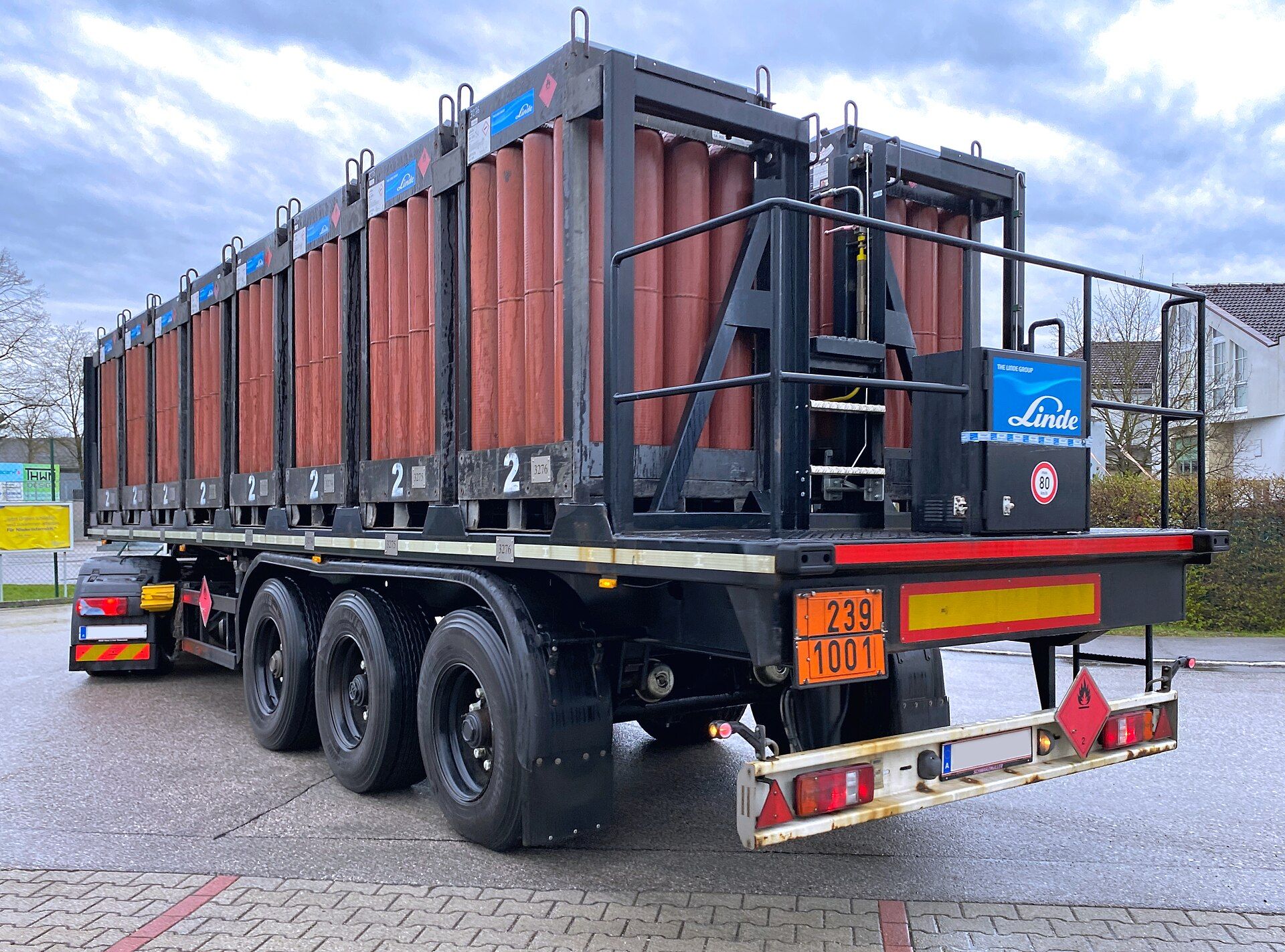
An ADR trailer is not a trailer built to a generally higher standard. It is a trailer that falls inside one of five definitions, has been inspected against the requirements attached to that definition, and carries a certificate saying so. Which of the five applies decides what it may carry and what its annual inspection has to prove; which tunnels it may not enter is decided by the goods on board, not by the designation.
The text in force is ADR 2025, published by UNECE as ECE/TRANS/352 in two volumes, applicable from 1 January 2025 with a transitional measure in 1.6.1.1 that allowed the previous version until 30 June 2025. Inside the EU it governs national movements too: Annex I, Section I.1 of Directive 2008/68/EC, as replaced by Commission Delegated Directive (EU) 2025/149, applies ADR Annexes A and B as they stand from 1 January 2025, and Article 2(4) defines a vehicle to include any trailer.
Below the threshold, the vehicle regime falls away
Column (15) of Table A in Chapter 3.2 puts most entries in a transport category from 0 to 4; where none has been assigned, the explanatory note to that column in Chapter 3.2 says the top of the cell shows a dash instead. Where there is a category, 1.1.3.6.3 sets what it allows in one transport unit: nothing at all for category 0, then 20, 333, 1 000 and unlimited. What the number counts is set out in the closing text of that same 1.1.3.6.3, under the table: net mass in kilograms for solids and for liquefied, refrigerated liquefied and dissolved gases; the total quantity of the goods in litres for liquids; the receptacle’s water capacity in litres for compressed gases, adsorbed gases and chemicals under pressure; and for articles the total mass in kilograms of the articles without their packagings, which for Class 1 means the net mass of the explosive substance. Footnote a to the table then fixes a named list of UN numbers, UN 1005 and UN 1017 among them, at 50 kg per transport unit. Its markers sit only on transport category 1 entries, so it lifts those goods above the 20 the category would otherwise give, rather than capping them. Below the figure, 1.1.3.6.2 lets the goods travel in packages without Chapter 5.3, most of Part 8, or Part 9 — the entire vehicle construction and approval regime. The frame is packages, and a tank is not one: put the same substance in a fixed tank and the exemption is gone at any capacity. The capacities in 9.1.1.2 decide which designation the vehicle then needs, which is the next section’s subject.
The five designations
Part 9 applies to vehicles of categories N and O carrying dangerous goods (9.1.1.1). Category O is trailers, so a semi-trailer is approved in its own right, separately from whatever pulls it. The definitions in 9.1.1.2 are EX/II and EX/III for explosives of Class 1; FL in four cases; AT in two; and MEMU, the mobile explosives manufacturing unit defined in 1.2.1.
FL covers liquids with a flash-point of not more than 60 °C, and hydrogen peroxide above 60 % under UN 2015, each in fixed or demountable tanks above 1 m³ or in tank-containers or portable tanks above 3 m³ individually; flammable gases in fixed or demountable tanks above 1 m³ or in tank-containers, portable tanks or MEGCs above 3 m³ individually; and battery-vehicles above 1 m³ for flammable gases. Within FL, only the gas case names MEGCs. AT catches the rest: carriage other than EX/III, FL or a MEMU in fixed or demountable tanks above 1 m³ or in tank-containers, portable tanks or MEGCs above 3 m³ individually, and battery-vehicles above 1 m³ that are not FL.
Diesel is where this is most often read wrong. The FL definition carves out diesel complying with standard EN 590:2013 + A1:2017, and gas oil and light heating oil under UN No. 1202 with a flash-point as specified in that standard. Table A therefore carries three separate UN 1202 entries: the one for gas oil, diesel or light heating oil with a flash-point of not more than 60 °C shows FL in column (14); the EN 590 entry shows AT; the entry for a flash-point above 60 °C and not more than 100 °C also shows AT. All three carry hazard identification number 30 and tunnel code (D/E). Petrol, UN 1203, is FL, transport category 2, hazard number 33. A fuel tanker is not automatically an FL vehicle.
The certificate, and what it physically looks like
Conformity is certified by a certificate of approval from the competent authority of the country of registration, accepted by the other Contracting Parties while its validity continues (9.1.3.2) and carried in the driver’s cab under 8.1.2.2 (a), which calls for one for each transport unit or element thereof — the wording that makes the trailer’s own certificate separately necessary. The physical description in 9.1.3.3 is the most useful verification tool a used buyer has. The certificate follows the model in 9.1.3.5, measures 210 mm × 297 mm — A4 — may use both sides, and is white with a pink diagonal stripe. It may carry a hologram, UV printing, guilloche patterns or a barcode, and a Contracting Party adding such features must lodge an example and explanatory notes with the UNECE secretariat, which publishes them. Where the issuing language is not English, French or German, the title and the remarks under No. 11 must also appear in one of the three.
Then read the boxes. No. 7 is the vehicle designation under 9.1.1.2, with EX/II, EX/III, FL, AT and MEMU printed and the inapplicable ones struck out. No. 9 describes the fixed tank or battery-vehicle, including its approval number, year of manufacture and tank code. No. 10 states the goods authorised. No. 12 is the expiry date.
That date comes off an annual cycle. Under 9.1.2.3 the vehicle takes an annual technical inspection in its country of registration, and validity expires not later than one year after the date of the inspection preceding the certificate’s issue (9.1.3.4). Where the inspection falls within one month either side of the nominal expiry date the next term still runs from that date, which stops the cycle creeping earlier every year. After that date the vehicle may not carry dangerous goods until it holds a valid certificate.
The price of getting this wrong sits outside ADR. Directive (EU) 2022/1999, which codified and repealed Council Directive 95/50/EC on 12 November 2022, puts carriage in a vehicle without an appropriate certificate of approval in risk category I of Annex II, which at the roadside normally leads to immediate and appropriate corrective measures, immobilisation of the vehicle among them. Annex II describes itself as a non-exhaustive list offering guidance, and leaves the category of a given infringement to the particular circumstances and to the discretion of the enforcing body or officer. That Annex II is the one Commission Delegated Directive (EU) 2025/1801 put in its place, applicable since 24 June 2026; the item numbering in the 2022 Official Journal text is not the numbering in force.
The orange plate
Under 5.3.2.1.1 a transport unit carrying dangerous goods displays two rectangular orange plates in a vertical plane, one front and one rear, and if a trailer containing dangerous goods is uncoupled during carriage a plate stays on its rear. The specification in 5.3.2.2.1 is exact: reflectorized, 40 cm across the base and 30 cm high, black border 15 mm wide, weather-resistant. The plate must not come off its mount after fifteen minutes’ engulfment in fire, and must stay attached whatever way up the vehicle ends. Where the available surface area is insufficient the same paragraph lets the dimensions fall to a minimum of 300 mm base, 120 mm height and a 10 mm border; the ±10 % tolerance on the dimensions in that sub-section is 5.3.2.2.4. Digits are black, 100 mm high with a 15 mm stroke, hazard identification number above and UN number below, split by a 15 mm black line (5.3.2.2.2). Annex II to Directive (EU) 2022/1999 lists no size rule for the orange plate: its risk category III covers the size of placards or labels, and of the letters, figures or symbols on them. The orange plate reaches Annex II as marking, and at three levels rather than two. Carriage with no placarding, marking or other identification signs on the vehicle is item 18 of risk category I, and orange-coloured plate marking is named inside that limb — the same immobilisation tier as a missing certificate of approval. Incorrect plate marking is item 9 of category II, where the response is rectification on the spot or, failing that, by the end of the transport operation. Failure to affix it properly is item 5 of category III.
Plates that do not relate to the goods on board are removed or covered, and a covering must be total and still effective after fifteen minutes in fire (5.3.2.1.8). The requirements carry over to tanks and bulk vehicles that are empty but uncleaned, not degassed or not decontaminated (5.3.2.1.7) — an empty tank trailer is still a plated vehicle. Under 1.6.1.8, existing plates meeting the specification applicable up to 31 December 2004 may continue to be used only until 31 December 2026, and only where the plate, numbers and letters stay affixed whatever way up the vehicle ends, as 5.3.2.2.1 and 5.3.2.2.2 require.
Reading the number is a system rather than a lookup. Under 5.3.2.3.1 the figures mean emission of gas due to pressure or to chemical reaction (2), flammability of liquids (vapours) and gases or a self-heating liquid (3), flammability of solids or a self-heating solid (4), oxidising effect (5), toxicity or risk of infection (6), radioactivity (7), corrosivity (8) and risk of spontaneous violent reaction (9). Doubling a figure intensifies that hazard, except in the combinations the same paragraph sets aside — 22, 323, 333, 362, 382, 423, 44, 446, 462, 482, 539, 606, 623, 642, 823, 842, 90 and 99 — which 5.3.2.3.2 defines one by one. Where one figure says enough a zero follows it; a prefixed X means the substance reacts dangerously with water. Class 1 uses its classification code instead. So 33 over 1203 is petrol, and 239 over 1001 — the plate on the trailer photographed above — is a flammable gas which can spontaneously lead to violent reaction, dissolved acetylene.
One national exception survives: Annex I, Section I.2, point 5 of Directive 2008/68/EC lets a Member State keep, for vehicles registered on its own territory, rules in force on 31 December 1996 that display an emergency action code or hazard card in place of the hazard identification number.
The tunnel code
Column (15) carries two things: the transport category, and beneath it in brackets the tunnel restriction code. A dash inside the bracket means the goods are not subject to any tunnel restriction, save that for UN Nos. 2919 and 3331 restrictions may still form part of the special arrangement approved by the competent authority under 1.7.4.2 (8.6.3.1); where a transport unit carries goods with different codes, the most restrictive governs the whole load (8.6.3.2).
The categorisation is national, not European: Chapter 1.9 is headed transport restrictions by the competent authorities, and 1.9.5.1 has each Contracting Party’s own competent authority assign the tunnels on its territory to one of five categories, and then only when it applies restrictions to the passage of dangerous goods at all. There is no common European list, the same tunnel may sit in more than one category depending on the hour or the day, and 1.9.5.3.7 leaves it to each Contracting Party to notify its restrictions to the UNECE secretariat, which publishes them. The assignment rests on the assumption in 1.9.5.2.1 that the dangers are explosion, release of toxic gas or volatile toxic liquid, and fire. The five categories themselves are 1.9.5.2.2. A carries no restriction; B restricts goods that may cause a very large explosion; C adds a large explosion or large toxic release; D adds a large fire; E restricts everything except entries marked with a dash in column (15), and also catches goods carried in limited quantities under Chapter 3.4 where the load exceeds 8 tonnes total gross mass per transport unit. The category comes off the sign: no sign is A, and an additional panel bearing B, C, D or E gives the rest (8.6.2). Those signs go where an alternative route can still be chosen (1.9.5.3.4).
| Code | Restriction |
|---|---|
| B | Forbidden through tunnels of category B, C, D and E |
| B1000C | Net explosive mass over 1 000 kg: forbidden through B, C, D and E. Not over 1 000 kg: forbidden through C, D and E |
| B/D | Tank carriage: forbidden through B, C, D and E. Other carriage: forbidden through D and E |
| B/E | Tank carriage: forbidden through B, C, D and E. Other carriage: forbidden through E |
| C | Forbidden through tunnels of category C, D and E |
| C5000D | Net explosive mass over 5 000 kg: forbidden through C, D and E. Not over 5 000 kg: forbidden through D and E |
| C/D | Tank carriage: forbidden through C, D and E. Other carriage: forbidden through D and E |
| C/E | Tank carriage: forbidden through C, D and E. Other carriage: forbidden through E |
| D | Forbidden through tunnels of category D and E |
| D/E | Bulk or tank carriage: forbidden through D and E. Other carriage: forbidden through E |
| E | Forbidden through tunnels of category E |
| – | Allowed through all tunnels (for UN Nos. 2919 and 3331, see also 8.6.3.1) |
Petrol and diesel are both (D/E), so a fuel tanker is shut out of category D and E tunnels but runs through B and C. LPG under UN 1965 is (B/D), and so is acetylene under UN 1001, which closes every category above A to a gas tanker. Anhydrous ammonia and chlorine are both (C/D). A route that works for the diesel contract can be closed to the LPG one behind the same tractor.
What has to come with a used tank trailer
Start at boxes 7 and 10 of the certificate and check them against the work you have rather than the work the seller had. Then ask for the tank record defined in 1.2.1 — the file holding the type approval and inspection certificates for that tank. Under 4.3.2.1.7 the owner or operator keeps it for the life of the tank and fifteen months beyond, and on a change of owner it passes to the new one without delay.
The tank carries a corrosion-resistant metal plate, permanently attached where it can be reached for inspection (6.8.2.5.1), showing the approval number, manufacturer and serial number, year of manufacture, test pressure, capacity, and the date and type of the most recent inspection — month and year followed by P for an initial or periodic inspection, or L for an intermediate one. Those letters date the tank’s position in its cycle from the plate alone.
The cycle differs by containment, and 6.8.1.1 sets out the two-column convention that decides which figure applies. Fixed tanks — tank-vehicles — demountable tanks and battery-vehicles take a periodic inspection no later than every six years (6.8.2.4.2) and an intermediate one no later than three years after the initial and each periodic inspection (6.8.2.4.3). Tank-containers, tank swap bodies and MEGCs run to five years and two and a half. A tank semi-trailer and a tank-container on a skeletal trailer are on different clocks, and 9.1.3.4 says the annual ADR inspection shortens neither.
All of this sits on top of the ordinary purchase questions — the plating and axle loads in truck weights, the shapes and uses in trailer types, the document file in buying a used truck, and the annual inspection that lands on the same sheet as tractor unit running costs. The ADR layer replaces none of them. It decides whether the vehicle may do the work at all.
Quick answers
- How long is an ADR certificate of approval valid?
- Its validity expires not later than one year after the date of the technical inspection preceding its issue (ADR 9.1.3.4). Where the inspection falls within one month either side of the nominal expiry date, the next term still runs from that date rather than from the inspection.
- What is the difference between an FL vehicle and an AT vehicle?
- FL covers four cases in ADR 9.1.1.2. Liquids with a flash-point of not more than 60 °C — other than diesel complying with EN 590:2013 + A1:2017, and gas oil and light heating oil under UN No. 1202 with a flash-point as specified in that standard — in fixed or demountable tanks above 1 m³ or in tank-containers or portable tanks above 3 m³ individually; flammable gases in fixed or demountable tanks above 1 m³ or in tank-containers, portable tanks or MEGCs above 3 m³ individually; battery-vehicles above 1 m³ for flammable gases; and hydrogen peroxide above 60 % under UN 2015 in the same containments as the liquids case. AT covers the other two: carriage other than EX/III, FL or MEMU in fixed or demountable tanks above 1 m³ or in tank-containers, portable tanks or MEGCs above 3 m³ individually, and battery-vehicles above 1 m³ that are not FL.
- Does a diesel tanker need an FL vehicle?
- Only if the diesel is off-specification. Diesel complying with EN 590:2013 + A1:2017, and gas oil and light heating oil under UN 1202 with a flash-point as specified in that standard, are written out of the FL definition in ADR 9.1.1.2, and Table A shows AT in column (14) against that entry. The separate UN 1202 entry for gas oil, diesel fuel or light heating oil with a flash-point of not more than 60 °C shows FL, and the entry for a flash-point above 60 °C and not more than 100 °C shows AT.
- How big is an ADR orange plate?
- ADR 5.3.2.2.1 states it as 40 cm base and 30 cm high, with a black border 15 mm wide, and lets the dimensions fall to a minimum of 300 mm base, 120 mm height and a 10 mm border where the available surface area is insufficient. The digits are 100 mm high with a 15 mm stroke (5.3.2.2.2). The permitted tolerance on the dimensions in that sub-section is ±10 % (5.3.2.2.4).
- What does tunnel restriction code (D/E) mean?
- Bulk or tank carriage is forbidden through tunnels of category D and E, and other carriage is forbidden through tunnels of category E (ADR 8.6.4). Petrol under UN 1203 and diesel under UN 1202 both carry (D/E) in column 15 of Table A.
Sources
- ADR 2025 Volume I (ECE/TRANS/352) — Parts 1 to 3, including 1.1.3.6, 1.6.1, 1.9.5 and Table A of Chapter 3.2 — United Nations Economic Commission for Europe
- ADR 2025 Volume II (ECE/TRANS/352) — Parts 4 to 9, including 4.3.2, 5.3.2, 6.8.2, 8.6 and 9.1 — United Nations Economic Commission for Europe
- Directive 2008/68/EC on the inland transport of dangerous goods, consolidated text — EUR-Lex, European Union
- Commission Delegated Directive (EU) 2025/149 amending the Annexes to Directive 2008/68/EC — EUR-Lex, European Union
- Directive (EU) 2022/1999 on uniform procedures for checks on the transport of dangerous goods by road, consolidated text applicable from 24 June 2026 — EUR-Lex, European Union
- Commission Delegated Directive (EU) 2025/1801 replacing Annexes I and II to Directive (EU) 2022/1999 — EUR-Lex, European Union