Iveco
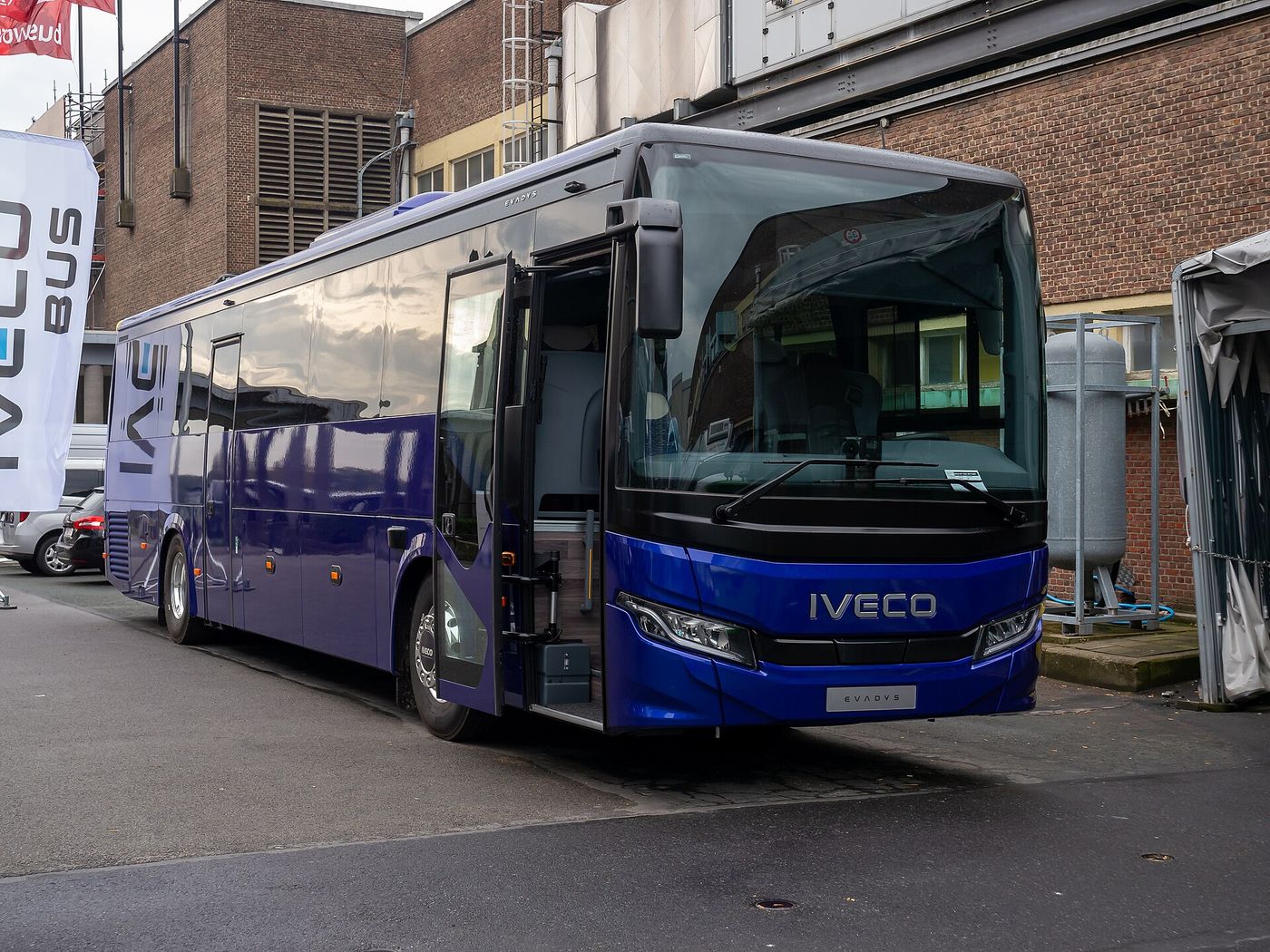
Iveco Evadys
Iveco Bus's Evadys coach in 12 and 13 m with a single middle, double middle or rear door: the Cursor 9 engine, dimensions, weights, luggage volumes and equipment.
- 294 kW
- Euro VI Step E
- 12.1 m
- 19 t

Model overview
- Segment
- Bus
- Emission
- Euro VI Step E
- Transmission
- Automatic ZF Ecolife; automatic Voith Diwa NXT optional
- Gross vehicle
- 19 000 kg
- Length
- 12 097 mm
- Wheelbase
- 6 200 mm
- Capacity
- Up to 53–55 (12 m) and 59–63 (13 m), by door layout
- Doors
- Front door plus a single middle, double middle or rear door
Engine families
- Power
- 294 kW
- Torque
- 1700 Nm
- Rated speed
- 2200 rpm
The Evadys is a coach built by Iveco Bus in two lengths, 12 m and 13 m, with a front door and one of three second doors: a single middle door, a double middle door or a rear door. Iveco’s brochure places it in the Crossway range as the model that “completes the upscale segment of combined interurban/excursion coaches”, and the product page says it was designed “for regional and national route services, airport transfers, organized travel tours and excursions”, with “the DNA of Crossway and the experience of Magelys”. The figures on this page come from Iveco Bus’s three international data sheets for the Evadys, one per door layout, each footed SEPT 2023; from the English Evadys brochure, footed PUBLICATION EVADYS_EN 09/24; and from the Evadys product page on Iveco Bus’s worldwide site, undated and read on 26 October 2026. The Crossway intercity range is described on the Iveco Crossway page.
Two lengths, three door layouts
The three data sheets print the same dimensions and weights for every door layout and differ in doors, seats, luggage volume and some equipment. The subheadings of the brochure’s range overview put the double middle door with regional line transport over medium and long distances “with UFR accessibility”, the single middle door with touristic transport and the single rear door with excursion buses and airport shuttles. Its text names the single middle door as the layout “when a central toilet is required”, the double middle door as the one “to accommodate a wheelchair lift” and the single rear door as the one with the largest luggage compartment, and counts 15 different configurations.
On the Single Middle Door sheet the front and middle doors are 800 mm wide, each with one leaf opening outwards; on the Double Middle Door sheet the front door is 800 mm with one leaf and the middle door 1,200 mm with two leaves; on the Rear Middle Door sheet the front and rear doors are 800 mm with one leaf. The brochure’s range overview gives the same widths. The dimension table of all three sheets prints “800 mm / 1200 mm” in its door-width row.
| Door layout | Length | Example layout on the sheet | Passenger seats, up to |
|---|---|---|---|
| Single middle door | 12 m | 51 + hostess + mini kitchen + WC | 53 |
| Single middle door | 13 m | 55 + hostess | 59 |
| Double middle door | 12 m | 44+2+2+hostess+WC | 55 |
| Double middle door | 13 m | 53+4+2+hostess | 61 |
| Rear door | 12 m | 50 + hostess + WC | 55 |
| Rear door | 13 m | 59 + hostess | 63 |
Each sheet adds that the seat layout “can be changed in case of request”. The brochure’s range overview gives the same maximum seat counts, with “55 (with podium)” for the 12 m coach with the double middle door. Its seat-layout page shows other examples: 53 seats (49 + 2 + 2) at 12 m and 61 (55 + 4 + 2) at 13 m with the double middle door, 51 seats with hostess, WC and kitchen at 12 m and 55 with hostess at 13 m with the single middle door, and 53 and 57 seats with hostess with the rear door. Iveco says it offers four seat models; the sheets list LINEO Tilting passenger seats as standard and Spacio seats as an option.
Dimensions and weights
| Data sheet row | 12 m | 13 m |
|---|---|---|
| Length | 12,097 mm | 12,962 mm |
| Width | 2,550 mm | 2,550 mm |
| Height (row headed with / without AC) | 3,460 mm | 3,460 mm |
| Wheelbase | 6,200 mm | 7,065 mm |
| Front / rear overhang | 2,605 / 3,292 mm | 2,605 / 3,292 mm |
| Interior height (aisle) | 1,998 mm | 1,998 mm |
| Front / middle / rear door access height | 344 / 344 mm | 344 / 344 mm |
| Turning radius, curb to curb | 8,990 mm | 10,120 mm |
| Turning radius, wall to wall | 10,770 mm | 11,900 mm |
| Approach / departure angles | 8.3° / 8° | 8.3° / 8° |
| Maximum technically permissible gross vehicle weight | 19,000 kg | 19,000 kg |
| Maximum axle load, rear / front | 12,600 kg / 7,100 kg | 12,600 kg / 7,100 kg |
The rows for front and rear track and for the internal turning radius are blank on all three sheets. The gross vehicle weight sits in a row headed “MAX. TECHNICALLY PERMISSIBLE GVW CURSOR / TECTOR” with a single figure, and a footnote says that the maximum axle loads and gross vehicle weight depend on local regulation in the country of registration. The brochure’s range overview gives a floor height in the corridor and under the seats of about 1,140 mm, an internal height of about 2,000 mm and a door access height of 344 mm, and its text a luggage room entrance height of 860 mm. What such coach data-sheet rows describe is set out in how to read a coach data sheet.
Luggage space
| Door layout | Length | Luggage compartment (data sheet) | Luggage racks (data sheet) | Total including racks, up to (brochure) |
|---|---|---|---|---|
| Single middle door | 12 m | 8.1 / 6.7 m³ | 1.6 m³ | 9.5 m³ |
| Single middle door | 13 m | 9.7 / 8.3 m³ | 1.9 m³ | 11.3 m³ |
| Double middle door | 12 m | 6.8 m³ | 1.4 m³ | 8.0 m³ |
| Double middle door | 13 m | 8.4 m³ | 1.6 m³ | 9.7 m³ |
| Rear door | 12 m | 8.9 m³ | 1.6 m³ | 10.2 m³ |
| Rear door | 13 m | 10.5 m³ | 1.8 m³ | 12.00 m³ |
The Single Middle Door sheet prints two compartment volumes for each length and does not say what separates them. The brochure’s text gives up to 10.5 m³ of luggage compartment and 1.8 m³ of interior racks, “for a total capacity up to 12.3 m3”, which it equates to an average of 200 L of luggage per passenger; its range overview tops out at 12.00 m³, for the 13 m coach with the single rear door. The product page gives “up to 12.3 m3 of luggage capacity” in one place and “up to 12 m3” in another. The luggage compartment doors are aluminium; the brochure lists pantograph luggage doors among its options and the sheets a ski box preparation.
Engine and aftertreatment
The three sheets and the brochure list one engine, the Iveco Cursor 9 Euro VI: 8.7 litres, six cylinders in line, mounted vertically and transversely at the rear, with common rail injection. The sheets give 294 kW (400 hp) at 2,200 rpm and 1,700 Nm at 1,200 rpm; the Double Middle Door sheet heads its power row “POWER @ 2500 RPM” above the same 2,200 rpm figure. The title bar of the Single and Double Middle Door sheets reads “CURSOR 9 DIESEL AND PARAFFINIC FUEL EURO VI STEP E”, the Rear Middle Door sheet carries “STEP E” in its table heading, and the product page carries a “Diesel & Biofuels” heading. Paraffinic diesel is covered in what is HVO.
Aftertreatment is Iveco’s Hi-SCR system, whose main components the sheets list as a diesel oxidation catalyst, a diesel particulate filter, selective catalytic reduction of NOx with AdBlue and a clean-up catalyst; what Euro VI requires an SCR system to detect is set out in SCR and AdBlue. The brochure speaks of an “Exclusive HI-SCR technology avoiding regeneration”, and attributes the coach’s low noise and vibration level to a dual-mass flywheel and an optimised aerodynamic drag coefficient.
Gearbox, axles, suspension and brakes
The standard gearbox is an automatic ZF Ecolife, with an automatic Voith Diwa NXT as the option; the brochure lists “2 gearboxes available”. The rear axle is a single-reduction hypoid axle with a “Quiet ride gears set” for low noise, at a standard ratio of 5.63. The front axle has independent wheel suspension, and the steering is a worm-type unit with integrated power steering.
Suspension is full air with self-levelling: at the front two combined air springs, two shock absorbers and one levelling sensor, at the rear four air springs, four shock absorbers, a stabiliser bar and two levelling sensors. Lifting and lowering of the suspension and reinforced shock absorbers are options on all three sheets, and kneeling is an option on the Double Middle Door sheet. Compressed air comes from a dual-cylinder compressor of 630 cm³ at 9.5 bar with an integrated air dryer.
Braking is EBS with ESP: a pneumatic service and emergency braking system with two independent air circuits, disc brakes front and rear with floating calipers and ABS, and a pneumatic parking brake on the rear wheels. Every sheet lists a decompression engine brake. The Single Middle Door and Rear Middle Door sheets add an Intarder with brake-pedal and hand-lever control; the Double Middle Door sheet lists an “Electromagnetic retarder with brake pedal control and hand lever control, Hydraulic integrated retarder” as standard and a hydraulic integrated retarder again among its options. Retarder types are described in retarders and engine braking.
Tanks, electrics and wheels
The diesel tank holds 310 l, with a 310+120 l tank as an option. The AdBlue tank holds 50 l on the Single Middle Door and Rear Middle Door sheets and 80 l on the Double Middle Door sheet. Electrical equipment includes two 12 V – 225 Ah batteries, three 150 A alternators with a LIN intelligent regulator, an electrical box with circuit breakers, LED lights and a fire detection system. The Single Middle Door sheet lists halogen headlights, fog lights and LED daytime running lights, with the corner light integrated in the fog light; the other two sheets list front fog lights and corner lights. Tyres are 295/80 R 22.5, with a spare wheel carrier in the front overhang; a spare wheel and aluminium wheel rims are options.
Body, passenger area and driver’s area
The structure and body receive a cataphoretic anti-corrosion treatment finished with a polyurethane resin top coat. The front lights are reached through opening corners, and the heated exterior mirrors are electrically controlled. A ski box preparation, a towing device preparation and a towing device are listed as options.
The standard passenger area has fixed double-glazed windows, air conditioning with heating, air conditioning for the driver, convector heating, an independent heater, two manually operated roof hatches and reinforced insulation of the sides, front and rear panel. Side walls and roof are covered in artificial leather, the floor in anti-slip PVC, and the internal luggage racks have individual lights and air outlets; curtains and four STOP request buttons are standard. Options on the sheets include touristic luggage racks, a refrigerator integrated in the dashboard, removable carpet on the steps and corridor, a toilet (a “Water toilet” on the Single Middle Door sheet), indirect lighting, warning lights with open doors, reverse sensors, one or two 19-inch LCD monitors, road and hostess cameras, electrically operated roof hatches, reinforced convector heating and electric windscreen defrosting. The Double Middle Door sheet adds a central platform opposite the middle door, a removable podium and a hydraulic ramp for disabled persons. The brochure lists among its options a toilet, a kitchen, a lift for wheelchair, a built-in Q’Straint for wheelchair, a hostess seat with folding backrest, Wi-Fi, USB multisets, video and audio with 19-inch LCD monitors, ACC and telematics.
The driver’s seat is air-suspended, with a headrest and a three-point belt; the driver’s window is electric, and cruise control, an on-board computer with fuel-consumption control, a digital tachograph, two USB plugs and a cup holder are standard. Options include driver’s heating, a driver’s refrigerator, an electric front sun visor, a hostess seat with three-point belt and, on the Double Middle Door and Rear Middle Door sheets, a connected alcohol tester.
Safety and driver assistance
Each sheet lists, under “ADAS/GSR equipment including”, a blind spot information system (with the far side optional), a moving off information system, a reverse camera, intelligent speed assistance with a speed limit display, driver drowsiness and attention warning and preparation for an alcohol ignition interlock. Options are blind spot information on both sides, high beam assist, an alcohol ignition interlock and lane departure warning (LDWS). The brochure groups BSIS, MOIS, ISA and DDAW as “ADAS GSR B safety features”, the systems listed in mandatory driver assistance systems, and places them in the new front face: a radar in the front and a camera behind the windscreen that together detect vulnerable road users approaching from the front and the sides, and road signals, with a light sensor in the camera that switches the headlights on automatically.
The sheets list AEBS as an option; the brochure states “AEBS for class III is standard” and lists “AEBS (standard for Class III vehicles)”. No sheet assigns an R107 class to a version; the classes are set out in bus classes.
Connectivity
The brochure says the Smart Pack is included as series equipment in all IVECO BUS heavy range vehicles and lists the IVECO ON Customer Portal and control room reports as its features. It also describes the IVECO Easy Bus app, which offers driving style evaluation and over-the-air software updates. A Premium Pack adds fleet management, and the TiGR Web API, which the brochure says is specified by the European ITxPT association, delivers fleet data as a standardised multi-brand data stream.
Model line and testing
Iveco’s slogan for the Evadys on its product page is “Born versatile, built profitable”. No document opened gives a launch date, a production plant or an earlier generation of the Evadys; the brochure’s design page heads its description of the current front “New front face”. The brochure says the Evadys was “Repeatedly tested in extreme traffic and climatic conditions, from -30°C to +50°C”, with more than 120,000 km of road and functional tests and the equivalent of 2,000,000 km on European roads as endurance tests.
Source notes
The overview figures are the 12 m Evadys’s, from the three international data sheets footed SEPT 2023 (Single Middle Door, Double Middle Door and Rear Middle Door), which print the same dimensions and weights for all three door layouts. The 13 m Evadys is 12,962 mm long on a 7,065 mm wheelbase. Both lengths are 2,550 mm wide and 3,460 mm high, one figure printed in a row headed WITH / WITHOUT AC, with front and rear overhangs of 2,605 / 3,292 mm, an interior aisle height of 1,998 mm and door access heights of 344 / 344 mm. Turning radii are 8,990 mm (12 m) and 10,120 mm (13 m) curb to curb and 10,770 mm and 11,900 mm wall to wall; approach and departure angles are 8.3 and 8 degrees. The gross vehicle weight of 19,000 kg is printed in a row headed MAX. TECHNICALLY PERMISSIBLE GVW CURSOR / TECTOR, with maximum axle loads of 12,600 kg rear and 7,100 kg front, under a footnote that maximum axle load and GVW depend on local regulation in the registration country. The dimension table gives a door width of “800 mm / 1200 mm” on all three sheets; the equipment lists give 800 mm single-leaf front and middle doors (Single Middle Door), an 800 mm single-leaf front door and a 1,200 mm two-leaf middle door (Double Middle Door) and 800 mm single-leaf front and rear doors (Rear Middle Door), and the brochure’s range overview gives the same widths as the equipment lists. Seats, up to, at 12 and 13 m: 53 and 59 (Single Middle Door), 55 and 61 (Double Middle Door, where the brochure adds “with podium” to the 55) and 55 and 63 (Rear Middle Door). The sheets’ example layouts are 51 + hostess + mini kitchen + WC and 55 + hostess (Single Middle Door), 44+2+2+hostess+WC and 53+4+2+hostess (Double Middle Door), and 50 + hostess + WC and 59 + hostess (Rear Middle Door); the brochure’s seat layout page shows 53 (49 + 2 + 2) and 61 (55 + 4 + 2) seats with the double middle door, 51 seats + hostess + WC + kitchen and 55 + hostess with the single middle door, and 53 + hostess and 57 + hostess with the rear door. Luggage compartment volume at 12 and 13 m is 8.1/6.7 and 9.7/8.3 cubic metres on the Single Middle Door sheet, two figures per length without a label, 6.8 and 8.4 on the Double Middle Door sheet and 8.9 and 10.5 on the Rear Middle Door sheet; luggage racks add 1.6 and 1.9, 1.4 and 1.6, and 1.6 and 1.8 cubic metres. The brochure’s range overview gives total luggage volume including racks of up to 9.5 and 11.3 (single middle door), 8.0 and 9.7 (double middle door) and 10.2 and 12.00 cubic metres (single rear door); its text gives up to 10.5 cubic metres of compartment and 1.8 of racks, a total of up to 12.3 cubic metres and an average of 200 L per passenger, and the product page gives up to 12.3 in one place and up to 12 in another. The brochure also gives a floor corridor height of 1,140 mm, an internal height of about 2,000 mm, a door access height of 344 mm and a luggage room entrance height of 860 mm. The Cursor 9 Euro VI is an 8.7-litre six-cylinder in-line engine, mounted vertically and transversely at the rear, with common rail, giving 294 kW (400 hp) at 2,200 rpm and 1,700 Nm at 1,200 rpm; the Double Middle Door sheet heads its power row POWER @ 2500 RPM above the same 2,200 rpm figure. The standard axle ratio is 5.63. The diesel tank holds 310 l, with a 310+120 l tank as an option; the AdBlue tank holds 50 l on the Single Middle Door and Rear Middle Door sheets and 80 l on the Double Middle Door sheet. Electrical equipment includes two 12 V – 225 Ah batteries, 3x150 A alternators and 12 V / 24 V sockets; the air compressor is a dual-cylinder unit of 630 cm3 at 9.5 bar. The sheets list AEBS as an option, while the brochure says AEBS is standard for Class III. The brochure, footed PUBLICATION EVADYS_EN 09/24, gives testing from -30 °C to +50 °C, more than 120,000 km of road and functional tests and the equivalent of 2,000,000 km of endurance tests. No document opened gives a launch date or an earlier generation.
Quick answers
- Which engines are available in the Iveco Evadys?
- The record for the Iveco Evadys covers these engine families: IVECO Cursor 9 Euro VI (8.7 l). Output spans 294 kW and 1700 Nm.
- What emission standard does the Iveco Evadys meet?
- Euro VI Step E.
- Which transmission does the Iveco Evadys use?
- Transmission: Automatic ZF Ecolife; automatic Voith Diwa NXT optional.
- What is the gross vehicle weight of the Iveco Evadys?
- Gross vehicle weight: 19 000 kg.
- How long is the Iveco Evadys?
- Length: 12 097 mm; Wheelbase: 6 200 mm.
- How many passengers does the Iveco Evadys carry?
- Capacity: Up to 53–55 (12 m) and 59–63 (13 m), by door layout.
Articles that mention the Iveco Evadys
More Iveco on this site
Sources
- EVADYS 12/13 M — Cursor 9 diesel and paraffinic fuel Euro VI Step E, Single Middle Door (international data sheet, footer SEPT 2023) — Iveco Bus
- EVADYS 12/13 M — Cursor 9 diesel and paraffinic fuel Euro VI Step E, Double Middle Door (international data sheet, footer SEPT 2023) — Iveco Bus
- EVADYS 12/13 M — Cursor 9 diesel and paraffinic fuel Euro VI, Rear Middle Door (international data sheet, footer SEPT 2023) — Iveco Bus
- Evadys — brochure (PUBLICATION EVADYS_EN 09/24) — Iveco Bus
- Evadys — coach product page (worldwide site) — Iveco Bus