Iveco
Iveco E-Way
Iveco Bus's battery-electric E-Way city bus in 12 and 18 m, with the 9.5 and 10.7 m midibuses: Siemens ELFA 3 motor, NMC batteries of 346 to 624 kWh, charging and dimensions.
- 12.05 m
- 20 t
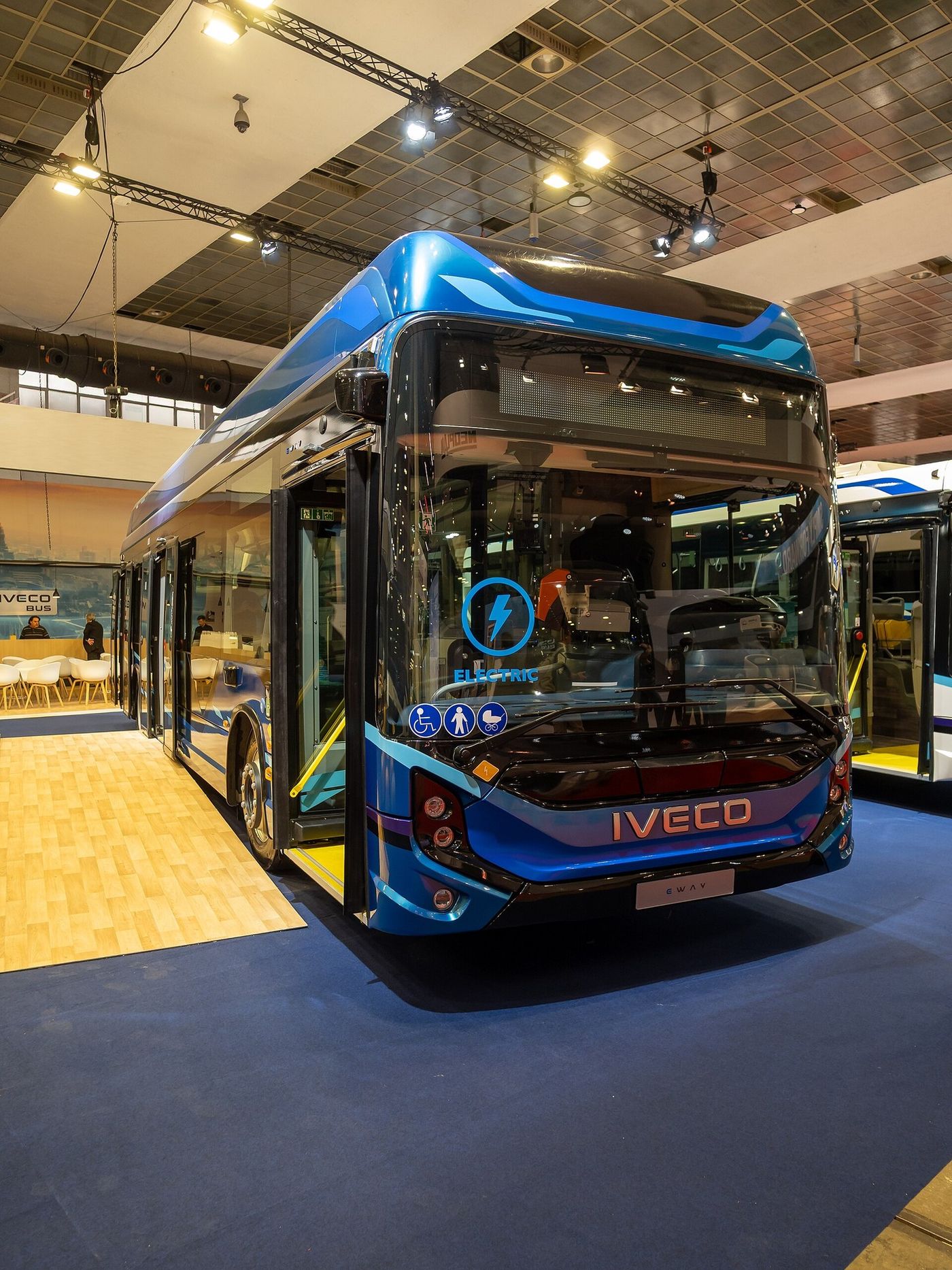

Model overview
- Segment
- Bus
- Transmission
- Central Siemens ELFA 3 electric motor in the rear compartment; ZF AV 133 rear axle
- Gross vehicle
- 20 000 kg
- Battery capacity
- 346–485 kWh
- Charging
- 150 kW (CCS Combo2)
- Electric motor
- 290 kW peak
- Length
- 12 050 mm
- Wheelbase
- 6 120 mm
- Capacity
- 27 or 24, plus a wheelchair space
- Doors
- 2 or 3 inward swinging/sliding doors
The E-Way is Iveco Bus’s battery-electric city bus, offered in four lengths, 9.5 m, 10.7 m, 12 m and 18 m, with the 12 m and 18 m buses also available as a Bus Rapid Transit (BRT) version named LINIUM. The figures on this page come from six Iveco Bus documents in English on the company’s international site, all read on 27 October 2026: the data sheets for the 12 m and 18 m E-Way, whose PDF files were created on 16 October 2024 and 16 January 2025; the data sheets for the 9.5 m and 10.7 m E-Way, both created on 6 October 2023; the E-Way brochure, footed PUBLICATION E-WAY_EN 10/24 and created on 21 October 2024; and the undated E-Way product page, which links the brochure and the four sheets. The sheets carry the address of IVECO France in Vénissieux. Iveco Bus’s intercity range is described on the Iveco Crossway page.
Four lengths and the LINIUM version
The brochure’s range page reads “the E-Way by HEULIEZ is available in 4 different lengths (9.5 m, 10.7, 12 m and 18 m), with a choice of overnight slow charging or fast charging using a pantograph”. Its range table gives length by width as 9.5 by 2.33 m, 10.7 by 2.33 m, 12 by 2.55 m and 18 by 2.55 m, and the configuration as STD for the two shorter buses and STD / BRT for the 12 m and 18 m. The product page calls the two shorter buses the “E-WAY midibus models”, 9.5 or 10.7 m long and 2.33 m wide.
The product page says that the 12 m and 18 m models “now are available as a Bus Rapid Transit system (BRT version), named LINIUM”, and that the customisation of the LINIUM “includes among other things, a distinctive front end, roof trim and wheel covers”. The 12 m and 18 m data sheets list a GX LINIUM front end and wheel covers as BRT options. They give the BRT version as 12,302 mm and 18,212 mm long and the standard version as 12,050 mm and 17,960 mm, with an overhang of 2,957 mm for the BRT version and 2,705 mm for the standard one.
Dimensions and weights
| Data sheet row | 9.5 m | 10.7 m | 12 m | 18 m |
|---|---|---|---|---|
| Gross vehicle weight (G.V.W. max permitted weight) | 16,000 kg | 17,900 kg | 20,000 kg | 30,000 kg |
| Overall length (12 m, 18 m: standard / BRT version) | 9,510 mm | 10,735 mm | 12,050 / 12,302 mm | 17,960 / 18,212 mm |
| Overhang (12 m, 18 m: standard / BRT version) | 2,505 mm | 2,505 mm | 2,705 / 2,957 mm | 2,705 / 2,957 mm |
| Wheelbase | 4,130 mm | 5,355 mm | 6,120 mm | 5,355 / 6,675 mm |
| Overall width | 2,330 mm | 2,330 mm | 2,550 mm | 2,550 mm |
| Total height, full load (12 m, 18 m: without / with pantograph) | 3,234 mm | 3,234 mm | 3,234 / 3,318 mm | 3,234 / 3,318 mm |
| Inside headroom (12 m, 18 m: front part / rear part) | 2,370 mm | 2,370 mm | 2,384 / 2,262 mm | 2,384 / 2,262 mm |
| Slope of the floor (rear part only) | 7.2% | 7.2% | 7.2% | 7.2% |
| First step height, front door | 320 mm | 320 mm | 320 mm | 320 mm |
| First step height, centre door (12 m, 18 m: centre / rear door) | 330 mm | 330 mm | 330 / 340 mm | 330 / 340 mm |
| Width of doors (9.5 m, 10.7 m: front / centre) | 1,000 / 1,200 mm | 1,000 / 1,200 mm | 1,200 mm | 1,200 mm |
| Floor height | 340 mm | 340 mm | 340 mm | 340 mm |
| Ground clearance, under skirt | 300 mm | 300 mm | 300 mm | 300 mm |
| Front / rear tracking | 1,950 / 1,796 mm | 1,950 / 1,796 mm | 2,087 / 1,869 mm | 2,087 / 1,869 mm |
| Inner turning radius | 6,570 mm | 8,085 mm | 9,095 mm | 10,182 mm |
| Outer turning radius | 8,147 mm | 9,671 mm | 10,890 mm | 11,650 mm |
| Angle of attack / escape | 8° / 8° | 8° / 8° | 7.4° / 7.2° | 7.4° / 7.4° |
The 12 m and 18 m sheets give the kerb weight as “according to equipment”; the 9.5 m and 10.7 m sheets have no kerb-weight row. The 18 m sheet prints two wheelbase figures, 5,355 / 6,675 mm, without naming them. The brochure says that the battery technology and the layout of the E-Way keep “the overall height of the vehicle” below 3300 mm, “allowing the E-Way to pass under small bridges and small tunnels”.
Seats and doors
| Length | Doors | Seat layouts drawn on the sheet |
|---|---|---|
| 9.5 m | 2 | 16 seats + wheelchair space + driver |
| 10.7 m | 2 | 17 seats + wheelchair space + driver |
| 12 m | 2 or 3 | 27 seats + wheelchair space + driver; 24 seats + wheelchair space + driver |
| 18 m | 3 or 4 | 35 seats + wheelchair space + driver |
All four sheets describe the doors as inward swinging/sliding, with both leaves of the front door double-glazed, and list a manual or electric 800 mm access ramp at the central door; the 12 m and 18 m sheets give the doors as electric or pneumatic. A kneeling and raising system with a 72 mm stroke works on the right-hand side of the bus and is controlled from the driving position. The sheets list a wheelchair and pram space, cantilever seats, epoxy or stainless-steel handrails (stanchions and handrails on the 18 m sheet) and a high-wear-resistant floor covering up to the top of the plinths. No document opened gives a standing or total passenger capacity.
The product page says the floor is flat “along the entire length of the vehicle” for passengers with reduced mobility, prams or wheelchairs, that interior colours and seat layouts can be chosen, and that integrated information screens and video surveillance are available. The brochure describes triangular windows in the lower section of the platform and full LED lighting, with the Lampa’Bus option for indirect ambient lighting in blue, green or white. The accessibility requirements for ramps, kneeling systems and wheelchair spaces are set out in bus accessibility.
Electric motor and drive
All four data sheets name a Siemens ELFA 3 electric motor. The brochure describes a new central eMotor in the rear compartment, with its power electronics stowed there, and says that the high-voltage equipment and the eDrive are installed in the rear compartment and on the roof, “leaving the passenger room and the floor free from any HV device”. The sheets and the brochure give these ratings:
| Document | 9.5 m | 10.7 m | 12 m | 18 m |
|---|---|---|---|---|
| Data sheet, power | 310 kW peak power | 310 kW peak power | 290 kW max power (R85) | 450 kW max power (R85) |
| Data sheet, maximum torque | 3,000 Nm | 3,000 Nm | 3,000 Nm | 5,000 Nm |
| Brochure, maximum power | 290 kW | 290 kW | 290 kW | 450 kW |
| Brochure, maximum torque | 3,000 Nm | 3,000 Nm | 3,000 Nm | 4,000 Nm |
The brochure’s text says the eMotor delivers “up to 290 kW power for 9.5, 10.7 and 12 meters, whereas it delivers up to 450 kW for the 18 m bus”. The 18 m sheet carries the words “To be updated” at the top of its second page, where its motor, battery and equipment are listed. No document opened splits continuous from peak power or names a gearbox.
The rear axle on all four sheets is a ZF AV 133, with a row reading “Axle torque: 7,36 (16x37)” (“Axle torque: 7,36 - 16 x 37” on the 18 m sheet). The front axle has independent wheels; the 12 m and 18 m sheets head their front-axle entry with “8,165 tons axle”. How a battery-electric city bus is put together is explained in electric buses explained.
Batteries and charging
All four sheets list an NMC (nickel manganese cobalt) “High energy battery”. The brochure calls it “the latest NMC battery technology industrialized specifically by FPT for IVECO BUS, whose single-unit capacity reaches 69.3 kWh”, in packs of which some sit on the roof and the others in the rear compartment, and the product page speaks of NMC chemistry with a “high-performance Battery Management System”. What NMC stands for is set out in battery chemistries in heavy trucks.
| Length | Data sheet: serial | Data sheet: option | Brochure: packs and capacity |
|---|---|---|---|
| 9.5 m | 346 kWh (no serial/option label) | none listed | 5 packs, 346 kWh |
| 10.7 m | 346 kWh | 416 kWh | 5 packs, 346 kWh; 6 packs, 416 kWh |
| 12 m | 346 kWh | 416 or 485 kWh | 5 packs, 346 kWh; 6 packs, 416 kWh; 7 packs, 485 kWh |
| 18 m | 416 kWh | 485, 554 or 624 kWh | 5 packs, 346 kWh; 6 packs, 416 kWh; 7 packs, 485 kWh; 8 packs, 554 kWh; 9 packs, 624 kWh |
The brochure’s text says that “From 5 to 7 packs are offered for the 9.5, 10.7 and 12 meters, while the 18 meters version can include up to 9 packs”; its table lists five packs for the 9.5 m and five or six for the 10.7 m. It also says that with this battery technology “IVECO BUS can now offer overnight charging at the depot on the articulated version of the E-Way”, and that “The extended battery capacity will enable to provide a range of up to 400 km according to operation conditions”. No document opened gives a usable battery capacity. The product page describes a “Modularity approach”: “By increasing the payload on the front axle and introducing a new element in the design, we can create various combinations of roof component layouts to maximize passenger capacity based on desired autonomy and charging strategy.”
Every sheet lists a CCS Combo2 plug of up to 150 kW. The 12 m and 18 m sheets add opportunity charging by a bottom-up or top-down pantograph of up to 450 kW; the 9.5 m and 10.7 m sheets are headed OVERNIGHT CHARGE and list the plug alone. The product page describes overnight charging at the depot and opportunity charging by top-down or bottom-up pantograph, which it gives for the 12 and 18 m buses, says that smart charging “in accordance with ISO 15 118” is included, and says that “The plug-in charge can be placed at multiple points based on customer requirements and complies with VDV 236 standards”. The sheets declare compliance with ISO 15-118 for smart charging. The two pantograph arrangements are described in opportunity charging and pantographs.
The sheets list optional air conditioning for the passenger and/or driver’s compartment by an R134a system or a CO2 heat pump, and thermal comfort pre-conditioning. The brochure says the heat pump “can also use its power to keep the batteries in the proper temperature range”, and the product page says the CO2 heat pump works to optimise the electric consumption in cold and hot weather, “allowing to increase the portion of battery capacity dedicated to the traction of the vehicle”.
Suspension, brakes and wheels
Suspension is constant-height air suspension, with the kneeling and raising system on the right-hand side. Compressed air is at 10 bar from an electric compressor with an output of 400 l/min, with a single-tower air dryer, manual bleeding on the air tanks, a cyclone air cleaner and an oil separator.
The service brakes are air-controlled discs at the front and rear, with ABS-ASR and EBS. The parking brake and the door brake are controlled through separate circuits; the parking brake is pneumatic, applied by lack of air, with spring chambers on the rear wheels, and the brakes are applied when the central door opens. The sheets also list “Service braking: electrical FAE” and a retarder “made by the electric traction motor”, with a manual retarder control.
Tyres are Michelin or Bridgestone, 275/70 R 22.5 at the front; at the rear the 12 m and 18 m sheets give twin tyres and the 9.5 m and 10.7 m sheets 455/45 R 22.5 tyres. The 12 m and 18 m sheets list wheel covers as optional, and the brochure says the wheels carry sensors for a tyre pressure monitoring system.
Body, glazing and heating
The structure is self-supporting and integral, with the chassis protected against corrosion by cataphoretic immersion. The body consists of five panels, front, rear, left, right and top, made of welded stainless-steel sections and sheet panels and bolted to the chassis; the 18 m sheet gives five panels in that line and “Assembling of the 8 panels” in the next. The floor is 12 mm plywood protected by phenolic resins on both sides and wax-containing resins on the ground side. The front and rear ends, roof and side panels are composite and bonded, the wheel arches gravel-resistant and the bumpers composite in three parts; external advertising frames are optional. The product page says the stainless-steel structure goes with a design “rewarded at the DNA Paris Design Awards 2021”.
The windscreen is a bonded panoramic laminated glass, TSA tinted or Shade-Lite, and the driver’s window slides in its front part. The side windows are bonded, in TSA tinted glass all round or in Athermal Venus Grey 40 or 35 tinted glass except the driver’s window, front door and rear window; triangular windows on the platform are optional. The roof is insulated, with two air exhausters on its rear part (four on the 18 m sheet). The sheets list a “HVO or fuel or electric 20 kW or mix HVO/electric heater”, one to three heaters for the passenger compartment on the 12 m and 18 m and one or two on the 9.5 m and 10.7 m, and thermal insulation of the water circuit.
Electrical equipment and driver’s area
The sheets list two maintenance-free 12 V batteries, 225 Ah on the 12 m and 18 m and 185 Ah on the 9.5 m and 10.7 m, on a sliding support in an outside compartment at the front left, and a 600/24 V DC/DC converter with an optional 24 V plug in the rear compartment. Lighting is LED inside and outside, with doorstep lighting at door opening, lighting of the driver’s compartment, paying position and steps, and optional atmosphere lighting. The sheets also list an FMS 4.0 socket, an electricity-saving system for intensive use “whilst engine is off”, thermal circuit-breakers, a FENWICK socket for battery re-loading and starting, four passenger loudspeakers (eight on the 18 m sheet), one driver loudspeaker and one outside loudspeaker, preparation for front, side and rear electronic destination panels, a telematics system and a cybersecurity secure logger. Flashing/stop indicators on the top of the rear end, complete radio equipment, a gong for pedestrian zones, front fog lights and preparation for ITxPT are optional.
The driver has a steering wheel adjustable for height and angle, an air-suspended seat with its adjustment control on the right-hand side, a VDV instrument panel with warning lamps and a control display panel, two spotlights and a luggage box, and a driver’s door with or without an anti-aggression gate; the wall behind the driver has a glazed upper part. The sheets list manual or electric left and right rear-view mirrors, self-defrosting and with integrated flag holders, and camera mirrors with or without an approach camera. The product page says the driver’s position is elevated in relation to the passenger floor, and describes a lateral dashboard and a digital cluster.
Safety and driver assistance
Each sheet lists, under “ADAS/GSR equipment including”, a blind spot information system, a moving off information system, a reverse camera, intelligent speed assistance with a speed limit display, driver drowsiness and attention warning, preparation for an alcohol interlock, tyre pressure monitoring and an emergency stop signal. The brochure places BSIS, MOIS, ISA and DDAW in the new front face: a radar in the front and a camera behind the windscreen that together detect vulnerable road users approaching from the front and the sides, and road signals, with a light sensor in the camera that switches the headlights on automatically. It describes blind spot monitoring on the right side, with the left side as an option, and a rear camera with dynamic lines that warns of the risk of collision with a vulnerable road user, shown on a screen in the upper front panel or at the top right. The product page lists camera mirrors, a bird’s-eye view and BSIS on the driver’s side as systems in addition to those mandatory under the GSR. The systems the GSR requires are listed in mandatory driver assistance systems.
The certification section of the sheets reads “In accordance with the R100-2 Regulation”, “In accordance with the appendix 8 of the ECE R107 Regulation and with the appendix 11 of the decree of August 3rd, 2007” and “Compliance with R66, R29 & R93 standards”, with compliance with ISO 15-118 for smart charging. The brochure ties R29 to the driver’s workplace, R66 to the passenger room and R93 to frontal collisions with a car, and the product page says that the E-Way structure “offers leading achievements in both mandatory and complementary regulations for passive safety in a class I CityBus”. What R66 covers is set out in UN R66 rollover strength.
Connectivity
The brochure says the Smart Pack is included as series equipment in all IVECO BUS heavy range vehicles, with the IVECO ON customer portal and control room reports, including a dedicated traction battery report, and it describes the IVECO Easy Bus app, with driving style evaluation and over-the-air software updates. The Premium Pack is a fleet management service for real-time indicators such as geolocation, energy consumption and traction battery state of charge or remaining range; the brochure says that new services “will support” e-bus fleets with charging station monitoring, smart charging and depot management, and presents fleet management products from ChargePoint, which it says can be activated through the IVECO ON portal. The TiGR Web API, which the brochure says is specified by the European ITxPT association, delivers fleet data as a standardised multi-brand data stream. The product page adds real-time online fleet reports, control room support and a web API for custom reports.
Model line
Iveco Bus’s brochure says the company has “more than 20 years of experience paving the way for generations of trolleybuses, hybrid buses and battery-electric buses”, and that “Close to 1,000 units are currently in service in more than a dozen European countries, having run more than 55,000,000 km”. It presents the current bus as the “E-Way new generation”, and the product page as “the new IVECO BUS E-WAY”. No document opened gives a launch date for the E-Way or for its new generation, or describes the earlier E-Way.
Source notes
The overview figures are the 12 m E-Way’s in its standard version, from the international data sheet EN-Eway-12m-01_2025 (PDF created 16 October 2024): a Siemens ELFA 3 electric motor of 290 kW maximum power (R85) and 3,000 Nm, NMC batteries of 346 kWh as standard and 416 or 485 kWh as options, a CCS Combo2 plug of up to 150 kW and opportunity charging by bottom-up or top-down pantograph of up to 450 kW, a gross vehicle weight of 20,000 kg, a length of 12,050 mm (12,302 mm for the BRT version), a width of 2,550 mm, a height at full load of 3,234 mm without and 3,318 mm with pantograph, a wheelbase of 6,120 mm, 27 or 24 seats, each layout with a wheelchair space, and 2 or 3 doors. The kerb-weight row of the 12 m and 18 m sheets reads according to equipment. The 18 m sheet (PDF created 16 January 2025) gives 450 kW maximum power (R85), 5,000 Nm, 416 kWh as standard and 485, 554 or 624 kWh as options, the same plug and pantograph ratings, a gross vehicle weight of 30,000 kg, a length of 17,960 mm (18,212 mm for the BRT version), wheelbases of 5,355 / 6,675 mm, inner and outer turning radii of 10,182 and 11,650 mm, 35 seats with a wheelchair space and 3 or 4 doors; its second page carries the words To be updated at the top. The brochure footed PUBLICATION E-WAY_EN 10/24 gives the 18 m bus 450 kW and 4,000 Nm and lists 5 to 9 packs, 346 to 624 kWh, for it. The 9.5 m and 10.7 m sheets (PDFs created 6 October 2023, headed OVERNIGHT CHARGE) give a Siemens ELFA 3 motor of 310 kW peak power and 3,000 Nm, 346 kWh for the 9.5 m and 346 kWh with 416 kWh as an option for the 10.7 m, the CCS Combo2 plug of up to 150 kW and no pantograph, gross vehicle weights of 16,000 and 17,900 kg, lengths of 9,510 and 10,735 mm, a width of 2,330 mm, wheelbases of 4,130 and 5,355 mm, 16 and 17 seats with a wheelchair space and 2 doors; the brochure gives these two lengths 290 kW and 3,000 Nm. The brochure’s range table lists 5 packs (346 kWh) for the 9.5 m, 5 or 6 packs (346 or 416 kWh) for the 10.7 m and 5 to 7 packs (346 to 485 kWh) for the 12 m, while its text says that 5 to 7 packs are offered for the 9.5, 10.7 and 12 m and up to 9 for the 18 m, with a single-pack capacity of 69.3 kWh. No document opened gives a launch date, a description of an earlier generation, a kerb weight figure, a usable battery capacity, a standing or total passenger capacity, a wheel formula or a gearbox.
Quick answers
- Which transmission does the Iveco E-Way use?
- Transmission: Central Siemens ELFA 3 electric motor in the rear compartment; ZF AV 133 rear axle.
- What is the gross vehicle weight of the Iveco E-Way?
- Gross vehicle weight: 20 000 kg.
- What battery capacity does the Iveco E-Way have?
- Battery capacity: 346–485 kWh; Charging: 150 kW (CCS Combo2).
- How long is the Iveco E-Way?
- Length: 12 050 mm; Wheelbase: 6 120 mm.
- How many passengers does the Iveco E-Way carry?
- Capacity: 27 or 24, plus a wheelchair space.
Articles that mention the Iveco E-Way
More Iveco on this site
Sources
- E-WAY FULL ELECTRIC 12m — international data sheet (EN-Eway-12m-01_2025, PDF created 16 October 2024) — Iveco Bus
- E-WAY FULL ELECTRIC 18m — international data sheet (EN-Eway-18m-01-2025, PDF created 16 January 2025) — Iveco Bus
- E-WAY FULL ELECTRIC 10.7 m — international data sheet (PDF created 6 October 2023) — Iveco Bus
- E-WAY FULL ELECTRIC 9.5 m — international data sheet (PDF created 6 October 2023) — Iveco Bus
- E-Way — brochure (PUBLICATION E-WAY_EN 10/24) — Iveco Bus
- E-WAY — city bus product page (worldwide site) — Iveco Bus