Truck driving licences: C1, C1E, C and CE, and minimum ages
Category CE is a C truck with a trailer over 750 kg; C1 ends at 7,500 kg. C and CE need 21, or 18 with a CPC, and a new directive takes over in 2029.
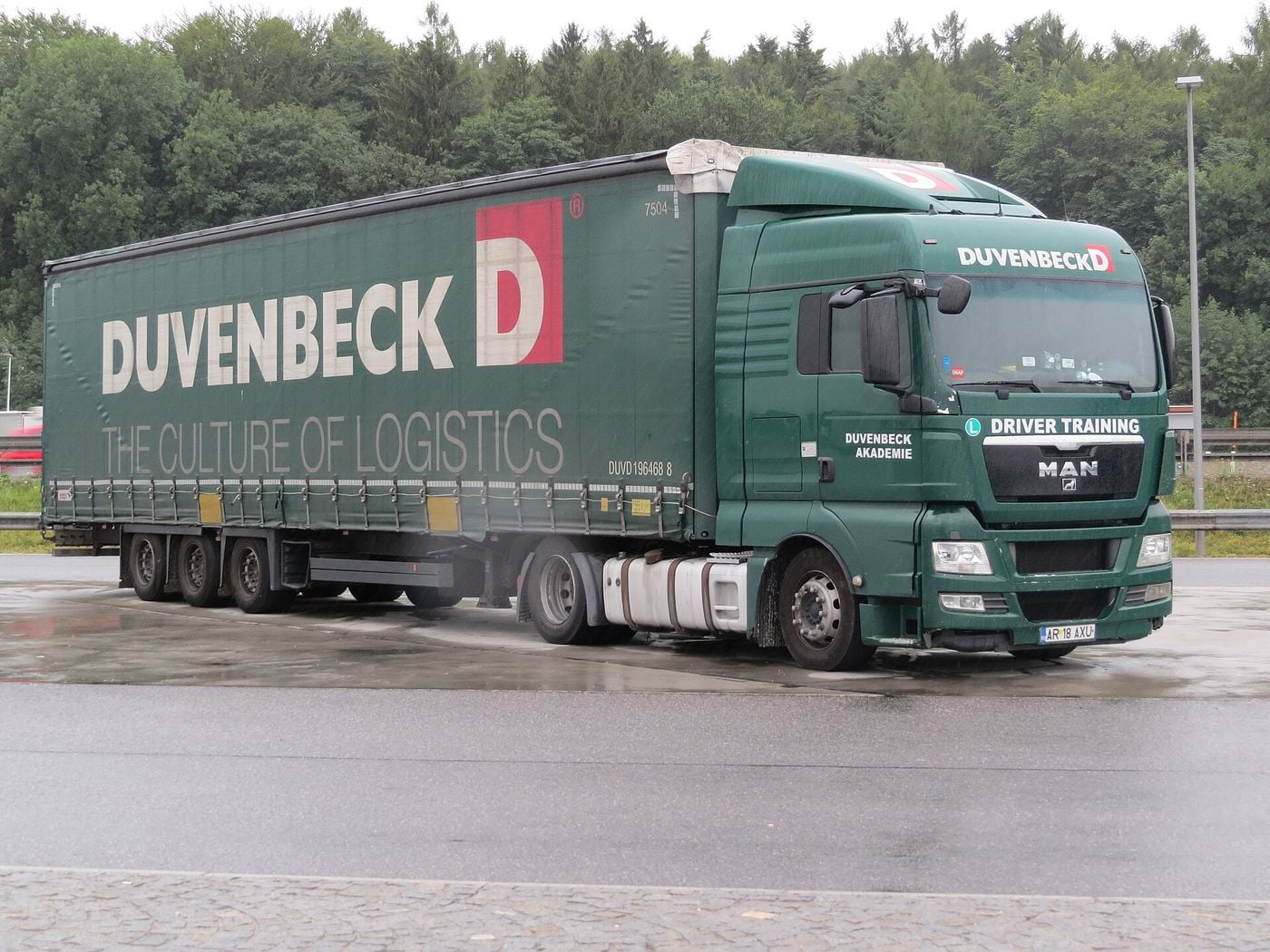
The European driving licence has no category called truck. It has four goods categories, C1, C1E, C and CE, divided by a maximum authorised mass of 7,500 kg, by a trailer of 750 kg, and by a limit of eight passengers in addition to the driver. The ages attached to them are not one number either, because the licence directive in force hands part of the question to the professional qualification directive, and the directive that replaces it has already been adopted on a timetable that runs to 26 November 2029. Great Britain publishes its own licensing rules through DVLA and DVSA; they are read separately in HGV licences in Great Britain and Driver CPC in Great Britain.
In short, under Directive 2006/126/EC, the directive in force: a motor vehicle other than those in categories D1 or D, with a maximum authorised mass over 3,500 kg, designed and constructed for no more than eight passengers in addition to the driver, is in category C, which has no upper mass limit; category C1 takes the same vehicles up to a maximum authorised mass of 7,500 kg. Either may pull a trailer with a maximum authorised mass not exceeding 750 kg. A C vehicle drawing a trailer or semi-trailer with a maximum authorised mass over 750 kg is in CE, which covers an articulated vehicle and a C vehicle with a trailer alike, and a C1 vehicle drawing one is in C1E, provided the combination does not exceed 12,000 kg. A vehicle designed and constructed for more than eight passengers is in a bus category however much it weighs, as set out in bus driving licences.
The four goods categories
Directive 2006/126/EC is the driving licence directive in force; EUR-Lex shows it as “In force: This act has been changed. Current consolidated version: 01/11/2020”. It defines the four categories in Article 4(4), points (d) to (g).
| Category | What it covers |
|---|---|
| C1 | Motor vehicles other than those in categories D1 or D, with a maximum authorised mass over 3,500 kg but not over 7,500 kg, designed and constructed for no more than eight passengers in addition to the driver; may be combined with a trailer with a maximum authorised mass not exceeding 750 kg |
| C1E | A C1 tractor vehicle with a trailer or semi-trailer with a maximum authorised mass over 750 kg, the combination not exceeding 12,000 kg; or a category B tractor vehicle with a trailer or semi-trailer over 3,500 kg, the combination not exceeding 12,000 kg |
| C | Motor vehicles other than those in categories D1 or D, with a maximum authorised mass over 3,500 kg, designed and constructed for no more than eight passengers in addition to the driver; may be combined with a trailer with a maximum authorised mass not exceeding 750 kg |
| CE | A C tractor vehicle with a trailer or semi-trailer with a maximum authorised mass over 750 kg |
Three parts of those definitions do most of the work. The first is the line at 7,500 kg, which is the entire difference between C1 and C: category C has no upper mass bound. The second is the passenger limb. Both solo categories exclude vehicles in D1 or D and are confined to vehicles designed and constructed for no more than eight passengers in addition to the driver, so a vehicle built for more is in a bus category however much it weighs; those are set out in bus driving licences. The third is the trailer. A C1 or C vehicle may pull a trailer of up to 750 kg on its own licence, and a heavier one moves the combination into C1E or CE.
CE has no mass ceiling of its own. Its definition asks only that the tractor vehicle be in category C and that the trailer or semi-trailer exceed 750 kg, so it covers an articulated vehicle and a C vehicle with a trailer alike; Annex II, point 5.2, accepts either as the test vehicle for the category. What such a combination may actually weigh on the road is a different rulebook, set out in truck weights.
C1E is the one category of the four whose definition caps the combination, at 12,000 kg, and the one with a second way in. Its second indent takes a category B tractor vehicle with a trailer or semi-trailer over 3,500 kg, provided the combination stays within 12,000 kg. That is where a car or van towing a heavy trailer lands, because category BE, in point (c) of the same paragraph, stops at a trailer or semi-trailer with a maximum authorised mass not exceeding 3,500 kg.
The licence lines are not the type-approval lines. Article 4(1)(b) of Regulation (EU) 2018/858 divides goods vehicles by maximum mass into N1, not exceeding 3.5 tonnes, N2, above 3.5 and not exceeding 12 tonnes, and N3, above 12 tonnes. The licence shares the first boundary but not the second: its step from C1 to C comes at 7,500 kg of maximum authorised mass, inside the N2 band, so an N2 vehicle is not by that fact a C1 vehicle. The two schemes touch at the trailer. Where Directive 2006/126/EC speaks of a trailer with a maximum authorised mass not exceeding 750 kg, Directive (EU) 2025/2205 speaks of a trailer of category O1 under Article 4(1)(c)(i) of that Regulation, which is a trailer with a maximum mass not exceeding 0.75 tonnes.
Which licence comes before which
Today the categories are staged. Article 6(1)(a) of Directive 2006/126/EC issues C1 and C only to drivers already entitled to drive category B, and point (b) issues C1E and CE only to drivers already entitled to drive C1 and C respectively, so a combination category is always added to its solo category. Nothing requires C1 before C. Article 6(2) then runs the equivalences downwards: a C licence is valid for C1 under point (f), a CE licence for C1E combinations under point (c), and C1E and CE licences for BE combinations under point (a).
From 26 November 2029 the staging is flatter. Article 9(1) of Directive (EU) 2025/2205 issues BE, C1, C1E, C and CE, along with the bus categories, only to drivers already entitled to drive category B, and names no other prerequisite. Article 9(2)(d) makes a CE licence also valid for C and C1, and point (f) a C1E licence valid for C1. The test is written for the driver who arrives at a combination category without the solo one: Annex II, point 8(2), requires that where the applicant is not already entitled to drive C1 or C, competence in driving the towing vehicle without a trailer be ensured before driving in traffic with a trailer connected. Annex II of Directive 2006/126/EC has no such point. Read together, and the reading is ours rather than a sentence in either directive, a driver may go from a car licence to CE in one step once the new rules apply, and then holds C and C1 by equivalence.
The ages that apply today
Article 4(4) of Directive 2006/126/EC fixes the minimum age at 18 years for C1 and C1E, in the last indent of point (e), and at 21 years for C and CE, in the last indent of point (g). For C and CE that is not the whole answer.
Article 4(7), added by Directive (EU) 2018/645, derogates from point (g): the minimum age for issuing a C or CE licence “shall be the minimum age prescribed for the driving of such vehicles for holders of a CPC” in Article 5(2) of the qualification directive, “as applicable”. The reference still names Directive 2003/59/EC, and Article 14 of Directive (EU) 2022/2561, which repealed it, construes it as a reference to the codified text. Its Article 5(2) sets 18 for C and C+E with the full CPC of Article 6(1), 18 for C1 and C1+E with the accelerated CPC of Article 6(2), and 21 for C and C+E with the accelerated one; under its Annex III, C+E and C1+E are that directive’s notation for CE and C1E. How that hand-off governs entry to the job is set out in European truck driver supply, and what each certificate involves in Driver CPC explained.
Article 4(7) does not say in terms that the lower age depends on the applicant holding the certificate; reading it that way is ours. The new directive puts the condition in words. Annex VII of Directive (EU) 2025/2205 maps the first subparagraph of Article 4(7) onto Article 7(1), points (e) and (g), which grant their ages only “provided that the driver holds” a CPC. With the accelerated certificate the age is 21, the same figure as point (g) of the old text.
| Category | Directive 2006/126/EC, today | With a CPC, Directive (EU) 2022/2561 | Directive (EU) 2025/2205, from 26 November 2029 |
|---|---|---|---|
| C1, C1E | 18, point (e) | 18 with an Article 6(2) CPC, point (a)(ii) | 18, point (b) |
| C, CE | 21, point (g) | 18 with an Article 6(1) CPC, point (a)(i); 21 with an Article 6(2) CPC, point (b) | 21, point (d); 18 with an Article 6(1) CPC, point (e) |
The licence directive has one national option below 21 that does not turn on a CPC, and it is narrow. The second subparagraph of Article 4(6) lets a Member State lower the minimum age for category C to 18 for vehicles used by the fire service and vehicles used for maintaining public order, and for vehicles undergoing road tests for repair or maintenance purposes. A licence issued that way is valid only on the territory of the issuing Member State until the holder reaches the minimum age in paragraphs 2 to 4, and other Member States may, but need not, recognise it on theirs.
The qualification directive has an option of its own. Under the last subparagraph of Article 3(1)(a) of Directive (EU) 2022/2561, a Member State may authorise a driver to drive within its territory before obtaining a CPC while undergoing a national vocational training course of at least six months, for a maximum period of three years. That provision speaks to the certificate, not to the licence, and names no age.
In Türkiye
Both directives are addressed to the Member States: Directive 2006/126/EC in its Article 19, Directive (EU) 2025/2205 in its Article 32. In Türkiye the licence categories, and the age and experience conditions for a licence, are left to regulation by Articles 38 and 41 of Law No 2918 on Road Traffic (Karayolları Trafik Kanunu), and the Road Traffic Regulation (Karayolları Trafik Yönetmeliği), which its Article 2 says was issued under that law, sets them.
Article 75 of the Regulation uses the same four goods category names, in its own wording. C1 is issued to those who will drive trucks and tractor units with a maximum laden mass over 3,500 kg and not over 7,500 kg, C to those who will drive trucks and tractor units, and CE to those who will drive combinations of a vehicle used with a C licence and a trailer or semi-trailer with a maximum laden mass over 750 kg; C1E, like the directive’s, stops at a combination of 12,000 kg. Article 3 defines a truck as a motor vehicle built to carry goods with a permissible maximum laden mass over 3.5 tonnes, and a tractor unit as a motor vehicle built to draw trailers and semi-trailers that carries no goods.
Article 85 lets a C holder also drive the vehicles used with M (mopeds), B, B1, C1 and F (wheeled tractors) licences, and a CE holder those used with M, B, BE, B1, C, C1, C1E and F licences and, where the holder also has category D, with DE, D and D1E licences as well. Under Article 86, holders of B, C, C1, D and D1 licences may also draw a light trailer with a maximum laden mass of up to 750 kg, 750 kg included.
Article 76 requires applicants to have completed the age of 18 for C1 and C1E and of 21 for C and CE, and to hold at least category B for C1 or C, category C1 for C1E and category C for CE. It has no age of 18 for C or CE tied to a certificate of professional competence. The one lower age it names for C is 20, for those studying at or graduated from the education and training institutions of the General Directorate of Security or the officer and non-commissioned-officer schools and courses of the Turkish Armed Forces that the article lists, and for graduates of university colleges that give driver education; it applies to A, C, D and D1, not to CE, and the article’s experience condition is not required of them. Under Article 87, C1, C1E, C and CE licences are valid for five years.
When the new directive takes over
EUR-Lex records Directive (EU) 2025/2205 as in force from 25 November 2025, but in force is not the same as applied. Article 29(1) gives Member States until 26 November 2028 to adopt and publish the measures needed to comply with it and has them apply those measures from 26 November 2029, the date from which Article 30(1) repeals Directive 2006/126/EC; EUR-Lex lists 25 November 2029 as the old directive’s date of end of validity. Two parts run earlier. Article 29(2) brings the equivalences in Article 9(2), points (j) and (k), forward to 26 November 2027, the date from which Article 30(1) repeals the old Article 6(4)(c), and Article 29(3) brings the accompanied driving scheme of Article 17 forward to 26 November 2028. Apart from those two parts, the definitions, ages and validity rules a licensing authority applies until 26 November 2029 are those of Directive 2006/126/EC as transposed into national law. Annex VII, the correlation table, carries the old Article 4(4), points (d) to (g), into Article 6(1)(c)(iv) to (vii) of the new directive and their age indents into Article 7(1).
What moves in 2029, and what moves earlier
For drivers of 18 and over, the goods ages do not move. Article 7(1) keeps 18 for C1 and C1E in point (b) and 21 for C and CE in point (d), and point (e) writes the professional exception into the licence directive itself: 18 for C and CE “provided that the driver holds” a CPC as referred to in Article 6(1) of Directive (EU) 2022/2561. Article 27 of the new directive amends Article 5 of the CPC directive, but only by adding a point (c) to paragraph 2 and by replacing paragraph 3, which holds the passenger ages. Points (a) and (b) of Article 5(2), the goods ages in the table above, are left as they are.
The national option for emergency work is reworded. Article 7(3) lets a Member State lower the age for category C to 18 for power-driven emergency vehicles used for the purpose of maintaining public safety and order, such as police vehicles, ambulances, civil protection and rescue vehicles, or fire brigade vehicles, and for vehicles undergoing road tests for repair or maintenance purposes; the old text names vehicles used by the fire service and for maintaining public order. Under Article 7(4) such a licence is still valid only on the issuing Member State’s territory until the holder reaches the paragraph 1 age, and a third subparagraph lets Member States mutually recognise the ones issued for emergency vehicles.
The 17-year-old is the genuinely new case, and it runs on the 2028 date. Article 17(2) allows a Member State, for driving on its own territory, to issue C1, C1E or C licences marked with Union code 98.02 to applicants who have reached 17 and hold a CPC under Article 6(1) for category C, or under Article 6(2) for C1 and C1E. CE is not in the list, and the scheme is optional for the Member State. Such licences are mutually recognised only among the Member States that issue them, and under Article 17(3) a holder under 18 drives only with an accompanying person in the front passenger seat. The conditions on that person, and what the scheme means for recruitment, are set out in European truck driver supply; the matching point (c) that Article 27(a) adds to Article 5(2) of the CPC directive is covered in Driver CPC explained.
Three changes bring vehicles in the C1 mass band within reach of a category B licence, and the first lands before 2029. Today Article 6(4)(c) of Directive 2006/126/EC lets a Member State, after consulting the Commission, authorise on its own territory the holder of a category B licence issued at least two years before to drive an alternatively fuelled vehicle with a maximum authorised mass over 3,500 kg but not over 4,250 kg for the transport of goods, without a trailer. It carries two conditions: the mass above 3,500 kg must be due exclusively to the extra mass of the propulsion system compared with a vehicle of the same dimensions with a conventional combustion engine, and the cargo capacity must not be increased. From 26 November 2027, Article 9(2)(j) of Directive (EU) 2025/2205 puts an equivalence in its place in the directive itself: two years after a category B licence was first issued, it is also valid for motor vehicles powered wholly or in part by alternative fuels and approved under Regulation (EU) 2018/858, with a maximum authorised mass over 3,500 kg but not over 4,250 kg, emergency vehicles included and motor caravans excluded, and with a trailer up to a combination of 5,000 kg where the training or test condition of Article 6(1)(c)(ii) has been met. Point (j) repeats neither the propulsion-mass condition nor the cargo-capacity condition. Point (k) extends the equivalence to a BE licence for such a vehicle drawing a trailer or semi-trailer of category O1 or O2.
The other two arrive with the rest of the directive on 26 November 2029, in the definition of category B in Article 6(1)(c)(ii). After a training course or a test of skills and behaviour under Annex V, or both where the Member State requires both, a category B licence also covers a motor caravan with a maximum authorised mass over 3,500 kg but not over 4,250 kg, including with a trailer where the combination does not exceed 5,000 kg. The same point takes in emergency vehicles, but only subject to a Member State’s authorisation under Article 9(4)(d): power-driven vehicles used for maintaining public safety and order, such as police vehicles, ambulances, civil protection and rescue vehicles, and fire brigade vehicles, over 3,500 kg but not over 5,000 kg, trailer included, driven on that Member State’s territory by B holders who have reached 20, have completed the same training or test, and drive solely for the purpose the vehicle is intended for, necessary maintenance and test drives included. Member States may mutually recognise licences issued under that point, and Annex VII shows no predecessor for it in Directive 2006/126/EC.
The new directive also brings a probationary period that the old one does not have; Annex VII shows no predecessor for Article 18. A holder of a licence issued after a driving test is a novice driver for at least two years, and Member States must set stricter rules or sanctions, or both, on driving under the influence of alcohol for novice drivers than for others. A novice who already holds another category serves in principle only what remains of the existing period, but for categories other than AM a Member State may require an additional or supplementary period, “in particular to take account of the different risks and required skills associated with the new driving licence category”.
Validity, renewal and the medical
The goods and passenger categories share one regime here, and its detail, including the powers Member States have to shorten validity under both directives, is set out in bus driving licences. In short, Article 7(2)(b) of Directive 2006/126/EC gives categories C, CE, C1 and C1E, with the four bus categories, an administrative validity of five years, and Article 10(2)(b) of Directive (EU) 2025/2205 keeps five. Renewal under Article 7(3) of the old directive depends on continuing compliance with the minimum standards of physical and mental fitness in Annex III, and on normal residence in the issuing Member State, or evidence of at least six months of study there. Annex III puts all eight heavy categories in Group 2, and its point 4 requires a medical examination before first issue and a check under the national system of the Member State of normal residence at each renewal; from 26 November 2029, Article 11(2) of the new directive names a medical examination before renewal, and the alternatives to it in Article 11(3), a self-assessment form or a national fitness-assessment system, are not open to these categories. One shortening power in the new Article 10(2) has no counterpart in Article 7(3) of the old text: it lets a Member State reduce the validity of licences held by persons granted a temporary residence permit or benefiting from temporary protection, or from adequate protection under national law. The driver’s ADR training certificate for dangerous goods is a separate document from the licence, with its own validity and renewal, covered in ADR driver training certificate.
What the test is taken in
Annex II sets minimum standards for the vehicle the test of skills and behaviour is taken in, and for the goods categories they sit well above the licence thresholds.
| Category | Minimum test vehicle |
|---|---|
| C1 | Maximum authorised mass at least 4,000 kg, length at least 5 m, capable of at least 80 km/h; anti-lock brakes; recording equipment; closed box body at least as wide and as high as the cab |
| C1E | A C1 test vehicle with a trailer of maximum authorised mass at least 1,250 kg; combination at least 8 m long and capable of at least 80 km/h; closed box body on the trailer; trailer presented with at least 800 kg real total mass |
| C | Maximum authorised mass at least 12,000 kg, length at least 8 m, width at least 2.40 m, capable of at least 80 km/h; anti-lock brakes; a transmission providing for manual selection of gears by the driver; recording equipment; closed box body at least as wide and as high as the cab; presented with at least 10,000 kg real total mass |
| CE | An articulated vehicle, or a C test vehicle with a trailer at least 7.5 m long; maximum authorised mass at least 20,000 kg, length at least 14 m, width at least 2.40 m, capable of at least 80 km/h; anti-lock brakes; a transmission providing for manual selection of gears by the driver; recording equipment; closed box body at least as wide and as high as the cab; presented with at least 15,000 kg real total mass |
Annex II, point 5(2), of Directive (EU) 2025/2205 keeps those masses and dimensions. It drops the requirement for a transmission providing manual selection of gears from the C and CE entries, allows a C1 test vehicle without recording equipment where the candidate is not being tested on its use, and recommends as good practice that a CE test vehicle have a fifth wheel and a gearbox with at least eight forward ratios.
The gearbox also decides what the licence says. Under Annex II, point 5.1, of Directive 2006/126/EC a vehicle with manual transmission is one with a clutch pedal that the driver must operate when starting or stopping the vehicle and changing gears. Anything else counts as automatic, and a test passed in an automatic vehicle is recorded on the licence, which may then be used only for vehicles with automatic transmission; Annex I lists the restriction as code 78. On that definition it is the pedal and not the gearbox design that counts, so an automated manual transmission without a clutch pedal for the driver to operate falls on the automatic side. Point 5.1.3 lets a Member State leave the restriction off a C, CE, C1 or C1E licence where the applicant already holds a licence obtained on a vehicle with manual transmission in B, BE or any of the eight heavy categories, and has performed during the test the actions in point 8.4: driving safely and so as to reduce fuel consumption and emissions, when necessary by selecting gears manually. The new Annex II keeps that option in point 5(1)(c), now for an applicant who already holds a licence without the automatic restriction. The dedicated training or test that point 5(1)(b) of the new Annex adds, to keep the restriction off or remove it later, is available only for categories A1, A2, A, B1, B and BE.
Quick answers
- What vehicles does a category C licence cover?
- Motor vehicles other than those in categories D1 or D with a maximum authorised mass over 3,500 kg, designed and constructed for no more than eight passengers in addition to the driver, under Article 4(4)(f) of Directive 2006/126/EC, the driving licence directive in force. A C vehicle may be combined with a trailer with a maximum authorised mass not exceeding 750 kg; the category has no upper mass limit, and a heavier trailer needs CE. Article 6(2)(f) makes a C licence also valid for C1, and Article 6(1)(a) issues it only to drivers already entitled to drive category B. Professional driving also requires, subject to the exemptions in its Article 2, a certificate of professional competence under Directive (EU) 2022/2561. In Türkiye, Article 75 of the Road Traffic Regulation issues category C to those who will drive trucks and tractor units, and Article 85 lets a C holder also drive the vehicles used with M, B, B1, C1 and F licences.
- What is the minimum age for a category C or CE licence?
- 21 under Article 4(4)(g) of Directive 2006/126/EC, the directive in force, whose Article 4(7) sets the minimum age for issuing a C or CE licence at the age prescribed for holders of a certificate of professional competence in Article 5(2) of Directive (EU) 2022/2561, 'as applicable'. That paragraph allows C and C+E from 18 with the CPC of its Article 6(1) and from 21 with the accelerated CPC of Article 6(2). Directive (EU) 2025/2205 states the condition in words: from 26 November 2029 its Article 7(1)(e) sets 18 for C and CE 'provided that the driver holds' an Article 6(1) CPC. A Member State may also lower the age for category C to 18 for fire service and public-order vehicles and for vehicles undergoing road tests for repair or maintenance purposes, but such a licence is valid only on its territory until the holder reaches 21. From 26 November 2028, Article 17(2) of Directive (EU) 2025/2205 also lets a Member State issue a category C licence, though not CE, from 17 to a holder of an Article 6(1) CPC, for driving on its territory, marked with Union code 98.02 and accompanied until 18. In Türkiye, Article 76 of the Road Traffic Regulation requires applicants to have completed 21 years for C and CE and 18 for C1 and C1E, with no age of 18 tied to a certificate of professional competence; the one lower age it names for C is 20, for students and graduates of listed police and Turkish Armed Forces institutions and for graduates of university colleges that give driver education, and it does not apply to CE.
- What is the difference between a C1 and a C licence?
- 7,500 kg. Category C1 covers vehicles with a maximum authorised mass over 3,500 kg but not over 7,500 kg, and category C has no upper mass limit, under Article 4(4), points (d) and (f), of Directive 2006/126/EC. Under the directive in force the minimum age differs as well: 18 for C1, and 21 for C, or 18 with an Article 6(1) CPC. From 26 November 2028, Article 17(2) of Directive (EU) 2025/2205 lets a Member State issue either from 17 to a holder of the relevant CPC, for accompanied driving on its territory. A C licence is also valid for C1 under Article 6(2)(f).
- Can you drive a 7.5-tonne truck on a car licence?
- No. Category B ends at a maximum authorised mass of 3,500 kg under Article 4(4)(b) of Directive 2006/126/EC, and a vehicle above that and up to 7,500 kg is category C1. For goods vehicles, Article 6(4)(c) of the directive in force lets a Member State authorise, on its own territory, holders of a B licence issued at least two years earlier to drive alternatively fuelled goods vehicles of up to 4,250 kg without a trailer. Article 6(4)(b) separately lets it authorise B holders over 21 whose licence is at least two years old to drive vehicles over 3,500 kg, with no upper mass named, but only vehicles whose main purpose is use only when stationary as an instructional or recreational area, used by non-commercial bodies for social purposes, and modified so that they cannot carry more than nine persons or any goods other than those strictly necessary for that purpose. From 26 November 2027, Article 9(2)(j) of Directive (EU) 2025/2205 replaces point (c) with an equivalence in the directive itself: the vehicle is still capped at 4,250 kg, with a trailer allowed up to a combination of 5,000 kg where the training or test condition of Article 6(1)(c)(ii) is met. From 26 November 2029, category B also covers motor caravans of up to 4,250 kg after that training or test, and, where a Member State authorises it under Article 9(4)(d), emergency vehicles of up to 5,000 kg, trailer included, driven on its territory by B holders aged 20 or over who have completed the same training or test and drive solely for the vehicle's purpose.
- How long is a truck driving licence valid?
- Five years. Article 7(2)(b) of Directive 2006/126/EC gives categories C, CE, C1 and C1E, together with the bus categories, an administrative validity of five years, and Article 10(2)(b) of Directive (EU) 2025/2205 keeps that period from 26 November 2029. Member States may shorten it, and renewal depends on continuing to meet the minimum standards of physical and mental fitness in Annex III.
- What vehicles does a category CE licence cover?
- Combinations in which the tractor vehicle is in category C and the trailer or semi-trailer has a maximum authorised mass over 750 kg, under Article 4(4)(g) of Directive 2006/126/EC, the driving licence directive in force. The definition sets no ceiling for the combination, so it covers an articulated vehicle and a C vehicle with a trailer alike. A CE licence is also valid for C1E combinations under Article 6(2)(c), for BE combinations under point (a) of that paragraph, and for DE as long as the holder is entitled to drive category D, under point (b). Today CE is issued only to drivers already entitled to drive C, under Article 6(1)(b); from 26 November 2029, Article 9(1) of Directive (EU) 2025/2205 names category B as the only prerequisite, and Article 9(2)(d) makes a CE licence also valid for C and C1. In Türkiye, Article 85 of the Road Traffic Regulation lets a CE holder also drive the vehicles used with M, B, BE, B1, C, C1, C1E and F licences, and Article 76 requires category C before CE.
Sources
- Directive 2006/126/EC on driving licences (Recast), consolidated text of 1 November 2020 — Articles 4, 6, 7 and 19, Annex I point 12 (code 78), Annex II points 5.1, 5.2 and 8, Annex III points 1 and 4 — EUR-Lex, European Union
- Directive 2006/126/EC — document information: status, amending acts and dates of end of validity — EUR-Lex, European Union
- Directive (EU) 2025/2205 of 22 October 2025 on driving licences — Articles 6, 7, 9, 10, 11, 17, 18, 27, 29, 30 and 32, Annex II points 5 and 8, Annex III point 1, Annex V, Annex VII — EUR-Lex, European Union
- Directive (EU) 2025/2205 — document information: status and dates — EUR-Lex, European Union
- Directive (EU) 2022/2561 on the initial qualification and periodic training of drivers of certain road vehicles for the carriage of goods or passengers (codification) — Articles 2, 3, 5, 6 and 14, Annex III — EUR-Lex, European Union
- Directive (EU) 2022/2561 — document information: status and amendments by Directive (EU) 2025/2205 — EUR-Lex, European Union
- Regulation (EU) 2018/858 on the approval and market surveillance of motor vehicles and their trailers — Article 4(1), vehicle categories — EUR-Lex, European Union
- Karayolları Trafik Yönetmeliği (Road Traffic Regulation, Türkiye), Official Gazette 18/7/1997 No 23053, consolidated text including the amendment of 3/7/2026 No 33299 — Articles 2, 3, 75, 76, 85, 86 and 87 (Articles 75, 76, 85, 86 and 87 as replaced by Official Gazette 17/4/2015 No 29329; the paragraphs later added to Articles 76 and 85 are not used here) — Mevzuat Bilgi Sistemi, Republic of Türkiye
- Law No 2918 on Road Traffic (Karayolları Trafik Kanunu) — Articles 38 and 41 — Mevzuat Bilgi Sistemi, Republic of Türkiye