Electric-truck maintenance compared with diesel: what goes, what stays
What Volvo's service-contract lists drop and keep when a truck goes electric, how Volvo, MAN and Scania describe intervals, and what Great Britain's DVSA checks differently.
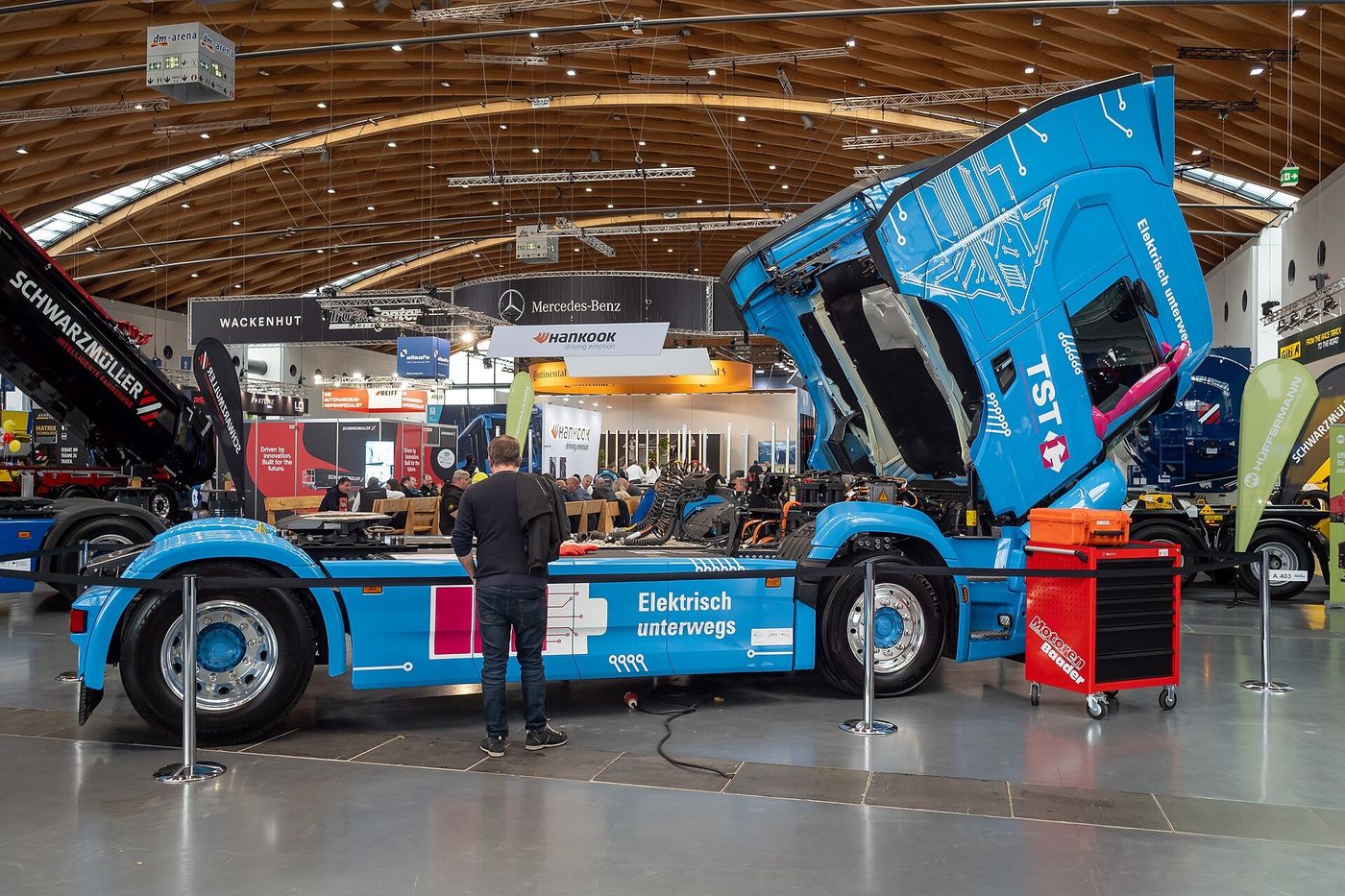
Volvo’s electric-truck FAQ says “The maintenance intervals are roughly the same, but servicing is different than servicing a traditional driveline”, and MAN says the average use of new eTrucks “can be less maintenance and wear-intensive than diesel vehicles – this depends very much on use”; neither puts a number on it. What differs is the list of work each contract names: by our count Volvo’s electric Blue service-contract list has ten items against seven on its diesel-and-gas Blue list, and it has no engine oil change, belt-and-tensioner replacement or particulate filter (DPF) item.
This page reads what three makers publish (Volvo’s service-contract lists and FAQ, MAN’s eTGX page, Scania Great Britain’s contract terms) and what the Driver and Vehicle Standards Agency (DVSA) publishes for Great Britain’s annual test and daily check. It cites no independent study comparing electric and diesel trucks for service frequency, cost or wear; none was opened. It describes what is maintained and what the contracts and inspections cover, not how anything is repaired; fault diagnosis, disassembly and part-replacement procedures are not here.
What Volvo’s contract lists drop and keep
Volvo Trucks’ Service Contracts page has three tabs: “Diesel & gas-powered trucks”, “Electric trucks” and “Used trucks”. Volvo says its Service Contracts for electric trucks work “the same way as Volvo Trucks’ standard Service Contracts” but have been “adapted to cover the components that make up the electric driveline, including the electric motor and energy storage system”. On both tabs the Blue level is described in the same words: it “covers all the necessary preventive maintenance required to keep your trucks in peak condition and is based on the actual usage of your truck”.
The page is Volvo’s global site, carries no publication date and was read on 29 September 2026. The lists below are Volvo’s own, not an industry rule, and Volvo’s country sites were not compared.
| Item | Diesel & gas-powered Blue | Electric Blue |
|---|---|---|
| Gearbox oil change | Listed | Listed |
| Axle oil change | Listed | Listed |
| Filter change | Listed | Listed |
| Engine oil change | Listed | Not listed |
| Belt & tensioner replacement | Listed | Not listed |
| Particulate filter (DPF) | Listed | Not listed |
| Main/basic checks | Listed | Not listed |
| Electric compressor oil chnage [sic] | Not listed | Listed |
| Coolant replace | Not listed | Listed |
| Cab and chassis lubrication | Not listed | Listed |
| Air dryer replacement | Not listed | Listed |
| Charging regulator replace | Not listed | Listed |
| Inspection & safety checks | Not listed | Listed |
| Software update | Not listed | Listed |
By our count the diesel-and-gas list has seven items and the electric list ten, and they share three: “Gearbox oil change”, “Axle oil change” and “Filter change”. On our reading of Volvo’s two lists, “Engine oil change”, “Belt & tensioner replacement”, “Particulate filter (DPF)” and “Main/basic checks” appear only on the diesel-and-gas list, and seven items appear only on the electric list, among them coolant, the air dryer, cab-and-chassis lubrication and a software update. The electric Blue and Silver lists print the compressor item as “chnage”; the Gold list prints “change”.
A name missing from a list is not a statement that the work is not done. Volvo’s electric Blue list names coolant, the air dryer and cab-and-chassis lubrication; its diesel-and-gas Blue list does not name them, and the page does not say what that means for either kind of truck. It gives no kilometre, hour or month interval for any item, and it does not define “Filter change” (which filter), “Charging regulator replace” or the repair-list items below; this page does not explain them either.
The Silver and Gold contracts add repair coverage, and the Gold contract adds wear-and-tear components. Volvo lists them per tab:
- Diesel-and-gas “Powertrain repairs”: “Engine”, “Exhaust system”, “Transmission”, “Drive unit”, “Fuel injection”, “Clutch cylinder”.
- Electric “Electric driveline repairs”: “Energy storage system (ESS)”, “Traction battery”, “DC/DC converter”, “Regenerative brake system”, “Energy storage control module”, “Extractable Service Box”, “On board charger”, “Charging switch unit”, “Cooling pump”, “Transmission”, “Drive unit”.
- Diesel-and-gas Gold “Wear & tear components”: “Batteries”, “Brake discs”, “Brake pads”, “Clutch plate”, “Thrust bearing”, “Springs”.
- Electric Gold “Wear & tear components”: “24V batteries”, “Brake discs”, “Brake pads”, “Wiper blades”.
By our count the repair lists hold six and eleven items, and both name “Transmission” and “Drive unit”. They are lists of what each contract covers; this page does not describe how any of these parts is repaired. “Brake discs” and “Brake pads” are wear-and-tear items on both Gold lists. No source read for this page quantifies how braking on an electric truck changes brake wear, so none is stated here.
Intervals: what Volvo, MAN and Scania say
Volvo’s FAQ answers “What about maintenance and Volvo electric trucks?” with “The maintenance intervals are roughly the same, but servicing is different than servicing a traditional driveline.” It adds that “the consumption of spare parts depends on the transport application, the region where the truck is in operation, and many other factors”, and that the trucks “are connected, and can report on the condition of different components”. The FAQ says it refers “specifically, unless stated otherwise, to cab-over-engine truck models: Volvo FH Aero, FH, FM, FMX, FM Low Entry, FE, and FL”. For one of those trucks, see the Volvo FH Electric model page.
MAN’s eTGX page says, under the heading “Maintenance and repair of the MAN eTGX battery”, that battery-led maintenance intervals “depend heavily” on how the truck is used and are “calculated and determined individually for each vehicle”, helped by “continuous analyses of the battery data (battery analysis)”. It speaks of battery-led intervals, not of every service interval on the truck; for the truck itself, see the MAN eTGX model page. In another passage the page says: “The average use of new MAN eTrucks can be less maintenance and wear-intensive than diesel vehicles – this depends very much on use.”
Scania (Great Britain)’s terms for battery-electric vehicles, with a publication date of 14 December 2023, define “Flexible Maintenance Services” as vehicle maintenance “not periodical as set out in a Vehicle-specific plan or schedule at the time of Vehicle delivery” whose content, “as to required maintenance measures along with intervals for and timing thereof”, “dynamically evolves over time depending on the prevailing and potentially fluctuating operational conditions for the Vehicle”. For that option the vehicle-specific maintenance schedule(s) “will vary depending on evaluation by Scania or Scania Workshops of changes in the operational conditions of the Vehicle(s)” (clause 2.10.1), and the workshop “shall endeavour to notify the Customer that the Vehicle or Ancillary Equipment is due planned Maintenance at least ten (10) days in advance of the due date for such Service” (clause 2.10.3). The same terms define “Maintenance” as maintaining a vehicle “according to its individualised program of scheduled maintenance”, and clause 2.10 opens “For Flexible Maintenance Services:”, so on our reading flexible maintenance is one option within the terms.
Scania (Great Britain) Limited’s general Repair and Maintenance Agreement (Rev. 21.08.2020) reads differently: under clause 2.1.1 the Company shall “carry out Routine Maintenance and inspections to the Vehicle at the intervals and in the manner prescribed by the manufacturer or at such intervals as may be required by regulations made under any Act of Parliament existing at the date hereof”. The two documents are more than three years apart, the 2020 agreement does not say which powertrain it is for, and neither document says whether the difference comes from the powertrain or from the years between them.
Electric contracts: battery monitoring, charging terms and exclusions
An article on Volvo Trucks Stories, dated 2024-12-04 on the page, lists what the Gold Service Contract for electric trucks includes; among the items are “Preventive maintenance tailored to the truck’s usage” and “Battery replacements”. The article says Volvo “can track the health and energy usage levels of the vehicle’s batteries in real time” and adds: “Since Volvo Trucks knows the maximum energy that any given customer needs, we can act if the minimum useable energy reaches certain levels earlier than expected.”
Scania (Great Britain)’s terms for battery-electric vehicles are governed by the laws of England and Wales (clause 12.7). Under clause 3.1.2 the Customer shall “use and maintain each Vehicle & Ancillary Equipment with due and diligent care as according to applicable operating manuals and other instructions by the manufacturer or Scania”, including “regular functionality checks, charging procedures and conditions, topping up of operational fluids and other ordinary maintenance measures”. Every exclusion below opens with “Unless otherwise agreed by the Parties in writing”. Clause 4.3 lists elements that “shall not form part of the Services”, among them:
- “battery charging (of any kind)” (clause 4.3.2);
- “repair, renewal or replacement of any Propulsion Battery or management system”, either (i) “due to capacity loss caused by natural degradation (i.e. electro-chemical reactions in the cell as a result of long-term use)” or (ii) one “that meets or exceeds its ‘Propulsion Batteries Coverage Limit’ or ‘Technical Life Length’ (each as contained in the R&M Schedule)” (clause 4.3.3).
Clause 4.4 says the Services “will not cover defects in, damages to or depreciation of a Vehicle or any Ancillary Equipment, nor for consequential costs, when arising as a direct or indirect result of, or otherwise caused by” a list that includes:
- “usage of improper Propulsion Battery charging devices or sockets, or not respecting the charging procedures and conditions as described in Vehicle operation instructions or the driver manual” (clause 4.4.2);
- “the tampering, removal or re(installation) of the Propulsion Battery by unauthorised parties” (clause 4.4.3);
- “the Propulsion Battery coming into direct contact with open fire or with excessive amounts of water (including through cleaning with high pressure cleaners or liquids being applied directly to the Propulsion Battery)” (clause 4.4.4).
The values of the “Propulsion Batteries Coverage Limit” and the “Technical Life Length” sit in the R&M Schedule, which is not published, so none is given here. Clause 4.3.3 is an exclusion in a repair-and-maintenance contract, not a description of any warranty. How makers state battery cover is set out in electric truck and bus battery warranties.
The terms also contain a contracted value for energy use per kilometre. “Cycled Energy” is defined as “the volume of electrical energy charged-in and recuperated from a Vehicle to its Propulsion Batteries plus the volume of the electrical energy discharged from the Propulsion Batteries (regardless of the purpose and the use of such discharged energy)”, and “Cycled Energy Per Km” as “the amount of Cycled Energy used by the Vehicle per km of operation as defined in the R&M Schedule”. If, at the end of an R&M Year, the actual value “exceeds the contracted value of Cycled Energy Per Km”, Scania is “entitled to review and vary the applicable Charges for the remaining Contract term” (clause 5.8.4). If the actual value exceeds the contracted value “by more than ten (10) percent”, Scania “may also at any time terminate this Contract (or alternatively, any part of the Services) with immediate effect through written notice” (clause 9.3.2.2). The two thresholds are separate: any excess for a charge review, more than ten (10) percent for termination. The contracted value is in the R&M Schedule; none is given here.
Set beside the 2020 general agreement, on our comparison of the two documents (Scania (Great Britain), 14 December 2023 and Rev. 21.08.2020, more than three years apart), tyres and consumables are excluded in both, so those two exclusions are not specific to the electric terms. The 2023 terms exclude “repair, replacement or balancing of tyres, wheels and fastening components” (clause 4.3.14) and “consumables, such as anti-freeze, oil and other operational fluids or lubricants used between Services” (clause 4.3.5); the 2020 agreement’s Excluded Items include “Tyres;” and “Antifreeze, coolant inhibitor, oils and lubricants (top-ups) used between services;”. The rest differs:
- Named in the 2023 terms and not in the 2020 agreement: battery charging, natural degradation of a propulsion battery, improper charging devices, unauthorised battery removal, contact with open fire or excessive water, Cycled Energy Per Km and Flexible Maintenance Services.
- Named in the 2020 agreement and not in the 2023 terms: “Routine Maintenance shall include Diesel Particulate Filter changes, and maintenance of filters and associated components (unless excluded in the Schedule)”, and, among Excluded Items, “ignored regeneration warnings and misuse (including early blocking of the Diesel Particulate Filter)”.
Daily checks and the annual test in Great Britain
The DVSA pages read here apply to England, Scotland and Wales; the GOV.UK manual page links a separate “Publication for Northern Ireland”, which was not read. The EU test framework and other countries’ practice are not described here; for the EU framework see Roadworthiness tests and roadside checks.
Daily walkaround. DVSA’s guidance “Carry out HGV daily walkaround checks” records an update of 18 April 2023: “Added 3 new items to the list of walkaround checks”. The three are item 9, “Security and condition of cab, doors and steps”; item 16, “High voltage emergency cut-off switch”; and item 17, “Alternative fuel systems and isolation”. Item 16 reads “Check that:”
- “you know where the high voltage emergency cut-off switch is located”;
- “the high voltage emergency cut off switch operates correctly”;
- “all high voltage electrical components are secure and not damaged”.
Item 14, “Diesel exhaust fluid (AdBlue)”, reads “Check that your diesel vehicle has enough AdBlue diesel exhaust fluid and top up if necessary”, and item 15, “Excessive engine exhaust smoke”, reads “Check that the exhaust does not emit an excessive amount of smoke”. DVSA’s page does not say which items apply to a battery-electric truck; on our reading, items 14 and 15 do not. For what AdBlue is, see SCR and AdBlue explained.
DVSA’s maintenance guide. The “Guide to maintaining roadworthiness” (cover dated April 2025) describes itself as “Outlining the regulatory requirements and industry best practice”; its sentences are reported here as the guide’s own, not as the text of a regulation. In its passage on “Alternatively fuelled vehicles”, whose list of categories includes “Battery Electric Vehicle (BEV)”, it says: “There are specific risks for each fuel type. Maintenance staff and drivers must be trained, provided with suitable safety equipment and aware of measures to be taken in emergency situations.” The passage does not say which training. The German and British answers to the question of who may work on a high-voltage vehicle are set out in who may work on high-voltage trucks and buses.
The annual test. DVSA’s HGV inspection manual sets out “Inspection processes and standards for lorry, trailer and other heavy goods vehicle (HGV) MOT tests (annual tests)”; the GOV.UK page was last updated on 19 February 2026 and lists the manual “from 1 April 2026”. The manual defines “EV (Electric Vehicle)” as “A vehicle that is powered by electric power train only”, adding that “A vehicle with a hydrogen fuel cell should be considered an electric vehicle”, and “HEV (Hybrid Electric Vehicle)” as “A vehicle powered by a power train that consists of both an internal combustion engine and an electrical energy/power storage device”. Some of its items that name hybrid or electric vehicles:
| Item | What the manual says |
|---|---|
| 05 Exhaust Emissions | “This inspection applies to all Compression Ignition engine vehicles.” For hybrids: “HEVs do not require a metered smoke test or a visual smoke test. However, if during the test excessive smoke is observed, this will be a deficiency under item 2b.” The manual does not say so for battery-electric vehicles; on our reading, the item does not apply to a battery-electric HGV. |
| 42 Electrical Wiring and Equipment | “When checking the condition and security of the wiring, care needs to be taken when inspecting the high voltage systems of Hybrid Electric Vehicles and Electric Vehicles. These high voltage wires are colour coded orange.” In the deficiency table, item 4 “A Power train:” is graded Major where it is “insecure” and Dangerous where it “presents a risk of fire or injury”. |
| 43 Engine and Transmission Mountings | “This inspection applies to all vehicles, including Hybrid Electric Vehicles and Electric Vehicles. Where there is separate power train equipment this should be treated as an engine/transmission.” |
| 57 Transmission | “This inspection applies to all vehicles including Hybrid Electric Vehicles (HEVs), Electric Vehicles (EVs) and to trailers with driven axles.” “Transmission shafts include those shafts that transmit drive for HEVs and EVs.” |
| 58 Additional Braking Devices | For hybrid and electric vehicles where the power train equipment acts as a regenerative brake, “the unit(s) should be inspected as if it is an additional braking device. This should be marked on the technical record.” |
| 71 Service Brake Performance | “Due to the nature of the control systems some vehicles cannot be tested on the Roller Brake Tester and must receive a decelerometer brake test.” “If the regenerative system cannot be disconnected from the service brake, a decelerometer brake test is required. If the regenerative system can be disconnected and the vehicle control system allows a roller brake test this must be carried out.” “Brake testing HEVs and EVs with a regenerative brake system must be appropriately charged (appropriately in this context, means the warning light is not illuminated).” |
Item 05 is one item of the inspection, not the whole test. For retarders and engine brakes, see Retarders and engine braking explained.
What these sources do not settle
- No independent comparison of service frequency, cost, brake wear or tyre wear between electric and diesel trucks was opened; the two sentences quoted at the top, from Volvo and from MAN, are the only statements on the subject here.
- Only Volvo’s lists and FAQ, MAN’s eTGX page and Scania Great Britain’s terms were read; other makers’ contract lists were not.
- Volvo’s lists come from its undated global site; its country sites were not compared, and Volvo’s page does not define several list items.
- The values in Scania’s R&M Schedule are in a customer-specific document, not in the published terms, and the documents do not say why Scania’s 2020 and 2023 terms differ.
- The DVSA texts cover England, Scotland and Wales; the EU test rules and other countries’ practice are not covered.
Quick answers
- Do electric trucks need less maintenance than diesel trucks?
- The makers word it differently. Volvo's FAQ says "The maintenance intervals are roughly the same, but servicing is different than servicing a traditional driveline", while MAN says the average use of new eTrucks "can be less maintenance and wear-intensive than diesel vehicles – this depends very much on use". None of the documents read for this page puts a number on the difference, and no independent comparison is cited.
- Does an electric truck still need oil changes?
- Volvo's electric Blue contract list has no "Engine oil change" item but names "Gearbox oil change" and "Axle oil change", as its diesel-and-gas Blue list does, and adds an electric-compressor oil item (printed "Electric compressor oil chnage"). The list gives no interval, and an item missing from a list is not a statement that no such work is done.
- How often is an electric truck serviced?
- None of the makers' documents read for this page gives a service interval in kilometres, hours or months. Volvo's FAQ calls the intervals "roughly the same", MAN says battery-led maintenance intervals are "calculated and determined individually for each vehicle", and Scania (Great Britain)'s terms of 14 December 2023 define a "Flexible Maintenance Services" option whose content "dynamically evolves over time".
- Do electric trucks still wear out brake pads and discs?
- Volvo's Gold contract for electric trucks still lists "Brake discs" and "Brake pads" under "Wear & tear components", as its diesel-and-gas Gold contract does. No source read for this page quantifies any change in brake wear.
- What does a service contract for an electric truck not cover?
- That depends on the contract. In Scania (Great Britain)'s terms for battery-electric vehicles of 14 December 2023, unless the parties agree otherwise in writing, the services do not include "battery charging (of any kind)" (clause 4.3.2) or repair or replacement of a propulsion battery "due to capacity loss caused by natural degradation" (clause 4.3.3), and do not cover defects or damage arising from "usage of improper Propulsion Battery charging devices or sockets" (clause 4.4.2) or from the battery "coming into direct contact with open fire or with excessive amounts of water" (clause 4.4.4). Tyres and consumables are also excluded in Scania's general agreement (Rev. 21.08.2020), so those two exclusions are not specific to electric vehicles.
- Is the annual test different for an electric HGV in Great Britain?
- In DVSA's HGV inspection manual (edition from 1 April 2026) the exhaust-emissions inspection applies to "all Compression Ignition engine vehicles" (so, on our reading, not to a battery-electric HGV), a regenerative brake is inspected "as if it is an additional braking device", and a decelerometer brake test is required where regenerative braking cannot be disconnected from the service brake. DVSA's daily walkaround check has carried a high voltage emergency cut-off switch item (16) since 18 April 2023. These texts apply to England, Scotland and Wales; the EU and other countries are not covered.
Models in this article
Sources
- Volvo Service Contracts (diesel & gas-powered and electric truck contract lists) — Volvo Trucks
- FAQ electric trucks and services — Products and services — Volvo Trucks
- The benefits of service contracts for electric trucks — Volvo Trucks, 4 Dec 2024
- MAN eTGX — overview (maintenance and repair of the MAN eTGX battery) — MAN Truck & Bus
- Repair and Maintenance for Battery Electric Vehicles — General Terms — Scania (Great Britain), 14 Dec 2023
- Repair and Maintenance Agreement (Rev. 21.08.2020) — Scania (Great Britain) Limited, 21 Aug 2020
- MOT inspection manual: HGVs — Heavy goods vehicle (HGV) inspection manual (from 1 April 2026) — Driver and Vehicle Standards Agency (GOV.UK)
- Carry out HGV daily walkaround checks — Driver and Vehicle Standards Agency (GOV.UK)
- Guide to maintaining roadworthiness: commercial goods and passenger carrying vehicles (April 2025) — Driver and Vehicle Standards Agency (GOV.UK)