Who may work on high-voltage trucks and buses
Who the German DGUV guidance lets work on high-voltage vehicles, level by level with minimum training units, and what Britain's law and the IMI's TechSafe scheme say.
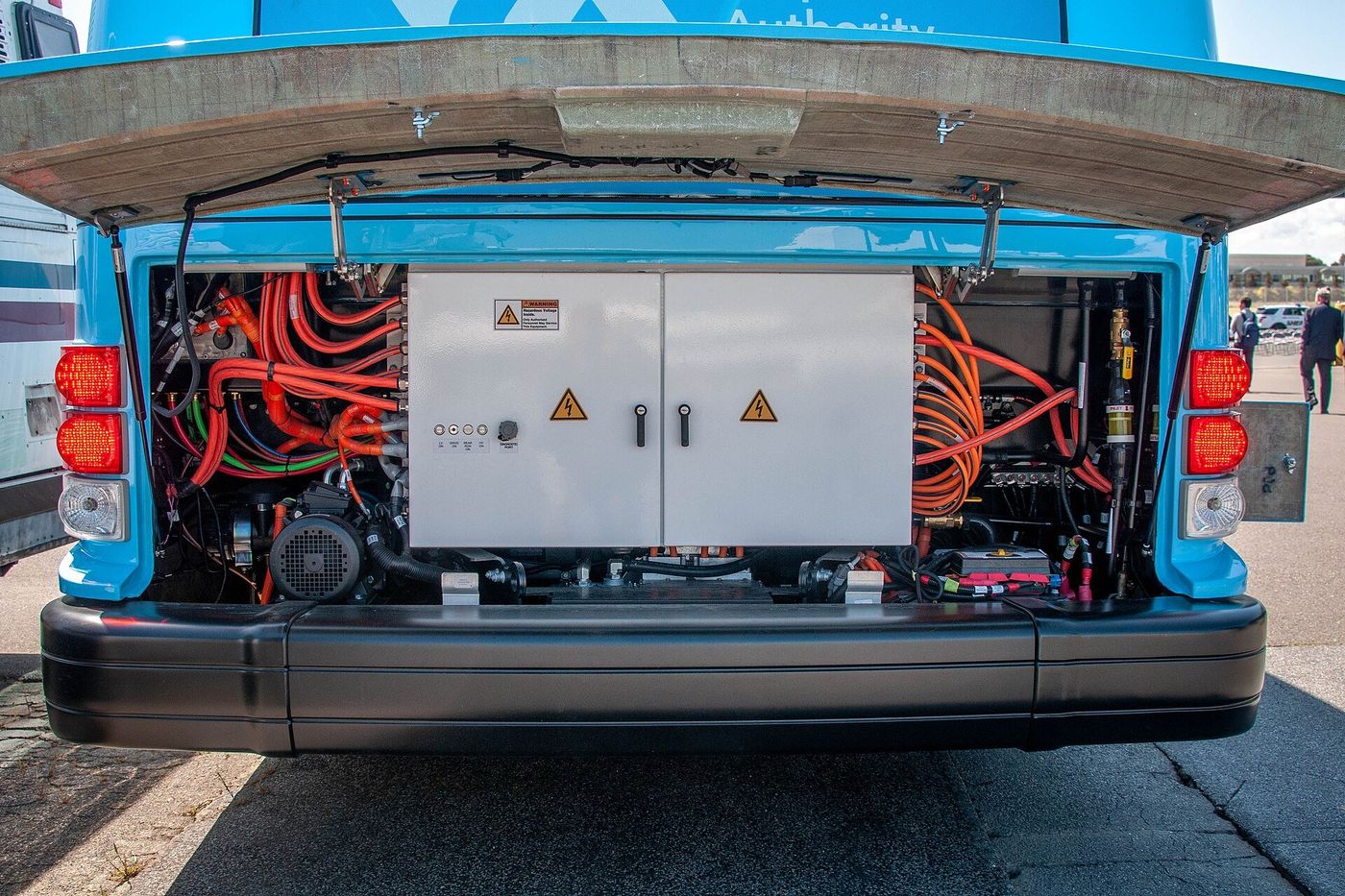
In Germany, DGUV Information 209-093 (August 2021) says that work on a vehicle’s high-voltage system in the voltage-free state may be done only by a “Fachkundige Person Hochvolt” (FHV, level 2S) or under an FHV’s direction and supervision, and it places work on live high-voltage components at level 3S. The document is guidance that builds on a binding German accident-prevention rule, not a rule itself, and it is not an EU rule; in Great Britain the law asks for competence in general terms (regulation 16 of the Electricity at Work Regulations 1989) and the IMI’s TechSafe scheme is opt-in, with the IMI calling for a mandate.
This page says who may do the work, not how it is done: it describes no working method, no de-energising steps and no repair. No other country’s rules were read for this page, so it says nothing either way about them. Periodic roadworthiness testing is a separate regime, covered in HGV roadworthiness and roadside checks, and access to a manufacturer’s repair information has its own page, Repair information access rights.
Two countries, two kinds of rule
In Germany the binding rule read for this page is DGUV Vorschrift 3, the accident-prevention rule “Elektrische Anlagen und Betriebsmittel” (electrical installations and equipment), of 1 April 1979 in the version of 1 January 1997. Its § 3(1) makes the employer responsible for seeing that such installations and equipment are erected, changed and maintained “nur von einer Elektrofachkraft oder unter Leitung und Aufsicht einer Elektrofachkraft”, in line with the electrotechnical rules. Under § 2(3) an Elektrofachkraft is someone who, on the strength of technical training, knowledge and experience and knowledge of the relevant provisions, can assess the work assigned and recognise possible dangers.
That text speaks of electrical installations and equipment, and as read for this page it does not mention vehicles. The link to vehicles is made by the guidance: its foreword says that under DGUV Vorschrift 3 and 4 electrotechnical work (erecting, changing and maintaining) may be carried out only by Elektrofachkräfte or under their direction and supervision, and that the “Fachkundige Person Hochvolt” (FHV) it describes is an Elektrofachkraft under those rules for the electrotechnical sub-field of high-voltage systems. Only Vorschrift 3 was read for this page; Vorschrift 4 is cited here only as the guidance cites it.
The guidance is DGUV Information 209-093, “Qualifizierung für Arbeiten an Fahrzeugen mit Hochvoltsystemen”, edition August 2021, published by the Deutsche Gesetzliche Unfallversicherung (DGUV) in cooperation with the Zentralverband Deutsches Kraftfahrzeuggewerbe (ZDK). The DGUV describes its own rule set this way: the DGUV Vorschriften are the legally binding accident-prevention rules, while its Regeln, Informationen and Grundsätze serve employers and insured persons as aids in meeting their duties, and a DGUV Information contains “Hinweise und Empfehlungen”, notes and recommendations. The foreword says the guidance describes how employers can (“können”) organise safe work on vehicles with high-voltage systems on the basis of the risk assessment, and how the qualification need can be determined; the DGUV’s catalogue entry adds that it sets “Mindestanforderungen”, minimum requirements, for the content and scope of the qualification need, and that it describes the required qualification measures both for research, development and production and for service workshops.
Among the laws and rules that describe the employer’s responsibility for safe work the guidance lists the Arbeitsschutzgesetz, the Betriebssicherheitsverordnung and DGUV Vorschrift 1 “Grundsätze der Prävention”, and among the employer’s tasks it lists ensuring that only sufficiently qualified employees carry out work on the high-voltage systems of vehicles. The levels below are therefore a German guidance document’s minimum requirements; this page does not present them as a statutory requirement.
The DGUV publications catalogue, opened on 29 September 2026, gives the issue date of the German edition as 2021.08 and the earlier number as DGUV Information 200-005. The edition’s own list of changes on the 2012 version includes a new DGUV number and that the level model now also covers the service sector. The English translation is dated June 2023; it states “No liability is accepted for translation errors.” and does not attempt to translate the designations for the “Fachkundige Personen”, so this page follows the German original and keeps the German designations.
What counts as high voltage, and which vehicles
The guidance defines high voltage, with a reference to UNECE R100, as voltages above 60 V and up to 1,500 V direct current (DC) or above 30 V and up to 1,000 V alternating current (AC) in vehicle engineering, in particular in hybrid and fuel-cell technology and in battery-electric vehicles. That is the DGUV’s wording; the text of UNECE R100 itself was not opened for this page.
Its definition of land vehicles (“Landfahrzeuge”) lists passenger cars and trucks (Lastkraftwagen), buses (Omnibusse) and trailers (Anhängefahrzeuge), among others. The scope is the qualification of persons who work on vehicles with high-voltage systems and their components, and in principle also work on bodies and attachments that are connected directly to the high-voltage system and have the same protective measures. The guidance lists what it does not describe:
- track-guided vehicles, for example railways and trolleybuses (“Oberleitungsbussen”); trolleybuses as a bus type are covered in City bus propulsion;
- bodies, attachments and work equipment of vehicles that fall under the Machinery Directive and need protection against electric shock and fault arcs under DIN EN 60204-1 (VDE 0113-1);
- low-voltage electrical installations on vehicles that fall under VDE 0100, for example 230 V sockets in buses;
- vehicles permanently connected to the mains while in use, for example earth-moving machinery;
- water and air vehicles.
Other qualification requirements may exist alongside the guidance’s levels: it names expertise for work on gas vehicles, the restricted expertise P1 for pyrotechnic restraint systems and expertise for air-conditioning systems as examples.
Four levels for vehicles in service: S, 1S, 2S, 3S
For series-production vehicles the guidance starts from the observation that under normal conditions the installed high-voltage components pose no electrical hazard, but that during repair or service work live parts may still be touched, and that the hazard is higher on accident vehicles with high-voltage components (section 5.1.1). It sets four levels (figure 13).
| Level | Designation | Work the figure assigns |
|---|---|---|
| S | Sensibilisierte Person | Bedienen von Fahrzeugen (operating vehicles) |
| 1S | Fachkundig unterwiesene Person (FuP) | Allgemeine Arbeiten (general work) |
| 2S | Fachkundige Person (FHV) | Work on high-voltage systems in the voltage-free state |
| 3S | Fachkundige Person für Arbeiten an unter Spannung stehenden HV-Komponenten | Work on live high-voltage components; the figure’s examples are Fehlersuche (fault finding) and Bauteile unter Spannung tauschen (replacing components under voltage) |
S. For operating high-voltage vehicles the guidance says it is sufficient (“ausreichend”) to point employees to the intended use and to instruct them on the particulars to be observed. Under its definition, operating covers everything needed to drive a vehicle and includes connecting it to charging equipment and topping up operating fluids. It also counts service work whose electrical hazard is comparable to the driver’s, with these examples: changing wiper blades and topping up washer fluid; special procedures for equipping vehicles (its example is preparing vehicles at transport operators, “Verkehrsbetriebe”); using familiar filler connections, for instance for engine oil and coolant; and using controls with new symbols and hazard markings or new connections, for instance the charging device on the vehicle. Interior and exterior cleaning also count as operating. Drivers are to be made aware of the additional hazards that can arise in accidents, damage and recovery or towing (“Bergen/Abschleppen”) and instructed in additional controls such as an emergency-off switch at the driver’s workplace, and the awareness-raising can be carried out by the employer or by a suitable person, for example an FuP.
1S. According to the guidance an FuP may do general work on the vehicle that does not directly concern the high-voltage system; its examples are body work, oil and wheel changes, work on the conventional brake system near wheel-hub motors, work beside the high-voltage cables on the steering, combustion engine or axles, and work on the conventional on-board network up to 30 V AC and 60 V DC. An FHV must instruct them on the hazards, protective measures and rules of conduct; the instruction must also cover that work on the high-voltage components is “unzulässig” (not permitted), and it must be documented. Elsewhere (section 3.1) the guidance says an FuP may not work on high-voltage systems and components on their own responsibility (“eigenverantwortlich”) and may do work on the high-voltage system in the voltage-free state only under the direction and supervision of an FHV.
2S. The guidance says successful qualification at this level enables the FHV to work “selbstständig und sicher” (independently and safely) on high-voltage systems. It counts all work on voltage-free high-voltage systems and components, or in their danger zone, as work on high-voltage systems in the voltage-free state; its examples are measuring insulation resistances, repairing, replacing, changing and testing. Its rule is that such work is for FHVs alone or for persons working under an FHV’s direction and supervision (“nur von Fachkundigen Personen (FHV) oder unter Leitung und Aufsicht einer FHV”), and that direction and supervision of work on high-voltage systems must be taken over at least by an FHV. The guidance says the FHV must be able to establish the voltage-free state in accordance with the “Fünf Sicherheitsregeln” and the manufacturer’s information; this page does not describe those steps. Where the risk assessment or the manufacturer’s specification makes switching to the voltage-free state necessary, the guidance says it is done only under the direction and supervision of a person at level 2S (figure 12).
3S. The guidance says the 3S qualification allows fault finding on live high-voltage components where the vehicle cannot be switched voltage-free or the absence of voltage cannot be established, and that the same goes for work on live energy storage and for work with a comparable hazard potential. The conditions for 3S are in the next section.
New vehicle types. The guidance says instruction by an FHV of further persons on the hazards of high-voltage systems is to be given whenever work is to be done on new vehicle types or on vehicles equipped with new high-voltage systems or components, and that it must always be carried out and documented by an FHV. It adds that the employer, or the managers it appoints, must ensure that for work on high-voltage components only expert persons (“fachkundige Personen”) are used who can correctly assess the hazards and determine the protective measures required (section 5.1.1).
Minimum training for 1S, 2S and 3S
The unit in the guidance is the UE (Unterrichtseinheit), defined as 45 minutes; the English translation calls it a “teaching period” (TP) of the same length. The guidance writes the figures as minimums (“mindestens”) that depend on the type and scope of the work, and says the scope of a qualification depends on the degree of electrical hazard and on the employee’s prior knowledge.
| Level and entry route | Who it addresses | Minimum |
|---|---|---|
| 1S | Persons doing general work on the vehicle | Instruction by an FHV, at least 2 UE |
| 2S, Einstieg A | Persons with a technical training but without electrotechnical prior knowledge | At least 80 UE, of which at least 8 UE practice |
| 2S, Einstieg B | Persons with electrotechnical prior knowledge in the vehicle field, for example in vehicle electrics, mechatronics, mechanics or agricultural and construction machinery mechatronics | At least 16 UE, of which at least 8 UE practice |
| 2S, Einstieg C | Persons with theoretical electrotechnical knowledge | Determined individually, including at least 8 UE practice |
| 3S | Persons who meet the conditions listed below | At least 24 UE, of which at least 16 UE practice |
For entry route A (“Einstieg A”) the guidance’s wording is “mindestens 80 UE (davon mindestens 8 UE Praxis)”. Eighty UE of 45 minutes are 3,600 minutes, or 60 hours; that conversion is our arithmetic and not a figure in the guidance. The guidance says the course is to be designed so that all participants must carry out practical exercises, and that the expertise is to be proven by an examination and documented (Annex 8 gives an example).
For 3S the guidance says it must be proven before the measure begins that the person:
- holds at least a qualification at level 2S;
- is at least 18 years old (“mindestens 18 Jahre alt”);
- has completed first-aid training including cardiopulmonary resuscitation, 9 UE under DGUV Information 204-022 “Erste Hilfe im Betrieb”.
It adds that it must be ensured that the person has no health restrictions that could create hazards in work on live high-voltage components, with implant carriers and epilepsy as examples, and that shortly before the training (“zeitnah vor der Ausbildung”) the employee must have at least one year of practical professional experience in the vehicle or electrical field, which a vocational training in vehicle mechatronics meets, for example. Because work on live high-voltage components is in principle (“grundsätzlich”) hazardous work under § 8 of DGUV Vorschrift 1, “in der Regel” (as a rule) a second person is required, who must be at least an FuP and trained in first aid. For holders of 2S without a training in the vehicle or electrical field, the guidance says their existing knowledge must be tested to decide what additional knowledge is required for 3S.
When an apprenticeship already counts
The guidance states which vocational training carries a level:
- Vehicle mechatronics under the regulation of 14 June 2013, in the focus areas Personenkraftwagentechnik, Nutzfahrzeugtechnik, Motorradtechnik and Karosserietechnik: completing it gives “die Fachkunde nach Stufe 2S”. Figure 12 says the same in one line: all Kfz-Mechatronikerinnen and Kfz-Mechatroniker trained under the new 2013 training regulation already hold 2S.
- Vehicle mechatronics with the focus “System- und Hochvolttechnik”: completing it gives level 3S.
- Body and vehicle-construction mechanics (Karosserie- und Fahrzeugbaumechaniker) under the FzMechAusbV of 10 June 2014, in the focus areas Karosserieinstandhaltungstechnik and Karosserie- und Fahrzeugbautechnik: the guidance names level 2S for those who meet three conditions together, namely the completed training, a one-week inter-company training (“einwöchige überbetriebliche Ausbildung”) and a passed examination of expertise (Sachkundeprüfung) in “Hochvolttechnik”.
The equivalence is the DGUV guidance’s statement. The training regulation itself, on gesetze-im-internet.de on 29 September 2026, is dated 14 June 2013 (“Ausfertigungsdatum”) and shows “Geändert durch Art. 2 V v. 27.1.2014 I 90”; its § 3 lists five focus areas: Personenkraftwagentechnik, Nutzfahrzeugtechnik, Motorradtechnik, System- und Hochvolttechnik and Karosserietechnik. The passages read say nothing about training completed before the 2013 regulation.
2E is not 2S: development and production
The guidance is built as two tracks. Its foreword divides it into sections that include “Qualifizierungsbedarf in Forschung, Entwicklung und Produktion” (research, development and production) and “Qualifizierungsbedarf in Servicewerkstätten” (service workshops). The first track uses the letter E (levels E, 1E, 2E and 3E, figure 8, “Qualifizierungsstufen für Arbeiten vor Produktionsstart”); the second is the S levels above.
The dividing line is SoP, start of production, which the guidance defines as the start of series production, at which assembly follows standardised working procedures and the development phase and prototype or pre-series production are complete. The guidance says that when FHVs are employed it is to be taken into account whether they are qualified for work in the project-planning and development process (before SoP), for assembly of the high-voltage system, or for service work on series vehicles (after SoP), and that the area in which they can work can be read from the qualification records and certificates.
Level 2E has its own minimums: entry route A “mindestens 100 UE (davon mindestens 16 UE Praxis)”, B “mindestens 48 UE (davon mindestens 16 UE Praxis)”, C “mindestens 24 UE (davon mindestens 16 UE Praxis)”, and D individually determined with at least 16 UE of practice. These are not the 2S figures above. The entry route C group differs too: in 2E it is persons with an electrotechnical training, for example industrial electronics technicians, electrical fitters and electrical engineers, while in 2S it is persons with theoretical electrotechnical knowledge. Level 3E carries the same numbers as 3S (“mindestens 24 UE Präsenzschulung (davon mind. 16 UE Praxis)”) but is a separate level.
Breakdown assistance, recovery and end of life
Three passages of the guidance name who may act outside the workshop:
- Breakdown assistance (“Pannenhilfe”) on vehicles with a high-voltage system requires a qualification from the series-vehicle levels of figure 13, “mindestens jedoch” level 1S (section 5.2).
- Rescue and recovery personnel (“Rettungs- und Bergepersonal”) need at least an FuP qualification under section 5.1.3; in unclear situations, or if an electrical hazard cannot be excluded, an expert person (“Fachkundige Person”) is to be called in (section 5.3).
- Scrapping, recovery and recycling (section 5.4): the high-voltage system is to be safely freed of voltage by an FHV, following the manufacturer’s specific instructions. If work on live high-voltage components has to be done, its example being the taking apart of the energy storage, level 3S is required.
An example risk assessment in Annex 1 of the guidance, marked “©BGHM” and “Stand: 05.11.2019”, states that work on charging columns and comparable parts of installations, and on the building installation, is electrotechnical work that may not be carried out by an FHV (“nicht durch eine Fachkundige Person Hochvolt (FHV) durchgeführt werden dürfen”). It is an example inside the guidance, not part of its main text.
Who certifies, and keeping the qualification current
The guidance says the qualification of employees must be carried out by persons who have the required knowledge in the field, didactic ability and experience in adult education; that successful participation must be documented traceably with the content taught; and that training can be carried out internally or by external training providers. The accident insurers certify neither courses nor training providers: the English translation renders it as “Accident insurers do not provide certification of training courses or educational institutions.” The sample 2S certificate in Annex 8 has signature fields for the “Ausbildungsträger/in” and the “Lehrgangsleitung” and reads “Diese Qualifizierungsmaßnahme erfüllt die Mindestanforderungen der DGUV Information 209-093.”
To prove competence the employer can draw on vocational qualifications, professional practice already gained (certificates and the like), expertise, and special briefing and instruction, and the currency of the competence must be ensured (“Aktualität der Befähigung”). After a successful qualification the guidance says the expertise is to be kept up to date by regular participation in training; the passages read give no interval in years. The sample 1S certificate in Annex 7 states that the instruction does not release the employer from the duty of recurring instruction under § 4 of DGUV Vorschrift 1.
Great Britain: a general legal duty and a voluntary scheme
The legal duty. Regulation 16 of the Electricity at Work Regulations 1989 (S.I. 1989/635), headed “Persons to be competent to prevent danger and injury”, says no person is to be engaged in any work activity where “technical knowledge or experience is necessary to prevent danger” or, where appropriate, injury, unless they possess such knowledge or experience or are under “such degree of supervision as may be appropriate” having regard to the nature of the work. It names no qualification, no hours and no level. legislation.gov.uk records it as in force from 1 April 1990 with an extent of England, Wales and Scotland, and regulation 3(1)(a) puts the duties of the Regulations on every employer and self-employed person, so far as they relate to matters within their control.
The Health and Safety Executive. Its page on electric and hybrid vehicles (footer: updated 8 May 2025) says additional skills and training will be necessary for people to work safely with these vehicles and that the levels of competency required “will vary greatly” with the type of work. It identifies four categories of work: valeting, sales and other lower-risk activities; incident response including emergency services and vehicle recovery; maintenance and repair excluding high-voltage electrical systems; and working on high-voltage electrical systems. This page does not line the four categories up against the DGUV levels; they are separate lists from separate bodies. HSE calls dc voltages between 60 and 1,500 volts “high voltage” for electric and hybrid vehicles and notes that high voltage is defined differently in other industry sectors, and on qualifications and training it points readers to the IMI’s awards for further information.
The voluntary scheme. The Institute of the Motor Industry (IMI) describes IMI TechSafe, on a page read on 29 September 2026, as “a recognition of skills, qualification achievements and a commitment to CPD” within the IMI Professional Register. Anyone can gain the recognition with a valid achievement of an IMI-approved qualification or an IMI-accredited product, joining the IMI membership community and the IMI Professional Register; once a valid entry-route qualification or IMI accreditation is completed, the person submits an “opt-in request”. The recognition is retained through specific CPD requirements over a three-year CPD cycle. There are three TechSafe categories: Electric Vehicle, Advanced Driver Assistance Systems (ADAS) and Hydrogen Vehicles, and eligible hydrogen vehicle achievements “will be added when they become available”. The list of eligible achievements under the page’s “Electric and Hybrid Vehicle Category” heading includes three qualifications named for heavy vehicles:
- IMI Level 2 Award in Preparing Heavy Electric/Hybrid Vehicles for Repair;
- IMI Level 3 Award in Heavy Electric/Hybrid Vehicle System Repair and Replacement;
- IMI International Level 4 Fault Diagnosis, Testing and Repair of Heavy Electric / Hybrid Vehicles and Components.
The call for a mandate. The IMI’s article of 2 June 2026, “What is IMI TechSafe and why should it be mandated?”, describes TechSafe as the IMI’s standard for showing that a technician has the right skills to work safely on modern vehicles, says “there isn’t yet a consistent, nationwide standard in place”, and says the IMI is “calling on the government” for TechSafe to be mandated across four key areas of the automotive sector: connected vehicles; automated vehicle technology, including ADAS and sensor calibration; electric vehicles, where the IMI says high-voltage safety and battery health are essential; and alternative fuels such as hydrogen. Earlier, on Thursday 14 May 2026, the IMI held a policy panel on the future of automotive workforce safety (news release of 19 May 2026), attended by the Shadow Secretary of State for Transport, a shadow post and not a government minister. These are demands by an industry body. The sources read describe TechSafe as opt-in and none of them states a mandate.
Quick answers
- What is level 2S for high-voltage vehicle work in Germany?
- Level 2S is the level DGUV Information 209-093 assigns to work on high-voltage systems in the voltage-free state on series-production vehicles, and its holder is a 'Fachkundige Person Hochvolt' (FHV). The guidance calls the FHV an Elektrofachkraft under DGUV Vorschrift 3 and 4 for the electrotechnical sub-field of high-voltage systems, and says work on high-voltage systems in the voltage-free state may be done only by FHVs or under an FHV's direction and supervision. It is a German guidance document of August 2021, not an EU rule.
- How many hours of training does level 2S require?
- For entry route A, the one for persons with a technical training but without electrotechnical prior knowledge, the guidance says at least 80 UE, of which at least 8 UE are practice. A UE is 45 minutes, so 80 UE is 60 hours, our arithmetic. Entry route B needs at least 16 UE, of which at least 8 UE are practice; for entry route C the amount is determined individually and includes at least 8 UE of practice. The guidance writes these as minimums that depend on the type and scope of the work, and says the expertise is to be proven by an examination.
- Does a Kfz-Mechatroniker apprenticeship count as level 2S?
- Under the guidance, yes for four of the five focus areas of the training regulation of 14 June 2013: Personenkraftwagentechnik, Nutzfahrzeugtechnik, Motorradtechnik and Karosserietechnik; persons who have completed the training in one of them hold the expertise of level 2S. Completing the focus area System- und Hochvolttechnik gives level 3S. The equivalence is the DGUV guidance's statement, and the guidance names only the 2013 regulation for the Kfz-Mechatroniker.
- What is needed before training for level 3S?
- Before the measure begins the guidance says it must be proven that the person holds at least a level 2S qualification, is at least 18 years old and has completed first-aid training including cardiopulmonary resuscitation (9 UE under DGUV Information 204-022). It also requires that the person has no health restrictions that could create hazards in work on live components, with implant carriers and epilepsy as examples, and at least one year of practical professional experience in the vehicle or electrical field shortly before the training. The 3S course is at least 24 UE, of which at least 16 UE are practice, and as a rule ('in der Regel') work on live components needs a second person.
- Is IMI TechSafe mandatory in the UK?
- No mandate appears in the sources read. IMI TechSafe is described as an opt-in recognition within the IMI Professional Register, retained through CPD over a three-year cycle, and the IMI's article of 2 June 2026 is a call on the government to mandate it in four areas, electric vehicles among them. A call is a demand, not a rule. The legal rule read for this page, for England, Wales and Scotland, is the general competence rule in regulation 16 of the Electricity at Work Regulations 1989, which names no qualification.
- Does DGUV Information 209-093 cover trolleybuses?
- No. The guidance does not describe the qualification for work on track-guided vehicles, and gives railways and trolleybuses ('Oberleitungsbussen') as examples. It also excludes low-voltage installations that fall under VDE 0100, for example 230 V sockets in buses, while buses ('Omnibusse') are among the land vehicles its definition names.
Sources
- DGUV Information 209-093 — Qualifizierung für Arbeiten an Fahrzeugen mit Hochvoltsystemen (Ausgabe August 2021) — Deutsche Gesetzliche Unfallversicherung (DGUV)
- DGUV Information 209-093 — publication record (Ausgabedatum 2021.08, formerly DGUV Information 200-005) — Deutsche Gesetzliche Unfallversicherung (DGUV)
- DGUV Information 209-093 — Training for work on vehicles with high voltage systems (English translation, June 2023) — Deutsche Gesetzliche Unfallversicherung (DGUV)
- DGUV Vorschrift 3 — Unfallverhütungsvorschrift Elektrische Anlagen und Betriebsmittel (Fassung vom 1. Januar 1997) — Deutsche Gesetzliche Unfallversicherung (DGUV)
- Vorschriften- und Regelwerk der gesetzlichen Unfallversicherung — Deutsche Gesetzliche Unfallversicherung (DGUV)
- DGUV Informationen und DGUV Grundsätze — Deutsche Gesetzliche Unfallversicherung (DGUV)
- Verordnung über die Berufsausbildung zum Kraftfahrzeugmechatroniker und zur Kraftfahrzeugmechatronikerin (KfzMechaAusbV 2013) — Bundesministerium der Justiz (gesetze-im-internet.de)
- The Electricity at Work Regulations 1989 — regulation 16: persons to be competent to prevent danger and injury — legislation.gov.uk (The National Archives)
- The Electricity at Work Regulations 1989 — regulation 3: persons on whom duties are imposed by these Regulations — legislation.gov.uk (The National Archives)
- Electric and hybrid vehicles (motor vehicle repair) — Health and Safety Executive (HSE)
- IMI TechSafe — Institute of the Motor Industry (IMI)
- What is IMI TechSafe and why should it be mandated? (2 June 2026) — Institute of the Motor Industry (IMI)
- Industry leaders and Shadow Secretary of State for Transport unite to call for mandatory TechSafe standards across UK automotive sector (19 May 2026) — Institute of the Motor Industry (IMI)