Battery-electric, hydrogen or combustion: heavy-vehicle powertrains and what the sources say
What ACEA's registrations, the IEA's outlooks, EU law and makers' own programmes say about battery-electric, hydrogen and combustion trucks and buses — with no verdict.
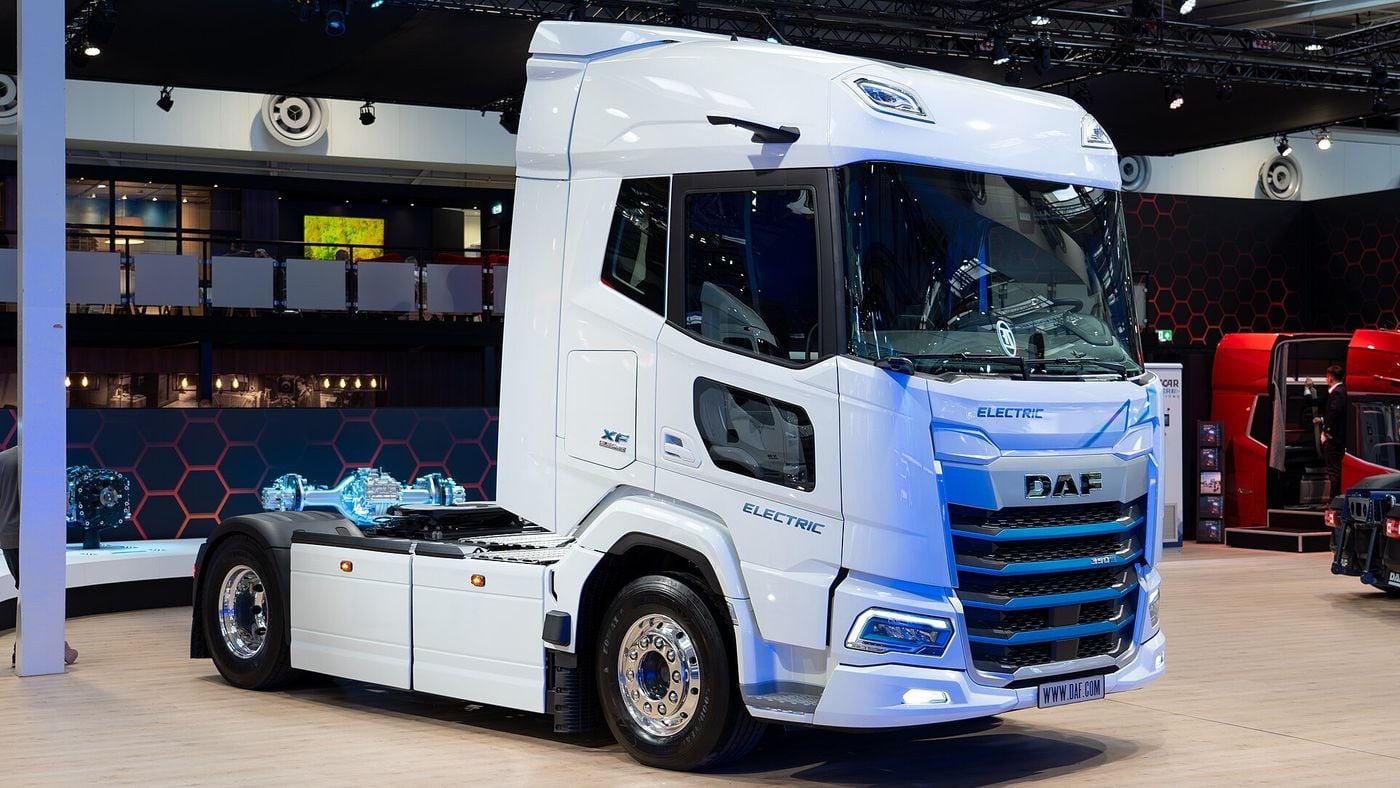
ACEA says diesel accounted for 93.2% of new registrations in the EU heavy- and medium-duty truck market in 2025 and that electrically-chargeable trucks above 3.5 tonnes, battery-electric and plug-in hybrid together, secured 4.2%, while the IEA counts electric trucks at 9% of all truck sales worldwide in 2025, 97% of them battery-electric. This page sets side by side what those two sources, EU law and the makers’ own programmes say about battery-electric, hydrogen and combustion powertrains in trucks and buses, attributes every statement to whoever made it, and gives no verdict.
It is not buying advice, and it does not compare lifecycle emissions or running costs. Its tables sort each source’s statement under three headings that are this page’s own: “in its favour” for what a source presents as progress, capability or an enabling rule; “against it” for what a source names as a barrier or a limit; and “signals of continuity” for the plans, targets and stops that a source dates.
Volvo Trucks says it is pursuing its net-zero emissions target for 2040 with a “three-path technology strategy”, built on battery electric, fuel cell electric and combustion engines that run on renewable fuels such as green hydrogen, biogas (bio-LNG), biodiesel and HVO (hydrotreated vegetable oil). The three headings of the main table follow that split as this page’s own grouping: battery-electric; hydrogen, in a fuel cell or in a combustion engine; and combustion engines on diesel, HVO or gas. ACEA’s registration columns and the EU’s definition of a zero-emission vehicle, both below, cut the field differently.
What the EU registration figures show
ACEA, the European Automobile Manufacturers’ Association, describes itself as a Brussels-based trade association of 17 major car, van, truck and bus producers in Europe; its commercial vehicle members are DAF Trucks, Daimler Truck, Ford Trucks, Iveco Group, TRATON GROUP (MAN Truck & Bus, Scania Group) and Volvo Group. The counts below are ACEA’s registration tables. The explanations it attaches to them are the association’s position, and are labelled that way here.
ACEA sorts new vehicles into columns. Its footnotes say that “electrically-chargeable” includes battery electric and plug-in hybrids, that “hybrid electric” includes full and mild hybrids, and that “others” includes fuel cell electric vehicles (FCEVs) and vehicles powered by natural gas, liquefied petroleum gas (LPG), E85/ethanol and other fuels; the H1 2026 footnote adds “other and unknown fuels”. Two things follow for this page. ACEA’s “electrically-chargeable” share is not a battery-electric share, and ACEA gives no separate hydrogen or gas share, so none is derived here.
In its full-year 2025 release of 29 January 2026, ACEA reports 307,460 new EU truck registrations, down 6.2%. It says electrically-chargeable trucks above 3.5 tonnes “now secure 4.2% of the market, up from 2.3% last year”, and that diesel “maintained its leading position in the EU heavy- and medium-duty truck market in 2025, accounting for 93.2% of new registrations, despite the 8% drop in volumes”. In its release for the first half of 2026, of 29 July 2026, it reports 171,933 new EU truck registrations, up 9.8%; diesel trucks accounted for 92.1% of new EU registrations, up 9.3% year-to-date, and electrically-chargeable trucks grew by 47.7%, securing 4.8% of the market, from 3.6% in H1 2025.
The heavy category, “heavy commercial vehicles of 16 tonnes and over”, is in the page-5 table of each release’s PDF:
| Period | Electrically-chargeable | Hybrid electric | Others | Petrol | Diesel | Total | Chargeable share of total (our arithmetic) |
|---|---|---|---|---|---|---|---|
| 2025 | 4,991 | 30 | 6,852 | 25 | 242,590 | 254,488 | 2.0% |
| 2024 | 3,303 | 57 | 7,404 | 5 | 258,192 | 268,961 | 1.2% |
| H1 2026 | 3,518 | 17 | 4,917 | 11 | 137,293 | 145,756 | 2.4% |
| H1 2025 | 1,919 | 18 | 5,415 | 13 | 123,773 | 131,138 | 1.5% |
ACEA does not publish the last column. It is the electrically-chargeable count divided by the total, rounded to one decimal place: 4,991 of 254,488 for 2025, 3,303 of 268,961 for 2024, 3,518 of 145,756 for H1 2026 and 1,919 of 131,138 for H1 2025. In each row the five fuel columns add up to the total, by our arithmetic.
For buses, ACEA says the share of EU electrically-chargeable bus registrations increased to 23.8% by the end of 2025, and that diesel bus registrations increased by 5.7%, now holding a 62.1% market share, down from 63.2% the year before. In the first half of 2026 it reports electrically-chargeable bus registrations up 56.8%, with their market share rising from 21.6% to 27.7%, and diesel up 11%, holding a 58.2% share.
ACEA’s explanation is the association’s position. In its 2025 release it says progress “remains too slow, as market uptake remains constrained by insufficient enabling conditions”, naming inadequate infrastructure, high energy costs, unfavourable total cost of ownership and inconsistent policy frameworks as what continues to slow it; in the H1 2026 release it says uptake “remains below the required pace, constrained by insufficient enabling conditions, notably in the heavier vehicle segments”. Country breakdowns and the definitions of ACEA’s categories are on the registrations page.
What the IEA counts worldwide
The IEA’s Global EV Outlook 2026 was published on 20 May 2026. It counts “trucks” as medium and heavy freight trucks: medium freight trucks have a gross weight of 3.5 to 15 tonnes and heavy freight trucks a gross weight above 15 tonnes. Its bus count covers buses with 10 or more seats, urban and intercity.
Worldwide, the IEA reports that sales of electric trucks exceeded 400,000 for the first time in 2025, doubling on the previous year, and reached 9% of all truck sales; battery electric trucks were 97% of electric truck sales. China accounted for over 90% of global sales, and electric heavy freight trucks reached 28% of total heavy freight truck sales there in 2025, up from 13% in 2024.
In Europe, the IEA says, electric truck sales (medium and heavy together) increased by 40% year-on-year in 2025, reaching nearly 17,000 and accounting for 3% of all truck sales in the region, and electric heavy freight trucks had a sales share of around 1.5% at the end of 2025, up from 1% in 2024. Among buses, it says the share of electric buses in new bus sales exceeded 12% in 2025, and that battery electric city buses reached a share of over 55% in 2025 in the European Union, up from around 45% the previous year.
The IEA’s scenario results run to 2035. In its Current Policies Scenario (CPS), electric trucks reach around 20% of truck sales globally by 2035, and about 10% of the truck stock is electric; in the Stated Policies Scenario (STEPS) electrification is faster, “with the market share 3 percentage points higher”. For buses, the sales share of electric buses reaches “close to 25% globally by 2035 in the STEPS”, which the IEA says “reflects the challenges faced in electrifying intercity buses”.
The IEA’s and ACEA’s figures are not the same measure. The IEA pages opened for this article do not define the region “Europe”, and its truck count is medium plus heavy freight trucks; ACEA counts EU registrations, and its heavy category is 16 tonnes and over. The IEA’s “around 1.5%” for electric heavy freight trucks in Europe and the 2.0% our arithmetic gives from ACEA’s 16-tonne table for 2025 differ in region, in weight class and in the basis of the count (sales for the IEA, registrations for ACEA), and this page does not set one against the other. The same holds for buses: the IEA’s “exceeded 12%” (electric buses with 10 or more seats), ACEA’s 23.8% (electrically-chargeable, so including plug-in hybrids) and the IEA’s “over 55%” (battery electric city buses in the European Union) are three different measures.
The EU rules behind the tables
Two sets of CO2 percentages
Regulation (EU) 2024/1610 of 14 May 2024, published in the Official Journal on 6 June 2024, amended Regulation (EU) 2019/1242 as regards strengthening the CO2 emission performance standards for new heavy-duty vehicles. The Article 3a(1) it inserted into Regulation (EU) 2019/1242 sets reductions in “the average CO2 emissions of the Union fleet of new heavy-duty motor vehicles”, special purpose vehicles, off-road vehicles and off-road special purpose vehicles excluded, “compared to the average CO2 emissions of the reporting period of the year 2019”:
| Reporting periods | Reduction | Applies to |
|---|---|---|
| 2025 to 2029 | 15% | vehicle sub-groups 4-UD, 4-RD, 4-LH, 5-RD, 5-LH, 9-RD, 9-LH, 10-RD and 10-LH |
| 2030 to 2034 | 45% | all vehicle sub-groups other than vocational vehicles |
| 2035 to 2039 | 65% | all vehicle sub-groups |
| 2040 onwards | 90% | all vehicle sub-groups |
Annex I point 4.3.1 sets targets for each vehicle sub-group, and its figures for 2030 to 2034 and for 2035 to 2039 differ from Article 3a(1)’s:
| Vehicle sub-groups | 2025 to 2029 | 2030 to 2034 | 2035 to 2039 | From 2040 |
|---|---|---|---|---|
| Medium lorries | 0 | 43% | 64% | 90% |
| Heavy lorries above 7.4 t | 0 | 43% | 64% | 90% |
| Heavy lorries above 16 t with 4x2 and 6x4 axle configurations | 15% | 43% | 64% | 90% |
| Vocational vehicles | 0 | 0 | 64% | 90% |
| Coaches and interurban buses | 0 | 43% | 64% | 90% |
The table has further rows, among them trailers (0, then 7.5% in each later period) and semi-trailers (0, then 10%). So 45% and 43% for 2030 to 2034 are two different figures in the same regulation, one for the Union fleet average and one per sub-group, and the same holds for 65% and 64% in 2035 to 2039. Daimler Truck’s release of 13 September 2026 speaks of a 43 percent reduction in CO2 for new heavy-duty commercial vehicles by 2030 compared with 2019, and recital (4) of Directive (EU) 2025/2459 speaks of “a CO2 emissions reduction target of 43 % by 2030”; both use the sub-group figure. Article 3a(1) sets its percentages on an average, that of the Union fleet; it does not set a limit for any single vehicle.
A zero-emission share for urban buses
Article 3d(1) says that for the vehicles it calls “urban buses”, manufacturers “shall comply with the 90 % and 100 % minimum shares of zero-emission heavy-duty vehicles in their fleet of new heavy-duty vehicles in accordance with point 4.3.2 of Annex I”. The table in point 4.3.2 has a single group, urban buses: 0 before 2030, 90% for 2030 to 2034, and 100% for 2035 to 2039 and from 2040. How the mandate works for city buses is on the city bus propulsion page.
What zero-emission means in Regulation 2019/1242
Article 3(11) lists the vehicles that count as a “zero-emission heavy-duty vehicle”; its point (a) is “a heavy-duty motor vehicle without an internal combustion engine, or with an internal combustion engine that emits not more than 3 g CO2/(tkm) or 1 g CO2/(pkm) as determined in accordance with Article 9 of Regulation (EU) 2017/2400”. For a vehicle that does have an internal combustion engine, that point looks at a CO2 value determined under Regulation (EU) 2017/2400, not at the type of engine.
The 2026 change to emission credits
Regulation (EU) 2026/1046 of 29 April 2026, published on 7 May 2026, amends Regulation (EU) 2019/1242 “as regards the calculation of emission credits for heavy-duty vehicles for the reporting periods of the years 2025 to 2029”. Its recital (2) says it is essential that the level of the CO2 emissions reduction targets “remain unchanged”. Recital (3) gives the EU legislator’s reason for the change to credits: “in light of the delay in the deployment of the public charging infrastructure along motorways for heavy-duty vehicles, manufacturers should be able to generate more emission credits before that year”, the year being 2030, the start of “the targets applicable as of 2030”. Recital (4) says that during the reporting periods of 2025 to 2029 manufacturers “should collect emission credits if their specific CO2 emissions are below the specific CO2 emissions target rather than below the CO2 emissions reduction trajectory”, and recital (5) says the Regulation “should not apply to urban buses”. In the consolidated text of Regulation (EU) 2019/1242 of 10 September 2026, Article 3a(1)(b) to (d) still read 45%, 65% and 90%.
Road charges
Directive (EU) 2025/2459 of 26 November 2025, published on 4 December 2025, amends Directive 1999/62/EC “as regards the extension of the period in which zero-emission heavy-duty vehicles can benefit from significantly reduced rates of infrastructure or user charges or from exemptions to pay them”. Its Article 1 replaces, in Article 7ga(1), fifth subparagraph, of Directive 1999/62/EC, the date “31 December 2025” with “30 June 2031” and “1 January 2026” with “1 July 2031”. Recital (6) says: “The optional nature of the amended provision means that Member States are not obliged to transpose this Directive.” Recital (1) gives the legislator’s reasons: registrations of new zero-emission heavy-duty vehicles “have recently increased but remain too low to achieve the CO2 emission reduction targets of the transport sector”, and one of the main barriers is “the high upfront cost of acquiring such a vehicle”. The rules from 1 July 2031 and Germany’s use of the option are on the road tolls page.
Weight allowance
The latest consolidated text of Directive 96/53/EC that this page opened is dated 14 August 2019 and includes the amendment made by Regulation (EU) 2019/1242. In Annex I, points 2.2.1 (road trains with five or six axles) and 2.2.2 (articulated vehicles with five or six axles) each say: “In the case of vehicle combinations including alternatively fuelled or zero-emission vehicles, the maximum authorised weights provided for in this section shall be increased by the additional weight of the alternative fuel or zero-emission technology with a maximum of 1 tonne and 2 tonnes respectively.” On our reading of “respectively”, the maximum is 1 tonne for alternatively fuelled and 2 tonnes for zero-emission vehicles. The IEA says, on 20 May 2026, that zero-emissions trucks in the EU “already benefit from an additional 2 tonne allowance” and that the EU “is considering a further increase in weight and length limits for zero-emissions trucks”; the proposal and how far it has got are on the weights page.
What the sources say, powertrain by powertrain
Each row is one statement with its speaker. “Maker’s release” means a press release by the maker about its own product or plan; “maker’s position” means an opinion or an estimate. Quoted conditions such as “up to” and footnotes stay with the figure they qualify.
Battery-electric
| Heading | What the source says | Who says it |
|---|---|---|
| In its favour | Sales of electric trucks exceeded 400,000 worldwide for the first time in 2025, doubling on the previous year, and battery electric trucks were 97% of electric truck sales. | IEA, Global EV Outlook 2026, 20 May 2026 (data) |
| In its favour | Volvo Trucks “has now started series production of its new generation of heavy-duty electric trucks”, including the FH Aero Electric with extended range, “capable of driving up to 700 km on a single charge”. A footnote says range depends on external conditions such as the weather and wind resistance, and on factors such as the truck’s total weight and the driver’s performance. The first trucks have rolled off the assembly line in Tuve, Gothenburg; the release says the electric trucks will be produced in Tuve and in Ghent, Belgium. | Volvo Trucks, 14 September 2026 (maker’s release) |
| In its favour | The first series-production vehicle equipped with the Megawatt Charging System has rolled off the assembly line at the MAN plant in Munich. MAN gives up to 750 kW, with up to 1,000 amps and up to 750 volts, and 20% to 80% state of charge in less than 30 minutes for an eTGX or eTGS with six batteries and a total capacity of 534 kWh. More on megawatt charging. | MAN Truck & Bus, 30 July 2026 (maker’s release) |
| In its favour | “Battery-electric trucks can already be deployed reliably and economically in a growing number of customer applications.” | Daimler Truck, 13 September 2026 (maker’s position) |
| In its favour | Two EU texts name zero-emission vehicles: the weight allowance of up to 2 tonnes in Directive 96/53/EC, Annex I, and the option of significantly reduced rates of infrastructure or user charges, or exemptions from them, to 30 June 2031 in Directive (EU) 2025/2459 (wording above). Under Article 3(11)(a) of Regulation (EU) 2019/1242, a heavy-duty motor vehicle “without an internal combustion engine” is a zero-emission heavy-duty vehicle. | EU law (Directive 96/53/EC; Directive (EU) 2025/2459; Regulation (EU) 2019/1242) |
| Against it | The IEA says that “the purchase price of electric trucks remains two to three times higher than of diesel trucks”; the sentence names no region, so it is not an EU price. It adds that the payload limitations of electric trucks “result from their large batteries and can limit their cargo capacity”. | IEA, Global EV Outlook 2026, 20 May 2026 (data and commentary) |
| Against it | “There is currently no harmonised regulatory regime for measuring the actual range of electric HDVs across different countries and regions.” | IEA, Global EV Outlook 2026, 20 May 2026 |
| Against it | Uptake is “constrained by insufficient enabling conditions”; ACEA names inadequate infrastructure, high energy costs, unfavourable total cost of ownership and inconsistent policy frameworks. | ACEA, 29 January 2026 and 29 July 2026 (association’s position) |
| Against it | Of battery-electric trucks, Daimler Truck says “scaling their adoption continues to be significantly constrained by the expansion of Europe’s charging infrastructure and by insufficient energy supply, particularly at competitive prices”. Customer demand “is not yet developing at the pace required by current regulations”, and “regulation and reality are not aligned”. | Daimler Truck, 13 September 2026 (maker’s position) |
| Against it | Registrations of new zero-emission heavy-duty vehicles “remain too low” for the transport-sector CO2 targets the recital cites, and “the high upfront cost of acquiring such a vehicle” is one of the main barriers (recital (1)). Manufacturers should be able to generate more emission credits before 2030 “in light of the delay in the deployment of the public charging infrastructure along motorways for heavy-duty vehicles” (Regulation 2026/1046, recital (3)). | EU legislator, Directive (EU) 2025/2459 and Regulation (EU) 2026/1046 (recitals) |
| Signals of continuity | Electrically-chargeable trucks secured 4.8% of new EU truck registrations in H1 2026, from 3.6% in H1 2025, and electrically-chargeable buses 27.7%, from 21.6%. Our arithmetic from ACEA’s 16-tonne table: 2.4% in H1 2026 against 1.5% in H1 2025, and 2.0% in 2025 against 1.2% in 2024. | ACEA, 29 January 2026 and 29 July 2026 (registrations); our arithmetic |
| Signals of continuity | By 2035, electric trucks reach around 20% of truck sales globally in the Current Policies Scenario, with about 10% of the truck stock electric; in the Stated Policies Scenario the market share is 3 percentage points higher. Electric buses reach close to 25% of sales globally by 2035 in the Stated Policies Scenario. | IEA, Global EV Outlook 2026, 20 May 2026 (scenario results) |
| Signals of continuity | The market share of heavy-duty battery-electric trucks in Europe “was only two percent in 2025”; to achieve the 43 percent target, “around 35 percent of all newly registered trucks in Europe would need to be battery-electric or hydrogen-powered by 2030”. | Daimler Truck, 13 September 2026 (maker’s own statement and estimate) |
Declared battery, range and charging figures for one battery-electric model are on the eActros 600 page.
Hydrogen, in a fuel cell or in a combustion engine
| Heading | What the source says | Who says it |
|---|---|---|
| In its favour | Using the sLH2 refuelling standard developed by Daimler Truck and Linde, the Mercedes-Benz NextGenH2 Truck “can be filled with liquid hydrogen within 10–15 minutes”. | Daimler Truck, 26 January 2026 (maker’s release) |
| In its favour | A fuel-cell truck has no internal combustion engine, so on our reading it falls under point (a) of the definition of a zero-emission heavy-duty vehicle quoted above; the weight allowance and road-charge texts in the battery-electric table speak of zero-emission vehicles. | Our reading of Regulation (EU) 2019/1242, Article 3(11)(a) |
| Against it | Global hydrogen demand surpassed 100 million tonnes in 2025, and hydrogen use in industry and refining accounted for almost all of it. Low-emissions hydrogen production grew by 20% in 2025 to almost 1 million tonnes, “but progress is concentrated in a small number of projects”. The pipeline of announced low-emissions production projects “has shrunk to 27 Mt by 2030, mostly due to delays post 2030 and cancellations”. These figures are for hydrogen as a whole, not for trucks. | IEA, Global Hydrogen Review 2026, 18 June 2026 (data) |
| Against it | “In the near term, low-emissions hydrogen production will remain more costly than fossil-based hydrogen in most parts of the world, apart from China”, where renewable hydrogen could become cost-competitive by 2030. The IEA also says that “slow and uncertain policy implementation is failing to address the main barriers – particularly high costs, uncertain demand, unclear or complex regulations and lack of infrastructure”. | IEA, Global Hydrogen Review 2026, 18 June 2026 |
| Against it | On the NextGenH2 small series, Daimler Truck says customer interest is strong “despite the refueling infrastructure still being limited”. | Daimler Truck, 13 September 2026 (maker’s position) |
| Signals of continuity | “As part of a limited small-series production, 100 vehicles are set to be deployed in customer operations from the end of 2026 onwards”; the release says the 100 units will be manufactured at the Mercedes-Benz plant in Wörth. “Series production of fuel cell trucks is targeted for the early 2030s.” | Daimler Truck, 26 January 2026 (maker’s release) |
| Signals of continuity | The release says the first vehicle from the 100-truck small series “is scheduled to enter customer operations by the end of the year”, and: “Nearly half of the small series has already been assigned to customers”. Daimler Truck “invests a mid-three-digit million euro amount in hydrogen trucks by the end of the decade”. From the end of 2026 it plans to deploy a small series of around 100 NextGenH2 Trucks in real-world customer operations in Germany. | Daimler Truck, 13 September 2026 (maker’s release) |
| Signals of continuity | The release says visitors at IAA would get the chance to test “the future hydrogen-powered combustion engine truck that will be launched before 2030”; the vehicle it lists for the test drives is a “Volvo FH Aero hydrogen-powered combustion engine test truck”. | Volvo Trucks, 1 July 2026 (maker’s release) |
| Signals of continuity | The stock of fuel cell electric vehicles grew 20% in 2025, to almost 130,000, “due to truck sales in China and a rebound of car sales in Korea”, and policies in those countries are the main driver behind a projected tripling of stock by 2030. The stock is all fuel cell electric vehicles, not trucks alone. | IEA, Global Hydrogen Review 2026, 18 June 2026 (data and projection) |
| Signals of continuity | Nikola, Phoenix, 19 February 2025: the company and certain subsidiaries “have filed voluntary petitions under Chapter 11 of the Bankruptcy Code in the United States Bankruptcy Court for the District of Delaware”, and, subject to court approval, it intends to continue certain limited service and support operations, “including certain HYLA fueling operations through the end of March 2025”. Hyzon, Bolingbrook, Illinois, 25 March 2025: its stockholders voted to approve the transfer of all or substantially all of the company’s assets through an assignment for the benefit of creditors and “the liquidation and dissolution of the Company pursuant to a plan of dissolution”. These are dated events at two US companies, and this page draws no conclusion about a market from them. | Nikola and Hyzon, press releases filed with the SEC |
Combustion: diesel, HVO and gas
| Heading | What the source says | Who says it |
|---|---|---|
| In its favour | Volvo says its new engine can deliver “up to 4%” lower fuel consumption versus the engine it is replacing, “when using the benefits of the new engine in combination with Volvo Trucks’ latest fuel-saving innovations”. The footnote gives an example based on simulations of a Volvo FH 42 T 500 hp 35-tonne GCW with the new D13 engine and use of Cruise Control, I-See and I-Roll with engine stop/start functionality, against the previous standard D13 eSCR engine, “in representative European driving conditions”. The release gives its own timing: “Sales will begin during the third quarter of 2026”. | Volvo Trucks, 12 May 2026 (maker’s release) |
| In its favour | “The new engine platform is ready for alternative fuels such as biodiesel/B100, HVO, biogas/bio-LNG and green hydrogen.” | Volvo Trucks, 12 May 2026 (maker’s release) |
| In its favour | Daimler Truck’s release lists for the Powerliner driveline generation: “Up to four percent lower fuel consumption compared with a similarly specified predecessor vehicle.” The two “up to” figures, Volvo’s and Daimler’s, have different bases and are not added together or generalised. | Daimler Truck, 13 September 2026 (maker’s release) |
| Against it | The average CO2 emissions of the Union fleet of new heavy-duty motor vehicles are to be reduced by 45% for 2030 to 2034, 65% for 2035 to 2039 and 90% from 2040, against the reporting period of 2019; for urban buses, manufacturers “shall comply with the 90 % and 100 % minimum shares of zero-emission heavy-duty vehicles in their fleet of new heavy-duty vehicles” (Articles 3a(1) and 3d(1)). | EU law, Regulation (EU) 2019/1242 as amended by Regulation (EU) 2024/1610 |
| Signals of continuity | Diesel accounted for 93.2% of new registrations in the EU heavy- and medium-duty truck market in 2025 and 92.1% in H1 2026; diesel buses held 62.1% of new EU bus registrations in 2025 and 58.2% in H1 2026. | ACEA, 29 January 2026 and 29 July 2026 (registrations) |
| Signals of continuity | “From April 2027, the new powertrain generation will be available in all Mercedes-Benz Actros and Arocs”; the new engine generation is also to be used by Daimler Buses. | Daimler Truck, 13 September 2026 (maker’s release) |
| Signals of continuity | Reinert Logistics “signed a contract for 500 Volvo FH Aero gas-powered trucks, with deliveries starting in 2027”. “2025 was Volvo’s best sales year ever for trucks powered by gas”, and Volvo Trucks has delivered “more than 10,000 gas-powered trucks globally”. More on LNG and bio-LNG trucks. | Volvo Trucks, 24 September 2026 (maker’s release) |
Who is speaking
Five kinds of source stand behind the tables. EU legal texts are the legislator’s own words: articles set rules, recitals give reasons, and this page says which it quotes. The IEA publishes data for past years and scenario results for 2035, and the page words the scenario results as scenario results. ACEA is the manufacturers’ association, so its explanations of the market are its position; its counts are its tables. The makers’ releases state capabilities and plans, with their “up to” and footnote conditions kept, and one maker’s figures are never added to another’s. The Nikola and Hyzon entries are company documents filed with the SEC, about the companies themselves and dated.
What is scheduled, by date
Each entry is a plan, a target or a rule dated by its source; none is reported here as having happened.
- From the end of 2026: Daimler Truck plans to deploy a small series of around 100 Mercedes-Benz NextGenH2 Trucks in real-world customer operations in Germany (release of 13 September 2026).
- From April 2027: the new Powerliner powertrain generation to be available in all Mercedes-Benz Actros and Arocs (Daimler Truck, 13 September 2026).
- From 2027: deliveries of the 500 Volvo FH Aero gas-powered trucks ordered by Reinert Logistics (Volvo Trucks, 24 September 2026).
- Before 2030: Volvo’s hydrogen-powered combustion engine truck “will be launched before 2030” (Volvo Trucks, 1 July 2026).
- Reporting periods 2030 to 2034: the 45% Union fleet reduction of Article 3a(1)(b) and, for urban buses, the 90% zero-emission share of point 4.3.2.
- Early 2030s: series production of fuel cell trucks is targeted (Daimler Truck, 26 January 2026).
- 30 June 2031: the date to which Directive (EU) 2025/2459 moves the end of the period in which Member States may apply significantly reduced rates of infrastructure or user charges, or exemptions, to zero-emission heavy-duty vehicles.
Quick answers
- What share of new EU trucks is battery-electric?
- ACEA counts electrically-chargeable trucks above 3.5 tonnes — battery-electric and plug-in hybrid together — at 4.2% of new EU registrations in 2025, up from 2.3%, and at 4.8% in the first half of 2026, up from 3.6% in the first half of 2025; it does not report battery-electric trucks on their own. For heavy trucks of 16 tonnes and over, our arithmetic from ACEA's table gives 2.0% for 2025 and 2.4% for the first half of 2026. Daimler Truck's own statement is that the market share of heavy-duty battery-electric trucks in Europe was 'only two percent' in 2025. ACEA groups fuel cell electric vehicles with gas and other fuels under 'others', so it gives no hydrogen share either.
- Is the EU CO2 target for trucks 43% or 45% by 2030?
- Both figures are in Regulation (EU) 2024/1610, which amended Regulation (EU) 2019/1242. Article 3a(1)(b) reduces the average CO2 emissions of the Union fleet of new heavy-duty motor vehicles by 45% for the reporting periods of 2030 to 2034, against the reporting period of 2019, for all vehicle sub-groups other than vocational vehicles; Annex I point 4.3.1 sets 43% for the same periods for medium and heavy lorries and for coaches and interurban buses. For 2035 to 2039 the two figures are 65% and 64%, and from 2040 both are 90%. Regulation (EU) 2026/1046 changed how emission credits are calculated for 2025 to 2029, and its recital (2) says it is essential that the level of the targets 'remain unchanged'.
- Are hydrogen trucks in series production?
- Daimler Truck's plan is a small series: 100 vehicles set to be deployed in customer operations from the end of 2026 (release of 26 January 2026), 'around 100' NextGenH2 trucks in Germany (13 September 2026), with series production of fuel cell trucks 'targeted for the early 2030s'. Volvo Trucks listed a 'Volvo FH Aero hydrogen-powered combustion engine test truck' for test drives and said on 1 July 2026 that the future hydrogen-powered combustion engine truck 'will be launched before 2030'. This page gives no hydrogen share of EU registrations because ACEA does not report one.
- Do zero-emission trucks pay road tolls in the EU?
- Directive (EU) 2025/2459 replaces 31 December 2025 with 30 June 2031 as the end of the period in which Member States can apply significantly reduced rates of infrastructure or user charges to zero-emission heavy-duty vehicles, or exempt them. It is an option: recital (6) says Member States are 'not obliged to transpose' it, so on our reading the Directive does not itself exempt any vehicle. The road tolls page covers the rules from 1 July 2031 and Germany's use of the option.
- What does the EU CO2 regulation set for new diesel and other combustion trucks?
- Regulation (EU) 2019/1242, as amended by Regulation (EU) 2024/1610, sets reductions of 45% for 2030 to 2034, 65% for 2035 to 2039 and 90% from 2040 in the average CO2 emissions of the Union fleet of new heavy-duty motor vehicles, against the reporting period of 2019, with vocational vehicles left out of the 45% figure for 2030 to 2034. The targets are set on that fleet average, not as a limit for any single vehicle. The table of zero-emission shares in Annex I, point 4.3.2, has a single group, urban buses: 90% for 2030 to 2034 and 100% from 2035.
Models in this article
Sources
- New commercial vehicle registrations: vans -8.8%, trucks -6.2%, buses +7.5% in 2025 — ACEA (European Automobile Manufacturers' Association), 29 Jan 2026
- New commercial vehicle registrations, European Union — full year 2025 (press release PDF, heavy truck table on page 5) — ACEA (European Automobile Manufacturers' Association), 29 Jan 2026
- New commercial vehicle registrations: vans +1.9%, trucks +9.8%, buses +22.7% in H1 2026 — ACEA (European Automobile Manufacturers' Association), 29 Jul 2026
- New commercial vehicle registrations, European Union — H1 2026 (press release PDF, heavy truck table on page 5) — ACEA (European Automobile Manufacturers' Association), 29 Jul 2026
- Global EV Outlook 2026 — Trends in other EV modes — International Energy Agency (IEA), CC BY 4.0, 20 May 2026
- Global EV Outlook 2026 — Outlook for electric mobility — International Energy Agency (IEA), CC BY 4.0, 20 May 2026
- Global Hydrogen Review 2026 — Executive summary — International Energy Agency (IEA), CC BY 4.0, 18 Jun 2026
- Global Hydrogen Review 2026 — Demand — International Energy Agency (IEA), CC BY 4.0, 18 Jun 2026
- Regulation (EU) 2024/1610 amending Regulation (EU) 2019/1242 as regards strengthening the CO2 emission performance standards for new heavy-duty vehicles (Article 3(11), Articles 3a and 3d, Annex I points 4.3.1 and 4.3.2) — Official Journal of the European Union (Publications Office)
- Regulation (EU) 2019/1242 setting CO2 emission performance standards for new heavy-duty vehicles, consolidated text of 10 September 2026 — EUR-Lex
- Regulation (EU) 2026/1046 amending Regulation (EU) 2019/1242 as regards the calculation of emission credits for heavy-duty vehicles for the reporting periods of the years 2025 to 2029 — Official Journal of the European Union (EUR-Lex)
- Directive (EU) 2025/2459 amending Directive 1999/62/EC as regards the extension of the period in which zero-emission heavy-duty vehicles can benefit from significantly reduced rates of infrastructure or user charges or from exemptions to pay them — Official Journal of the European Union (Publications Office)
- Council Directive 96/53/EC on maximum dimensions and weights — consolidated text of 14 August 2019 (Annex I points 2.2.1 and 2.2.2) — Publications Office of the European Union
- IAA Transportation 2026: Daimler Truck Celebrates 130 Years of Trucks and Drives Transportation Forward — Daimler Truck, 13 Sept 2026
- Daimler Truck presents Mercedes-Benz NextGenH2 Truck with small-series production planned from end of 2026 — Daimler Truck, 26 Jan 2026
- Mercedes-Benz Trucks Powerliner: New Driveline Generation with Four Percent Lower Fuel Consumption — Daimler Truck, 13 Sept 2026
- Volvo starts series production of electric trucks with up to 700 km range — Volvo Trucks, 14 Sept 2026
- Volvo Trucks at IAA 2026: New drivelines and technologies show the way forward for customers and the transport industry — Volvo Trucks, 1 Jul 2026
- Volvo Trucks’ all-new combustion engine platform: Superior fuel efficiency and ready for a wide range of alternative fuels — Volvo Trucks, 12 May 2026
- Volvo Trucks receives record order for gas-powered trucks — Volvo Trucks, 24 Sept 2026
- MAN starts series production of MCS-ready eTrucks — MAN Truck & Bus, 30 Jul 2026
- Nikola Initiates Comprehensive Voluntary Chapter 11 Sale Process (press release filed with the SEC) — U.S. Securities and Exchange Commission (EDGAR), 19 Feb 2025
- Hyzon Announces Stockholder Approval of Assignment Proposal and Dissolution Proposal (Exhibit 99.1 filed with the SEC) — U.S. Securities and Exchange Commission (EDGAR), 25 Mar 2025