Hydrogen trucks: fuel cell (FCEV) vs hydrogen combustion (H2-ICE)
How a fuel-cell truck differs from a hydrogen combustion truck, how the hydrogen is stored and where each maker says its programme stands, every figure attributed.
A hydrogen truck uses its hydrogen in one of two ways: a fuel cell converts it into electricity on board to drive electric motors (a fuel cell electric vehicle, FCEV), or an internal combustion engine burns it (a hydrogen combustion truck, H2-ICE). This page describes how each is built, how the hydrogen is stored and where the makers say their programmes stand, with every figure attributed to the maker or source that published it.
The range, consumption and efficiency values the makers give below are their own declarations, not independent measurements. Dates are those of the documents cited, and where a document speaks of a plan, the page says so.
How a fuel-cell truck works
Daimler Truck describes the principle for its Mercedes-Benz NextGenH2 Truck: “In operation, the fuel cell generates electrical energy through the reaction between hydrogen (H₂) and oxygen (O₂). Together with a buffer battery, this powers the electric motors integrated into the e-axle”. Its only emission, Daimler Truck says, is “pure water vapor”. Volvo describes fuel cell electric trucks as trucks “where electricity is produced on board the truck” and says they “do not emit any tailpipe emissions, only water vapor”. The Union of Concerned Scientists (UCS), in a review of November 2023, puts it this way: “An FCEV can be thought of as an electric vehicle with an onboard power plant.”
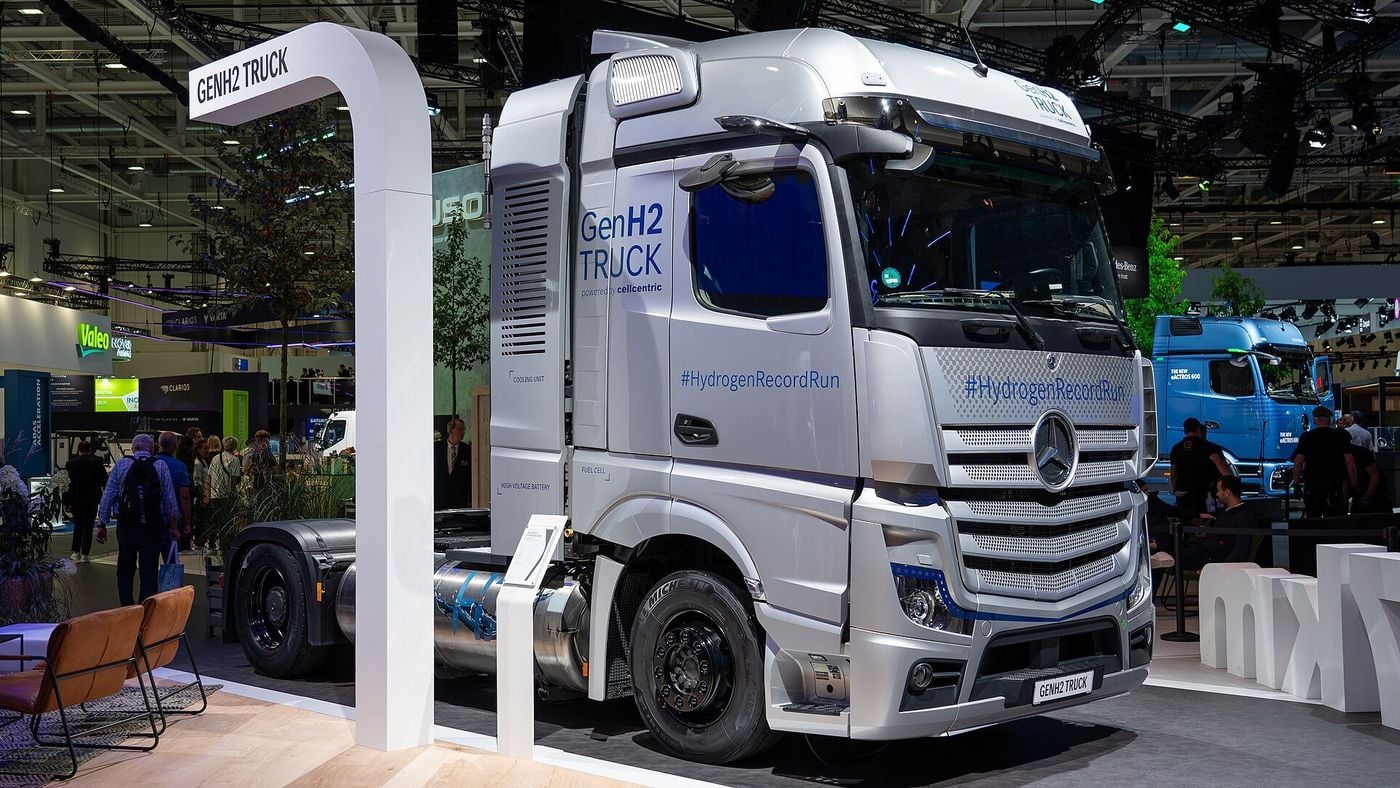
The NextGenH2 shows the parts. Its fuel cell is the cellcentric BZA150, cellcentric being “a joint venture between Daimler Truck and Volvo Group”, and Daimler Truck says “Two fuel cell units operate as a twin system with a total system output of 300 kW (150 kW each)” in the engine compartment beneath the cab. The buffer is a high-voltage battery of 101 kWh installed capacity; the release calls it a lithium-iron-phosphate (LFP) battery that “serves as a buffer for the fuel cell and stores energy during recuperation”, and footnotes the 101 kWh as the nominal capacity of a new battery, based on internally defined parameters. The drive is “the same efficient in-house-developed electric drive axle as used in the eActros 600”, described on our eActros 600 page, with a 4-speed transmission including two reverse gears. Daimler Truck says the truck “delivers up to 340 kW in Economy Mode and up to 370 kW in Power Mode”. The cover photograph shows its predecessor, the GenH2 Truck, at IAA Transportation 2024, with the fuel cell and the high-voltage battery labelled on the panel behind the cab.
Hyundai’s EU catalogue (edition 2506) describes the XCIENT Fuel Cell as “powered by a twin fuel cell system that runs on hydrogen”. Its technical table gives the fuel cell system 220 kW gross (2 x 110 kW) and 188 kW net (2 x 94 kW), a battery of 72 kWh (3 x 24 kWh) at 630 V, a motor of 350 kW and 2,237 Nm and a 5-speed automatic transmission.
How a hydrogen combustion truck works
UCS describes the emissions side of burning hydrogen this way: “while burning hydrogen in internal combustion engines eliminates tailpipe carbon dioxide pollution, these vehicles still produce significant levels of air pollutants, such as ozone-forming nitrogen oxides.”
Volvo announced on 1 April 2026 that it “has begun on-road testing of heavy trucks powered by hydrogen combustion engines”, with a commercial launch “planned before 2030”. It says its “advanced hydrogen engine technology is derived from its diesel powertrain”. The release explains the injection method: “High Pressure Direct Injection (HPDI), a technology where a small amount of ignition fuel is injected with high pressure to enable compression ignition before hydrogen is added.” Volvo says the hydrogen trucks will use HPDI technology from Cespira, and that it already uses the technology in its gas-powered trucks, “with more than 10,000 units sold globally”, which LNG and bio-LNG trucks describes on gas. On range Volvo gives no figure, only that hydrogen-powered Volvo trucks “will have an operational range exceeding many customers’ daily driving distance”. Volvo’s release for IAA 2026, dated 1 July 2026, lists a “Volvo FH Aero hydrogen-powered combustion engine test truck”; neither Volvo release gives a tank, power or range figure for it.
MAN describes the engine of its hTGX as “the MAN 16.8-litre H4576 six-cylinder in-line hydrogen engine” and says “The hydrogen combustion engine H45 is based on the proven D38 diesel unit and will be produced in the engine and battery plant in Nuremberg.” The same release of 16 September 2024 gives a “700 bar hydrogen pressure tank with a capacity of 56 kilograms”, a range “of around 600 kilometres made possible by” that tank, and 6x2 and 6x4 axle configurations.
Dongfeng showed a hydrogen internal combustion engine hybrid system at IAA Transportation 2026 beside three fuel cell systems. Its bulletin of 14 September 2026 says the system has “an engine displacement of 16.2 L”, “a peak power of 412 kW and a peak torque of 2500 N·m”, and supports “14 operating modes including pure electric, hybrid drive, range-extending, braking and charge retention”.
Storing hydrogen: 350 bar, 700 bar or liquid
The three trucks below store their hydrogen in three ways, each figure as its maker states it.
| Truck | Drive | Storage | Hydrogen | Range as stated | Source |
|---|---|---|---|---|---|
| Hyundai XCIENT Fuel Cell | fuel cell | Type IV fuel tank, 350 bar | 31.08 kg (1,351 L) | approximately 400 km per refueling, “with the potential for even longer distances depending on the load and driving conditions” | Hyundai EU catalogue, edition 2506 |
| MAN hTGX | hydrogen combustion | 700 bar hydrogen pressure tank | 56 kilograms | around 600 kilometres | MAN, 16 September 2024 |
| Mercedes-Benz NextGenH2 | fuel cell | two connected liquid hydrogen tanks | up to 85 kg in total | “well over 1,000 kilometers on a single tank filling at full load” | Daimler Truck, 26 January 2026 |
Hyundai’s catalogue adds that the Type IV tank “includes a safety device for pressure relief in emergencies” and footnotes that driving range and refueling times “can vary depending on external factors”.
Daimler Truck “prefers the use of liquid hydrogen”. At -253 degrees Celsius, it says, liquid hydrogen “has a significantly higher energy density compared to gaseous hydrogen, allowing more hydrogen to be stored”. Refueling is possible from both sides because the two tanks are connected, and “Using the sLH2 refueling standard developed by Daimler Truck and Linde, the truck can be filled with liquid hydrogen within 10–15 minutes”. Daimler Truck’s own view is that “liquid hydrogen tanks offer cost and weight advantages over gaseous high-pressure tanks.” The NextGenH2 also has, in its words, “a new boil-off management system that meets all regulatory requirements for handling hydrogen, including parking the vehicle in enclosed spaces”, and a sensor system that “responds to the highly unlikely event of hydrogen leakage” and “now allows overnight stays in the truck’s two standard beds fitted in the cab”.
The earlier GenH2 Truck belongs to the previous generation. Daimler Truck says that at the end of 2023, during the #HydrogenRecordRun, a GenH2 Truck “with a gross combined vehicle weight of around 40 tonnes covered 1,047 km on a single filling of liquid hydrogen”.
On pressure, Toyota says: “Toyota’s long-term vision is to establish 700bar as a standard for fuel cell electric vehicles and products.” By its own wording, that is a long-term vision.
What “zero-emission” means for a hydrogen truck in EU law
Regulation (EU) 2024/1610 of 14 May 2024 amended Regulation (EU) 2019/1242, the CO2 emission performance standards for new heavy-duty vehicles. Its Article 1 replaces point 11 of Article 3 with a definition of “zero-emission heavy-duty vehicle” with three points. Point (a) reads: “a heavy-duty motor vehicle without an internal combustion engine, or with an internal combustion engine that emits not more than 3 g CO2/(tkm) or 1 g CO2/(pkm) as determined in accordance with Article 9 of Regulation (EU) 2017/2400”. Recital 9 adds: “Zero-emission heavy-duty vehicles currently include battery electric vehicles, fuel-cell and other hydrogen-powered vehicles, and technological innovation continues.” The definition itself does not mention hydrogen. Our page on city bus propulsion sets out the same definition from the bus side.
Volvo says its trucks “with combustion engines powered by green hydrogen have the potential to deliver net zero CO2 well-to-wheel when using renewable HVO as ignition fuel”, and that they “are categorized as ‘Zero Emission Vehicles’ (ZEV) under the agreed EU CO2 emission standards”. MAN says: “By being classified as a ‘zero-emission vehicle’, the hTGX makes an important contribution to the decarbonisation of road freight transport”. Whether a particular truck stays under the threshold in point (a) is a matter of its determination under Regulation (EU) 2017/2400. The two statements are the makers’ declarations, and we did not open a type-approval or certification result.
Efficiency and consumption: the published figures
UCS is a secondary source here. It says its work combines technical analysis and advocacy, and the figures below are ones it cites from studies we did not open.
UCS gives a well-to-wheel energy efficiency of 81 percent for battery-electric vehicles (BEVs) and “a final energy efficiency of 38 percent” for FCEVs, in a figure adapted from Jones and Neilson 2021. It attributes the FCEV figure “mostly” to “the significant amount of electricity needed to power hydrogen production and inefficiencies of today’s fuel cell technology”. Citing a study of European alternative-fuel freight trucks (O’Connell et al. 2023), it also reports that a BEV truck can travel three times as far as an FCEV using the same amount of renewable energy. For hydrogen combustion, UCS says “these trucks are estimated to have fuel efficiencies even lower than that of today’s diesel trucks (Basma et al. 2023)”.
The makers give their own figures. Toyota says its third-generation fuel cell system, “Compared with the previous generation”, delivers “twice the output, twice the durability, 20% better fuel efficiency and significantly lower cost”. Dongfeng gives two efficiency figures for its 400 kW technology, and they are not the same measure. For the stack: “The 400 kW hydrogen fuel-cell stack achieves over 58-percent efficiency under typical operating conditions”. For the system: “The system with the 400kW hydrogen fuel cell stack” achieves “a peak efficiency of 65%”.
Consumption figures are the makers’ too. Daimler Truck says that “In early customer trials with the Mercedes-Benz GenH2 Truck, hydrogen consumption, for example, averaged between 5.6 kg/100 km and 8 kg/100 km, with gross combined vehicle weights ranging between 16 and 34 tonnes.” That is the GenH2, the earlier generation; the January 2026 release gives no consumption figure for the NextGenH2. In its description of the T1 platform, Dongfeng’s bulletin gives “a hydrogen consumption as low as 7 kg per 100 km, a curb weight as low as 8.8 tons, and an equivalent durability of 33,000 operating hours” and says its hydrogen storage module “delivers a single-refueling range of 1,700 km”. The bulletin states no conditions for these figures.
Fuel-cell systems for heavy vehicles
| System | Output as stated | Also stated | Source |
|---|---|---|---|
| cellcentric BZA150 (Mercedes-Benz NextGenH2) | two units, total system output of 300 kW (150 kW each) | integrated in the engine compartment beneath the cab | Daimler Truck, 26 January 2026 |
| Hyundai XCIENT Fuel Cell | 220 kW gross (2 x 110 kW); 188 kW net (2 x 94 kW) | twin fuel cell system | Hyundai EU catalogue, edition 2506 |
| Toyota third generation, for Scania | “Toyota’s latest 300 kW fuel cell system” | 40 heavy-duty vehicles in Scania’s Pilot Partner programme | Toyota Motor Europe, 14 September 2026 |
| Toyota fuel cell systems, for the IVECO S-eWay Fuel Cell | fuel cell systems “with a total output of 300 kW” | “designed for a driving range beyond 900 km and durability of more than 25,000 operating hours” | Toyota Motor Europe, 14 September 2026 |
| Dongfeng 400 kW stack | 400 kW hydrogen fuel cell stack | system: gravimetric power density of 1350 W/kg, dynamic response of 60 kW/s, equivalent lifetime of 33,000 hours, cold start at -40°C | Dongfeng, 14 September 2026 |
Dongfeng also exhibited systems with 120 kW and 150 kW stacks and says it “has built a full-range fuel-cell stack portfolio spanning 20 kW to 400 kW”. It names six core modules of its T1 platform: “fuel-cell module, hydrogen storage module, power-battery module, electric-drive system module, central domain controller and integrated thermal-management system”.
Toyota’s release also recalls “earlier news in July this year that The Volvo Group, Daimler Truck AG, cellcentric and Toyota Motor Corporation signed a binding agreement for Toyota to join cellcentric as an equal partner and shareholder in cellcentric”, and adds: “The transaction is still subject to regulatory approval.”
Where the programmes stand, as each maker states it
Mercedes-Benz NextGenH2. Daimler Truck’s release of 26 January 2026 says that “In a small-series production run at the Mercedes-Benz plant in Wörth, 100 units of these further developed semi-trailer tractors will be manufactured and deployed with various customers from the end of 2026 onwards”, and that “Series production of fuel cell trucks is targeted for the early 2030s.” Its IAA release of 13 September 2026 says the truck “will celebrate its public debut at IAA Transportation” and that Daimler Truck “plans to deploy a small series of around 100” NextGenH2 Trucks in customer operations in Germany from the end of 2026, the first customer being logistics service provider Dachser. At Dachser, one liquid-hydrogen fuel-cell tractor unit is to be deployed in daily operations from the end of 2026, “followed by two additional identical vehicles by mid-2027”, based at Dachser’s Karlsruhe logistics center. The release adds that “Nearly half of the small series has already been assigned to customers, despite the refueling infrastructure still being limited”, and that the GenH2 Trucks “have already completed almost 600,000 kilometers in customer trials”. Both releases put the NextGenH2 deployments in the future tense.
Volvo. On 1 April 2026 Volvo said the commercial launch of its hydrogen combustion trucks is “planned before 2030” and that it “plans to launch fuel cell electric trucks in low volumes before 2030”. On 1 July 2026 it said that visitors to IAA 2026 could “test the future hydrogen-powered combustion engine truck that will be launched before 2030”.
MAN hTGX. MAN’s release of 16 September 2024, headed “IAA Commercial Vehicles”, says the hTGX won the Truck Innovation Award 2025 and that MAN accepted the award during the press day. It says the small series, “initially planned with around 200 units”, “is to be delivered to customers in Germany, the Netherlands, Norway, Iceland and selected non-European countries as early as 2025”. That is a plan as of September 2024; the sources we opened do not say whether those deliveries took place.
Toyota with Scania and IVECO. Toyota Motor Europe’s release of 14 September 2026 says the first Scania trucks with Toyota’s 300 kW system “are expected to start operating in the first quarter of 2027”. For the IVECO S-eWay Fuel Cell, Toyota says it is working with IVECO through EMPOWER, “the EU-funded Horizon Europe project for zero-emission heavy-duty transport”, and that “Validation starts in the fourth quarter of 2026, with on-road trials planned for the first half of 2027.”
Dongfeng T1. Dongfeng’s bulletin of 14 September 2026 says it showed three hydrogen-powered models built on its T1 New-Energy Commercial-Vehicle Platform at IAA Transportation 2026. The bulletin gives no tank capacity for them, no vehicle power figure and no European sales schedule.
Hydrogen supply: the IEA’s 2026 picture
The IEA’s Global Hydrogen Review 2026, published on 18 June 2026, says “Global hydrogen demand surpassed 100 million tonnes (Mt) in 2025, driven by growth in traditional sectors”, and that “Hydrogen use in industry and refining accounted for almost all demand in 2025.” Low-emissions hydrogen production “grew by 20% in 2025 to reach almost 1 Mt”. The pipeline of announced projects for low-emissions hydrogen production “has shrunk to 27 Mt by 2030, mostly due to delays post 2030 and cancellations”. In the near term, the IEA says, low-emissions hydrogen production “will remain more costly than fossil-based hydrogen in most parts of the world, apart from China, where renewable hydrogen could become cost-competitive by 2030.”
On vehicles, the review’s demand chapter says fuel cell electric vehicle stock grew 20% in 2025 to almost 130,000, which it attributes to “truck sales in China and a rebound of car sales in Korea”. The figure covers all fuel cell electric vehicles, cars included.
In European registration statistics, ACEA counts FCEVs in its “others” category, as European truck registrations explained sets out. AFIR, Regulation (EU) 2023/1804, holds the EU’s hydrogen refuelling-station targets in its Article 6, which LNG and bio-LNG trucks and city bus propulsion quote from the regulation; this page gives no infrastructure counts. A fuel-cell city bus appears on the Otokar Kent page.
How the British inspection manual treats a hydrogen lorry
For a hydrogen lorry, or hydrogen HGV, the DVSA’s HGV inspection manual (revision of 1 April 2026) says in its interpretation of terms: “EV (Electric Vehicle) A vehicle that is powered by electric power train only. A vehicle with a hydrogen fuel cell should be considered an electric vehicle.” Section 45, “Fuel Tanks and System”, says: “For Hydrogen Fuel Cell vehicles, hydrogen tanks will be classed as fuel tanks.” Its deficiency table lists “LPG/CNG/LNG/Hydrogen tank excessively damaged and/or corroded” as “Major”. The revision record dates the hydrogen fuel cell tank provision to the revision of 1 April 2025.
These provisions are in the British manual and concern the inspection of vehicles in Great Britain; this page makes no statement about roadworthiness rules elsewhere.
Quick answers
- What is the difference between a hydrogen fuel-cell truck and a hydrogen combustion truck?
- The difference is what the hydrogen does on board. In a fuel cell electric truck, Volvo says, "electricity is produced on board the truck", and Daimler Truck says the fuel cell, together with a buffer battery, powers the electric motors integrated into the e-axle. In a hydrogen combustion truck the hydrogen is burned in an engine: Volvo's hydrogen engine technology "is derived from its diesel powertrain" and uses high pressure direct injection, in which "a small amount of ignition fuel is injected with high pressure", and MAN says its hydrogen combustion engine H45 "is based on the proven D38 diesel unit".
- How is hydrogen stored on a truck?
- The three makers quoted here use three arrangements. Hyundai's EU catalogue gives the XCIENT Fuel Cell 31.08 kg of hydrogen at 350 bar in a Type IV tank of 1,351 L. MAN gives the hTGX a 700 bar hydrogen pressure tank with a capacity of 56 kilograms. Daimler Truck gives the NextGenH2 two connected liquid hydrogen tanks holding up to 85 kg in total, liquid hydrogen being at -253 degrees Celsius, and says the truck can be filled with liquid hydrogen within 10–15 minutes using the sLH2 refueling standard developed by Daimler Truck and Linde.
- Do hydrogen combustion trucks count as zero-emission under EU CO2 rules?
- The EU definition accepts an internal combustion engine that emits not more than 3 g CO2/(tkm) or 1 g CO2/(pkm) as determined under Article 9 of Regulation (EU) 2017/2400 (point (a) of the definition that Regulation (EU) 2024/1610 put in place of point 11 of Article 3 of Regulation (EU) 2019/1242). The definition does not mention hydrogen, and recital 9 says zero-emission heavy-duty vehicles currently include "fuel-cell and other hydrogen-powered vehicles". Volvo and MAN each say their hydrogen combustion trucks are classed as zero-emission; those are the makers' statements, and we did not open a type-approval or certification result.
- Is a hydrogen fuel-cell lorry treated as an electric vehicle in Great Britain's HGV inspection manual?
- Yes. The DVSA HGV inspection manual, revision of 1 April 2026, says "A vehicle with a hydrogen fuel cell should be considered an electric vehicle" and, in section 45, that "hydrogen tanks will be classed as fuel tanks" for hydrogen fuel cell vehicles. It is the British manual, and this answer covers Great Britain only.
- When will hydrogen trucks be built in series?
- Daimler Truck says series production of fuel cell trucks "is targeted for the early 2030s"; before that it plans a small series of 100 NextGenH2 units built at Wörth and deployed with customers from the end of 2026. Volvo says the commercial launch of its hydrogen combustion truck is "planned before 2030" and that it "plans to launch fuel cell electric trucks in low volumes before 2030". All are plans as stated in releases dated 26 January and 1 April 2026.
- How much hydrogen does a fuel-cell truck use?
- Daimler Truck reports an average between 5.6 kg/100 km and 8 kg/100 km in early customer trials with the earlier-generation GenH2 Truck, at gross combined vehicle weights between 16 and 34 tonnes; its January 2026 release gives no consumption figure for the NextGenH2. Dongfeng's bulletin of 14 September 2026 gives "a hydrogen consumption as low as 7 kg per 100 km" for its T1 platform and states no conditions. Both are the makers' own declarations.
Models in this article
Sources
- Daimler Truck presents Mercedes-Benz NextGenH2 Truck with small-series production planned from end of 2026 (26 January 2026) — Daimler Truck AG
- IAA Transportation 2026: Daimler Truck celebrates 130 years of trucks and drives transportation forward (13 September 2026) — Daimler Truck AG
- Powerful and fuel-efficient – meet Volvo's future hydrogen truck (1 April 2026) — Volvo Trucks
- Volvo Trucks at IAA 2026: New drivelines and technologies show the way forward for customers and the transport industry (1 July 2026) — Volvo Trucks
- IAA Commercial Vehicles: MAN honoured with Truck Innovation Award 2025 (16 September 2024) — MAN Truck & Bus
- Toyota expands hydrogen fuel cell technology for heavy-duty transport (14 September 2026) — Toyota Motor Europe
- DONGFENG debuts at IAA Transportation, unveiling hydrogen solutions (14 September 2026) — Dongfeng Motor Group
- XCIENT Fuel Cell — digital catalogue (EU, LHD, edition 2506) — Hyundai Motor Company
- Regulation (EU) 2024/1610 amending Regulation (EU) 2019/1242 as regards strengthening the CO2 emission performance standards for new heavy-duty vehicles (Article 1, new point 11 of Article 3; recital 9) — Official Journal of the European Union (EUR-Lex)
- Global Hydrogen Review 2026 — Executive summary — International Energy Agency
- Global Hydrogen Review 2026 — Demand — International Energy Agency
- Heavy goods vehicle (HGV) inspection manual (revision of 1 April 2026: Interpretation of Terms; section 45, Fuel Tanks and System) — Driver and Vehicle Standards Agency (GOV.UK)
- Hydrogen-Powered Heavy-Duty Trucks: a review of the environmental and economic implications of hydrogen fuel for on-road freight (November 2023) — Union of Concerned Scientists