Hyundai
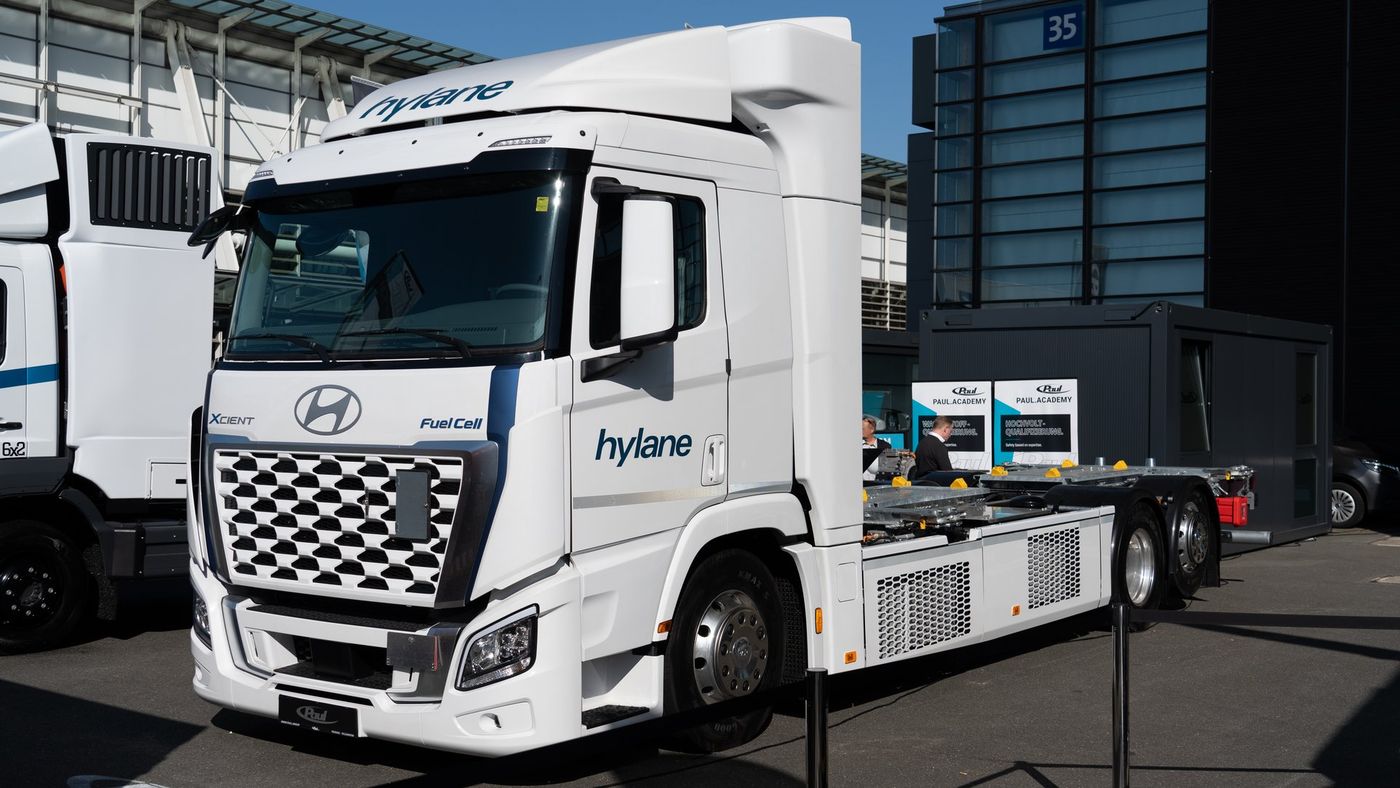
Hyundai XCIENT Fuel Cell
The European XCIENT Fuel Cell's twin fuel-cell system, 350-bar hydrogen store, motor, battery, 4x2 and 6x2 dimensions, weights and safety systems, from Hyundai's own documents.
- 2 configurations

Model overview
- Segment
- Distribution
- Axle configurations
- 2 (4x2…)
- Transmission
- Allison ATM 4500 R automatic, 5 forward gears and 1 reverse
- Gross combination
- 38 t (4x2 chassis cab, all four wheelbases; 6x2: 42 t)
- Battery capacity
- 72 kWh
- Electric motor
- 350 kW peak
- Fuel cell
- 220 kW · 2 × 110 kW
- Hydrogen tank
- 31.08 kg · gaseous
- Storage pressure
- 350 bar
- Range on hydrogen
- 400 km
Axle configurations: 4x2 · 6x2
The XCIENT Fuel Cell is Hyundai’s hydrogen fuel-cell heavy-duty truck. Hyundai’s product page for it states that “These specifications are based on European models”, and the figures for that European model come from that page, from Hyundai’s catalogue (code “EU. LHD 2506 ENG.”, with a 2025 copyright line) and from three Hyundai press releases dated 2020, 2024 and 2026. Hyundai’s tables list the truck as a chassis cab in two wheel formulas, 4x2 and 6x2 (Steering Tag), each in four wheelbases. Hyundai headlines it as “The world’s first fuel cell heavy-duty truck in commercial operation”, a claim that is the maker’s own.
Hyundai states that the values in its catalogue table “are based on internal testing results and are subject to change after final validation”, and that some of the equipment shown or described in the catalogue “may not be standard”. Both caveats apply to every catalogue figure below, and a figure that carries a condition of its own is given with it. Hyundai lists a separate North American model on its own product page.
Overview and generations
Hyundai’s release of 6 July 2020 says the company that day shipped the first 10 units of the XCIENT Fuel Cell to Switzerland. It describes that first version as follows: a 190 kW hydrogen fuel-cell system with two 95 kW stacks (the release’s word); seven hydrogen tanks with a combined storage capacity of around 32.09 kg; a battery of 661 V and 73.2 kWh, named as made by Akasol; a motor and inverter of 350 kW and 3,400 Nm, named as made by Siemens; and a range of about 400 km on a single refuelling, footnoted as given for a 4X2 truck with a refrigerated upfit configuration operating as a 34 ton truck and trailer combination. The release gives a refuelling time of approximately 8-20 minutes for each truck, mentions Swiss refuelling stations “running with 350 bar”, and adds that Hyundai Hydrogen Mobility (HHM), a joint venture with the Swiss company H2 Energy, would lease the trucks on a pay-per-use basis. The suppliers, the tank count and the refuelling time belong to that 2020 version; Hyundai’s current documents give none of them.
Fleet operations began in Switzerland in October 2020. Hyundai’s release of 12 June 2024 says the trucks had by then passed a cumulative 10 million km in Swiss fleet use, in three years and eight months, and that 48 XCIENT Fuel Cell trucks were in operation in Switzerland. The same release describes the truck as powered by “two 90-kW fuel cell systems (total 180 kW power)” and a 350 kW e-motor, “giving a maximum range of over 400 km”. That is a different fuel-cell rating from the 190 kW (2 x 95 kW) that the 2020 release gave for the trucks shipped to Switzerland; Hyundai’s two releases give different figures. The release of 5 February 2026 says the European fleet had recorded 20 million km of driving as of January 2026, achieved over five years, with 165 units in operation across Switzerland, Germany, France, the Netherlands and Austria. The work it lists by country includes food, beverage and clothing logistics in Switzerland; supermarket chains, textile companies and fleet operators in Germany; refuse and crane trucks in France; a tarpaulin truck for a construction-materials distributor in the Netherlands; and a reefer van with a supermarket chain in Austria. Hyundai’s catalogue and product page carry a further, undated sentence: nearly 200 XCIENT Fuel Cell trucks in Europe have accumulated over 15 million kilometres. Hyundai gives no date for it and does not say how it relates to the 165 units.
Hyundai’s current European catalogue, which carries a 2025 copyright line, describes an improved fuel cell system rated at 220 kW gross, described under the fuel-cell heading below. The release of 5 February 2026 says Hyundai “launched the new XCIENT Fuel Cell truck in 2025”, with an upgraded hydrogen fuel cell system; it does not say for which market, and none of the Hyundai documents opened for this page dates the start of sales or production of the 220 kW version in Europe.
Cab
The specification table lists the cab as electric driven hydraulic tilting, with air full-floating mounting and multifunction-type seats. Hyundai gives no cab name and no interior dimensions in the documents opened for this page; how cab types are grouped and named across the industry is set out in truck cabs explained.
Inside, the catalogue describes a 12.3-inch digital cluster and a 12.3-inch touchscreen, and says the built-in navigation is TomTom-based. It lists Motor Assist Hydraulic Steering (MAHS) as optional, and an Electronic Parking Brake (EPB) with Autohold. It lists a 10-way air suspension seat and adds that multi-stage seat heating and cooling are included; wireless charging is listed at 10 W. The smart key includes remote start and ECAS operation from outside the vehicle, and Hyundai’s footnote reads “Two keys standard, optional extras available”. Behind the driver’s seat the catalogue describes a wider bed and gives no dimensions for it.
On the outside, Hyundai states that its rounded corners and elongated bumper reduce air resistance, enhancing aerodynamic performance by 2.8% and fuel efficiency by 1.2%. Neither document says what those percentages are measured against.
Fuel-cell system and hydrogen storage
The catalogue says the truck is powered by a twin fuel cell system that runs on hydrogen. Its table lists two systems, a gross system power of 220 kW (110 kW x 2), a net system power of 188 kW (94 kW x 2) and an output voltage of 250 V to 450 V. The catalogue’s page on the hydrogen system footnotes the 220 kW as “Gross”, and the product page’s key-figures box labels it “Max Stack Power”. The 220 kW is therefore a gross figure, with the 188 kW net figure given beside it, and it is not the truck’s drive rating, which is the motor’s, below; how a truck’s power figures are read is set out in reading truck power figures. Hyundai calls the system improved, “offering improved system output and enhanced safety”. The current documents name no supplier for the fuel cell system, the battery or the motor.
The hydrogen store holds 31.08 kg at 350 bar: the product page gives a filling pressure of 350 Bar and a capacity of 31.08 kg, and the catalogue table gives the fuel tank capacity as 1,351 L (31.08 kg H2) and the fuel tank material as Type IV (CFRP with a plastic liner). Hyundai says the improved Type IV fuel tank includes a safety device for pressure relief in emergencies, and that the hydrogen storage and delivery system is safe thanks to rigorous testing for open flame, ballistic penetration, and exposure to temperature extremes. The current documents give no tank count; the seven tanks of the 2020 version are described under the overview above.
Electric motor, battery and transmission
The catalogue’s table lists a maximum power of 350 kW and a torque of 2,237 Nm for the motor, and a motor code, LSM380C-HV-08 (“Application Motor”); the product page speaks of “a maximum output of 350 kW and 2,237 Nm of torque”. The 350 kW is Hyundai’s maximum figure: neither document gives a continuous rating or a motor count.
The battery is lithium-ion, three units (3 ea) at 630 V and 72 kWh, which the product page gives as 3 x 24 kWh; Hyundai does not say whether the 72 kWh is installed or usable capacity. Hyundai says the battery system’s reinforced mounting structure helps reduce the risk of fire in the event of battery cell thermal runaway. The electrical system carries a battery listed as 24 V-230 AH MF.
The transmission is an Allison ATM 4500 R automatic with 5 forward gears and 1 reverse gear, with gear selection listed as “Multi function switch RH lever shift”. Hyundai says the five-speed automatic transmission adjusts power delivery to load and driving speed.
The auxiliary brake is listed as “Retarder+Regenerative Braking”: the retarder is oil operated and the regenerative braking is electric operated; what a retarder is, and how it differs from an engine brake, is set out in retarders and engine braking explained. Hyundai’s Smart Regenerative System optimizes regenerative braking from brake force level 0 to level 4, and Hyundai notes that the feature does not bring the vehicle to a complete stop. Hyundai also notes that the truck does not require urea or engine oil.
Range and calculated performance
Hyundai’s catalogue and product page state a driving range of approximately 400 km per refuelling, and footnote that driving range and refuelling times can vary depending on external factors; the product page’s footnote says “charging times”. The product page’s key-figures box shows the figure under the label “All Electric Range” and adds that it is “based on internal testing with full load” and that range can vary depending on external conditions. Other Hyundai documents attach other conditions to a 400 km figure: the 2020 release footnoted its “about 400 km” to a refrigerated 4X2 truck at a 34 ton combination, and the June 2024 release, for the Swiss fleet, says “a maximum range of over 400 km”. The three statements are Hyundai’s own, on different dates.
Under “Calculated Performance” the catalogue lists a maximum speed of 85 km/h, with “90 OPT”, and a maximum gradeability, given as tanθ, of 0.28 for the 4x2 and 0.23 for the 6x2. These are Hyundai’s calculated values, and the gradeability is given as tanθ, not as a percentage.
Chassis, axles, suspension and brakes
The catalogue describes a reinforced ladder-frame chassis: a “C” type frame with channel-section side rails and cross members, the side rail measuring 280 x 90 x 8 mm (depth x flange x thickness). The 6x2 has a rear tag axle, its columns are headed “6x2 (Steering Tag)”, and Hyundai says rear-axle steering is available on 6x2 models only. What the 4x2 and 6x2 notations mean is set out in axle configurations explained.
The rear axle is a full floating type with a capacity of 12,500 kg and a final reduction gear ratio of 4.889; the front axle is a reverse Elliot type “I” beam with a capacity of 8,000 kg on both the 4x2 and the 6x2. Tyres are 315/70 R22.5 on 22.5 x 9.00 wheels: single front and dual rear on the 4x2, single front, dual rear and single tag on the 6x2. The service brake is a disc of ø430 x 45 mm on front, rear and tag, with automatic adjusters.
Suspension is air spring at the front and rear: the catalogue lists 2 air springs at the front and 4 at the rear, with 2 at the tag axle on the 6x2, and hydraulic double-acting telescopic shock absorbers on the front and rear axle. Hyundai’s catalogue and product page also list an ECAS (Electronically Controlled Air Suspension) switch and an Axle Weight Display. The exhaust system is listed as an exhaust hose, silencer and tail pipe, the tail pipe being a droptail type that blows rearward and downward relative to the chassis.
Dimensions and weights
Hyundai’s table gives the chassis-cab dimensions in millimetres, in four wheelbases for each wheel formula. The column names are Hyundai’s, and “C.A” and “C.E” are Hyundai’s labels for the distance from the end of the hydrogen tank to the rear axle and to the end of the frame.
| 4x2 | Short | Medium | Long | Long Plus |
|---|---|---|---|---|
| Wheelbase | 5,130 | 5,330 | 5,530 | 5,730 |
| Overall length | 9,780 | 9,780 | 9,780 | 9,780 |
| Rear overhang | 3,075 | 2,875 | 2,675 | 2,475 |
| C.A (hydrogen tank end to rear axle) | 4,025 | 4,225 | 4,425 | 4,625 |
| C.E (hydrogen tank end to end of frame) | 7,100 | 7,100 | 7,100 | 7,100 |
| Minimum turning radius (m) | 10.03 | 10.38 | 10.73 | 11.07 |
| 6x2 (Steering Tag) | Short | Medium | Long | Extra Long |
|---|---|---|---|---|
| Wheelbase | 5,000+1,350 | 5,330+1,350 | 5,530+1,350 | 5,970+1,350 |
| Overall length | 9,780 | 11,550 | 11,725 | 12,035 |
| Rear overhang | 1,855 | 3,295 | 3,270 | 3,140 |
| C.A (hydrogen tank end to rear axle) | 3,895 | 4,225 | 4,425 | 4,865 |
| C.E (hydrogen tank end to end of frame) | 7,100 | 8,870 | 9,045 | 9,355 |
| Minimum turning radius (m) | 9.81 | 10.38 | 10.73 | 11.49 |
Hyundai gives one value for all eight variants for three dimensions: overall width 2,540 mm, given as “With Side Protector. EU and CH”; overall height 3,730 mm with the standard spoiler and 3,900 mm with the add-on spoiler; and front overhang 1,575 mm. A minimum ground clearance of 230 mm, given for the rear axle, is printed in the 4x2 columns only; the 6x2 columns leave that row blank. The wheel tread, front and rear, is 2,050 and 1,845 mm on the four 4x2 variants, and 2,050, 1,845 and 2,050 mm on the four 6x2 variants. The turning figure is a minimum turning radius, not a diameter.
| Weight (kg) | 4x2 | 6x2 (Steering Tag) |
|---|---|---|
| Max. gross vehicle weight * (front / rear) | 19,500 (8,000 / 11,500) | 27,000 (8,000 / 11,500 / 8,000) |
| Technically permissible maximum weight (front / rear) | 8,000 / 12,500 | 8,000 / 12,500 / 8,000 |
| Max. gross combination weight | 38,000 | 42,000 |
Hyundai puts an asterisk on the gross vehicle weight row, footnoted “Figures stated in relation to EU-Regulation 96/53/EC”; 96/53/EC is a Council Directive, and the difference between a gross vehicle weight and a gross combination weight is set out in truck weights, GVW and GCW. The footnote is on that row only. The technically permissible weights and the gross vehicle weights are separate rows in Hyundai’s table. Hyundai’s row label names two positions, front and rear, while the 6x2 rows print three figures; the weight rows do not name the third.
Hyundai’s second footnote reads “Allowed to exceed European overall length regulations (≤12m) according to elongated cab regulations”. The table does not mark which cell it belongs to; the only length above 12 m in the table is the 6x2 Extra Long’s 12,035 mm. The length rules themselves are set out in aerodynamic cabs and length rules. The catalogue’s features pages also list Duomatic trailer connectors and brake hoses for a trailer.
Safety and driver-assistance systems
Hyundai states that the truck is “fully compliant with General Safety Regulation (GSR) II Step B”; what that regulation requires, and from when, is set out in mandatory driver assistance systems. The catalogue’s driver-assistance page names a front camera sensor, a front radar sensor, front corner radar sensors and rear corner radar sensors, and Hyundai says the side-front and side-rear sensors detect blind spots and prevent accidents during reversing and lane changes.
The catalogue names these driver-assistance functions:
- Forward Collision-Avoidance Assist (FCA), which helps prevent collisions with vehicles, pedestrians and cyclists ahead, and Forward Collision Warning-Near (FCW-Near).
- Blind-Spot Collision Warning (BCW) and Blind-Spot Collision Warning-Near (BCW-Near).
- Intelligent Speed Limit Assist (ISLA): the catalogue says that when driving between 70–90 km/h with Smart Cruise Control activated, the system adjusts the set speed by recognising speed limit signs.
- Highway Driving Assist (HDA), marked optional, which works with Lane Following Assist (LFA), Smart Cruise Control (SCC) and Hands Off Detection (HOD).
- Driver Attention Warning (DAW), which monitors the driver’s attention level on a scale from 0 to 5, and Driver State Warning (DSW), marked optional, which uses an in-cabin camera.
For stability and braking the catalogue names Vehicle Dynamic Control (VDC), Electronic Brake Force Distribution (EBD) and the Easy Hill Start System (EHS), which holds the main brake for about three seconds. It also lists High Beam Assist (HBA), a Tire-Pressure-Monitoring Sensor (TPMS), a “Vehicle On” warning and an alcohol interlock interface, described as an interface for connecting an external alcohol detection module. A further catalogue page is headed “Cybersecurity & OTA” (over-the-air software updates). Hyundai marks only HDA and DSW as optional in this group; the catalogue does not say whether the others are standard.
Equipment and options
The documents mark five items as optional: Motor Assist Hydraulic Steering (MAHS), Highway Driving Assist (HDA), Driver State Warning (DSW), digital side mirrors (DSM) and an electric power take-off (ePTO). Hyundai lists the ePTO at a maximum of 100 kW and marks it “This feature will be available soon”, adding that the upfit example shown “is not currently compatible”. It marks the digital side mirrors as an optional feature that will be available soon. No date is given for either.
The catalogue’s features pages list roof spoilers, wide LED headlamps, heated side mirrors with an LED welcome lamp, a digital tachograph, a rear view camera, a driver’s airbag, 12 V and 24 V power outlets and a passenger-side folding table, among other items. The catalogue does not separate standard from optional equipment and says some equipment “may not be standard”.
Source notes
Hyundai’s figures for the European model, from its product page and its catalogue (EU. LHD 2506 ENG.), which states that the table’s values are based on internal testing results and are subject to change after final validation. The fuel cell system is two units, 220 kW gross (110 kW x 2) and 188 kW net (94 kW x 2), with an output voltage of 250 V to 450 V; it is not the drive rating. The drive motor, LSM380C-HV-08, gives a maximum 350 kW and 2,237 Nm. The lithium-ion battery is three packs, 630 V and 72 kWh (3 x 24 kWh); Hyundai does not say whether that is installed or usable. Hydrogen: 31.08 kg at 350 bar, 1,351 L, in a Type IV fuel tank (CFRP and plastic liner). Range is approximately 400 km per refuelling, which the product page bases on internal testing with full load. Gross vehicle weight is 19,500 kg on the 4x2 (8,000 front, 11,500 rear) and 27,000 kg on the 6x2 steering-tag (8,000 / 11,500 / 8,000), a row Hyundai footnotes as stated in relation to 96/53/EC; technically permissible weights are 8,000 / 12,500 and 8,000 / 12,500 / 8,000; gross combination weight is 38,000 kg on the 4x2 and 42,000 kg on the 6x2. Wheelbases are 5,130 to 5,730 mm on the 4x2 and 5,000+1,350 to 5,970+1,350 mm on the 6x2; length is 9,780 mm on every 4x2 and on the 6x2 Short, and 11,550, 11,725 and 12,035 mm on the 6x2 Medium, Long and Extra Long; height is 3,730 mm with the standard spoiler and 3,900 mm with the add-on spoiler. Calculated maximum speed is 85 km/h, printed as “85 (90 OPT)”.
Quick answers
- What axle configurations does the Hyundai XCIENT Fuel Cell come in?
- 4x2, 6x2.
- Which transmission does the Hyundai XCIENT Fuel Cell use?
- Transmission: Allison ATM 4500 R automatic, 5 forward gears and 1 reverse.
- What is the gross combination weight of the Hyundai XCIENT Fuel Cell?
- Gross combination weight: 38 t (4x2 chassis cab, all four wheelbases; 6x2: 42 t).
- What battery capacity does the Hyundai XCIENT Fuel Cell have?
- Battery capacity: 72 kWh.
Articles that mention the Hyundai XCIENT Fuel Cell
Sources
- XCIENT Fuel Cell Truck — product page (specifications based on European models) — Hyundai Motor Company
- XCIENT Fuel Cell — catalogue, EU. LHD 2506 ENG. (Copyright 2025) — Hyundai Motor Company
- Hyundai Motor's XCIENT Fuel Cell Truck Fleet Achieves 20-Million-Kilometer Milestone in Europe (5 February 2026) — Hyundai Motor Company
- Hyundai Motor's XCIENT Fuel Cell Trucks Achieve Record of 10 Million km Total Driving Distance in Switzerland (12 June 2024) — Hyundai Motor Company
- Hyundai XCIENT Fuel Cell Heads to Europe for Commercial Use (6 July 2020) — Hyundai Motor Company