Turbocompound engines: how they work and what makers claim
A turbocompound engine's second exhaust turbine returns energy to the crankshaft; on the Volvo D13 I-Save and Renault Trucks DE13 TC it shows up as torque.
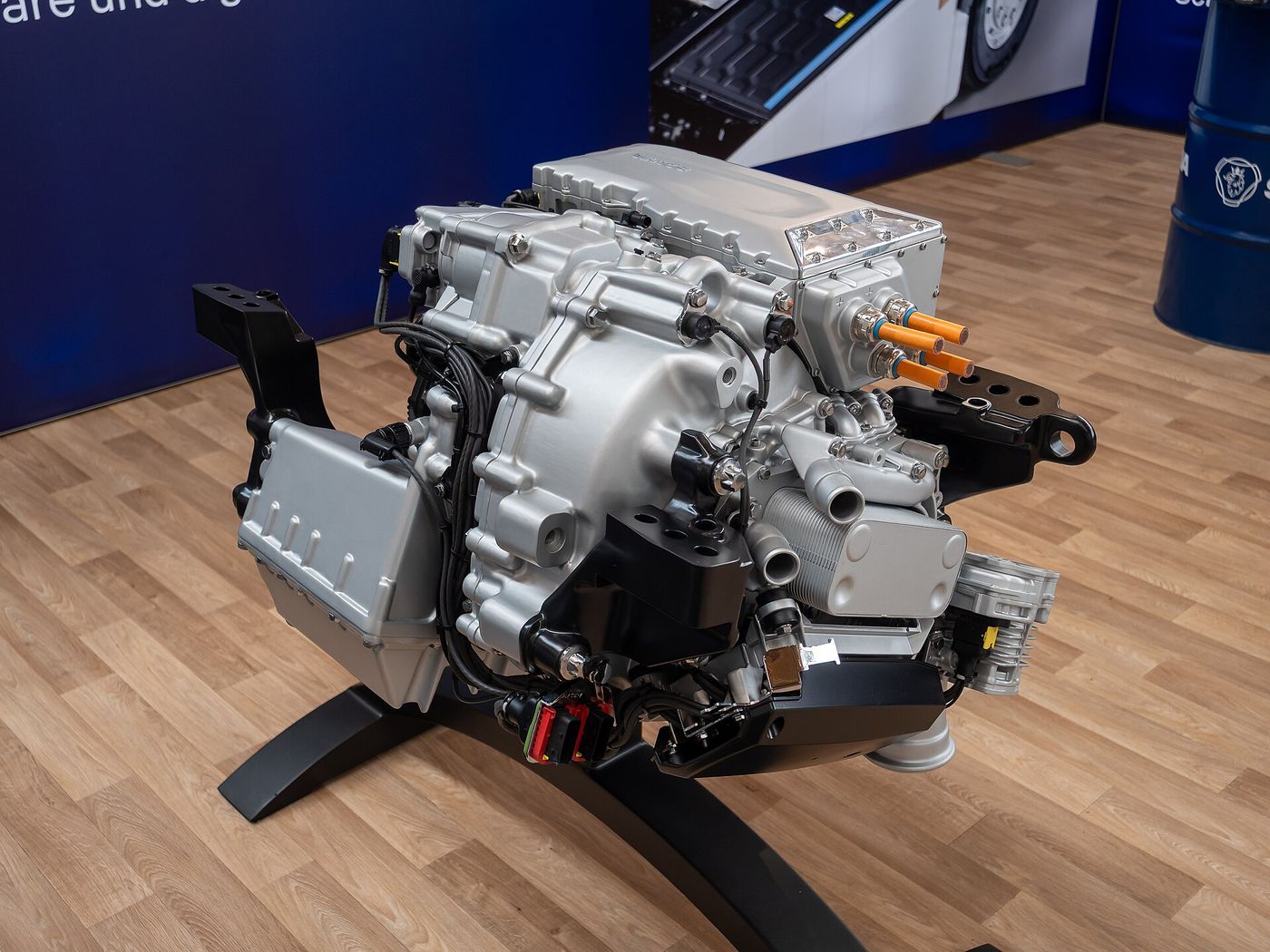
A spec sheet that reads D13TC, or MP8HE, or “Energy Recovery Technology”, is telling you one specific thing: there is a second turbine in the exhaust stream, and it is not there to feed the intake. Its job is to take back energy that would otherwise leave through the pipe and return it to the crankshaft. Volvo’s launch release for I-Save, the package that combines its turbocompound D13TC with other fuel-saving features, ties what the package is worth to how far the truck runs: “The longer they drive, the more they can potentially save.”
What the second turbine actually does
The turbocharger on these engines is, in Volvo’s words, the one “used to manage engine intake air”. Turbocompounding adds a further turbine for something else. On Volvo’s description of its North American D13TC, a simple turbine wheel sits “downstream of the actual turbocharger” and is “linked through a network of reduction gears to the engine’s crankshaft”; Volvo UK’s release for the FH says the recovered exhaust energy powers the flywheel. Mack says its Energy Recovery Technology captures heat “that would otherwise be lost”, converts exhaust emissions “to mechanical energy” and delivers it “back to the crankshaft as torque”.
The reason there is anything left to recover is the diesel engine’s own efficiency. “Typically, for every gallon of diesel burned, only about 42 percent of the energy content actually makes it to the wheels,” Volvo product marketing manager John Moore told Volvo’s North American customer magazine. “The rest is wasted as heat.” In 2018, as Transport Topics reported, he told Equipment & Maintenance Update that the unit would raise the North American D13TC’s brake thermal efficiency from 43% to 48%, by capturing energy that would have been lost in the stack or the cooling system.
On the Volvo FH and Renault Trucks T, it shows up as torque, not as headline power
Our own record for the Volvo FH, built from the engines Volvo UK still listed in September 2026, gives a standard D13 spanning 309–397 kW with 2,100–2,600 Nm, and the turbocompound D13 I-Save at 309–368 kW with 2,400–2,800 Nm. The turbocompound engine tops out lower on power and higher on torque. Volvo’s own launch material puts the difference at up to 300 Nm extra.
The Renault Trucks T record, built from Renault Trucks’ May 2023 brochure, shows the same shape from a second manufacturer: the DE13 TC is listed at 330 and 360 kW, the two steps the plain DE13 also has, but with 2,500 and 2,700 Nm against 2,200 and 2,400 — and it is not listed at all on the 390 kW step, so the turbocompound family again stops lower on power and higher on torque.
That shape is not a rule of turbocompounding. For its North American D13TC, Volvo’s 2017 release says “the 50 additional horsepower is fed directly to the crankshaft”, and Volvo’s North American magazine says the net effect is “adding additional torque and horsepower to the crankshaft”, but that “unlike turbo compounding used in the past, Volvo decided not to use the technology to add horsepower”. “I can either add it to my max power and deliver more power, or I can reduce how much fuel I’m putting in the engine for the same output. We choose the latter,” its chief engineer in powertrain, John Bartel, told the magazine. Volvo’s European release gives the payoff as “less acceleration and fuel is needed to keep a steady speed in highway traffic”, and Mack says its system “enables the engine to operate at 1,000-1,100 RPM, saving fuel without sacrificing performance”. Paired with a downspeeding driveline, Volvo’s magazine adds, turbocompounding lets the transmission “stay in top gear longer in rolling terrain”, for a fuel gain it puts at “about 3 percent”.
The published figures, and what they are measured against
Volvo Trucks says the Volvo FH with I-Save “can cut fuel costs by up to 7% in long-haul operations” (Volvo UK’s version: “could”), measured against a D13 Euro VI Step D without the Long Haul Fuel Package, and presents it as “the combined efficiency gains of all these products and services”: the D13TC plus new rear axles, an updated I-See, I-Shift software for long haul, I-Cruise with I-Roll, engine idle shutdown and a variable-displacement steering pump. The two versions of its 7 March 2019 release disagree on who that is for: Volvo’s global release says I-Save was tailored especially to long-haul operators that typically drive more than 120,000 km per year, while Volvo UK’s version gives 160,000 km and calls the D13TC ideal for long-haul customers “typically exceeding 160,000 km per annum”. Both versions footnote that actual fuel economy “will vary” (the UK version: “may vary”) depending on many factors, such as use of cruise control, vehicle specification, vehicle load, topography, the driver’s experience and weather.
Volvo’s North American figure is split differently. Its July 2017 release for the new VNL gives “up to a 6.5 percent improvement in fuel efficiency from the engine alone” against its previous GHG14 D13 engines, and up to 7.5% overall once the new VNL’s aerodynamics add a further 1 percent. Transport Topics reported in July 2018 that Mack’s turbocompounder, combined with features such as the aerodynamic improvements in the HE+ package, lets Mack Anthem models improve fuel efficiency by up to 9.5%.
Read those carefully. The European 7% and the Mack 9.5% are package figures. The 6.5% is the one figure here that its maker gives for the engine alone, and it is measured against Volvo’s own previous engine.
The work it is built for
Volvo calls the FH with I-Save “tailor-made for demanding long-haul operations”, and its 2017 North American release says the D13TC was “designed for customers with long-haul, steady-speed operations”. In 2018 Volvo told Transport Topics that the biggest improvement from turbocompounding comes in long-haul applications that are downsped, and Jack Legler, technical director of the American Trucking Associations’ Technology & Maintenance Council, said it can be especially effective for fleets that are downspeeding. Volvo’s current North American D13TC page adds that fleets running variable-load applications, “including tanker, bulk haul and flat-bed deliveries”, “can benefit”.
Volvo attached conditions to that percentage: the annual mileage it was tailored for, and the footnote’s cruise-control use, vehicle load and topography.
Detroit’s DD15 and Navistar: the other route
Detroit’s DD15 had turbocompounding before the 2014 greenhouse-gas regulations. According to Detroit’s Brian Daniels, quoted by Transport Topics in 2018, that engine’s 2014 update left it out and relied instead on the Detroit Asymmetric Turbocharger, which he described as a simplified, more efficient and more durable design that is 70 pounds lighter; the same article reported that Detroit still used turbocompounding on its largest engine, the DD16. Detroit’s current DD15 page lists a ball-bearing simple-geometry turbo and claims the engine is “up to 3% more fuel efficient than our previous model”. Turbocompounding is not mentioned on it at all.
Navistar told the same publication it had no plans to add a turbocompounder to its International trucks. Jim Nachtman, its marketing director for the heavy-duty product segment, said that “if you add a lot of complexity to a vehicle, there’s a higher propensity for something to fail”, that fleets tell Navistar a day of downtime is worth $1,000 to $1,500 depending on the fleet, plus the cost of the repair itself, and that “if you save a small amount of fuel economy but incur some extra downtime, in general that is not advantageous to the customer’s bottom line”. That is the counter-case, and it comes from people who sell trucks for a living. Navistar said it would keep improving the turbocharger itself instead, alongside a low-friction ring pack, low-friction piston skirt coatings, a slower water pump, a six-blade fan it said freed 31 horsepower, and predictive cruise control it put at 1% to 2%.
Volvo’s answer to the durability question, on its North American D13TC page, is that the engine’s fixed-geometry turbocharger is “designed to meet the 1.2 million mile B50 life of the engine, with no extra maintenance required”; its 2017 release has Moore saying the turbocompound system “adds no additional routine maintenance to the engine”.
Why it exists at all
The idea is not new: Volvo’s own magazine notes that turbocompounding “was used on heavy aircraft engines during the second world war”. The makers give their own reasons for it now. Volvo’s European release sets I-Save against trucks covering increasingly longer distances and rising diesel prices; in North America, Transport Topics reported that the D13TC was introduced as part of Volvo’s powertrain compliant with the 2017 greenhouse-gas standards.
The EU’s CO2 targets for new heavy-duty vehicles
Regulation (EU) 2019/1242, as amended, sets CO2 reduction targets for the Union fleet of new heavy-duty motor vehicles, other than special-purpose and off-road vehicles, “compared to the average CO2 emissions of the reporting period of the year 2019”: 15% for the reporting periods 2025 to 2029 for vehicle sub-groups 4-UD, 4-RD, 4-LH, 5-RD, 5-LH, 9-RD, 9-LH, 10-RD and 10-LH; 45% for 2030 to 2034 (vocational vehicles excepted); 65% for 2035 to 2039; and 90% from 2040 onwards. The regulation’s Annex I (point 3.2) applies the 2019 reporting period as the reference only to those nine sub-groups; sub-groups 1, 2, 3, 11, 12 and 16 are measured against 2021, and all others against 2025. The Commission describes them as a reduction “across all vehicles manufactured by a company”, with CO2 emissions and fuel consumption simulated in the VECTO tool “based on data from relevant vehicle components”.
How the variant is named
On a Volvo the engine designation carries it — the 2019 launch release lists “D13TC (Turbo Compound)”, and Volvo UK lists it for the FH as the D13 I-Save; Mack’s is the MP8HE with Energy Recovery Technology.
Quick answers
- What does a turbocompound engine do?
- It adds a second turbine to the exhaust stream that does not feed the intake. Volvo describes the one on its North American D13TC as sitting downstream of the turbocharger and linked through reduction gears to the crankshaft; Mack says its Energy Recovery Technology delivers the recovered energy back to the crankshaft as torque. In 2018, as Transport Topics reported, Volvo’s John Moore said the unit would raise the North American D13TC’s brake thermal efficiency from 43% to 48%.
- How do the Volvo FH and Renault Trucks T turbocompound engines compare with the standard engines on power and torque?
- On the Volvo FH, as Volvo UK listed its engines in September 2026, the D13 I-Save (turbocompound) runs 309–368 kW with 2,400–2,800 Nm against the standard D13’s 309–397 kW and 2,100–2,600 Nm; Volvo’s 2019 launch release gives up to 300 Nm extra torque. In Renault Trucks’ May 2023 brochure the DE13 TC is listed at 330 and 360 kW with 2,500 and 2,700 Nm, against the plain DE13’s 2,200 and 2,400 Nm on the same steps, and not at all on the 390 kW step. For its North American D13TC, Volvo’s magazine says that, unlike turbocompounding used in the past, Volvo decided not to use the technology to add horsepower and uses the recovered energy to reduce fueling for a given rating. The same magazine says that, with a downspeeding driveline, turbocompounding lets the transmission stay in top gear longer in rolling terrain.
- How much fuel does turbocompounding save?
- Volvo says the Volvo FH with I-Save “can cut fuel costs by up to 7% in long-haul operations” (Volvo UK’s version: “could”) against a D13 Euro VI Step D without the Long Haul Fuel Package, and calls it the combined gain of the whole package — engine, rear axles, I-See, I-Shift software and more. The two versions of its March 2019 release name different target mileages: more than 120,000 km a year in Volvo’s global release, more than 160,000 km in the Volvo UK version. For its North American D13TC, Volvo’s July 2017 release gives up to 6.5% from the engine alone against its previous GHG14 D13, and up to 7.5% overall with the new VNL’s aerodynamics.
- What kind of work is a turbocompound engine built for?
- Long-haul, on the makers’ own account. Volvo calls the FH with I-Save “tailor-made for demanding long-haul operations” and says the longer operators drive, the more they can potentially save; its 2017 North American release says the D13TC was designed for “long-haul, steady-speed operations”, and its current North American page says fleets running variable-load applications, including tanker, bulk haul and flat-bed deliveries, “can benefit”. Volvo’s footnote names cruise-control use, vehicle specification, vehicle load, topography, the driver’s experience and weather among the factors that move the saving.
Models in this article
Sources
- Lorries, buses and coaches: CO2 emission performance standards — European Commission — Climate Action
- Regulation (EU) 2019/1242 setting CO2 emission performance standards for new heavy-duty vehicles, consolidated text of 10 September 2026 — EUR-Lex
- New Volvo FH with I-Save cuts fuel costs by up to 7% (press release, 7 March 2019) — Volvo Trucks
- Cut Fuel Costs by up to 7% Using the New Volvo FH With I-Save (press release, 7 March 2019) — Volvo Trucks UK
- Volvo D13 Turbo Compound Engine Powers New Volvo VNL Series to 7.5 Percent Improvement in Fuel Efficiency (press release, 17 July 2017) — Volvo Group
- The Right Technology at the Right Time (Volvo Trucks magazine) — Volvo Trucks North America
- Volvo D13TC engine — Volvo Trucks North America
- MP8HE with Energy Recovery Technology — Mack Trucks
- Detroit DD15 engine — Detroit (Daimler Truck North America)
- OEMs mixed on turbo compounding (20 July 2018) — Transport Topics