Renault Trucks
Renault Trucks T
Three engine families, four cabs and a turbocompound option — what the Renault Trucks T is, which engine suits which job, and what its own documents will not confirm.
.jpg)
Model overview
Axle configurations: 4x2 · 6x2 trailing axle · 6x2 pusher axle · 6x2 steering pusher axle
Engine families
- Power
- 285–344 kW
- Torque
- 1800–2200 Nm
- Power
- 330–390 kW
- Torque
- 2200–2550 Nm
- Power
- 330–360 kW
- Torque
- 2500–2700 Nm
Neither weight above is one vehicle's plate. The range poster gives 19 t gross vehicle for the 4x2 and 26 t for the 6x2, and prints 40 t / 44 t / 60 t as a single gross combination column spanning every cab, silhouette and engine without tying a figure to a vehicle; renault-trucks.de states 44 t for both ranges but calls it zulässiges Gesamtgewicht on the T page and zulässiges Zuggesamtgewicht on the T High page, which are two different quantities. The DE11 belongs to the T alone: the T High is offered with the DE13 and the DE13 TC only. The DE13 TC is an option on the 440 and 480 hp steps and is not available with the Day cab. Four cabs are published — Day cab, Night & Day cab, Sleeper cab and High Sleeper cab — with interior heights of 1605 mm for the first two and 2136 mm for the other two, a 200 mm engine tunnel on the first three and a flat floor on the High Sleeper, which is also the only one reached by four steps rather than three. Engine weight including oil: 965 kg for the DE11, 1 067 kg for the DE13 and 1 196 kg for the DE13 TC. A DE13 R at up to 540 hp and 2800 Nm was announced in June 2026 for the 2027 model year; no kilowatt figure is published for it, so it has no row above. The DE11, DE13 and DE13 TC rows are the current engine generation, which Renault Trucks introduced with and after its 2021 overhaul of the T, T High, C and K; the T was launched in June 2013 with DTI 11 and DTI 13 engines, and the T and T High still carried them in December 2018. Exterior dimensions are published only as cab drawings for 4x2 tractors — six overall heights from 3167 to 3898 mm across the four cabs, cab widths of 2423 and 2464 mm and cab lengths of 1799 and 2309 mm — so no single length, width or height is recorded above.
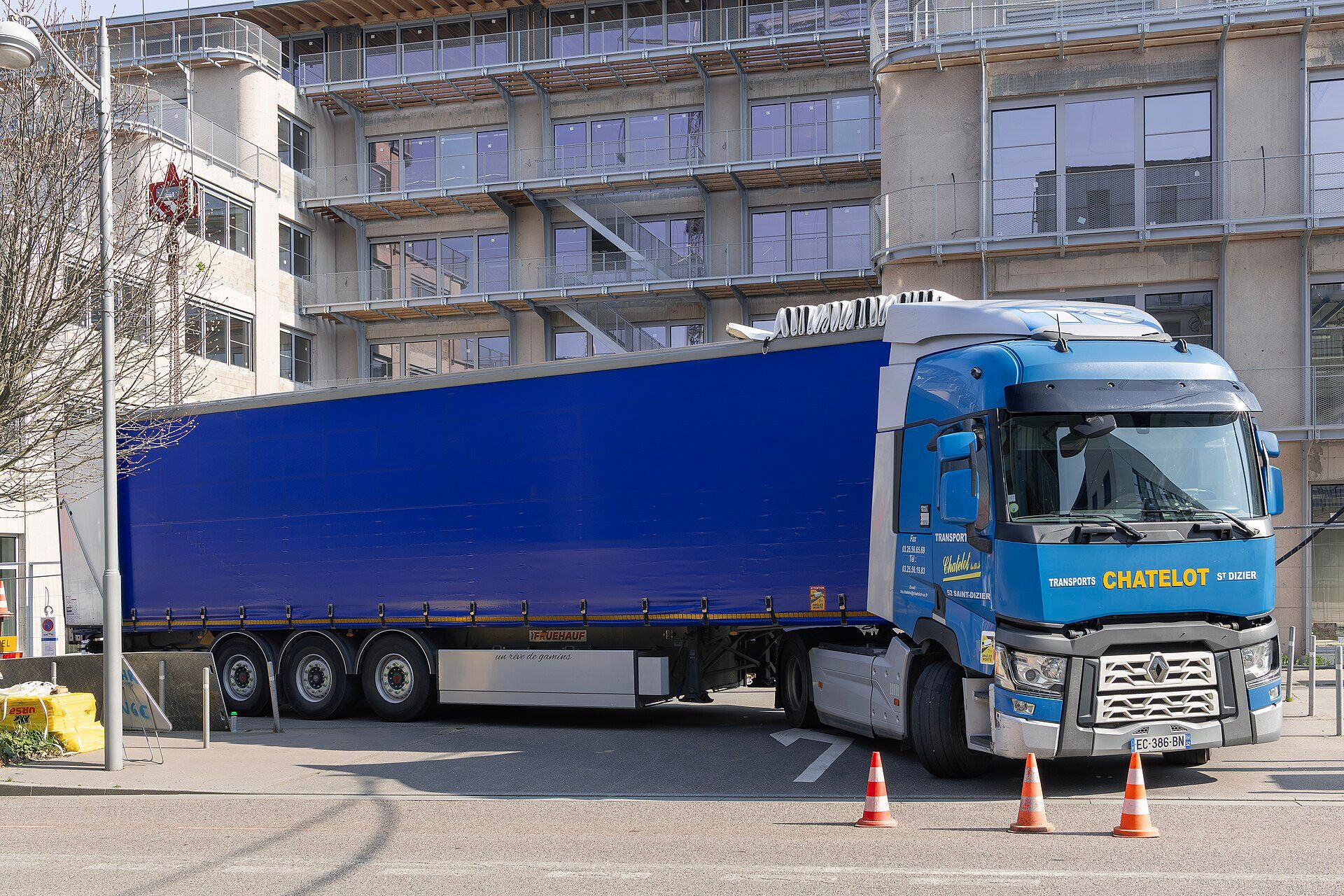
Renault Trucks builds one long-haul range and sells it under two names. The T is the family; the T High is the same vehicle under the flat-floored High Sleeper cab. The T arrived on 11 June 2013, when the manufacturer replaced its whole line-up at once to meet Euro 6 — a renewal the Volvo Group, which owns the brand, funded to the tune of more than two billion euros, and whose newsroom now holds the only surviving account of the launch. That account calls the new long-haul offer a single vehicle, names the T and never the T High; the earliest Renault Trucks document that opens and carries the second name is the press release of 12 December 2018. That ownership is why cross-shopping this truck against a Volvo means comparing two products of the same group rather than two rivals. The cab was restyled in 2021 and the present engine generation followed. The photograph above is of the earlier front — chrome grille bars, a solid chrome diamond and separate rectangular headlamps — and not the restyled one drawn in the brochure these figures come from.
Three engine families, and the T High only gets two
The figures below come from the May 2023 T / T High brochure; the 2025 edition on the same site has no technical table at all. That spread prints a full table for each family: displacement, cylinders, bore, stroke, compression ratio, weight with oil, every power step with its torque, and a curve underneath.
The DE11 is the 10.8-litre. Three steps: 285 kW (380 hp) with 1,800 Nm, 323 kW (430 hp) with 2,050 Nm and 344 kW (460 hp) with 2,200 Nm. It is the light engine — 965 kg with oil — and it belongs to the T alone: the corporate long-haul page lists it under the T and not under the T High, and the range poster agrees.
The DE13 is the 12.8-litre and the centre of the range: 330 kW (440 hp) with 2,200 Nm, 360 kW (480 hp) with 2,400 Nm and 390 kW (520 hp) with 2,550 Nm. Both the T and the T High are sold with it, and 520 hp is the top of the current diesel line-up in both.
Every one of those steps is published as a kilowatt figure and a horsepower figure on the same line, which matters because how truck power figures are measured decides what may be compared with what: a horsepower number converted by a third party is not a manufacturer’s number.
What the turbocompound option actually changes
The DE13 TC is the third table, and read beside the second it is the clearest worked example of turbocompounding this site has found inside a single manufacturer document. Same displacement, same two power steps — 330 kW (440 hp) and 360 kW (480 hp) — but 2,500 Nm and 2,700 Nm against the plain DE13’s 2,200 and 2,400 at the identical outputs. That is 300 Nm more at each step, and the subtraction is ours: Renault Trucks prints both tables and never draws the comparison.
The price is on the same page. The DE13 TC weighs 1,196 kg with oil against the DE13’s 1,067 kg — 129 kg of extra engine, again our arithmetic — and the curve shows what it is bought for: at the 440 hp step the full 2,500 Nm is available from 900 rpm. Two footnotes restrict it: an option on the 440 and 480 hp steps, never the 520, and never with the Day cab.
The fuel claim needs reading carefully. The UK product page puts “up to 10% fuel savings” against the DE13 Turbo Compound engine. The German press release announcing the same engine generation frames it differently: up to ten per cent for the new DE11 and DE13 engines together with new technologies and dedicated services, measured against the manufacturer’s own previous generation. Same headline number, two frames, and only the second names a baseline — which is where it belongs in a tractor unit’s running costs.
What we could not confirm
The Euro VI step. Renault Trucks publishes three different answers for one range. The German T page states “Abgasnorm: EURO 6d”; the German T High page states “EURO 6e”; the German press release announcing these engines calls them “Euro VI Step E”; and the brochure carrying the actual figures heads all three of its tables simply “EURO VI ENGINE”. The record therefore stops at Euro VI. Where the step matters — for tolls and access schemes it does, as Euro 6 and Euro 7 explains — it has to be read off the individual vehicle’s documents, not off the model name.
The rated speed. Every step is published as a band rather than a point: 1,700–1,900 rpm across all three DE11 steps, 1,404–1,700 rpm for the 440 and 480 hp DE13 and 1,431–1,700 rpm for the 520, 1,240–1,600 rpm and 1,250–1,600 rpm for the two turbocompound steps. A single rated-speed figure would be invented, so that row is blank.
The DE13 R. A new 13-litre was announced in June 2026 for the 2027 model year across the T, T High, C and K, at up to 540 hp with 2,800 Nm and 250 bar peak cylinder pressure. Renault Trucks publishes horsepower and newton-metres for it and no kilowatt figure, so it gets no row above.
Which vehicle the gross combination weight belongs to. The range poster prints 40 t, 44 t and 60 t as one column spanning every cab, every silhouette and every engine, tying no figure to a truck. The only Renault Trucks page giving a single number is the German one, and it calls 44 t zulässiges Gesamtgewicht on the T page and zulässiges Zuggesamtgewicht on the T High page — gross vehicle weight and gross combination weight are not the same quantity, and the difference is the one set out in gross vehicle and gross combination weight.
An overall length, and any turning circle. Neither is published for the T or the T High on any Renault Trucks page or PDF that opens, and a single length could not be: the wheelbase strip prints eighteen values from 3,200 to 6,700 mm, of which the tractor rows are ticked at six — 3,200, 3,400, 3,700, 3,800, 3,900 and 4,100 mm — every longer wheelbase belonging to the straight-truck chassis. Height and width the brochure does publish, but as a menu too, drawn cab by cab and qualified for one axle configuration; the figures are in the cab section below, and none of them is a model-level dimension, which is why those fields are empty as well.
Axles and weights
Four tractor profiles are drawn in the chassis table: 4x2, and three different 6x2s — trailing axle, pusher axle and steering pusher axle. The straight-truck chassis in the same range is offered as 4x2, 6x2 steering axle and 6x2 trailing axle instead, which is why the list above is shorter than the brochure page. If pusher and tag are not second nature, axle configurations explained covers it.
There is no 6x4 and no 8x4 T: those axles belong to the C and K construction ranges.
Gross vehicle weight follows the build: 19 t for the 4x2 and 26 t for the 6x2, written on the corporate page as “GVW 18/19 > 26 t”.
Optidriver, and the 2027 model year
The whole range is sold with one gearbox: the Optidriver, which the poster calls a robotic gearbox and lists with twelve speeds in every row. A single automated manual is the whole offer.
That changes for the 2027 model year. Renault Trucks announced a new generation of Optidriver in June 2026, claiming gear changes up to 20% faster than the previous generation, alongside the DE13 R. The engine brake goes with it: the DE13 R is fitted as standard with a more powerful Optibrake+ — a claim about that engine, not about the range as it stands, and the difference between an engine brake and a driveline retarder is worked through in retarders and engine braking. The 2027 T High has its world premiere at IAA Transportation in Hanover, from 15 to 20 September 2026: this range is about to be replaced at the top.
Four cabs, and the one that changes the floor
The Day cab is a short cab with a standard roof; the Night & Day cab is a deep cab with the same roof; the Sleeper cab is deep with the high roof; the High Sleeper cab is deep, high-roofed and flat-floored. The published interior heights are 1,605 mm for the first two and 2,136 mm for the other two, stated with no qualification at all.
The qualifier belongs to the drawings beside that table, and those carry the exterior figures. Each cab is dimensioned twice from the ground — 3,167 and 3,246 mm for the Day and the Night & Day, 3,477 and 3,677 mm for the Sleeper, 3,722 and 3,898 mm for the High Sleeper — under a single footnote reading “For 4x2 tractors”, and nothing on the page says what separates the two figures in a pair. The plan views give 2,423 mm across the Day cab and 2,464 mm across the other three, over cab lengths of 1,799 and 2,309 mm. A cab length is not a vehicle length, and six heights for four cabs on one axle configuration are not a height.
The flat floor is the dividing line. The first three cabs are built over a 200 mm engine tunnel; the High Sleeper removes it, and it is also the only cab reached by four steps rather than three. Whether that is worth the height and mass is the argument set out in truck cabs explained, with one consequence peculiar to this range: the Day cab cannot be ordered with the turbocompound engine at all.
Who this truck is right for
National and international long-haul on made roads, where the vehicle spends its hours at steady load in a narrow speed band and the fuel bill decides everything. Renault Trucks builds the pitch around it: A+ tyres as standard on its product pages — a class explained in truck tyre labelling — plus optimised axle ratios, aerodynamic features and the driveline above.
It is the wrong truck for site work or for anything needing a driven front axle: both are the C and K ranges’ job.
Where it sits against its rivals
The T meets the FH, the TGX and the XG+ at the same weights on the same routes. The May 2023 brochure prints kilowatts, horsepower and newton-metres on the same line for every step of all three engine families, which is what makes the useful comparison possible: per-step tables side by side rather than top power figures, because a ceiling tells you nothing about the step you would order. Torque is only comparable at the same output — which is why the turbocompound reading above is worth doing. And an emission step named on a rival’s page cannot be matched against a T: its own documents give three different answers, 6d on one product page, 6e on another, Step E in the press release, and the brochure that carries the figures names no step at all.
Buying used
Ask which engine, then ask again whether it is the turbocompound. The badge carries a horsepower number both engines share at two of their steps, and what each was bought to do differs sharply. The May 2023 brochure footnotes the turbocompound as unavailable with the Day cab, so a Day-cab truck of that model year is not a turbocompound; for any other year, read the engine off the build record rather than off the cab.
Confirm the generation first. A truck advertised with DTI 11 or DTI 13 engines predates the current naming and the current cab — those were the engines the T carried from the 2013 launch, and the T and the T High still carried them in December 2018 — and the standard used-truck checks then apply to a different vehicle than the one described here.
Then read the specification against the work. A 4x2 on the smallest DE11 that has spent its life at maximum weight in the mountains was asked for more than it was specified to give, and a 520 hp T High on regional distribution is a lot of truck to have paid for and to keep fed. Service history around the emission system matters here as much as on any Euro VI vehicle. The brochure’s contract table lists the parts covered by its repair and preventive-maintenance contracts, and the cover depends on which of the three was bought: the emissions control system and the air compressor are covered under Performance and Excellence but not under Reference, while the particulate filter is covered at all three levels.
Quick answers
- Which engines are available in the Renault Trucks T?
- The record for the Renault Trucks T covers these engine families: DE11 (10.8 l), DE13 (12.8 l), DE13 TC (Turbo Compound) (12.8 l). Output spans 285–390 kW and 1800–2700 Nm.
- What axle configurations does the Renault Trucks T come in?
- 4x2, 6x2 trailing axle, 6x2 pusher axle, 6x2 steering pusher axle.
- What emission standard does the Renault Trucks T meet?
- Euro VI.
Compared with
- Volvo FH
- MAN TGX
- DAF XG+
Sources
- Renault Trucks T / T High brochure, May 2023 edition — Renault Trucks
- Renault Trucks T, C and K brochure, 2025 — Renault Trucks UK
- Renault Trucks at IAA 2026: practical solutions to accelerate the decarbonisation of road transport — Renault Trucks
- Renault Trucks T 2019: comfort, fuel savings and lower CO2 emissions — Renault Trucks
- Long haul range — Renault Trucks T and T High — Renault Trucks
- Renault Trucks T High — product page — Renault Trucks UK
- Renault Trucks T — Technische Daten — Renault Trucks Deutschland
- Renault Trucks T High — Technische Daten — Renault Trucks Deutschland
- Bis zu zehn Prozent Kraftstoffersparnis mit der neuen Motorengeneration — Renault Trucks Deutschland
- New Renault Trucks powertrain: up to 4% lower fuel consumption — Renault Trucks
- New Renault Trucks Range: centres of profit serving customers' businesses — Volvo Group