Krone
Krone Profi Liner
Krone's curtainsider in the SDP 27 eLB50-CS specification — a 5,940 kg tare, four published weights that answer four different questions, and a rating that is not a road limit.
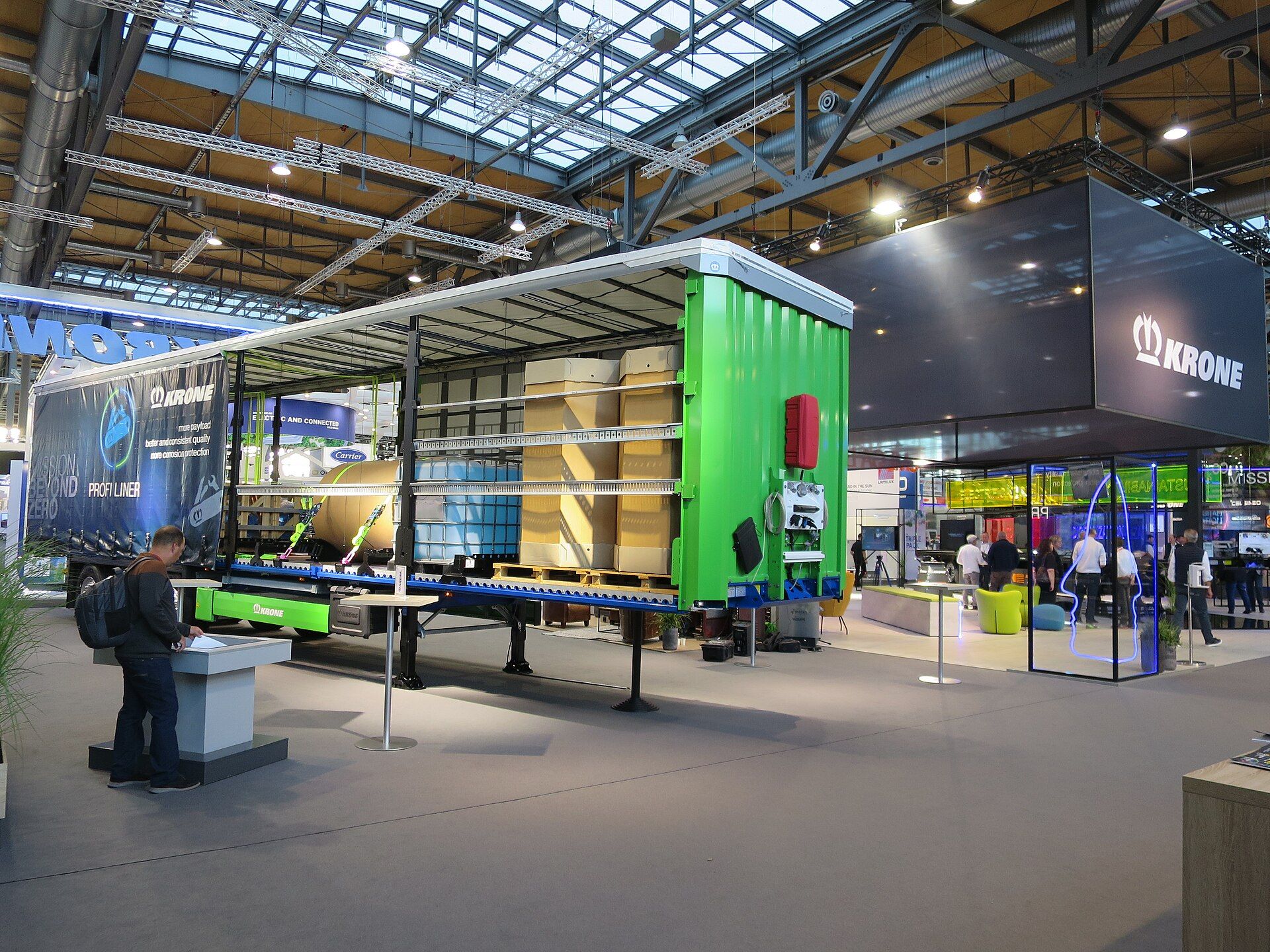

Model overview
All figures are Krone's for type SDP 27 eLB50-CS in the standard build; the data sheet is qualified "(Dimensions and weights for standard units)" and "Subject to modifications!", and the tare and the payload are both stated as approximate. The 27,000 kg axle load and the 39,000 kg permissible total are labelled "technically possible", and Krone's own build description for this type gives the German registration values separately and lower: 24,000 kg axle load and 36,000 kg gross weight for registration and operation, against an unchanged 12,000 kg fifth-wheel load. Technically possible payload, Krone's figure: approx. 33,060 kg. Two Krone statements about coupling height do not agree — the technical table on both product pages and both data sheets gives 1,050 - 1,200 mm unloaded, while the prose on the same English product page says the coupling height is variable from 1,050 to 1,170 mm; the table is followed above. Krone attributes that variability to the height-adjustable running gear together with the bolted, hole-pattern superstructure, not to the 125 mm neck height, which is a fixed front construction height. The 2,550 mm width above is a dimension on the drawing rather than a table line; the drawing also dimensions the king pin 1,668 mm behind the front of the load space and the centre of the bogie 7,630 mm behind the king pin, against an Aggregatabstand of 7,780 mm in the build description for one optioned show vehicle, order 2721708. The EN 12642 Code XL certificate is on the data sheet for the standard build. The VDI 2700 beverage certificate and the "up to 140 km/h" qualifier appear on the product page against the optional Safe Curtain rather than against the standard curtain, and the show vehicle whose build description was read carries that option. Krone's Turkish market page publishes a different vehicle under the same nameplate: SDP 27 eLB43-CS, 7,000 kg tare in the standard version at +/- 3 %, 24,000 kg axle load, 35,500 kg registered laden mass, a 102 mm neck and an internal height of 2,700 - 3,000 mm, on the same 13,620 x 2,480 mm deck.
The Profi Liner is Krone’s curtainsider. What this record covers has to be said first, because the name on the curtain covers much more than the table does: every figure here belongs to one variant, type SDP 27 eLB50-CS, and comes from Krone’s per-variant data sheet for it, checked against the German edition of the same sheet, both product pages, and a nine-page Krone build description for the same type code. The trailer articles on this site, from trailer types to load securing, were written about the class rather than about a vehicle. This is one of the vehicles they describe.
One nameplate, five generations
Krone dates its own product, which is rarer than it sounds. Its twenty-fifth anniversary news item of March 2023 puts the first appearance of the Liner family at the IAA Nutzfahrzeuge of 1998, where the name Profi Liner was introduced; the Profi Liner 2 followed in 2003 with the Multi-Lock outer frame, the third generation in 2006, the fourth in 2009, and the vehicle sold today is the fifth. That is the most important thing to know before reading any number below, because an advertisement saying “Krone Profi Liner” has given you the body type and the builder and nothing else.
Four weights, and none stands in for another
A semi-trailer specification is mostly weight, and Krone publishes four figures answering four separate questions. The tare weight, approximately 5,940 kg, is what the trailer weighs empty — the only one a buyer cannot change after the vehicle is built, and freight not carried for the whole of its life. The axle load, 27,000 kg, is what the bogie is rated at. The king pin load, 12,000 kg, is barely a trailer weight at all: it is what the loaded trailer imposes on the tractor’s fifth wheel, a demand made of another vehicle. The permissible total weight, 39,000 kg, is what the whole trailer may weigh loaded.
Krone prints all four as table lines. The fourth also happens to be the sum of the second and third — 12,000 plus 27,000 — but that is an observation of ours rather than a derivation Krone sets out. Krone does print the consequence, a technically possible payload of approximately 33,060 kg. Tare and payload both carry Krone’s own “approx.”, and the sheet is qualified “(Dimensions and weights for standard units)” and “Subject to modifications!”. None of the four is a road limit: that limit applies to tractor and trailer together, and reading a trailer rating as one is the misreading gross vehicle and gross combination weight exists to prevent.
“Technically possible” is a different claim from “permitted”
Krone labels the 27,000 kg and the 39,000 kg technically possible, and its own build description shows what the qualifier carries. On the same document, against the same order, the registration and operating values are printed separately and lower: 24,000 kg axle load and 36,000 kg gross weight for German registration and operation, against a fifth-wheel load unchanged at 12,000 kg. Three tonnes apart at the bogie and three at the gross — our subtraction in both cases — on one manufacturer’s sheet for one trailer.
Neither pair is wrong. One says what the structure and running gear can take, the other what the vehicle is registered and operated at in one member state, and a buyer who reads only the higher pair has read a laboratory figure as a licence. The same document gives what the axle load is built from — three axles of 9,000 kg each, which is where the 27,000 kg comes from, that multiplication ours. A trailer has no wheel formula, which is why the record above says tri-axle; formulae describe driven and steered axles on a motor vehicle, and are explained in axle configurations.
The deck is the same as everybody else’s
The clear side length is 13,620 mm and the clear side width 2,480 mm — neither of them a Krone decision in any interesting sense, since European curtainsiders converge on the same deck for reasons that belong to semi-trailer dimensions rather than to a brochure.
Three figures place the deck against the king pin. The data sheet’s side elevation is dimensioned 1,668 mm from the front of the load space to the king pin, and 7,630 mm from the king pin back to the centre of the bogie; the table gives the axle spread as two gaps of 1,310 / 1,310 mm. At the front, one number appears under three names in three Krone documents: a turning radius on the English sheet, a front overhang radius on the German one, the corner dimension of the 2” king pin in the build description. All three say 2,040 mm, and it is the radius that keeps the front corners of a turning trailer clear of the cab.
What it asks of the tractor
Two lines are requirements on the towing vehicle rather than properties of the trailer: the 12,000 kg king pin load, and the unloaded fifth coupling height, published as a band rather than a value at 1,050 to 1,200 mm. A tractor whose fifth wheel sits outside that band is the wrong tractor whatever its plates say. Krone gives the reason on its English product page: the coupling height is variable because the running gear is height adjustable and the superstructure is bolted, the front wall and roof connections and the side post carriage drilled to a hole pattern so they can be re-set, with the curtains cut ex works to suit. The 125 mm front construction height is not that mechanism — it is a fixed neck depth, quoted in the build description as including the floor and the fifth-wheel plate. The build description shows the band in use: that show vehicle was built with its coupling height set at 1,150 mm. How imposed load, coupling class and height fit together is the subject of the king pin and the fifth wheel.
Brakes
The brake system is to ECE R 13 and includes a vehicle stabilising system and a spring parking brake. The electronic side is a 2S/2M EBS with two sensors on one axle and RSS, diagnostics through an ISO 7638 socket. Underneath are low-maintenance axles with air suspension and 430 mm disc brakes at offset 120, on six tyres in 385/65 R 22.5 to Krone’s choice of brand. What a category O3 or O4 trailer must have, as against what a maker chooses to fit, is drawn in trailer brakes and EBS.
The body is part of the load restraint
The data sheet’s technical description carries a load security certificate to EN 12642 Code XL for the standard build — a statement about the strength of the structure rather than about the straps inside it, and what a Code XL body may do without additional securing is set out in load securing. Two other lines belong to the same subject: the Multi Lock side rave carries securing positions every 100 mm along the vehicle, and the floor is 30 mm phenolic coated plywood with strength to DIN EN 283, rated for stacker-truck axle loads up to 7,000 kg.
One narrowing, because Krone’s page invites the opposite reading. The VDI 2700 beverage certificate and the “up to 140 km/h” qualifier appear there against the optional Safe Curtain, not against the standard curtain on the data sheet, and the show vehicle whose build description was read carries that option.
What we could not confirm
A single internal height. Krone publishes only a range, 2,600 to 2,700 mm of clear side height at the lower edge of the cant rail, and the record has one field for one number, so it is blank. The build description’s 2,600 mm at the front, 2,650 mm at the rear and 2,695 mm under the mid crossbar belong to one show vehicle at one coupling height.
A pallet capacity for the deck. None is published on any document that opened, and the deck is not divided into pallets here to invent one. Two pallet counts do appear on Krone documents, and neither is a deck capacity. The build description lists a closed pallet box for 32 Euro pallets — a stowage box bolted to the chassis. The product page credits the optional double-deck equipment — five pairs of centre posts, twelve longitudinal loading beams and 23 transverse beams — with 33 additional pallet spaces on a second level. Reading either as the floor’s capacity is exactly the mistake this page is trying not to make.
An overall length. None is stated as a data-sheet line and none is dimensioned on the drawing. Width and height are not the same case, and this section should be exact about which. The drawing dimensions the vehicle at 2,550 mm across the rear elevation, extension lines on the outermost edges, on both language editions of the sheet — a model figure, and one this record keeps. The 4,000 mm on the side elevation is a height envelope rather than a built height, and the build description’s unladen overall height of approximately 4,009 mm belongs to one show unit at one coupling height. Neither of those two is a model figure.
Which bogie position is the model’s. The data sheet’s side elevation dimensions the king pin to the centre of the bogie at 7,630 mm, on both language editions. Krone’s build description specifies an Aggregatabstand of 7,780 mm for order 2721708 — one optioned show vehicle, which also carries lift-axle control on its first axle. The data sheet is followed above and the difference left on the record rather than averaged away.
Which coupling height band is current. The technical table gives 1,050 to 1,200 mm on both product pages and both data sheets; the prose on the same English product page says variable from 1,050 to 1,170 mm. The table is followed.
Which tare is the tare. The technical documents say approximately 5,940 kg, the anniversary news item 5,950 kg in standard equipment. The technical documents are followed and the ten kilograms left visible rather than averaged away.
The same name on a different trailer
Krone’s Turkish market page publishes a Profi Liner that is not this vehicle. It is type SDP 27 eLB43-CS: a tare of 7,000 kg in the standard version at plus or minus 3 %, a 24,000 kg axle load, a registered laden mass of 35,500 kg, a 102 mm neck and an internal height of 2,700 to 3,000 mm — on the same 13,620 by 2,480 mm deck. Same nameplate, same builder, same body length, and over a tonne heavier empty — our subtraction of the two published tares. Anyone comparing offers across markets is comparing type codes whether they know it or not.
Who this trailer is right for
General palletised freight loading from the side, the rear or through the roof. The curtainsider is the European default because it is the only body allowing all three, and this is the volume answer within it: a fleet running near the legal ceiling, loading often enough that side access beats a lockable wall.
It is the wrong trailer where the load needs a hard, sealed body, where the freight is temperature controlled, or where load height is the binding constraint — the last is what the Mega Liner exists for, and the three are compared by published weight in trailer types. It is wrong too for a buyer who needs a pallet count in writing.
Where it sits against its rivals
Schmitz Cargobull’s S.CS, Kögel’s Cargo and Schwarzmüller’s curtainsider answer the same brief on an identical deck, because that part is not up to any of them. What separates them is tare weight, the securing system built into the body, the curtain, and what the maker will certify. No scored comparison is attempted here, for the reason it is not attempted on the truck records: the makers do not publish on a common basis, and a few hundred kilograms of quoted tare can be a difference in what the quotation includes rather than in the vehicle. The comparison that pays is against the tractor anyway, since weight saved on a trailer is saved on every kilometre it runs — the arithmetic in tractor unit running costs.
Buying used
Read the type plate before the advertisement. The type code tells you which of the numbers above apply, and the plate carries the registered and operating weights rather than the technically possible ones — the pair the vehicle actually runs on. Where the two differ, the plate wins.
Measure the coupling height against the tractor that will pull it. The 1,050 to 1,200 mm band is unloaded and describes a new trailer; ride height is adjustable on this running gear, and one that spent its life under a single fleet’s tractors may have been set to suit them.
Ask for the load-securing certificate as a document. A Code XL body is worth paying for only if the paper exists and the body has not been modified since it was issued, and the same goes for the ISO 7638 marking that has to stay legible where the lines are connected. What an inspector looks at is in roadworthiness and roadside checks. Then the floor and the side rave, which carry the working life of the vehicle in a way the chassis does not.
Compared with
- Schmitz Cargobull S.CS
- Kögel Cargo
- Schwarzmüller Curtainsider
Sources
- Profi Liner — technical data, type SDP 27 eLB50-CS — Fahrzeugwerk Bernard Krone GmbH & Co. KG
- Profi Liner — Technische Daten, Typ SDP 27 eLB50-CS — Fahrzeugwerk Bernard Krone GmbH & Co. KG
- Profi Liner 5-CS data sheet, type SDP 27 eLB50-CS (issue 09/2020) — Fahrzeugwerk Bernard Krone GmbH & Co. KG
- Profi Liner 5-CS Datenblatt, Typ SDP 27 eLB50-CS (Ausgabe 09/2020) — Fahrzeugwerk Bernard Krone GmbH & Co. KG
- Baubeschreibung, SDP 27 eLB50-CS, order 2721708 — Fahrzeugwerk Bernard Krone GmbH & Co. KG
- 25 Jahre KRONE Profi Liner — Fahrzeugwerk Bernard Krone GmbH & Co. KG
- Profi Liner — teknik veriler, tip SDP 27 eLB43-CS — Fahrzeugwerk Bernard Krone GmbH & Co. KG