operating
Load securing: the forces the rules assume and the standards behind them
Annex III of Directive 2014/47/EU sets the yardstick for a roadside cargo check at 0.8 of the cargo weight forward and 0.5 sideways and rearward. What the figures mean and who answers for them.
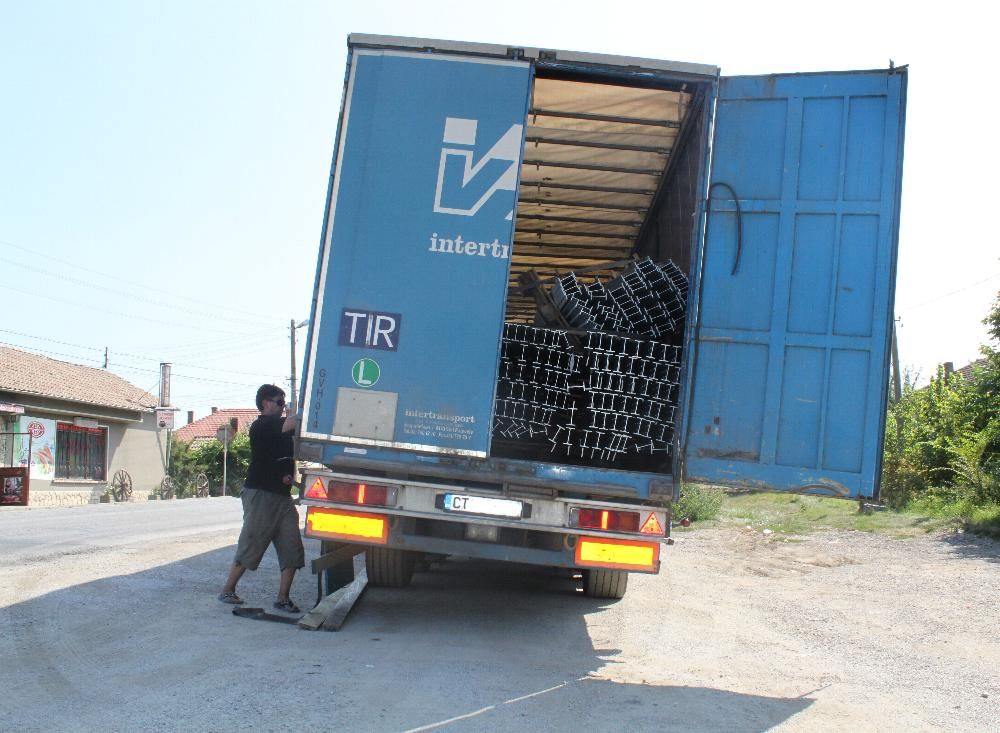
A load that has not moved is not the same thing as a load that is secured. The roadside inspector does not assess the journey that has just finished; he assesses whether the restraint would hold in the one that has not happened yet. That test is numeric, and Union law supplies the three figures it is run against — as a yardstick a member state may measure by, not as a ceiling it may not go above.
The three numbers in Annex III
Directive 2014/47/EU governs technical roadside inspection of commercial vehicles. It is in force in the consolidated version of 27 September 2022, and it repealed the earlier Directive 2000/30/EC. Article 2(1) fixes what it reaches: M2 and M3 passenger vehicles, N2 and N3 goods vehicles over 3.5 tonnes, O3 and O4 trailers over 3.5 tonnes, and certain wheeled tractors used for commercial haulage above 40 km/h. Article 2(2) puts the rest outside it in terms, naming light commercial vehicles of category N1 having a maximum mass not exceeding 3,5 tonnes. For a van or a small trailer, what follows is a matter of national law only. Article 1 describes the whole instrument as establishing minimum requirements.
Annex III opens with the principles of cargo securing, and the first is the figure to memorise. It is reached by permission rather than by command. Under Article 10(1)(c) an inspector may carry out a visual assessment of the securing of the vehicle’s cargo; under Article 13(1) a vehicle may be subject to an inspection of its cargo securing in accordance with Annex III; under Article 13(2) cargo securing and its inspection may be carried out in accordance with the principles and, where appropriate, the standards laid down in Section I of Annex III. Annex III supplies the measure. Whether a member state picks it up, and whether it demands more, are its own affairs. Inside the annex the wording is imperative.
Cargo securing shall withstand the following forces resulting from accelerations and decelerations of the vehicle: in driving direction, 0,8 times the weight of the cargo; in lateral direction, 0,5 times the weight of the cargo; against driving direction, 0,5 times the weight of the cargo. And, in general, it must prevent tilting or tipping of cargo.
Read the last clause as a fourth requirement, not a summary of the first three: a tall, narrow item that rotates about its base edge has defeated the system without sliding a centimetre.
Annex III paragraph 2 adds something that is not about restraint at all: the distribution of cargo shall take into account the maximum authorised axle loads as well as the necessary minimum axle loads. A load can be immaculately strapped and still be an offence because of where along the deck it sits — the problem set out in truck weights and answered by the choice of axle configuration.
Where the numbers come from
The coefficients are not arbitrary, and the Commission has published its working twice. The earlier 208-page European Best Practice Guidelines on Cargo Securing for Road Transport, from the Directorate-General for Energy and Transport, records in its quick lashing guide that experimental work was carried out and actual acceleration, braking and centrifugal forces were determined through scientific measurements, which were then used to formulate the minimum requirements given in EN 12195-1. The estimated maxima for normal traffic driving conditions — conditions which, the document is careful to say, include emergency braking — map onto three ordinary events. Starting from a standstill throws the load rearward at 0.5 times its weight. Braking throws it forward at up to 0.8. Cornering pushes it sideways at up to 0.5. For loads that are not stable, that edition adds an additional roll factor of 0.2 times the weight of the load.
The successor, Cargo securing for road transport: 2014 European best practices guidelines, final version of 8 May 2014, drops the roll factor and puts a fourth coefficient in its place. There the securing arrangement must be capable of withstanding 0,8 of the cargo weight forwards, 0,5 of the cargo weight sideways and towards the rear, and 0,6 of the cargo weight sideways if there is risk of the load tipping. Annex III did not follow the guidelines there, and the directive’s three figures are what an inspection is measured against; but an operator reading the current Commission text will find the sideways number stated twice, and the higher one is the one that applies to a load liable to tip.
Neither edition binds, and both say so in the same words: not a legal act adopted by the Union, but the accumulated knowledge of European experts. The earlier preface carries the estimate that motivated the exercise — up to 25 percent of accidents involving trucks may be attributable to inadequate cargo securing — a figure the 2014 edition does not repeat.
The vehicle is part of the restraint system
Annex III paragraph 3 makes the body a component of the securing arrangement rather than a container for it: the applicable requirements regarding the strength of certain vehicle components, such as the headboard, sideboard, endboards, stanchions or lashing points, shall be taken into account when those components are used for the cargo securing. Both hedges matter. The list is illustrative rather than closed, and the paragraph points outward, to requirements set somewhere else. Somewhere else is EN 12642, named in Annex III point 5.
The Commission’s 2014 guidelines, which state their focus as vehicles over 3.5 tonnes maximum mass, set out what each body code is assumed to hold as a fraction of payload. A Code L headboard takes 40 percent, though for a vehicle with a payload over 12.5 tonnes the requirement is capped at 5,000 daN; a Code L rear wall takes 25 percent, capped at 3,100 daN; Code L side walls take 30 percent in a box trailer — and on a curtainsider, nothing.
That last point is the one that decides how much of European freight has to be secured. The earlier guidelines put it with two words capitalised: unless they are purposely designed according to EN 12642-XL, the curtains of curtain-sided vehicles MUST NOT be considered as part of any load restraint system; if they have been designed as a restraint system the load capability should be clearly marked on the vehicle, and if no mark can be seen it should be assumed the curtain has NO load-bearing function. The 2014 edition makes the same point in the flat register of a note: side walls in a curtainsider built to EN 12642 L are regarded as weather protection only. Which body a fleet runs is therefore a load-securing decision before it is a loading-speed one, a point returned to in trailer types and answered by a document rather than by the look of the curtain: Krone’s data sheet for the Profi Liner carries a load-securing certificate to EN 12642 Code XL for the standard build.
What a Code XL certificate buys
The XL variant of EN 12642 raises the tested strength of the whole structure, and it is not a curtainsider’s certificate alone: Schmitz Cargobull publishes DIN EN 12642 Code XL as standard for the rigid FERROPLAST box of the S.KO COOL SMART.
| Body component | EN 12642 Code L | EN 12642 Code XL |
|---|---|---|
| Headboard / front wall | 0.4 of payload, capped at 5,000 daN | 0.5 of payload |
| Side walls | 0.3 of payload; nil on a curtainsider | 0.4 of payload |
| Rear wall / endboard | 0.25 of payload, capped at 3,100 daN | 0.3 of payload |
The conditions attached to the XL rating are the whole story, and Britain’s enforcement agency states them tightly. DVSA’s code of practice — which applies in England, Scotland and Wales, was updated on 9 December 2024, and replaced both Safety of loads on vehicles: code of practice and Load securing: vehicle operator guidance — puts the build standard first: vehicles built to the BS EN 12642 XL standard can withstand a minimum of 40% of the rated payload to the side without additional load securing if they’re loaded to the manufacturer’s specification. The 50 percent figure the trade quotes sits on top of that as an enforcement concession, and the guidance labels it as one: for proactive enforcement purposes, XL vehicles are accepted as restraining 50% of the rated payload to the side without any extra securing if the load fills the entire load area.
Four conditions define filling it, and all four must hold together: within 30 cm of the front, within 30 cm of the rear, within 8 cm of either side, and without cumulative gaps or a single gap of more than 30 cm along the vehicle load bed. That is positive fit. Where the load will not reach, DVSA allows the gaps to be filled with packing material, dunnage, empty pallets or timbers; where they cannot be filled, the rating stops being effective and the load must be secured as on any non-XL vehicle.
The Commission’s earlier guidelines carry an 80 mm figure of their own, and it is not the same test. There the requirement is that total maximum sideways gaps must not exceed 80 mm for packages to count as properly blocked between sideboards — both sides added together, and only where the vehicle’s superstructures comply with EN 12642 and the load is uniformly distributed. DVSA’s 8 cm is measured against each side separately, which permits twice as much gap across the vehicle. The same number, on a different basis.
Two consequences follow. On multi-drop work a vehicle that leaves in positive fit stops being so at the first delivery, and the driver must then fill the gaps or add securing. And the rating attaches to the complete body rather than to a part of it: in DVSA’s words, fitting XL rated curtains to a standard or ‘L’ rated vehicles does not meet the standard.
For a buyer this is a document check, not a walk-round. Annex III’s inspection table grades insufficient strength of the front wall, board walls, rear wall and stanchions as a major deficiency, and for the first three qualifies it by the phrase certificate or label if applicable. The stanchion entry does not: item 10.4.2 reads insufficient strength or design, and names no document at all. Where the parenthesis does appear, the certificate and the plate turn a claim into a defence at the roadside, which puts them among the papers that decide a used vehicle’s value — see buying a used truck.
The three grades of deficiency
Section II of Annex III scores what the inspector finds, in three definitions worth quoting. A minor deficiency exists when the load has been properly secured but a safety advice might be appropriate. A major deficiency exists when the load has not been sufficiently secured and a significant shifting or overturning of the load or parts thereof is possible. A dangerous deficiency exists when traffic safety is directly endangered due to a risk of loss of cargo or parts thereof or a hazard deriving directly from the cargo or an immediate endangering of persons.
The gap between the first and the second is the word sufficiently, and that is where the coefficients do their work: sufficiency is measured against 0.8 and 0.5, not against whether anything actually moved. Table 1 then works through specifics whose values are explicitly indicative, subject to the inspector’s discretion — a gap forward to the front wall used for direct securing that is too great is major, while more than 15 cm with danger of penetrating the wall is dangerous.
The escalation rule
The least understood sentence in Annex III follows those definitions, and it turns two survivable findings into an unsurvivable one.
Where several deficiencies are present, the transport is classified in the highest deficiency group. If, in the event that there are several deficiencies, as the effects based on the combination of those deficiencies are expected to reinforce one another, the transport shall be classified in the next higher deficiency level.
Two distinct operations are described, and they are usually conflated. The first is aggregation: three minor findings and one major finding produce a major classification, because the transport takes the grade of its worst item. Nothing is added for quantity alone.
The second is escalation, and it is conditional on interaction. Where the deficiencies reinforce one another, the transport moves up one further level from that highest group. Take an illustration of our own, assembled from two entries in Table 1: a damaged load-restraint device, major under item 20.3.3, and a distance forward to the front wall that the inspector judges too great, major under item 20.1.1.1 but short of the 15 cm with danger of penetrating the wall that would be dangerous on its own. Apart they are two major findings. Together, the strap that will not hold and the run-up the load has been given are not two problems but one worse problem, and a major assessment becomes a dangerous one — the difference between a rectification at the roadside and a prohibition.
Two details repay attention. Annex III says shall, not may: where the reinforcing effect is expected, escalation is not an option. And Annex III attaches no locality condition. The parallel provision for vehicle defects, Article 12(3) of the same directive, is drafted more narrowly — a vehicle showing several deficiencies within the same inspection areas may be classified in the next most serious group. The cargo rule is both wider in scope and firmer in wording than the vehicle rule beside it, which is the opposite of what most operators assume.
What follows a finding
Article 13(3) makes the follow-up machinery of Article 14 available for a cargo securing finding — available, not automatic. The directive says those procedures may also apply in the case of major or dangerous deficiencies related to cargo securing, and the choice is the member state’s. Where it is made, Article 14(1) requires the deficiency to be rectified before the vehicle is further used on public roads, and Article 14(3), for deficiencies presenting a direct and immediate risk to road safety, requires use of the vehicle to be restricted or prohibited until they are. Where a vehicle registered in another member state is found with a major or dangerous deficiency, or is restricted or prohibited, Article 18(1) sends the result to the contact point of the state of registration; for a vehicle registered outside the Union no such duty applies, and under Article 14(2) member states merely may decide to inform the country of registration. Article 15 allows a reasonable and proportionate fee where deficiencies have been found following a more detailed inspection, linked to the cost of carrying that inspection out.
The item that outlasts all of these is Article 6. For M2 and M3, N2 and N3, and O3 and O4 vehicles — the tractor categories are left out of this one — member states must ensure that information on the number and severity of deficiencies found under Annex II and, where applicable, Annex III on vehicles operated by individual undertakings is fed into the risk rating system established under Article 9 of Directive 2006/22/EC, and that it is used to check high-rated undertakings more closely and more often. A cargo securing finding therefore raises the odds of the next stop, and every stop is unbilled time — the overhead described in tractor unit running costs.
Who answers for it
The directive allocates responsibility for cargo securing to nobody. Article 13 sets out how the check may be done and is silent on who answers for what it finds. Article 7(3) is about the vehicle rather than the load: it requires member states to ensure that the responsibilities of undertakings for keeping their vehicles in a safe and roadworthy condition are defined, without prejudice to the responsibilities of the drivers of those vehicles. Article 25 leaves penalties to national law, requiring only that they be effective, proportionate, dissuasive and non-discriminatory.
The Commission’s earlier guidelines are blunter about why the driver cannot be the whole answer. Liability for the loading and unloading operations should be assumed by the driver, within his responsibilities, and the persons who have executed them — and in practice, the text observes, the driver often couples to a pre-loaded trailer, collects a sealed container, or is made to wait elsewhere while the shipper’s employees load the vehicle. One cannot state that in all circumstances the driver is the sole person responsible for the load carried on his vehicle.
National law is where that becomes concrete, and the numbers are not uniform either. In England, Scotland and Wales the statutory hook is a general one and carries no coefficient at all: section 40A of the Road Traffic Act 1988, on using a vehicle in a dangerous condition, and regulation 100 of the Road Vehicles (Construction and Use) Regulations 1986, on maintenance and use so as not to be a danger. The figures come from DVSA’s code of practice, as the yardstick the agency enforces to, and the forward one is higher than the directive’s: a load securing system must withstand forces equivalent to the entire weight of the load in the forward direction, half the weight of the load to the sides and half to the rear. The same guidance names those who can face a custodial sentence where an insecure load kills or injures — the driver, consignors, the operator, and company directors or partners.
Because Article 1 makes the directive a set of minimum requirements, a stricter national figure is not an anomaly but the design working as intended. The number a load must satisfy depends on where the vehicle is going, and the person who filled the deck sits inside the liability chain whether or not he ever sat in the cab.
Quick answers
- What forces must load securing withstand in the EU?
- Section I of Annex III to Directive 2014/47/EU states that cargo securing shall withstand 0.8 times the weight of the cargo in the driving direction, 0.5 times its weight in the lateral direction and 0.5 times its weight against the driving direction, and in general must prevent tilting or tipping. Those figures are the yardstick a roadside check may be run against rather than a uniform obligation: Article 13(1) provides that a vehicle may be subject to an inspection of its cargo securing in accordance with Annex III, and Article 13(2) that the inspection may be carried out in accordance with the principles laid down in Section I.
- What is the difference between a minor, major and dangerous load securing deficiency?
- A minor deficiency exists when the load has been properly secured but a safety advice might be appropriate. A major deficiency exists when the load has not been sufficiently secured and a significant shifting or overturning of the load or parts thereof is possible. A dangerous deficiency exists when traffic safety is directly endangered due to a risk of loss of cargo or parts thereof or a hazard deriving directly from the cargo or an immediate endangering of persons.
- Can two minor load securing faults become a major one?
- Yes. Annex III states that where several deficiencies are present the transport is classified in the highest deficiency group, and that where the combined effects are expected to reinforce one another it shall be classified in the next higher deficiency level. Faults that compound each other therefore move the transport up a grade.
- Is a Code XL body worth paying for?
- The Commission's 2014 best practice guidelines record an EN 12642 XL body as taking 0.5 of payload at the headboard, 0.4 at the side walls and 0.3 at the rear wall, against 0.4, 0.3 and 0.25 for a Code L body, the Code L headboard and rear wall being capped at 5,000 and 3,100 daN. DVSA treats an XL vehicle as withstanding a minimum of 40 percent of the rated payload to the side as built, and — for proactive enforcement purposes only — as restraining 50 percent without extra securing where the load fills the load area: within 30cm of the front, within 30cm of the rear, within 8cm of either side, and with no single or cumulative gap of more than 30cm along the load bed.
- Who is liable for an insecure load?
- Not the driver alone, and the directive does not say who. Article 7(3) of Directive 2014/47/EU requires member states to ensure that the responsibilities of undertakings for keeping their vehicles in a safe and roadworthy condition are defined, without prejudice to the responsibilities of the drivers of those vehicles — a provision about the vehicle rather than the load — and Article 25 leaves penalties to national law. The Commission's guidelines state that one cannot say the driver is in all circumstances the sole person responsible. DVSA guidance for England, Scotland and Wales extends penalties to the driver, consignors, the vehicle operator and company directors or partners.
Sources
- Directive 2014/47/EU on the technical roadside inspection of the roadworthiness of commercial vehicles — consolidated text of 27 September 2022, including Annex III — EUR-Lex, European Union
- Directive 2014/47/EU, Annex III — text as published on legislation.gov.uk for UK cross-reference, version as at 19 May 2014, no post-IP-completion-day amendments applied — legislation.gov.uk (The National Archives)
- Cargo securing for road transport — 2014 European best practices guidelines, final version 8 May 2014 (PDF ISBN 978-92-79-43643-7) — European Commission, Directorate-General for Mobility and Transport / Publications Office of the European Union
- European Best Practice Guidelines on Cargo Securing for Road Transport — the earlier 208-page edition, superseded by the 2014 guidelines — European Commission, Directorate-General for Energy and Transport
- Securing loads on HGVs and goods vehicles: code of practice — responsibility for load security, and load securing: the basics — Driver and Vehicle Standards Agency (GOV.UK)
- Securing loads on HGVs and goods vehicles, section 4 — ways to secure a load, including positive fit — Driver and Vehicle Standards Agency (GOV.UK)
- Securing loads on HGVs and goods vehicles, section 5 — how to load different HGVs, including XL curtainsiders — Driver and Vehicle Standards Agency (GOV.UK)