Swap bodies (Wechselbrücke) explained: what they are, and how they differ from semi-trailers and containers
A swap body is a freight unit optimised to road vehicle dimensions, with handling devices for transfer between modes. What the glossary, EN 284 entries and makers' data sheets say.
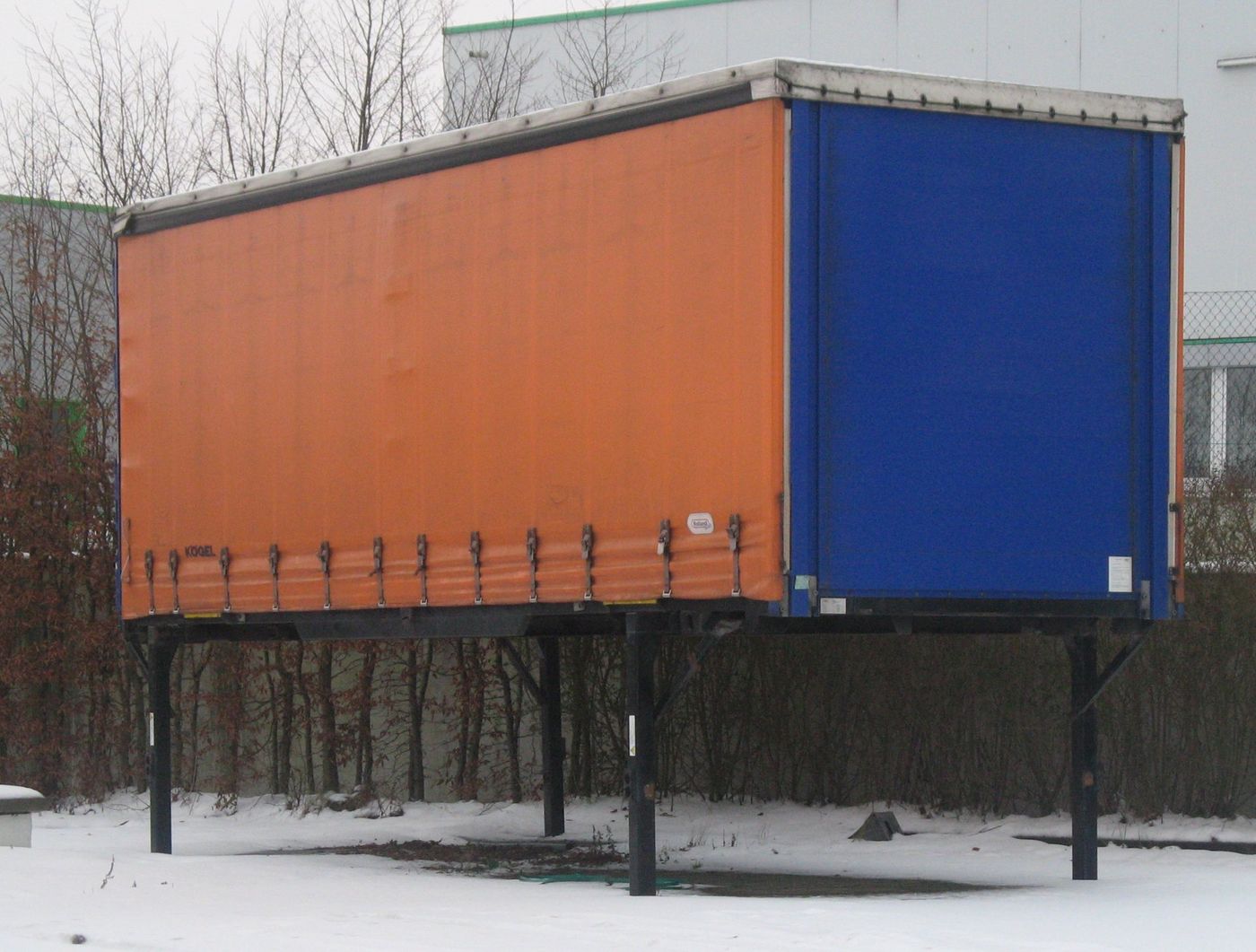
For swap bodies of class C, the non-stackable class covered by EN 284, the railway operator Rhätische Bahn (RhB) lists three types among the units its container wagons can carry: C 715, C 745 and C 782, with lengths of 7,150 mm, 7,450 mm and 7,820 mm. The body maker Wecon gives the same three lengths for class C bodies under EN 284, with room for Euro pallets: 17 in the shortest, 18 in the middle one and 19 in the longest. DPD defines its standard swap body as a C 745 under DIN EN 284, 7.45 m long, 2.55 m wide and 2.75 m high.
The three class C lengths as RhB and Wecon publish them:
| Class | Length | Euro-pallet spaces (Wecon) |
|---|---|---|
| C 715 | 7,150 mm | 17 |
| C 745 | 7,450 mm | 18 |
| C 782 | 7,820 mm | 19 |
A swap body is a freight-carrying unit optimised to road vehicle dimensions and fitted with handling devices for transfer between modes, usually road and rail; that is the definition in the Eurostat, UN and ITF glossary for transport statistics, and the 2001 UN/ECE terminology on combined transport gives it in the same words. The glossary lists it as a loading unit where it lists a semi-trailer as a goods road vehicle, and it names the sizing to road vehicles as the main feature that separates a swap body from a container.
What a swap body is
The glossary entry (G.II-08) adds that some swap bodies are equipped with folding legs on which the unit stands when not on the vehicle. The Terminology on Combined Transport, prepared by the UN/ECE, the European Conference of Ministers of Transport and the European Commission (New York and Geneva, 2001), has the same definition and the same sentence about legs in its entry 4.9.
The glossary defines a loading unit as container, swap body, and an intermodal transport unit as a container, a swap body or a semi-trailer or goods road motor vehicle suitable for intermodal transport. Intermodal transport is, in the same glossary, the carriage of goods in one and the same such unit by successive modes without handling the goods themselves when changing modes.
The name varies by language and by document. The UN/ECE terminology’s German entry is Wechselbehälter, and it says Wechselaufbau and Wechselbrücke are also used; the German standard titles below say Wechselbehälter, and the German texts of the two EU Directives say Wechselaufbau. The Spanish texts of Directives 92/106/EEC and 96/53/EC say caja móvil, the UN/ECE terminology’s Russian entry is съемный кузов, and the Turkish combined-transport regulation keeps the English words swap body.
Swap body, semi-trailer, container: how they differ
Semi-trailer. The glossary defines a semi-trailer as a goods road vehicle with no front axle, designed so that part of the vehicle and a substantial part of its loaded weight rests on a road tractor. A swap body is listed as a loading unit, and the glossary’s list of body types of goods road vehicles includes a skeletal container and swap-body transporter. The body types of semi-trailers are compared in trailer types explained.
Container. The glossary describes a container as a special box designed to carry freight that is strengthened and stackable. Its more formal technical definition lists, among its conditions, that the article is stackable and has an internal volume of 1 m³ or more, and it ends with the sentence “Swap bodies are excluded.” Of swap bodies the glossary says they were not originally designed to be stacked when full or top-lifted, that many now can be, though not to the same extent as containers, and that the main distinguishing feature is their optimisation to road vehicle dimensions.
Where the two meet. The 2001 UN/ECE terminology says corner fittings, the fixed points on a container into which twistlocks or other devices engage, are increasingly used on swap bodies, not on the corners but at points compatible with 20 or 40 feet container corner fittings. Krone says its swap boxes are available in a stackable version, with corner protection at the top; in Krone’s operating instructions, stackable units carry identification plates with the stacking load and the CSC mark beside the type plate, and the instructions say the CSC plates give the stackability, the permitted weights and the registration number.
The European standards behind it
The standards themselves are sold. What follows comes from the catalogue entries of BSI, AFNOR and DIN Media as we read them on 28 September 2026, not from the standards’ texts.
EN 284. The title is Swap bodies — Non-stackable swap bodies of class C — Dimensions and general requirements. BSI lists it as BS EN 284:2006, published 31 January 2007, identical to EN 284:2006, with the status “Current, Under Review”. DIN Media lists DIN EN 284:2007-01, in German Wechselbehälter — Nicht stapelbare Wechselbehälter der Klasse C — Maße und allgemeine Anforderungen, as current, and AFNOR lists NF EN 284 of December 2006 as current.
BSI’s catalogue description says the standard specifies basic requirements for non-stackable swap bodies of class C having a gross mass of not more than 16 t. It says these are intended for the international exchange of goods and for transport by road and rail, including interchange between the two, but not for carriage by container ships, and that the standard covers the requirements, dimensions and tolerances for bottom fittings, grappler arm lifting areas, steering tunnel, front stop and supporting legs. AFNOR’s summary describes the same class as non-stackable swap bodies for rail and road with lower corner pieces positioned as specified for ISO 1 C (20 ft) containers, and its contents list includes a normative annex on support legs with a safety device. The scope is limited to non-stackable class C bodies, so the stackable versions Krone lists are not within the scope these entries describe.
EN 452. DIN Media lists DIN EN 452:1995-06, Swap bodies — Swap bodies of class A — Dimensions and general requirements (German: Wechselbehälter — Wechselbehälter der Klasse A — Maße und allgemeine Anforderungen), as current. The entry carries no scope text, so this article says nothing further about class A.
EN 283. BSI lists BS EN 283:1991, Swap bodies. Testing, published 20 December 1991 and identical to EN 283:1991, as “Current, Under Review”. Krone says the sliding roof and curtain fabrication of its Carrier System are tested according to EN 283 for combined traffic.
Dimensions as the makers publish them
The standards’ dimension tables are sold and we have not read them. Two makers publish detailed data for their own swap bodies. Krone and Schmitz Cargobull both list total lengths of 7,450 mm and 7,820 mm.
| Dry Box (WK 7.3 STG) | Carrier System, curtain (WP 7,3 LS5-CS) | Cool Box, refrigerated (WR 7.3 S) | |
|---|---|---|---|
| Total length | 7,450 mm | 7,450 mm | 7,450 mm |
| Clear length of load compartment | 7,300 mm | 7,280 mm | 7,240 mm |
| Clear width of load compartment | 2,470 mm | 2,480 mm | 2,460 mm |
| Clear height | 2,525 mm (inner height) | 2,390 mm (side height) | 2,400 mm (inner height) |
| Corner height | 2,750 mm | 2,750 mm | 2,750 mm |
| Permitted total weight | 16,000 kg | 16,000 kg | 16,000 kg |
| Empty weight, as Krone labels it | approx. 2,950 kg (dead weight) | approx. 2,580 kg (tare weight) | approx. 3,490 kg (dead weight without cooling system) |
| Parking level | 1,320 mm | 1,320 mm | 1,320 mm |
For the Cool Box Krone also gives an approximate payload of 12,150 kg. Krone’s operating instructions (505410825-02, 07/2023) also list types with a total length of 7,820 mm, among them the WK 7.7 STG, with a load compartment 7,670 mm long and 2,470 mm wide, and the WP 7.7 LS5, with 7,650 mm by 2,480 mm; the same table gives the WK 7.3 STG and WP 7.3 LS5 at a total length of 7,450 mm. Krone says its volume swap bodies (7.82 m) have a front wall offset optimised for driving round corners, and the instructions say the maximum weight of a swap body is given on its type plate.
| W.BO 7.45 S | W.BO 7.45 G | W.BO 7.82 G | |
|---|---|---|---|
| Side walls | beaded | smooth | smooth |
| Length | 7,450 mm | 7,450 mm | 7,820 mm |
| Width | 2,550 mm | 2,550 mm | 2,550 mm |
| Height | 2,750 mm | 2,750 mm | 2,750 mm |
| Clear length | 7,290 mm | 7,310 mm | 7,680 mm |
| Clear width | 2,470 mm | 2,470 mm | 2,470 mm |
| Clear height | 2,517 mm | 2,517 mm | 2,517 mm |
| Total weight | 16,000 kg | 16,000 kg | 16,000 kg |
| Unladen weight | ca. 3,200 kg | ca. 3,200 kg | ca. 3,450 kg |
| Payload | 12,800 kg | 12,800 kg | 12,550 kg |
| Installation height | 1,320 mm | 1,320 mm | 1,320 mm |
| Codification profile | C 30 | C 30 | C 30 |
Both makers give 16,000 kg as the total weight of these bodies (Krone labels it permitted total weight, Schmitz Cargobull total weight). That is the same figure as the upper gross mass in BSI’s catalogue description of EN 284; this article does not assign any of these bodies to a class. The data sheet’s codification profile line is reproduced as printed: none of the sources we opened explains it, and we do not interpret it.
Legs, parking height and the carrier
Schmitz Cargobull says that thanks to the support legs a W.BO can be left standing until a truck comes and places it on its chassis frame. The data sheet lists four support legs with diagonal securing according to DIN EN 284, “as standard version with fixed fifth wheel height of 1,320 mm”, and four receptacles for securing with twist locks according to coding profile C30. Schmitz says flexible parking height is possible with optional telescopic support legs and gives their adjustment as 1,120 mm, 1,220 mm and 1,320 mm. For intermodal use it says the W.BO can be handled on its handle strips with mobile equipment, and for freight rail transport its interchangeable boxes are equipped with gripping edges. Krone says the loading points of its Carrier System are of extremely high strength for handling by cranes and fork-lift trucks.
On the trailer side, Krone’s data sheet for the Box Carrier AZW 18 eL3B9 gives an axle load of 18,000 kg, an approximate dead weight of 2,570 kg and a payload without load carrier of 15,280 kg. It gives a wheelbase of 5,170 mm, a draw fork length of 2,200 mm, a locking distance of 5,853 mm and a total length of 9,045 mm up to the centre of the coupling ring. Frame height, unloaded, is 1,190 mm lowered, 1,370 mm lifted and 1,255 mm in driving position, and the parking level is given as 1,220 to 1,320 mm.
Krone says the Profi Box Carrier B9 is designed for parking levels of 1,220 and 1,320 mm, “which is the standard for swap body transport”; that is Krone’s statement, not a standard’s or a rule’s. Its other variants are dimensioned for other levels: the Mega Box Carrier, a central-axle carrier for high-volume swap bodies, for 920 to 1,070 mm; the Box Carrier B7 for 1,020 to 1,320 mm; and the E13 Multi Box Carrier, which has a height-adjustable locking system, for 890 to 1,320 mm. Krone lists on its swap body trailers a control console with raising and lowering valves, twist locks, and a guide tunnel on the swap body that is bevelled at the front to ease retraction of the centring rollers; it says an additional parking position for the centring rollers allows ISO containers to be seated.
In its IAA Transportation 2022 press kit, Schmitz Cargobull says it has, after several years, reintroduced the A.WF trailer swap chassis and the Z.WF central axle swap chassis for the transport of short swap containers. It describes the A.WF as a two-axle steel chassis with locks for 1 x 20’ containers, and says both chassis are designed and tested with a payload of approximately 14.5 t and are suitable for transporting containers and swap bodies with standardised ISO container mountings (20’). Of the W.BO the kit says swap containers can be set down and immediately replaced by another swap container ready for further transport.
What the EU weights and dimensions rules say
Council Directive 96/53/EC (consolidated text of 14 August 2019) sets maximum dimensions and weights. Annex I says that removable superstructures and standardized freight items such as containers are included in the dimensions specified in points 1.1, 1.2, 1.3, 1.6, 1.7, 1.8 and 4.4. The English text says “removable superstructures” in that sentence; the German text says Wechselaufbauten and the Spanish text cajas móviles.
Those points include the maximum lengths of point 1.1, among them 18.75 m for a road train; the maximum width of point 1.2, 2.55 m, or 2.60 m for superstructures of conditioned vehicles or conditioned containers or swap bodies transported by vehicles; the maximum height of point 1.3, 4.00 m for any vehicle; and two loading-area distances measured along the road train from the foremost external point of the loading area behind the cabin to the rearmost external point of the trailer, 15.65 m in point 1.7 (after deducting the distance between the rear of the drawing vehicle and the front of the trailer) and 16.40 m in point 1.8. The length, width, height and kingpin-to-rear limits among them are set out in semi-trailer dimensions.
The Directive has provisions that name swap bodies. Article 2 defines an intermodal transport operation as either a combined transport operation, as defined in Article 1 of Directive 92/106/EEC, carrying one or more containers or swap bodies up to a total maximum length of 45 feet, or a transport operation carrying such units up to that length using waterborne transport, provided that the initial or final road leg does not exceed 150 km in the territory of the Union; for the vehicles it lists, that distance may be exceeded to reach the nearest suitable transport terminal. Under Article 10c the maximum lengths in point 1.1 and the distance in point 1.6 may be exceeded by 15 cm for vehicles or vehicle combinations transporting 45-foot containers or 45-foot swap bodies, empty or loaded, provided the road transport is part of an intermodal transport operation.
Annex I also carries the 42 and 44 tonne limits. They apply to an articulated vehicle, a motor vehicle with a semi-trailer: 44 tonnes for a three-axle motor vehicle with a two- or three-axle semi-trailer and 42 tonnes for a two-axle motor vehicle with a three-axle semi-trailer, in each case carrying, in intermodal transport operations, one or more containers or swap bodies up to a total maximum length of 45 feet. For a road train, a motor vehicle with a trailer, the corresponding Annex I entries, a two-axle motor vehicle with a three-axle trailer and a three-axle motor vehicle with a two- or three-axle trailer, are 40 tonnes. The weight tables are set out in truck weights, GVW and GCW.
Article 10f is the provision most specific to swap bodies. It requires Member States to lay down rules under which the shipper gives the haulier who transports a container or swap body a statement of its weight, and the haulier provides access to all relevant documentation provided by the shipper. It also requires Member States to lay down rules on the liability of both the shipper and the haulier, as appropriate, where that information is missing or incorrect and the vehicle or vehicle combination is overloaded. The text is addressed to Member States: it is their rules that require the shipper to give the statement.
Swap bodies in combined transport
Council Directive 92/106/EEC of 7 December 1992 (consolidated text of 1 July 2013) names the swap body in its definition of combined transport: the transport of goods between Member States where the lorry, trailer, semi-trailer, with or without tractor unit, swap body or container of 20 feet or more uses the road on the initial or final leg of the journey and, on the other leg, rail, inland waterway or maritime services where that section exceeds 100 km as the crow flies. The road leg is the one between the point where the goods are loaded and the nearest suitable rail loading station, or between the nearest suitable rail unloading station and the point where the goods are unloaded, or it lies within a radius not exceeding 150 km as the crow flies from the inland waterway port or seaport of loading or unloading.
On rail, the Eurostat glossary adds that a swap body would need UIC approval to be used; the rail side is otherwise outside this article.
Türkiye’s Combined Transport Regulation (Resmî Gazete 27 May 2022, No. 31848, amended 21 January 2025, No. 32789) says in its Article 4 that it was prepared in the framework of alignment with EU legislation, taking Directive 92/106/EEC into account. Its Article 5(1)(h) defines a transport unit (taşıma birimi), within that regulation, as trailers or semi-trailers, with or without tractor, together with swap bodies and containers of 20 ft, 40 ft or 45 ft length, and it uses the English words swap body. That is the regulation’s own definition, not a general definition in Turkish road law.
Quick answers
- What is a swap body (Wechselbrücke)?
- In the Eurostat, UN and ITF glossary a swap body is a freight-carrying unit optimised to road vehicle dimensions and fitted with handling devices for transfer between modes, usually road/rail. The glossary adds that some swap bodies are equipped with folding legs on which the unit stands when not on the vehicle. The 2001 UN/ECE terminology gives Wechselbehälter as the German term and says Wechselaufbau and Wechselbrücke are also used.
- What size is a swap body?
- Krone and Schmitz Cargobull both list total lengths of 7,450 mm and 7,820 mm for their swap bodies. Schmitz gives its W.BO a width of 2,550 mm and a height of 2,750 mm, and both makers give 16,000 kg as the total weight (Krone's label: permitted total weight); BSI's catalogue description of EN 284 gives the same 16 t as the upper gross mass for non-stackable swap bodies of class C. These are makers' figures. The class C lengths C 715, C 745 and C 782 (7,150, 7,450 and 7,820 mm) are given here as Rhätische Bahn (RhB) and DPD publish them; the standard's own dimension tables are sold and have not been read.
- How is a swap body different from a semi-trailer?
- The glossary defines a semi-trailer as a goods road vehicle with no front axle, designed so that part of the vehicle and a substantial part of its loaded weight rests on a road tractor. It lists a swap body as a loading unit instead: a freight-carrying unit with handling devices for transfer between modes, some of which stand on folding legs when they are not on the vehicle.
- How is a swap body different from a shipping container?
- The glossary names one main distinguishing feature: swap bodies are optimised to road vehicle dimensions. Its formal technical definition of a container includes being stackable and having an internal volume of 1 m³ or more, and it ends 'Swap bodies are excluded.' The glossary says swap bodies were not originally designed to be stacked when full or top-lifted, and that many now can be, though not to the same extent as containers.
- Why does a swap body have legs?
- The glossary says some swap bodies have folding legs on which the unit stands when it is not on the vehicle. BSI's catalogue entry for EN 284 describes supporting legs as used to support the swap body when it is removed from the carrier vehicle and to replace it on the vehicle, using on-board means. Schmitz Cargobull says that thanks to the support legs a W.BO can be left standing until a truck comes and places it on its chassis frame.
- Who has to declare the weight of a swap body?
- Article 10f of Council Directive 96/53/EC requires Member States to lay down rules under which the shipper gives the haulier a statement of the weight of the container or swap body transported, and the haulier provides access to all relevant documentation provided by the shipper. Member States must also lay down rules on the liability of both where that information is missing or incorrect and the vehicle or vehicle combination is overloaded.
Sources
- Glossary for transport statistics, 5th edition 2019 — entries B.II-30 Semi-trailer, G.II-03 Container and G.II-08 Swap body — Eurostat, United Nations and International Transport Forum (co-publishers; Publications Office of the European Union)
- Terminology on Combined Transport (New York and Geneva, 2001) — section IV, loading units (archived capture 9 December 2024) — UN/ECE, European Conference of Ministers of Transport and European Commission, via the Internet Archive
- Council Directive 92/106/EEC on common rules for certain types of combined transport of goods between Member States — consolidated text of 1 July 2013 — Publications Office of the European Union
- Council Directive 96/53/EC on maximum dimensions and weights — consolidated text of 14 August 2019 — Publications Office of the European Union
- BS EN 284:2006 Swap bodies. Non-stackable swap bodies of class C. Dimensions and general requirements — catalogue entry — BSI (British Standards Institution)
- NF EN 284 (December 2006) Swap bodies — Non-stackable swap bodies of class C — catalogue entry — AFNOR
- DIN EN 284:2007-01 Wechselbehälter — Nicht stapelbare Wechselbehälter der Klasse C — catalogue entry — DIN Media
- DIN EN 452:1995-06 Swap bodies — Swap bodies of class A — Dimensions and general requirements — catalogue entry — DIN Media
- BS EN 283:1991 Swap bodies. Testing — catalogue entry — BSI (British Standards Institution)
- Dry Box swap body — technical data (WK 7.3 STG) — Fahrzeugwerk Bernard Krone GmbH & Co. KG
- Carrier System curtain swap body — technical data (WP 7,3 LS5-CS) — Fahrzeugwerk Bernard Krone GmbH & Co. KG
- Cool Box refrigerated swap body — technical data (WR 7.3 S) — Fahrzeugwerk Bernard Krone GmbH & Co. KG
- Box Carrier swap body trailer — technical data (AZW 18 eL3B9) — Fahrzeugwerk Bernard Krone GmbH & Co. KG
- Operating instructions — Swap bodies, 505410825-02 (07/2023), section 12 Technical data — Fahrzeugwerk Bernard Krone GmbH & Co. KG
- Swap Bodies W.BO — product page — Schmitz Cargobull AG
- Brief Information Swap Bodies W.BO — Technical Data (W.BO-FLY-DEGB-10367-3521) — Schmitz Cargobull AG
- Efficient solutions for multi-modal transport: the A.WF trailer swap chassis, Z.WF central axle swap chassis and W.BO swap box (IAA Transportation 2022 press kit, September 2022) — Schmitz Cargobull AG
- Kombine Taşımacılık Yönetmeliği (Resmî Gazete 27.5.2022, No. 31848; amended 21.1.2025, No. 32789) — consolidated text, Articles 4 and 5 — Republic of Türkiye, Presidency Legislation Information System (mevzuat.gov.tr)
- Wechselbehälter — Wechselbehälter- und Container-Typen for RhB container wagons, including Wechselbehälter der Klasse C (DIN 284) — Rhätische Bahn AG (RhB), Bündner Güterbahn
- Kombinierter Verkehr — product page, section Wissenwertes zu BDF-Wechselsystemen — WECON GmbH
- Definition Standard-Wechselbrücke (PDF, uploaded 07/2023) — DPD Deutschland