HGV, lorry and bus speed limits in Great Britain
Lorries over 7.5 t: 60 mph on motorways; on dual and single carriageways 60 and 50 mph in England and Wales, 50 and 40 mph in Scotland.
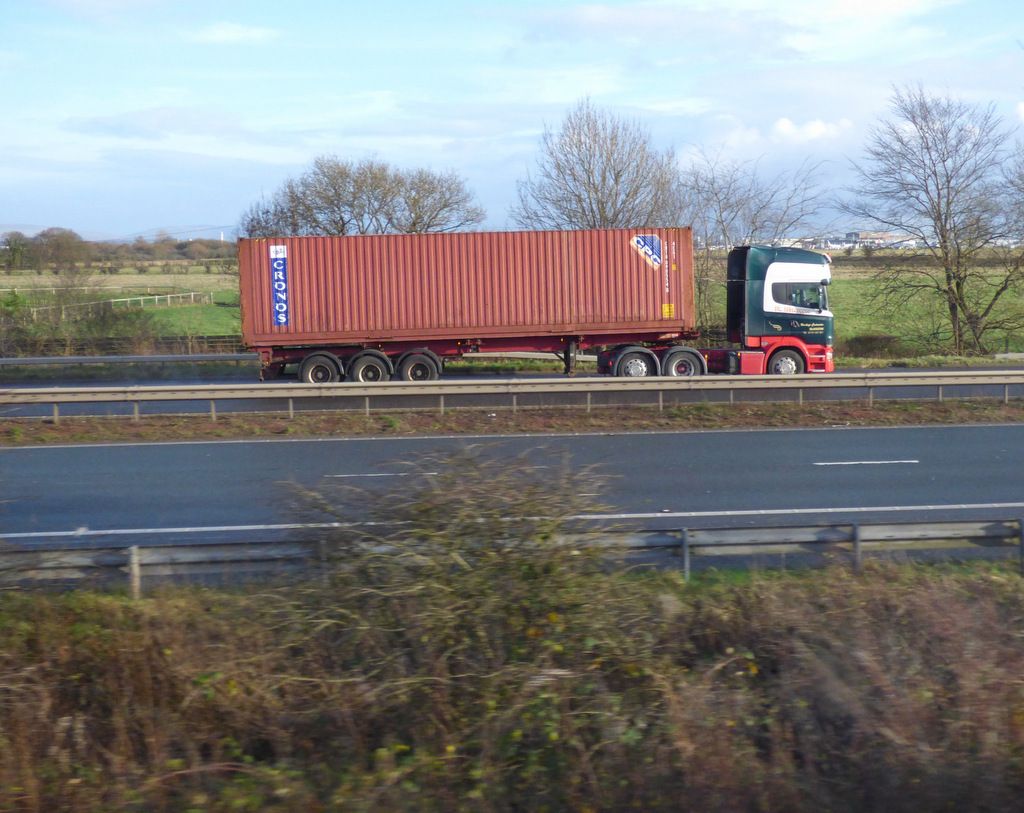
In Great Britain a goods vehicle with a maximum laden weight over 7.5 tonnes may be driven at up to 60 mph on a motorway; on a dual carriageway its limit is 60 mph in England and Wales and 50 mph in Scotland, and on a single carriageway 50 mph in England and Wales and 40 mph in Scotland. Buses and coaches have 70 mph on motorways, or 60 mph when longer than 12 metres, 60 mph on dual carriageways and 50 mph on single carriageways, and on roads with street lights a limit of 30 mph, or 20 mph in Wales, generally applies to all motor vehicles. Separately, the Road Vehicles (Construction and Use) Regulations 1986 require speed limiters on the goods vehicles and buses they define by weight and date of first use: 90 km/h for goods vehicles and 100 km/h for buses, except that some goods vehicles first used from 1992 to 2004 have 60 mph and coaches first used from 1974 to 1987 have 112.65 km/h.
Status: 27 October 2026. All texts were read that day: Schedule 6 and sections 81, 82 and 86 of the Road Traffic Regulation Act 1984 and section 192 of the Road Traffic Act 1988, which legislation.gov.uk marks as up to date with all changes known to be in force on or before 27 October 2026; regulations 3, 36A, 36B and 70A of the Road Vehicles (Construction and Use) Regulations 1986, for which it records no known outstanding effects; the 2014 regulations for England and Wales and for the A9 and the 2022 order for Wales as made; the draft HGV Speed Limit (Variation) (Scotland) Regulations 2026 with its policy note; GOV.UK’s Speed limits page, rule 124 of the Highway Code and the Department for Transport’s written statement of 28 November 2014. legislation.gov.uk warns that “Revised legislation carried on this site may not be fully up to date”. It gives Schedule 6 and sections 81, 82 and 86 the extent England, Wales and Scotland; Northern Ireland is not covered here.
| Vehicle | Single carriageways | Dual carriageways | Motorways |
|---|---|---|---|
| Goods vehicle, maximum laden weight not more than 7.5 tonnes | 50 (80) | 60 (96) | 70 (112); 60 (96) if articulated or towing a trailer |
| Goods vehicle, maximum laden weight more than 7.5 tonnes, England and Wales | 50 (80) | 60 (96) | 60 (96) |
| Goods vehicle, maximum laden weight more than 7.5 tonnes, Scotland | 40 (64) | 50 (80) | 60 (96) |
| Bus, coach or minibus, not more than 12 metres overall length | 50 (80) | 60 (96) | 70 (112) |
| Bus, coach or minibus, more than 12 metres overall length | 50 (80) | 60 (96) | 60 (96) |
For built-up areas, GOV.UK and the Highway Code give the same figures for each of these vehicles: 30 (48) in England and Scotland and 20 (32) in Wales; GOV.UK’s page lists Northern Ireland with England and Scotland for the 30 mph figure. The Act states its limits in miles per hour only; the kilometres per hour in brackets are the ones GOV.UK and the Highway Code print.
What is the HGV speed limit on each type of road?
The class limits come from section 86(1) of the Road Traffic Regulation Act 1984: “It shall not be lawful for a person to drive a motor vehicle of any class on a road at a speed greater than the speed specified in Schedule 6 to this Act as the maximum speed in relation to a vehicle of that class.” Part I of Schedule 6, which applies to vehicles with pneumatic tyres on every wheel, sets three columns: (a) “Motorway”, (b) “Dual carriageway road not being a motorway” and (c) “Other road”. The explanatory note to the 2014 regulations for England and Wales calls column (c) single carriageway roads.
| Item | Class of vehicle | Motorway | Dual carriageway road | Other road |
|---|---|---|---|---|
| 1(i) | Passenger vehicle, motor caravan or dual-purpose vehicle not drawing a trailer, with an unladen weight over 3.05 tonnes or adapted to carry more than 8 passengers, not exceeding 12 metres in overall length | 70 | 60 | 50 |
| 1(ii) | The same, exceeding 12 metres in overall length | 60 | 60 | 50 |
| 3 | Passenger vehicle, motor caravan, car-derived van or dual-purpose vehicle drawing one trailer | 60 | 60 | 50 |
| 4 | The same drawing more than one trailer | 40 | 20 | 20 |
| 5(1) | Goods vehicle with a maximum laden weight not exceeding 7.5 tonnes that is not an articulated vehicle, not drawing a trailer and not a car-derived van | 70 | 60 | 50 |
| 5(2)(a) | Articulated vehicle with a maximum laden weight not exceeding 7.5 tonnes; motor vehicle, other than a car-derived van, drawing one trailer where the aggregate maximum laden weight does not exceed 7.5 tonnes | 60 | 60 | 50 |
| 5(2)(b) | Articulated vehicle with a maximum laden weight exceeding 7.5 tonnes; motor vehicle exceeding 7.5 tonnes not drawing a trailer; motor vehicle drawing one trailer where the aggregate maximum laden weight exceeds 7.5 tonnes | 60 | 60 England and Wales; 50 Scotland | 50 England and Wales; 40 Scotland, 50 on the listed parts of the M9/A9 |
| 5(2)(c) | Motor vehicle, other than a car-derived van, drawing more than one trailer | 40 | 20 | 20 |
In those two cells of item 5(2)(b) legislation.gov.uk prints two figures each. Its annotations record that the figures 50 and 40 were substituted for England and Wales from 6 April 2015 by S.I. 2014/3552, so 60 and 50 apply there; for Scotland, GOV.UK and the Highway Code give 50 and 40.
Part IV of the Schedule defines the terms. A “dual-carriageway road” is “a road part of which consists of a central reservation to separate a carriageway to be used by vehicles proceeding in one direction from a carriageway to be used by vehicles proceeding in the opposite direction”. “Maximum laden weight” means, for a vehicle or combination for which “a gross weight not to be exceeded in Great Britain is specified in construction and use requirements, that weight”, and otherwise “the weight which the vehicle, or combination of vehicles, is designed or adapted not to exceed when in normal use and travelling on a road laden”. A “car-derived van” is a goods vehicle constructed or adapted as a derivative of a passenger vehicle with a maximum laden weight not exceeding 2 tonnes. “Goods vehicle” takes its meaning from section 192(1) of the Road Traffic Act 1988: “a motor vehicle constructed or adapted for use for the carriage of goods, or a trailer so constructed or adapted”. Where the 7.5 tonne line sits in other British texts is set out in What is an HGV?, and the general weight terms in truck weights.
A vehicle can fit more than one item. Paragraph 4(1) of Part IV settles that case: “A vehicle falling in two or more classes specified in Part I, II or III of this Schedule shall be treated as falling within the class for which the lower or lowest speed limit is specified.”
GOV.UK adds that most vans “must follow the speed limits for goods vehicles of the same weight”. For a lorry of up to 7.5 tonnes, the licence questions are covered in Can I drive a minibus or 7.5-tonne lorry on a car licence?
Speed limits for buses and coaches
Item 1 of the Schedule covers a passenger vehicle, motor caravan or dual-purpose vehicle not drawing a trailer with an unladen weight over 3.05 tonnes or adapted to carry more than 8 passengers. Its dividing line is length: up to 12 metres overall, 70 mph on motorways, 60 on dual carriageways and 50 on other roads; over 12 metres, 60, 60 and 50. For such a vehicle drawing one trailer, item 3 gives 60, 60 and 50; drawing more than one, item 4 gives 40, 20 and 20.
GOV.UK’s Speed limits page gives item 1’s figures for “Buses, coaches and minibuses” in two rows, “not more than 12 metres overall length” and “more than 12 metres overall length”. The Highway Code has one row, “Buses, coaches and minibuses (not exceeding 12 metres in overall length)”, with the motorway figure marked by a footnote: “† 60 mph (96 km/h) if exceeding 12 metres in overall length.” Unlike the Schedule 6 limits for heavy goods vehicles, those for buses are the same in England, Wales and Scotland.
Scotland: 40 mph on single carriageways, except on parts of the A9
The 2015 increase for heavy goods vehicles applies in England and Wales only. The Motor Vehicles (Variation of Speed Limits) (England and Wales) Regulations 2014 state in regulation 1(2): “These Regulations extend to England and Wales.” Under section 86(7) of the 1984 Act, the authority that may vary Schedule 6 is the Secretary of State for roads in England, the Welsh Ministers for roads in Wales and the Scottish Ministers for roads in Scotland, and section 86(8) makes regulations by the Scottish Ministers subject to the affirmative procedure.
Scotland has one exception of its own. The HGV Speed Limit (M9/A9 Trunk Road) Regulations 2014 (S.S.I. 2014/274), made on 21 October 2014 and in force from 28 October 2014, inserted a sentence after the table: for a vehicle in class 5(2)(b), the maximum speed on a part of the M9/A9 Trunk Road specified in the Schedule to those Regulations “is 50 miles per hour (rather than 40 miles per hour as specified in column 3(c) of the Table above).” Their explanatory note says the increase applies “when it is being driven on a single carriageway stretch of the M9/A9 Trunk Road specified in the Schedule” and that “The relevant stretches all lie between Perth and Inverness.” The Schedule lists eight stretches, from Luncarty to Pass of Birnam in the south to Tomatin to Moy in the north. legislation.gov.uk holds the 2014 Regulations only in their original form, and its list of changes affecting them returned no results.
Draft change from 1 April 2027
A draft of the HGV Speed Limit (Variation) (Scotland) Regulations 2026 has been laid before the Scottish Parliament under section 86(8), for approval by resolution. legislation.gov.uk states: “This is a draft item of legislation and has not yet been made as a Scottish Statutory Instrument.” The draft would come into force on 1 April 2027 and extend to Scotland only. For class 5(2)(b) it would substitute “60” for “50” in column 3(b) and “50” for “40” in column 3(c), omit the A9 sentence and revoke the 2014 A9 Regulations.
The draft policy note by Transport Scotland, dated September 2026, says the National Speed Management Review proposed both reducing “the national speed limit for motor vehicles on single carriageway roads from 60 mph to 50 mph” and increasing HGV limits, and that after a public consultation that closed in March 2025, “it was announced that only the increase in HGV speed limits would be progressed.” On 27 October 2026 the revised Schedule 6 still carried the Scottish figures shown in the tables above.
England and Wales: the 2015 increase
S.I. 2014/3552, made on 30 November 2014 and in force from 6 April 2015, varied item 5, paragraph (2)(b): “for the figure “50” in column 3(b) (dual carriageway road), substitute “60”” and “for the figure “40” in column 3(c) (other road), substitute “50””. Its explanatory note describes the two changes as a maximum of 60 mph in place of 50 mph on dual carriageway roads and of 50 mph in place of 40 mph on single carriageway roads. A footnote records approval by the House of Lords on 26 January 2015 and by the House of Commons on 2 February 2015.
The Department for Transport’s written statement of 28 November 2014 announced the dual carriageway change and said it “complements the decision that the government has already announced to raise the national speed limit for HGVs over 7.5 tonnes on single carriageway roads”. It added: “The amended speed limit will cover dual carriageway roads in England and Wales, unless specific lower local or urban speed limits are in effect.”
Built-up areas: 30 mph, and 20 mph in Wales
Section 81(1) sets a limit for every motor vehicle on a restricted road: “It shall not be lawful for a person to drive a motor vehicle on a restricted road at a speed exceeding 30 miles per hour.” Under section 82(1), a road is restricted in England and Wales if it has “a system of street lighting furnished by means of lamps placed not more than 200 yards apart”; in Scotland, if it has “a system of carriageway lighting furnished by means of lamps placed not more than 185 metres apart and the road is of a classification or type specified for the purposes of this subsection in regulations made by the Scottish Ministers”. Under section 82(2) the traffic authority may direct that a road ceases to be, or becomes, a restricted road.
In Wales the figure changed on 17 September 2023. Article 2(1) of the Restricted Roads (20 mph Speed Limit) (Wales) Order 2022 reads: “The rate of speed fixed by section 81(1) of the Road Traffic Regulation Act 1984 (general speed limit for restricted roads) is reduced to 20 miles per hour.” The Order applies in relation to Wales.
Rule 124 of the Highway Code joins the limits for the road and for the vehicle: “You MUST NOT exceed the maximum speed limits for the road and for your vehicle (see the table below). A speed limit of 30 mph (48 km/h), or 20mph (32km/h) in Wales, generally applies to all roads with street lights (excluding motorways) unless signs show otherwise.” It lists examples of locally set limits: “20 mph (32 km/h) in some built-up areas in England and Scotland”, “30 mph (48 km/h) in some built-up areas in Wales” and “50 mph (80 km/h) on single carriageways with known hazards”, and notes that “variable speed limit signs are used on some motorways and dual carriageways to change the maximum speed limit.” The rule gives its legal basis as “RTRA sects 81, 86, 89 & sched 6 as amended by MV(VSL)(E&W), RR(20)O”.
Speed limiters: 90 km/h for goods vehicles, 100 km/h for buses
Speed limiters are required by the Construction and Use Regulations. GOV.UK says a speed limiter must be fitted on “vehicles with more than 8 passenger seats, for example, buses, minibuses, coaches, stretch limousines” and “goods vehicles with a maximum laden weight of more than 3.5 tonnes”, and that “Having a speed limiter may mean that your vehicle cannot reach the speed limit.” The regulations themselves set the scope by maximum gross weight and date of first use: regulation 36B for goods vehicles and regulation 36A for buses and coaches.
| Vehicle | First used | Limiter | Regulation |
|---|---|---|---|
| Goods vehicle, maximum gross weight over 12,000 kg | On or after 1 January 1988 | Set so that the stabilised speed does not exceed 90 km/h | 36B(2), (9) |
| Goods vehicle, over 3,500 kg up to 12,000 kg | On or after 1 January 2005 | 90 km/h, as above | 36B(1A), (9) |
| Goods vehicle, over 3,500 kg up to 12,000 kg, meeting the Euro III emission limit values | On or after 1 October 2001 and before 1 January 2005 | 90 km/h, as above | 36B(1B), (9) |
| Goods vehicle, over 7,500 kg up to 12,000 kg, other than those in the row above | On or after 1 August 1992 and before 1 January 2005 | Calibrated to a set speed not exceeding 60 mph | 36B(1), (8) |
| Bus, maximum gross weight over 7.5 tonnes | On or after 1 January 1988 | Set so that the vehicle cannot exceed 100 km/h; see paragraph (7A) below | 36A(2), (7), (7A) |
| Bus over 5 tonnes up to 10 tonnes not within paragraph (2); bus up to 5 tonnes | On or after 1 January 2005 | Set so that the vehicle cannot exceed 100 km/h | 36A(2A), (2B), (7) |
| Bus up to 10 tonnes not within paragraph (2), meeting the Euro III emission limit values | On or after 1 October 2001 and before 1 January 2005 | Set so that the vehicle cannot exceed 100 km/h | 36A(2C), (7) |
| Coach | On or after 1 April 1974 and before 1 January 1988 | Calibrated to a set speed not exceeding 112.65 km/h | 36A(1), (6) |
The thresholds in the table are written into each paragraph: a goods vehicle is covered if it “has, or if a speed limiter were not fitted to it would have, a relevant speed exceeding 90 km/h” (60 mph for the 1992 to 2004 group), and regulation 36B defines relevant speed as “a speed which a vehicle is incapable, by means of its construction, of exceeding on the level under its own power when unladen”. A bus is covered if it has, or would have without a limiter, a maximum speed exceeding 100 km/h, and a coach of 1974 to 1987 one exceeding 112.65 km/h. Regulation 36B gives the goods vehicle setting as 90 km/h and regulation 36A the bus setting as 100 km/h; neither states a figure in miles per hour for them. Paragraph (7A) of regulation 36A provides that the limiter of a bus first used before 1 January 2005 with a maximum gross weight over 10 tonnes, or first used before 1 October 2001 and over 7.5 but not over 10 tonnes, “may be set at a maximum speed of 100 km/h.”
Regulation 3 of the same Regulations defines a bus as “a motor vehicle which is constructed or adapted to carry more than eight seated passengers in addition to the driver”, a coach as “a large bus with a maximum gross weight of more than 7.5 tonnes and with a maximum speed exceeding 60 mph”, and a large bus as a vehicle “constructed or adapted to carry more than 16 seated passengers in addition to the driver”.
Under regulation 70A, every vehicle to which regulation 36A or 36B applies and which is fitted with a speed limiter must carry a plate “in conspicuous position in the driving compartment of the vehicle” that “is clearly and indelibly marked with the speed at which the speed limiter has been set.”
Both regulations list exemptions. Among them are vehicles used for fire and rescue, ambulance or police purposes and vehicles owned by the Secretary of State for Defence and used for naval, military or air force purposes; regulation 36B also exempts a goods vehicle in any calendar week in which it is used on public roads only to pass from land occupied by its keeper to other land the keeper occupies, for no more than an aggregate of six miles in that week.
The speed limits in the EU countries, Liechtenstein, Norway, Switzerland and Türkiye, and the EU rule on speed limiters, are covered in truck and bus speed limits in Europe.
Quick answers
- What is the HGV speed limit on a motorway?
- 60 mph (96 km/h) for a goods vehicle with a maximum laden weight over 7.5 tonnes, in England, Wales and Scotland alike. A goods vehicle of up to 7.5 tonnes has 70 mph (112 km/h) if it is not articulated and not towing a trailer, and 60 mph (96 km/h) if it is articulated or towing one trailer. The limits are in Schedule 6 to the Road Traffic Regulation Act 1984 and in the table in rule 124 of the Highway Code.
- What is the lorry speed limit on a single carriageway?
- 50 mph (80 km/h) in England and Wales and 40 mph (64 km/h) in Scotland for a goods vehicle over 7.5 tonnes maximum laden weight. In Scotland, 50 mph applies on the parts of the M9/A9 Trunk Road listed in the HGV Speed Limit (M9/A9 Trunk Road) Regulations 2014, single-carriageway stretches between Perth and Inverness. A goods vehicle of up to 7.5 tonnes has 50 mph (80 km/h) in all three nations.
- What is the HGV speed limit on a dual carriageway?
- 60 mph (96 km/h) in England and Wales, since 6 April 2015, and 50 mph (80 km/h) in Scotland, for a goods vehicle over 7.5 tonnes. Draft regulations laid before the Scottish Parliament would raise the Scottish limits to 60 mph on dual carriageways and 50 mph on other roads from 1 April 2027; on 27 October 2026 legislation.gov.uk recorded them as a draft that had not yet been made.
- What is the speed limit for buses and coaches?
- For a bus, coach or minibus up to 12 metres long: 70 mph (112 km/h) on motorways, 60 mph (96 km/h) on dual carriageways and 50 mph (80 km/h) on single carriageways. Over 12 metres the motorway limit is 60 mph (96 km/h). On roads with street lights a limit of 30 mph (48 km/h), or 20 mph (32 km/h) in Wales, generally applies unless signs show otherwise.
- What speed are lorry and bus speed limiters set to?
- 90 km/h for goods vehicles and 100 km/h for buses, under regulations 36B and 36A of the Road Vehicles (Construction and Use) Regulations 1986, each only where the vehicle could otherwise exceed that speed. The 90 km/h applies to goods vehicles over 12,000 kg first used on or after 1 January 1988 and to those over 3,500 kg up to 12,000 kg first used on or after 1 January 2005 (or from 1 October 2001 if they meet the Euro III limits); goods vehicles over 7,500 kg up to 12,000 kg first used from 1 August 1992 and before 1 January 2005, other than those Euro III vehicles, have a set speed not exceeding 60 mph. The 100 km/h applies to buses over 7.5 tonnes first used on or after 1 January 1988 and to other buses first used on or after 1 January 2005 (or from 1 October 2001 if they are up to 10 tonnes and meet the Euro III limits); coaches first used on or after 1 April 1974 and before 1 January 1988 have a set speed not exceeding 112.65 km/h.
- What is the speed limit for a 7.5 tonne lorry?
- A goods vehicle with a maximum laden weight not exceeding 7.5 tonnes may do 70 mph (112 km/h) on a motorway, 60 mph (96 km/h) on a dual carriageway and 50 mph (80 km/h) on a single carriageway, in England, Wales and Scotland alike. If it is articulated, or draws one trailer and the aggregate maximum laden weight does not exceed 7.5 tonnes, its motorway limit is 60 mph (96 km/h). A lorry drawing one trailer where the aggregate maximum laden weight exceeds 7.5 tonnes falls in the same class as a vehicle over 7.5 tonnes: 60 mph on motorways; on dual and single carriageways 60 and 50 mph in England and Wales, 50 and 40 mph in Scotland.
Sources
- Road Traffic Regulation Act 1984 (c. 27), Schedule 6: speed limits for vehicles of certain classes (revised text, up to date with changes known to be in force on or before 27 October 2026) — legislation.gov.uk (The National Archives)
- Road Traffic Regulation Act 1984, section 86: speed limits for particular classes of vehicles (revised text) — legislation.gov.uk (The National Archives)
- Road Traffic Regulation Act 1984, sections 81 and 82: general speed limit for restricted roads, and what roads are restricted roads (revised text) — legislation.gov.uk (The National Archives)
- The Motor Vehicles (Variation of Speed Limits) (England and Wales) Regulations 2014 (S.I. 2014/3552), as made — legislation.gov.uk (The National Archives)
- The HGV Speed Limit (M9/A9 Trunk Road) Regulations 2014 (S.S.I. 2014/274), as made — legislation.gov.uk (The National Archives)
- The HGV Speed Limit (Variation) (Scotland) Regulations 2026: draft laid before the Scottish Parliament, with the draft policy note (September 2026) — legislation.gov.uk (The National Archives); policy note by Transport Scotland
- The Restricted Roads (20 mph Speed Limit) (Wales) Order 2022 (S.I. 2022/800 (W. 177)), as made — legislation.gov.uk (The National Archives)
- The Road Vehicles (Construction and Use) Regulations 1986 (S.I. 1986/1078), regulation 36A: speed limiters (revised text) — legislation.gov.uk (The National Archives)
- The Road Vehicles (Construction and Use) Regulations 1986, regulation 36B: speed limiters for goods vehicles (revised text) — legislation.gov.uk (The National Archives)
- The Road Vehicles (Construction and Use) Regulations 1986, regulation 70A: speed limiters, plates (revised text) — legislation.gov.uk (The National Archives)
- The Road Vehicles (Construction and Use) Regulations 1986, regulation 3: interpretation (revised text) — legislation.gov.uk (The National Archives)
- Road Traffic Act 1988, section 192: general interpretation (revised text) — legislation.gov.uk (The National Archives)
- Speed limits — GOV.UK (Department for Transport and Driver and Vehicle Standards Agency)
- The Highway Code: general rules, techniques and advice for all drivers and riders (103 to 158), rule 124 — GOV.UK (Department for Transport)
- HGV speed limits on dual carriageways: written ministerial statement of 28 November 2014 — GOV.UK (Department for Transport), 28 Nov 2014