Truck and bus speed limits in Europe by country, and the EU speed limiter rule
Speed limits for heavy goods vehicles over 3.5 t and for buses in 32 European countries, by type of road, and the EU limiter rule: 90 km/h for trucks, 100 km/h for buses.
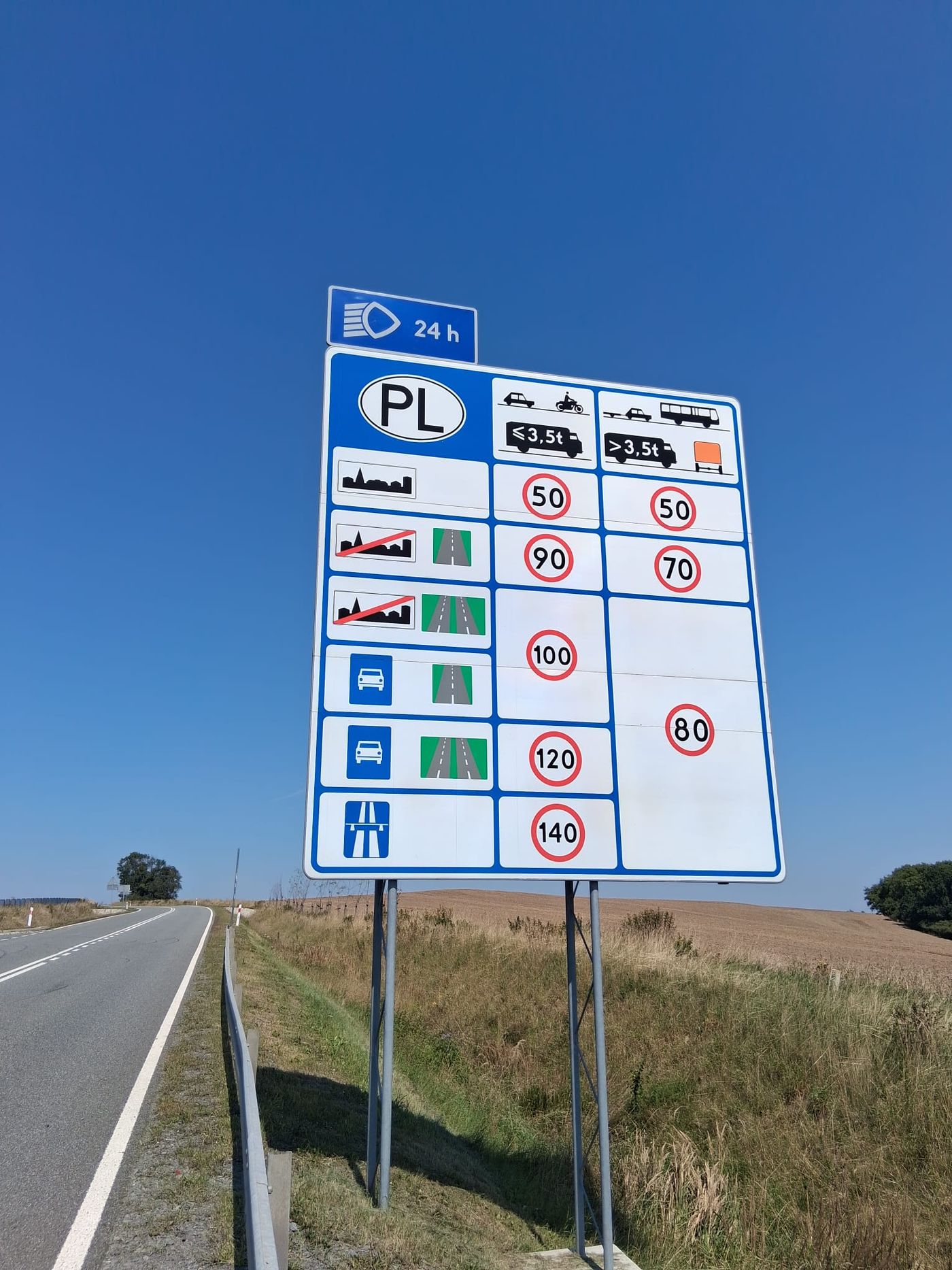
Speed limits for trucks and buses in Europe are national: each country sets them by type of road and often by vehicle weight, and the figures differ. On the European Commission’s pages for the 27 EU countries, Liechtenstein, Norway and Switzerland, heavy goods vehicles over 3.5 tonnes are limited on motorways to 80 or 90 km/h in most of the countries, outside built-up areas to figures mostly between 60 and 90 km/h, and in built-up areas usually to 50 km/h; buses and coaches are allowed 100 km/h on motorways in many of them. Council Directive 92/6/EEC leaves these road limits to the Member States. What it sets is the speed limiter: as amended by Directive 2002/85/EC, it provides that trucks of categories N2 and N3 may be used on the road only with a limiter set so that they cannot exceed 90 km/h, and buses and coaches of categories M2 and M3 only with one set so that they cannot exceed 100 km/h. Great Britain sets its limits in miles per hour, and Türkiye has its own table and its own limiter settings.
Status as at 27 October 2026. Read on that day: Council Directive 92/6/EEC and Directive 2002/85/EC in their Official Journal texts; the European Commission’s Your Europe pages “Road rules and safety” for the 27 EU countries, Liechtenstein, Norway and Switzerland; rule 124 of the Highway Code on GOV.UK; and Schedule 6 to the Road Traffic Regulation Act 1984 on legislation.gov.uk. Türkiye’s Highway Traffic Regulation was read in its consolidated text on 28 September 2026. The records of the EU Publications Office, queried on 28 September 2026, listed both directives as in force.
What EU law sets: the speed limiter
Council Directive 92/6/EEC of 10 February 1992 concerns “the installation and use of speed limitation devices for certain categories of motor vehicles in the Community”. It leaves the speed limits on the roads to the Member States: in the words of its last recital, the Directive “does not affect Member States’ prerogatives as regards speed restriction provisions for traffic”. An earlier recital records why some Member States had already made the devices compulsory: environmental protection, and the fact that the engine power heavy goods vehicles and buses need for climbing slopes “enables them to be driven on level roads at excessive speeds that are not compatible with the specifications of other components of those vehicles such as brakes and tyres”.
Directive 2002/85/EC of 5 November 2002 replaced Articles 1 to 5. It extended the scope, which had covered only the heaviest vehicles, “to motor vehicles of category M2, to vehicles of category M3 having a maximum mass of more than 5 tonnes but not exceeding 10 tonnes and to vehicles of category N2” (recital 5). In this version the Directive covers any power-driven vehicle “falling within category M2, M3, N2 or N3, intended for use on the road and having at least four wheels and a maximum design speed exceeding 25 km/h” (Article 1). What the four categories contain is set out in vehicle categories M, N and O.
- Buses and coaches, M2 and M3. They “may be used on the road only if equipped with a speed limitation device set in such a way that their speed cannot exceed 100 kilometres per hour” (Article 2). M3 vehicles with a maximum mass over 10 tonnes registered before 1 January 2005 “may continue to be equipped with devices on which the maximum speed is set at 100 kilometres per hour”.
- Trucks, N2 and N3. The device must be “set in such a way that their speed cannot exceed 90 kilometres per hour” (Article 3(1)).
- Dangerous goods. Member States may require that the device in vehicles “registered in their territory and used exclusively for the transport of dangerous goods” is set so that those vehicles “cannot exceed a maximum speed of less than 90 kilometres per hour” (Article 3(2)).
Article 6, which the 2002 Directive left in place, exempts motor vehicles “used by armed forces, civil defence, fire and other emergency services and forces responsible for maintaining public order”, and vehicles that by their construction cannot drive faster than the limits in Articles 2 and 3, that are used for scientific tests on roads, or that are “used only for public services in urban areas”. Member States had to bring into force the laws, regulations and administrative provisions needed to comply with the amending Directive by 1 January 2005 at the latest (Article 2 of Directive 2002/85/EC).
The 1992 text covered only M3 vehicles over 10 tonnes and N3 vehicles. For the N3 device it added that, “bearing in mind the technical tolerance which is allowed, at the present state of technology, between the regulating value and the actual speed of traffic, the maximum speed on this device shall be set at 85 km/h” (86 km/h in the English text as first published, corrected by a corrigendum), and it allowed a setting below 85 km/h for vehicles used exclusively for the carriage of dangerous goods. Neither figure is in the text as amended in 2002.
From when the limiter applies
| Vehicles | Registered | Articles 2 and 3 apply |
|---|---|---|
| M3 over 10 t, N3 | From 1 January 1994 | From 1 January 1994 |
| M3 over 10 t, N3 | Between 1 January 1988 and 1 January 1994 | From 1 January 1995 for vehicles in national and international transport; from 1 January 1996 for vehicles used exclusively in national transport |
| M2; M3 over 5 t up to 10 t; N2 | From 1 January 2005 | From 1 January 2005 at the latest |
| M2; M3 over 5 t up to 10 t; N2, if complying with the limit values of Directive 88/77/EEC | Between 1 October 2001 and 1 January 2005 | At the latest from 1 January 2006 for vehicles in national and international transport; from 1 January 2007 for vehicles used solely in national transport |
For no more than three years from 1 January 2005, any Member State could exempt “category M2 vehicles and category N2 vehicles with a maximum mass of more than 3,5 tonnes but not exceeding 7,5 tonnes, registered in the national register and not travelling on the territory of another Member State” (Article 4(3)).
Heavy goods vehicles over 3.5 t, country by country
The figures for the EU countries, Liechtenstein, Norway and Switzerland are the “Standard speed limits (unless otherwise stated by traffic signs)” that the European Commission publishes on its Your Europe portal, in the class “Heavy goods vehicles over 3.5 t”. Belgium’s page calls the class “Heavy-duty motor vehicles”, Greece’s “Lorries (N2/N3)”, and Latvia’s page lists only “Vehicles over 7.5 t”. Each page states that its content “is provided by the national authorities according to Article 8(1) of Directive (EU) 2015/413/EU” and that the Commission “does not assume liability for this content or its accuracy”. The pages carry their own “Last checked” dates: 18 September 2024 for 24 of them, later dates for Austria, Denmark, Germany, Greece, Lithuania and Spain. The rows for Great Britain and Türkiye come from national texts, described in the sections below.
| Country | Built-up areas | Outside built-up areas | Motorways and expressways | Source |
|---|---|---|---|---|
| Austria | 50 | 70 | 80 | Your Europe, 29 Oct 2024 |
| Belgium | 50; 30 in Brussels | 90 in Wallonia and Brussels, 70 in Flanders; over 7.5 t, 60 on other public roads | 90 | Your Europe, 18 Sep 2024 |
| Bulgaria | 50; 40 with dangerous goods | 80; 70 with an O3 or O4 trailer or semi-trailer; 50 with dangerous goods | 100; 90 with an O3 or O4 trailer or semi-trailer, or with dangerous goods | Your Europe, 18 Sep 2024 |
| Croatia | 50 | 80 | 90 | Your Europe, 18 Sep 2024 |
| Cyprus | 50 | 64 | 80 | Your Europe, 18 Sep 2024 |
| Czechia | 50 | 80 | 80 | Your Europe, 18 Sep 2024 |
| Denmark | 50 | 80 | 80 | Your Europe, 24 Apr 2025 |
| Estonia | 50 | 90 | 90 | Your Europe, 18 Sep 2024 |
| Finland | 50 | 80; “On any other highways”, 60 for vehicles over 7.5 t | 80 | Your Europe, 18 Sep 2024 |
| France | 50 | 80; 60 for combinations over 12 t | 80 / 90 | Your Europe, 18 Sep 2024 |
| Germany | 50 | 80 up to 7.5 t; 60 over 7.5 t or with a trailer | 80 with one or two trailers; no figure given for a truck without a trailer | Your Europe, 1 Jul 2025 |
| Great Britain | 48 (30 mph); 32 (20 mph) in Wales | 80 (50 mph) on single, 96 (60 mph) on dual carriageways; over 7.5 t in Scotland, 64 (40 mph) and 80 (50 mph) | 96 (60 mph) over 7.5 t; 112 (70 mph) up to 7.5 t, 96 (60 mph) if articulated or towing a trailer | Highway Code, rule 124 |
| Greece | 50; the page’s general limits are 30 on urban roads and 50 on certain multi-lane urban roads | 80; 70 with a trailer, and for a tractor unit with a semi-trailer | 85 / 80; 80 / 70 with a trailer, and for a tractor unit with a semi-trailer | Your Europe, 1 Oct 2026 |
| Hungary | 50 | 70 | 80 | Your Europe, 18 Sep 2024 |
| Iceland | Not verified | Not on Your Europe’s country list; no national text read | ||
| Ireland | 50 | 80 | 90 | Your Europe, 18 Sep 2024 |
| Italy | 50 | 80 up to 12 t; 70 over 12 t | 100 up to 12 t; 80 over 12 t | Your Europe, 18 Sep 2024 |
| Latvia | 50 (vehicles over 7.5 t) | 80 (vehicles over 7.5 t) | Not given on the page | Your Europe, 18 Sep 2024 |
| Liechtenstein | 50 | 80 | No motorways: “This road category does not exist in Liechtenstein” | Your Europe, 18 Sep 2024 |
| Lithuania | 50 | 80 on asphalt and concrete roads; 70 on other roads | 90 | Your Europe, 24 Apr 2026 |
| Luxembourg | 50 | 75 | 90 | Your Europe, 18 Sep 2024 |
| Malta | 40 | 60 | 60 | Your Europe, 18 Sep 2024 |
| Netherlands | 50 | 80 | 80 | Your Europe, 18 Sep 2024 |
| Northern Ireland | Not verified | No text read | ||
| Norway | 50 | 80 | 80 | Your Europe, 18 Sep 2024 |
| Poland | 50; 20 in residential areas | 70 | 80, also on dual carriageways with at least two lanes in each direction | Your Europe, 18 Sep 2024 |
| Portugal | 50 | 80 | 90 / 80 | Your Europe, 18 Sep 2024 |
| Romania | 50 | 80 / 90 | 110 | Your Europe, 18 Sep 2024 |
| Slovakia | 50 | 90 | 90 | Your Europe, 18 Sep 2024 |
| Slovenia | 50 | 80 | 90 / 80 | Your Europe, 18 Sep 2024 |
| Spain | 50 with two or more lanes in each direction; 30 with one lane in each direction; 20 where road and pavement are on one level | 80 | 90 | Your Europe, 1 Oct 2026 |
| Sweden | 50 | 70 | 90; 80 for vehicles with trailers | Your Europe, 18 Sep 2024 |
| Switzerland | 50 | 80 | 80 | Your Europe, 18 Sep 2024 |
| Türkiye | 50 | 80 on two-way roads; 85 on divided roads | 90; with a trailer or semi-trailer, each limit in this row 10 km/h lower, with exceptions | Highway Traffic Regulation, Art. 100 |
Buses and coaches, country by country
The bus figures come from the same pages, where the class is headed “Buses” (Greece: “Buses (M2/M3)”). The Latvian page gives none.
| Country | Built-up areas | Outside built-up areas | Motorways and expressways | Source |
|---|---|---|---|---|
| Austria | 50 | 80 | 100 | Your Europe, 29 Oct 2024 |
| Belgium | 50; 30 in Brussels | 75 in Wallonia and Brussels, 70 in Flanders; 90 on roads with two or more lanes in both directions (in Flanders, separated other than by road markings) | 90; 100 for buses and coaches with seat belts and a speed limiter set to a maximum of 100 | Your Europe, 18 Sep 2024 |
| Bulgaria | 50 | 80; 70 with a trailer | 100 / 90 | Your Europe, 18 Sep 2024 |
| Croatia | 50 | 80 | 100 | Your Europe, 18 Sep 2024 |
| Cyprus | 50 | 80 | 100 | Your Europe, 18 Sep 2024 |
| Czechia | 50 | 90 | 130 on motorways; 110 on expressways | Your Europe, 18 Sep 2024 |
| Denmark | 50 | 80 | 80 | Your Europe, 24 Apr 2025 |
| Estonia | 50 | 90 | 90 | Your Europe, 18 Sep 2024 |
| Finland | 50 | 80 | 100 / 80 | Your Europe, 18 Sep 2024 |
| France | 50 | 80; 90 on some roads with 90 km/h signs; 70 with standing passengers | 100 / 90, the page giving 100 for buses below 10 t; 70 with standing passengers | Your Europe, 18 Sep 2024 |
| Germany | 50 | 80; 60 for buses with standing room for passengers | 80; 60 for buses with standing room for passengers; 100 for buses with special technical equipment | Your Europe, 1 Jul 2025 |
| Great Britain | 48 (30 mph); 32 (20 mph) in Wales | 80 (50 mph) on single, 96 (60 mph) on dual carriageways | 112 (70 mph) up to 12 m long; 96 (60 mph) over 12 m | Highway Code, rule 124 |
| Greece | 50; the page’s general limits are 30 on urban roads and 50 on certain multi-lane urban roads | 80; 70 for articulated and double-decker buses; 60 for school buses | 100 / 90; 80 for double-decker and school buses and with a light trailer; 70 for articulated buses | Your Europe, 1 Oct 2026 |
| Hungary | 50 | 70 | 80 | Your Europe, 18 Sep 2024 |
| Iceland | Not verified | Not on Your Europe’s country list; no national text read | ||
| Ireland | 50 | 80 | 100 | Your Europe, 18 Sep 2024 |
| Italy | 50 | 80 | 100 | Your Europe, 18 Sep 2024 |
| Latvia | Not verified: the page gives no figures for buses | Your Europe, 18 Sep 2024 | ||
| Liechtenstein | 50 | 80 | No motorways | Your Europe, 18 Sep 2024 |
| Lithuania | 50 | 80 on asphalt and concrete roads; 70 on other roads | 100 on motorways; 90 on highways | Your Europe, 24 Apr 2026 |
| Luxembourg | 50 | 75 | 90 | Your Europe, 18 Sep 2024 |
| Malta | 40 | 60 | 60 | Your Europe, 18 Sep 2024 |
| Netherlands | 50 | 80 | 100 / 80 | Your Europe, 18 Sep 2024 |
| Northern Ireland | Not verified | No text read | ||
| Norway | 50 | 80 | 80 | Your Europe, 18 Sep 2024 |
| Poland | 50; 20 in residential areas | 70 | 80, also on dual carriageways with at least two lanes in each direction; 100 for buses with special technical equipment | Your Europe, 18 Sep 2024 |
| Portugal | 50 | 80 | 100 / 90 | Your Europe, 18 Sep 2024 |
| Romania | 50 | 90 / 80 | 110 | Your Europe, 18 Sep 2024 |
| Slovakia | 50 | 90 | 100; the page adds 90 in built-up areas | Your Europe, 18 Sep 2024 |
| Slovenia | 50 | 80; 70 for “articulated buses or coaches”; 60 with standing passengers; 50 for city public transport buses | 100 for buses without a trailer “for which this is the maximum permitted speed”; 80 for “articulated buses or coaches” | Your Europe, 18 Sep 2024 |
| Spain | 50 with two or more lanes in each direction; 30 with one lane in each direction; 20 where road and pavement are on one level | 90 | 100 | Your Europe, 1 Oct 2026 |
| Sweden | 50 | 70 | 90 | Your Europe, 18 Sep 2024 |
| Switzerland | 50 | 80 | 100 | Your Europe, 18 Sep 2024 |
| Türkiye | 50 | 80 on two-way roads; 90 on divided roads | 100 | Highway Traffic Regulation, Art. 100 |
National limits above the limiter settings
Some figures for EU Member States in the two tables are above the speeds that the limiters required by Directive 92/6/EEC allow. For heavy goods vehicles they are 100 km/h on motorways in Bulgaria and, for vehicles up to 12 t, in Italy, and 110 km/h on motorways in Romania. For buses they are 110 km/h on motorways in Romania, and 110 km/h on expressways and 130 km/h on motorways in Czechia. Articles 2 and 3 of the Directive name no road type: the vehicles in their scope “may be used on the road only if equipped with a speed limitation device” set so that their speed cannot exceed 100 km/h for M2 and M3 and 90 km/h for N2 and N3.
Great Britain: limits in miles per hour
In Great Britain the limits for classes of vehicle are in Schedule 6 to the Road Traffic Regulation Act 1984, which legislation.gov.uk marks as extending to England, Wales and Scotland. Rule 124 of the Highway Code sets them out in a table, with kilometres per hour in brackets, and gives as its legal basis “RTRA sects 81, 86, 89 & sched 6 as amended by MV(VSL)(E&W), RR(20)O”. It adds that a limit of 30 mph (48 km/h), “or 20mph (32km/h) in Wales, generally applies to all roads with street lights (excluding motorways) unless signs show otherwise”.
| Vehicle | Built-up areas | Single carriageways | Dual carriageways | Motorways |
|---|---|---|---|---|
| Buses, coaches and minibuses not exceeding 12 metres in overall length | 30 (48) | 50 (80) | 60 (96) | 70 (112); 60 (96) if exceeding 12 metres |
| Goods vehicles not exceeding 7.5 tonnes maximum laden weight | 30 (48) | 50 (80) | 60 (96) | 70 (112); 60 (96) if articulated or towing a trailer |
| Goods vehicles exceeding 7.5 tonnes maximum laden weight, England and Wales | 30 (48) | 50 (80) | 60 (96) | 60 (96) |
| Goods vehicles exceeding 7.5 tonnes maximum laden weight, Scotland | 30 (48) | 40 (64) | 50 (80) | 60 (96) |
Schedule 6 defines the classes. Item 1 covers a passenger vehicle, motor caravan or dual-purpose vehicle not drawing a trailer, “with an unladen weight exceeding 3·05 tonnes or adapted to carry more than 8 passengers”: 70 mph on motorways, 60 mph on dual carriageways and 50 mph on other roads up to 12 metres in overall length, and 60, 60 and 50 mph above that. Item 5 covers goods vehicles by maximum laden weight, by articulation and by trailers; a goods vehicle drawing more than one trailer is limited to 40 mph on motorways and 20 mph on all other roads. A vehicle that falls within two or more classes “shall be treated as falling within the class for which the lower or lowest speed limit is specified” (Part IV, paragraph 4(1)).
The figures for goods vehicles over 7.5 tonnes on dual carriageways and other roads have differed between England and Wales and Scotland since 6 April 2015, when the Motor Vehicles (Variation of Speed Limits) (England and Wales) Regulations 2014 (S.I. 2014/3552) substituted new figures for England and Wales; in Scotland they remain 50 and 40 mph. On the part of the M9/A9 trunk road specified in the HGV Speed Limit (M9/A9 Trunk Road) Regulations 2014, the limit for these vehicles is “50 miles per hour (rather than 40 miles per hour as specified in column 3(c) of the Table above)”, words inserted into Schedule 6 for Scotland from 28 October 2014. The Highway Code notes that locally set limits may apply, among them variable limits shown on signs on some motorways and dual carriageways. The 3.5 and 7.5 tonne lines in British law are set out in what is an HGV, and the limits for each type of road and class of vehicle in Great Britain in HGV, lorry and bus speed limits in Great Britain.
Türkiye
Türkiye’s limits are in Article 100 of the Highway Traffic Regulation (Karayolları Trafik Yönetmeliği). For trucks and tractor units of categories N2 and N3 its table gives 50 km/h in built-up areas, 80 km/h on two-way intercity roads, 85 km/h on divided roads and 90 km/h on motorways; for buses of categories M2 and M3 it gives 50, 80, 90 and 100 km/h. With a trailer or semi-trailer the maximum is 10 km/h lower than for the same kind of vehicle without one. Rubber-tyred tractors with a trailer, vehicles carrying dangerous goods and vehicles on the road under a special load or special permit document are excepted from that rule and have rows of their own in the table.
Article 99(c) makes a speed limiter compulsory in N2 and N3 trucks and tractor units and in M2 and M3 minibuses and buses. Article 100, in the wording of an amendment published on 19 February 2014, sets the limiter, whatever the road, at 110 km/h for M2 and M3 and at 99 km/h for N2 and N3, and requires these vehicles to keep to the maximum limits of other vehicles on urban roads.
Minimum speeds and lane rules tied to speed
- Belgium: “Access to motorways is prohibited to drivers of agricultural vehicles and to drivers of vehicles or vehicles with trailers who cannot reach the speed of 70 km/h on a horizontal road”, according to its Your Europe page.
- Ireland: according to its Your Europe page, drivers “must not drive a type of vehicle that is restricted to a maximum vehicle speed limit of 90 km/h or less in the traffic lane nearest the centre median of the motorway (the outside, or overtaking lane), except where the general speed limit is 90km/h or less”.
- Türkiye: except in cases of necessity, the minimum speed for motor vehicles on intercity roads is 15 km/h whatever the type of vehicle, and 40 km/h on motorways (Article 100).
What this page does not cover
- Iceland and Northern Ireland: no official text was read for this page, and both appear in the tables as not verified. Countries outside the EU, the EEA, Switzerland, the United Kingdom and Türkiye are not covered.
- Limits set by signs, temporary and weather-related limits, and the separate limits for vehicles with dangerous goods or abnormal loads, except where the tables name them.
- Penalties for speeding. The EU rules for following up offences committed with a vehicle registered in another Member State are covered in cross-border traffic fines in the EU.
- Days and hours when heavy trucks may not drive at all, which are covered in truck driving bans in Europe.
- Intelligent speed assistance, which is covered in mandatory driver assistance systems.
Quick answers
- What is the speed limit for trucks on motorways in Europe?
- It depends on the country. On the European Commission's Your Europe pages, heavy goods vehicles over 3.5 t are limited on motorways to 80 km/h in Austria, Cyprus, Czechia, Denmark, Finland, Hungary, the Netherlands, Norway, Poland and Switzerland, and to 90 km/h in Belgium, Croatia, Estonia, Ireland, Lithuania, Luxembourg, Slovakia, Spain and Sweden (80 km/h with a trailer in Sweden). Malta gives 60 km/h and Romania 110 km/h. Separately, under Directive 92/6/EEC as amended in 2002, trucks of categories N2 and N3 may be used on the road only with a speed limiter set so that they cannot exceed 90 km/h.
- How fast can a bus or coach drive on European motorways?
- The national figures differ. The Your Europe pages give 100 km/h for buses on motorways in Austria, Croatia, Cyprus, Ireland, Italy, Spain and Switzerland and on Lithuanian motorways, 90 km/h in Estonia, Luxembourg and Sweden, and 80 km/h in Denmark, Hungary and Norway; Germany and Poland give 80 km/h, with 100 km/h for buses with special technical equipment. Under Directive 92/6/EEC as amended in 2002, buses and coaches of categories M2 and M3 may be used on the road only with a speed limiter set so that they cannot exceed 100 km/h.
- Does the EU set speed limits for trucks and buses?
- The road limits are left to the Member States: Directive 92/6/EEC states that it "does not affect Member States' prerogatives as regards speed restriction provisions for traffic". What it sets is the speed limiter: as amended by Directive 2002/85/EC, vehicles of categories N2 and N3 may be used on the road only with a limiter set so that they cannot exceed 90 km/h, and vehicles of categories M2 and M3 only with one set so that they cannot exceed 100 km/h. N3 trucks and M3 buses over 10 t registered from 1 January 1994 have needed one since that date; for M2, N2 and M3 buses of 5 to 10 t the rule applies at the latest to vehicles registered from 1 January 2005.
- What is the speed limit for HGVs in the UK?
- In Great Britain, goods vehicles over 7.5 tonnes maximum laden weight are limited to 60 mph (96 km/h) on motorways. On dual carriageways the limit is 60 mph in England and Wales and 50 mph (80 km/h) in Scotland, on single carriageways 50 mph in England and Wales and 40 mph (64 km/h) in Scotland, and in built-up areas 30 mph (48 km/h), or 20 mph (32 km/h) in Wales. Goods vehicles up to 7.5 tonnes may do 70 mph (112 km/h) on motorways, or 60 mph if articulated or towing a trailer. These are the figures of rule 124 of the Highway Code, whose table covers England, Scotland and Wales.
- Which trucks and buses must have a speed limiter in the EU?
- Under Directive 92/6/EEC as amended in 2002, every power-driven vehicle of category M2, M3, N2 or N3 intended for use on the road, with at least four wheels and a maximum design speed above 25 km/h. Under Article 4 the rule covers M3 vehicles over 10 t and N3 vehicles registered from 1 January 1988, and the other vehicles registered from 1 January 2005, or from 1 October 2001 if they comply with the limit values of Directive 88/77/EEC. Article 6 exempts vehicles of the armed forces, civil defence, fire and other emergency services and the forces maintaining public order, and vehicles that by their construction cannot exceed the set speeds, that are used for scientific tests on roads or that are used only for public services in urban areas.
Sources
- Council Directive 92/6/EEC of 10 February 1992 on the installation and use of speed limitation devices for certain categories of motor vehicles in the Community — Official Journal text (OJ L 57, 2.3.1992): recitals and Articles 1 to 8 — EUR-Lex, European Union, 10 Feb 1992
- Directive 2002/85/EC of the European Parliament and of the Council of 5 November 2002 amending Council Directive 92/6/EEC — Official Journal text (OJ L 327, 4.12.2002): recitals and Articles 1 to 4 — EUR-Lex, European Union, 5 Nov 2002
- Road rules and safety – Austria: speed limits by vehicle class (content provided by the national authorities; page last checked 29 October 2024), read on 27 October 2026 — European Commission, Your Europe
- Road rules and safety – Belgium: speed limits by vehicle class (content provided by the national authorities; page last checked 18 September 2024), read on 27 October 2026 — European Commission, Your Europe
- Road rules and safety – Bulgaria: speed limits by vehicle class (content provided by the national authorities; page last checked 18 September 2024), read on 27 October 2026 — European Commission, Your Europe
- Road rules and safety – Croatia: speed limits by vehicle class (content provided by the national authorities; page last checked 18 September 2024), read on 27 October 2026 — European Commission, Your Europe
- Road rules and safety – Cyprus: speed limits by vehicle class (content provided by the national authorities; page last checked 18 September 2024), read on 27 October 2026 — European Commission, Your Europe
- Road rules and safety – Czechia: speed limits by vehicle class (content provided by the national authorities; page last checked 18 September 2024), read on 27 October 2026 — European Commission, Your Europe
- Road rules and safety – Denmark: speed limits by vehicle class (content provided by the national authorities; page last checked 24 April 2025), read on 27 October 2026 — European Commission, Your Europe
- Road rules and safety – Estonia: speed limits by vehicle class (content provided by the national authorities; page last checked 18 September 2024), read on 27 October 2026 — European Commission, Your Europe
- Road rules and safety – Finland: speed limits by vehicle class (content provided by the national authorities; page last checked 18 September 2024), read on 27 October 2026 — European Commission, Your Europe
- Road rules and safety – France: speed limits by vehicle class (content provided by the national authorities; page last checked 18 September 2024), read on 27 October 2026 — European Commission, Your Europe
- Road rules and safety – Germany: speed limits by vehicle class (content provided by the national authorities; page last checked 1 July 2025), read on 27 October 2026 — European Commission, Your Europe
- Road rules and safety – Greece: speed limits by vehicle class (content provided by the national authorities; page last checked 1 October 2026), read on 27 October 2026 — European Commission, Your Europe
- Road rules and safety – Hungary: speed limits by vehicle class (content provided by the national authorities; page last checked 18 September 2024), read on 27 October 2026 — European Commission, Your Europe
- Road rules and safety – Ireland: speed limits by vehicle class (content provided by the national authorities; page last checked 18 September 2024), read on 27 October 2026 — European Commission, Your Europe
- Road rules and safety – Italy: speed limits by vehicle class (content provided by the national authorities; page last checked 18 September 2024), read on 27 October 2026 — European Commission, Your Europe
- Road rules and safety – Latvia: speed limits by vehicle class (content provided by the national authorities; page last checked 18 September 2024), read on 27 October 2026 — European Commission, Your Europe
- Road rules and safety – Liechtenstein: speed limits by vehicle class (content provided by the national authorities; page last checked 18 September 2024), read on 27 October 2026 — European Commission, Your Europe
- Road rules and safety – Lithuania: speed limits by vehicle class (content provided by the national authorities; page last checked 24 April 2026), read on 27 October 2026 — European Commission, Your Europe
- Road rules and safety – Luxembourg: speed limits by vehicle class (content provided by the national authorities; page last checked 18 September 2024), read on 27 October 2026 — European Commission, Your Europe
- Road rules and safety – Malta: speed limits by vehicle class (content provided by the national authorities; page last checked 18 September 2024), read on 27 October 2026 — European Commission, Your Europe
- Road rules and safety – Netherlands: speed limits by vehicle class (content provided by the national authorities; page last checked 18 September 2024), read on 27 October 2026 — European Commission, Your Europe
- Road rules and safety – Norway: speed limits by vehicle class (content provided by the national authorities; page last checked 18 September 2024), read on 27 October 2026 — European Commission, Your Europe
- Road rules and safety – Poland: speed limits by vehicle class (content provided by the national authorities; page last checked 18 September 2024), read on 27 October 2026 — European Commission, Your Europe
- Road rules and safety – Portugal: speed limits by vehicle class (content provided by the national authorities; page last checked 18 September 2024), read on 27 October 2026 — European Commission, Your Europe
- Road rules and safety – Romania: speed limits by vehicle class (content provided by the national authorities; page last checked 18 September 2024), read on 27 October 2026 — European Commission, Your Europe
- Road rules and safety – Slovakia: speed limits by vehicle class (content provided by the national authorities; page last checked 18 September 2024), read on 27 October 2026 — European Commission, Your Europe
- Road rules and safety – Slovenia: speed limits by vehicle class (content provided by the national authorities; page last checked 18 September 2024), read on 27 October 2026 — European Commission, Your Europe
- Road rules and safety – Spain: speed limits by vehicle class (content provided by the national authorities; page last checked 1 October 2026), read on 27 October 2026 — European Commission, Your Europe
- Road rules and safety – Sweden: speed limits by vehicle class (content provided by the national authorities; page last checked 18 September 2024), read on 27 October 2026 — European Commission, Your Europe
- Road rules and safety – Switzerland: speed limits by vehicle class (content provided by the national authorities; page last checked 18 September 2024), read on 27 October 2026 — European Commission, Your Europe
- The Highway Code: general rules, techniques and advice for all drivers and riders (103 to 158) — rule 124 and its speed limits table, read on 27 October 2026 — GOV.UK
- Road Traffic Regulation Act 1984, Schedule 6: speed limits for vehicles of certain classes — latest available version, up to date with all changes known to be in force on or before 27 October 2026 — legislation.gov.uk, The National Archives
- Karayolları Trafik Yönetmeliği (Highway Traffic Regulation), consolidated text — Articles 3, 99 and 100, read on 28 September 2026 — Mevzuat Bilgi Sistemi, Republic of Türkiye
- Karayolları Trafik Yönetmeliğinde Değişiklik Yapılmasına Dair Yönetmelik (Regulation amending the Highway Traffic Regulation), Official Gazette 19/2/2014 No. 28918 — Articles 14 and 15 — Resmî Gazete, Republic of Türkiye, 19 Feb 2014