What is an HGV? HGV, LGV and the 3.5 and 7.5 tonne lines in British law
HGV stands for heavy goods vehicle; LGV is large goods vehicle for DVSA, light goods vehicle in DfT vehicle licensing statistics. Where British Acts and GOV.UK set 3.5 t, 7.5 t and 12,000 kg lines.
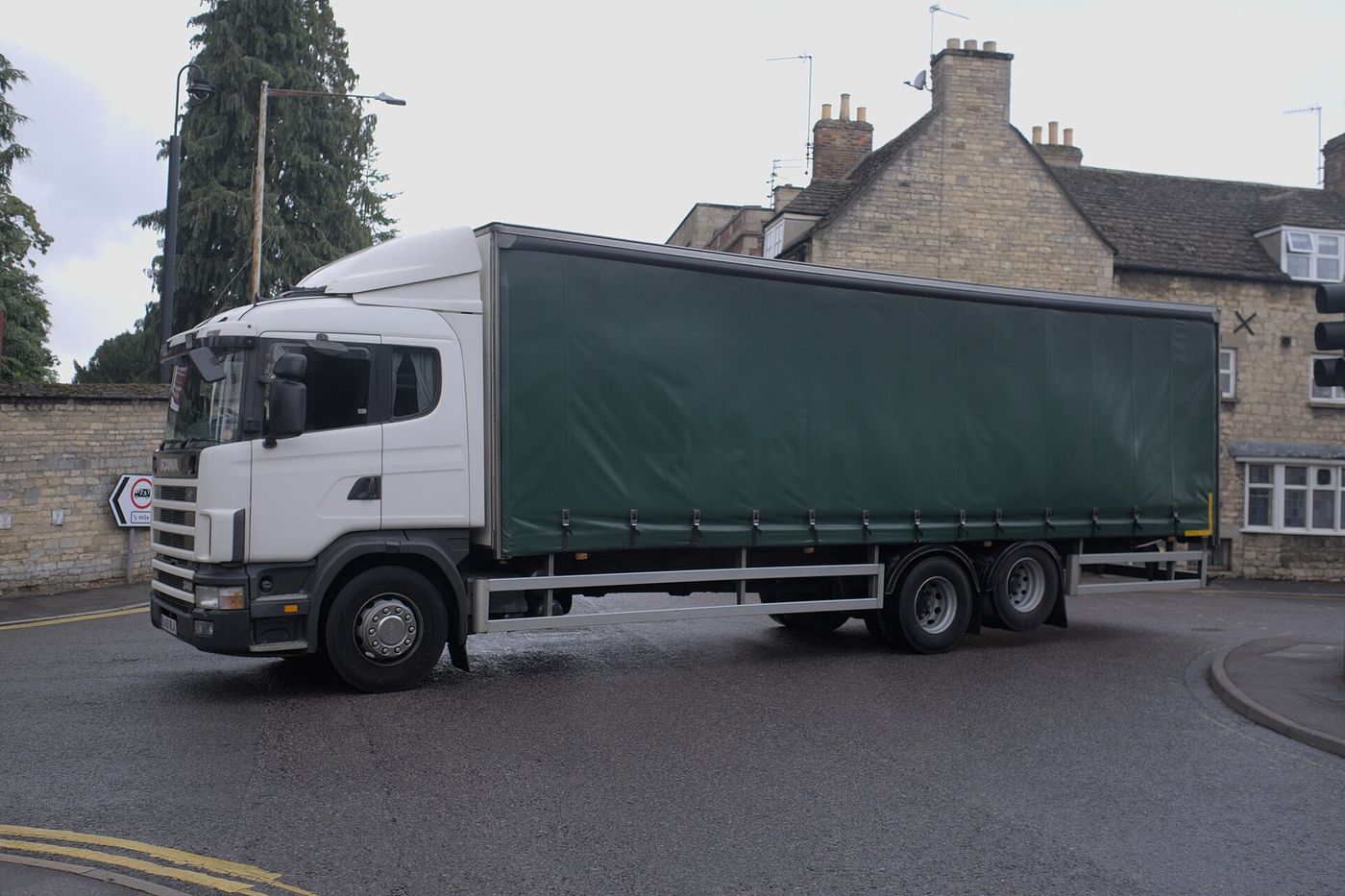
HGV stands for heavy goods vehicle, as in GOV.UK’s guide “Become a qualified heavy goods vehicle (HGV) or bus driver”, and LGV, on DVSA’s pages, for large goods vehicle. Section 121 of the Road Traffic Act 1988 defines a large goods vehicle, for Part IV of the Act, as a motor vehicle, other than a medium-sized goods vehicle, “constructed or adapted to carry or to haul goods and the permissible maximum weight of which exceeds 7.5 tonnes”; below that line, section 108 defines, for Part III, a medium-sized goods vehicle, one whose permissible maximum weight “exceeds 3.5 but not 7.5 tonnes”. Other texts draw other lines: 3.5 tonnes between heavy and light goods vehicles in the Goods Vehicles (Licensing of Operators) Act 1995, and 12,000 kilograms for the HGV levy. In the vehicle licensing statistics of the Department for Transport (DfT), LGV means light goods vehicle.
Status as of 8 October 2026. All texts were read that day: the revised Acts on legislation.gov.uk, which marks the sections used as up to date with changes known to be in force on or before 5 or 8 October 2026 or records no known outstanding effects for them; the original section 120 of the 1988 Act; and the GOV.UK pages listed. legislation.gov.uk warns that “Revised legislation carried on this site may not be fully up to date”. This page covers Great Britain.
Where each text draws the line
| Text | Term | Line |
|---|---|---|
| Road Traffic Act 1988, section 108 (Part III) | Medium-sized goods vehicle | Permissible maximum weight exceeding 3.5 but not 7.5 tonnes; not adapted to carry more than nine persons inclusive of the driver; includes combinations with a trailer of up to 750 kg relevant maximum weight |
| Road Traffic Act 1988, section 121 (Part IV) | Large goods vehicle | Permissible maximum weight exceeding 7.5 tonnes; not a medium-sized goods vehicle |
| Goods Vehicles (Licensing of Operators) Act 1995, section 58(1) | Heavy goods vehicle; light goods vehicle | Goods vehicle, or combination including one, with a maximum laden weight exceeding 3.5 tonnes; not exceeding 3.5 tonnes |
| HGV Road User Levy Act 2013, section 2(1) | Heavy goods vehicle | Revenue weight of 12,000 kg or more, or a heavy motor car, taxed at the exceptional-load or goods-vehicle rate (see below) |
| GOV.UK, Driving licence categories (DVLA) | Medium-sized vehicles (C1, C1E); large vehicles (C, CE) | C1: between 3,500 and 7,500 kg maximum authorised mass; C: over 3,500 kg |
| DfT vehicle licensing statistics | Light goods vehicles (LGVs); heavy goods vehicles (HGVs) | Gross weight of 3.5 tonnes or less, or 4.25 tonnes or less if zero emission; over those weights |
| DfT road traffic estimates 2025 | Vans (light commercial vehicles, LCVs); lorries (HGVs) | Not exceeding 3.5 tonnes gross vehicle weight; over 3.5 tonnes |
Each text uses its own measure: permissible maximum weight, maximum laden weight, revenue weight, maximum authorised mass, gross weight or gross vehicle weight. General weight terms are explained in truck weights.
The Road Traffic Act: medium-sized and large
Section 121 defines its terms “In this Part of this Act”, Part IV, entitled “Licensing of drivers of large goods vehicles and passenger-carrying vehicles” in the legislation.gov.uk notes, and gives permissible maximum weight “the same meaning as in Part III of this Act”. Section 108, in Part III, sets that meaning case by case. For a motor vehicle that is neither an articulated goods vehicle nor drawing a trailer, it is “the relevant maximum weight of the vehicle”; for an articulated goods vehicle drawing only a semi-trailer, “the relevant maximum train weight of the articulated goods vehicle combination”.
DVSA writes LGV for large goods vehicle: its page for instructors speaks of “a large goods vehicle (LGV) driving licence”, and its test statistics are headed “large goods vehicles (LGV)”. GOV.UK’s page on driving licence categories lists C1 and C1E under “Medium-sized vehicles” and C and CE under “Large vehicles”, and its guide to qualifying as an HGV or bus driver points to “the licence categories for large vehicles - which include heavy goods vehicles (HGVs) - and buses”. Categories, ages and tests are covered in HGV licences in Great Britain.
Before 1991. As originally enacted, section 120 defined, for Part IV of the Act as it then stood, a heavy goods vehicle as “an articulated goods vehicle” or a large goods vehicle whose permissible maximum weight exceeded 7.5 tonnes. legislation.gov.uk records that Part IV, then entitled “Licensing of drivers of heavy goods vehicles”, was repealed from 1 April 1991 by the Road Traffic (Driver Licensing and Information Systems) Act 1989, which inserted a new Part IV.
Operator licensing: heavy and light
The Goods Vehicles (Licensing of Operators) Act 1995 defines a heavy goods vehicle as “a goods vehicle, or a vehicle combination including a goods vehicle, that has a maximum laden weight exceeding 3.5 tonnes”, and a light goods vehicle in the same words with “not exceeding 3.5 tonnes” (section 58(1)). legislation.gov.uk records these definitions as inserted on 17 March 2022 by S.I. 2022/293. Who needs which licence is covered in goods vehicle operator licences in Great Britain.
The levy and the statistics
Section 2(1) of the HGV Road User Levy Act 2013 defines a heavy goods vehicle as a mechanically propelled vehicle “with a revenue weight of 12,000 kilograms or more”, or a heavy motor car as defined in section 185 of the Road Traffic Act 1988, charged to vehicle excise duty at the rate for vehicles used for exceptional loads or for goods vehicles, or that would be so charged but for an exemption granted on the basis that it is only temporarily in the United Kingdom. Bands and rates are in the HGV levy in the UK.
The DfT’s vehicle licensing statistics define light goods vehicles (LGVs) as vehicles “constructed for transporting goods” with “a gross weight of 3.5 tonnes or less, or 4.25 tonnes or less if zero emission”, and heavy goods vehicles (HGVs) as those above, adding: “This includes vehicles that are not used for freight.” The DfT’s road traffic estimates for 2025 count “Lorries (Heavy Goods Vehicles - HGVs)” as “all goods vehicles over 3.5 tonnes gross vehicle weight” and the goods vehicles below as vans, “Light Commercial Vehicles - LCVs”.
The European and UN categories for goods vehicles, N1 to N3, are set out in vehicle categories M, N and O.
Quick answers
- What does HGV stand for?
- Heavy goods vehicle, as in the GOV.UK guide 'Become a qualified heavy goods vehicle (HGV) or bus driver'. Two Acts draw the line in different places: the Goods Vehicles (Licensing of Operators) Act 1995 calls a goods vehicle, or a vehicle combination including one, with a maximum laden weight exceeding 3.5 tonnes a heavy goods vehicle (section 58(1)), and the HGV Road User Levy Act 2013 uses, among other conditions, a revenue weight of 12,000 kilograms or more (section 2(1)). The Department for Transport's vehicle licensing statistics count goods vehicles with a gross weight over 3.5 tonnes, or over 4.25 tonnes if zero emission, as HGVs.
- What is an LGV?
- It depends on the text. On DVSA's pages LGV stands for large goods vehicle. Section 121 of the Road Traffic Act 1988 defines a large goods vehicle, for Part IV of the Act, as a motor vehicle, other than a medium-sized goods vehicle, constructed or adapted to carry or to haul goods whose permissible maximum weight exceeds 7.5 tonnes. The Department for Transport's vehicle licensing statistics use LGVs for light goods vehicles, with a gross weight of 3.5 tonnes or less, or 4.25 tonnes or less if zero emission.
- What is the difference between a medium-sized and a large goods vehicle?
- In the Road Traffic Act 1988 their definitions set different permissible maximum weights. Section 108 defines, for Part III of the Act, a medium-sized goods vehicle as a motor vehicle constructed or adapted to carry or to haul goods, not adapted to carry more than nine persons inclusive of the driver, whose permissible maximum weight exceeds 3.5 but not 7.5 tonnes, including a combination with a trailer of not more than 750 kilograms relevant maximum weight. Section 121 defines, for Part IV, a large goods vehicle as one, not being a medium-sized goods vehicle, whose permissible maximum weight exceeds 7.5 tonnes. GOV.UK lists licence categories C1 and C1E under 'Medium-sized vehicles' (C1: between 3,500 and 7,500 kg maximum authorised mass) and C and CE under 'Large vehicles' (C: over 3,500 kg).
- How did the Road Traffic Act 1988 originally define a heavy goods vehicle?
- As originally enacted, section 120 defined, for Part IV of the Act, a heavy goods vehicle as an articulated goods vehicle or a large goods vehicle whose permissible maximum weight exceeded 7.5 tonnes. legislation.gov.uk records that Part IV, then entitled 'Licensing of drivers of heavy goods vehicles', was repealed from 1 April 1991 by the Road Traffic (Driver Licensing and Information Systems) Act 1989, which inserted a new Part IV entitled 'Licensing of drivers of large goods vehicles and passenger-carrying vehicles'.
Sources
- Road Traffic Act 1988, section 108 (interpretation of Part III) — latest available revised text — legislation.gov.uk, The National Archives, United Kingdom
- Road Traffic Act 1988, section 121 (interpretation of Part IV) — latest available revised text, with its textual amendment notes — legislation.gov.uk, The National Archives, United Kingdom
- Road Traffic Act 1988, section 120 (interpretation of Part IV) — original version as enacted — legislation.gov.uk, The National Archives, United Kingdom
- Goods Vehicles (Licensing of Operators) Act 1995, section 58 (general interpretation) — latest available revised text — legislation.gov.uk, The National Archives, United Kingdom
- HGV Road User Levy Act 2013, section 2 (meaning of heavy goods vehicle) — latest available revised text — legislation.gov.uk, The National Archives, United Kingdom
- Become a qualified heavy goods vehicle (HGV) or bus driver — GOV.UK (Driver and Vehicle Licensing Agency and Driver and Vehicle Standards Agency)
- Driving licence categories — GOV.UK (Driver and Vehicle Licensing Agency)
- Become an LGV driving instructor — GOV.UK (Driver and Vehicle Standards Agency)
- Driving test and theory test data: large goods vehicles (LGV) — updated 3 September 2026 — GOV.UK (Driver and Vehicle Standards Agency), 3 Sept 2026
- Vehicle licensing statistics: notes and definitions — updated 23 September 2026 — GOV.UK (Department for Transport and Driver and Vehicle Licensing Agency), 23 Sept 2026
- Road traffic estimates in Great Britain, 2025: Traffic in Great Britain by vehicle type — updated 30 September 2026 — GOV.UK (Department for Transport), 30 Sept 2026