Truck driving bans in Europe: weekends, holidays, summer Saturdays and nights
Weekend, holiday, summer and night bans for heavy trucks in 15 European countries: which vehicles, which roads and hours, the extra days of 2026 and what is known about 2027.
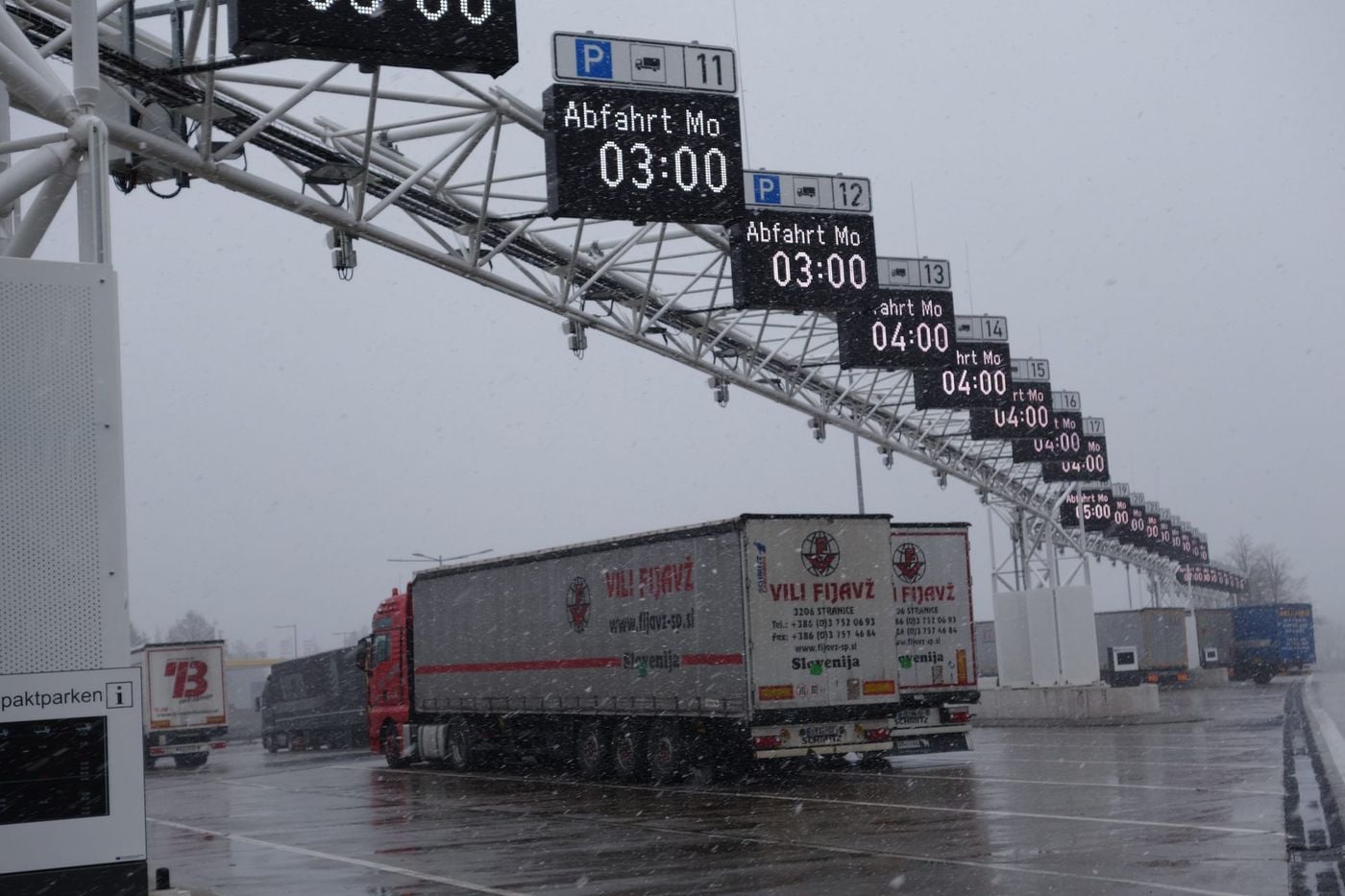
Most European countries keep heavy trucks off the road at set times. The usual threshold is 7.5 tonnes, the usual window is Sunday and public holidays, and many countries add Saturdays in the summer holidays. There are exceptions on every point: Poland starts at 12 tonnes, Switzerland and Austria also ban heavy trucks at night, Spain bans them only on listed road sections, Luxembourg only in transit towards France and Germany, and Greece announces its bans holiday by holiday. Portugal has no general ban for ordinary trucks that we could find.
Status: 1 October 2026. This overview follows the laws, decrees and official notices of 15 countries, read on 1 October 2026; the German texts were read on 28 September 2026. It gives the main rule, the extra days of 2026 and the 2027 status for each country. Exemptions are summarised in one line each: the full lists are long, and many need a permit.
Three kinds of ban
- Standing bans are written into the road traffic law and apply every week: Germany’s Sunday and holiday ban, Czechia’s Sunday afternoon ban, Hungary’s weekend ban.
- Calendars add days that change every year, usually summer Saturdays and the days around holidays. Austria, France, Italy and Spain publish them by decree or resolution; Poland’s summer period follows the school holidays.
- Night bans apply every night in Switzerland and Austria. Tyrol adds a stricter night ban on the A 12.
The weight in these rules is the permissible total weight or mass of the vehicle, not what it carries on the day.
Country by country
| Country | Vehicles | Roads | Standing ban | Legal basis |
|---|---|---|---|---|
| Austria | Over 7.5 t; trucks with a trailer if truck or trailer is over 3.5 t | All roads | Saturday 15:00–24:00, Sundays and holidays 00:00–22:00; night 22:00–05:00 for trucks over 7.5 t | StVO 1960, § 42 |
| Switzerland | Heavy goods vehicles over 3.5 t; articulated vehicles over 5 t train weight; trailers over 3.5 t | Nationwide | All Sundays and 8 listed holidays; night 22:00–05:00 | SVG Art. 2; VRV Art. 91 |
| Germany | Over 7.5 t and trailers behind trucks, for commercial goods transport | All roads | Sundays and holidays 00:00–22:00 | StVO § 30 |
| France | Over 7.5 t, except specialised and agricultural vehicles | Whole road network | Saturdays and holiday eves from 22:00 to 22:00 on Sundays and holidays | Arrêté of 16 April 2021 |
| Italy | Over 7.5 t | Roads outside built-up areas | Sundays, holidays and other days listed in the annual decree | Highway Code art. 6; DM 325/2025 |
| Spain | Over 7 500 kg | Road sections listed in the annual resolution | Section by section; no single national weekend window | DGT resolution of 14 January 2026 |
| Portugal | Dangerous goods in tanks; Porto VCI: over 3 500 kg with 3 or more axles | Mainland network; VCI in Porto | Dangerous goods in tanks: Sundays and national holidays 00:00–24:00; no general ban for ordinary trucks found | Portaria 281/2019; Decreto-Lei 155-A/2026 |
| Poland | Over 12 t, buses excluded | All roads | Public holidays 08:00–22:00; the eve of most of them 18:00–22:00 | Regulation of 31 July 2007 (Dz. U. 2023 poz. 2423) |
| Czechia | Over 7 500 kg; over 3 500 kg with a trailer | Motorways and class I roads | Sundays and holidays 13:00–22:00 | Act 361/2000, § 43 |
| Slovakia | Over 7 500 kg; over 3 500 kg with a trailer | Motorways, expressways and class I roads | Sunday and the last day of rest 06:00–22:00 | Act 8/2009, § 39 |
| Hungary | Over 7.5 t, Hungarian and foreign | All public roads | September to June: from 22:00 the day before to 22:00 on Sundays and holidays | Government Decree 190/2008 |
| Slovenia | Over 7 500 kg | Listed motorways and main roads | Sundays and holidays 08:00–22:00; Good Friday 14:00–22:00 | Order, Uradni list RS 75/2011 |
| Croatia | Over 7.5 t, and vehicles longer than 14 m | Listed state roads, mostly on the coast | Good Friday and holiday eves 15:00–23:00; last day of a holiday 14:00–23:00; D2 to Dubrava Križovljanska on Sundays 06:00–22:00 | Order, NN 64/2009 |
| Greece | Over 3.5 t | Sections named in each notice | No standing ban found; police bans around public holidays | Hellenic Police notices |
| Luxembourg | Over 7 500 kg in transit towards France or Germany | Public roads | Saturdays and holiday eves from 21:30 (towards France) or 23:30 (towards Germany) to 21:45 on Sundays and holidays | Grand Ducal regulation of 19 July 1997 |
The extra days of 2026
- Austria: the federal calendar banned trucks over 7.5 t on all Saturdays from 4 July to 29 August, 08:00 to 15:00, on the B 177, B 178, B 179, B 181, B 182 and B 320, and to 5 September on the A 4 between Schwechat and Nickelsdorf; it added days on the A 12 and A 13 in April, June and October. The A 10 Tauern motorway had its own summer Saturdays, 07:00 to 15:00. Works on the Luegbrücke added Saturday bans, 07:00 to 15:00, for trips over the Brenner. In Tyrol, the A 12 night ban starts at 20:00 between November and April on every day except Sundays and public holidays, and covers all trucks over 7.5 t except battery-electric and fuel-cell vehicles.
- Germany: on all Saturdays from 1 July to 31 August, 07:00 to 20:00, trucks over 7.5 t and trucks with a trailer may not use the motorway sections and the two federal roads listed in the Ferienreiseverordnung. An amendment of 17 June 2026 rewrote the A 1 entry and added the A 113 and A 115.
- France: the 2026 order banned trucks on the summer Saturdays of 11, 18 and 25 July and 1 and 8 August, 07:00 to 19:00, on the whole mainland network, and on the winter Saturdays of 7, 14, 21 and 28 February and 7 March, 07:00 to 18:00, on listed roads in Auvergne-Rhône-Alpes.
- Italy: the 2026 calendar bans trucks on Sundays from 09:00 to 22:00, and from June to September from 07:00 to 22:00. In July and August every Saturday is banned, most of them from 08:00 to 16:00, and some Fridays from 16:00 to 22:00. ADR classes 1 and 7 are banned whatever the vehicle weighs on every Saturday from 08:00 and every Sunday from 23 May to 6 September.
- Spain: the DGT resolution lists the sections and hours one by one. An example: on all Sundays and holidays from 28 June to 6 September, the A-1 into Madrid from Boceguillas to the M-40 is closed to trucks from 21:00 to 23:00. Catalonia and the Basque Country publish their own resolutions, and Navarre sets its own rules.
- Poland: during the school summer holidays, which ran from 26 June to 30 August 2026, trucks over 12 t are banned on Fridays 18:00 to 22:00, Saturdays 08:00 to 14:00 and Sundays 08:00 to 22:00.
- Czechia and Slovakia: from 1 July to 31 August, Czechia adds Fridays 17:00 to 21:00 and Saturdays 07:00 to 13:00; Slovakia adds the first day of rest and Saturdays 09:00 to 19:00.
- Hungary: in July and August the weekend ban starts on Saturday at 15:00, if Saturday is not a working day, and runs to Sunday 22:00.
- Slovenia: in the 2026 tourist season, 27 June to 6 September, trucks over 7 500 kg were also banned on Saturdays from 08:00 to 13:00, and from 06:00 to 16:00 on the Primorska motorway and some other listed roads.
- Croatia: from 15 June to 15 September, the listed roads are closed to trucks on Saturdays from 04:00 to 14:00 and on Sundays from 12:00 to 23:00.
- Greece: the police banned trucks over 3.5 t around Clean Monday, 25 March, Easter, 1 May, Pentecost and 15 August. At Easter, for example, outbound traffic was banned on 9 April from 15:00 to 22:00 and on 10 April from 06:00 to 16:00, inbound traffic on 13 April from 12:00 to 22:00 and on 14 April from 11:00 to 23:00.
- Portugal: since 15 September 2026, goods vehicles over 3 500 kg with three or more axles may not use Porto’s VCI ring road on working days from 07:00 to 21:00, unless they are registered for loading or unloading in Porto or Vila Nova de Gaia.
2027
No 2027 calendar had been published by 1 October 2026. Austria’s federal legal database returned no ban calendar for 2027, Autostrade per l’Italia’s 2027 calendar page said no bans were listed yet, and France’s Bison Futé page still showed only the 2026 dates; nothing was found for Spain or Slovenia either. Poland’s summer period will follow the 2026/27 school calendar. Germany, Switzerland, Czechia, Slovakia, Hungary, Croatia and Luxembourg have standing rules that need no annual calendar, and Greece announces its bans shortly before each holiday.
Exemptions in short
Every country exempts some transports, and the lists overlap: perishable food and live animals, combined transport to and from terminals, post and newspapers, emergency services and road maintenance are found almost everywhere. A few rules matter most to international hauliers:
- Italy: for vehicles arriving from abroad the ban starts four hours later, and for vehicles leaving for abroad it ends two hours earlier.
- Hungary: from 4 November to 1 March part of the ban does not apply to Euro 3 or cleaner trucks in international traffic.
- Poland, Slovakia and Slovenia: each lets a truck coming back from abroad finish its trip, on its own terms. Poland exempts vehicles of operators based in Poland that are returning to complete the carriage or to reach the consignee, a vehicle that entered Poland outside the ban’s days or hours for up to 50 km from where it crossed the border, and vehicles waiting at the border to leave Poland. Slovakia exempts vehicles returning to Slovak territory to the destination of their trip. Slovenia lets trucks registered in Slovenia drive from the border to the driver’s home, or to the destination if that is nearer, by the shortest route and without a break.
- Switzerland: zero-emission vehicles up to 4 250 kg, or 5 750 kg for articulated vehicles, are exempt.
- Austria: low-noise trucks carrying the required confirmation are exempt from the night ban, but not in Tyrol on the A 12.
How the bans fit around a driver’s breaks is covered in driving time and rest rules; tolls in the same countries in truck tolls in Europe.
What this page does not cover
- Romania and Bulgaria: no official text could be retrieved on 1 October 2026, so neither is described here.
- Bans in cities and low-emission zones, and heat-wave restrictions.
- Dangerous goods, except where named above.
- Tyrol’s other sectoral and local bans, and Navarre’s own rules.
- How to apply for a permit.
Quick answers
- Which trucks do European weekend driving bans apply to?
- In most of the countries covered here, goods vehicles over 7.5 tonnes. Austria, Czechia and Slovakia also include lighter trucks towing a trailer, Poland starts at 12 tonnes, and Switzerland's Sunday and night bans and Greece's holiday bans start above 3.5 tonnes.
- Does Switzerland have a night ban for trucks?
- Yes. Heavy motor vehicles for the carriage of goods may not drive from 22:00 to 05:00 on any night, and a Sunday ban applies on all Sundays and on eight listed holidays. Austria has a night ban from 22:00 to 05:00 for trucks over 7.5 tonnes, except low-noise vehicles carrying the required confirmation.
- When were the summer Saturday bans in 2026?
- France banned trucks over 7.5 tonnes on 11, 18 and 25 July and on 1 and 8 August, 07:00 to 19:00. Germany bans them on listed motorways on every Saturday from 1 July to 31 August, 07:00 to 20:00. Czechia, Slovakia, Slovenia, Austria and Italy also have summer Saturday hours, each on its own roads.
- Are the 2027 calendars published yet?
- Not as of 1 October 2026. Austria's legal database had no 2027 ban calendar, Autostrade per l'Italia's 2027 calendar listed no bans yet, and France's Bison Futé page still showed only the 2026 dates. Most other countries in this overview have standing rules that need no annual calendar.
- Do trucks coming from abroad get any relief?
- Some. In Italy a ban starts four hours later for vehicles arriving from abroad and ends two hours earlier for vehicles heading abroad. Hungary lifts part of its ban from 4 November to 1 March for Euro 3 or cleaner trucks in international traffic, and Poland, Slovakia and Slovenia let a truck coming back from abroad finish its trip, each on its own terms.
- Is Luxembourg's Sunday ban for all trucks?
- No. It applies to trucks over 7.5 tonnes in transit towards France or Germany. Transit towards Belgium and transport within Luxembourg are not affected, according to the Grand Ducal Police.
Sources
- Straßenverkehrsordnung 1960, § 42 Fahrverbote (Fassung vom 24.04.2026) — Rechtsinformationssystem des Bundes (RIS), Austria
- Fahrverbotskalender 2026 (BGBl. II Nr. 77/2026) — Rechtsinformationssystem des Bundes (RIS), Austria
- Sommerreiseverkehr A 10 Tauern Autobahn 2026 (BGBl. II Nr. 190/2026) — Rechtsinformationssystem des Bundes (RIS), Austria
- Fahrverbote wegen der Sanierung der Luegbrücke (BGBl. II Nr. 338/2025) — Rechtsinformationssystem des Bundes (RIS), Austria
- Verordnung des Landeshauptmannes von Tirol, LGBl. Nr. 64/2010, § 3 Nachtfahrverbot A 12 — Rechtsinformationssystem des Bundes (RIS), Austria
- Strassenverkehrsgesetz (SVG, SR 741.01), Art. 2 — Fedlex, Swiss Confederation
- Verkehrsregelnverordnung (VRV, SR 741.11), Art. 91, 91a, 92 — Fedlex, Swiss Confederation
- Feiertage mit Fahrverbot — Bundesamt für Strassen ASTRA, Switzerland
- Straßenverkehrs-Ordnung (StVO), § 30 Sonn- und Feiertagsfahrverbot — gesetze-im-internet.de (Federal Ministry of Justice), Germany
- Ferienreiseverordnung, §§ 1 to 4 — gesetze-im-internet.de (Federal Ministry of Justice), Germany
- Sechzehnte Verordnung zur Änderung der Ferienreiseverordnung vom 17. Juni 2026 (BGBl. 2026 I Nr. 180) — Bundesgesetzblatt (recht.bund.de), Germany
- Arrêté du 16 avril 2021 relatif à l'interdiction complémentaire de circulation des véhicules de transport de marchandises — Journal officiel, via Bison Futé, France
- Arrêté du 26 décembre 2025 fixant les interdictions complémentaires de circulation pour 2026 — Journal officiel, via Bison Futé, France
- Régime général des interdictions de circulation — Bison Futé, France
- Decreto n. 325 del 12 dicembre 2025, calendario dei divieti di circolazione dei mezzi pesanti 2026 — Ministero delle infrastrutture e dei trasporti, Italy
- Calendario divieti mezzi pesanti 2026 e 2027 — Autostrade per l'Italia
- Resolución de 14 de enero de 2026 de la Dirección General de Tráfico, medidas especiales de regulación del tráfico 2026 (texto consolidado) — Boletín Oficial del Estado, Spain
- Restricciones a la circulación — Dirección General de Tráfico, Spain
- Portaria n.º 281/2019, restrições à circulação de veículos que transportam mercadorias perigosas — Instituto da Mobilidade e dos Transportes (IMT), Portugal
- Novas regras para veículos pesados na VCI entram em vigor a 15 de setembro — Instituto da Mobilidade e dos Transportes (IMT), Portugal
- Rozporządzenie Ministra Transportu w sprawie ograniczeń w ruchu pojazdów (tekst jednolity Dz. U. 2023 poz. 2423) — Sejm, ELI API, Poland
- Wakacyjne zakazy jazdy dla pojazdów ciężarowych — Wojewódzki Inspektorat Transportu Drogowego w Radomiu, Poland
- Zákon č. 361/2000 Sb., o provozu na pozemních komunikacích, § 43 — e-Sbírka, Czechia
- Zákon č. 8/2009 Z. z. o cestnej premávke, § 39 (znenie od 1. 10. 2026) — Slov-Lex, Slovakia
- 190/2008. (VII. 29.) Korm. rendelet a nehéz tehergépkocsik közlekedésének korlátozásáról — Nemzeti Jogszabálytár, Hungary
- Odredba o omejitvi prometa na cestah v Republiki Sloveniji (Uradni list RS 75/2011) — Uradni list Republike Slovenije
- Splošne omejitve prometa za tovorna vozila — promet.si (DARS), Slovenia
- Naredba o ograničenju prometa na cestama (NN 64/2009) — Narodne novine, Croatia
- Απαγόρευση κυκλοφορίας φορτηγών άνω των 3,5 τόνων κατά την περίοδο εορτασμού του Πάσχα 2026 — Ελληνική Αστυνομία (Hellenic Police)
- Απαγόρευση κυκλοφορίας φορτηγών άνω των 3,5 τόνων κατά τον εορτασμό του Δεκαπενταύγουστου 2026 — Ελληνική Αστυνομία (Hellenic Police)
- Règlement grand-ducal du 19 juillet 1997 concernant la circulation des poids lourds les dimanches et jours fériés — Legilux, Luxembourg
- Limitations de circulation pour les poids lourds — Police Grand-Ducale, Luxembourg