Lorry weight and size limits in Great Britain: 44 tonnes on six axles, axle weights, lengths and the cab height notice
In Great Britain: 44,000 kg on six axles, 40,000 kg on five, 11,500 kg on a single driving axle; 16.5 m articulated, 18.75 m with a drawbar trailer.
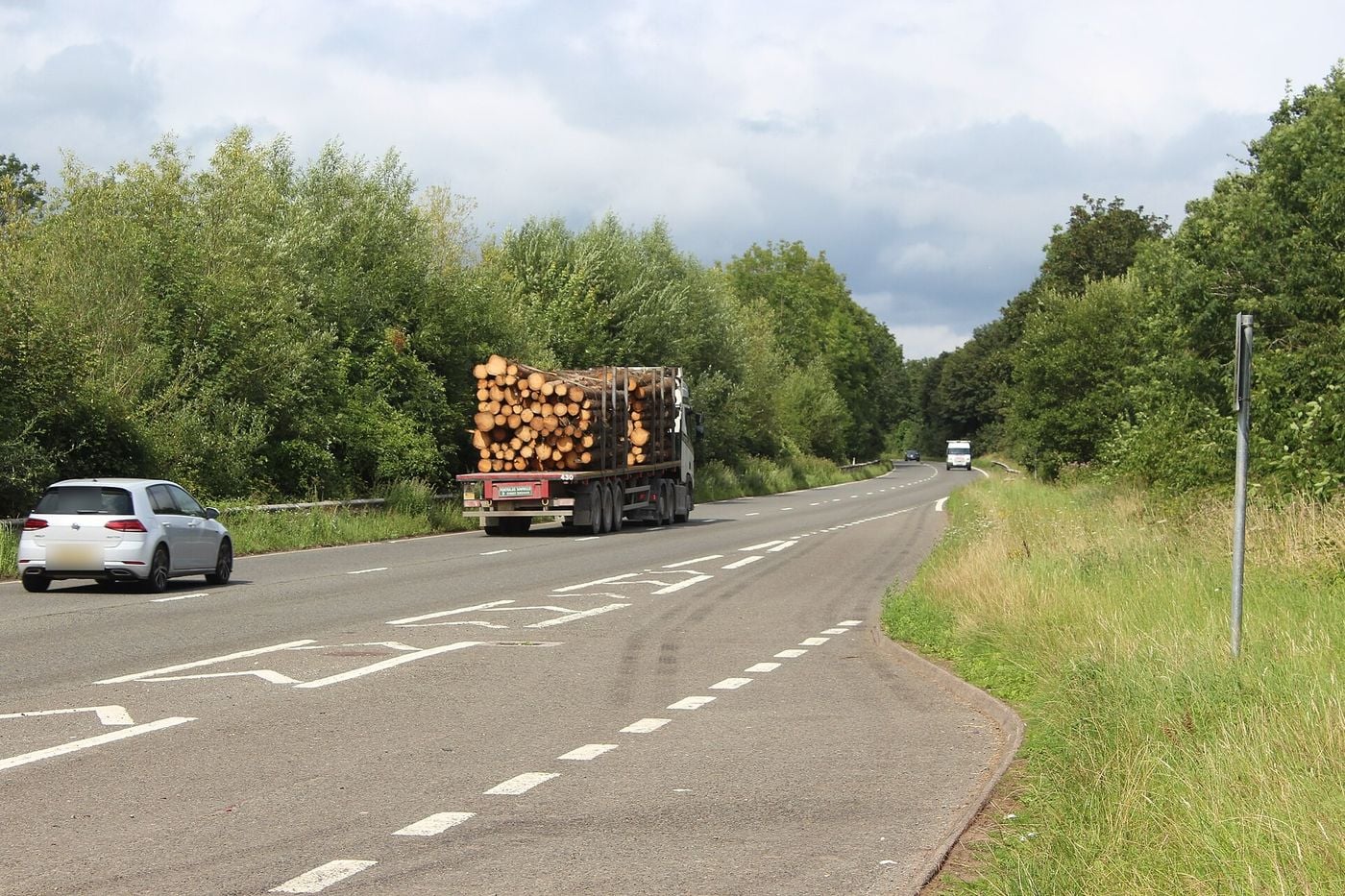
On the roads of England, Wales and Scotland a lorry may weigh up to 44,000 kg as an articulated vehicle or as a rigid lorry towing a trailer, provided the combination has six or more axles and meets conditions on its axles, its trailer suspension and its engine. Under the Road Vehicles (Authorised Weight) Regulations 1998, a combination with five axles may weigh up to 40,000 kg. Length is limited separately by the Road Vehicles (Construction and Use) Regulations 1986: 16.5 m for an articulated vehicle whose semi-trailer meets the kingpin rules and is not a low loader, 18.75 m for a lorry with a drawbar trailer and 12 m for a rigid lorry. Regulation 9 of the same Regulations sets a height only for buses, while regulation 10 requires, with some exceptions, a height notice in the cab of a motor vehicle whose overall travelling height exceeds 3 m.
Status: 22 November 2026. This page follows the official texts as read on 21 November 2026: GOV.UK’s guidance HGV maximum weights, from the Driver and Vehicle Standards Agency (DVSA) and the Department for Transport, which shows “Published 1 February 2010” and no later update; regulations 7, 8, 9 and 10 of the Construction and Use Regulations 1986 in the revised text on legislation.gov.uk, which records no known outstanding effects for any of them; the Explanatory Memorandum to S.I. 2023/760; and legislation.gov.uk’s list of changes to the 1998 Regulations. The 1998 Regulations and the amending instruments S.I. 2000/3224, 2001/1125, 2017/881 and 2023/760 are read as made. legislation.gov.uk warns that “Revised legislation carried on this site may not be fully up to date”. Regulations 7 to 10 extend to England, Wales and Scotland, and S.I. 2023/760 extends to England and Wales and Scotland; Northern Ireland is not covered.
| Limit | Figure | Provision |
|---|---|---|
| Articulated vehicle or rigid lorry with trailer, 6 or more axles | 44,000 kg, with conditions | Schedule 2, Table 3, items 13 and 14 |
| Articulated vehicle, 5 or more axles | 40,000 kg | Schedule 2, Table 3, item 8 |
| Rigid motor vehicle which is not a bus, 2 axles | 18,000 kg | Schedule 1, Table 1, item 1 |
| Single driving axle | 11,500 kg | Schedule 3, Table 5, item 1 |
| Wheeled motor vehicle other than a bus | 12 m long | Regulation 7, item 4 |
| Articulated vehicle, semi-trailer meeting paragraph (6), not a low loader | 16.5 m long | Regulation 7, item 3A |
| Motor vehicle drawing one trailer which is not a semi-trailer | 18.75 m long | Regulation 7, item 1 |
| Any other motor vehicle; refrigerated vehicle, conditioned container or swap body | 2.55 m wide; 2.60 m | Regulation 8, items 3 and 2 |
| Bus | 4.57 m high | Regulation 9(1) |
| Motor vehicle with an overall travelling height exceeding 3 m | Height notice in the cab | Regulation 10 |
Two sets of weight rules: Construction and Use, and Authorised Weight
Great Britain has two sets of weight rules for goods vehicles. GOV.UK says the maximum weights of the Construction and Use Regulations 1986 (C&U) are in regulations 75 to 79A and Schedules 11 and 11A. The Authorised Weight Regulations 1998 (AWR) came into force on 1 January 1999, and GOV.UK says that from that date “the maximum weight limits contained within EU Directive 96/53/EC were adopted by GB” as part of them. It describes the relationship between the two in one line: “vehicles may only comply with one of the regulations – individual parts of the 2 regulations cannot be combined.” The EU limits themselves are set out in gross combination weight, GVW and axle loads: the EU limits.
Regulation 4(1) of the AWR forbids the use on a road of a vehicle whose weight exceeds the maximum authorised weight under Schedule 1, of a combination whose weight exceeds the figure under Schedule 2, and of a vehicle whose axle weight on any axle exceeds the figure under Schedule 3. Regulation 4(2) says that a vehicle to which any of regulations 75 to 79 of the 1986 Regulations apply, “so long as it is so used that those provisions are complied with, shall be taken to comply with these Regulations”. S.I. 2000/3224 added an exception to that sentence for the provisions on retractable and loadable axles in paragraphs 3 and 4 of Schedule 3.
legislation.gov.uk holds the AWR only in its first form: “This item of legislation is currently only available in its original format.” The later wording exists in the amending instruments themselves. On 21 November 2026 legislation.gov.uk’s list of changes showed 49 effects on the 1998 Regulations, made by S.I. 2000/3224, 2001/1125, 2017/881 and 2023/760 and by the Road Vehicles (Approval) Regulations 2020 (S.I. 2020/818), whose five effects are in regulations 2(1), 3 and 4(3)(a).
Maximum gross weights: GOV.UK’s table
GOV.UK’s guidance calls its table “a summary of GB maximum gross weights for goods vehicles” under both sets of Regulations, which “highlights some of the principal criteria that must be met for operation at such weights”, and adds that “other criteria may apply”. The table was published on 1 February 2010, before the 2017 and 2023 amendments described below.
| Vehicle type | Axles | C&U | AWR |
|---|---|---|---|
| Rigid motor vehicle | 2 | 17,000 | 18,000 |
| Rigid motor vehicle | 3 | 25,000 (26,000 with RFS) | 25,000 (26,000 with RFS) |
| Rigid motor vehicle | 4 or more | 30,000 (32,000 with RFS) | 30,000 (32,000 with RFS) |
| Articulated vehicle | 3 | 25,000 (26,000 with RFS) | 26,000 |
| Articulated vehicle | 4 | 32,520 (35,000 with RFS) | 36,000 (38,000, note 1) |
| Articulated vehicle | 5 | 38,000 (44,000, note 2) | 40,000 |
| Articulated vehicle | 6 | 44,000 (note 2) | 44,000 (note 3) |
| Drawbar combination | 4 | 32,520 (35,000 with RFS) | 36,000 (note 4) |
| Drawbar combination | 5 | 32,520 (38,000 with RFS) | 40,000 (note 4) |
| Drawbar combination | 6 | 44,000 (note 2) | 44,000 (notes 3 and 4) |
- Note 1: 38,000 kg if the combination is a 2-axle tractor unit and a 2-axle semi-trailer, the tractor unit does not exceed 18,000 kg and the semi-trailer 20,000 kg, and the drive axle has twin tyres and road friendly suspension. GOV.UK’s footnote also gives a trailer axle spacing of at least 1.8 m.
- Note 2: “Operation at over 38000kg under the C&U regulations is restricted to combined transport operations.” Since 1 October 2017 the C&U Regulations use the term intermodal transport operations instead (S.I. 2017/881, regulations 9, 14, 15 and 17).
- Note 3: for operation above 40,000 kg the drive axle or axles must not exceed 10,500 kg and must have road friendly suspension, or must not exceed 8,500 kg; each part of the combination must have 3 axles and the trailer road friendly suspension; and “an engine complying with at least Euro 2 specification (or gas) is needed for operation over 41000kg”.
- Note 4: a distance of not less than 3 m between the rear axle of the motor vehicle and the front axle of the trailer.
GOV.UK says road friendly suspension is defined in the AWR as a suspension system “whereby at least 75% of the spring effect is produced by air or other compressible fluid under pressure”, or suspension recognised as equivalent under Annex II of Directive 96/53/EC.
The AWR text has more steps than the summary. Schedule 1 gives 18,000 kg for a 2-axle rigid motor vehicle which is not a bus and for a 2-axle tractor unit; 26,000 kg for a 3-axle rigid vehicle and for a tractor unit with 3 or more axles, and 32,000 kg for a rigid vehicle with 4 or more axles, where the driving axle, if it is not a steering axle, has twin tyres and road friendly suspension, or each driving axle has twin tyres and the maximum weight for each axle does not exceed 9,500 kg (25,000 kg and 30,000 kg otherwise); 18,000 kg for a 2-axle trailer and 24,000 kg for a trailer with 3 or more axles, in each case one which is not a semi-trailer or a centre-axle trailer. Schedule 2 sets the combinations out in Table 3.
| Item | Combination | Axles | kg |
|---|---|---|---|
| 1 | Articulated vehicle | 3 | 26,000 |
| 2 and 3 | Rigid motor vehicle with a trailer, with the 3 m spacing; without it | 3 | 26,000; 22,000 |
| 4 and 5 | Articulated vehicle meeting paragraph 1(3); other articulated vehicle | 4 | 38,000; 36,000 |
| 6 and 7 | Rigid motor vehicle with a trailer, with the 3 m spacing; without it | 4 | 36,000; 30,000 |
| 8 | Articulated vehicle | 5 or more | 40,000 |
| 9 and 10 | Rigid motor vehicle with a trailer, with the 3 m spacing; without it | 5 or more | 40,000; 34,000 |
| 11 and 12 | Articulated vehicle; rigid motor vehicle with a trailer, both meeting paragraph 1(4), item 12 also the 3 m spacing | 6 or more | 41,000 |
| 13 and 14 | Articulated vehicles; rigid motor vehicles towing a trailer, both meeting paragraphs 1(4) and 1(5), item 14 also the 3 m spacing | 6 or more | 44,000 |
Both Schedules also lower the figure by axle spacing where that gives less. For an articulated vehicle with 3 or more axles, Schedule 2 paragraph 2 takes the distance in metres between the kingpin and the centre of the rearmost axle of the semi-trailer, multiplies it by 5,500 and rounds up to the nearest 10 kg; Schedule 1 paragraph 2 does the same for single vehicles with the distance between the foremost and rearmost axles and factors from 5,000 to 6,000.
44 tonnes on six axles
Regulation 6 of S.I. 2000/3224 added items 13 and 14 to Table 3 with effect from 1 February 2001. The instrument’s explanatory note says it gives effect to proposals relating to “the introduction of 44 tonne motor vehicles and trailers into the United Kingdom on 1st February 2001”. S.I. 2001/1125, made on 21 March 2001 and in force from 17 April 2001, was made “in consequence of defects in S.I. 2000/3224” and extended paragraph 1(4) of Schedule 2 to items 13 and 14 and paragraph 1(2) to item 14; it also moved the low pollution engine condition, which S.I. 2000/3224 had added at the end of Schedule 2, to a new paragraph 1(5) after paragraph 1(4). The conditions for items 13 and 14 are:
- the axle weight of each driving axle does not exceed 10,500 kg;
- each driving axle is fitted with twin tyres and road friendly suspension, or each driving axle which is not a steering axle is fitted with twin tyres and has an axle weight of no more than 8,500 kg;
- each axle of the trailer is fitted with road friendly suspension;
- each vehicle in the combination has at least 3 axles (these four are paragraph 1(4) of Schedule 2);
- “the vehicle is fitted with a low pollution engine” (paragraph 1(5));
- for item 14 only, the distance between the rear axle of the motor vehicle and the front axle of the trailer is not less than 3 m (paragraph 1(2)).
S.I. 2000/3224 defines a low pollution engine as one fuelled solely by gas; one fuelled predominantly by gas with a minimum gas tank capacity of 400 litres; or a diesel engine that complies with at least the pollutant requirements of paragraph 6.2.1 of Annex I to Directive 88/77/EEC as amended by Directive 91/542/EEC, whose line B values are 4.0 g/kWh carbon monoxide, 1.1 g/kWh hydrocarbons, 7.0 g/kWh nitrogen oxides and 0.15 g/kWh particulates. Its explanatory note says the definition “incorporates the new system requirements for the Euro II engine specified in Directive 91/542/EEC”. GOV.UK puts the condition as an engine of at least Euro 2 specification, or gas, for operation over 41,000 kg.
Under C&U, GOV.UK’s table also shows 44,000 kg for six-axle combinations and for a five-axle articulated vehicle, with operation above 38,000 kg restricted to what are now intermodal transport operations. As substituted by S.I. 2017/881, paragraph 9(3) of Part IV of Schedule 11A to the C&U Regulations defines these as the transport of containers or swap bodies of no more than 45 feet in total, with a road leg at the start or end, another leg by rail or waterborne transport, no goods added or removed on the way, and an initial or final road leg that “does not exceed 150 km in Great Britain, except where necessary to reach the nearest transport terminal”.
GOV.UK says vehicles “are permitted to operate at weights above 44 tonnes in exceptional circumstances (such as when moving abnormal indivisible loads)” under the Road Vehicles (Authorisation of Special Types) (General) Order 2003. That Order and its weight categories are covered in low-loader trailers and abnormal loads.
Axle weights
Schedule 3 sets the maximum authorised weight of each axle or axle group, lowered by Table 6 where the axles are close together.
| Axle | Table 5 | Table 6, by spacing |
|---|---|---|
| Single driving axle | 11,500 | none |
| Single non-driving axle | 10,000 | none |
| Driving tandem axle | 19,000 with the conditions of paragraph 1(2); 18,000 otherwise | 11,500 if the two axles are less than 1 m apart; 16,000 from 1 m to less than 1.3 m |
| Non-driving tandem axle | 20,000 | 11,000 below 1 m; 16,000 from 1 m to less than 1.3 m; 18,000 from 1.3 m to less than 1.8 m |
| Triaxle | 24,000 | 21,000 if the distance between any one axle and the nearer of the other two is 1.3 m or less |
The conditions for 19,000 kg on a driving tandem axle are that the driving axle is fitted with twin tyres and road friendly suspension, or that each driving axle is fitted with twin tyres and no axle has an axle weight exceeding 9,500 kg. S.I. 2000/3224 added paragraphs 3 and 4 on retractable and loadable axles, in force from 1 January 2002. Paragraph 3 applies to vehicles first used on or after that date: such an axle must lower to the ground automatically when the front axle, or the nearest axle or axles of a group, is laden to its maximum authorised weight. In the slippery-surface case the paragraph describes, the weight on each axle may exceed its maximum by up to 30 per cent, so long as it does not exceed the value stated by the manufacturer for this purpose, and the axle must lower again or be reloaded once the vehicle has moved off and reached 30 km per hour. The Department for Transport’s Explanatory Memorandum to the 2023 amendment says “The maximum weight limits for individual axles will remain unchanged.”
The Schedule 3 figures by axle layout are also in the axle load calculator, and the gross weights of Schedules 1 and 2 in the truck payload calculator.
Extra weight for alternative fuel and zero-emission vehicles
S.I. 2017/881, in force from 1 October 2017, let a relevant alternatively fuelled vehicle exceed its Schedule 1 figure by up to 1,000 kg, and the definition of alternative fuel it inserted lists electricity, hydrogen, natural gas including biomethane, liquefied petroleum gas, and mechanical energy from on-board sources. S.I. 2023/760, made on 5 July 2023 and in force the day after, extended this. It defines a zero-emission vehicle as one “without an internal combustion engine”, or with one that emits less than 1 g CO2 per kWh or per km under the EU type-approval rules it names, and it sets two kinds of increase:
| Applies to | Alternatively fuelled | Zero-emission |
|---|---|---|
| Vehicles in Schedule 1, Table 1, items 1, 2, 5, 6, 7, 8 and 9: 2-axle rigid motor vehicle which is not a bus, tractor units, rigid vehicles with 3 axles, articulated bus | By the additional weight of the alternative fuel power train, maximum 1,000 kg | 2,000 kg |
| Combinations in Schedule 2, Table 3, items 4, 8, 9, 11 and 12 (38,000 to 41,000 kg) | By the additional weight of the alternative fuel power train, maximum 1,000 kg | 2,000 kg |
Each 2023 increase applies only where a type or individual approval, under the Type Approval Regulation or the Road Vehicles (Approval) Regulations 2020, “provides evidence that the weight of the alternative fuel power train exceeds the weight of a conventional power train by a specified amount”, and where that weight is included in the maximum permitted gross weight, or for a combination the gross train weight, on the plates required by C&U regulation 66 or 70. The 2017 provision for alternatively fuelled vehicles, regulation 4(3), likewise requires an approval giving that evidence and the weight included on the plates. The 44,000 kg items 13 and 14 and the 4-axle rigid items 10 and 11 are not among the items listed. The Explanatory Memorandum, paragraph 7.12, says no additional allowance for zero-emission or alternatively fuelled vehicles “will apply to the heaviest weights for articulated lorry and road train combinations (of 44 tonnes) or four axles motor vehicles (of 32 tonnes)”.
Plated weights and overloading
GOV.UK describes two kinds of plate. With limited exceptions, all goods vehicles must carry a manufacturer’s plate showing “the maximum axle, gross and train weights at which the vehicle is designed to operate”. The ministry plate or plating certificate is issued by DVSA to goods vehicles above 3,500 kg gross weight and “denotes the potential maximum legal weight of the vehicle”, and GOV.UK says the maximum weights on either plate must not be exceeded. DVSA’s plates and certificates are described in HGV, bus and trailer roadworthiness in Great Britain.
GOV.UK says a vehicle could be overloaded on its axle or axles, its gross weight and its train weight, and that each would be a separate offence: its example is a 3-axle articulated vehicle over its plated weights on the first axle, the second axle and the gross weight, which would make both operator and driver liable to three separate offences. It adds that an overloading conviction is one of the factors that could lead a Traffic Commissioner to take disciplinary action against the operator’s licence. Since 1 October 2017, AWR regulation 6 has also required the shipper of a container or swap body to give the haulier “a written statement indicating the gross weight of the container or swap body being transported”.
How long can a lorry be?
Regulation 7(1) of the C&U Regulations caps the overall length of a vehicle or combination by class, a combination’s length “being calculated in accordance with regulation 81(g) and (h)”.
| Item | Class of vehicle | Maximum length |
|---|---|---|
| 1 | A motor vehicle drawing one trailer which is not a semi-trailer | 18.75 |
| 2 and 2A | An articulated bus; a bus drawing a trailer | 18.75 |
| 3 | An articulated vehicle whose semi-trailer does not meet paragraph (6) and is not a low loader | 15.5 |
| 3A | An articulated vehicle whose semi-trailer meets paragraph (6) and is not a low loader | 16.5 |
| 3B | An articulated vehicle whose semi-trailer is a low loader | 18 |
| 3C | An articulated vehicle whose semi-trailer meets paragraph (6), is not a low loader and carries containers or swap bodies up to a total of 45 feet as part of an intermodal transport operation (from 1 October 2017) | 16.65 |
| 4 | A wheeled motor vehicle other than a bus | 12 |
| 4A and 4B | A bus with two axles; a bus with more than two axles | 13.5; 15 |
| 7 | A semi-trailer manufactured on or after 1 May 1983 which does not meet paragraph (6) and is not a low loader | 12.2 |
| 8 | A trailer, not a semi-trailer or composite trailer, with at least 4 wheels, drawn by a goods vehicle with a maximum gross weight exceeding 3,500 kg, or an agricultural trailer | 12 |
| 9 | Any other trailer, not an agricultural trailed appliance or a semi-trailer | 7 |
Paragraph (6) is the semi-trailer rule behind items 3, 3A, 3C and 7. The distance from the axis of the kingpin to the rear of the semi-trailer must not exceed 12.5 m for a car transporter, 12.15 m when carrying containers or swap bodies of up to 45 feet in an intermodal transport operation, and 12 m in any other case; and no point of the semi-trailer forward of the kingpin may be more than 4.19 m from it on a car transporter, or 2.04 m in any other case. For a lorry and drawbar trailer that are both goods vehicles, paragraph (5A) limits the distance from the foremost point of the loading area behind the cab to the rear of the trailer to 16.4 m, and to 15.65 m after subtracting the gap between the two vehicles; the 15.65 m figure does not apply if both vehicles are car transporters.
Paragraph (5) limits a motor vehicle drawing two or more trailers, or one trailer built and normally used for indivisible loads of exceptional length, to 9.2 m, and the whole combination to 25.9 m unless the conditions in paragraphs 1 and 2 of Schedule 12 have been complied with; under paragraph (9) the same Schedule 12 conditions apply to any trailer longer than 18.65 m. Paragraph (3) takes items 1, 1A, 3, 3A and 3B away from combinations with a trailer built and normally used for indivisible loads of exceptional length, from a broken-down vehicle being towed, from articulated vehicles whose low loader semi-trailer was manufactured before 1 April 1991, and from combinations that include a motor vehicle of category N2 or N3 with an elongated cab; paragraph (3D) takes item 4 away from N2 and N3 vehicles whose elongated cab is type approved under point 1.4 of Part C of Annex I of the Type Approval Masses and Dimensions Regulations.
The rules for longer semi-trailers in Great Britain are set out in semi-trailer dimensions.
How wide can a lorry be?
Regulation 8 sets 2.55 m for “Any other motor vehicle” and for “A trailer drawn by a motor vehicle other than a motor cycle”, and 2.60 m for “A refrigerated vehicle, conditioned container or swap body”. Paragraph (4) defines a refrigerated vehicle as “any vehicle which is specially designed for the carriage of goods at low temperature and of which the thickness of each of the side walls inclusive of insulation, is at least 45 mm”, and a conditioned container or swap body as one “used to carry goods at controlled temperatures on different modes of transport”. The 2.55 m figures date from 1 January 1996 and the present wording of item 2 from 1 October 2017. Under paragraph (2) the limit does not apply to a broken-down vehicle being drawn in consequence of the breakdown.
Height: the bus limit and the cab notice
Regulation 9 reads, in full as it now stands: “(1) The overall height of a bus shall not exceed 4.57 m.” Its paragraphs (2), (2A) and (3) were omitted with effect from 1 June 1995 by S.I. 1995/1201, and regulation 9 now contains no other figure.
Regulation 10(1) says no person shall drive or cause or permit to be driven on a road “a motor vehicle with an overall travelling height exceeding 3m unless a notice is displayed in the cab, in such a manner that it can easily be read by the driver”. Overall travelling height is the overall height for the time being of the vehicle, its equipment and load, or of the whole combination when it draws a trailer (paragraph (9)(b)). Paragraph (3) sets out the notice:
- it gives the vehicle height in feet and inches, or in both feet and inches and metres;
- the figures in feet and inches are at least 40 mm tall;
- the height shown is not less than the overall travelling height or, for a vehicle to which regulation 10A applies, not less than the greater of that height and the predetermined height mentioned in regulation 10A(2)(a);
- the height in feet and inches does not exceed the overall travelling height by more than 150 mm, or by more than 1 m for a “relevant vehicle”: one where the vehicle or a trailer it draws is fitted with high level equipment with a maximum height of more than 3 m and the overall travelling height is less than the maximum travelling height (paragraph (9)(c));
- feet and inches and metres, where both are shown, do not differ by more than 50 mm, and no other letters or numbers that could be read as a height appear in the notice.
Paragraph (2) also forbids other letters or numbers in the cab that the driver could read as a height of the vehicle or its trailer. The notice is not required where it is “highly unlikely” that the driver would meet a bridge or other overhead structure less than 1 m higher than the overall travelling height, or for a vehicle to which regulation 10A applies the maximum travelling height (paragraph (4)); where documents within easy reach of the driver describe a route that avoids any risk of collision with such structures and the vehicle is on it, or off it because of an unforeseeable diversion (paragraph (5)); or where carried documents give the heights of structures the vehicle can and cannot pass under, in a form that would enable any driver to complete the journey without risk of a collision (paragraph (6)). Under paragraph (8), paragraphs (1) and (2) do not apply to a motor vehicle with an overall travelling height of not more than 4 m which is registered or put into circulation in an EEA State and used in international traffic, or which draws such a trailer.
Buses and coaches
The same Regulations set the main bus figures. Regulation 7 allows 13.5 m for a bus with two axles, 15 m with more than two axles, and 18.75 m for an articulated bus or a bus drawing a trailer; regulation 9 caps a bus’s overall height at 4.57 m; and regulation 8 has no separate bus entry, its 2.55 m covering “Any other motor vehicle”. In the AWR, item 1A of Schedule 1, inserted by S.I. 2017/881 from 1 October 2017, gives a 2-axle rigid motor vehicle which is a bus 19,500 kg, and item 9 gives an articulated bus 28,000 kg.
Quick answers
- What is the maximum weight for a lorry in the UK?
- In Great Britain it is 44,000 kg, for an articulated vehicle or a rigid motor vehicle towing a trailer, with 6 or more axles in the combination: items 13 and 14 of Table 3 in Schedule 2 to the Road Vehicles (Authorised Weight) Regulations 1998, added with effect from 1 February 2001. The conditions are that no driving axle carries more than 10,500 kg; that each driving axle has twin tyres and road friendly suspension, or each driving axle which is not a steering axle has twin tyres and carries no more than 8,500 kg; that every trailer axle has road friendly suspension; that each vehicle in the combination has at least 3 axles; and that the vehicle is fitted with a low pollution engine. A rigid lorry with a trailer also needs at least 3 m between its rear axle and the trailer's front axle. GOV.UK says vehicles are permitted to operate at weights above 44 tonnes in exceptional circumstances, such as moving abnormal indivisible loads, under the Road Vehicles (Authorisation of Special Types) (General) Order 2003.
- What is the maximum axle weight in the UK?
- In Great Britain, Schedule 3 to the Authorised Weight Regulations 1998 sets 11,500 kg for a single driving axle and 10,000 kg for a single non-driving axle. A driving tandem axle may carry 19,000 kg if the driving axle has twin tyres and road friendly suspension, or if each driving axle has twin tyres and no axle exceeds 9,500 kg, and 18,000 kg otherwise; a non-driving tandem axle 20,000 kg and a triaxle 24,000 kg. Table 6 of the Schedule sets lower figures when the axles are close together, for example 11,500 kg for a driving tandem axle whose two axles are less than 1 m apart and 21,000 kg for a triaxle with a spacing of 1.3 m or less.
- How long can a lorry be in the UK?
- In Great Britain, regulation 7 of the Road Vehicles (Construction and Use) Regulations 1986 allows 12 m for a wheeled motor vehicle other than a bus and 18.75 m for a motor vehicle drawing one trailer which is not a semi-trailer. An articulated vehicle may be 16.5 m long if its semi-trailer meets paragraph (6) and is not a low loader, and 15.5 m if the semi-trailer does not meet paragraph (6); with a low loader semi-trailer the limit is 18 m, and 16.65 m applies when an articulated vehicle whose semi-trailer meets paragraph (6) and is not a low loader carries containers or swap bodies of up to 45 feet in total as part of an intermodal transport operation. Paragraph (6) limits the distance from the kingpin to the rear of the semi-trailer to 12 m, or 12.5 m for a car transporter and 12.15 m when carrying containers or swap bodies of up to 45 feet in an intermodal transport operation.
- Is there a height limit for lorries in the UK?
- In Great Britain, regulation 9 of the Construction and Use Regulations 1986 now sets a height only for buses: 'The overall height of a bus shall not exceed 4.57 m.' Its paragraphs (2), (2A) and (3) were omitted with effect from 1 June 1995 by S.I. 1995/1201. Regulation 10 requires a notice in the cab of a motor vehicle with an overall travelling height exceeding 3 m, giving the height in feet and inches, or in both feet and inches and metres, with the feet-and-inches figures at least 40 mm tall. The regulation also sets out cases in which the notice is not required.
- How wide can a lorry be in the UK?
- In Great Britain, regulation 8 of the Construction and Use Regulations 1986 sets 2.55 m for 'Any other motor vehicle' and for a trailer drawn by a motor vehicle other than a motor cycle, and 2.60 m for a refrigerated vehicle, conditioned container or swap body. A refrigerated vehicle, in the regulation's definition, is specially designed for the carriage of goods at low temperature and each of its side walls, inclusive of insulation, is at least 45 mm thick.
- Can electric lorries be heavier in the UK?
- Yes, in Great Britain: since 6 July 2023 the Road Vehicles (Authorised Weight) (Amendment) Regulations 2023 add 2,000 kg for certain zero-emission vehicles and combinations, and certain alternatively fuelled combinations may exceed their limit by the extra weight of the alternative fuel power train, up to 1,000 kg. The combinations are items 4, 8, 9, 11 and 12 of Table 3, whose base weights are 38,000 to 41,000 kg; the Department for Transport's Explanatory Memorandum says no additional allowance will apply to the 44-tonne combinations or to four-axle motor vehicles of 32 tonnes. In every case a type or individual approval must show the extra power train weight, and that weight must be included in the weight shown on the vehicle's plates.
Sources
- HGV maximum weights (guidance, published 1 February 2010) — GOV.UK — Driver and Vehicle Standards Agency and Department for Transport
- The Road Vehicles (Authorised Weight) Regulations 1998 (S.I. 1998/3111) — regulations 1 and 4, as made (the only version legislation.gov.uk holds) — legislation.gov.uk (The National Archives)
- The Road Vehicles (Authorised Weight) Regulations 1998 — Schedule 1, Maximum authorised weights for vehicles, as made — legislation.gov.uk (The National Archives)
- The Road Vehicles (Authorised Weight) Regulations 1998 — Schedule 2, Maximum authorised weights for vehicle combinations, as made — legislation.gov.uk (The National Archives)
- The Road Vehicles (Authorised Weight) Regulations 1998 — Schedule 3, Maximum authorised axle weights, as made — legislation.gov.uk (The National Archives)
- Changes to Legislation: changes affecting S.I. 1998/3111 (49 effects, as displayed on 21 November 2026) — legislation.gov.uk (The National Archives)
- The Road Vehicles (Authorised Weight) (Amendment) Regulations 2000 (S.I. 2000/3224), as made on 7 December 2000 — legislation.gov.uk (The National Archives)
- The Road Vehicles (Authorised Weight) (Amendment) Regulations 2001 (S.I. 2001/1125), as made on 21 March 2001 — legislation.gov.uk (The National Archives)
- The Road Vehicles (Authorised Weight) and (Construction and Use) (Amendment) Regulations 2017 (S.I. 2017/881), as made on 6 September 2017 — legislation.gov.uk (The National Archives)
- The Road Vehicles (Authorised Weight) (Amendment) Regulations 2023 (S.I. 2023/760), as made on 5 July 2023 — legislation.gov.uk (The National Archives)
- Explanatory Memorandum to the Road Vehicles (Authorised Weight) (Amendment) Regulations 2023 (S.I. 2023/760) — Department for Transport, on legislation.gov.uk
- The Road Vehicles (Construction and Use) Regulations 1986 (S.I. 1986/1078), regulation 7: length (revised text, read on 21 November 2026) — legislation.gov.uk (The National Archives)
- The Road Vehicles (Construction and Use) Regulations 1986, regulation 8: width (revised text, read on 21 November 2026) — legislation.gov.uk (The National Archives)
- The Road Vehicles (Construction and Use) Regulations 1986, regulation 9: height (revised text, read on 21 November 2026) — legislation.gov.uk (The National Archives)
- The Road Vehicles (Construction and Use) Regulations 1986, regulation 10: indication of overall travelling height (revised text, read on 21 November 2026) — legislation.gov.uk (The National Archives)